
TLDR — 10 Takeaways for Building a Compounding, Integrated Growth System
- Rising CAC is a symptom, not the disease — before spending more, check whether your teams are even measuring the same numbers.
- Nobody owns your growth system — individual contributors are optimizing in isolation, and that’s the actual emergency.
- Your CEO should not be the integration layer — if the founder is stitching vendors together 15 hours a week, that’s a structural failure.
- Map your full growth chain on one page this week — trace every handoff, tool, and team from first touch to retained customer.
- Audit your measurement stack before you optimize anything — if you can’t name your fully loaded CAC by channel, start there.
- Marketing activity is not a growth engine — unless acquisition, activation, product, and retention data feed back into each other, you have motion without compounding.
- Vendor sprawl is draining your budget — marketers use only 49% of their stack, and most Series B companies carry $50K–$200K/month in redundant spend.
- Pick one leverage point and go deep — find the biggest gap between effort and outcome in acquisition, activation, or retention, and fix that first.
- Alignment compounds faster than any individual tactic — org design is a growth strategy, treat it like one.
- If this hits close to home, reach out to us about a free 360 Blueprint call. MAVAN can embed a cross-functional growth team in days.
Does Your Startup Growth Feel Broken Despite Hard Work and Green Lights?
You’re not slacking. Your team is shipping campaigns, filling dashboards, running standups. You probably haven’t taken a real vacation in two years. So why does everything still feel like it’s held together with duct tape and wishful thinking?
We talk to founders in this exact position every week. They’ve raised a round. They’ve hired smart people. They’re spending real money on acquisition. But when the board asks, “Why did CAC go up 30% last quarter?” — nobody in the room can answer with confidence. And when the founder tries to figure out who owns the fix, the answer lands like a thud: everybody and nobody.
This is the fragmentation trap. It doesn’t look like failure — it looks like “busyness.” And that’s precisely what makes it so dangerous.
The Growth Fragmentation Trap: What It Is and Why It Gets Worse as You Scale
Here’s something counterintuitive: fragmentation doesn’t hurt most at the early stage. When you’re pre-product-market-fit with a small team, you — the founder — are the connective tissue. You’re in every Slack channel, on every call. The whole business fits in your head.
The problem starts when things work well enough that you add layers. You hire a head of growth. You bring on an agency for paid media. You contract out creative. You add a data analyst. Each move makes perfect sense on its own. But collectively, they create an operating model where no single person sees the full picture — and nobody owns the system that ties the pieces together.
MAVAN Founder and CEO Matt Widdoes has watched this pattern unfold across companies of every size. “I’ve seen this time and time again at startups as well as massive enterprises,” he says. “When I first joined King (Candy Crush), they had been running their own attribution for years. New, and curious how it worked, I naturally started asking questions and quickly realized that a lot of the security measures around click fraud were nowhere to be found.”
The attribution system had been built during a period of explosive growth — 100,000 downloads a week — and no one had ever gone back to test it against modern fraud methods. Widdoes assembled a task force of internal and external partners to identify the gaps. “We ultimately identified that over $25 million per year in ad spend was actually unscrupulous ad networks claiming organic users as having come from their networks through a variety of attribution fraud methods,” he says. “Within eight weeks we were able to resolve 95% of the threat vectors and around another eight weeks to close off the rest.”
That’s $25 million a year — hiding in plain sight — at one of the most successful mobile gaming companies in the world. If it can happen at King, it can happen anywhere.
What Fragmented Growth Actually Looks Like Inside a Scaling Company
The symptoms are specific, even if they’re easy to normalize. We see the same patterns over and over in companies between Seed and Series C:
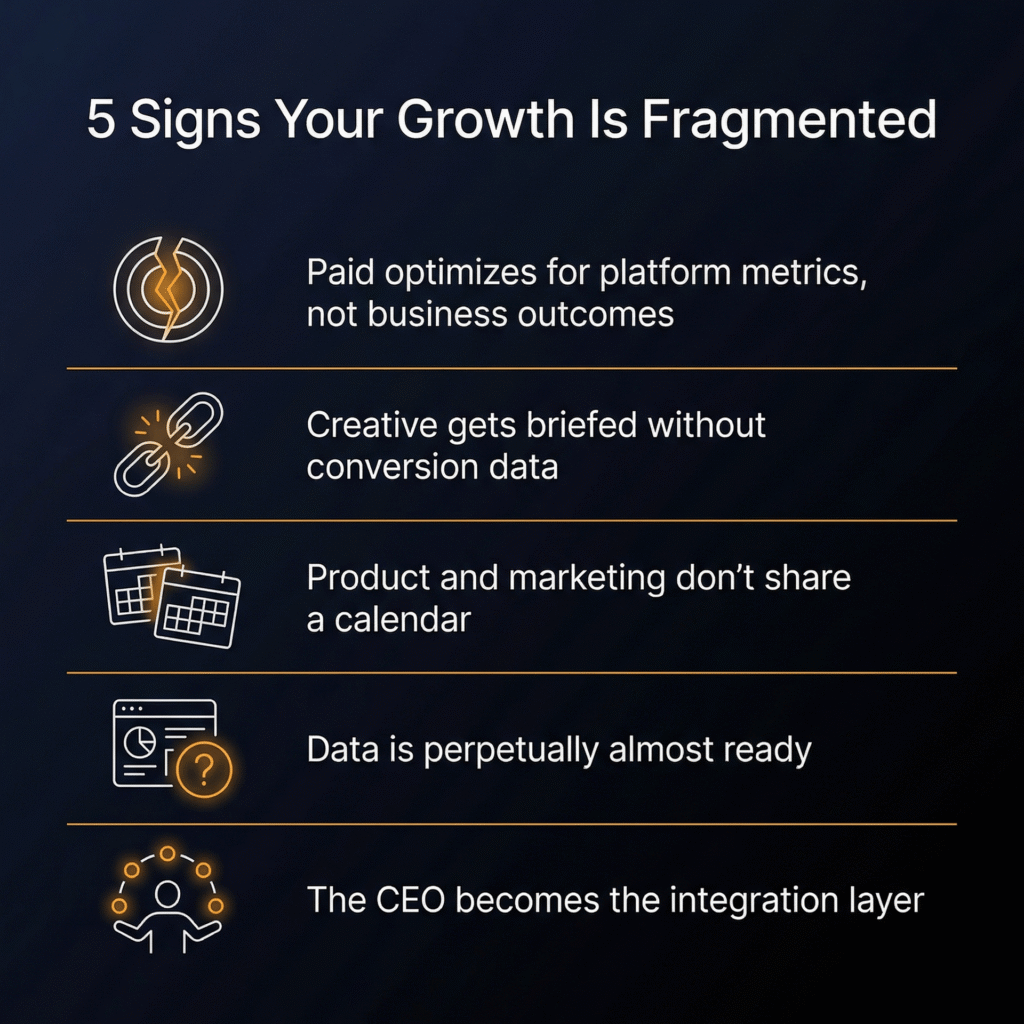
- Paid acquisition optimizes for platform metrics, not business outcomes. Your Meta buyer celebrates a 20% drop in CPM. Meanwhile, your actual payback period is getting longer. The platform looks great. The bank account tells a different story.
- Creative gets briefed in a vacuum. Nobody feeds back which value propositions actually convert. So the creative team keeps producing variations on themes that tested well six months ago — while the market has moved on.
- Product and marketing don’t share a calendar. A major onboarding redesign launches the same week as a big acquisition push. Nobody coordinated. New users pour into a funnel that’s mid-construction.
- Data is perpetually “almost ready.” Attribution is a mess. Nobody trusts the numbers enough to make real decisions. So everyone defaults to gut instinct and whoever argues loudest in the meeting.
- The CEO becomes the integration layer by default. The person who should focus on strategy and fundraising is spending 15 hours a week playing air traffic controller between vendors and teams.
This isn’t a talent problem. It’s a structural one. And it compounds without notice — until it reaches critical mass and becomes impossible to ignore.
The Numbers Behind the Problem: Why This Matters More Than Ever
Let’s put some context around why fragmentation is so costly right now.
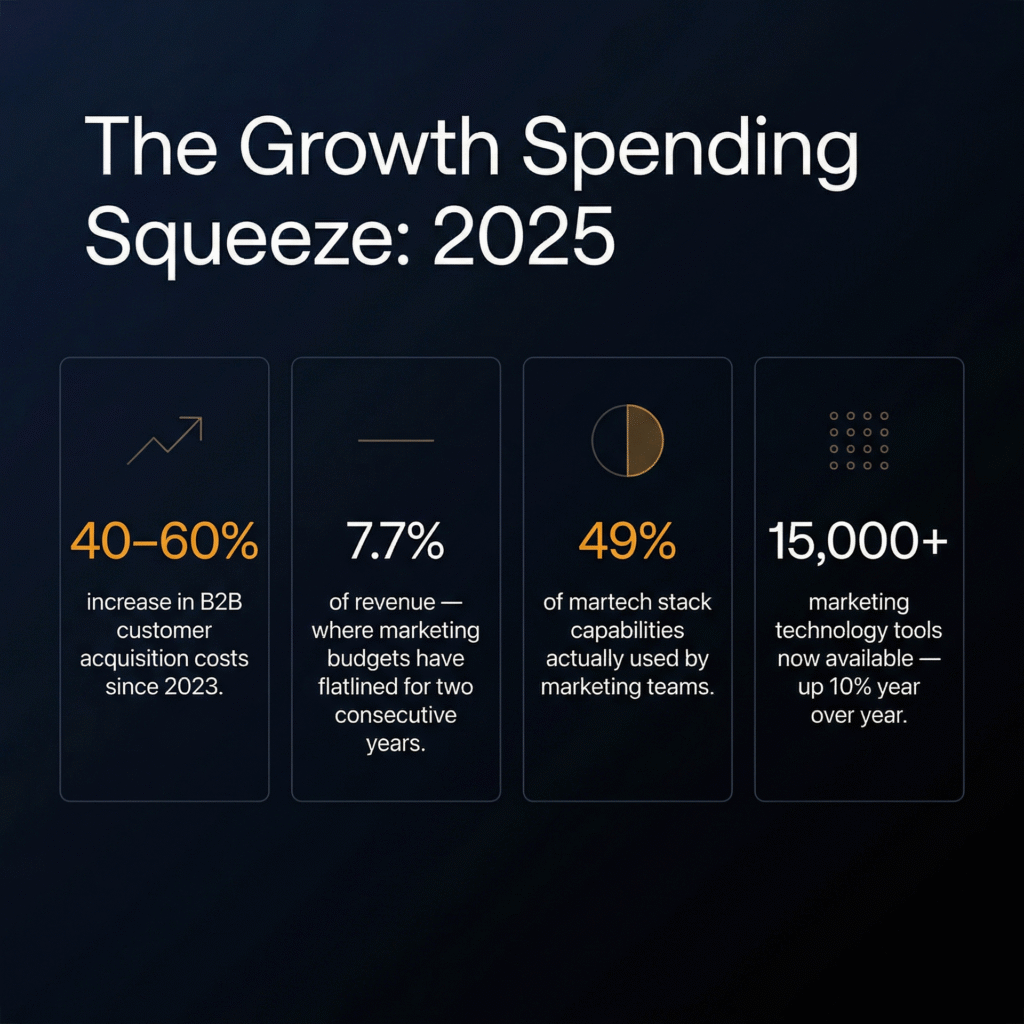
Customer acquisition costs across B2B tech have climbed 40–60% since 2023, according to industry benchmarks reported by Data-Mania. The average cost per lead on Google Ads alone hit $70.11 in 2025 — a 5% year-over-year increase. For B2B SaaS companies targeting mid-market or enterprise buyers, acquisition costs routinely land between $1,200 and $2,000 per customer.
At the same time, marketing budgets aren’t growing to match. Gartner’s 2025 CMO Spend Survey found that marketing budgets have flatlined at 7.7% of company revenue for a second straight year — and 59% of CMOs say that’s not enough to execute their strategy. Paid media now commands nearly a third of total marketing budgets, but media price inflation means every dollar buys less than it did last year.
And then there’s the martech problem. Gartner’s 2025 Marketing Technology Survey found that marketers are using only 49% of their stack’s capabilities. The martech landscape itself now includes over 15,000 tools — up nearly 10% year-over-year — and the average enterprise marketing org uses more than 90 distinct platforms. As Marketing Week reported, many teams end up with “redundant platforms” and pay heavily for capabilities they barely touch.
Here’s what all of this means in practice: you’re spending more to acquire customers, your budget isn’t growing, your tools are underused, and the teams managing all of it aren’t talking to each other. That’s not a recipe for growth. That’s a recipe for burning runway.
The Hidden Costs That Don’t Show Up on Any Dashboard
Fragmented growth doesn’t appear as a single line item. It shows up as a collection of subtle inefficiencies that most teams have normalized:
- Slower decision cycles. When growth spans five vendors and three internal teams, getting alignment on a strategic pivot takes weeks instead of days. By the time everyone agrees on a direction, the window has shifted.
- Vendor sprawl and redundant spend. Most Series B companies we’ve worked with are paying for overlapping tools, duplicate analytics, and agency retainers where nobody remembers the original scope. It’s not unusual to find $50,000–$200,000 a month in pure waste — not because anyone is being irresponsible, but because nobody has line of sight across all of it.
- False confidence from partial data. This is the most dangerous one. When your paid team reports a 3x ROAS but your finance team says unit economics are underwater, you don’t have a data problem. You have a fragmentation problem. The paid team measures what they can see. Finance measures what they can see. Nobody measures the full journey.
- Institutional knowledge that walks out the door. When your growth strategy lives across six vendor relationships and three contractor agreements, every personnel change resets the clock. There’s no shared playbook. No compounding advantage.
Widdoes has a story that makes this painfully concrete. “We recently ran what we call a 360 Blueprint for a new client who runs an at-scale consumer application,” he says. “In the first 48 hours we uncovered around $350,000 a month that was being spent on an evergreen paid media campaign that had never been anywhere close to profitable and had not been updated or optimized for over six months.”
How does that happen? “It turns out that the teams were looking at different numbers,” Widdoes explains. “It boiled down to not having a line of sight into actual revenue hitting the bank, a predictive model that was out of date, data being misinterpreted through an automation layer, and a dashboard that showed the media teams everything was fine — when in reality the leads from that campaign had NEVER been profitable.”
That’s $4.2 million a year. Found in 48 hours. Just by asking, “How does all of this work?” and hearing back, “That’s a great question — I’m not really sure.”
The Difference Between Marketing Activity and a Growth Engine
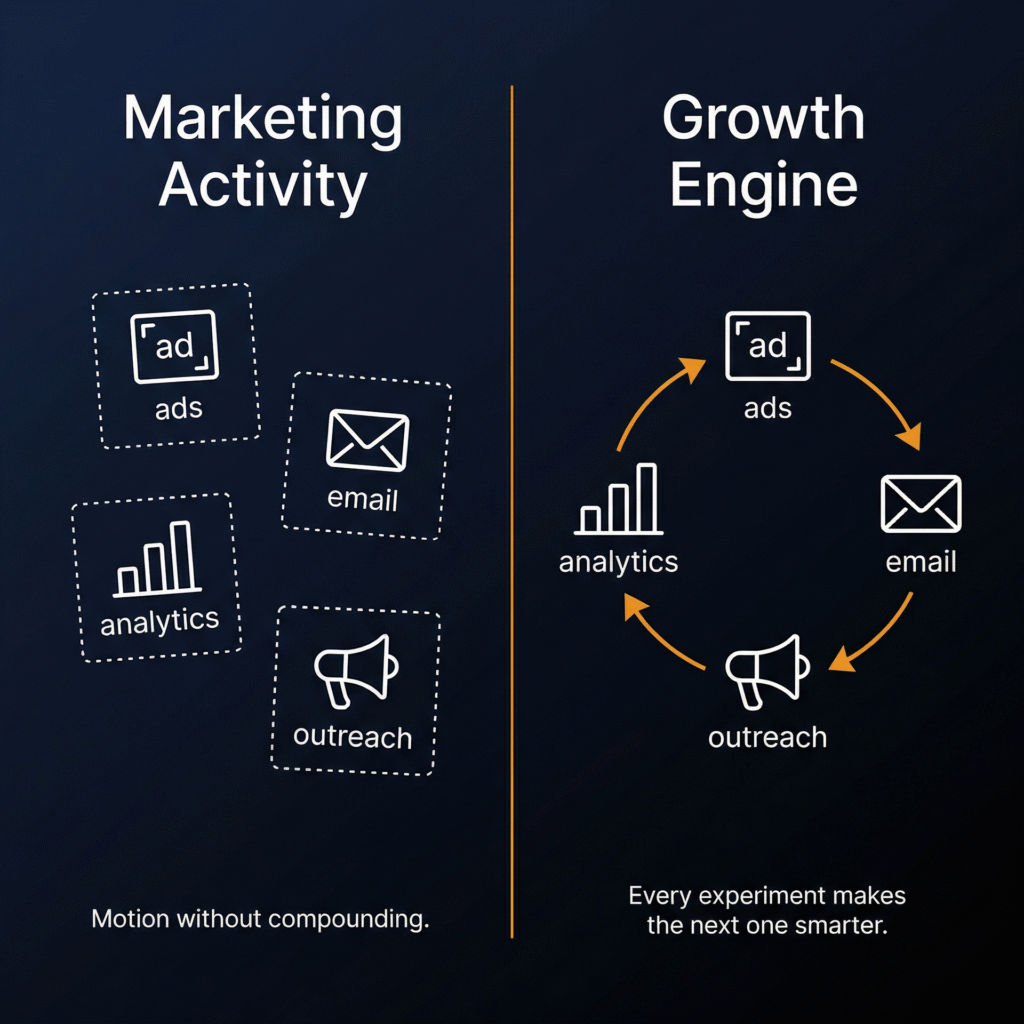
A company with a lot of marketing activity has campaigns running, creative being produced, emails going out, experiments in a backlog, and reports being generated. It looks like growth is happening. Everyone has something to show in the weekly standup.
A company with a working growth engine has something fundamentally different: a closed loop. Acquisition feeds into activation. Activation data feeds back into targeting and creative. Product usage patterns inform lifecycle messaging. Retention metrics shape the acquisition strategy. Every function connects to the others, and there’s a single team — or at minimum, a single owner — accountable for how the whole system performs.
The difference matters because growth compounds. In a working engine, every experiment makes the next one smarter. In a fragmented setup, experiments are isolated. The paid team learns something that never makes it to product. The lifecycle team discovers a retention insight that never reaches the acquisition team. The creative team keeps guessing because nobody closes the feedback loop.
As Erin Clift, CMO of KidStrong, put it about working with MAVAN’s integrated model: “It truly felt like MAVAN was a part of our in-house team. They were collaborative, responsive, and dialed in to our goals. MAVAN quickly drove results that cut our customer acquisition costs by 60%.”
That kind of result doesn’t come from one team working harder. It comes from every team working together.
When Founder-Led Hustle Stops Being Enough
If you’re a founder reading this, here’s an honest truth: the fragmentation probably started because of you. That’s not a criticism. It’s a natural consequence of how startups scale.
In the early days, you were the growth engine. You knew every customer, every channel, every metric. But somewhere around $2–$10 million ARR — or right after a funding round with aggressive growth targets — the business outgrew your personal bandwidth. You started delegating pieces of growth to different people and vendors. The mistake wasn’t delegation. The mistake was delegating the pieces without designing the system.
Here’s a quick diagnostic. If several of these ring true, fragmentation is likely dragging on your growth:
- You can’t explain your growth model on a whiteboard in under five minutes.
- Your CAC is rising and nobody can agree on why.
- Strategic pivots take months, not weeks.
- You keep hiring to solve what’s actually a coordination problem.
- Experiments don’t compound — the same mistakes get made across different teams.
Widdoes has seen how deep this can go, even at massive scale. “I was recently introduced to the CMO of a major direct-to-consumer clothing brand, by one of their board members, spending $12 million per month on paid,” he recalls. “His biggest concern was ‘how do we scale Meta faster?’ I explained that we would want to first understand what’s happening in data — where it’s coming in and out from, how it’s being routed — and from there we’d want to understand the perspective of the product teams, creative teams, and especially the lifecycle team.”
What happened next was telling. “He looked like he’d seen a ghost,” Widdoes says. “‘I can’t have you speaking with the data or product teams — they’re too busy. We just need to fix Meta ad spend.’ And there it was. The CMO of a major company did not have the internal willpower or political capital to even get the other major business leaders in the org on a call.”
This is a company doing close to a billion dollars a year in revenue. And the internal teams are not collectively working toward the same goal.
The Three Paths Forward — And the Tradeoffs Nobody Talks About
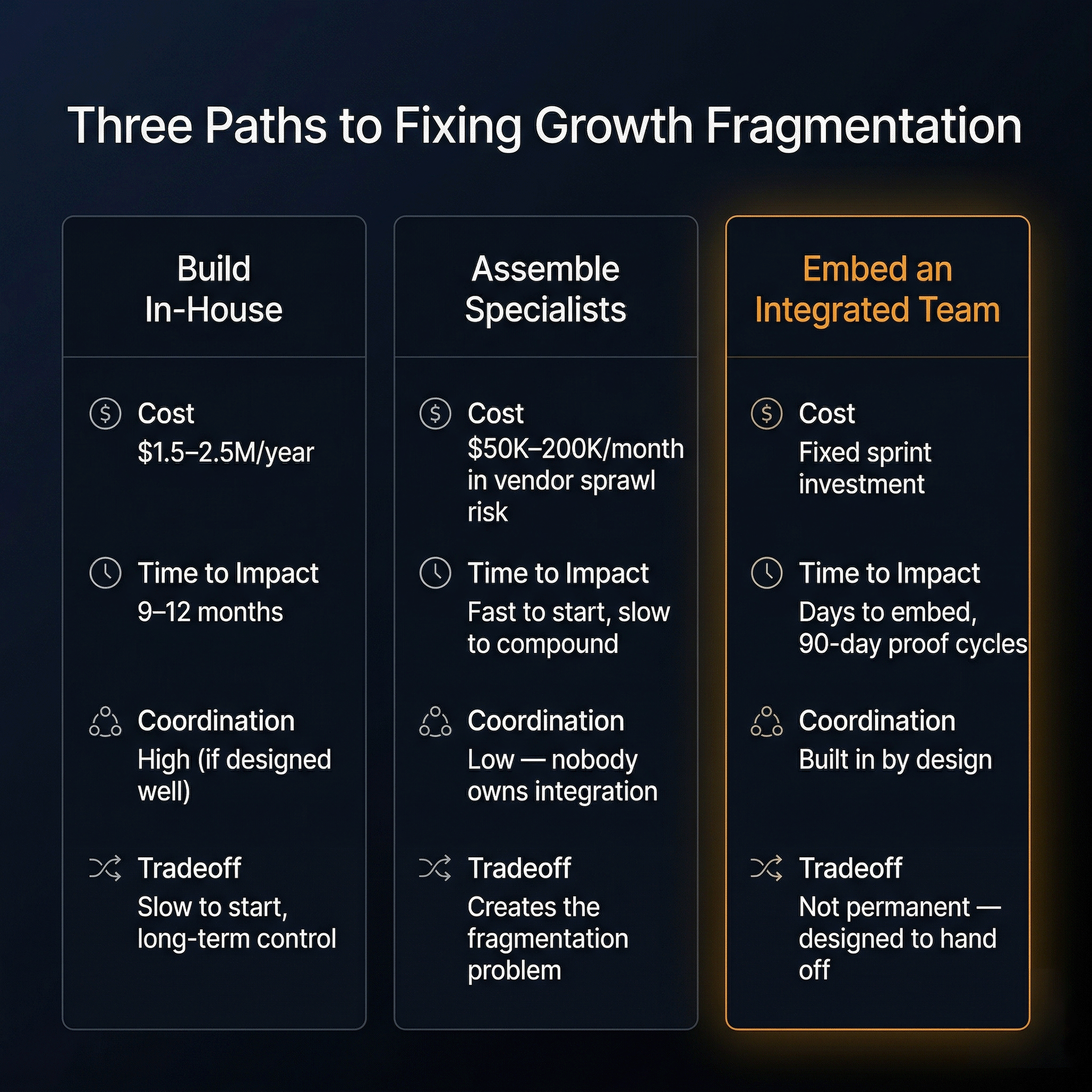
When founders recognize fragmentation, they typically consider three options. Each has real costs that deserve an honest look.
Path 1: Build the Full Team In-House
The appeal is obvious — full control, deep institutional knowledge, aligned incentives. The reality is harder. A cross-functional growth team (strategy, paid acquisition, creative, analytics, lifecycle, and CRO) requires five to eight senior hires. At market rates, you’re looking at $1.5–$2.5 million in annual fully loaded cost before a single experiment ships. Recruiting takes three to six months per role. Ramp-up takes another three to six. You’re nine to twelve months from full productivity — assuming you hire well the first time.
For companies with the capital and the runway, this is the right long-term play. But with only 18% of seed-funded companies raising a Series A in 2025 (per investor readiness data compiled by Presta), most growth-stage companies can’t afford twelve months of patience.
Path 2: Assemble Specialists (Agencies + Freelancers + Consultants)
This is where most companies land by default — and it’s the setup that creates fragmentation in the first place. You get a paid media agency here, a creative freelancer there, a fractional data scientist somewhere else, and a strategy consultant who shows up quarterly with a deck.
Each specialist may be excellent in isolation. But nobody owns the integration. Nobody is accountable for how acquisition, creative, product, and analytics work together. And the founder becomes the project manager — which is exactly the failure mode we’ve been describing.
Path 3: Embed One Integrated Growth Team for a Defined Period
This is the model we built MAVAN around. The logic is simple: instead of hiring five to eight people over twelve months, or managing five vendors who don’t talk to each other, you embed a single cross-functional team that arrives with a shared operating system, a common data framework, and accountability across the full growth chain.
The embedded model solves the coordination problem by design. There’s no integration layer needed because the team is already integrated. And because the engagement runs in defined cycles — typically 90-day sprints — there’s a natural forcing function for clarity: what are we trying to achieve, how will we measure it, and what did we learn?
The tradeoff is that it’s not permanent. The team builds the system, proves it works, and hands over the playbook. If you want to bring it in-house afterward, you now know exactly what roles to hire, what tools to use, and what the operating cadence should look like. We help our clients do that transition too.
Luke Harries, Head of Growth at ElevenLabs, described how this played out for his team: “Within months, MAVAN scaled our Search spend to a high six-figure monthly budget, maintaining efficiency consistently for nearly a year. After we had proven the channel with MAVAN, we were able to confidently transition the program to our in-house team.”
That’s the model working as designed. Embed, prove, hand off.
Your 30-Day Fragmentation Fix: A Practical Playbook
If you suspect your growth is fragmented but aren’t sure where to start, here’s what we’d tell you to focus on in the next 30 days.
Week 1–2: Map your full growth chain on a single page. Not a fancy diagram — literally a whiteboard or a doc that traces how a person goes from not knowing you exist to becoming a paying, retained customer. Identify every handoff, every team responsible, every tool involved. You’ll almost certainly find gaps, overlaps, and handoffs where nobody is clearly accountable.
Week 2–3: Audit your measurement stack. Can you confidently answer these three questions with data you trust?
- What is our actual, fully loaded CAC by channel?
- What does the activation-to-retention curve look like by cohort?
- Where in the funnel are we losing the most value?
If you can’t answer all three, your measurement stack is your first problem. You can’t fix what you can’t see.
Week 3–4: Identify the single biggest leverage point. Don’t try to fix everything at once. Look at your map and your data and ask: where is the single biggest gap between effort and outcome? Usually it’s one of three places — acquisition efficiency (you’re spending but not learning), activation (you’re getting users but not converting them), or retention (you’re converting but not keeping them). Pick one. Focus.
Throughout: Decide who owns the system, not just the pieces. This is the hardest one. Someone — a person, not a committee — needs to be accountable for how all the growth functions work together. If that person is you, acknowledge it and protect the time. If it’s someone on your team, give them real authority. If you don’t have that person, that’s the most important gap to fill.
Your Next Step: Find Cross-Functional Alignment
We want to leave you with something Widdoes says that sums up why this matters so deeply: “The one thing I’ve seen over and over again are companies that have hired amazing people and set them loose to figure things out. This is great in the beginning, but as you scale, systems have to be built to facilitate communication around cross-functional insights.”
He’s right — and the data backs it up. When companies scale without those systems, “teams can get so focused on what’s on their own plate that they lose track of the rest of the org, or worse — they often feel like their growth limitations are directly tied to another org within the company not pulling their own weight,” as Widdoes puts it.
“Growth requires not only exceptional people in every seat,” he adds, “but exceptional org design, systems, testing frameworks, and alignment on a single easily measured outcome. It’s a lot to get right, and it’s never easy. It is, however, relatively straightforward — with well-worn paths on what ‘great’ looks like. Once companies see it, they always wished they’d taken a look sooner.”
Growth-stage companies don’t usually fail because the team isn’t working hard enough. They fail because hard work gets distributed across too many disconnected efforts — and nobody owns the system that ties them together. The fix isn’t to spend more. It’s to integrate what you already have.
Your If–Then Micro-Plan For Building an Integrated Growth System
If you read through the 30-day playbook above and realized you can’t confidently map your growth chain or answer those three measurement questions — then your next step is clear: you need outside eyes on the system, not just the pieces. Reach out to us about booking a free 360 Blueprint call with MAVAN. We’ll walk through your growth chain together, identify where the biggest gaps are hiding, and give you a clear picture of what’s working, what’s leaking, and what to fix first. No pitch deck. No pressure. Just an honest look at the machine — from a team that’s found millions in hidden waste for companies just like yours.
Frequently Asked Questions About Building a Compounding Growth Engine
Why is my startup’s CAC increasing even though we’re spending more on marketing?
Rising CAC is almost always a fragmentation problem, not a budget problem. When paid acquisition, creative, product, and data teams optimize in isolation — each measuring different metrics with no shared source of truth — spend goes up while efficiency goes down. Customer acquisition costs across B2B tech have climbed 40–60% since 2023, and flat marketing budgets mean every wasted dollar hurts more. The fix starts with auditing whether your teams are looking at the same numbers and whether anyone owns the full customer journey from first touch to retention.
What is growth fragmentation and how do I know if my company has it?
Growth fragmentation happens when your acquisition, creative, data, product, and lifecycle functions operate as disconnected silos — each doing good work that never compounds. Key warning signs: you can’t explain your growth model on a whiteboard in five minutes, your CAC is rising and nobody agrees on why, strategic pivots take months instead of weeks, you keep hiring to solve what’s actually a coordination problem, and experiments across teams never inform each other.
What’s the difference between marketing activity and a growth engine?
Marketing activity means campaigns are running, emails are going out, and reports are being generated — it looks like growth is happening. A growth engine is a closed loop where acquisition feeds activation, activation data feeds targeting and creative, product usage informs lifecycle messaging, and retention metrics reshape acquisition strategy. The difference is compounding: in an engine, every experiment makes the next one smarter. In an activity model, learnings stay siloed and you start from scratch every quarter.
Should I build an in-house growth team or hire an agency?
Both paths have real tradeoffs. Building in-house gives you control and institutional knowledge, but a full cross-functional growth team (strategy, paid, creative, analytics, lifecycle, CRO) requires five to eight senior hires, costs $1.5–$2.5M annually, and takes nine to twelve months to reach full productivity. Assembling agencies and freelancers is faster but creates the fragmentation problem — nobody owns the integration. A third option is embedding one integrated growth team for a defined period (typically 90-day sprints) that builds the system, proves it works, and hands over the playbook so you know exactly what to hire for when you’re ready.
How do I audit my startup’s growth and marketing spend for waste?
Start by mapping your full growth chain on a single page — every handoff, tool, and team from first touch to retained customer. Then audit your measurement stack: can you name your fully loaded CAC by channel, your activation-to-retention curve by cohort, and the biggest value leak in your funnel? If not, measurement is your first fix. From there, review your vendor and tool landscape for overlapping capabilities and forgotten retainers. Gartner’s 2025 data shows marketers use only 49% of their stack, and most Series B companies carry $50K–$200K per month in redundant spend without realizing it.
When should a founder stop leading growth themselves?
Usually somewhere between $2–$10M ARR, or right after a funding round with aggressive growth targets. The signal isn’t that you’re doing it badly — it’s that the business has outgrown your personal bandwidth to hold the full picture. If you’re spending 15+ hours a week coordinating between vendors and teams instead of focusing on strategy and fundraising, you’ve become the integration layer by default. The move isn’t just to delegate the pieces — it’s to design (or bring in) the system that connects them.
What is an embedded growth team and how does it work?
An embedded growth team is a single cross-functional unit — typically covering strategy, paid acquisition, creative, analytics, and lifecycle — that plugs directly into your company and operates like an internal team. Unlike a collection of agencies and freelancers, an embedded team arrives with a shared operating system, a common data framework, and accountability across the full growth chain. Engagements are usually structured in 90-day sprints with clear goals, shared metrics, and a built-in handoff plan so you can confidently transition to in-house when you’re ready.
How do I get my marketing, product, and data teams aligned on growth?
Alignment starts with a single, easily measured outcome that every team works toward — not separate KPIs that optimize in isolation. Map the full customer journey so every function can see where they fit and where handoffs break. Establish a shared source of truth for data so paid, product, and finance aren’t arguing over different dashboards. And assign one person (not a committee) to own how the growth functions work together. As MAVAN CEO Matt Widdoes puts it: “Growth requires not only exceptional people in every seat, but exceptional org design, systems, testing frameworks, and alignment on a single easily measured outcome.”
Book a complimentary consultation with one of our experts
to learn how MAVAN can help your business grow.
Want more growth insights?
Thank you! form is submitted
[hubspot type=”form” portal=”20951211″ id=”9c538ed2-fb12-45f1-a573-ad7953c058cc”]
Related Content
-

Why Your Startup Growth Feels Broken — And How to Fix It Before CAC Eats Your Runway
TLDR — 10 Takeaways for Building a Compounding, Integrated Growth System Does Your Startup Growth Feel Broken Despite Hard Work and Green Lights? You’re not slacking. Your team is shipping campaigns, filling dashboards, running standups. You probably haven’t taken a real vacation in two years. So why does everything still feel like it’s held together…
-

Website Conversion Is a Trust Problem: SEO, UX, Messaging Fixes Growth-Stage Teams Can Make in 90 Days
TLDR — 10 Trust Fixes That Move Website Conversion The Friction You Can’t See Eight steps. That’s how many it took for a new user to go from landing on a consumer product’s website to actually using the thing they came for. MAVAN Growth Lead Matt Saunders worked on that funnel — and when he…
-

Acquisition Architecture That Scales: A Practical Performance Marketing Framework for Venture-Backed Teams
TLDR — 10 Growth Takeaways for Acquisition Architecture When Rising CAC Isn’t Just a Paid Media Problem It’s not uncommon for people to treat acquisition like a media problem. You might swap channels, raise bids, or cut creative. And since you’re taking action, it can feel like you’re accomplishing something. But as Sam McLellan, MAVAN’s…