
Rising customer acquisition cost is usually a system problem, not a channel problem. Before spending more, diagnose whether the break is in measurement, product readiness, creative, or conversion design. Fix measurement first — a defined conversion path, platform-native tracking, and one source of truth — then scale only what earns it.
TLDR — What Are the Key Takeaways for Fixing Rising CAC?
- Rising CAC is usually a system problem, not a channel problem.
- Before spending more, ask: is the break in measurement, product, creative, or conversion?
- Attribution is the most common hidden culprit — especially when last-touch stops matching real buying behavior.
- Fix measurement first: defined conversion path, platform-native tracking, one source of truth.
- Smaller budgets don’t buy precision — they buy constraint, so keep campaign structures broad until scale earns granularity.
- Read performance in layers (ad → intent → activation → commercial → revenue), not just top-line metrics.
- A product that gets clicks or trials is not automatically a product that’s ready to scale.
- Creative is part of the acquisition system, not decoration — protect a standing test budget and refresh before fatigue hits.
- Payback math only works if growth, product, and finance agree on the window and check back against reality.
- If your CAC is climbing and you can’t pinpoint why, reach out to MAVAN for an acquisition architecture diagnostic.
You cut creative, swap channels, raise bids — and CAC keeps climbing. Sound familiar?
Most teams treat rising acquisition costs like a paid media problem. That’s understandable. Spend feels like action. But as Sam McLellan, MAVAN’s VP of Growth, puts it: when a team says “we need growth help,” it can mean many things. It can point to product issues, execution issues, attribution issues, or expansion issues. And the more common culprit now? Attribution — especially once last-touch stops matching how people actually buy.
If the product isn’t converting, media won’t save it. If tracking is thin, your insight is mostly guesswork. And if you scale before the basics work, you’re just burning runway faster.
We’ve watched this pattern play out across dozens of engagements. The good news is that the fix isn’t mysterious. It starts with asking better questions.
Why Is My Customer Acquisition Cost Rising?
Rising CAC usually signals a system problem, not a channel problem. It can stem from broken attribution, a product that doesn’t convert, creative fatigue, or audience mismatch — and most teams don’t know which one is failing. The smartest first move is diagnosis, not more spend.
That’s a hard pill for fast-moving teams. When the board wants growth yesterday, slowing down to audit the system feels counterintuitive. But we’ve seen what happens when teams skip that step. Budgets get cut for the wrong reasons. Product and growth start blaming each other. And the company loses time it can’t afford.
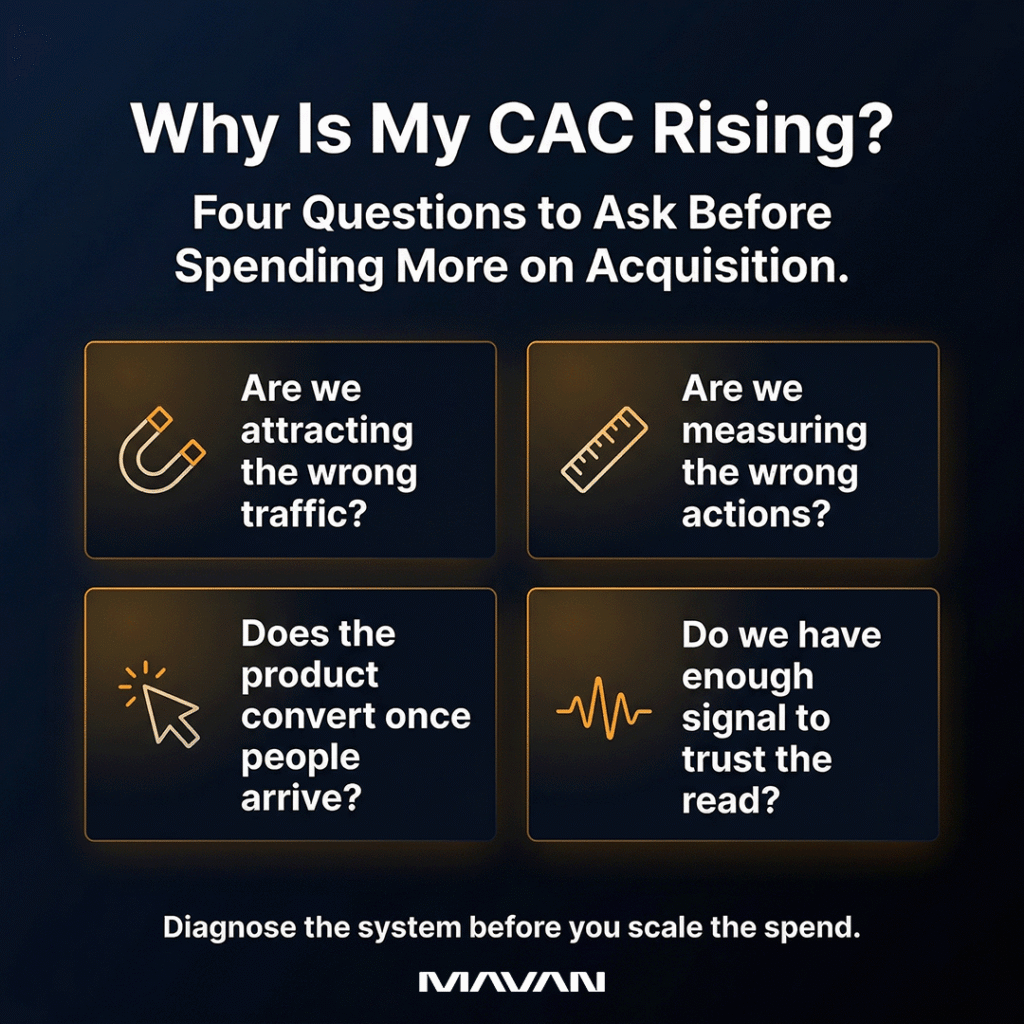
We recommend starting with four honest questions when diagnosing rising CAC:
- Are we attracting the wrong traffic?
- Are we measuring the wrong actions?
- Does the product convert once people arrive?
- Do we have enough signal to trust the read?
How Do I Find the Real Break in My Acquisition System?
Read your performance in layers — from the ad all the way down to revenue. Each step should tell you whether the next step has a chance to work.
Work down this five-layer diagnostic ladder in order; each layer tells you whether the next one has any chance of working.
- Check the ad signal: confirm the click-through rate is strong enough to earn attention before examining anything downstream.
- Check the intent signal: verify that clicks are converting into visits, installs, or signups.
- Check the activation signal: confirm that users complete onboarding or reach a key first-value action.
- Check the commercial signal: confirm that users reach a paywall, trial start, or demo request.
- Check the value signal: confirm that early revenue tracks against the expected LTV curve, and inspect traffic quality and pricing if it lags.
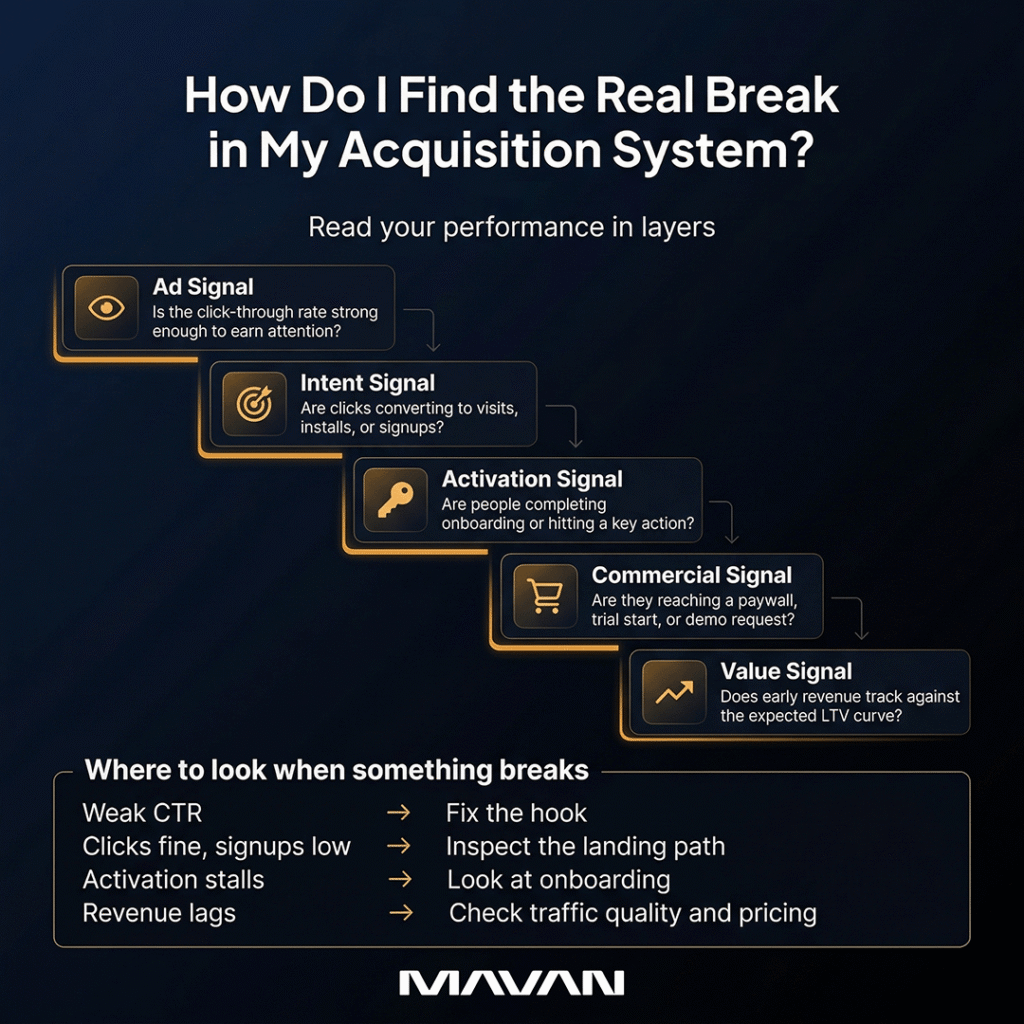
If CTR is weak, fix the hook. If clicks are fine but signups are low, inspect the landing path. If activation stalls, look at onboarding. If everything looks strong on the surface but revenue lags — check traffic quality and pricing. This layered approach helped MAVAN cut CAC by more than 3x at Titan while scaling paid acquisition 5x, largely by rebuilding tracking infrastructure and prioritizing top-performing channels.
What Should I Fix Before Spending More on Ads?
Fix measurement first. You need to know where the money is going before you spend more of it. That means a defined conversion path, platform-native tracking, one shared source of truth, and a regular review cadence.
Sam McLellan is clear on this: startups don’t need the full enterprise stack on day one. If you’re running one or two major channels, platform-native tools can be enough to start. But you do need attribution at a basic level. In one B2B SaaS engagement, MAVAN found that attribution was limited to last-touch and original source, with many key touchpoints untracked. CAC had climbed to a reported $60K–$100K. The fix wasn’t more budget — it was better instrumentation and fuller touchpoint tracking.
This is especially important because smaller budgets don’t buy precision. They buy constraint. If signal density is low, you need broader groupings you can actually trust — not endless campaign splits pretending to be rigorous.
Is My Product Actually Ready to Scale?
A product can be marketable enough to get clicks or trials. That doesn’t mean it’s scalable. If revenue, engagement, and retention signals aren’t there, paid acquisition won’t magically create them — it will just make the weakness more expensive.
Sam shared a sharp example: a subscription company saw strong free-trial starts — 75% of incoming traffic converted. But paid conversion later collapsed into the single digits. Many users were teenagers without credit cards. Early demand looked promising. The business result didn’t.
Before scaling your product, ask four questions:
- Do users consistently reach the activation moment?
- Do meaningful cohorts stick around?
- Does monetization support payback?
- Can we measure these answers with enough confidence to act?
If the answer is no, limited spend for learning may be fine — but only if everyone is honest about the tradeoff.
The Fastest Way to Stop Bleeding Budget
If you need to act now, here’s a triage plan you can start today:
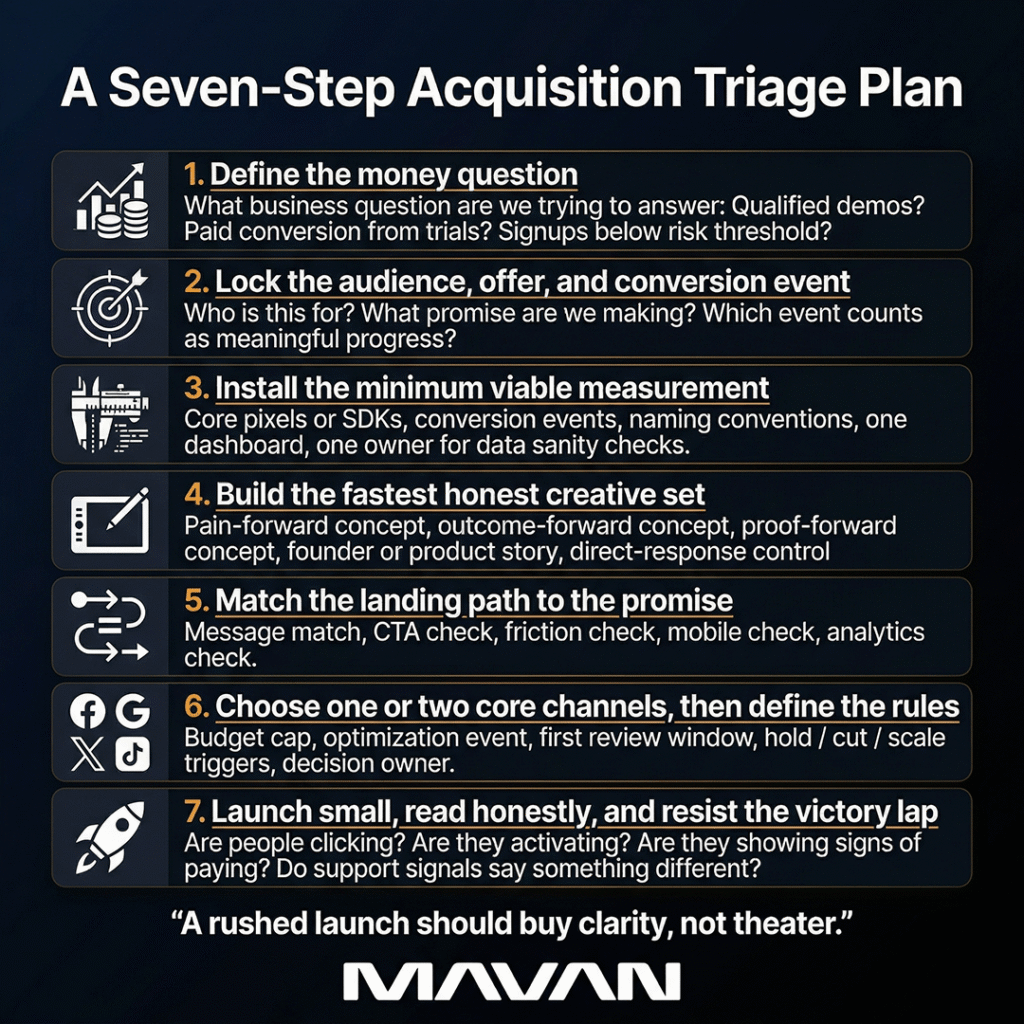
- Define one concrete business question your spend must answer, such as “Can this channel produce qualified demos below $X?” — raising awareness is not a measurable business goal.
- Lock your target audience, offer, and primary conversion event before launching any campaign.
- Install minimum viable measurement: core pixels, defined conversion events, one dashboard, and one named owner accountable for data quality.
- Build three to five creative variants around distinct buyer tensions, such as pain-forward, outcome-forward, and proof-forward angles.
- Match the landing page to the ad’s promise by checking message alignment, CTA friction, and mobile experience.
- Concentrate spend on one or two channels rather than spreading a small budget across many platforms.
- Read results in layers — click, signup, activation, payment — instead of judging performance by top-line metrics alone.
This is the approach that drove a 32% increase in conversions at KidStrong — whose CMO, Erin Clift, also reported a 60% reduction in customer acquisition costs. At ElevenLabs, MAVAN used a similar discipline to scale search spend from zero to a high six-figure monthly budget while maintaining sub-12-month payback across 20-plus international markets.
Frequently Asked Questions about CAC and Acquisition Architecture
Why are my free-trial signups high but paid conversions low?
High trial starts with weak paid conversion usually means early demand doesn’t reflect a scalable, willing-to-pay audience. In one example, most trial users were teenagers without credit cards. Before scaling spend, confirm that users reach activation, meaningful cohorts retain, and monetization actually supports your payback math.
How long should it take to know if a marketing channel is working?
It depends on your buying motion. For self-serve products, early signals often appear within days or weeks. For B2B with longer sales cycles, expect months — especially when the path includes nurture, education, and internal buy-in before a purchase decision is reached.
Do I need a multi-touch attribution tool for a startup?
Not right away. If you run only one or two major channels, platform-native tracking tools are usually enough to start. Add a multi-touch attribution setup once channel count, spend, and complexity justify it — adopting heavy tooling too early adds cost without improving decisions.
What is a good CAC payback period for a SaaS company?
Bessemer Venture Partners frames it clearly for cloud companies: 12–18 months is good, 6–12 months is better, and under 6 months is best. The right window still depends on your product type, gross margin, and retention quality, so treat these bands as guidance, not absolutes.
Why does creative matter for lowering CAC?
Creative is part of the acquisition system, not decoration. Nielsen and NCSolutions research found creative drives roughly 49% of advertising’s contribution to incremental sales. Weak or stale creative forces your media team to optimize around a poor promise, which raises cost per acquisition and isn’t sustainable.
So What’s the First Step to Lowering My CAC?
Rising CAC is almost never just an ad problem. It’s a system problem — and the fix starts with finding the real break across measurement, product readiness, creative, and conversion design. Diagnose before you spend. Fix the weakest link. Scale only what earns it.
If your CAC is climbing and you’re not sure where the system is actually breaking — reach out to us for an acquisition architecture diagnostic. We’ll help you find the real constraint, close the signal gaps, and identify the highest-leverage fix. Then you can decide your next move with clarity, not panic.
Key Terms: CAC, Attribution, and Acquisition Architecture Defined
- Customer Acquisition Cost (CAC)
- Customer Acquisition Cost (CAC) is a marketing metric that measures the total sales and marketing spend required to acquire one new customer. Rising CAC often signals a systemic break in measurement, product readiness, creative, or conversion design — not simply higher ad prices.
- Acquisition Architecture
- Acquisition architecture is the connected system behind growth, spanning who you target, what promise you make, where you send people, what you measure, and what happens after the click. It is not a channel mix; it is the model that makes every channel decision smarter.
- Attribution
- Attribution is the measurement practice of assigning credit for a conversion to the marketing touchpoints that influenced it. Last-touch attribution credits only the final interaction, which distorts CAC when it stops matching real buying behavior across multiple channels and touchpoints.
- CAC Payback Period
- CAC payback period is a unit-economics metric measuring the number of months required to recover the cost of acquiring a customer through the gross profit that customer generates. A shorter payback period frees cash for reinvestment; benchmark targets vary by product type, gross margin, and retention quality.
- Activation
- Activation is a product-engagement stage in which a new user completes onboarding or reaches a key first-value action. In acquisition diagnostics, weak activation — not ad performance — often explains why paid traffic fails to convert into retained, paying customers.
Casey Rock is Content Director at MAVAN, where he helps turn complex ideas into clear, strategic content that drives growth. With over 15 years of experience across content strategy, SEO, media, and digital marketing, Casey focuses on building content systems that connect audience insight, brand storytelling, and measurable business outcomes.
Book a complimentary consultation with one of our experts
to learn how MAVAN can help your business grow.
Want more growth insights?
Thank you! form is submitted
[hubspot type=”form” portal=”20951211″ id=”9c538ed2-fb12-45f1-a573-ad7953c058cc”]
Related Content
-
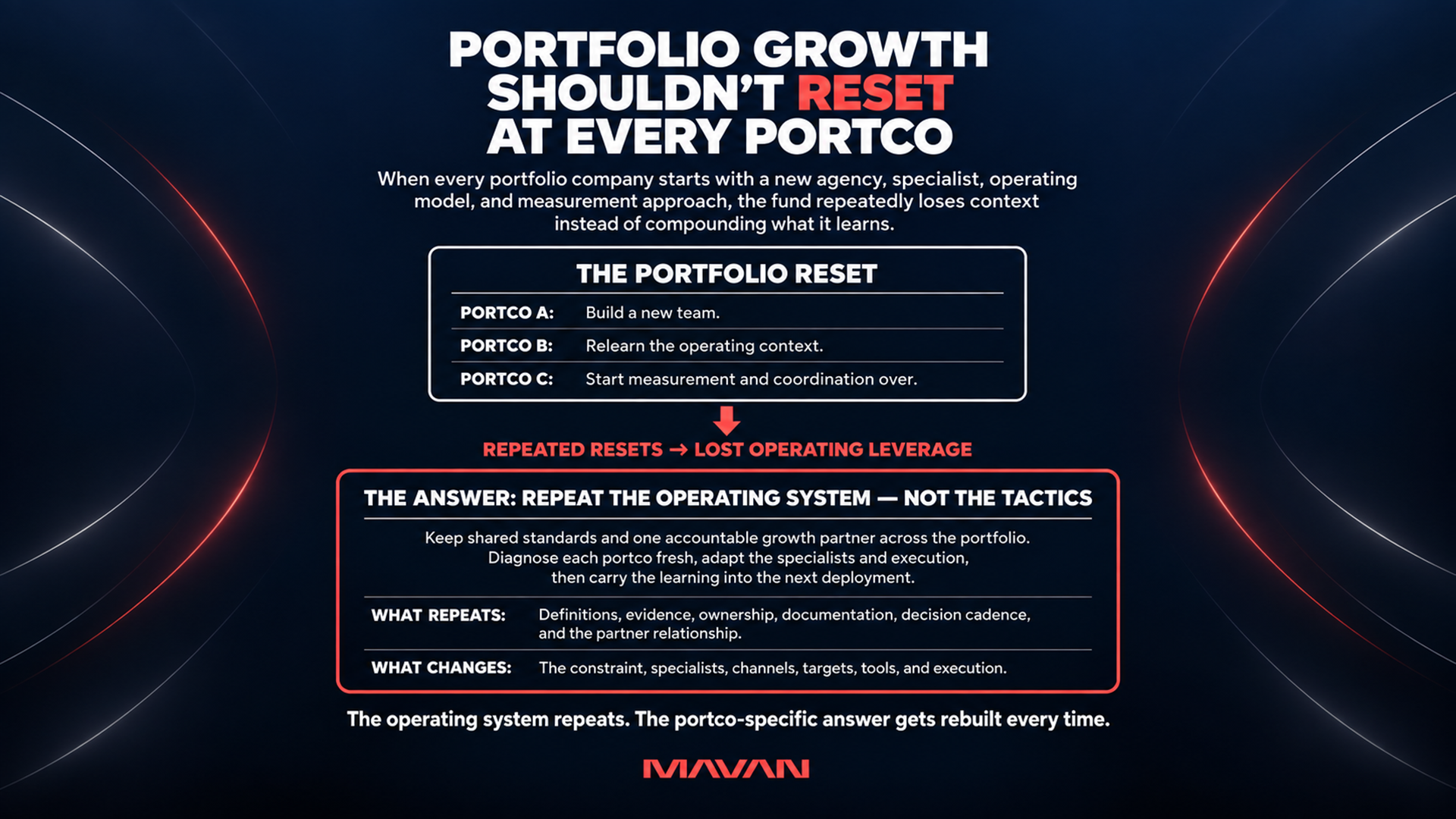
How Can Private Equity Funds Repeat Growth Across Portfolio Companies?
Growth becomes repeatable across a VC or PE portfolio when the fund installs one operating system instead of referring each company to a different specialist. The system has three parts: a single source of truth every team trusts, a board-ready scoreboard of ten to twelve metrics, and an embedded pod that diagnoses the real constraint in ninety days before anyone spends more.
-
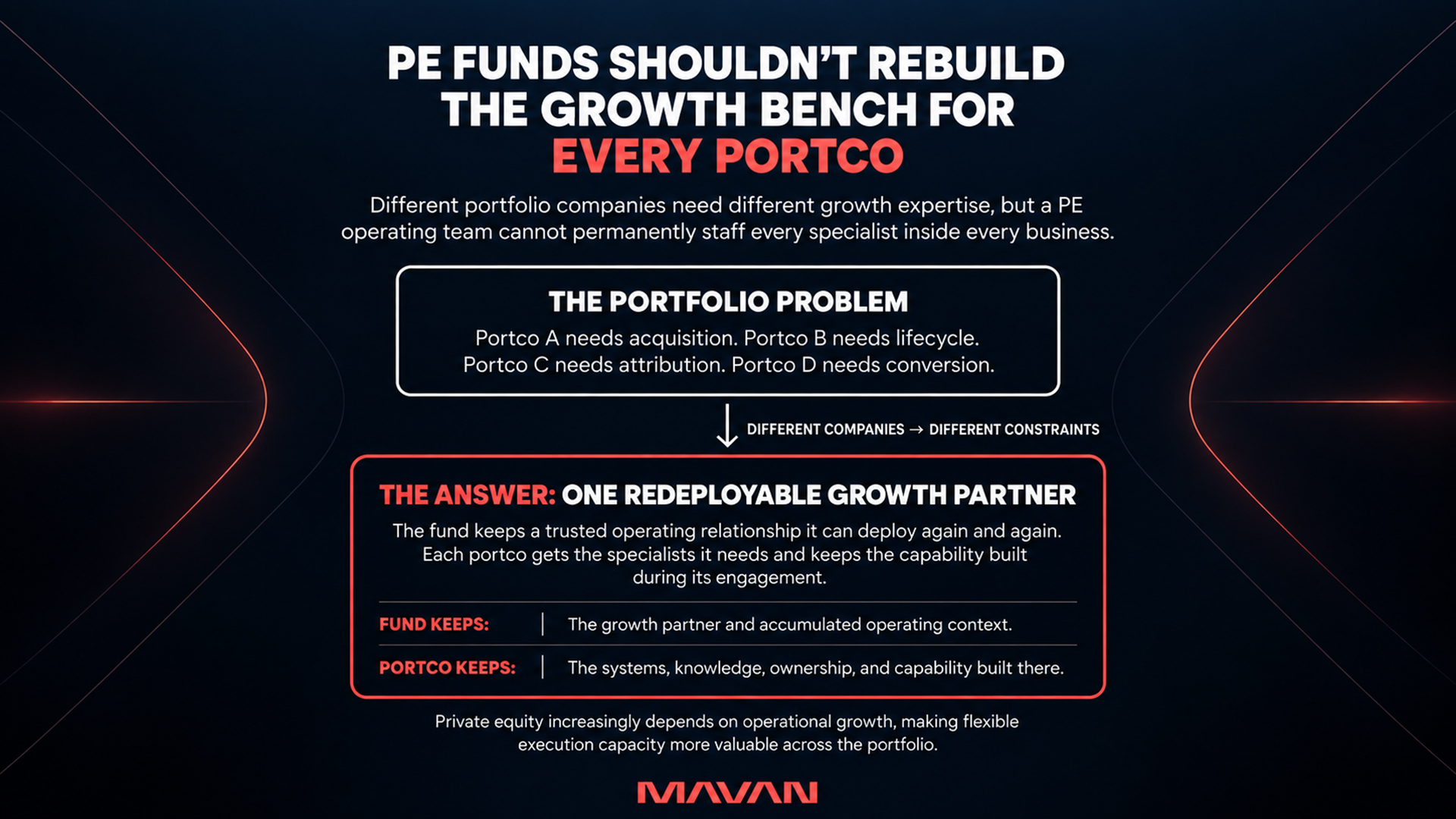
What Do PE Funds Want From a Portfolio Growth Partner? Repeatability!
What funds actually want from a portfolio growth partner is repeatability — a portable growth operating system that produces comparable results across very different portfolio companies. Repeatability shows up as a single source of truth, a board-grade scoreboard, a 90-day sprint, and a clean handoff, so each win compounds across the portfolio instead of staying at one company.
-
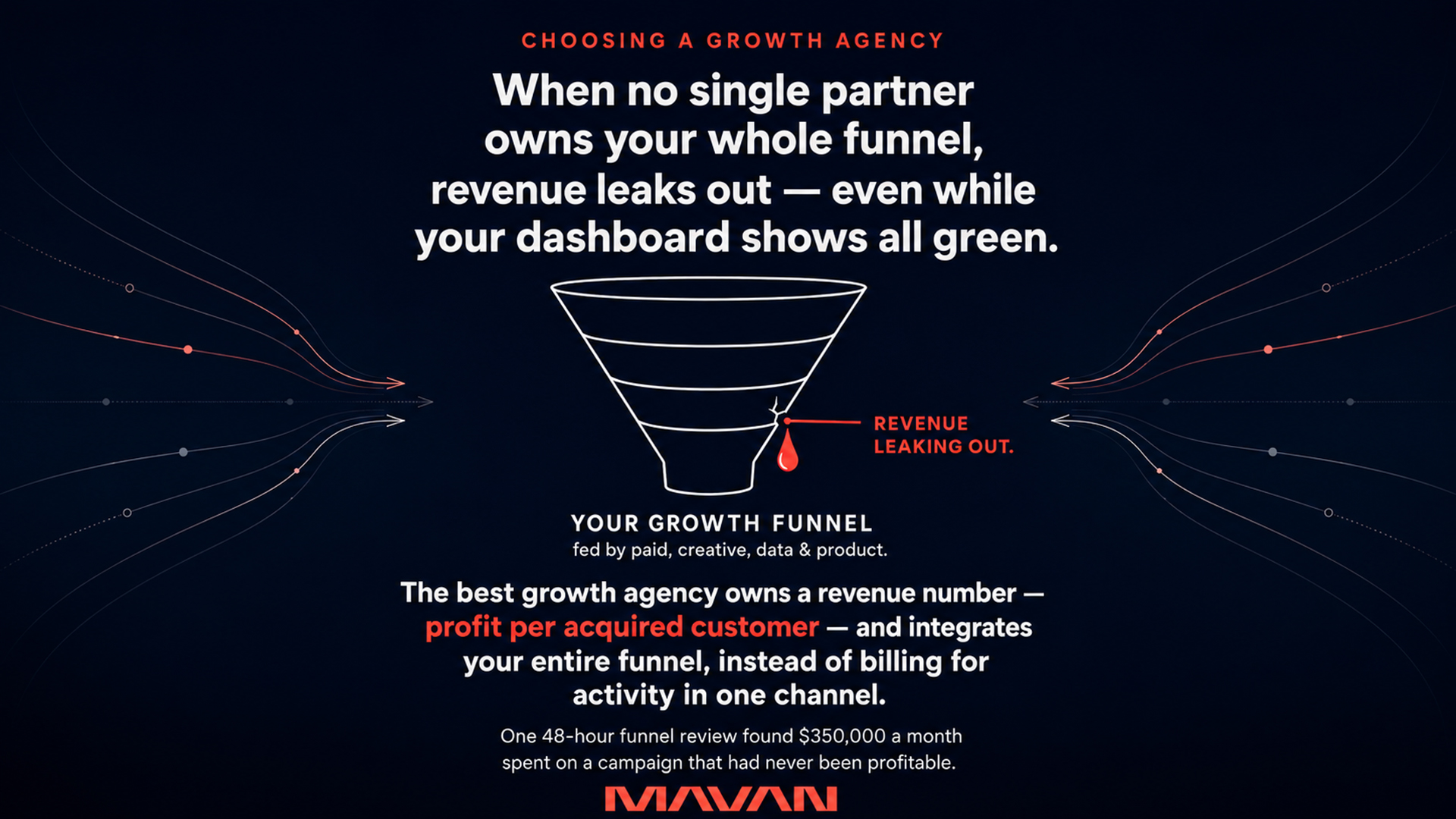
What’s the Best Growth Agency For VC & PE?
The best growth agency for a venture-backed or PE-owned company behaves less like a traditional agency and more like an embedded operating partner. It diagnoses your whole funnel, owns a revenue number such as CAC payback or LTV:CAC, and executes inside your team — rather than billing for activity in one channel.