
What funds actually want from a portfolio growth partner is repeatability — a portable growth operating system that produces comparable results across very different portfolio companies. Repeatability shows up as a single source of truth, a board-grade scoreboard, a 90-day sprint, and a clean handoff, so each win compounds across the portfolio instead of staying at one company.
TLDR — What Funds Look For In A Portfolio Growth Partner
- Funds want repeatability, not a single hero result at one portco.
- Repeatability means one growth operating system that transfers across companies.
- The system beats the tactic — discipline travels, channel-specific hacks do not.
- Bain’s “12 is the new 5” makes transferable growth a portfolio-level need.
- Proof of repeatability is cross-vertical breadth, not one lucky vertical.
- MAVAN has moved core metrics in SaaS, consumer, fitness, and clean tech.
- The 90-day sprint is the repeatable unit funds can inspect.
- A single source of truth makes “did it work?” answerable at every portco.
- A strong partner hands the system back to your in-house team.
- Start with one portco, prove the motion, then repeat it.
- Need help getting started? Check out our 360 Growth Analysis.
You’ve said the same sentence in five different portfolio-company board meetings this quarter: we need to bring in growth help. Each time, you started from zero — a new agency, new intro calls, a new ramp, new hope. The win, when it came, stayed put. It never traveled to the next company on your list.
That reset is expensive. In today’s market, the math has changed underneath every fund. Bain & Company’s Global Private Equity Report for 2026 calls it “12 is the new 5”: deals that once cleared the benchmark return on roughly 5% annual EBITDA growth now need about 10% to 12%, because cheap debt and easy multiple expansion are gone. Rebecca Burack, who leads Bain’s global private equity practice, put it plainly — attractive returns now demand sustained, double-digit growth. Bain’s own read on who wins: firms that turn their edge into a repeatable system rather than a slogan.
Growth has to come from inside the businesses now, at company after company. That is why the question funds ask about a growth partner has shifted — from can they win here to can they win everywhere we send them. This article answers the second question, and shows what a repeatable answer looks like in practice.
What Do Funds Actually Want From a Portfolio Growth Partner?
Funds want repeatability — a portable growth operating system that produces comparable results across very different portfolio companies. A one-off win at a single portco is welcome, but it does not compound. What moves a fund is a motion that transfers: the same discipline, installed company by company, generating growth the board and LPs can trust.
The outcome a fund is buying is portfolio-wide EBITDA growth on a tighter clock. The mechanism that delivers it is a system that installs the same way in each company. The best platform teams already work this way. When Bain Capital Ventures built its own platform function, it described the old model bluntly: support ran on individual effort and personal networks, and there was little that was repeatable or scalable about it. The fix was a system matched to what portfolio companies actually need.
A portfolio growth partner is the same move, applied to growth. Instead of a heroic push at one company, the fund gets a discipline that can be deployed across many — the connective tissue that outlasts any single engagement. MAVAN Founder and CEO Matt Widdoes frames growth problems as a machine to be understood, not a channel to be tweaked. Most hidden losses, he says, “can only be found by taking an honest look at the entire machine vs a ‘problem du jour’ approach that we see so many companies take.” Read the machine once, build the discipline to read it every time, and the fund stops starting over.
MAVAN President Dan Barnes describes the engine underneath that discipline in one line: “The heartbeat of the organization is the insight-to-action cycle.” A partner that installs a fast, clean version of that cycle at each portco is selling the one thing a fund can actually reuse.
Why Isn’t One Big Win at a Single Portco Enough?
Because a single win stays where it happened. If a partner triples one company’s efficiency but leaves nothing another portco can reuse, the fund pays to start over at every company. Repeatable systems compound across the portfolio; isolated wins reset the clock each time, and the reset is what costs you.
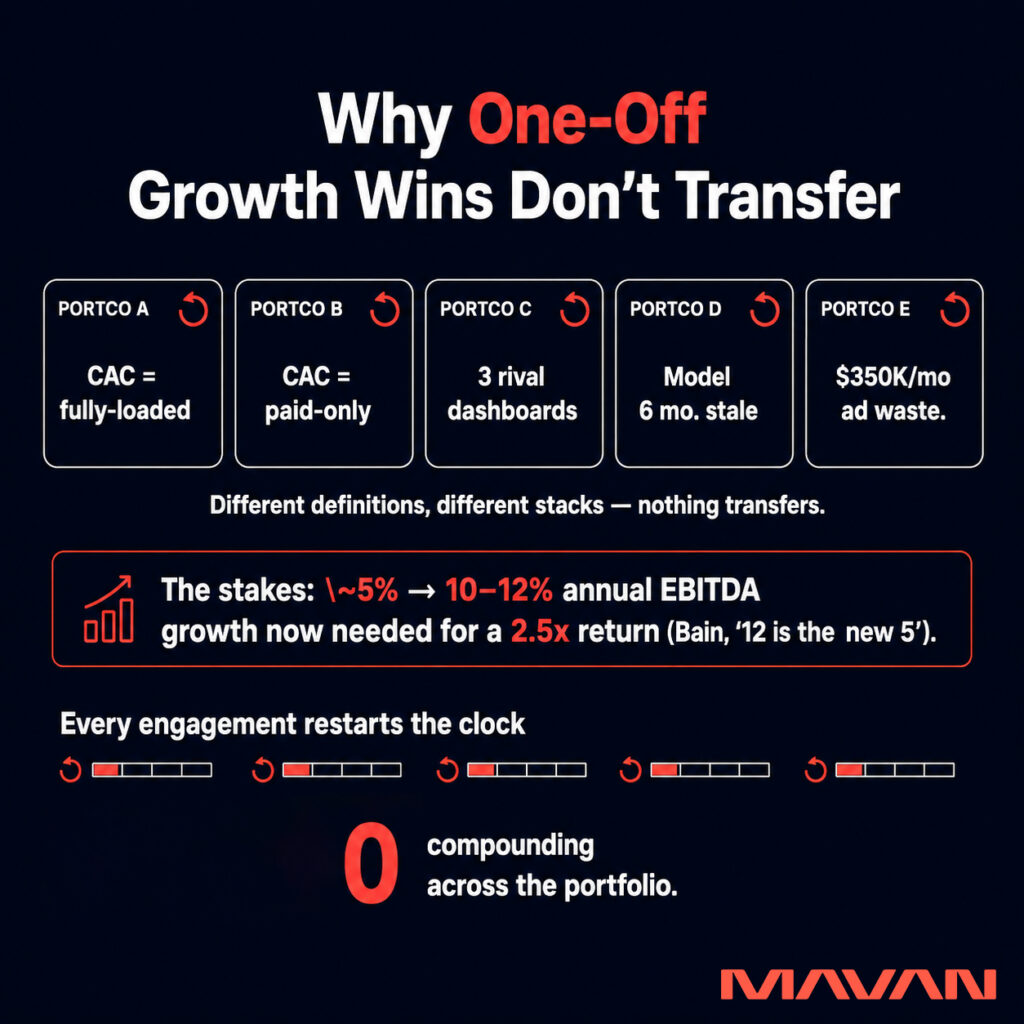
Picture the week of a value-creation or platform lead. Three of your companies use slightly different analytics stacks, two define CAC differently, and the same questions surface again and again — who do you use for attribution, whose dashboard is right, why is payback drifting. Every answer gets rebuilt from scratch because nothing was designed to travel. That friction is not a talent problem; it is a systems problem, and it compounds.
Set that against “12 is the new 5.” Every quarter a portco runs on a non-transferable engagement is EBITDA growth left on the table — growth the next company could have inherited on day one. This is the same fragmentation problem that drains individual companies, scaled to the size of a portfolio. Hard work gets spread across disconnected efforts, and no one owns the system tying them together.
The affirming version of this is the more useful one. You are already generating alpha; your instinct to bring in growth help is right. Repeatability simply lets you generate that alpha at every company you back, not the lucky one where the pieces happened to click. The goal is not to rescue a failing portco. It is to take the win you know how to produce and make it portable.
What Does “Repeatability Across Portcos” Actually Mean?
Repeatability means the same growth operating system — one source of truth, a board-grade scoreboard, a fixed insight-to-action cadence, and a 90-day sprint — installed at each portco and adapted to its market. The vertical changes; the discipline holds. That is what lets a partner produce a comparable result at company after company.
The load-bearing piece is measurement. MAVAN President Dan Barnes reduces a board-ready metric to four requirements: “One definition. One owner. One source of truth. And a threshold, not a target.” A target tells a team where it wants to go; a threshold tells it when to change behavior. Install that same discipline in every portco and the fund gets numbers that mean the same thing everywhere they appear.
Without it, each company invents its own reality. “Multiple sources of truth means there’s no way to be objective about outcomes,” Barnes says, “and when you can’t be objective about outcomes, accountability falls through the cracks.” The repeatable partner’s job is to remove that ambiguity before it hardens, so “did it work?” has one answer per company rather than three.
The system also carries a bias toward speed. Barnes’s test for whether work is even worth doing is simple: “If you can’t answer why you’re doing something before you do it, you don’t have a hypothesis. You have an opinion.” Clear hypothesis in, defined measurement out — run that loop fast and clean, and a portco compounds learning instead of accumulating activity. The tactics differ by market. The loop does not.
Key VC & PE Growth Terms, Defined
- Repeatability (across portcos)
- The ability of a growth partner to produce comparable results at company after company by installing the same operating system — data, scoreboard, cadence, and sprint — and adapting only the market-specific tactics. It is the opposite of a one-off, non-transferable win.
- Portfolio growth partner
- An external growth team a fund deploys across multiple portfolio companies to build acquisition, conversion, lifecycle, and measurement systems. Unlike a single-channel agency, it works cross-functionally, embeds like an internal team, and then hands the system back to the company.
- Single source of truth
- One reconciled data warehouse and metric set that finance, product, and marketing all use. It replaces conflicting dashboards so a company can answer “did it work?” objectively. Without it, accountability slips and every team defends a different number.
- Insight-to-action cycle
- The operating loop that shortens the time between seeing a signal and acting on it. A clear hypothesis precedes each action and a defined measurement follows it. The faster and cleaner the loop, the faster a portco turns learning into growth.
- 90-day sprint
- A fixed, three-month engagement cycle with defined goals, shared metrics, and a built-in handoff. It forces clarity on what a team is trying to achieve, how success is measured, and what was learned — and it is the repeatable unit a partner runs at each portco.
How Do You Know a Growth Partner’s Playbook Actually Transfers Across Verticals?
You look for evidence in unrelated verticals. A partner that has moved the same core metrics — CAC, payback, LTV:CAC, retention — in SaaS, consumer, fitness, and clean tech is showing you a portable discipline, not a single-category fluke. Breadth across markets is the clearest proof that the system, not the sector, produced the result.
Consider the spread. In B2B SaaS, MAVAN scaled ElevenLabs’ paid Search from zero to a high-six-figure monthly budget while holding sub-12-month payback across 20-plus international markets, and scaled Fireflies into 31 new regions at roughly 1.5x ROAS on non-brand campaigns. At Titan, the same discipline rebuilt tracking and delivered a 3x improvement in CAC efficiency while growing paid volume 5x. Different products, same core metrics moving in the same direction.
The pattern holds outside software. In fitness, KidStrong saw a 32% lift in form conversion alongside a 35% improvement in blended cost per lead and a 37% improvement in paid CPL; CrossFit hit its event-registration goals at an LTV:CAC above 3.0. In clean tech, Arcadia’s lifecycle program lifted engagement 60% and drove 38% of attributed revenue. In consumer, 818 Tequila ran 57% below its category CPA benchmark through the most contested ad window of the year. The vertical keeps changing; the discipline keeps producing.
Depth sits underneath the breadth. MAVAN’s leaders scaled some of the most data-dense businesses in the world — Matt Widdoes at King and Zynga, Dan Barnes at MachineZone and Zynga — where an insight had to become an action in hours, not quarters. That pedigree is why the operating discipline transfers cleanly into slower-moving categories. As Barnes puts it, “being open to new viewpoints and having complementary intelligences focused on problems is ultimately how you win.” A partner that has done this across gaming, SaaS, consumer, fitness, and clean tech is not guessing whether its playbook travels. It has the receipts.
What Should a Fund Expect in the First 90 Days at a Portco?
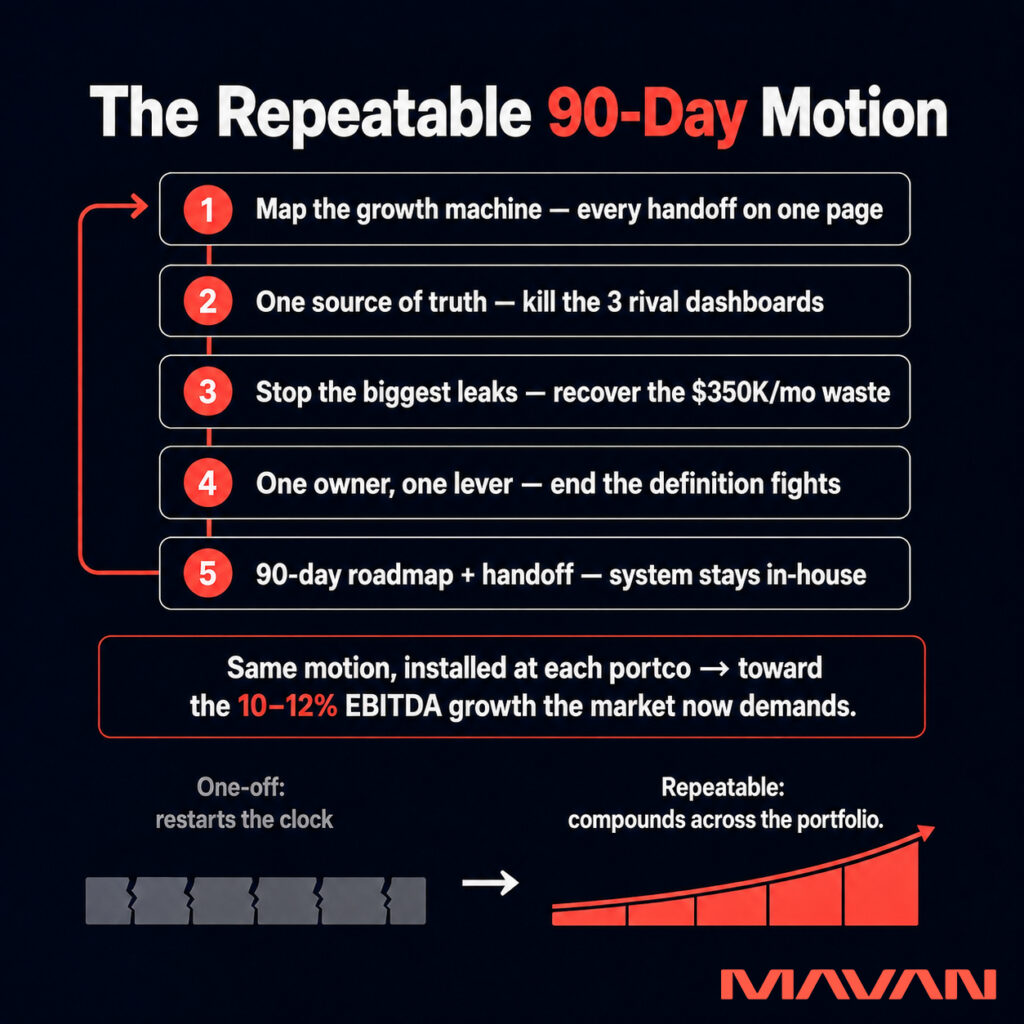
Expect a diagnosis, not a campaign. In the first weeks, a strong partner maps the whole growth machine, reconciles the numbers into one source of truth, finds the waste, and returns a prioritized 90-day roadmap. The sprint is the repeatable unit — the same opening motion you can run at the next portco, and the next.
The early value is usually hiding in plain sight. Describing an at-scale consumer engagement, Matt Widdoes recalls what basic questions surfaced almost immediately: “In the first 48 hours we uncovered around $350k a month that was being spent on an evergreen paid media campaign that had never been anywhere close to profitable” and had gone six months without an update. Teams were reading different numbers, a predictive model had gone stale, and a dashboard reported healthy while the bank account disagreed. Outside eyes found it in two days because they knew where the machine tends to leak.
That first month should hand the company back a single consolidated view of its business — data, paid, lifecycle, product, and finance reconciled in one place, often for the first time — plus the quick wins the team can execute in week two and a sequenced 90-day roadmap. Here is the opening motion a repeatable partner runs at each portco:
How a Repeatable Growth Partner Runs the Opening 90 Days
- Map the entire growth machine on one page — every handoff, tool, and team from first touch to retained customer — so the whole system is visible before anyone touches a channel.
- Reconcile the numbers into a single source of truth, so finance, product, and marketing stop defending different dashboards and start from one set of facts.
- Find the waste first — the evergreen campaigns, stale models, and tracking gaps draining budget — and stop the largest leaks inside the first two weeks.
- Pick one leverage point, not ten, and assign a single owner accountable for how the whole machine performs.
- Return a prioritized 90-day roadmap that sequences what to do first, second, and third — executable with the partner or in-house.
- Install the scoreboard and cadence so the next portco can run the same opening motion from day one.
Run this once and it is an engagement. Run it the same way at company after company and it becomes a growth system that scales beyond founder-led GTM — the portable asset a fund actually wants. Speed is real, too. Founder Quin Garcia of Autotech Ventures put one launch in context: “In just 90 days, the team at MAVAN validated, built, and launched our product into market.”
How Does Repeatability Show Up on the Board Scoreboard?
It shows up as the same small set of numbers, defined the same way, at every portco. When one source of truth feeds a board-grade scoreboard, “did it work?” has one answer instead of three. That consistency is what makes portfolio-wide growth legible to your partners and your LPs.
MAVAN President Dan Barnes is strict about what belongs on that scoreboard. “You are what you measure,” he says. “The metrics you put on the scoreboard tell your team what actually matters.” He keeps the list short on purpose — a scoreboard nobody can recite from memory is not a scoreboard — and pairs each metric with a red, yellow, or green threshold that tells a team exactly when to escalate. Installed the same way across the portfolio, that gives a fund one legible dashboard shape at every company instead of a dozen bespoke ones.
The difference between a one-off partner and a repeatable one is easiest to see side by side.
| Dimension | One-Off Growth Win | Repeatable Growth System |
| Unit of value | A result at one company | A motion installed at each company |
| Transfers to next portco? | No — rebuilt from zero | Yes — same system, new market |
| Survives team turnover? | Walks out the door | Lives in the scoreboard and playbook |
| Board and LP legibility | A different story per company | One metric shape across the portfolio |
| Effect over time | Resets the clock | Compounds across the portfolio |
A repeatable partner also treats the board pre-read as a working document rather than a status report — Barnes’s standard is that it should “drive a decision or explain a variance,” nothing more. When every portco reports in the same shape, your partners walk into each meeting already oriented, and portfolio-level patterns become obvious. That legibility is a large part of what a fund is really buying.
Every Portco is Different — Does Repeatability Survive This Truth?
The strongest objection: every portco is different, so no playbook can transfer. It is a fair point, and it misreads what transfers. Tactics do not move between a mobile game and a B2B SaaS company; operating discipline does. The source of truth, the sprint, and the insight-to-action cadence are vertical-agnostic. The tactics get rebuilt each time, on purpose.
This distinction is the whole game. A repeatable partner does not carry a mobile-gaming creative strategy into a clean-tech lifecycle program and hope. It carries the discipline — one definition per metric, one owner, one source of truth, a fast insight-to-action loop — and then builds market-specific tactics inside that frame. Matt Widdoes describes the frame itself as portable: growth needs “exceptional org design, systems, testing frameworks, and alignment on a single easily measured outcome,” and, he adds, the path is “relatively straightforward with well worn paths on what ‘great’ looks like.” The verticals differ; the definition of great does not.
The second objection is less obvious: does an embedded growth pod create dependency? A well-run engagement is designed against exactly that. It runs in defined sprints and ends with a handoff — the system, the scoreboard, and the playbook stay with the company. ElevenLabs’ Head of Growth, Luke Harries, described the arc: “After we had proven the channel with MAVAN, we were able to confidently transition the program to our in-house team.” The aim is a stronger internal muscle at each portco, so the fund’s benefit compounds long after the sprint ends.
Frequently Asked Questions About Portco Growth
What should a VC or PE fund look for in a portfolio growth partner?
Look for repeatability. The strongest partners install the same growth operating system — a single source of truth, a board-grade scoreboard, and a 90-day sprint — at each portco, then hand it off. Ask for proof across unrelated verticals, since breadth shows the discipline travels rather than depending on one lucky market.
How is a portfolio growth partner different from a fractional CMO or a single agency?
A fractional CMO is one person; a single agency usually owns one channel. A portfolio growth partner embeds a cross-functional team — data, acquisition, lifecycle, and creative — across companies, builds the whole system, and transfers it in-house. The difference is coverage and repeatability, not simply added hours.
Can one growth playbook really work across different industries?
The tactics cannot, though the operating discipline can. A mobile game and a B2B SaaS company need different channels and creative, yet both need one source of truth, a clear scoreboard, and a fast insight-to-action loop. That shared discipline is what transfers; the tactics get rebuilt for each market.
How quickly should a growth partner show results at a portco?
Expect a diagnosis within 30 days and a prioritized 90-day roadmap you can act on immediately. Early sprints often surface quick wins — paused budget waste, a fixed tracking gap — inside the first two weeks. Full compounding takes longer, but the motion should produce a legible result within a single sprint.
Does an embedded growth partner create dependency?
A good one designs against it. The engagement runs in defined sprints and ends with a handoff: the system, the scoreboard, and the playbook stay with your team. ElevenLabs proved a channel with MAVAN, then moved the program in-house. The goal is a stronger internal muscle, not a permanent crutch.
What Funds Really Want (& Need) Is a System That Repeats
What funds actually want and need from a portfolio growth partner is repeatability — a portable operating system that produces comparable growth across very different portcos. A one-off win stays at one company; a transferable system compounds across the whole portfolio and reads cleanly to the board and LPs. The proof is breadth: the same core metrics moved in SaaS, consumer, fitness, and clean tech. Start with one portco, prove the motion inside a 90-day sprint, then run it again.
If you are deciding how to deploy growth help across your portfolio, then start with the one company where a repeatable win would matter most — and run a single 90-day sprint to see the motion end to end. If that sprint produces a clean, board-ready result, then repeat it at the next portco.
Ready to see the motion? Check out our 360 Growth Analysis — a full audit of one portco’s growth machine and a prioritized 90-day roadmap you can run with us or in-house.
Casey Rock is Content Director at MAVAN, where he helps turn complex ideas into clear, strategic content that drives growth. With over 15 years of experience across content strategy, SEO, media, and digital marketing, Casey focuses on building content systems that connect audience insight, brand storytelling, and measurable business outcomes.
Book a complimentary consultation with one of our experts
to learn how MAVAN can help your business grow.
Want more growth insights?
Thank you! form is submitted
[hubspot type=”form” portal=”20951211″ id=”9c538ed2-fb12-45f1-a573-ad7953c058cc”]
Related Content
-
Which Is Best For Growth: Embedded Operators or Agency Retainers?
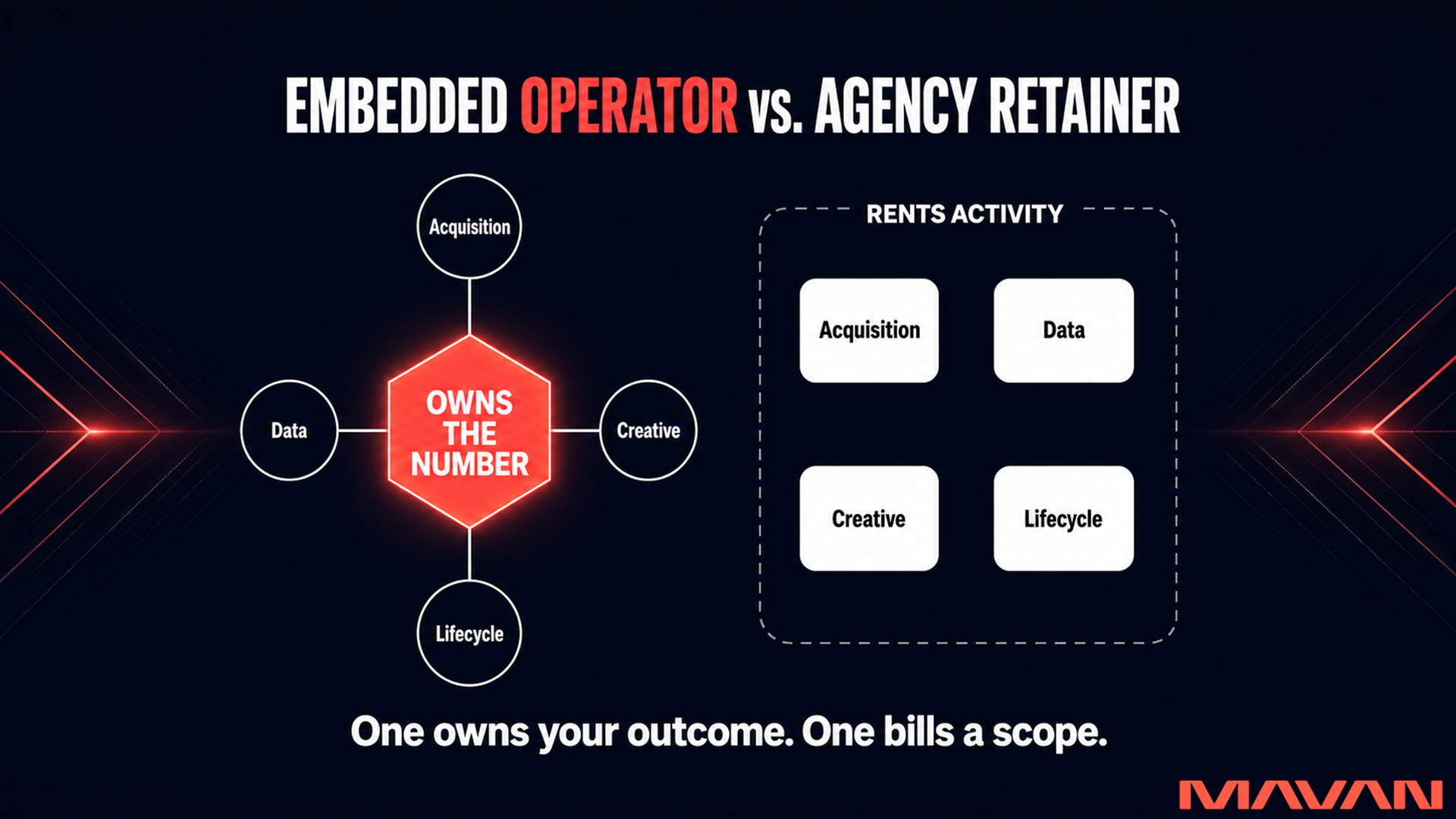
An embedded growth operator is an outside team that plugs into your company — your Slack, your data, your standups — and owns a business outcome as one accountable unit. A traditional agency retainer rents you activity at arm’s length across separate scopes. The embedded model exists to end the fragmentation that stalls venture-backed growth.
-
What Do Funds Want From a Portfolio Growth Partner? Repeatability!
What funds actually want from a portfolio growth partner is repeatability — a portable growth operating system that produces comparable results across very different portfolio companies. Repeatability shows up as a single source of truth, a board-grade scoreboard, a 90-day sprint, and a clean handoff, so each win compounds across the portfolio instead of staying at one company.
-
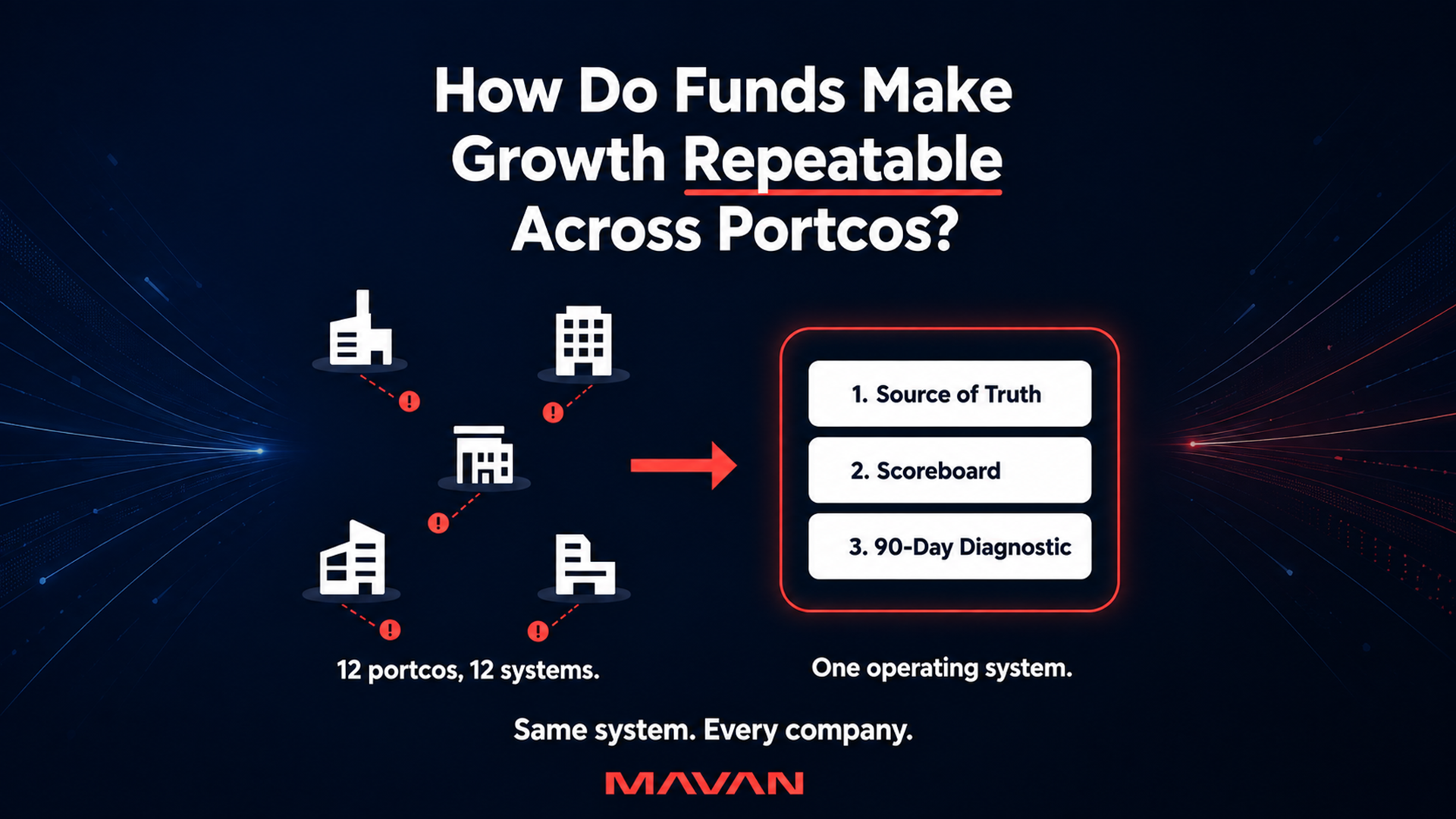
How Can VC And PE Funds Repeat Growth Across Portfolio Companies?
Growth becomes repeatable across a VC or PE portfolio when the fund installs one operating system instead of referring each company to a different specialist. The system has three parts: a single source of truth every team trusts, a board-ready scoreboard of ten to twelve metrics, and an embedded pod that diagnoses the real constraint in ninety days before anyone spends more.