
In the first 30 days of an embedded growth audit, you should get a 360-degree diagnostic across paid, lifecycle, product, data, and finance that delivers one prioritized 90-day roadmap you can execute on independently or with a partner.
TLDR — What Every B2B SaaS Growth Leader Should Know About Growth Audits
- Most growth problems hide in the gaps between teams, not inside any single function.
- A 360 audit covers paid, lifecycle, data, product, UX, and finance — not just ads.
- Marketing, product, and finance almost always measure CAC differently — reconcile it.
- One source of truth at the warehouse layer beats one shared dashboarding tool.
- Week one’s biggest unlock: get paid, lifecycle, product, data, and finance in one room.
- The fastest CAC fix is often pausing spend, not scaling it.
- Audit your sub-channels — wasted spend often hides in placements like search partners.
- Fix the tracking gap that breaks the most decisions first (usually CAPI or CRM postbacks).
- Growth audits should produce a 90-day roadmap that ranks fixes by impact and assigns owners.
- Reach out to MAVAN about a growth audit. Learn what’s blocking your next quarter of growth and how to unblock it.
Most B2B SaaS Growth Issues Stay Hidden
Most growth problems don’t announce themselves. They hide as a 3x ROAS on a paid dashboard that finance can’t reconcile against cash in the bank, a lifecycle program everyone assumed was fine, and a product team that hasn’t talked to the marketing team in six months about what actually hooks a new user. Sam McLellan, VP of Growth at MAVAN, sees the same pattern almost every time we embed with a new B2B SaaS client — and the first 30 days exist to make all of it visible at once.
For Heads of Growth, VPs of Marketing, and founder-operators at post-product-market-fit SaaS companies who’ve been asked to find growth on a budget that gets leaner every year, the task is big — and realistically requires coordination across all teams and departments. But this is also the task that MAVAN was built for.
We’ll walk through the actual mechanics of a MAVAN 30-day diagnostic — what we audit, how we prioritize, the quick wins we typically find in the first two weeks, and the single document we hand back that most clients describe as the first time their business has been written down in one place. You’re already doing real work. The point of the first 30 days is to make sure the next 90 compound it instead of scattering it.
What Is a 360-Degree Growth Audit, and What Does It Actually Cover?
A 360-degree growth audit is a 30-day diagnostic that examines every function touching growth — paid, lifecycle, data, attribution, product, UX, and finance — and delivers a single consolidated view of the business alongside a prioritized 90-day roadmap. It’s designed to find where your silos are costing you, not just how your growth initiatives are performing.
The reason it has to be 360-degrees is that growth isn’t a function — it’s a system. “Growth isn’t really one specific thing,” Sam McLellan, VP of Growth at MAVAN, explains. “It’s a system essentially that sits above all of these individual silos that normally don’t talk to each other. Product tends to do its own thing. Marketing does its own thing. Finance does its own thing. And they’re all interacting — but for the most part, when the day starts, they don’t go over and talk to marketing.” The audit’s job is to put those silos on the same page, literally, in the same document, against the same numbers.
In practice, that means MAVAN looks at six domains in the first 30 days, and each one gets its own subject-matter expert from our network of 150-plus vetted specialists — people who’ve run the equivalent function at Apple, Zynga, Airbnb, and similar.
The five domains are:
- Paid marketing — campaign architecture, channel mix, creative, waste, proxy events, attribution signal.
- Lifecycle and CRM — onboarding, activation, retention triggers, transactional emails, push, win-back flows.
- Data, analytics, attribution — instrumentation, dashboard integrity, what you can actually measure, and where your reporting obscures truth.
- Product and UX — where the product inhibits growth: onboarding friction, activation drop-offs, conversion blockers, and retention-suppressing UX.
- Finance — whether the CFO, CMO, and CEO can reconcile CAC, LTV, and payback — and whether unit economics support current spend.
Each of these gets a detailed document highlighting recommended fixes and how to execute them. The final deliverable, as Sam puts it, is “your encyclopedia of the current state of your business.” Sam emphasizes that these leave no stone unturned. One final document that MAVAN recently handed over ran 84 pages. There is an executive summary that gets sent to the leaders, but altogether this is a fully actionable document for the entire company — not just those at the top.
How Does MAVAN Onboard a New B2B SaaS Client in the First 30 Days?
MAVAN onboards a new B2B SaaS client by embedding as an internal team from day one, running a structured 360 diagnostic across paid, lifecycle, data, attribution, and product, and finishing the 30 days with one consolidated audit document plus a prioritized 90-day roadmap the client can execute with us or take in-house.
The embedded model is the point of pride for Sam — and it’s what differentiates the diagnostic from a traditional agency audit. “All of MAVAN have been an internal team,” he says. “The fact that we can kind of come in and make a significant impact acting as an internal team is probably one of the biggest sells for me, and also the place we get to make the biggest impact.” We’re not a paid marketing agency with a data add-on. We’re not a CRM shop. We sit above those silos, by design, because that’s where the real problems live.
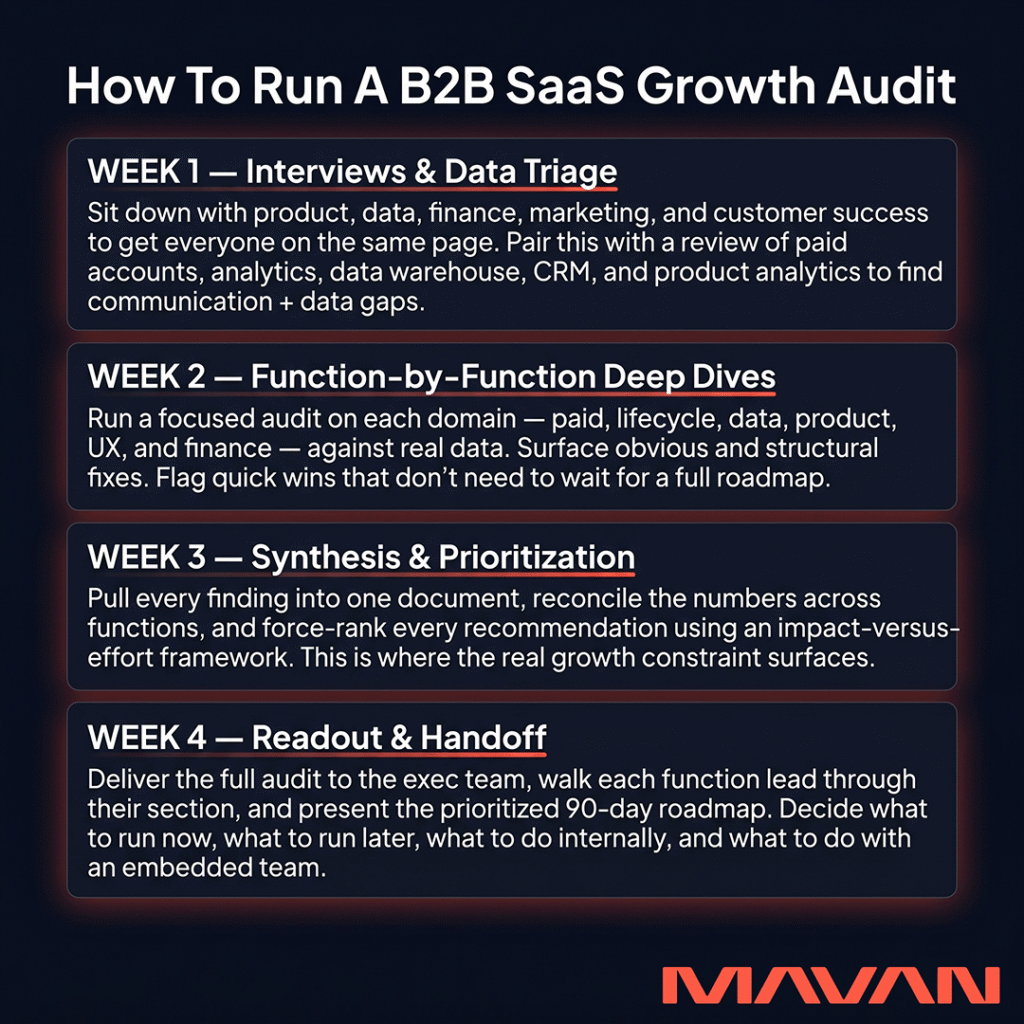
Concretely, here’s what the first 30 days of a B2B SaaS growth audit look like from the client’s side:
- Week 1 — Access, interviews, and data triage. We get read access to the paid accounts, analytics, data warehouse, CRM, product analytics, and — importantly — a seat in the room with product, data, finance, and customer success. Sam is emphatic about this: “We have to get these orgs to talk to each other.” Half the audit’s insight comes from the conversations the company hasn’t had with itself.
- Week 2 — Specialist deep-dives. Each MAVAN domain lead runs their audit against the client’s real data and surfaces both the obvious fixes and the structural ones. This is also when we surface the first quick wins that don’t need to wait for the full roadmap (more on those below).
- Week 3 — Synthesis and prioritization. We pull every finding into one document, reconcile the numbers across functions, and force-rank every recommendation using an impact-versus-effort framework.
- Week 4 — Readout and handoff. We deliver the full audit to the exec team, walk each function lead through their appendix, and present the prioritized 90-day roadmap. The client decides what to run with us, what to run internally, and what to defer.
Sam is explicit about the fact that many clients take the roadmap and run with it themselves. While MAVAN can embed as a longer-term play, the goal of the audit is to produce a standalone document that the client can run with on their own (including providing actionable insights on any recommended hiring).
Why Does Every Team Look at Different Data, and How Do We Fix It?
Every team looks at different data because each function — marketing, product, finance, exec — built its own dashboards in response to its own questions, usually at different points in the company’s life, and nobody reconciled them. The fix is to consolidate on one dataset, audit the definitions that differ across teams, and make the executive view match the operational view.
This is one of the most consistent patterns MAVAN VP of Growth Sam McLellan finds in the 30-day diagnostic, and it’s usually the one that shocks the CEO. “This happens a lot where everyone has their own Looker dash,” he explains. “And then when you actually begin to dig into it, it’s like, ‘Well, your data is cut differently from the way they’re looking at the data. And that’s different from the way finance is looking at data. And that’s very different from the way the execs are looking at the data.’ And so no one actually has the same image or picture of what’s going on here.”
The cost of that fragmentation isn’t theoretical. MAVAN CEO Matt Widdoes has described sitting with a CMO of a roughly billion-dollar company who wanted to fix Meta ad spend but flatly refused to let MAVAN speak with the data or product teams because they were “too busy” — which means the company is almost certainly still burning a meaningful share of its Meta budget against bad signal, paying to acquire users product can’t activate. Meanwhile, Sam has seen a finance team with “no idea what the cost of their acquiring a customer was” despite the fact that CAC is a huge impact on any company’s bottom line.
The MAVAN playbook for fixing this inside 30 days is straightforward, even when the underlying data work takes longer:
- Map every dashboard the company uses to one source table. This doesn’t mean using a single tool across the board — it means having one source of truth for all the tools used. Most companies need this at the warehouse layer (Snowflake, BigQuery) before the dashboards can agree.
- Write down every definition. CAC calculated by finance (fully loaded, including tools, salaries, and platform fees) is almost never the same number as CAC calculated by paid media (spend divided by conversions). Both are right. Neither agrees. Pick one for everyone to use (Sam recommends fully-loaded).
- Run a reconciliation meeting. Put finance, marketing, product, and data in one room with the numbers. This is often the first time those four functions have looked at the same chart in the same room. It’s also usually where the real growth constraint surfaces.
For B2B SaaS companies specifically, this is where most CAC blowups originate. In one recent MAVAN B2B SaaS 360-degree analysis, we found a client whose customer acquisition cost was running between $60,000 and $100,000 — and roughly 90% of their marketing/sales funnel was being tracked manually or not at all, with attribution limited to last-touch and original source. The CAC number on the dashboard wasn’t wrong — it was just measuring a small slice of the full picture. Following our rebuild recommendations would lead to a 30–50% CAC reduction through multi-touch attribution alone. That’s the kind of unlock that only shows up when you stop letting each team keep its own books.
What Quick Wins Can MAVAN Deliver in the First Two Weeks of a Growth Audit?
The most common quick win MAVAN finds in the first two weeks is in paid marketing — either a pocket of wasted spend that can be paused or repointed immediately, or a situation where the right call is to stop spending until the data and funnel can support scaling. Either way, the first two weeks usually move money in meaningful ways — even before the full strategy is built.
“Paid marketing is one of the ones where you can make a pretty easy call early on,” MAVAN VP of Growth Sam McLellan says. “Are you spending a ton of money and it’s just shooting off into the ether and you’re not getting anything for it? We can come in and pretty quickly make an impact there. And it may just be saying, ‘don’t spend the money yet. You’re not ready.’” That’s a counterintuitive win — a growth partner telling you to slow your spend — but it’s often the highest-leverage move available in week one. When the paid channel is broken, every dollar you pour in is compounding the problem. Stopping the bleed is the quick win.
When we do find waste to reallocate rather than pause, the patterns are remarkably consistent across B2B SaaS. In one recent MAVAN 360-degree analysis, we flagged a client’s Google search partners network as consuming 78% of their Google spend with essentially zero qualified opportunities — a single audit action that freed up the majority of a Google budget for accounts that actually converted. In another, a Meta diagnostic integration gap (no CAPI, broken postbacks to Salesforce) was scored as an exceptionally high priority on the 0–30-day roadmap because fixing it would unlock the optimization signal the algorithm had been starved of for months.
But the second kind of quick win is the one that’s harder to name and often matters more — the political one.
“A lot of mid and larger-sized corporate companies tend to have a lot of political battles that are underlying at any time,” Sam notes. “We were asked to come in because there’s a problem. And if we approach it from that perspective, we can essentially highlight where some of the biggest friction is between those orgs and how they’re not working at all in lockstep.” A MAVAN team often creates a measurable shift in week two just by being the neutral party that says out loud who needs to be listening to who and what teams need to know about each other.
The practical quick-win playbook for a B2B SaaS leader running this diagnostic internally — with or without us — looks like this:
- Week 1: Audit your paid spend by sub-channel. Pull a spend-by-placement or spend-by-network report for the last 90 days. If a single sub-channel is consuming more than 50% of spend with disproportionately low lead quality or conversion, pause it for a two-week holdout and watch what happens to pipeline. If pipeline doesn’t drop, you’ve just found the waste.
- Week 1: Run a single “whole funnel” standup. One hour. Paid, lifecycle, product, data, and finance in the same room, each presenting the one metric they’re most anxious about. The gaps between what each function is measuring is your quick win.
- Week 2: Fix the one tracking gap that breaks the most decisions. For most B2B SaaS companies this is CAPI implementation on Meta, full CRM-to-ad-platform postbacks, or conversion event consolidation. One of these three will likely be the highest priority action item on your list.
The point of a 30-day growth audit is that you walk out with a personalized list of priorities — so you know which one to do first.
How Does a 30-Day Growth Diagnostic Set Up the Next 90 Days?
A 30-day growth diagnostic sets up the next 90 days by producing a prioritized, force-ranked roadmap — typically using a RICE-style scoring framework — that sequences “immediate-to-do,” “nice-to-do,” and “structural” initiatives across every growth function, so the client knows exactly what to execute first, second, and third, and who should own each one. (RICE stands for “Reach, Impact, Confidence, Effort” with higher scores equaling a higher priority.)
The roadmap isn’t a wishlist. It’s an order of operations. “At the end of the 360, we give you a prioritized list of things that we believe are immediate to do, nice to do, right?” Sam explains. “We actually give you a full roadmap for the next 90 days at the end of that 30 days. And if you want us to do it, great — but we also designed these things to be handed to the client that they can then go execute on themselves.”
What the roadmap typically looks like, using the structure from recent MAVAN 360-degree analyses:
- Priority 1 (Days 0–30): Foundational fixes that unblock everything else. For B2B SaaS, this is usually fixing attribution and data plumbing (CAPI, CRM postbacks, touchpoint audit), killing the most obvious paid waste (search partners, duplicate events), and establishing a baseline dashboard everyone agrees on.
- Priority 2 (Days 31–60): Structural rebuilds that compound. Rebuilding Meta campaign structure into a proper prospecting–retargeting–testing architecture. Redesigning the welcome and reactivation lifecycle flows. Building the cohort and LTV models the finance team has been trying to produce manually.
- Priority 3 (Days 61–90): Scale and optimization. Expanding into tested channels, running creative sprints against the new tracking infrastructure, and starting the experiments that used to be impossible because the data wasn’t reliable.
The other thing this sequencing does is give the client real optionality. Sam is direct about this: “Some clients might say, ‘OK, top priority right now is fixing paid media and getting our data in line to be able to support that. So we’re going to do data first and then we’ll get paid media where it needs to be. And then you have lifecycle in here, but we’re just not ready to do that.’ We can definitely adjust.”
The 90-day plan is a map, not a contract. The value is knowing which fork compounds and which one doesn’t.
Frequently Asked Questions About the First 30 Days of a Growth Audit
How is a 360 growth audit different from a marketing audit?
A marketing audit typically examines paid channels, creative, and campaign performance — one silo, in isolation. A 360 growth audit examines every function that touches growth (paid, lifecycle, product, data, attribution, UX, finance) and specifically looks for the handoff failures between those functions, which is where most growth is actually leaking. A marketing audit tells you how your ads are performing. A 360 audit tells you why your ads can’t perform because your data, product, or finance team is working from a different picture.
What deliverables come out of a 30-day growth diagnostic?
Two things. The first is a consolidated audit document — at MAVAN, these typically run 40 to 80+ pages and include an executive summary, domain-specific appendices (paid, lifecycle, data, attribution, UX, finance), and a competitive landscape. The second is a prioritized 90-day roadmap with every initiative force-ranked using a RICE-style impact-versus-effort score, owners assigned, and level-of-effort estimates attached.
Do you have to use MAVAN to execute the roadmap after the 30-day audit?
No. The audit and the 90-day roadmap are explicitly designed to be useful whether MAVAN executes them, an internal team executes them, or some mix of both. Some clients hand the document to their internal team and go fix it themselves. Others keep us on for execution on specific functions (often paid, data, or lifecycle) and run the rest internally. The prioritization holds either way.
What if my company isn’t ready for paid spend yet — will the audit tell us that?
Yes, and this is often the most valuable answer. If your attribution, funnel, or product isn’t ready to support meaningful acquisition spend, the audit will say so and recommend you pause or reduce spend while the foundation is built. Spending into a broken funnel compounds the problem; the fastest way to improve your CAC is sometimes to stop spending until the signal density and tracking can justify the budget.
Who should be involved from my team during the first 30 days?
At minimum: one exec sponsor (usually the CEO, CMO, or Head of Growth), the paid media lead, the lifecycle/CRM lead, the data or analytics owner, and a finance representative. Product and customer success should be in at least one session. The biggest signal that an engagement will go well is whether the exec sponsor has the political capital to get all those functions in a room together or at least talking to MAVAN’s team. MAVAN CEO Matt Widdoes walks away from engagements where that isn’t the case because the audit can’t do its job if teams aren’t approachable and silos are enforced.
How much disruption does a 30-day audit cause the internal team?
Less than you’d expect, because MAVAN embeds rather than asking for weekly status calls. Most internal team time is concentrated in week one (access, interviews, data walkthroughs) and week four (readout and prioritization). Weeks two and three are largely MAVAN specialists working against the data with occasional clarifying questions. The goal is to feel like we’ve always been here, not like you’ve hired another vendor to manage.
So, What Should You Actually Expect In The First 30 Days Of A B2B SaaS Growth Audit?
The first 30 days of a MAVAN growth audit delivers three things. First, a single, consolidated view of your business — data, paid, lifecycle, product, and finance — written down in one place and reconciled across teams, often for the first time. Second, the quick wins your team can execute in week two without waiting: pausing the paid waste, fixing the highest-leverage tracking gap, and getting the silos in one room. Third, a prioritized 90-day roadmap, with action items scored and assigned, that sequences exactly what to do first, second, and third — with or without us.
If You’re Considering a 30-Day Growth Audit, Start Here
If you’re a B2B SaaS Head of Growth, CMO, or founder staring down the next 90 days, here’s a test that tells you whether a 30-day audit is worth your time. Name the single metric you, your team, or your board is most anxious about — CAC, activation, pipeline efficiency, NRR. If you can’t also name what to actually do about it — in what order, and who’s running each piece — that’s exactly what the first 30 days produces.
Casey Rock is Content Director at MAVAN, where he helps turn complex ideas into clear, strategic content that drives growth. With over 15 years of experience across content strategy, SEO, media, and digital marketing, Casey focuses on building content systems that connect audience insight, brand storytelling, and measurable business outcomes.
Book a complimentary consultation with one of our experts
to learn how MAVAN can help your business grow.
Want more growth insights?
Thank you! form is submitted
[hubspot type=”form” portal=”20951211″ id=”9c538ed2-fb12-45f1-a573-ad7953c058cc”]
Related Content
-
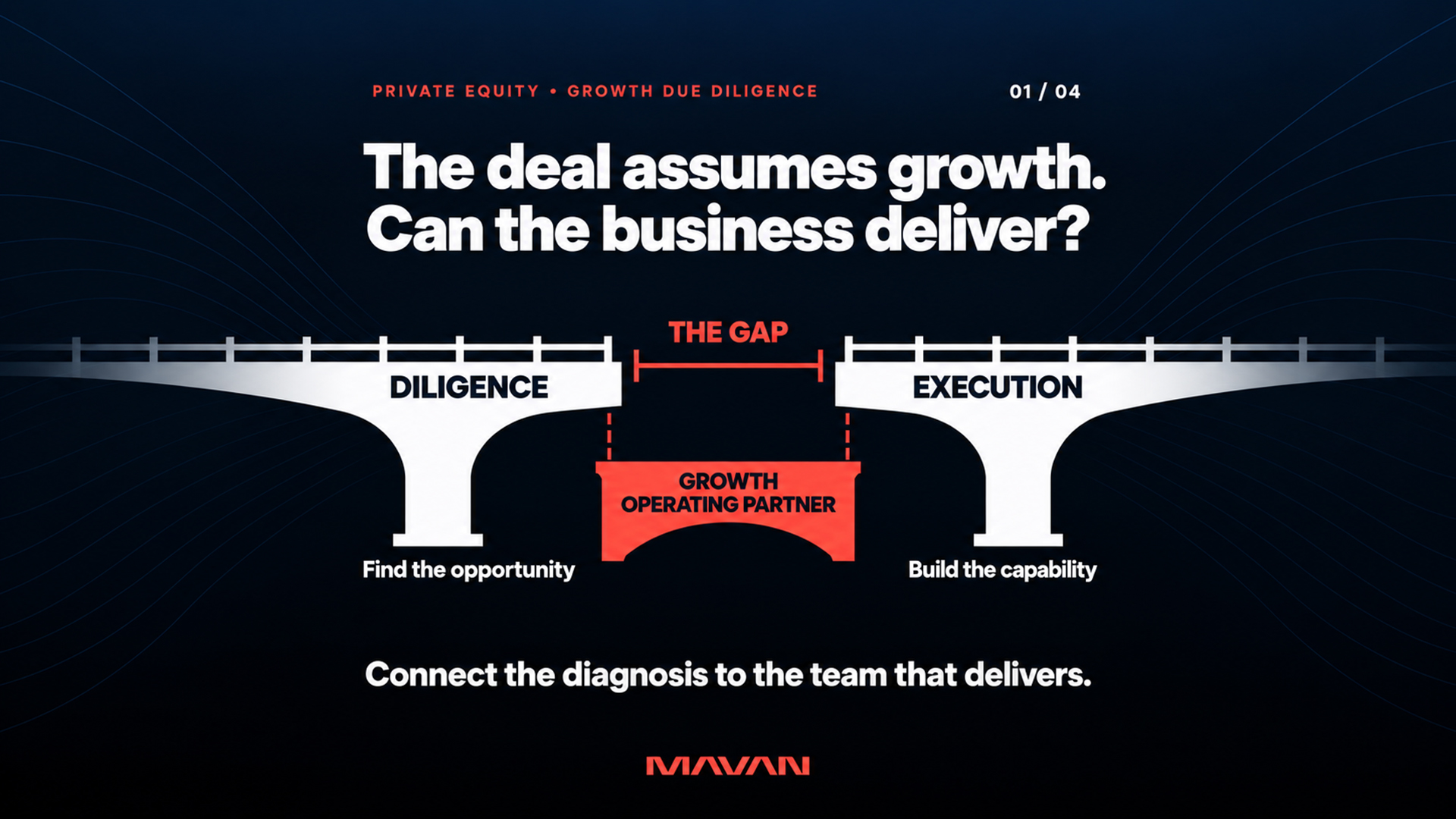
Who Does Growth & GTM Due Diligence for PE Deals?
Four kinds of provider run growth and go-to-market due diligence for private equity deals. Strategy consultancies test the market. Specialist commercial diligence firms audit the pipeline. Go-to-market boutiques rebuild the sales motion. And growth operating partners examine the full revenue engine from inside the business, then stay to operate it after close.
-
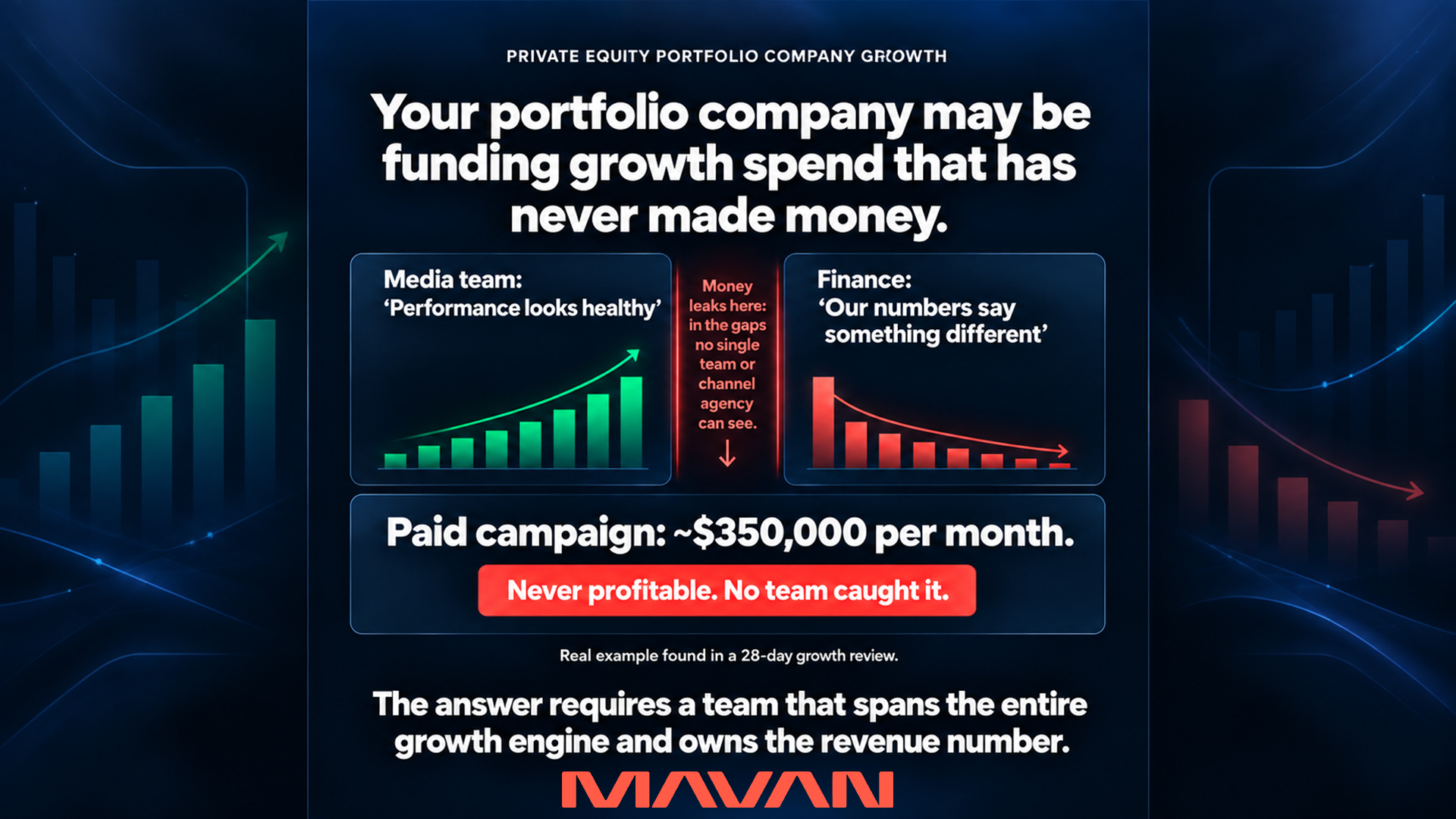
Who Is The Best Growth Partner For PE Portfolio Companies?
The best growth partner for a private equity portfolio company behaves like an operating partner you deploy, not an agency you brief. It reads the whole growth system before it spends, owns a revenue number alongside management, and leaves the capability behind so the sponsor can redeploy it.
-
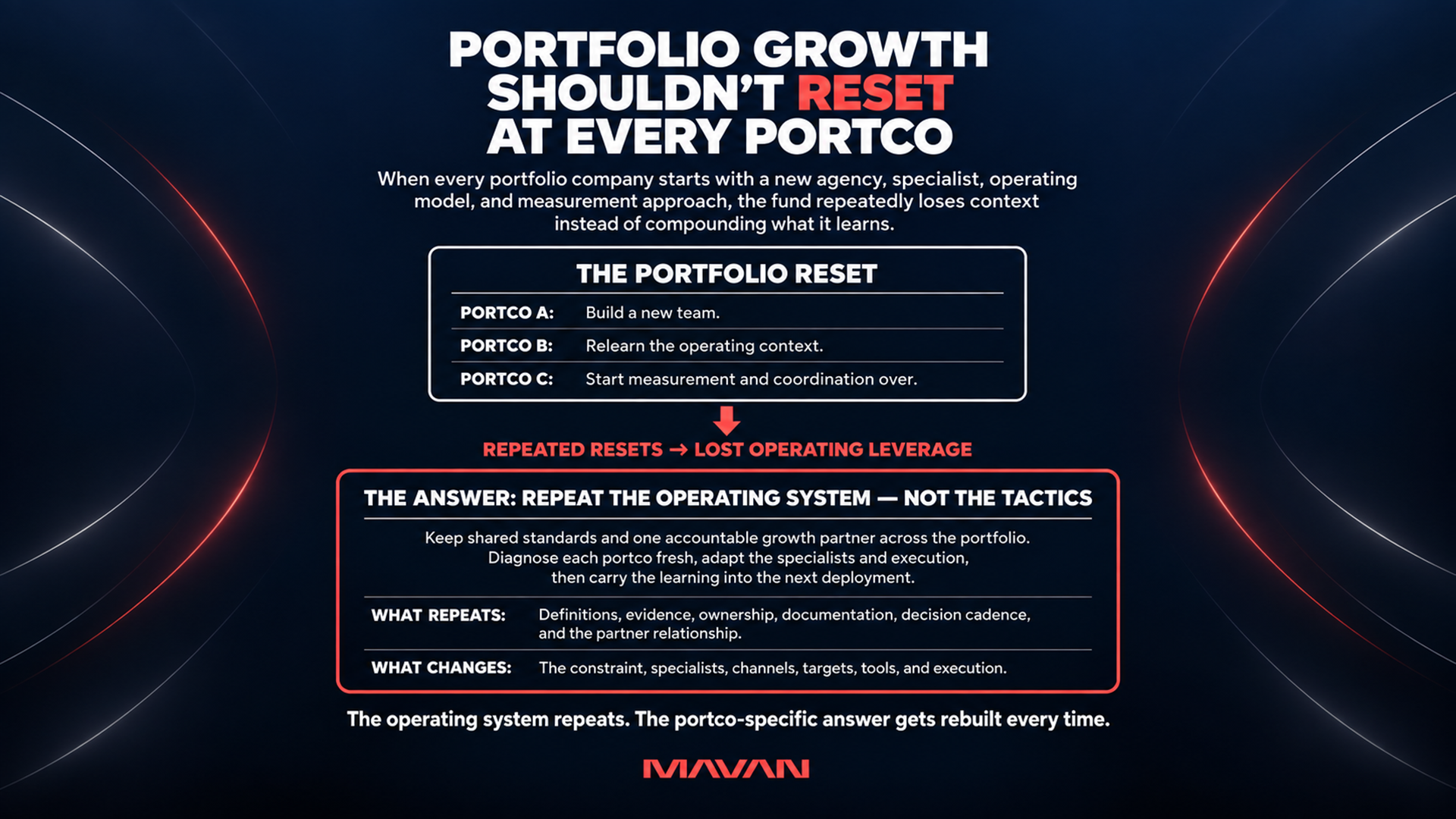
How Can Private Equity Funds Repeat Growth Across Portfolio Companies?
Growth becomes repeatable across a VC or PE portfolio when the fund installs one operating system instead of referring each company to a different specialist. The system has three parts: a single source of truth every team trusts, a board-ready scoreboard of ten to twelve metrics, and an embedded pod that diagnoses the real constraint in ninety days before anyone spends more.