
Most B2B SaaS attribution stacks fail in one of two predictable patterns: relying solely on last-touch data, or being bolted together piece by piece until the parts no longer communicate. The fix starts with mapping every top- to mid-funnel touchpoint in sequence and tying that complete journey back to the moment a contract closes.
TLDR — B2B SaaS Attribution Insights That Actually Move the Needle
- Last-touch attribution systematically defunds the channels that actually start customer relationships — not the ones that close them.
- Marketing budgets have dropped to 7.7% of revenue (Gartner, 2024), making every misallocated dollar more consequential than ever.
- A Frankenstein stack isn’t a tech failure — it’s a scaling failure; what worked at $1M ARR will break the moment you try to deploy a nine-figure raise.
- The fastest way to spot a Frankenstein stack: check whether any two channels report conversions using different attribution models.
- Full-funnel attribution requires capturing touchpoint sequence, not just touchpoint presence — the order prospects see your story is the data.
- CAC payback by channel only becomes calculable when closed-won CRM records are explicitly connected back to their first marketing touchpoint.
- When search feels like an arms race, it is — expanding to Meta or TikTok is a margin play, not a volume play.
- B2B SaaS buying cycles run five to nine months, meaning channel cuts made today could hollow out pipeline that won’t show up as missed revenue for half a year.
- Proper multi-touch attribution has shown 30–50% CAC reduction potential at companies previously relying on last-touch and original-source tracking alone.
- If your board is asking questions your attribution stack can’t answer, book a free growth audit with MAVAN — we’ll show you exactly where the gaps are and hand you a prioritized 30-day plan to close them.
You raised eight figures. Your board wants to know which channels are driving ARR (annual recurring revenue, the annualized value of your subscription contracts). The marketing ops team opens the dashboard — and nobody agrees on what they’re looking at.
This is the result of a classic attribution problem. If you’re a B2B SaaS company past your first real fundraise, the odds are overwhelmingly good that you have one — not because your team built the wrong thing, but because your measurement stack was assembled over time, under pressure, one urgent need at a time. It works. It just doesn’t work together.
The result is a system that can tell you roughly how much you spent and roughly how much came in — but can’t tell you why, or which channel earned it, or how long the payback really is. That gap doesn’t just frustrate your analysts. It inflates your customer acquisition cost (CAC — the total spend required to close one new customer), mis-signals your board, and quietly burns budget on channels that haven’t earned it.
The good news is that attribution breaks in predictable ways. Once you know which pattern you’re in, the path forward gets a lot clearer.
What Is a Broken Attribution Stack — and Why Does It Cost Real Money?
A broken attribution stack is any measurement system that can’t reliably tell you which marketing activity — which ad, which channel, which sequence of touchpoints — caused a customer to buy. It’s not a data hygiene issue in isolation. It’s a budget allocation problem hiding in plain sight, and it compounds with every dollar you spend.
When attribution is broken, growth investment happens with a blindfold on. You scale the channel that appears to win — usually the last one a prospect touched before converting — while systematically starving the channels that actually started the relationship. Over time, real CAC inflates, channel by channel, until the numbers your board sees no longer reflect where revenue actually comes from.
Gartner’s 2024 CMO survey found that marketing budgets had fallen to 7.7% of company revenue, down from 9.1% the year before. At that pressure level, every misallocated dollar matters more than it did. Sam McLellan, VP of Growth at MAVAN, says that one of the biggest issues he encounters when auditing growth-stage SaaS companies is that “attribution essentially is last-touch.”
“They look at the amount spent and they look at what came in,” he says. “It’s a workable system in theory at smaller scale — but it’s not really allowing you to mature, or treat your product, or multiple product offerings the right way.”
There is no longer a margin for figuring things out later, either. The board wants clarity now — and they’re asking harder questions than ever.
The Two Attribution Failure Modes We See at Nearly Every B2B SaaS Company
Most attribution problems aren’t unique. We see the same two failure modes across the overwhelming majority of SaaS companies we audit — and they’re both fixable once you can name them.
The Last-Touch Trap: Simple to Set Up, Dangerous at Scale
The most common attribution failure we encounter isn’t that companies have no tracking — it’s that they rely entirely on last-touch attribution, meaning the final touchpoint before a conversion gets all the credit for the sale. Last-touch is the default in most CRMs and most paid platforms. It’s easy to set up, easy to understand, and dangerously misleading at any real scale.
What last-touch misses is the entire story of how a customer decided to buy. In B2B SaaS, that story can span months. A prospect might click a LinkedIn ad in March, attend a webinar in May, read a competitor comparison blog in July, and book a demo in September after seeing a retargeting ad. Last-touch attribution credits the retargeting ad for the entire relationship — and your LinkedIn team gets defunded for something they built. The practical consequence is that you optimize toward the bottom of the funnel exclusively, hollowing out the upper-funnel channels that fill it. You double down on what appears to work. You cut what appears not to. The cycle reinforces itself until pipeline dries up months later.
The Frankenstein Stack: Built to Survive, Not to Scale
The second failure mode is subtler — and in many ways, more dangerous, because it looks like sophistication from the outside. We call it the Frankenstein stack.
“As companies grow, especially founder-led ones, you just kind of build stuff as you need it,” says Sam McLellan, VP of Growth at MAVAN. “Engineering resources are scarce. Resources in general are scarce. So you’re only going to build the stuff you really need, when you need it. There is no six-year roadmap and an engineering team of 40.”
What you end up with is a system assembled from necessity — a piece added when a campaign launched, another when the first hire joined, another when the CRM got integrated. Individually, each piece made sense. Together, they don’t talk to each other. McLellan describes the result with precision: “You have this problem that the Frankenstein pieces don’t necessarily all work together. You might have a creature now that has like five arms and no legs — you’ve built a thing and it worked, but now you actually have to take a step back and figure out how to make an efficient growth machine that is scalable to the point you want.”
In a Frankenstein stack, different funnels often run different attribution models. Some demos track first touch. Some track last touch. Some lead sources are captured automatically; others depend on a sales rep manually entering a CRM field. “There’s a whole lot of different things that can be factored into that Frankenstein model,” McLellan notes, “and they won’t all be consistent. They won’t all be the same for any company.”
This inconsistency is particularly brutal after a fundraise. Leadership expects to deploy budget at scale and get clear answers about what’s growing revenue. Instead, the moment you start scaling spend, the Frankenstein system breaks — because it was never designed for this volume or this level of scrutiny. Before you can spend the money effectively, you have to go back and rebuild the foundation.
How Do You Bridge MQLs to Board-Level CAC Payback by Channel?
This is the question boards are really asking — and it’s the one most marketing orgs can’t cleanly answer. Marketing tracks MQLs (marketing qualified leads — prospects who meet a defined interest threshold, usually through form fills or demo requests) and demo bookings. Finance tracks revenue. The connection between those two worlds — the actual story of what drove a contract to close — lives in no one’s dashboard. The bridge is full-funnel attribution: a connected tracking system that follows a prospect from their very first interaction with your brand all the way through to signed contract and, ideally, renewal.
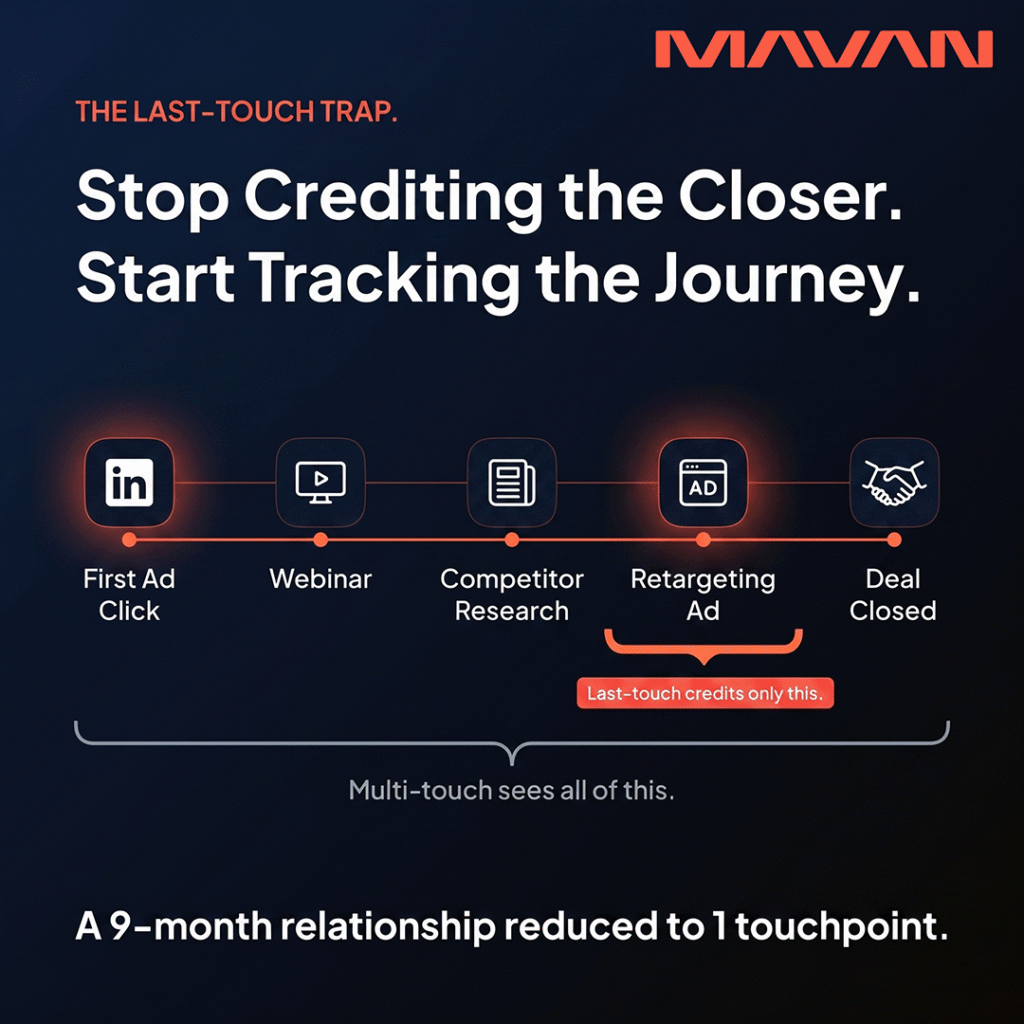
Building it requires three things to be true simultaneously — you need to know what the first touchpoint was (what introduced them to your brand), what happened in the middle (how you educated and nurtured them), and what triggered the final decision.
“At some point, people look at the beginning, the middle, and the end, and that’s it,” says Sam McLellan, VP of Growth at MAVAN. “But that top of funnel — between the first time they’ve just been introduced to the brand, or first seen an ad, to that MQL stage — has a whole bunch of steps in it. And those are varying different timelines for each different segment and different audience.”
The mechanics of the tracking need to capture more than raw click data. They need to capture sequence. “How are you telling the story of your product or your company if you don’t know in what order they’re seeing the images or the story you’re telling?” asks McLellan. “If you’re on LinkedIn versus Instagram Reels, those are probably two very different experiences for a very different person. LinkedIn might be something they’re doing at work on their computer. Reels is probably not.” That context — the platform, the creative, the order — is the story your attribution system should be reading.
Connecting that story to CAC payback by channel (the number of months it takes to recoup what you spent acquiring a customer from a specific channel) requires one more link: tying marketing activity to actual closed revenue, not just pipeline. That means your attribution system needs to speak to your CRM at the deal-close level, not just the lead-capture level. In practice, many Salesforce implementations are configured for sales management, not for multi-touch marketing attribution — they need a dedicated attribution layer added. Purpose-built B2B revenue attribution platforms like Dreamdata or Bizible (now Adobe Marketo Measure) integrate directly with Salesforce and are designed precisely for this.
MAVAN’s B2B SaaS attribution audits have identified CAC figures in the $60K–$100K range at companies where tracking was limited to last-touch and original source — with assessments showing a 30–50% CAC reduction achievable through proper multi-touch attribution and channel optimization. Better data doesn’t just answer your board’s questions. It changes the economic shape of your growth.
What Does Full-Funnel Tracking Actually Look Like in Practice?
Understanding the goal is one thing. Knowing what to build — and in what order — is another. Here’s the practical architecture of a working B2B SaaS attribution system, based on how we approach it at MAVAN. Step 1: Audit every touchpoint in your current stack. Step 2: Standardize your attribution model before adding more data. Step 3: Capture mid-funnel behavior, not just top and bottom. Step 4: Close the loop at the contract level. Step 5: Build a dashboard that answers board questions directly.
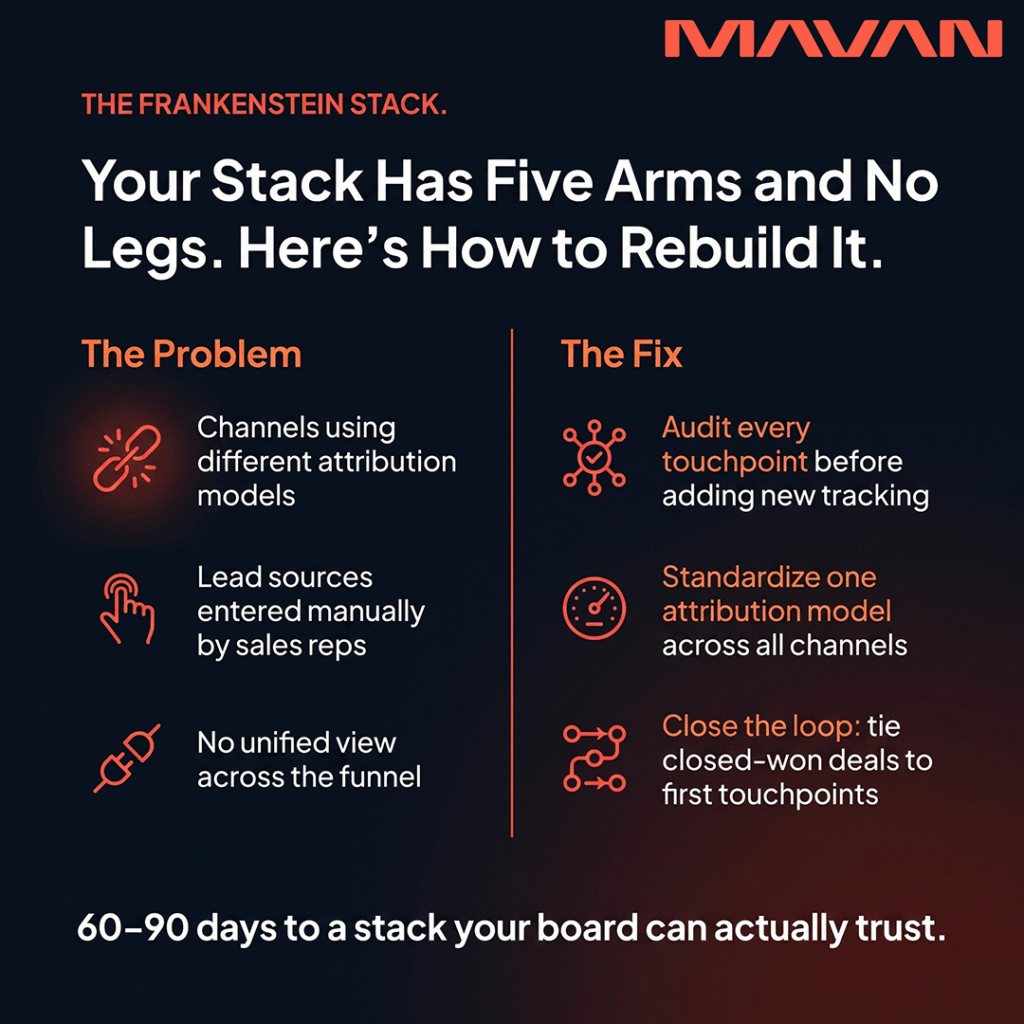
Here’s what that actually looks like in practice.
Step 1: Audit every touchpoint in your current stack. Before fixing attribution, document what’s actually being tracked and what isn’t. Go through every active channel — paid search, paid social, email, events, organic — and map what fires when. Which touchpoints create a record in your CRM? Which ones are invisible? Which ones track inconsistently depending on who set up the campaign?
Step 2: Standardize your attribution model before adding more data. One of the most common Frankenstein errors is layering new tracking on top of an inconsistent foundation. Decide on your attribution model — time-decay (more credit to touchpoints closer to conversion), position-based (credit split between first and last touch), or data-driven (historical patterns assign proportional credit) — and apply it consistently across all channels before anything else.
Step 3: Capture mid-funnel behavior, not just top and bottom. The middle of your funnel is where the story lives. “There’ll be an element of like you interact with our ad — that’ll be a click to a page view on one of our landing pages,” explains Sam McLellan, VP of Growth at MAVAN. “But the next interaction might be that they didn’t just bail. You’re able to look at those in order. You can actually see: they’re interested about costs. Then you know they bailed — but maybe we didn’t have enough information about costs on there, or they’re just not in the right moment to make that decision.” Tracking this sequence turns your mid-funnel from a black box into a diagnostic tool.
Step 4: Close the loop at the contract level. Every deal that closes should be traceable back to its first marketing touchpoint. That requires a clean integration between your marketing automation platform, your CRM, and your attribution layer — explicitly built and tested, not assumed.
Step 5: Build a dashboard that answers board questions directly. CAC by channel, CAC payback period by channel, pipeline contribution by channel — these should be live, not calculated manually before every board meeting. When your board can see those numbers in real time, the conversation shifts from whether the marketing is working to where dollars should be invested.
Where Is Your Marketing Budget Actually Leaking?
When we audit SaaS marketing spend, the most common leak isn’t on the platforms you’d expect. It’s in channel saturation — specifically, search.
“If you’re really all in on search and search is really effective for you, you’re going to keep pushing the search button,” says Sam McLellan, VP of Growth at MAVAN. “But there is also an element where at some point the friction of that channel increases — you’re kind of forcing it. You’re trying to find the lesser-known keywords. At some point it’s an arms race between you and a competitor in SaaS. And so some of the things we’re suggesting are: you should just cut some of this stuff. This is completely wasted spend in terms of expansion on this specific channel.”
The quick diagnostic: pull your Google Ads performance segmented by campaign type. If search partners — the extended network of search sites beyond Google.com itself — are consuming a meaningful share of your budget but delivering lower lead quality than core Google Search, that’s an immediate trim opportunity. If you’re expanding keyword coverage into increasingly marginal terms just to find volume, that’s a signal you’ve hit saturation on this channel.
The deeper question isn’t just where you’re wasting budget — it’s where you’re not yet investing that you should be. B2B SaaS channels have expanded dramatically. “Now we’re seeing it expanding heavily into paid social — Instagram and Facebook, even TikTok — which are now having B2B-style ads that are working, targeting very specific individuals on those platforms,” McLellan notes. “If there’s a way for you to expand and you’re not doing it, and it’s a massive-scale network like Meta or TikTok, you probably should try something there rather than trying to find the next 20 keywords your competitor totally hasn’t thought about — because they probably have. And you’re going to get into a bidding war on even more keywords that are just going to eat up budget.”
The strategic pivot here is to treat channel expansion as a margin play, not a volume play. Adding Meta or TikTok to your B2B mix isn’t about reach for its own sake — it’s about finding your ICP in environments where you’re not competing for the same keyword real estate at inflated CPCs. In those channels, you define the story. In saturated search, you’re playing someone else’s game at someone else’s price.
Does Attribution Even Work for B2B SaaS’s Five-to-Nine Month Sales Cycles?
This is a common question. B2B SaaS deals don’t close the week someone clicks an ad. Enterprise buying committees can involve five to eleven stakeholders across multiple business functions (per Gartner’s B2B Buying research), and the timeline from first awareness to signed contract can stretch across multiple quarters. The answer lies in building attribution that accounts for time.
“You have to hit them exactly at the right time — at the moment they were going to make a decision about a large software choice for an entire company,” says Sam McLellan, VP of Growth at MAVAN. “Most people go to work, and they have to tell it to their bosses. There’s a committee. There’s competitor research. They do pitches, they have meetings. If you’re in the corporate world, this is probably a five-to-nine month decision. So you have to be able to know how you told that story and be able to link it back once that actual contract closes.”
Multi-touch models are specifically designed for this, because they track the full history of a touchpoint sequence and assign credit across the entire journey rather than only at the moment of conversion. The practical requirement is that tracking must persist across sessions and devices — a cookie-based system that expires after thirty days will miss most of the relationship in a nine-month deal. Server-side tracking, CRM-tied identity resolution, and disciplined UTM parameter architecture are the mechanisms that make long-cycle attribution reliable.
The business case for doing this correctly is especially compelling precisely because cycles are long. If a channel contributes meaningfully to deals that close six months from now, you need to know that today — so you protect that budget rather than cutting it for appearing not to convert immediately.
Frequently Asked Questions About B2B SaaS Attribution
What is the difference between last-touch and multi-touch attribution in B2B SaaS?
Last-touch attribution gives 100% of the credit for a conversion to the final marketing touchpoint before a deal closes. Multi-touch attribution distributes credit across every touchpoint in a buyer’s journey — from first ad click to demo booking to closed contract. In B2B SaaS, where buying cycles span months, multi-touch attribution is essential: it reveals which channels start relationships, which ones sustain them, and which ones close them.
How do I calculate CAC payback period by channel for my SaaS company?
To calculate channel-level CAC payback, divide total spend on a channel by the number of customers that channel contributed to acquiring (using multi-touch attribution data). That gives you channel CAC. Then divide channel CAC by the average monthly gross margin per customer from that channel. The result is the number of months to recover what you spent. To do this accurately, your attribution system must connect closed-won CRM records back to their originating marketing touchpoints.
What are the signs my B2B SaaS company has a Frankenstein attribution stack?
Three signals: (1) Different marketing channels report conversions using different attribution models — some first-touch, some last-touch — with no unified view across them. (2) Your CRM has manually entered lead source data that sales reps fill in inconsistently. (3) You can tell leadership total MQLs and total CAC, but you can’t break CAC down reliably by channel or segment. If any of these are true, you have a Frankenstein stack — and the urgency to fix it scales directly with your budget.
Should B2B SaaS companies advertise on Meta and TikTok, not just Google and LinkedIn?
Yes — with intention. Meta (Facebook and Instagram) and TikTok now support B2B-specific targeting that can reach decision-makers and influencers at your ICP accounts. The strategic case isn’t that these channels are inherently better than search or LinkedIn — it’s that when search is saturated, expanding to high-scale social networks lets you reach your audience in contexts where you set the terms, not bid against a competitor for the same keyword. Start with a test budget, track to the channel-level CAC standards you’ve established elsewhere, and scale what proves out.
What attribution tools work best for B2B SaaS companies using Salesforce?
Purpose-built B2B revenue attribution platforms with native Salesforce integration are the strongest fit. Dreamdata and Bizible (Adobe Marketo Measure) are both designed for multi-touch attribution in B2B SaaS, with 30-day implementation timelines and clean integration into the Salesforce/Snowflake/Looker stacks common at growth-stage companies. The decision between tools should factor in your technical resources, existing martech stack, and the complexity of your funnel.
How long does it take to fix broken B2B SaaS attribution?
A structured attribution overhaul — from touchpoint audit through tool implementation to live reporting — typically runs 60–90 days when sequenced correctly. The first 30 days cover auditing every touchpoint, aligning on your attribution model, and selecting a tool. Days 31–60 cover implementation and funnel automation. Days 61–90 focus on optimization: analyzing new data, reallocating budget based on true multi-touch insights, and building a board-facing performance dashboard.
Your Attribution Stack IS Fixable
Most B2B SaaS companies don’t fail at attribution because they don’t care about data. They fail because their measurement systems were built responsively — one piece at a time, under resource constraints — and were never redesigned for the growth stage they’re now in. The two failure modes (last-touch reliance and Frankenstein stacks) produce the same result: CAC inflation, misallocated spend, and boards asking questions no dashboard can answer. The fix is a structured attribution rebuild — standardized model, connected touchpoints, closed-loop revenue tracking — that turns your measurement stack from a reporting tool into a genuine growth instrument. Once you can see CAC payback by channel in real time, every budget decision gets sharper, every board conversation gets cleaner, and every dollar you deploy earns its place.
If your board is asking questions your attribution stack can’t answer, pull spend and attribution model data for your top three channels. If any two channels report conversions using different models — one first-touch, one last-touch — that’s your Frankenstein signal. If all channels credit the same final touchpoint, that’s your last-touch trap. Identify which pattern you’re in.
Casey Rock is Content Director at MAVAN, where he helps turn complex ideas into clear, strategic content that drives growth. With over 15 years of experience across content strategy, SEO, media, and digital marketing, Casey focuses on building content systems that connect audience insight, brand storytelling, and measurable business outcomes.
Book a complimentary consultation with one of our experts
to learn how MAVAN can help your business grow.
Want more growth insights?
Thank you! form is submitted
[hubspot type=”form” portal=”20951211″ id=”9c538ed2-fb12-45f1-a573-ad7953c058cc”]
Related Content
-
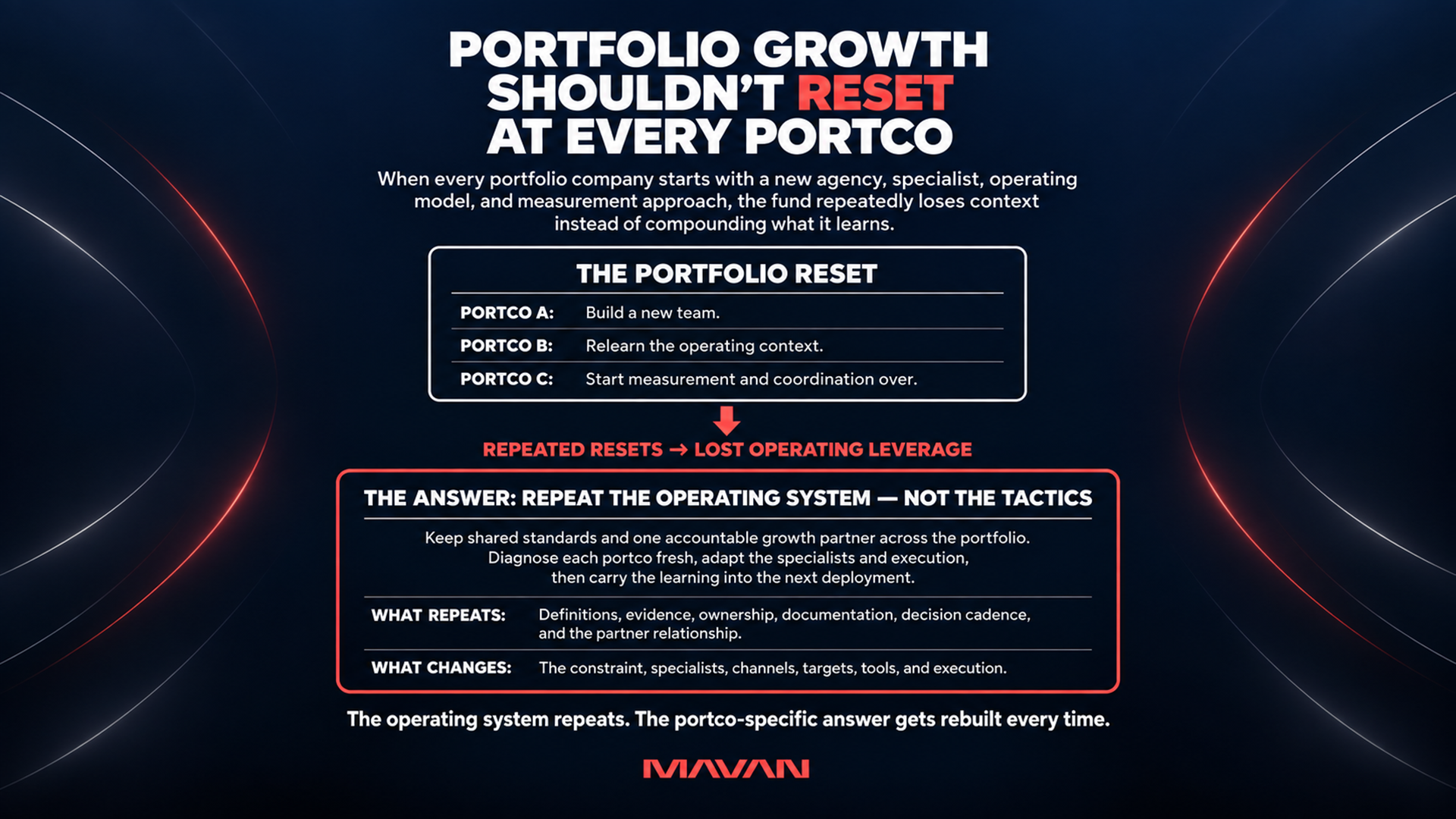
How Can Private Equity Funds Repeat Growth Across Portfolio Companies?
Growth becomes repeatable across a VC or PE portfolio when the fund installs one operating system instead of referring each company to a different specialist. The system has three parts: a single source of truth every team trusts, a board-ready scoreboard of ten to twelve metrics, and an embedded pod that diagnoses the real constraint in ninety days before anyone spends more.
-
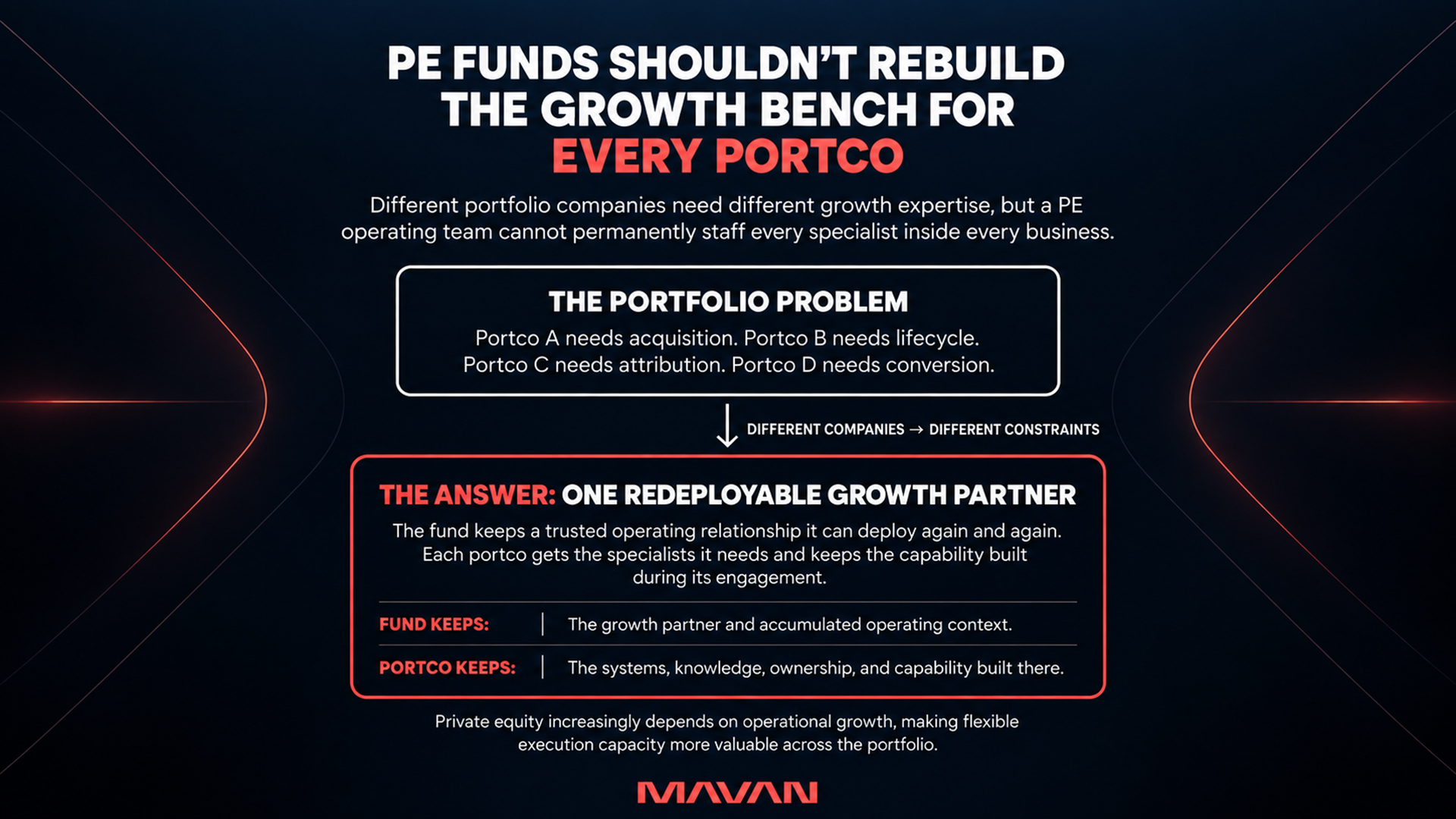
What Do PE Funds Want From a Portfolio Growth Partner? Repeatability!
What funds actually want from a portfolio growth partner is repeatability — a portable growth operating system that produces comparable results across very different portfolio companies. Repeatability shows up as a single source of truth, a board-grade scoreboard, a 90-day sprint, and a clean handoff, so each win compounds across the portfolio instead of staying at one company.
-
What’s the Best Growth Agency For VC & PE?
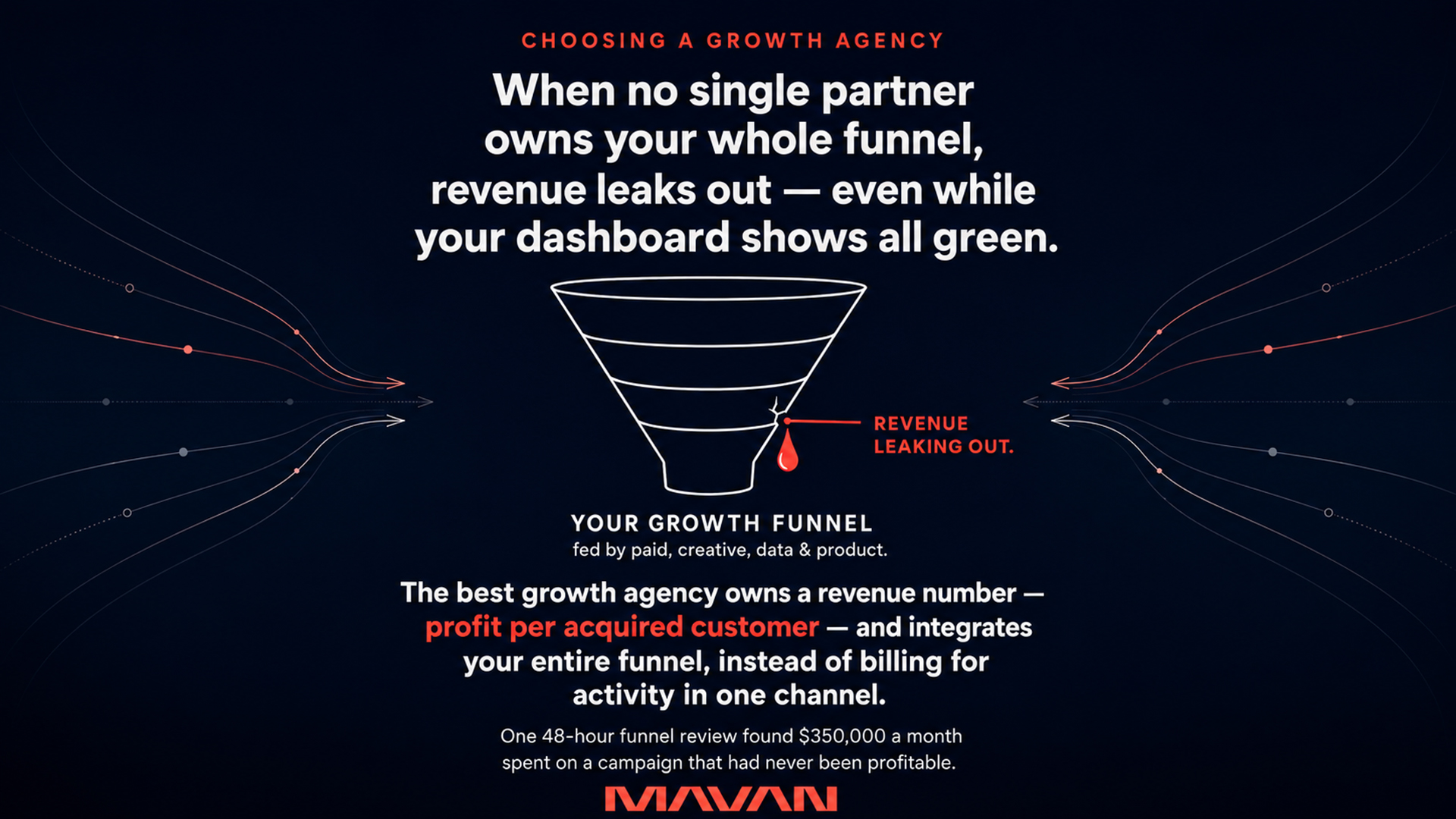
The best growth agency for a venture-backed or PE-owned company behaves less like a traditional agency and more like an embedded operating partner. It diagnoses your whole funnel, owns a revenue number such as CAC payback or LTV:CAC, and executes inside your team — rather than billing for activity in one channel.