
Startup growth breaks down when marketing, product, data, and creative teams work in silos. The fix starts with mapping your full growth chain, auditing your measurement stack, and assigning one owner to the whole system — not just the pieces.
TLDR — Top Takeaways For Fixing Fragmented Startup Growth
- Growth stalls from team fragmentation — not from lack of effort or talent.
- Fragmentation gets worse as you scale because each new hire or vendor adds a silo.
- Nobody owning the full growth system is the single most common structural failure.
- Your paid team’s metrics can look great while your actual unit economics are underwater.
- False confidence from partial data is the most dangerous symptom — it hides millions in waste.
- Week one fix: map your entire growth chain on one page and flag every unowned handoff.
- Week two fix: audit whether you can answer your true CAC, cohort retention, and biggest funnel leak with data you trust.
- Don’t fix everything at once — identify the single biggest gap between effort and outcome and focus there.
- Assign one person (not a committee) accountability for how all growth functions work together.
- If you can’t confidently map your growth chain or answer those three measurement questions, book a free 360 Blueprint call with MAVAN — we’ll show you where the leaks are hiding.
You haven’t taken a real vacation in two years. Your team ships campaigns, fills dashboards, runs standups. So why does everything still feel held together with duct tape? We talk to founders in this position every week — and the answer is almost never “your people aren’t good enough.” It’s that nobody owns the system connecting them.
What Is The Growth Fragmentation Trap — And Why Does It Get Worse As You Scale?
Growth fragmentation happens when individually smart hiring and vendor decisions create an operating model where no single person sees the full picture. It doesn’t look like failure. It looks like “busyness” — and that’s what makes it so dangerous.
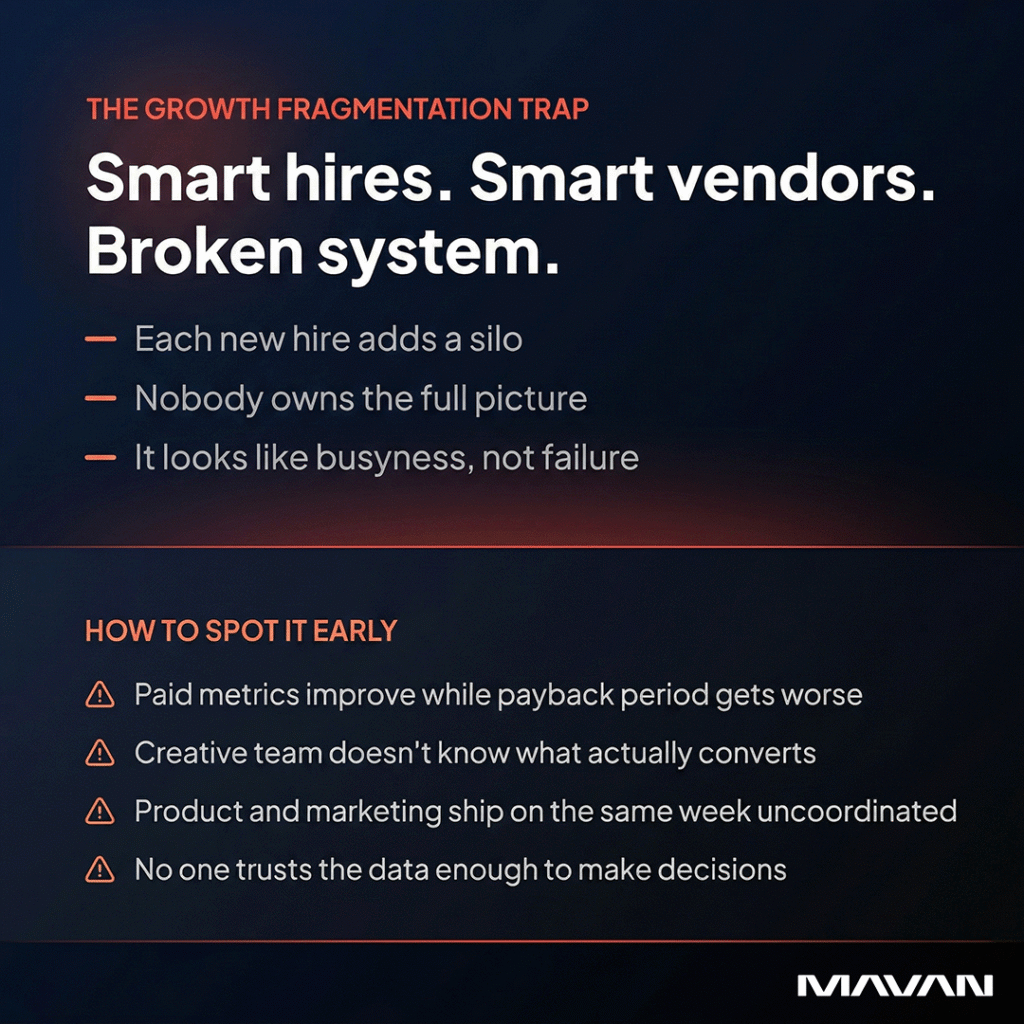
Here’s the counterintuitive part: fragmentation doesn’t hurt most at the early stage. When the team is small, the founder is the connective tissue. The problem starts when things work well enough that you add layers — a head of growth, a paid media agency, a freelance creative team, a data analyst. Each move makes sense alone. Together, they create silos where nobody owns the whole picture.
Matt Widdoes, Founder and CEO of MAVAN, has watched this unfold at companies of every size. “When I first joined King (Candy Crush), they had been running their own attribution for years,” he says. “I started asking questions and quickly realized that a lot of the security measures around click fraud were nowhere to be found.”
His task force discovered over $25 million per year in fraudulent attribution — hiding in plain sight. “Within eight weeks we were able to resolve 95% of the threat vectors,” Widdoes adds. If it can happen at King, it can happen anywhere.
How Do You Spot Fragmentation Before It Kills Your Runway?
Fragmentation shows up as symptoms most teams have normalized. Your paid team celebrates a drop in CPM while your payback period gets longer. Creative gets briefed without knowing which value propositions convert. Product launches a redesign the same week as a big acquisition push — which nobody coordinated.
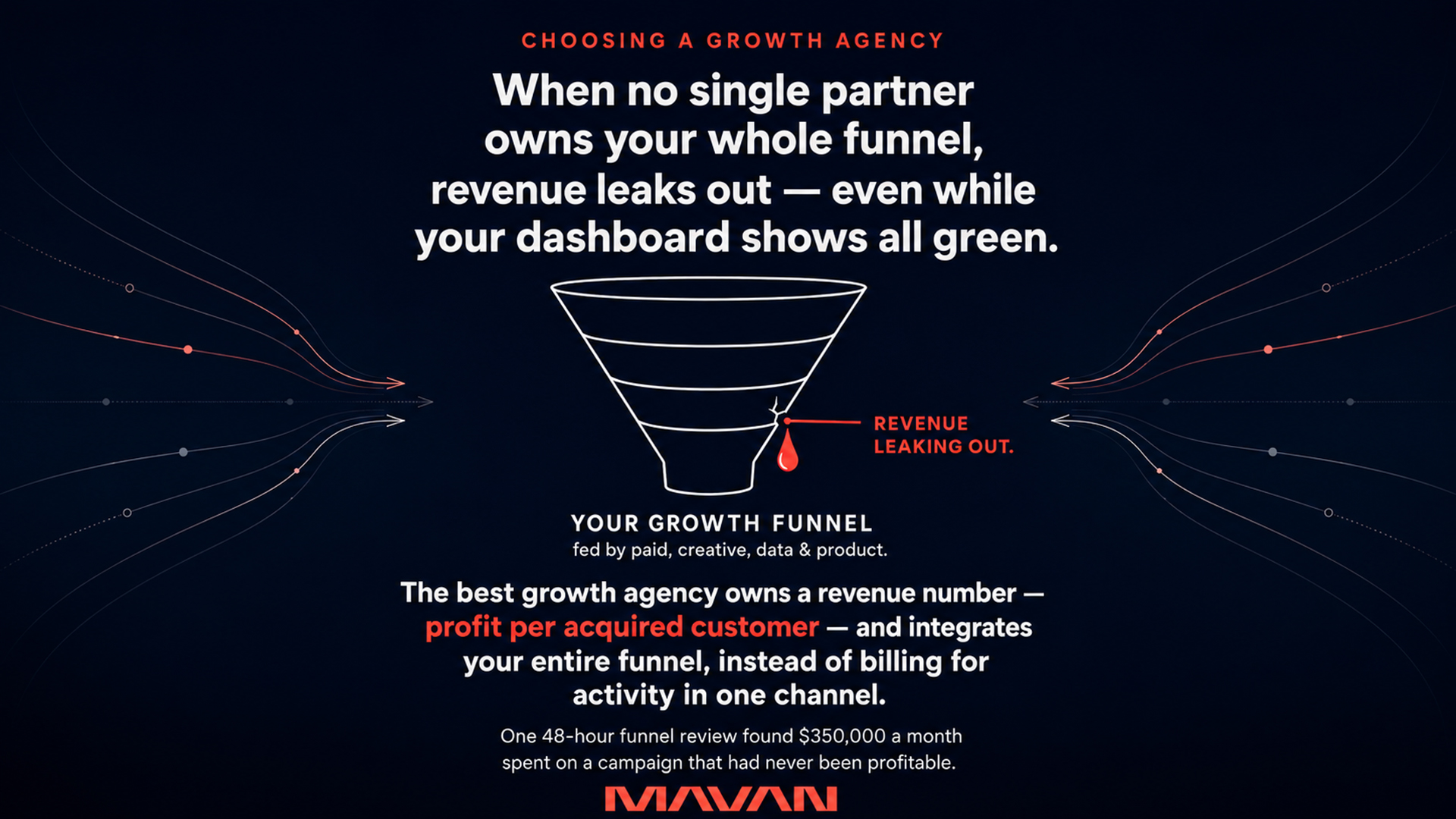
The most dangerous symptom? False confidence from partial data. “We recently ran a 360 Blueprint for a new client,” Widdoes explains. “In the first 48 hours we uncovered around $350,000 a month being spent on an evergreen paid campaign that had never been anywhere close to profitable.” That’s $4.2 million a year — found in two days — by asking “how does all of this work?”
How Do You Fix Fragmented Growth In 30 Days?
You don’t need to overhaul everything at once. Here’s a four-week playbook to diagnose the biggest gaps and start closing them.

- Week 1–2: Map your growth chain on a single page. Trace how someone goes from not knowing you exist to becoming a paying, retained customer. Mark every handoff, every team responsible, every tool involved. You’ll find gaps, overlaps, and handoffs where nobody is clearly accountable.
- Week 2–3: Audit your measurement stack. Can you confidently answer three questions with data you trust? 1) What is our actual, fully loaded CAC by channel? 2) What does the activation-to-retention curve look like by cohort? 3) Where in the funnel are we losing the most value? If you can’t answer all three, measurement is your first problem.
- Week 3–4: Identify the single biggest leverage point. Don’t fix everything. Ask: where is the biggest gap between effort and outcome? Usually it’s acquisition efficiency, activation, or retention. Pick one. Focus.
- Throughout: Decide who owns the system — not just the pieces. Someone — a person, not a committee — needs accountability for how all growth functions work together. As Widdoes puts it: “Growth requires not only exceptional people in every seat, but exceptional org design, systems, testing frameworks, and alignment on a single easily measured outcome. It’s a lot to get right, and it’s never easy. It is, however, relatively straightforward — with well-worn paths on what ‘great’ looks like.”
Frequently Asked Questions About Startup Growth
Why is my startup’s CAC rising even though we’re spending more on marketing?
Rising CAC usually signals fragmentation, not underspending. When paid, creative, product, and data teams optimize in isolation, money leaks through the gaps between them.
What is a growth fragmentation trap?
It’s when individually smart hires and vendor choices create an operating model where no one owns the system connecting acquisition, activation, and retention. It looks productive but compounds inefficiency.
How do I know if my startup needs an integrated growth team?
If you can’t explain your growth model on a whiteboard in five minutes and your CAC is rising without a clear reason, fragmentation is likely the drag.
Can I fix fragmented growth without hiring a full in-house team?
Yes. An embedded cross-functional MAVAN team can diagnose gaps, build the system, prove it works in 90-day sprints, and hand off a clear playbook — so you know exactly what roles and tools to bring in-house.
How To Fix Startup Growth That Feels Broken
Growth-stage companies don’t usually fail because the team isn’t working hard enough. They fail because hard work gets spread across too many disconnected efforts — and nobody owns the system tying them together. The fix isn’t spending more. It’s integrating what you already have: mapping your growth chain, auditing your data, picking one leverage point, and assigning a single owner to the whole machine.
Casey Rock is Content Director at MAVAN, where he helps turn complex ideas into clear, strategic content that drives growth. With over 15 years of experience across content strategy, SEO, media, and digital marketing, Casey focuses on building content systems that connect audience insight, brand storytelling, and measurable business outcomes.
Book a complimentary consultation with one of our experts
to learn how MAVAN can help your business grow.
Want more growth insights?
Thank you! form is submitted
[hubspot type=”form” portal=”20951211″ id=”9c538ed2-fb12-45f1-a573-ad7953c058cc”]
Related Content
-
What’s the Best Growth Agency For VC & PE?
The best growth agency for a venture-backed or PE-owned company behaves less like a traditional agency and more like an embedded operating partner. It diagnoses your whole funnel, owns a revenue number such as CAC payback or LTV:CAC, and executes inside your team — rather than billing for activity in one channel.
-

Is 1 GTM Motion the Biggest B2B SaaS Mistake?
The biggest go-to-market mistake in B2B SaaS is forcing one motion across SMB, mid-market, and enterprise, which buy on completely different timelines. The fix is running three coordinated motions inside one company: product-led growth for SMB, sales-assist for mid-market, and account-based marketing for enterprise, each matched to how that segment actually buys.
-

How Do You Evaluate a Portfolio Growth Partner?
To evaluate a growth partner for a fund’s portfolio, test two things. First, multi-company bandwidth: whether their operating model, not their headcount, lets them run many portfolio companies at once without quality slipping. Second, a proven playbook: a documented growth system that transfers between companies and survives leadership change, rather than living in one operator’s head.