
Growth-stage startups don’t usually stall because the team isn’t working hard enough. They stall because hard work gets distributed across too many disconnected efforts, and nobody owns the system that ties them together. The fix isn’t more ad spend or more specialists — it’s integrating what you already have.
TLDR — How To Diagnose And Fix Stalling Startup Growth
- Growth stalls between Series A–C from fragmented operations, not bad tactics.
- More spend, hires, or tools won’t fix what’s structurally broken.
- If your finance and marketing dashboards disagree, that’s a fragmentation issue.
- Typical Series B startups leak $50K–$200K monthly in invisible vendor waste.
- Pick one revenue number from the bank — and make every team report to it.
- Name one accountable owner for the full funnel, not a committee or council.
- Run cross-functional standups that include product, not just marketing.
- Use 90-day sprints anchored to one or two metrics that must move.
- Spend your first 30 days diagnosing — not fixing the loudest problem.
- Ready to map your growth operation? Tell MAVAN what needs to be solved.
A CMO at a direct-to-consumer brand spending $12 million a month on paid once asked Matt Widdoes, Founder and CEO of MAVAN, how to scale Meta faster. Matt’s answer was that they’d need to start somewhere else entirely — with the data team, the product team, the lifecycle team. “He looked like he’d seen a ghost,” Matt recalls. “‘I can’t have you speaking with the data or product teams, they’re too busy, we just need to fix Meta ad spend.’” The company was doing close to $1 billion a year. And the marketing leader couldn’t get the rest of the organization in a room to fix a growth problem that lived between functions, not inside one.
That moment is the moment most growth leaders eventually hit — somewhere between Series A and Series C. Revenue is growing. The team is growing. Spend is growing. Something feels off, but it’s hard to name. And when the board asks why CAC moved 30% last quarter, nobody can answer with confidence. We’ve worked with enough venture-backed teams now to call it what it is: a structural problem dressed up as a tactical one. This article is about how to diagnose it, what it actually costs you, and how to fix it without writing another check.
Why Does Startup Growth Stall Between Series A And Series C?
Growth typically stalls at this stage because the operating model fragments faster than the strategy can compound. Most founders start as the connective tissue between functions. As the team grows, layers get added — agency, specialists, vendors, tools — and the integration that used to live in the founder’s head simply disappears.
Here’s the counterintuitive part: fragmentation doesn’t hurt most companies pre-product-market-fit. When you’re small, the founder is in every Slack channel and on every call, holding the whole picture together. The problem starts when things are working well enough to add layers. You hire a head of growth. You bring on an agency for paid. You contract creative. You add a data analyst. Each move is individually rational. Collectively, they create an operating model that works against you.
What that looks like in practice — drawn from Matt’s account of the pattern he’s seen across King, Zynga, and dozens of MAVAN clients:
- Paid acquisition optimizes for platform metrics, not business outcomes. Your Meta buyer is celebrating a 20% drop in CPM while your actual payback period (the time it takes to recover what you spent on acquiring a customer) is getting longer.
- Creative gets briefed in a vacuum. Nobody’s feeding back which value propositions are actually converting downstream, so the creative team keeps producing variations of the same themes that tested well six months ago.
- Product and marketing don’t share a calendar. A major onboarding redesign launches the same week as a big acquisition push, and nobody coordinated — so you’re pouring new users into a funnel that’s mid-construction.
- Data is perpetually “almost ready.” Attribution (the system that tells you which channels drove which revenue) is a mess. Nobody trusts the numbers enough to make real decisions, so everyone defaults to whoever argues loudest in the meeting.
- The CEO becomes the integration layer by default. The person who should be focused on strategy, fundraising, and product vision is spending 15 hours a week playing air traffic controller between vendors and teams.
This isn’t a hiring problem. It isn’t a budget problem. As Matt puts it: “It’s a structural problem — and it compounds quietly.” You can keep throwing people, tools, and spend at it for years before realizing none of those things fix what’s actually broken.
How Do You Know If Your Growth Problem Is Structural, Not Tactical?
You probably have a structural problem if your team is busy but KPIs aren’t moving, your dashboards disagree, and decisions stall because no one owns the full funnel. Tactical problems are scoped to one channel or one number. Structural problems show up everywhere at once.
The clearest tell is the meeting where everyone reports green and the bank account reports red. Matt describes one recent engagement where MAVAN’s 360 Growth Analysis diagnostic — a top-to-bottom audit of how a company’s growth operation actually works — surfaced something stark within 48 hours: “We uncovered around $350,000 a month that was being spent on an evergreen paid media campaign that had never been anywhere close to profitable and had not been updated or optimized for over six months.” The campaign was running because no one team was looking at the same number. “It boiled down to not having a line of sight into actual revenue hitting the bank, a predictive model that was out of date, data being misinterpreted through an automation layer, and a dashboard that showed the media teams everything was fine, when in reality the leads from that campaign had NEVER been profitable.”
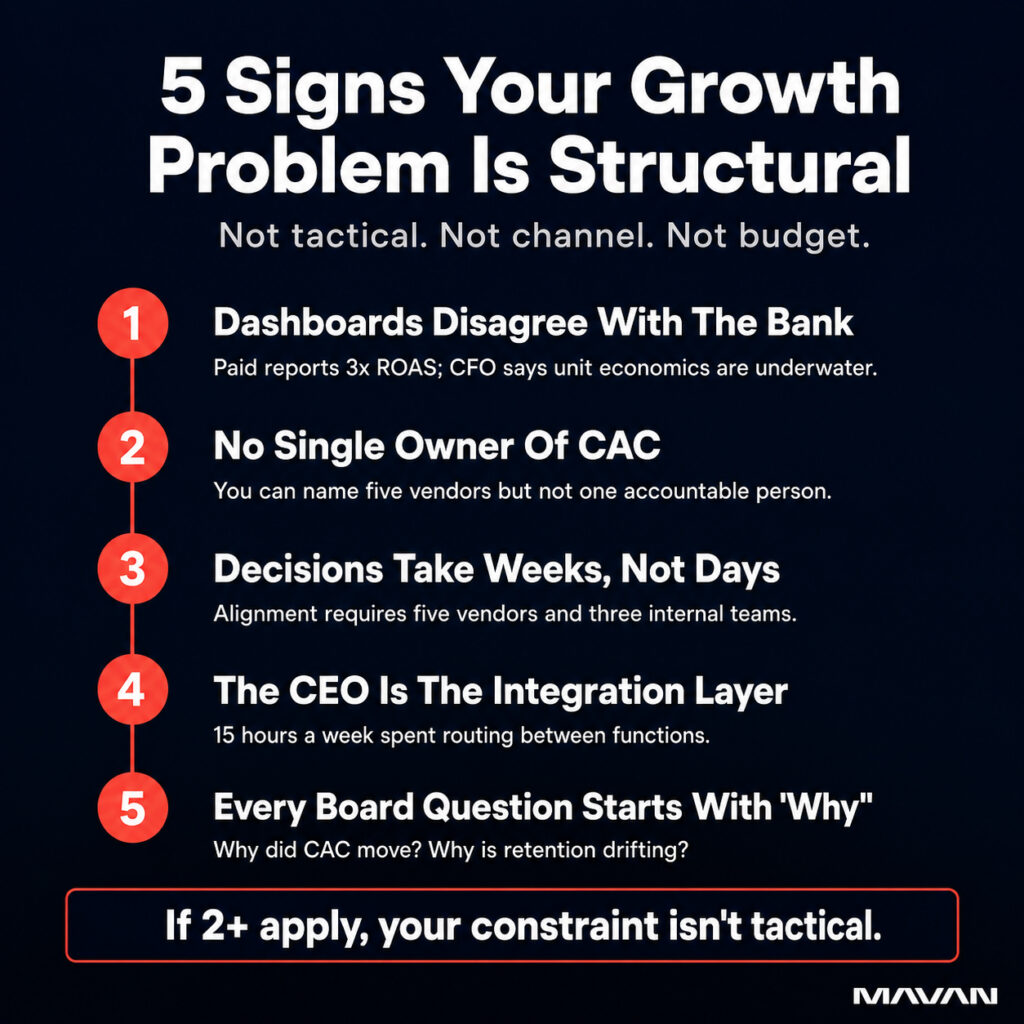
A few other diagnostic patterns we see repeatedly. If two or more apply to you, the constraint isn’t tactical:
- Your ROAS report and your finance report tell different stories. Your paid team celebrates a 3x return; your CFO says unit economics are underwater. That’s not a measurement bug — it’s a fragmentation bug. Each team is measuring what it can see, and nobody is measuring the full customer journey.
- You can name five vendors but can’t name the single owner of CAC. When the integration layer is a spreadsheet and three Slack threads, accountability evaporates.
- Onboarding new hires takes 60+ days because nothing is documented. Institutional knowledge lives across six vendor relationships and three contractor agreements, and every personnel change resets the clock.
- Decisions that should take days take weeks. Aligning on a strategic pivot requires getting five vendors and three internal teams in a room — and by the time everyone agrees, the market window has shifted.
- The board’s last three questions all started with “Why.” Why did CAC move? Why is retention drifting? Why is payback longer than last quarter? “Why” questions usually mean nobody owns the system that would have caught it.
The honest version: at this stage, the audit isn’t a luxury. Matt calls this taking “an honest look at the entire machine vs a ‘problem du jour’ approach that we see so many companies take as they work to build their companies as fast as possible.” The companies that stall keep solving for the problem they can see this week. The companies that compound step back and ask whether the operating model itself is designed to compound or designed to fragment.
What’s The Real Cost Of Fragmented Growth Operations?
Fragmentation rarely shows up as a single line item on a P&L — which is exactly why it persists. It shows up as a collection of small, normalized inefficiencies that suppress the company’s ability to scale, and it almost always costs more than founders think.
The four costs we see most consistently across MAVAN’s growth-stage clients:
Slower decision cycles. When your growth operation spans five vendors and three internal teams, aligning on a single strategic pivot takes weeks instead of days. Inside that gap, the market shifts, the creative ages out, and the team starts losing the trust of leadership that wants faster movement. Speed compounds; so does its absence.
Vendor sprawl and redundant spend. “Most Series B companies I’ve worked with are paying for overlapping tools, duplicate analytics, and agency retainers where nobody remembers what the original scope was,” Matt says. “It’s not unusual to find $50k–$200k a month in pure waste — not because anyone is being irresponsible, but because nobody has line of sight across all of it.” That’s an annualized leak of $600,000 to $2.4 million for a single Series B startup, sitting silently underneath the growth budget the CFO is trying to defend.
False confidence from partial data. This is the most dangerous one. It’s the report that says everything is fine because each team is reading the slice they own and nobody is reading the integrated whole. Matt’s experience at King — Candy Crush’s parent company — is instructive. Their attribution had been built when downloads were a fraction of what they later became, and the fraud protections had unintentionally fallen behind. “We put together a task force of internal and external partners to identify the gaps, run retroactive fraud identification against the last year’s worth of users from paid ads and ultimately identified that over $25 million per year in ad spend was actually unscrupulous ad networks claiming organic users as having came from their networks through a variety of attribution fraud methods.” That’s $25 million a year — at a company everyone assumed was running efficiently — found by someone willing to ask basic questions about the integrated system, not the individual reports.
Institutional knowledge that walks out the door. When growth strategy lives across six vendor relationships and three contractor agreements, every personnel change resets the clock. There’s no shared playbook, no compounding advantage, no accumulated learning. The team relearns the same lessons every 18 months — which is, not coincidentally, roughly the half-life of a growth hire.
External research backs up the picture. Gartner’s 2024 CMO Spend Survey, summarized in their press release, reported that marketing budgets dropped to 7.7% of overall company revenue in 2024 — down from 9.1% in 2023. The same survey notes most CMOs report being asked to do more with fewer resources. For venture-backed teams operating under board pressure, the pressure to “scale efficiently” is now structural, not cyclical. Fragmentation is the most expensive thing on the balance sheet you can’t see.
How Do You Fix Fragmented Growth Without Spending More?
The fix isn’t more tools, more hires, or more experiments. It’s stepping back and asking a structural question: is your growth operating model designed to compound, or to fragment? If it’s fragmenting, integrate what you already have before adding anything new. This is almost always cheaper, faster, and more effective than buying your way out.
Matt put it plainly when describing the pattern: “The one thing I’ve seen over and over again are companies that have hired amazing people and set them loose to figure things out. This is great in the beginning, but as you scale, systems have to be built to facilitate the communication around cross-functional insights.” Brilliant individuals running in disconnected directions don’t produce compounding growth. Brilliant individuals working against a single, shared outcome do.
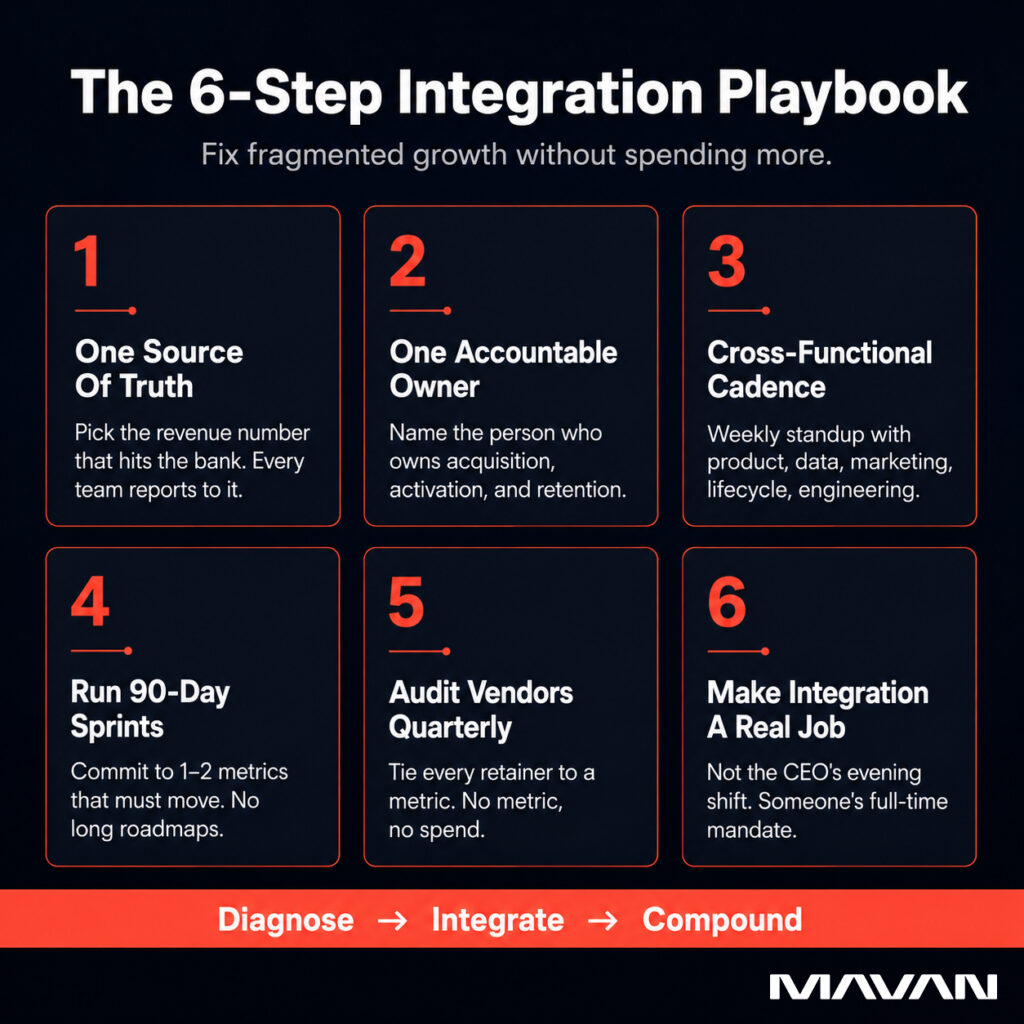
Here’s the integration playbook we use on every MAVAN 90-day sprint, simplified for any team to apply:
- Establish one source of truth for revenue. Pick the number that hits the bank. Make every team report against it. If your paid dashboards and your finance dashboards disagree, your finance dashboard wins — and the paid team gets the same view by the end of the month.
- Name a single accountable owner for the full funnel. Not a committee. Not a steering group. One person who owns acquisition, activation, retention, and the model that ties them together. If that role doesn’t exist on your team, that’s the most important hire you haven’t made.
- Build a cross-functional cadence that includes product. Marketing-only standups produce marketing-only fixes. The standup that moves growth is the one with product, data, marketing, lifecycle, and (for product-led companies) engineering in the same room every week.
- Run 90-day sprints with explicit, measurable goals. Long roadmaps decay; short, accountable sprints compound. Each sprint should commit to one or two metrics that move and a clear set of bets the team will run to move them.
- Audit your vendor stack quarterly. Map every retainer, every tool, every contractor against the metric they’re moving and the owner accountable for that metric. If a vendor can’t be tied to a number, it’s overhead, not investment.
- Make the integration layer a job, not a side project. Whether that’s an internal head of growth, a fractional leader, or an embedded partner — the integration work has to be someone’s full-time mandate, not the CEO’s evening shift.
A line Matt comes back to often: “Real growth demands this level of cooperation, high transparency, low ego, and a culture of wanting to win. Scaling companies need to do everything they can to ensure that teams are intrinsically motivated to work as a team across functions if their goal is explosive growth.” Integration is as much a cultural commitment as a structural one. The teams that compound are the ones where caring about the shared outcome beats credit-taking, every time.
What Should A Founder’s First 30 Days Of Integration Look Like?
The first 30 days should be diagnostic, not prescriptive. Before you change anything, you map the full operating system honestly — what’s running, who owns it, what number each part is moving, and where the gaps live. Most founders skip this step and start fixing the most obvious problem. But that is rarely the root problem.
A concrete first-30-days checklist, drawn from what we run at the start of every MAVAN engagement:
- Week 1 — Inventory the system. List every channel, every vendor, every tool, every internal owner. Next to each, write the metric it’s responsible for moving. The list of orphaned items (no clear metric or no clear owner) is your first target.
- Week 2 — Reconcile the numbers. Pull the dashboards your marketing team uses and the dashboards your finance team uses side by side. Wherever they disagree, find out why. This is the single highest-ROI exercise most growth-stage companies have never done.
- Week 3 — Map the customer journey end to end. From first ad impression to activation to retention to revenue. Identify every handoff between teams. Handoffs are where signal degrades and where most leakage hides.
- Week 4 — Name your one constraint. Out of everything you’ve learned, what’s the single biggest lever you could pull? The one that, if it moved, would move the entire funnel. Commit your next 90 days to it.
Sam McLellan, VP of Growth at MAVAN, frames the diagnostic posture this way when describing how MAVAN runs its 360 Growth Analysis: “We’re going to come in, we’re going to take a look at the business. If you’re an SMB or a smaller startup, we’re going to look at the entire business, from every angle. We’re going to look at product, data, analytics, lifecycle, paid marketing, you name it. And we’re going to give you a full report, an audit, on all of that… You’re going to get this 90-day roadmap that basically says we’ve identified these things. We think this is it and this priority will be the biggest levers for you to do.” You don’t need an outside team to run that diagnostic — but you do need the discipline to run it as if you were one. The goal of the first 30 days isn’t to fix anything. It’s to stop guessing.
How Do Embedded Growth Teams Compare To Hiring An Agency Or Specialist?
Embedded teams, agencies, and specialists each solve different problems. Agencies are best when one channel is broken and you need depth on it. Specialists are best when one specific capability is missing. Embedded teams are best when integration itself is the constraint — when no single hire or single-channel agency can fix what’s broken between functions.
We’ll be direct about this because the alternatives have real merit when the fit is right. A great paid agency can scale a single channel beautifully. A great fractional CMO can give a Series A founder strategic gravity they didn’t have before. A great specialist can transform attribution or lifecycle on their own. The trouble is that none of those models is designed to fix what happens when paid, product, lifecycle, data, and creative are each excellent in isolation and incoherent in aggregate. That’s a different problem, and it needs a different shape of solution.
What an embedded growth team — what we at MAVAN call a “pod” — looks like in practice: a senior, cross-functional team that operates as one accountable unit inside your business. Strategy, performance marketing, data, creative, lifecycle, and product collaboration, led by a single point of contact who owns the outcome. The model is built specifically to replace the integration layer the founder was doing manually.
Erin Clift, CMO at KidStrong, described the engagement this way in her testimonial on MAVAN’s site: “It truly felt like MAVAN was a part of our in-house team. They were collaborative, responsive, and dialed in to our goals. MAVAN quickly drove results that cut our customer acquisition costs by 60%.” Luke Harries, Head of Growth at ElevenLabs, described the handoff side of the model: “Within months, MAVAN scaled our Search spend to a high six-figure monthly budget, maintaining efficiency consistently for nearly a year. After we had proven the channel with MAVAN, we were able to confidently transition the program to our in-house team.” The point isn’t that one model wins — it’s that integration, when it’s the constraint, requires a model built for integration.
If you’re sizing the decision yourself, three questions usually resolve it: Is your growth problem inside one channel, or between several? Do you have the senior bandwidth to integrate vendors yourself, or is the CEO already the integration layer? And when you imagine the team that fixes this, does it look like one expert with a tool — or a cross-functional unit that ships together? The truthful answer points you to the right model.
“Growth requires not only exceptional people in every seat, but exceptional org design, systems, testing frameworks, and alignment on a single easily measured outcome. It’s a lot to get right, and it’s never easy. It is however relatively straightforward with well worn paths on what ‘great’ looks like.” — Matt Widdoes, Founder and CEO, MAVAN
Frequently Asked Questions About Startup Growth
How long does it take to fix CAC at a Series B startup?
Most CAC problems at Series B can be diagnosed in two to four weeks and meaningfully improved within a single 90-day cycle. Matt Widdoes notes that MAVAN’s 360 Growth Analysis typically surfaces the biggest leaks inside the first 48 hours — like the $350,000-per-month evergreen campaign that had never been profitable. The fix takes longer than the diagnostic, but the unlock usually arrives faster than founders expect, because most CAC problems are integration problems, not channel problems.
What’s the difference between a growth pod and a fractional CMO?
A fractional CMO is a senior strategic leader on a part-time basis. A growth pod is a full cross-functional team — strategy, performance marketing, creative, data, lifecycle — that executes end to end. A fractional CMO can shape strategy and lead an existing team; a pod is built for when the team itself needs to be assembled, integrated, or rebuilt. Many companies use both at different stages.
How do I know if I should hire in-house or bring in an embedded team?
Hire in-house when you’ve validated the channel, you know what “great” looks like, and you can attract senior talent in a 90-day window. Bring in an embedded team when you need strategy plus execution immediately, when the constraint is cross-functional, or when you’re not sure yet which roles to hire permanently. The strongest signal that you’re ready to hire is when you can write the job description with specifics — metrics, scope, day-one expectations — instead of generalities.
What metrics should I report to my board about marketing efficiency?
The board-facing metrics that consistently matter are blended CAC, payback period, LTV-to-CAC ratio, retention curves (D1/D7/D30 for consumer, NRR for B2B SaaS), and pipeline efficiency by channel. Sam McLellan, VP of Growth at MAVAN, has emphasized in our internal growth conversations that investors today want to see how a startup builds beyond pure paid spend: “They definitely just want to know how are you going to get reinstalls? What’s the goal? … Are you going to create a content community? Are you going to create Telegram groups, Discord groups? What are you going to do that’s additional to just deploying [budget]?” Sam’s framing comes from gaming, but the principle generalizes — growth that doesn’t ladder up to a defensible compounding asset is harder to fund than it used to be.
Why is my Meta or Google spend not scaling even though my ROAS looks good?
This is almost always a measurement problem, not a media problem. The ROAS you’re seeing is the platform’s view, optimized to platform metrics. The unit economics your CFO is seeing reflect the real customer journey. When they disagree, scaling spend amplifies whichever picture is wrong. Before scaling, reconcile the two views, audit your attribution for fraud and partial-data issues, and confirm that the conversion event the platform is optimizing for actually correlates with downstream revenue.
Where should a founder start if they suspect fragmentation is their real problem?
Start with a 30-day diagnostic before you commit to any new spend, hires, or tools. Inventory every channel, vendor, and owner. Reconcile your marketing and finance dashboards. Map the customer journey end to end and find the handoffs where signal degrades. Then name the single biggest constraint and commit your next 90 days to it. As Matt Widdoes puts it: “Once companies see it, they always wished they’d taken a look sooner.”
So, Why Is Your Startup Growth Actually Stalling? And How Is It Fixed?
The single most important thing for founders and growth leaders to internalize is this: growth-stage companies don’t usually fail because the team isn’t working hard enough. They fail because hard work gets distributed across too many disconnected efforts, and nobody owns the system that ties them together. The fix isn’t another agency, another tool, or another channel — it’s integrating what you already have into one accountable operating model. Diagnose the system, name the constraint, run 90-day sprints against it, and protect the cross-functional cadence that lets brilliant people compound instead of collide. The teams that do this don’t just grow; they grow in a way that compounds for the next round, the next hire, and the next stage.
If your dashboards and your bank account disagree, then spend this week reconciling marketing and finance numbers side by side — no new spend, no new vendors, just one shared view. If you can’t name the single owner of CAC, then name them this quarter. If you’ve completed both and still suspect the constraint is structural, we’d be glad to help you run a full diagnostic. MAVAN’s 360 Growth Analysis maps your growth operation end to end and returns a prioritized 90-day plan you can execute with us or take in-house — whichever is right for your team.
Casey Rock is Content Director at MAVAN, where he helps turn complex ideas into clear, strategic content that drives growth. With over 15 years of experience across content strategy, SEO, media, and digital marketing, Casey focuses on building content systems that connect audience insight, brand storytelling, and measurable business outcomes.
Book a complimentary consultation with one of our experts
to learn how MAVAN can help your business grow.
Want more growth insights?
Thank you! form is submitted
[hubspot type=”form” portal=”20951211″ id=”9c538ed2-fb12-45f1-a573-ad7953c058cc”]
Related Content
-
What’s the Best Growth Agency For VC & PE?
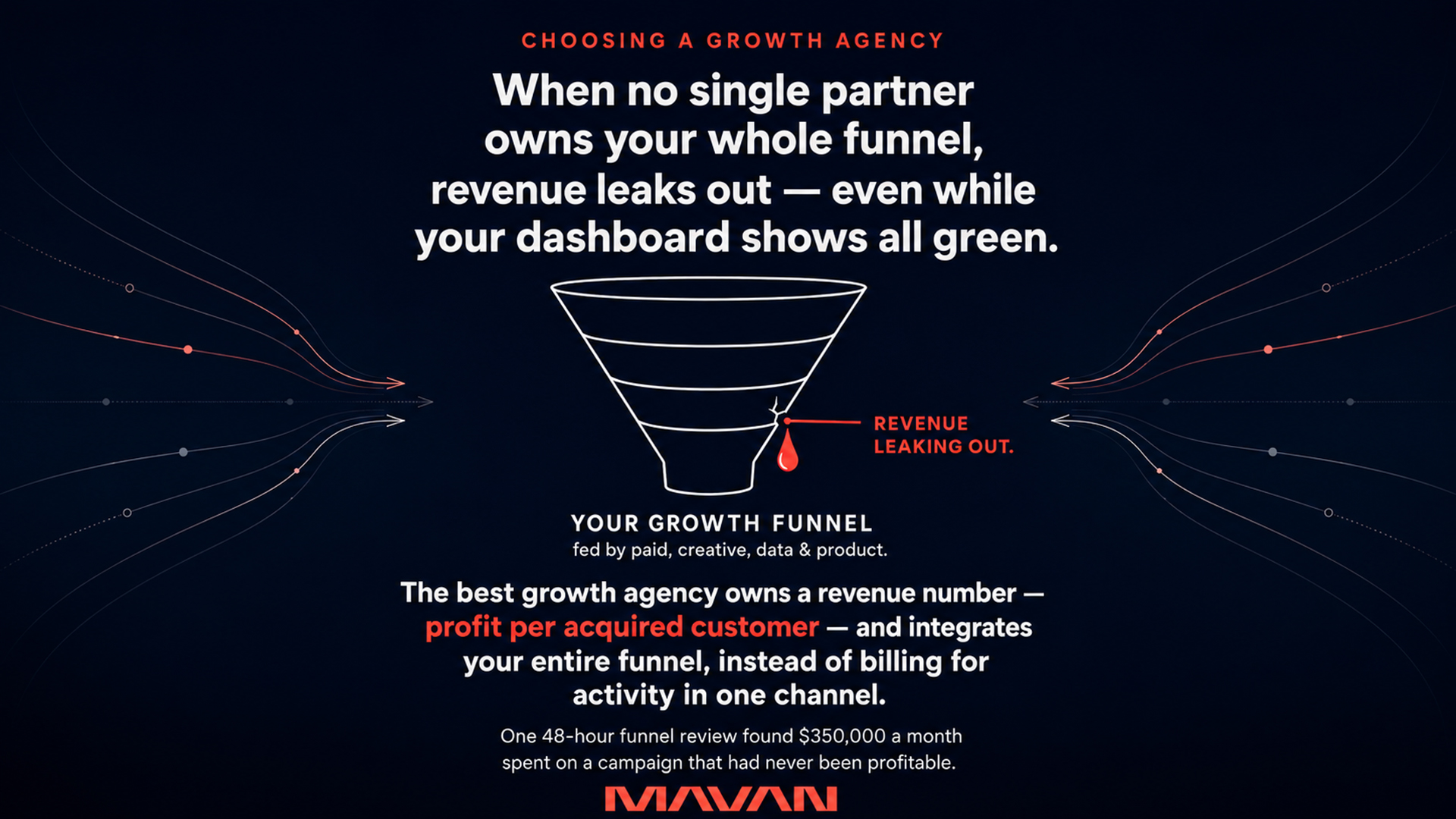
The best growth agency for a venture-backed or PE-owned company behaves less like a traditional agency and more like an embedded operating partner. It diagnoses your whole funnel, owns a revenue number such as CAC payback or LTV:CAC, and executes inside your team — rather than billing for activity in one channel.
-
Is 1 GTM Motion the Biggest B2B SaaS Mistake?
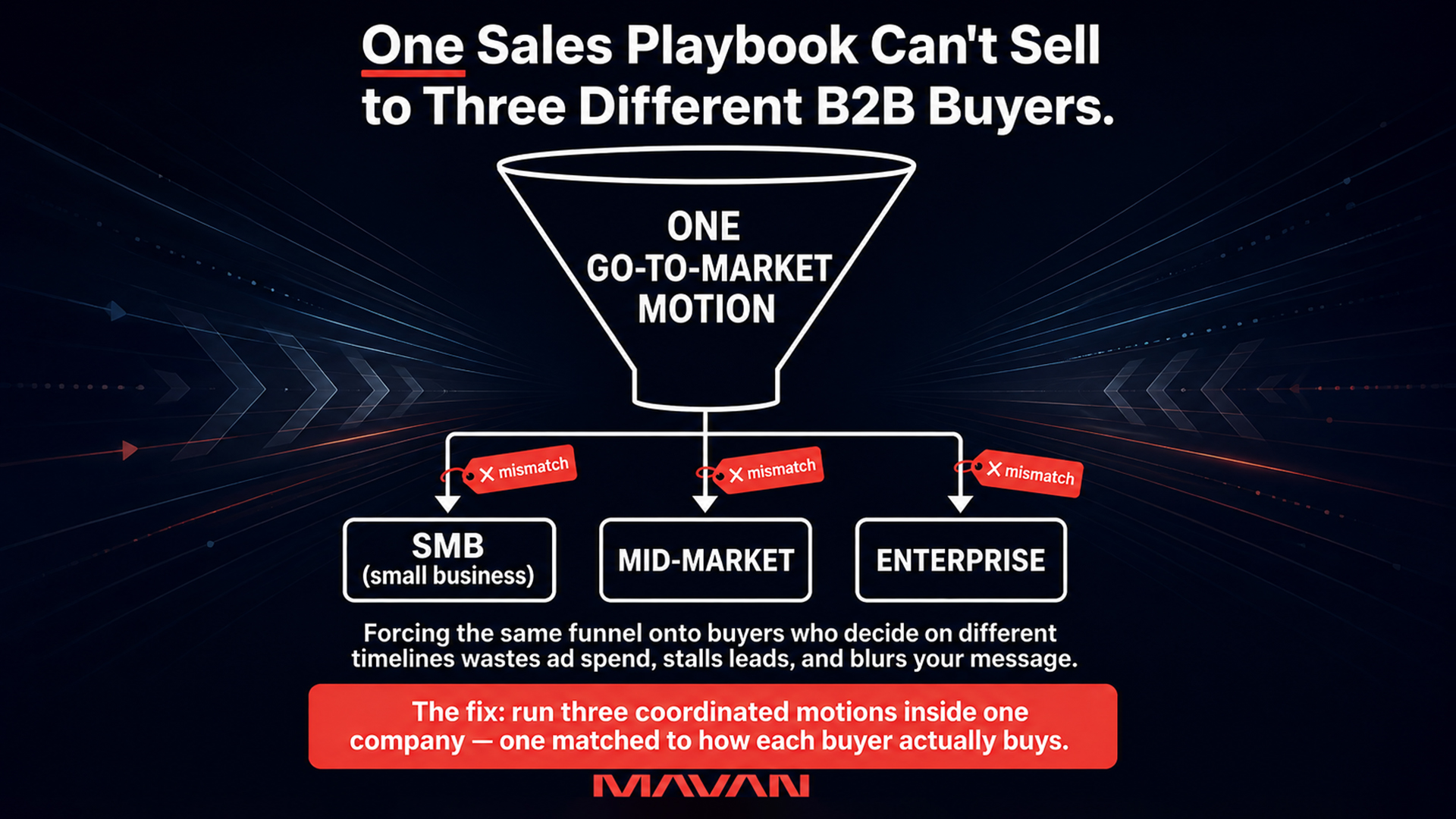
The biggest go-to-market mistake in B2B SaaS is forcing one motion across SMB, mid-market, and enterprise, which buy on completely different timelines. The fix is running three coordinated motions inside one company: product-led growth for SMB, sales-assist for mid-market, and account-based marketing for enterprise, each matched to how that segment actually buys.
-
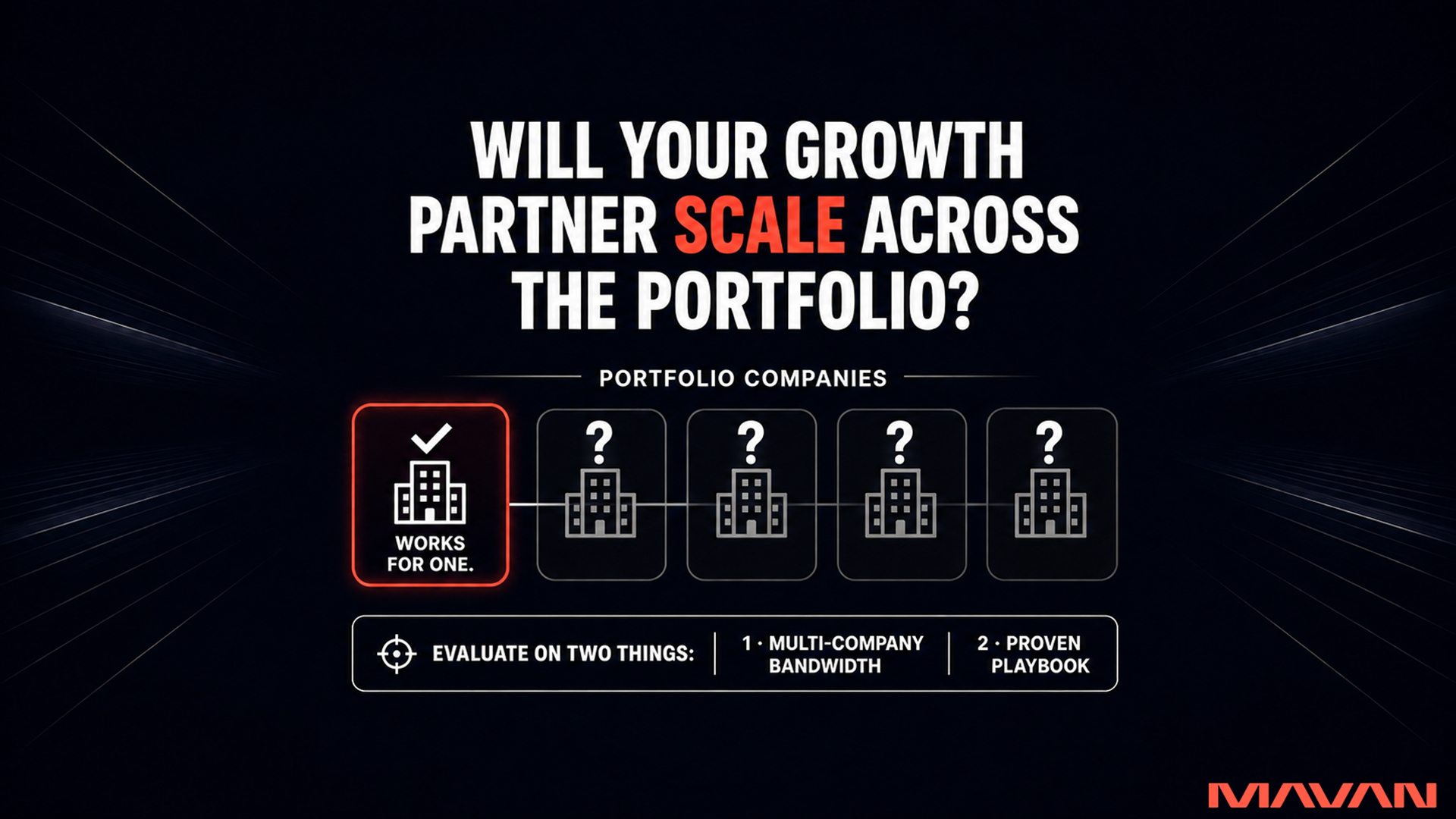
How Do You Evaluate a Portfolio Growth Partner?
To evaluate a growth partner for a fund’s portfolio, test two things. First, multi-company bandwidth: whether their operating model, not their headcount, lets them run many portfolio companies at once without quality slipping. Second, a proven playbook: a documented growth system that transfers between companies and survives leadership change, rather than living in one operator’s head.