
The fastest-scaling B2B SaaS companies are adopting measurement and experimentation disciplines from mobile gaming — including granular multi-touch attribution, ICP-segmented CAC tracking, and systematic creative testing. Companies that close that gap now are building compounding advantages that won’t be easy to replicate later.
TLDR — The 10 Most Important B2B SaaS Growth Lessons
- The fastest-scaling B2B SaaS companies win on measurement precision, not bigger budgets.
- If you can’t narrate every funnel step from first ad to closed contract, you’re not measuring — you’re guessing.
- “Frankenstein” attribution stacks silently inflate CAC and destroy board credibility at scale.
- A lump CAC number is a reporting metric; CAC broken down by ICP and channel is a decision tool.
- Hiring one growth exec without support is an expensive constraint — not a growth system.
- PLG, sales-assist, and ABM aren’t competing strategies; they’re segment-matched motions that should run simultaneously.
- A real experimentation program runs continuously, tracks results to closed revenue, and reserves a budget line for testing every month.
- Marketing budgets have dropped to 7.7% of revenue (Gartner, 2024) — measurement discipline is how you do more with less.
- Before you scale spend, get every team reading from the same data — misaligned dashboards cost as much as misallocated budget.
- If your growth system has any of these gaps, request a MAVAN Blueprint → and get a full 360° audit plus a 90-day roadmap in 30 days.
Your board just asked what your CAC payback period looks like by channel. You pull up your dashboard — a patchwork of Salesforce reports, ad platform exports, and a Google Sheet someone built two years ago — and you know the answer is technically in there. Somewhere. You give a number. It’s not wrong. But it’s not the full picture, either. And somewhere in that gap between “technically correct” and “genuinely understood,” a meaningful slice of your marketing budget is evaporating without a trace.
This is the moment most B2B SaaS growth teams are living in right now — and it’s the exact moment MAVAN was built to address.
We’ve spent years embedding with venture-backed SaaS companies at the inflection point where founder-led go-to-market stops being enough. What we keep finding is that the companies scaling fastest right now aren’t spending more — they’re measuring more precisely. And the blueprint for that precision has been sitting in mobile gaming for over a decade.
Why Do Gaming Teams Measure Growth Differently Than SaaS Teams?
Gaming teams developed their measurement discipline because they had no choice. When mobile gaming took off alongside Apple’s IDFA — a device-level identifier that let marketers target specific individuals on their phones — the entire industry had to build granular, user-level attribution from day one. SaaS developed in a different world: web-based, cookie-reliant, and structurally more forgiving of loose measurement. The result is that two industries solving similar problems — acquire users profitably and keep them — ended up with radically different measurement cultures.
Sam McLellan, VP of Growth at MAVAN, has lived on both sides of that divide. With a career spanning Zynga, Take-Two, and Kabam before transitioning to B2B SaaS, he describes the discipline gap plainly: “You’d be surprised the number of companies — even billion-dollar companies — that just don’t know the full funnel of their onboarding to a potential customer. From the very first touch, they look at the ad platform and then they just kind of say, came out the other end and we got 12% of interest. That’s not how this kind of works.”
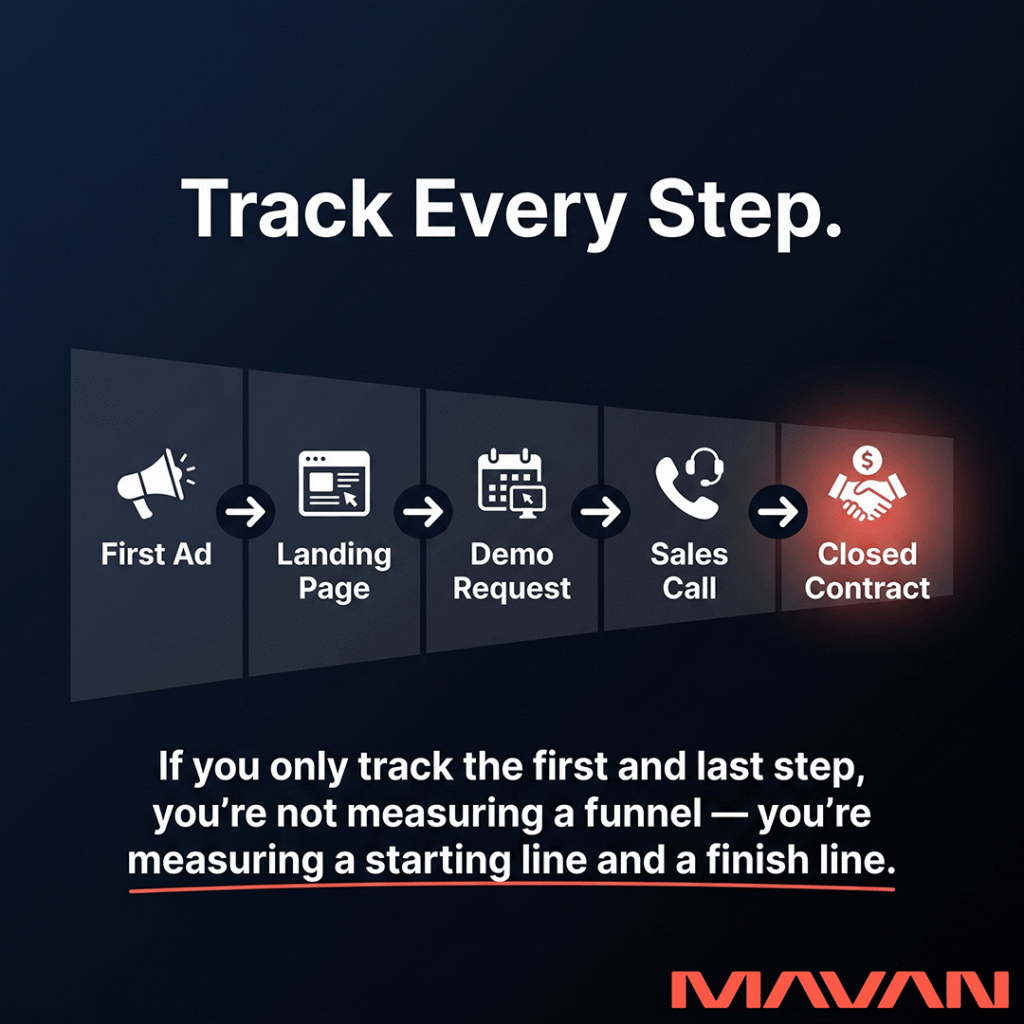
In gaming, tracking every step of the user journey — from first ad impression to revenue — is not a best practice. It is an operational requirement. Every click, every landing page view, every drop-off point is documented and mapped. That granularity is what lets gaming teams bid confidently, cut losing campaigns fast, and reallocate budget toward the users who actually drive revenue. The same rigor, applied to B2B SaaS funnels, produces identical results: faster decisions, fewer blind spots, and a clear line from spend to contract.
The first thing we recommend to any SaaS growth team — at any stage — is to audit your ability to tell the full story. Not just first touch and closed won, but every meaningful interaction between them: ad click to landing page, landing page to demo request, demo request to sales conversation, conversation to signed contract. If you cannot narrate that journey cohesively, you are not measuring a funnel. You are measuring a starting line and a finish line, and hoping the race in between went well.
What Is the Frankenstein Attribution Problem — and What Does It Actually Cost You?
The Frankenstein attribution problem is what happens when a company builds its measurement stack piece by piece, under resource pressure, over several years — ending up with a system that sort of works, but doesn’t really hold together. Think of it as a creature with five arms and no legs: every part was a reasonable decision in the moment, but taken together, it can’t walk anywhere useful.
Sam McLellan, VP of Growth at MAVAN, describes the pattern precisely: “As companies grow — especially founder-led ones — you just kind of build stuff as you need it. The engineering resources are scarce. Resources in general are scarce. You might have a creature now that has five arms and no legs, where we’ve built a thing and it worked — but now we actually have to take a step back and figure out how to make an efficient growth machine that is scalable.”
The most common version we encounter has some demos attributed to first touch, others to last touch, and a handful that fell entirely outside the attribution window because a Calendly integration broke six months ago and nobody noticed. When this kind of Frankenstein system gets exposed to serious budget — say, an eight- or nine-figure raise with a significant marketing allocation — the cracks become craters. You are deploying real capital into a system that cannot tell you where it went.
The cost is not just misallocated spend. It’s invisible CAC inflation — your acquisition costs appear higher than they are in some channels and lower in others, because the underlying data is inconsistent. It’s also a board credibility problem: the question you cannot confidently answer is the one they will keep asking. As Sam notes: “You go out there and raise eight, nine figures, a large expectation of that goes toward marketing — you’re going to run into some real problems really quickly if the Frankensteined system is still underneath.”
Fixing it is a three-part process:
- Audit your touchpoints. Map every place a prospect interacts with your brand — ads, content, landing pages, emails, sales calls — and identify what is tracked, what is tracked inconsistently, and what is invisible. Incomplete visibility into campaign performance leads directly to higher CAC and an inability to understand what’s actually driving LTV.
- Standardize your attribution model. Pick one approach — time-decay, position-based, or data-driven — and apply it consistently across all channels. You can evolve later. Inconsistency is worse than imperfection. Sam’s perspective: “No attribution system is great — all of them are pretty flawed. But that’s working with the mindset that if it’s all flawed, you have to take certain assumptions as truth and then work within that framework.”
- Connect the full revenue journey. Your attribution system needs to follow the prospect all the way to closed revenue — not just to MQL or demo booked. Until that connection exists, CAC is an estimate and payback period is a guess.
Dive deeper into broken B2B SaaS attribution and how to fix it.
How Do You Calculate CAC Properly — and Why Does the ICP Breakdown Matter So Much?
Calculating CAC — your customer acquisition cost, or the total spend required to win one new customer — is something most B2B SaaS companies do. Calculating it in a way that actually drives decisions is something far fewer do. Most companies report it as a single number: total marketing spend divided by total new customers acquired. That number is technically accurate and strategically almost useless.
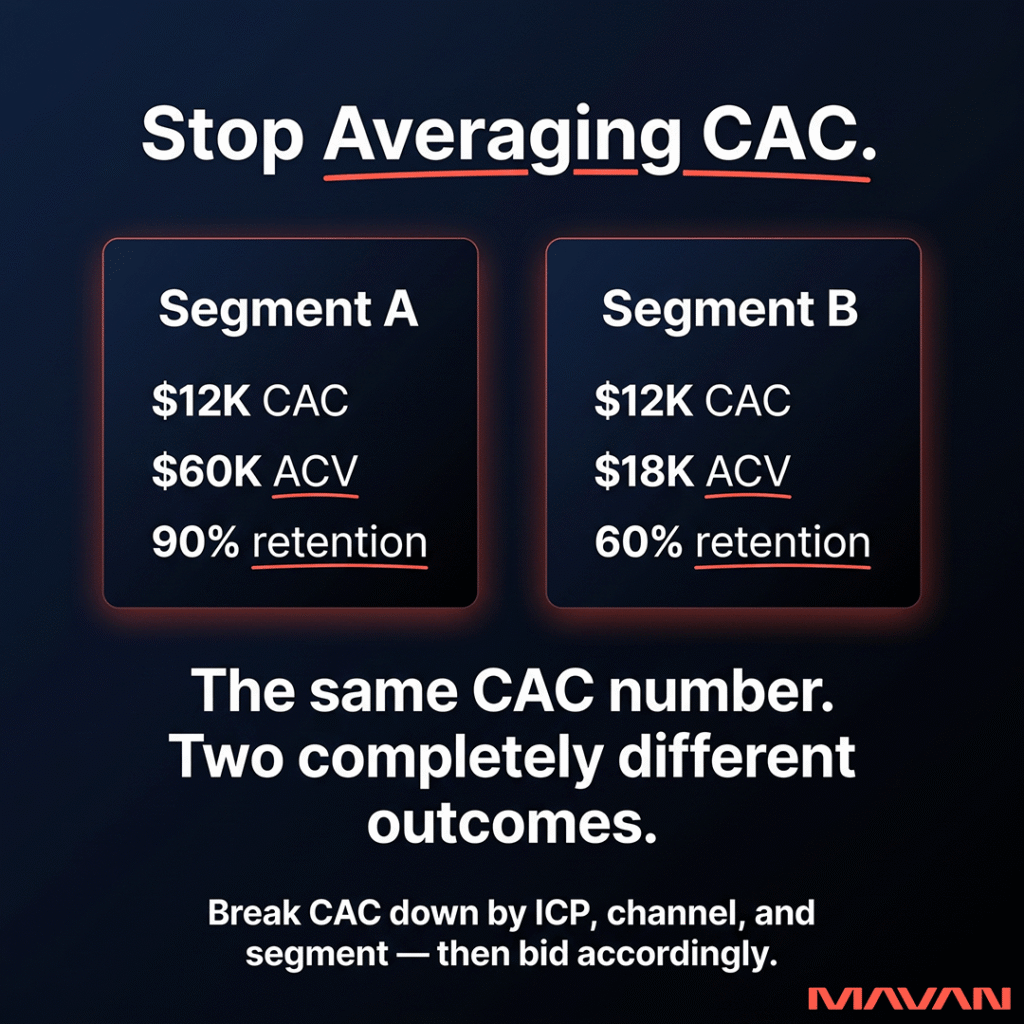
Sam McLellan, VP of Growth at MAVAN, puts it directly: “When you look at what’s your CAC and they’re like, ‘I just looked at the first number and divided by the last number.’ Yeah, I mean, that’s true. That’s a very rudimentary way of doing that. But you haven’t broken it up by ICP, you haven’t broken it up by campaign or platform. There’s a whole bunch of stuff that goes on there where they like to look at a lump number.”
Breaking CAC down by ICP — your ideal customer profile, meaning the specific type of company and buyer most likely to close and remain a customer — is what transforms a reporting metric into a decision-making tool. A $12,000 CAC that produces customers with $60,000 ACV and 90% retention is not the same business as a $12,000 CAC that produces $18,000 ACV customers with 60% first-year churn. Averaged together, those numbers tell you nothing useful. Separated by segment, they tell you exactly where to double down and where to stop.
The gaming parallel here is precise. In mobile, a small minority of players — typically 15–20% of a game’s user base — generate 80%+ of revenue. The implication for campaign strategy is enormous: you run separate campaigns to find and bid aggressively for those high-value users, rather than averaging your bids across the entire audience. SaaS companies have the same dynamic — some customer segments are dramatically more valuable than others — but most are not running their paid programs to reflect it.
To move from lump CAC to ICP-level CAC, start here:
- Segment your closed-won customers by company size, vertical, and buyer title. Identify which segments produce your highest ACV, fastest sales cycles, and strongest retention. Those are the segments your paid campaigns should be built around.
- Pull spend and conversion data by channel for each segment, even if the data is directionally imperfect. Directional accuracy is enough to start making better decisions.
- Build separate campaign structures — with distinct creative, targeting, and landing pages — for your top two or three ICP segments. This is what lets you bid intelligently instead of blending across audiences.
- Track CAC payback period — how many months of customer revenue it takes to recoup the acquisition cost — by segment and channel. This is the metric boards understand most intuitively, because it connects marketing activity to real financial outcomes.
The goal of granular CAC tracking is not complexity for its own sake. It’s the ability to say, with confidence: “We know which dollars are working, which aren’t, and where the next dollar should go.”
What Does the Transition from Founder-Led Go-to-Market to a Real Growth System Actually Look Like?
Founder-led go-to-market is the right model for early-stage companies — the founder knows the product best, can speak to the vision with genuine conviction, and is willing to do whatever it takes to close the first customers. That emotional commitment is an asset. At some point, it becomes a ceiling.
Sam McLellan, VP of Growth at MAVAN, describes the inflection point with characteristic directness: “At very early startups, it’s about emotion — you’re leading everyone, you’ve got an idea and you’re committing to it. Now you’re at the point where either you’ve raised a significant round or your product is live and seeing traction, and you actually have to begin growing this company as if it’s an actual thing. Like not an idea anymore. It’s out there. People are engaging with it. Okay, so how are you going to get that to them and actually treat it as a mature product?”
The mistake most founders make at this moment is hiring a single growth executive and expecting that hire to solve everything. Sam speaks from experience — and from his own career arc: “There’s a very limited number of people who are both willing to do the strategy and all the execution and do the board meetings and do all the other stuff you need in the startup world. We tend to either do all the execution — that’s our world — or we’re in strategy and want to manage a team. And with startups, there’s no budget to hire a full team.” A senior growth exec without support is an expensive constraint, not a solution.
The more effective path — especially for companies at Seed through Series B — is to first understand what’s actually working in the founder-led phase, then build infrastructure around those signals before adding headcount or dramatically increasing spend. The infrastructure question is: do we know enough about our funnel, our ICP, and our channel performance to make our next dollar of marketing spend smarter than our last? If the answer is no, more budget makes the problem bigger, not better.
How Should a B2B SaaS Company Structure Its Go-to-Market Motion Across Different Segments?
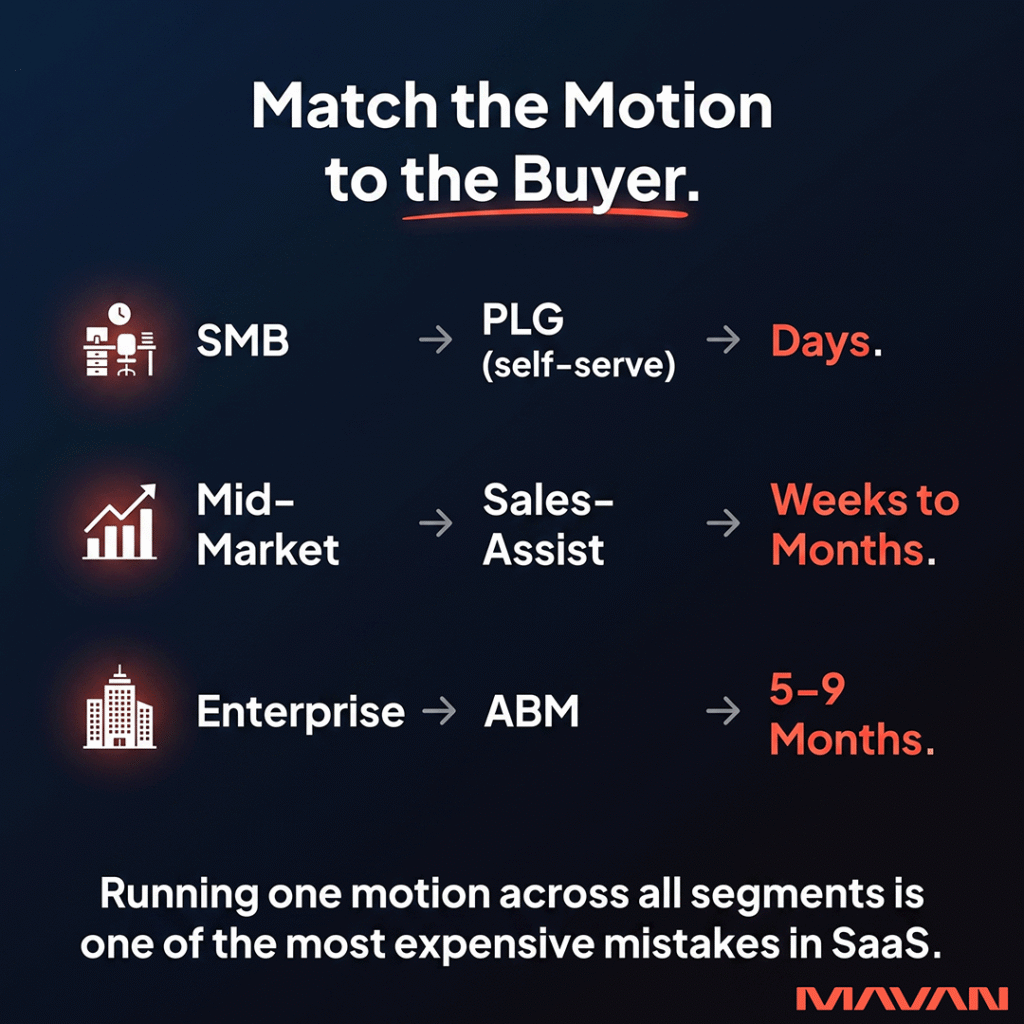
One of the most expensive mistakes in B2B SaaS is running a single go-to-market motion across all customer segments. A PLG motion — where users can sign up, experience the product, and convert without ever speaking to sales — works beautifully for some buyers and fails completely for others. The highest-leverage growth teams run multiple motions simultaneously, each matched to the right segment.
Sam McLellan, VP of Growth at MAVAN, breaks this down clearly:
For SMB (small and mid-sized business) buyers: “PLG for SMB — I think it’s essentially because SMBs are a short conversion time. You’re a small business. The decision holder is usually one or two people. There’s less scrutinizing. So you just kind of optimize your product towards converting that and offering what they need in the short term.”
For enterprise, the dynamic is fundamentally different — and the timeline reflects it: “ABM [account-based marketing — a targeted strategy focused on winning specific named accounts rather than broad audiences] is going to take a long time. You’ve got to nurture it. You’ve got to find the right messaging. It has to be absorbed by multiple touches on various platforms. You’re targeting very specific people — but it’s going to take a while.” The corporate buying cycle for a significant software decision commonly stretches five to nine months, Sam notes, because legal, security, procurement, and executive sign-off all need to happen in sequence. You are not converting a committee in two weeks.
Mid-market sits between the two — faster than enterprise, more involved than SMB — and is best served by a sales-assist motion: marketing doing the awareness and nurturing work, with sales stepping in to accelerate and close. Sam’s framing: “Your sales assist from mid-market — that’s similar to ABM, but you can remove some of the larger steps because of that corporate timeline. It’s not going to take a year to make that decision.”
The practical implication for your growth program is this: before you optimize, make sure you know which motion you’re actually running — and whether it matches the segment you’re chasing. Many B2B SaaS teams are running a slow enterprise ABM motion on prospects who could close PLG in two weeks. That mismatch costs pipeline velocity and marketing efficiency simultaneously.
What Does a Real B2B SaaS Experimentation Framework Actually Look Like?
Most B2B SaaS companies say they A/B test. Most of what they do doesn’t qualify. A one-off creative test with no hypothesis, no predetermined runtime, and no clear success metric is not an experiment — it is a coin flip with extra steps. What separates teams that learn fast from teams that stay stuck is the difference between ad hoc testing and a systematic experimentation program.
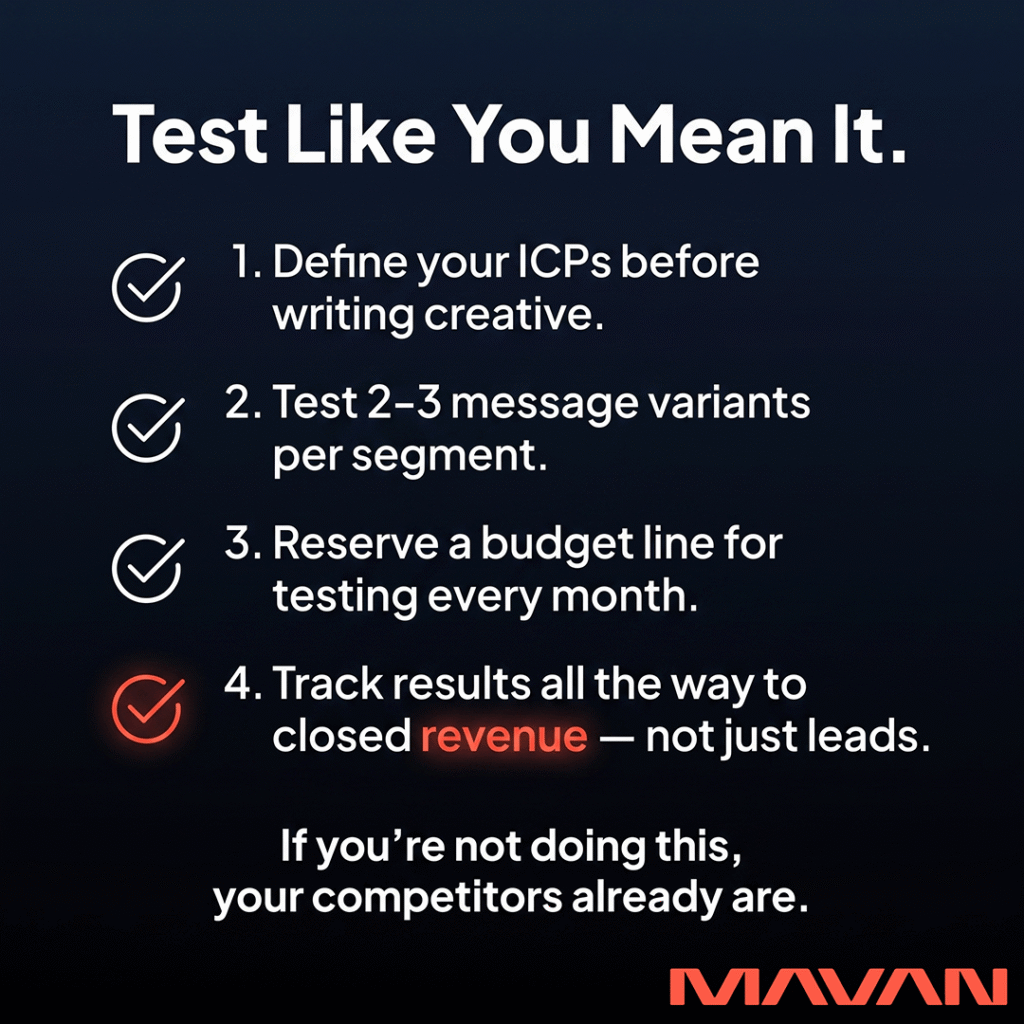
Sam McLellan, VP of Growth at MAVAN, is direct about what that looks like in practice: “If you don’t have a creative testing framework as part of your spend at any level — especially at the early levels — a percentage of your budget should be going to just testing in any given month. And if that sounds crazy, your competitors are already ahead of you. In an era where quantity of creative is one of the biggest things, you need to know what you’re making rather than just spewing random stuff out there and hoping it works. There should be a systematic, scientific process.”
The gaming industry has run continuous A/B tests as standard operating procedure for years — most mobile products of meaningful scale have an active test running at any given moment. In B2B SaaS, the obstacles are real: smaller sample sizes, longer sales cycles, and less surface area for rapid iteration. The answer is to concentrate experimentation where the feedback loop is fastest — creative and landing pages rather than pricing or core product — and to design tests with intention rather than reaction.
A minimum viable experimentation setup for B2B SaaS:
- Define ICPs before writing a single word of creative. Sam’s framework: pick two or three ICP segments, create three message variants for each, and test three different hooks per variant. That’s a real experiment matrix — not a guess. “Try specific messages and specific product features around it — three tops. That should resonate with the audiences you’re targeting.”
- Build a weekly experiment calendar. Document what is being tested, the time period it will run, what success looks like, and who owns the read-out and decision. Lack of process is how test results sit unread in a shared drive for three months.
- Track tests the full length of the sales cycle. A paid campaign might generate an MQL in week two. The contract might not close for another four months. As Sam explains: “This is the scientific systematic part — we’re going to track it all the way along. The people who were first touch here, we’re going to track that journey from first touch all the way through to closed contract.” Optimizing for lead volume and missing the revenue picture is a very easy trap to fall into.
- Make landing pages a dedicated testing surface. The ad sets an expectation. The landing page either delivers on it or breaks it. If prospects are clicking and leaving, get feedback — user surveys, recorded session replays, or direct conversations. Sam has literally stopped people on the street in San Francisco to get immediate reactions to a mobile game. The principle scales: nothing replaces talking to actual users.
What Happens in the First 30 Days When MAVAN Embeds with a B2B SaaS Company?
The first 30 days are not about execution. They’re about clarity — and getting to the truth of what’s actually happening across every function before recommending a single thing.
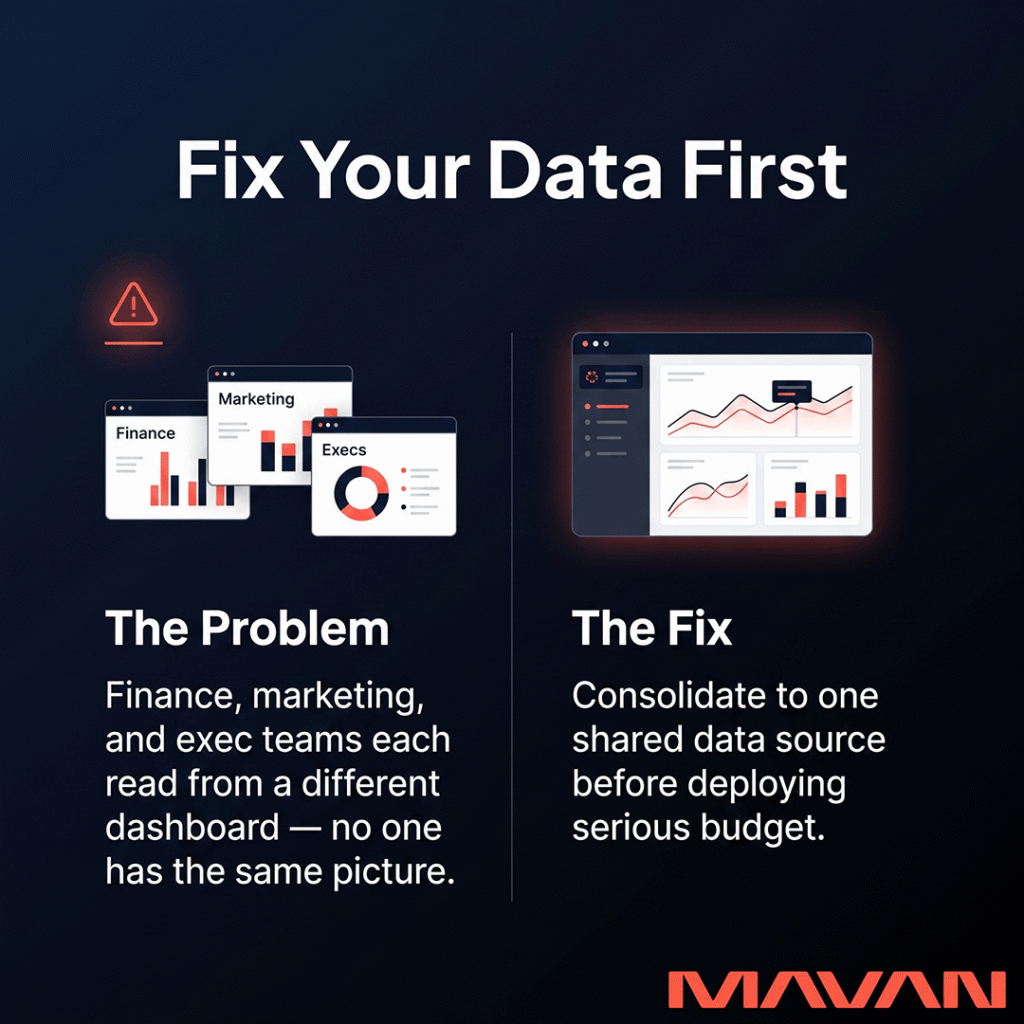
Sam McLellan, VP of Growth at MAVAN, describes the philosophy behind the 360° audit: “Growth isn’t one specific thing — it’s a system that sits above all of these individual silos that normally don’t talk to each other. Product tends to do its own thing. Marketing does its own thing. Finance does its own thing. We come in and look at how the company is conducting itself from a full 360 view: paid marketing, lifecycle and CRM, data health, attribution systems, and what does the data look like from across the company.”
One of the most common findings at that stage is that no two teams are working from the same numbers. Finance is cutting the data differently from how marketing reads it — both are different from what the executive team is seeing. As Sam describes it: “No one actually has the same image or picture of what’s going on here.” Getting everyone to the same dashboard is, in many cases, itself a transformative outcome.
The deliverable from the 30-day audit is a prioritized, executable roadmap. It can get substantial — Sam describes handing one recent client an 84-page document: “That’s your encyclopedia of your current state of the business. You’re going to get all of it: an executable roadmap with what the conclusion is. And after all of it, you get a 90-day roadmap that basically says — we’ve identified these things, we think this is the priority, these are the biggest levers. You can do it yourself.”
Some clients take that roadmap and execute independently. Others ask MAVAN to run it. Both outcomes are designed as successes — the goal of the audit is not dependency. It is clarity and capability. That includes access to MAVAN’s analytics platform, Nexus, which is included for six months following the Blueprint so clients can track their own progress against the plan. Every audit is also staffed with genuine subject matter experts — as Sam explains: “We paid over 150 different freelancers last year who are all essentially the top 1% performers we’ve known in our lifetime. If it’s UX, it’s a person who’s done UX for Apple. If it’s product, it’s people who’ve done product at Zynga or Airbnb.”
The fastest measurable improvement we typically find in the first two weeks is in paid media — either a clear case for reallocation toward what’s working, or a clear case for pausing spend until the infrastructure is ready to support it. Both of those calls have real value. As Sam puts it: “We can come in and pretty quickly make an impact there. It may just be saying, don’t spend the money yet — you’re not ready. Which is a pretty big impact, both on the incoming [pipeline] and on saving the money for when you’re ready to make a big move.”
FAQ: What B2B SaaS Growth Leaders Ask About Building a Scalable Growth System
What is multi-touch attribution in B2B SaaS, and why does it matter?
Multi-touch attribution tracks every marketing interaction a prospect has before becoming a customer — not just the first or last. It matters in B2B SaaS because buying cycles commonly span five to nine months and involve many touchpoints across ads, content, email, and sales calls. Without it, you’re crediting one interaction for a decision that took twenty — and allocating budget based on an incomplete story.
How do you calculate CAC by channel in B2B SaaS?
Assign each closed customer to the marketing channels they interacted with during their journey, using a consistent attribution model. Then divide total channel spend by the number of customers attributed to it. In B2B SaaS, the channel that drives first awareness is often different from the channel that drives conversion — which is why multi-touch models produce more actionable data than first-touch or last-touch alone.
When should a B2B SaaS company use PLG vs. a sales-led go-to-market motion?
Product-led growth works best for SMB buyers where decision authority is concentrated in one or two people and the sales cycle is short. Sales-led motions — including ABM for enterprise and sales-assist for mid-market — are better suited to buyers who need relationship, education, and organizational process before committing. Most B2B SaaS companies serving multiple segments need both motions running simultaneously, matched to the right ICP.
How do you run A/B tests in B2B SaaS when sample sizes are small and sales cycles are long?
Focus experimentation on the surfaces with the fastest feedback loops: ad creative and landing pages. Run structured tests with defined ICP segments, message variants, and creative hooks — and track results all the way to closed revenue, not just lead submission. Build the sales cycle’s lag time into your experiment timelines. The goal is directional confidence, not statistical perfection on small samples.
How much should a B2B SaaS company spend on marketing?
Marketing budgets across B2B companies dropped to 7.7% of revenue in 2024, down from 9.1% in 2023, according to Gartner research — and most marketing leaders report being asked to do more with less. The more important question isn’t the percentage: it’s whether your current spend is deployed within a measurement environment capable of telling you what’s working. A focused $500K budget consistently outperforms an unfocused $2M budget.
What does a B2B SaaS growth audit include?
A rigorous growth audit covers paid marketing performance, lifecycle and CRM programs, data health and attribution infrastructure, product-marketing alignment, and how the company is reporting on KPIs across functions. The output is a prioritized roadmap — distinguishing immediate opportunities from medium-term work — that can be executed by the internal team or with external support.
So What Does a Real B2B SaaS Growth System Look Like?
A real B2B SaaS growth system is not a single hire, a channel preference, or an ambitious budget line. It is a connected infrastructure — attribution that tracks the full funnel, CAC segmented by ICP and channel, go-to-market motions matched to segment stage, and an experimentation program running continuously — where every dollar of spend is more informed than the last. The companies building this infrastructure now are creating compounding advantages their competitors will struggle to explain, because the output looks like growth efficiency and the mechanism is measurement discipline. The gaming industry built this playbook over a decade. B2B SaaS is in the early innings of adopting it — and the window to get ahead is still wide open.
Ready to See Exactly Where Your Growth System Stands?
If your board is asking for CAC by channel and the honest answer is “our data doesn’t support that yet” — then the right first move is a 360° audit, not more spend. Understanding what’s actually happening across your funnel, your ICPs, and your channels is what makes the next dollar of investment defensible.
If you’ve raised a meaningful round and need to go from founder-led go-to-market to a real growth system in 90 days — then MAVAN’s Blueprint gives you a full 360° audit of your business, a prioritized action plan, and a 90-day roadmap built by practitioners who’ve done this at companies like ElevenLabs, Fireflies, and Titan — including six months of access to our analytics platform, Nexus, at no additional cost.
You can execute the roadmap yourself. You can bring us along for the build. Either way, you’ll know exactly where you stand and exactly where to go.
Casey Rock is Content Director at MAVAN, where he helps turn complex ideas into clear, strategic content that drives growth. With over 15 years of experience across content strategy, SEO, media, and digital marketing, Casey focuses on building content systems that connect audience insight, brand storytelling, and measurable business outcomes.
Book a complimentary consultation with one of our experts
to learn how MAVAN can help your business grow.
Want more growth insights?
Thank you! form is submitted
[hubspot type=”form” portal=”20951211″ id=”9c538ed2-fb12-45f1-a573-ad7953c058cc”]
Related Content
-
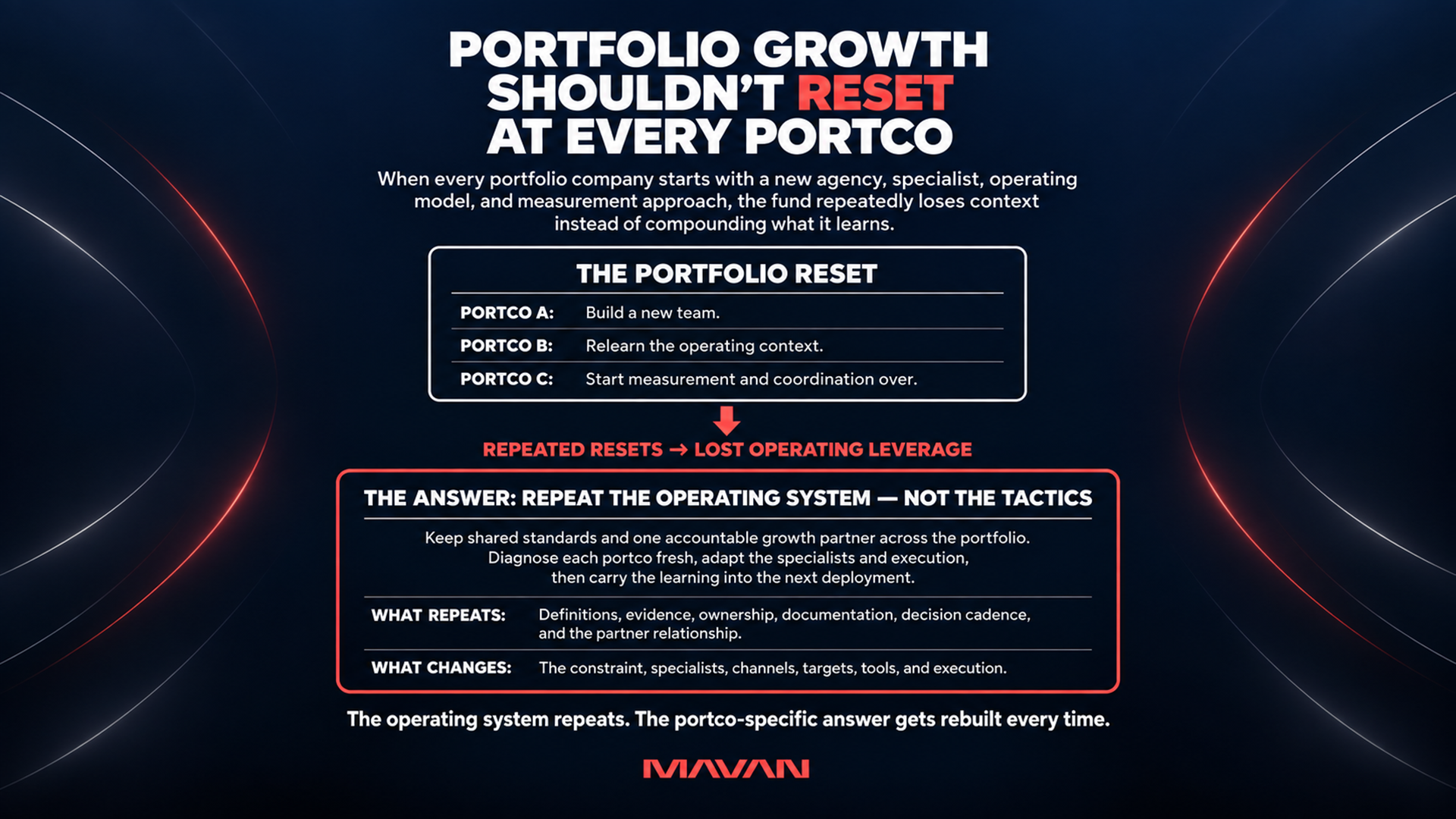
How Can Private Equity Funds Repeat Growth Across Portfolio Companies?
Growth becomes repeatable across a VC or PE portfolio when the fund installs one operating system instead of referring each company to a different specialist. The system has three parts: a single source of truth every team trusts, a board-ready scoreboard of ten to twelve metrics, and an embedded pod that diagnoses the real constraint in ninety days before anyone spends more.
-
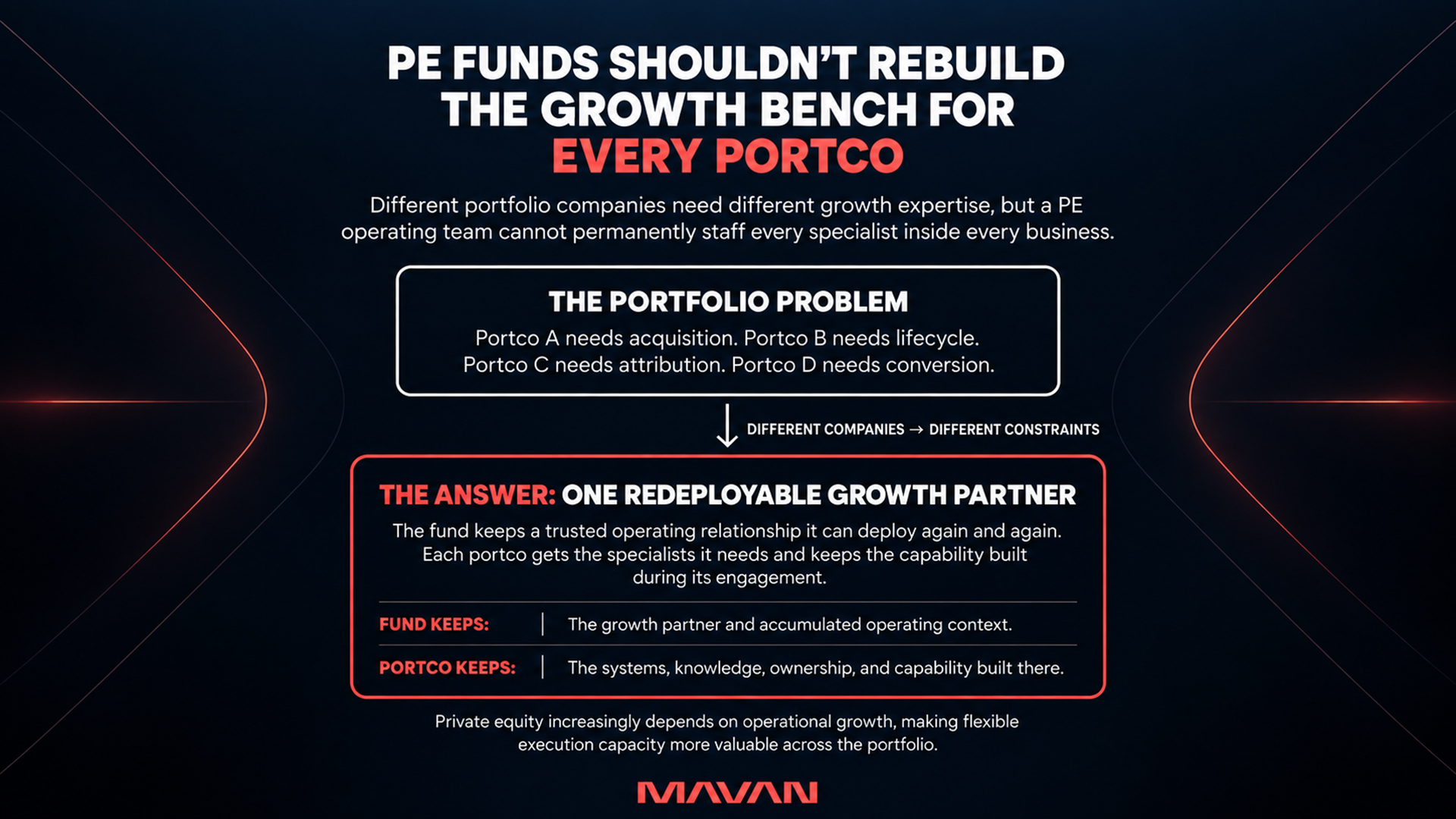
What Do PE Funds Want From a Portfolio Growth Partner? Repeatability!
What funds actually want from a portfolio growth partner is repeatability — a portable growth operating system that produces comparable results across very different portfolio companies. Repeatability shows up as a single source of truth, a board-grade scoreboard, a 90-day sprint, and a clean handoff, so each win compounds across the portfolio instead of staying at one company.
-
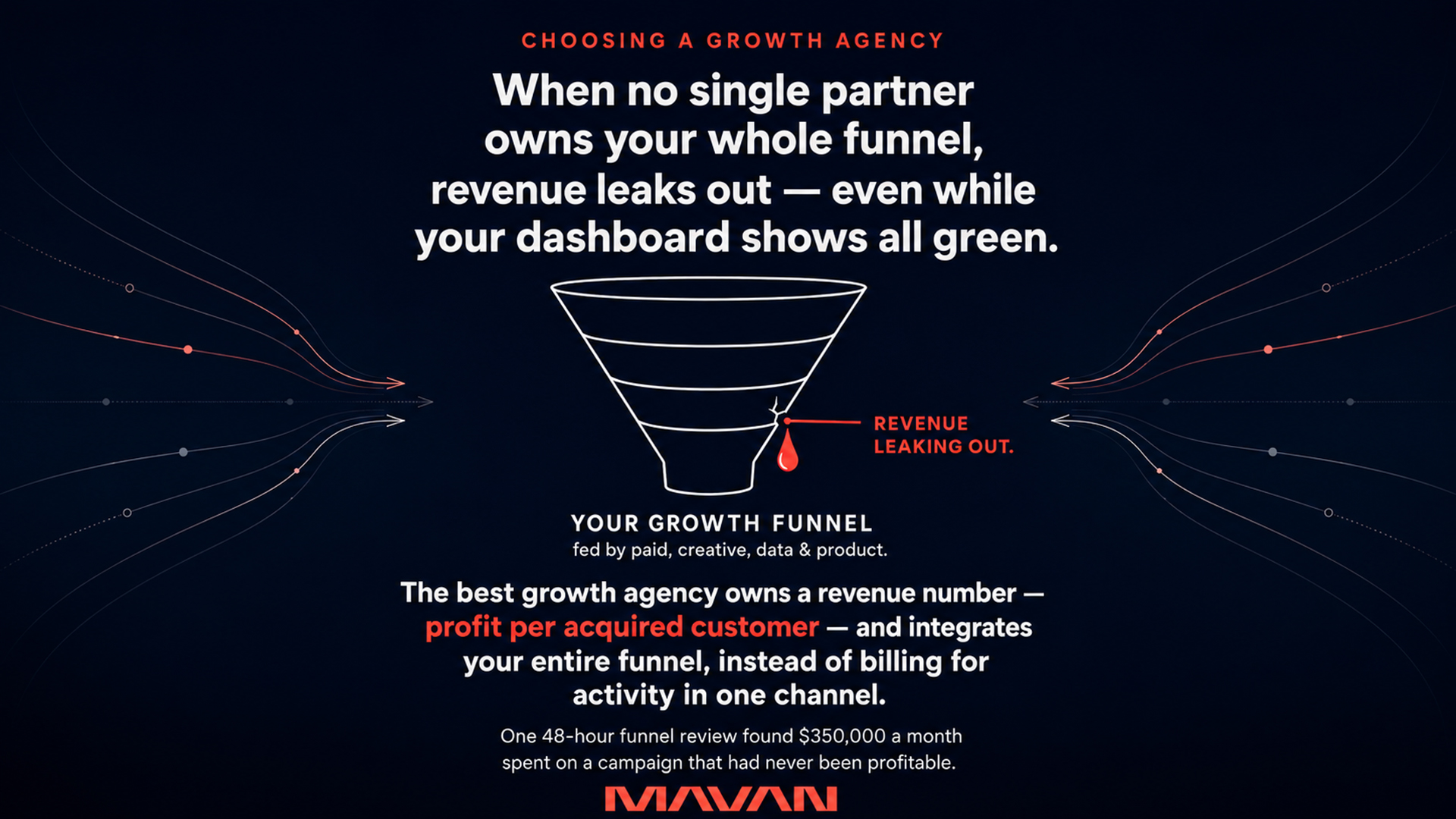
What’s the Best Growth Agency For VC & PE?
The best growth agency for a venture-backed or PE-owned company behaves less like a traditional agency and more like an embedded operating partner. It diagnoses your whole funnel, owns a revenue number such as CAC payback or LTV:CAC, and executes inside your team — rather than billing for activity in one channel.