
The biggest go-to-market mistake in B2B SaaS is forcing one motion across SMB, mid-market, and enterprise, which buy on completely different timelines. The fix is running three coordinated motions inside one company: product-led growth for SMB, sales-assist for mid-market, and account-based marketing for enterprise, each matched to how that segment actually buys.
TLDR — The 10 Most Critical GTM Lessons For B2B SaaS
- One GTM motion can’t serve SMB, mid-market, and enterprise — they buy on different clocks.
- SMB decides in days. Mid-market in months. Enterprise in a year-plus with a full committee.
- Run three coordinated motions: PLG for SMB, sales-assist for mid-market, ABM for enterprise.
- Give each motion its own optimization event, matched to that buyer’s reality.
- PLG doubles as an intelligence engine that feeds your mid-market and enterprise messaging.
- Optimize toward signals near revenue — front-funnel metrics lie in isolation.
- You get about three seconds to hook a buyer; twenty features reads as noise.
- Lead with aspiration — “you’re doing great, here’s how to do five times better.”
- Segment pipeline by real buying timeline, not by the deal-size field in your CRM.
- Suspect one funnel is doing three jobs? Check out our 360 Analysis or see all our growth services.
The Hidden Cost Of Running One GTM Motion Against Three Different Buyers
A two-person startup, a 400-person mid-market org, and a Fortune 500 procurement team just hit the same landing page, ran through the same email sequence, and got scored by the same qualification rule. The SMB paid by Thursday. The enterprise buyer is nine months from a signature. The mid-market lead is sitting in a drawer because nobody can agree whose job it is to close it. That isn’t a creative problem or a bidding problem. That is one motion stretched across three different businesses — and it’s one of the most expensive patterns we see across B2B SaaS right now.
Everyone talks about product-led growth as if it were the only motion that matters. It is not. According to Sam McLellan, VP of Growth at MAVAN, the real unlock is not picking one motion — it is running three coordinated motions inside the same company, matched to the way each segment actually buys. This article walks through how to do that without tripling your team, starting with how the timelines and decision structures differ, and ending with the messaging and signal choices that separate the motions that convert from the ones that look busy but don’t move revenue.
What Is The Biggest Go-To-Market Mistake B2B SaaS Companies Make?
The biggest mistake is forcing one go-to-market motion — usually product-led growth — across SMB, mid-market, and enterprise buyers who decide on completely different timelines. A single funnel treats three decision structures as one, flattening your customer acquisition cost, your messaging, and your pipeline quality at the same time.
Sam McLellan, VP of Growth at MAVAN, frames the distinction clearly: “PLG for SMB is essentially because SMBs are a short conversion time,” he says. “You’re a small business. The decision holder is usually one or two people, maybe tops, and it’s much smaller budget. So there’s less scrutinizing and all this kind of worry on the SMB side of things.” That short path is what makes product-led growth work — a user signs up, hits value fast, and pays with a credit card. Try that motion on an enterprise deal and you get a free-trial signup from a senior director who cannot actually sign a contract, attached to a procurement process that will take months.
The cost of the mismatch is rarely itemized on a dashboard, but it shows up in three places: wasted paid-media spend chasing enterprise logos through SMB-optimized funnels, sales-qualified leads that stall because nobody nurtured the buying committee, and messaging that gets so generic trying to reach everyone that it lands with nobody. Gartner’s B2B Buying Report notes that enterprise buying groups average five to eleven stakeholders across about five business functions — and that organizational change is the dominant driver of those purchases. One funnel, one message, one follow-up cadence cannot speak to five functions. This is why the companies we audit most often are spending more than they need to be, on fewer deals than they should be closing.
Key Terms: The GTM Vocabulary, in Plain Language
Before we dive in too deep, here are terms used throughout the article that are worth knowing.
- Product-Led Growth (PLG)
- A go-to-market motion where the product itself drives acquisition and conversion — users sign up, reach value, and pay, usually in days, with little or no sales contact. It fits low-scrutiny SMB buyers and short decision cycles.
- Sales-Assist
- A thin human layer added on top of PLG for deals the product can’t close alone. A rep steps in when a product-qualified lead crosses a mid-market threshold, handling security review, contracting, and committee alignment that self-serve can’t.
- Account-Based Marketing (ABM)
- A distinct enterprise motion that targets a named list of high-value accounts with coordinated, multi-touch campaigns over months or quarters. It nurtures a large buying committee rather than converting a single self-serve user.
- Product-Qualified Lead (PQL)
- A user whose in-product behavior — activation, seat growth, feature usage — signals readiness for a sales conversation. PQLs are the trigger that routes a self-serve account into the sales-assist motion at the right moment.
- Signal Density
- The volume of an optimization event, close enough to revenue, that ad platforms need to learn effectively. Thin signal spread across many channels teaches the algorithm nothing; concentrated signal on one event lets it optimize.
Why Can’t One GTM Motion Serve SMB, Mid-Market, and Enterprise?
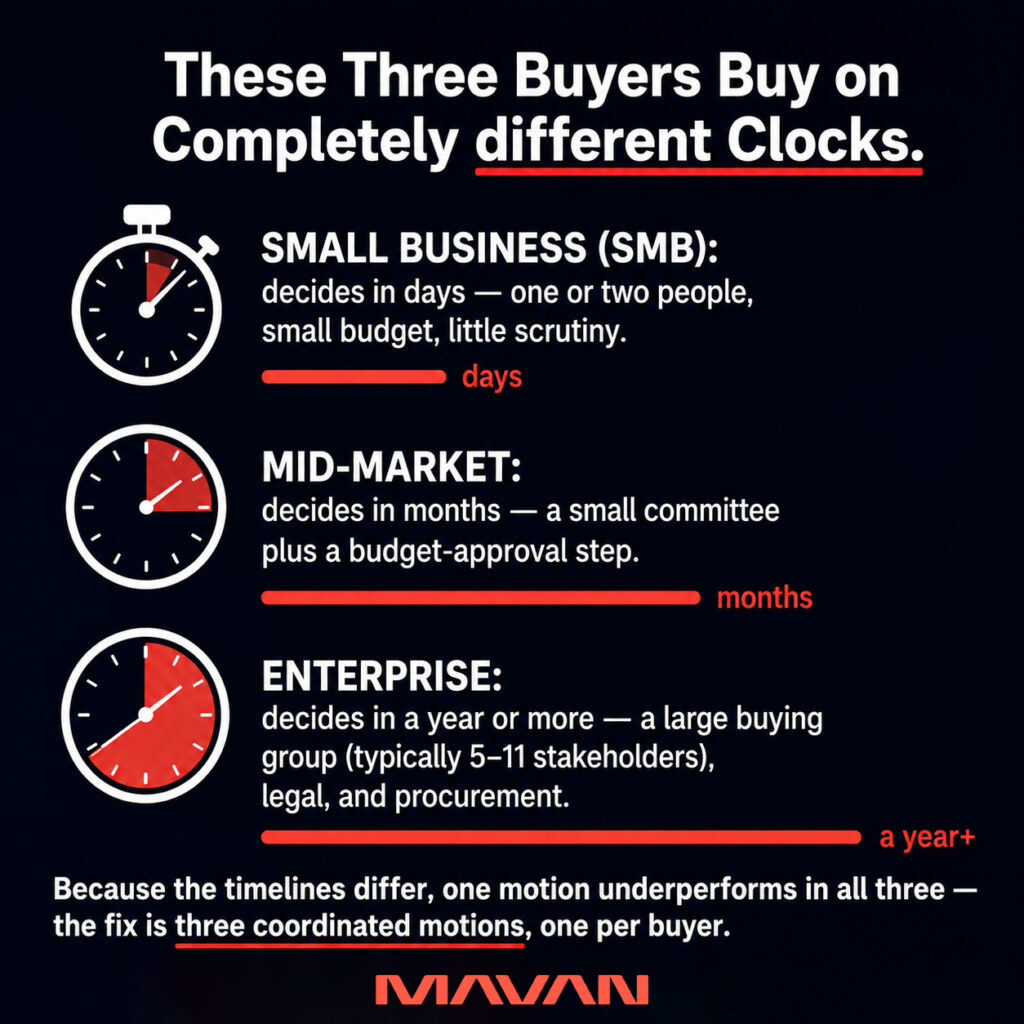
Because the three segments differ structurally in decision timeline, buying committee size, and budget scrutiny. SMB buys in days with one or two decision makers. Mid-market takes months with a small committee. Enterprise takes a year or more with a large committee, legal, and procurement. One motion ignores those realities and underperforms in all three.
Gartner’s 2026 sales survey found that 67% of B2B buyers now prefer a rep-free buying experience — up from 61% a year earlier — and 70% want a fully digital, self-service path. The same body of research shows buyers still pull a seller in for the contextual work — deciding whether a product actually fits their company — and that fully self-serve purchases on complex deals are far more likely to end in purchase regret. Gartner’s Robert Blaisdell put it plainly: buyers “still turn to sales reps to validate” the decision at the moments that matter.
That’s the entire case for three motions in a single line. Let self-serve own what self-serve is good at — the SMB path and the top of every funnel — and add a human layer exactly where the buyer wants one: the mid-market committee and the enterprise account weighing a year-long commitment. Rep-free is where buyers start. It’s not where complex deals close.
Sam McLellan, VP of Growth at MAVAN, lays out the timeline math: “ABM, that’s going to take a long time. You’ve got to nurture it. You’ve got to find the right messaging. You’ve got to have them and get that messaging out there, filter it through, and it has to be absorbed by multiple touches on various ads and various platforms.” He continues: “You’re targeting very specific people with it, but it’s going to take a while for you to actually get those folks hooked unless you have something that’s absolutely pure gold.” Mid-market is the same shape, compressed. “It’s not going to take a year for a mid-market company to make that decision. Might take months, but it’s not going to take as long as it will where you’re going to have to go through all this stuff. Very large corporations move pretty slowly because they can.”
The Three Segments at a Glance
| Segment | How They Actually Buy | Motion + Optimization Event |
| SMB | Days. One or two decision makers, small budget, low scrutiny. | PLG. Optimize to activation plus a paid upgrade. |
| Mid-Market | Months. A small committee and a budget-approval step. | Sales-assist. Optimize to a qualified meeting held. |
| Enterprise | A year or more. 5–11 stakeholders, legal, and procurement. | ABM. Optimize to multi-stakeholder account engagement. |
What Breaks When You Stack Three Motions Into One Campaign
Each segment needs its own optimization event, its own messaging ladder, and its own budget rhythm. An SMB motion optimizes toward product activation — onboarding finished, first invoice sent, a teammate invited — because that event predicts payment inside days. A mid-market motion optimizes toward a sales-qualified meeting with a champion who holds budget authority, because that champion becomes your internal seller. An enterprise motion optimizes toward multi-stakeholder engagement across an account — the VP grabs the white paper, the director joins the webinar, procurement visits the pricing page — because no single action moves that deal.
Try to stack all of that into one campaign structure and three things break at once. The ad platforms can’t reach the signal threshold they need to optimize, so they spend without learning. The sales team can’t tell which leads to chase, so good ones cool off. And the buyer can’t tell what the product is for, because the message was built to fit everyone. Everybody pays for that confusion — the finance team most of all.
How Do You Actually Structure PLG, Sales-Assist, And ABM Inside The Same Company?
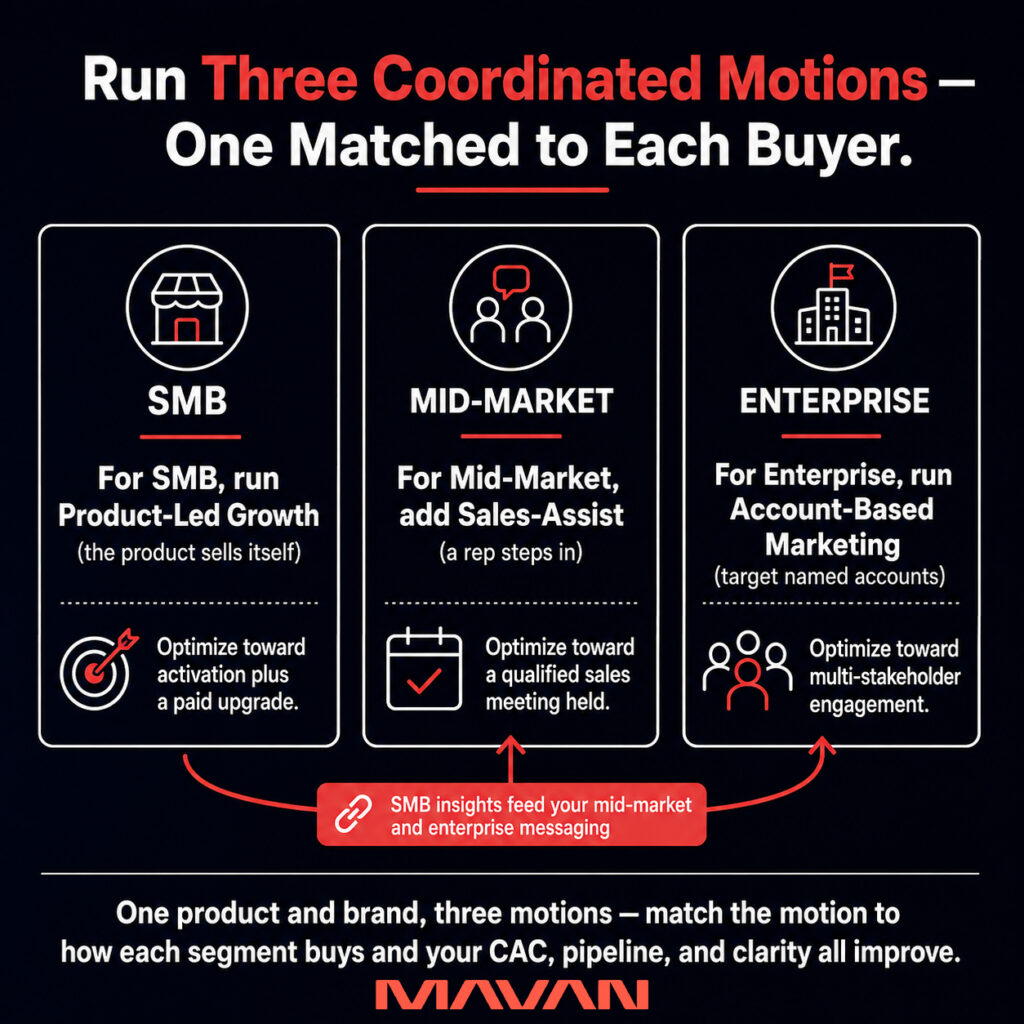
Run product-led growth as the default for SMB, layer a thin sales-assist motion over mid-market deals that self-identify inside the product, and run account-based marketing as a separate program for your named enterprise accounts. All three share one product and brand but use different qualification logic, messaging, and pacing.
Here’s the operating model McLellan describes, translated into three moves you can start this quarter:
- Make PLG the foundation for SMB. Tune your product and onboarding to convert self-serve users fast, and read in-product signals — activation events, invited teammates, upgrade triggers. Point paid acquisition at bottom-funnel search and high-intent social, with credit-card-friendly landing pages built for a short consideration window.
- Layer sales-assist over mid-market. Watch for product-qualified leads that match a mid-market firmographic — company size, domain, seat count — and route them to a human the moment they cross a threshold. The product handled the top of the funnel; sales closes the gap self-serve can’t: security review, custom contracting, and alignment across a small committee.
- Run ABM as a separate enterprise program. This is not a faster PLG. It’s a distinct motion with its own target-account list, content engine, and tempo. What you learn from SMB becomes the raw material for enterprise: “what the SMBs need is also what enterprise is going to need to a degree, but you have time to gather that from your SMBs and then begin building this sort of additional layers of enterprise stuff on top of it,” McLellan says.
The elegance is that PLG earns its keep twice — once as a motion, and again as an intelligence engine for the other two. Your SMB customers tell you which jobs-to-be-done resonate, which features drive stickiness, which onboarding paths convert. Every one of those signals feeds the mid-market message and the enterprise narrative. The mistake is treating PLG, sales-assist, and ABM as rival strategies competing for budget. They’re layers of one growth system, each matched to a different buying reality.
Which Conversion Signals Actually Predict Revenue?
The signals closest to money predict revenue: completed purchases, paid upgrades, qualified meetings held, and multi-stakeholder account engagement. The signals that look promising but often don’t convert are top-of-funnel metrics in isolation — free-trial starts, email opens, click-through rates — when they aren’t traced to a revenue event further down the funnel.
Sam learned this the hard way on a subscription product he ran. “Free trials were off the charts. 40% of incoming traffic was starting a free trial, if not higher. And at the time that was considered much higher than our other products. And then we saw that when it actually came to that 30-day mark after the free trial, 85% of that was just not actually factoring out. And so it was actually hugely unprofitable to run this stuff because the ultimate revenue number just wasn’t there. All the frontline metrics said ‘grow,’ the last thing said ‘no.’” The team had to rebuild the optimization strategy around a later event and shorten the trial window from thirty days to fourteen, then to seven, to accelerate the decision signal.
How to Give Each Motion Enough Signal to Learn From
The fix is in signal density — making sure the event you optimize toward has enough volume and is close enough to real revenue that ad platforms can actually learn from it. For SMB, that might be activation plus a paid upgrade inside seven days. For mid-market, it is a sales-qualified meeting with a decision-capable contact. For enterprise, it is multi-stakeholder engagement across a target account over a quarter. If your budget is small, consolidate channels until your signal density is strong enough on one. “If you’re just on Google, that’s all fine. That’s a great place to start,” Sam notes. Then expand. The failure mode we see most often is teams diversifying across five channels on a small budget, collecting a thin trickle of signals everywhere, and learning nothing anywhere.
A practical check: pull your last ninety days of marketing-qualified leads and trace each one to a revenue outcome. If the ratio of MQL to closed revenue is wildly different across segments — and it almost always is — your optimization event is probably wrong for at least one of them. Fix that before you touch creative.
Why Does Feature-Heavy Messaging Fail In B2B SaaS Ads?
Feature-heavy messaging fails because most paid surfaces give you roughly three seconds to hook someone, and twenty features in three seconds registers as noise. Often the long list is a targeting problem in disguise: the team hasn’t decided who the buyer is, so the ad does market research instead of driving conversion.
Sam has seen this pattern across MAVAN’s audit work, and his diagnosis is blunt. “A lot of companies, especially when you’re in that ecosystem, it’s really hard to determine what’s the best thing we’re doing. ‘We do like 20 different things.’ That’s great. Amazing. What’s the best one you do? And they’re like, ‘Well, it’s these five.’ It’s like, ‘Well, I asked you what was the best one.’” The reason the list keeps growing, he explains, is often not a creative problem — it is a targeting problem dressed up as a creative one. “The other side of that is that they’ve put everything in there because they don’t know who the target audience is. So they’re like, ‘We’ll figure it out. Tell them all about us. Like, tell them everything about us and then we’ll figure out who gets it.’ Which means you’re just spending a ton of money out there just to get a few people to click on it.”
Three seconds is the actual attention window on Meta, TikTok, and most paid-social surfaces, by the way — that’s not hyperbole. Twenty features in that window is a blur. One sharp outcome with the mechanism behind it is a hook. The discipline Sam recommends is to do the upfront thinking before you open the ad platform: identify the four ICPs that might want the product, prioritize them, pick the two or three messages you have the most evidence will resonate with the top ICP, and test those against two or three features that deliver the outcome. Not twenty. “Three tops. Like, don’t get too crazy with it.”
This is the same principle that shows up in MAVAN’s messaging work across verticals.
Feature-focused creative describes what the product is. Outcome-focused creative describes what the buyer becomes. The second one moves revenue. The first one generates impressions.
Should SaaS Brands Use Fear-Based Or Aspirational Messaging?
Lead with aspirational messaging that affirms what the buyer already does well and shows them how to do it better. Fear-based framing creates short-term anxiety but rarely converts, and it teaches buyers to associate your brand with stress rather than opportunity. Aspirational framing is simply an easier sell.
“You need a little bit of both,” MAVAN VP of Growth Sam McLellan says, “but I think in general what resonates more with people is not being told that they’re behind or that they’re bad: ‘You’re doing great, but you could be doing like five times more great.’ You know, if Claude told you that you had really bad ideas, you wouldn’t use it. Being told constantly that ‘you need to do better, and by the way, you can do better by giving us a bunch of money,’ is a hard sell. ‘Hey, you’re doing great. We can actually do a lot better and we can get you to your revenue goals’ — it’s a much easier sell.”
This matters because your buyers — heads of growth, CMOs, founders — are already under significant mental load. Gartner’s 2024 CMO Survey reported marketing budgets dropped to 7.7% of revenue, down from 9.1% the year before, and coverage of that research notes many marketers describe their budgets as inadequate to meet their goals. Peer-reviewed research on entrepreneur mental health has found meaningful differences in stress and burnout among founders compared to the broader population. Your buyer does not need another message telling them they are behind. They need a message telling them they are capable, and here is the specific mechanism that makes their next quarter better. Respectful targeting converts.
A working test: read your last three ad headlines out loud. Do they position the buyer as capable, or as a problem to be fixed? If it’s the latter, rewrite them. The cleanest aspirational headlines pair an outcome the buyer wants — more qualified pipeline, lower CAC, faster payback — with the specific mechanism that produces it. One outcome, one mechanism, in the buyer’s language.
What Are The First 3 Moves To Fix A Single-Motion GTM?
Start by segmenting your pipeline by actual buying timeline, not by the deal-size field in your CRM. Then map one optimization event to each cluster you find. Then audit your top ads and landing pages against those events. Most teams get real pipeline improvement from this alone, before spending a dollar more.
If you’re a head of growth who suspects your GTM is collapsing three motions into one, here’s the order we’d run it in, based on what we see working across MAVAN’s B2B SaaS portfolio.
- Segment by real buying timeline. Pull the last two quarters of closed-won and closed-lost and group them by how long they took from first touch to contract. You’ll almost certainly find three clusters — days, months, and year-plus — and see which segment each belongs to. That’s your real segmentation, not the picklist in the CRM.
- Map one optimization event to each cluster. For the days cluster, that’s usually in-product activation plus a first paid conversion. For the months cluster, a sales-qualified meeting with a decision-capable contact. For the year-plus cluster, multi-stakeholder engagement on a named account. Write these down and make each one the single number its motion is accountable to.
- Audit your top five ads and top five landing pages against those events. If the SMB page is selling an enterprise buyer, rewrite it. If the enterprise nurture runs on an SMB cadence, slow it down.
The objection we hear most often is that growth leads don’t have the team to run three motions. The honest answer is that you probably already are running three motions — just poorly, because the team is context-switching across them inside one funnel. Separating them clarifies who owns what, which usually reveals that you need one or two specific roles or capabilities, not a whole second team. That is the conversation MAVAN is often brought in to have, because it is the one most growth orgs are avoiding.
Match The Motion To How The Segment Actually Buys
One go-to-market motion can’t cover SMB, mid-market, and enterprise because their decision timelines, committee sizes, and budget scrutiny are structurally different. The companies winning in B2B SaaS right now run product-led growth for SMB, sales-assist for mid-market, and account-based marketing for enterprise — as three coordinated motions inside one company, sharing the same product and brand but using different qualification logic, different messaging, and different pacing. Get the motion right for the segment and your CAC, your pipeline quality, and your team’s sanity all improve at the same time. Get it wrong and you pay for the confusion three times over.
Frequently Asked Questions About GTM Motions
What is the difference between PLG, sales-assist, and ABM?
Product-led growth uses the product as the primary conversion vehicle — users sign up, reach value, and pay, usually in days. Sales-assist adds a human layer on top of PLG for deals that need help closing, typically mid-market. Account-based marketing is a separate motion targeting named enterprise accounts over months with coordinated, multi-touch campaigns across a buying committee.
When should a SaaS company move from PLG-only to a multi-motion GTM?
Usually when you start seeing meaningful self-serve signups from mid-market or enterprise-sized companies that stall at the paywall. That stall is the signal that the product alone can’t close the deal, because the buyer has committee, procurement, and security requirements self-serve doesn’t address. That’s the moment to layer sales-assist and begin a small, named ABM program.
How many ICPs should a B2B SaaS company target in its paid ads?
MAVAN VP of Growth Sam McLellan recommends naming up to four ICPs, prioritizing them, and running ads against the top one or two with two to three messages each — not more. Lists of twenty features across every persona register as noise in the three-second window most paid-social surfaces give you. Discipline at the ICP level beats volume at the creative level.
Is it worth running ABM if my company is only Seed or Series A?
Probably not as a primary motion — at that stage you rarely have the content engine, sales team, or time horizon to make ABM pay off. Focus on PLG and bottom-funnel paid acquisition first, use those motions to build signal density, and reserve ABM for when you have a clear enterprise ICP and a team that can run the long cycle.
What conversion signals should I optimize toward for B2B SaaS paid media?
Optimize toward the event closest to revenue that generates enough volume for ad platforms to hit their learning threshold — what’s called signal density. For SMB, usually activation plus a paid upgrade. For mid-market, a qualified meeting held. For enterprise, multi-stakeholder engagement on a target account. Top-of-funnel signals like free-trial starts are useful diagnostics but poor optimization targets alone.
How do I know if my messaging is feature-heavy instead of outcome-focused?
Read your headlines out loud. If they describe what the product is — “advanced analytics, unlimited seats, SOC 2 certified” — you’re feature-heavy. If they describe what the buyer becomes — “cut your reporting time in half,” “close your next enterprise deal without rebuilding your stack” — you’re outcome-focused. The second converts. The first generates impressions.
So, What Is The 1 Most Expensive Mistake B2B SaaS Makes? And How Is It Fixed?
One of the most expensive mistakes in B2B SaaS is forcing a single go-to-market motion — usually product-led growth — across SMB, mid-market, and enterprise segments that buy on completely different timelines. But one go-to-market motion cannot cover SMB, mid-market, and enterprise, because their decision timelines, committee sizes, and budget scrutiny are structurally different. The companies winning in B2B SaaS run product-led growth for SMB, sales-assist for mid-market, and account-based marketing for enterprise — three coordinated motions inside one company, sharing a product and brand but using different qualification logic, messaging, and pacing, with PLG doubling as the intelligence engine that feeds the other two. Give each motion its own optimization event and you sharpen CAC, pipeline quality, and your team’s clarity at the same time. Force one funnel across all three and you pay for the confusion three times over.
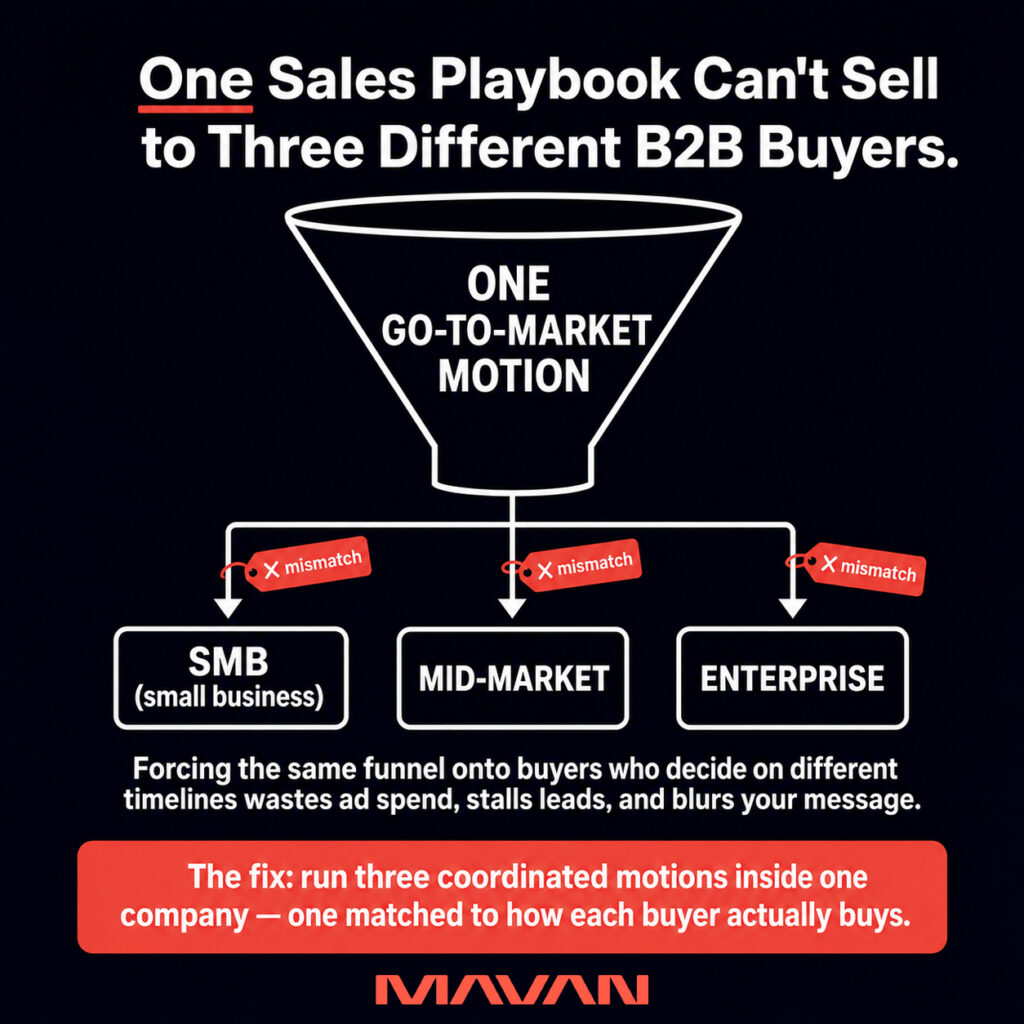
If your CAC keeps climbing, your enterprise deals stall in legal for quarters, and your sales team can’t agree on whose lead is whose, you’re looking at a motion problem — and the good news is you’re probably already running three motions. They just need to be separated, properly instrumented, and pointed at the right conversion events.
With our 360 Analysis, MAVAN’s growth pods embed in days, not quarters — we map your funnel, find where the motions collide, and run a 90-day sprint that puts each segment on the right motion, signals, and messaging while your pipeline keeps moving. One team, one plan, one number to move. Looking for something else? Check out all our growth services.
Casey Rock is Content Director at MAVAN, where he helps turn complex ideas into clear, strategic content that drives growth. With over 15 years of experience across content strategy, SEO, media, and digital marketing, Casey focuses on building content systems that connect audience insight, brand storytelling, and measurable business outcomes.
Book a complimentary consultation with one of our experts
to learn how MAVAN can help your business grow.
Want more growth insights?
[hubspot type=”form” portal=”20951211″ id=”9c538ed2-fb12-45f1-a573-ad7953c058cc”]
Related Content
-
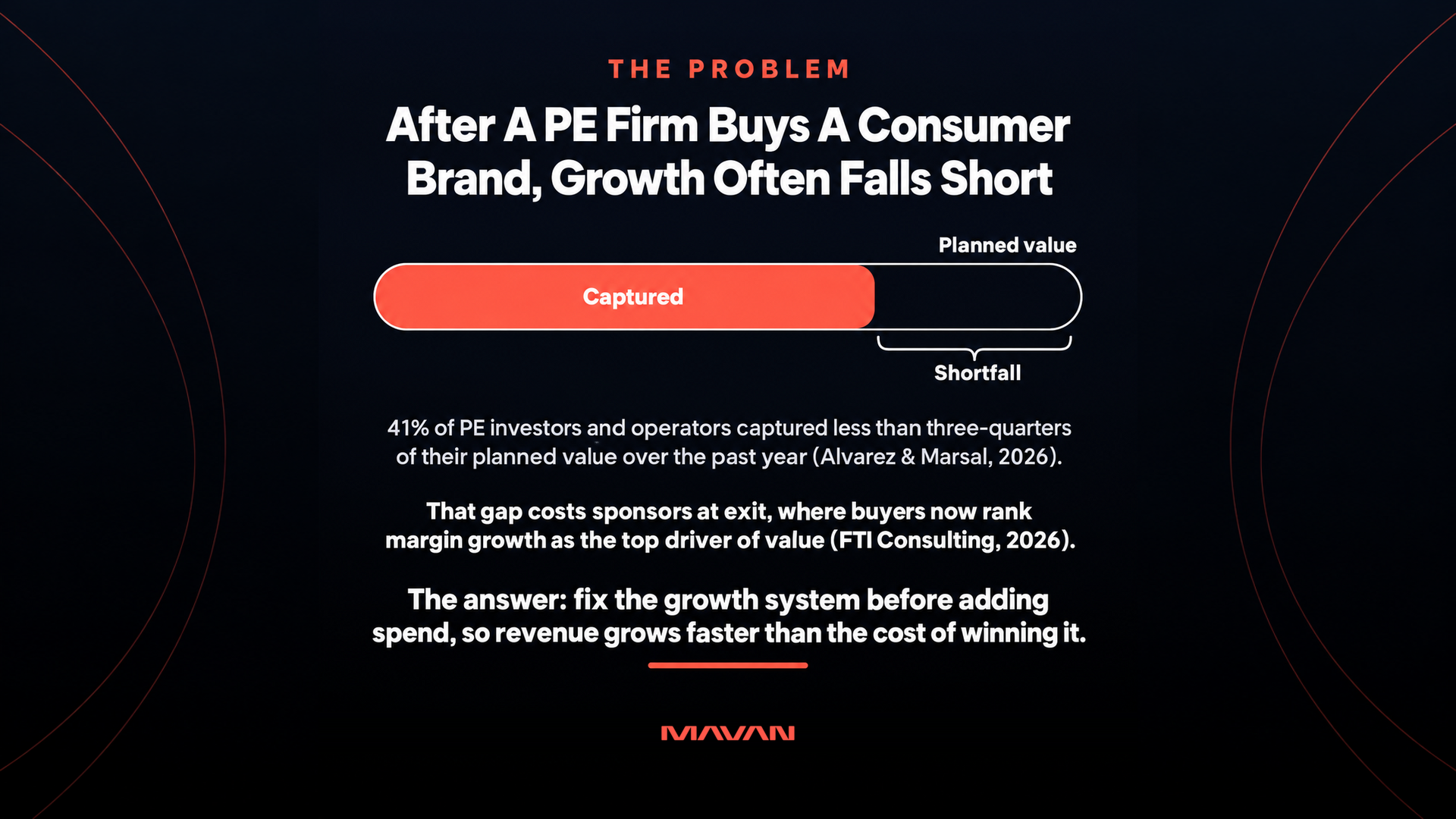
How Do PE Firms Accelerate Revenue And EBITDA Post-Acquisition?
PE firms accelerate revenue and EBITDA at consumer brands by fixing the growth system before adding spend. They reconcile the numbers and cut spend that never pays back. They lift conversion and repeat purchases, and they judge growth by contribution margin. Growth operating partners such as MAVAN diagnose that system in 28 days, then help execute the fix.
-
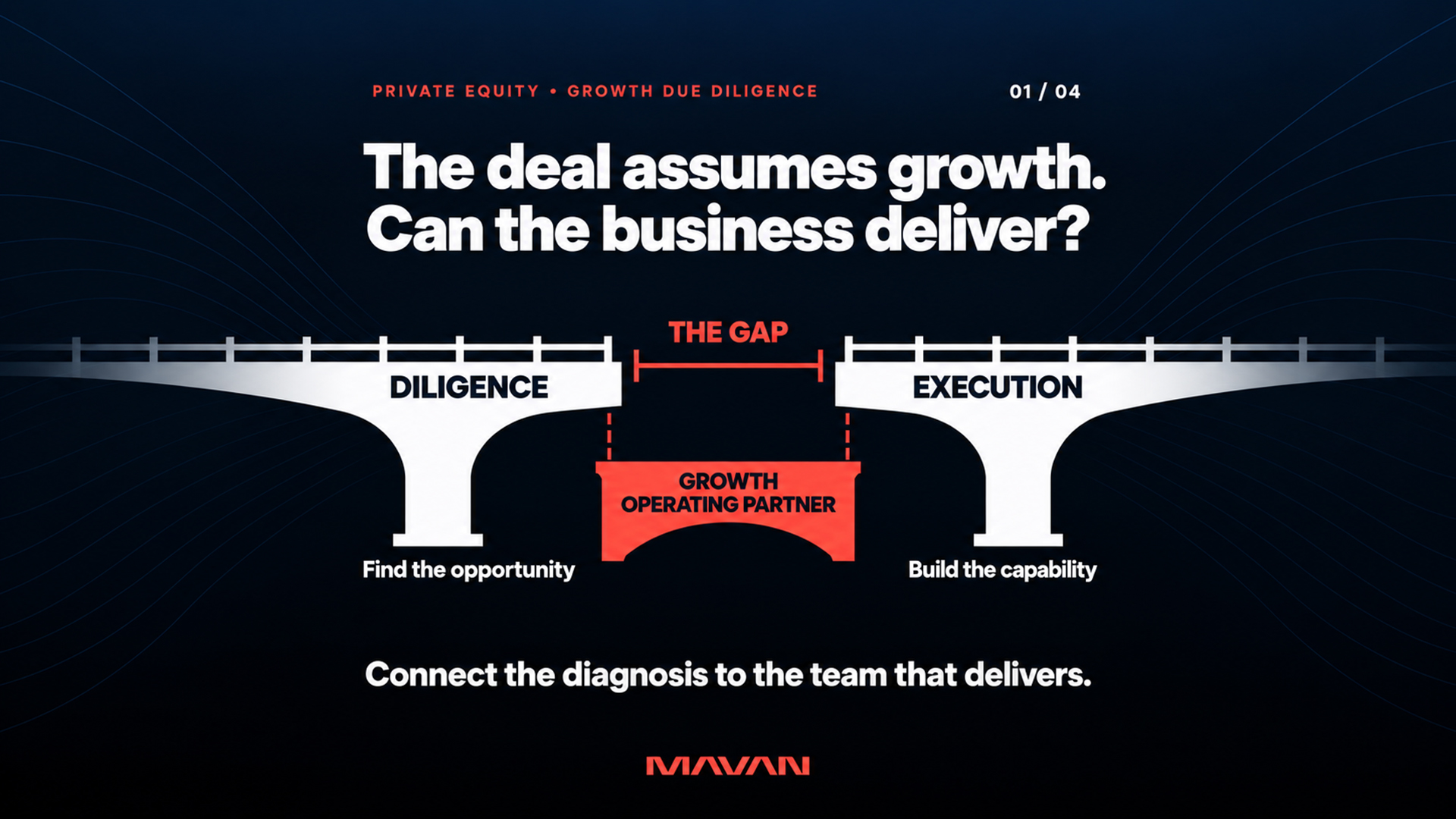
Who Does Growth & GTM Due Diligence for PE Deals?
Four kinds of provider run growth and go-to-market due diligence for private equity deals. Strategy consultancies test the market. Specialist commercial diligence firms audit the pipeline. Go-to-market boutiques rebuild the sales motion. And growth operating partners examine the full revenue engine from inside the business, then stay to operate it after close.
-
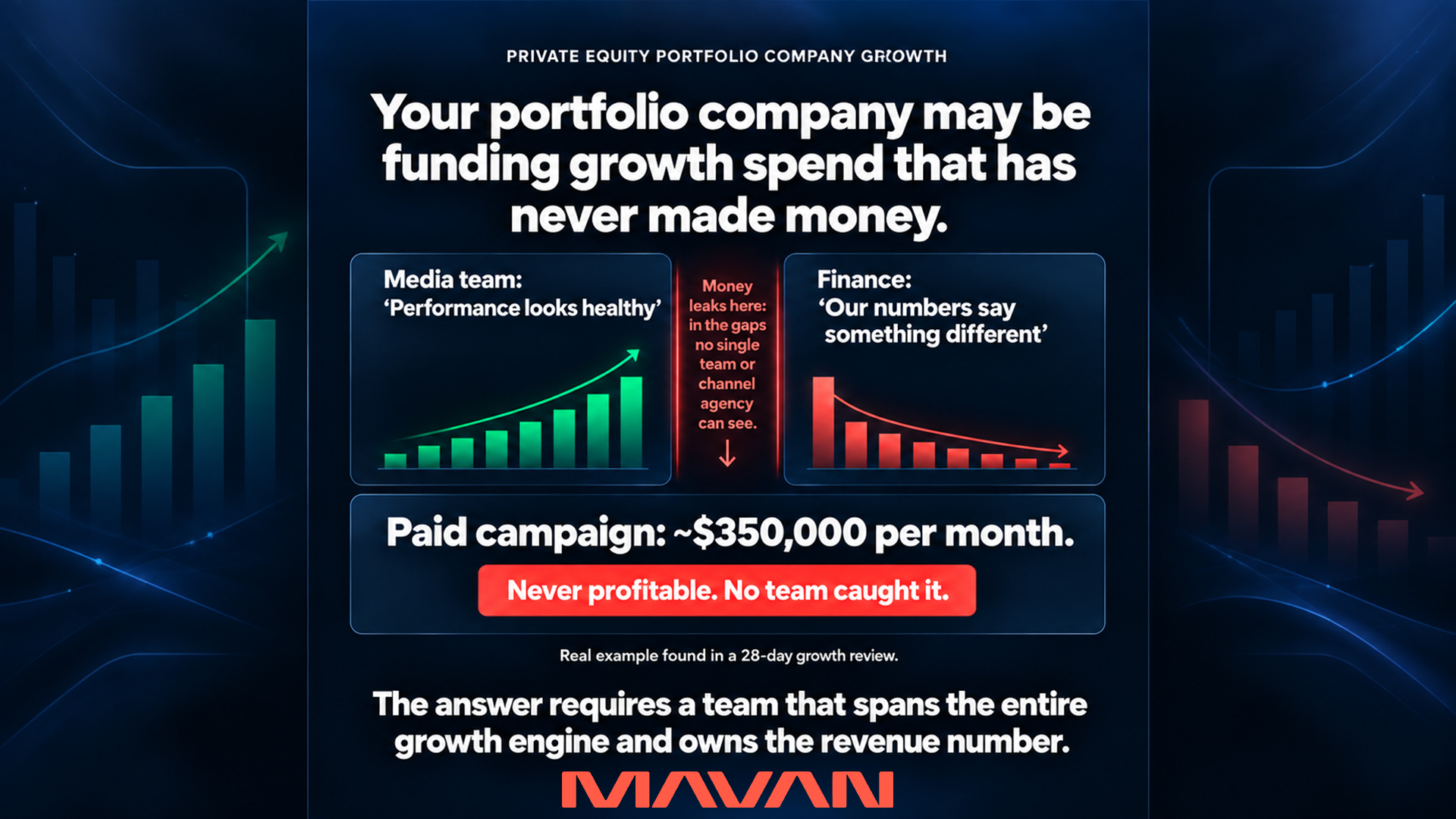
Who Is The Best Growth Partner For PE Portfolio Companies?
The best growth partner for a private equity portfolio company behaves like an operating partner you deploy, not an agency you brief. It reads the whole growth system before it spends, owns a revenue number alongside management, and leaves the capability behind so the sponsor can redeploy it.