
A fractional CMO gives a Series A startup senior marketing strategy on a part-time basis. A growth pod adds the cross-functional team that ships it. The right choice depends on whether your real bottleneck is direction or delivery.
TLDR — Growth Pod vs. Fractional CMO: Which Scales Growth Best?
- Diagnose the real bottleneck first — direction or delivery?
- Fractional CMO sells strategy; a growth pod ships strategy plus execution.
- After product-market fit, the gap is usually delivery, not direction.
- Growth stalls from fragmentation — not from a lazy team.
- CAC is a chain; the break can hide anywhere along it.
- A lone hire sees one stage; a pod owns the whole chain.
- Insist on one owner and one source of truth, always.
- Boards back whoever owns the number across functions.
- Compare cost per outcome, never cost per hour.
- Contact MAVAN for a 360 Growth Analysis — see your leaks in days.
A board member once introduced Matt Widdoes, Founder and CEO of MAVAN, to the CMO of a direct-to-consumer clothing brand spending $12 million a month on paid ads. The CMO had exactly one question: how do we scale Meta faster? Widdoes explained that the real answer started somewhere else — in the data, with the product team, with the lifecycle team, across the full customer journey. The CMO went pale. As Widdoes recalls it: “He looked like he’d seen a ghost. ‘I can’t have you speaking with the data or product teams, they’re too busy, we just need to fix Meta ad spend.’”
That reaction names the decision facing most Series A founders right now. You’ve found product-market fit — the match between what you sell and what a market wants to buy. The board wants you to pour fuel on growth. That’s a great problem to have, and you’ve earned it. The open question is what kind of marketing leadership converts that mandate into shipped results, and the honest answer rarely comes down to one heroic hire.
Two models dominate the conversation when founders staff a growth function: the fractional CMO and the growth pod. A fractional CMO is a senior marketing strategist who works part-time. A growth pod is a small cross-functional team that owns strategy and execution together, led by one accountable point of contact.
For most teams that have already cleared product-market fit, the bottleneck isn’t direction — it’s the cross-functional muscle to act on the direction you already have. This guide breaks down both models plainly, names when each one fits, and gives you a way to choose.
What’s the Difference Between a Growth Pod and a Fractional CMO?
A fractional CMO is a part-time senior marketing executive who sets direction and owns the marketing strategy. A growth pod is a small embedded team spanning the disciplines growth requires — acquisition, creative, data, lifecycle, and product — working as one unit under a single lead. The pod owns the plan and the hands that ship it.
The distinction matters because growth is not a single-discipline job. Matt Widdoes, Founder and CEO of MAVAN, frames effective growth work as product, marketing, engineering, and analytics operating as one team rather than a lone specialist. A fractional CMO supplies the senior brain. A growth pod supplies the senior brain plus the coordinated execution layer underneath it. Independent fractional-CMO guides make the same point from the other direction: most recommend pairing the strategist with a “modular team” or pod, because strategy alone rarely moves a number on its own.
There’s a reason the market keeps reinventing the pod. When founders try to assemble that execution layer themselves — a paid manager here, a freelance creative team there, a contracted data analyst, an SEO consultant, a lifecycle vendor — each hire is individually rational. Together they create a growth function with no shared playbook and no single owner of the whole. That’s the gap the pod model closes.
When Does a Series A Startup Actually Need a Fractional CMO?
A fractional CMO is the right call when your bottleneck is senior judgment, not execution capacity. If you already have capable hands — a paid buyer, a designer, an analyst — but no one to set priorities and own the marketing narrative, a part-time executive supplies that direction affordably. Published guides put fractional CMOs at roughly $5,000 to $15,000 a month.
We want to be fair to the model, because it solves a real problem. A full-time CMO carries total compensation that published market analyses commonly place between $250,000 and $500,000 or more — a heavy commitment for a company that hasn’t yet defined what its growth engine looks like. A fractional CMO gives you executive-level strategy without that fixed cost, and they can start in weeks rather than the months a full search takes. For a founder who has strong in-house execution and simply needs a seasoned hand on the tiller, that trade is hard to beat.
The honest limit shows up in the $12 million Meta example. A fractional strategist can write the right plan, yet still hit a wall when the plan requires the data team, the product team, and the lifecycle team to move in concert — and the strategist has neither the standing nor the hours to make that happen. A fractional CMO can tell you what to do across five functions. A pod can do it across five functions. That difference is the whole decision, and it’s why the strongest case for a fractional CMO is also the narrowest: you need it most when execution is already handled.
Why Does Growth Break Even When You’ve Hired Great People?
Growth breaks because the work scatters across too many disconnected efforts, and no one owns the system that ties them together. Paid chases platform numbers, creative gets briefed in a vacuum, product ships without telling marketing, and data is never quite ready. The result: a busy team, full dashboards, and a number nobody can explain.
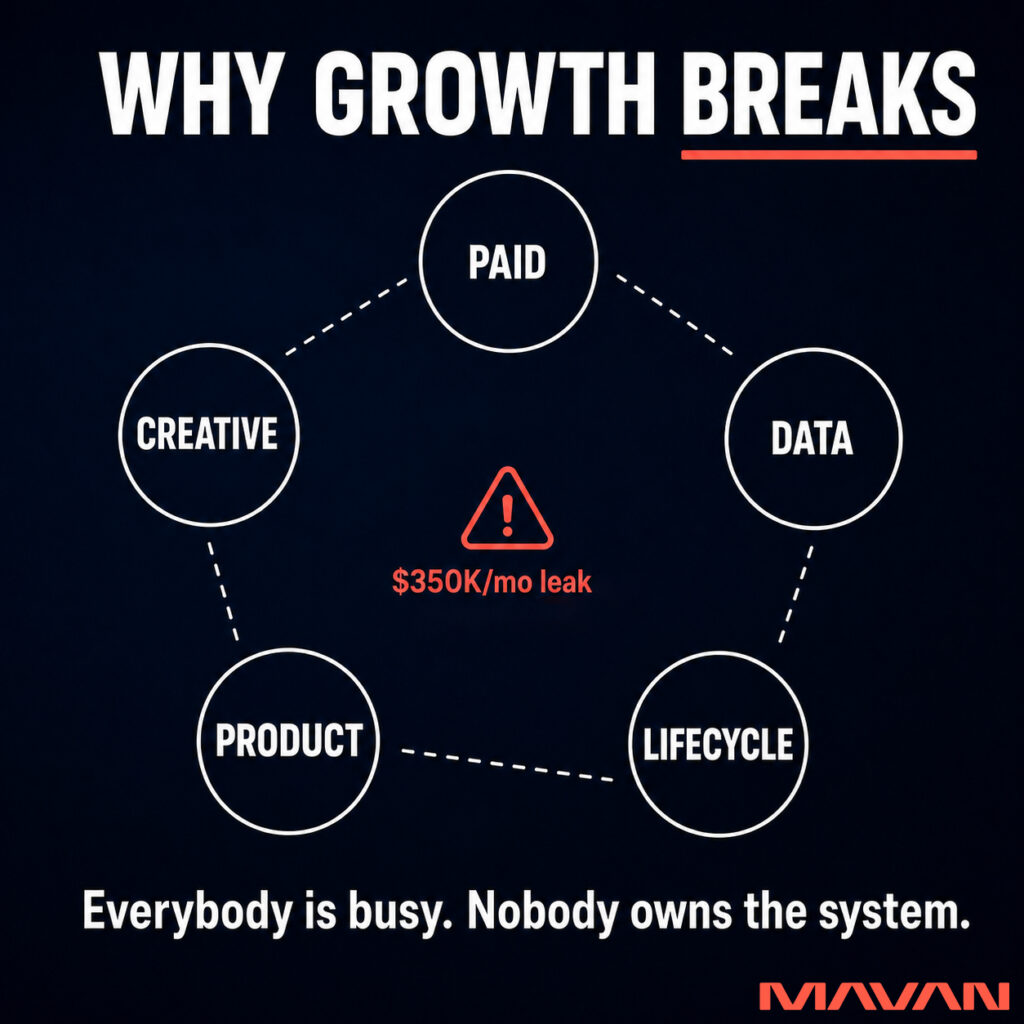
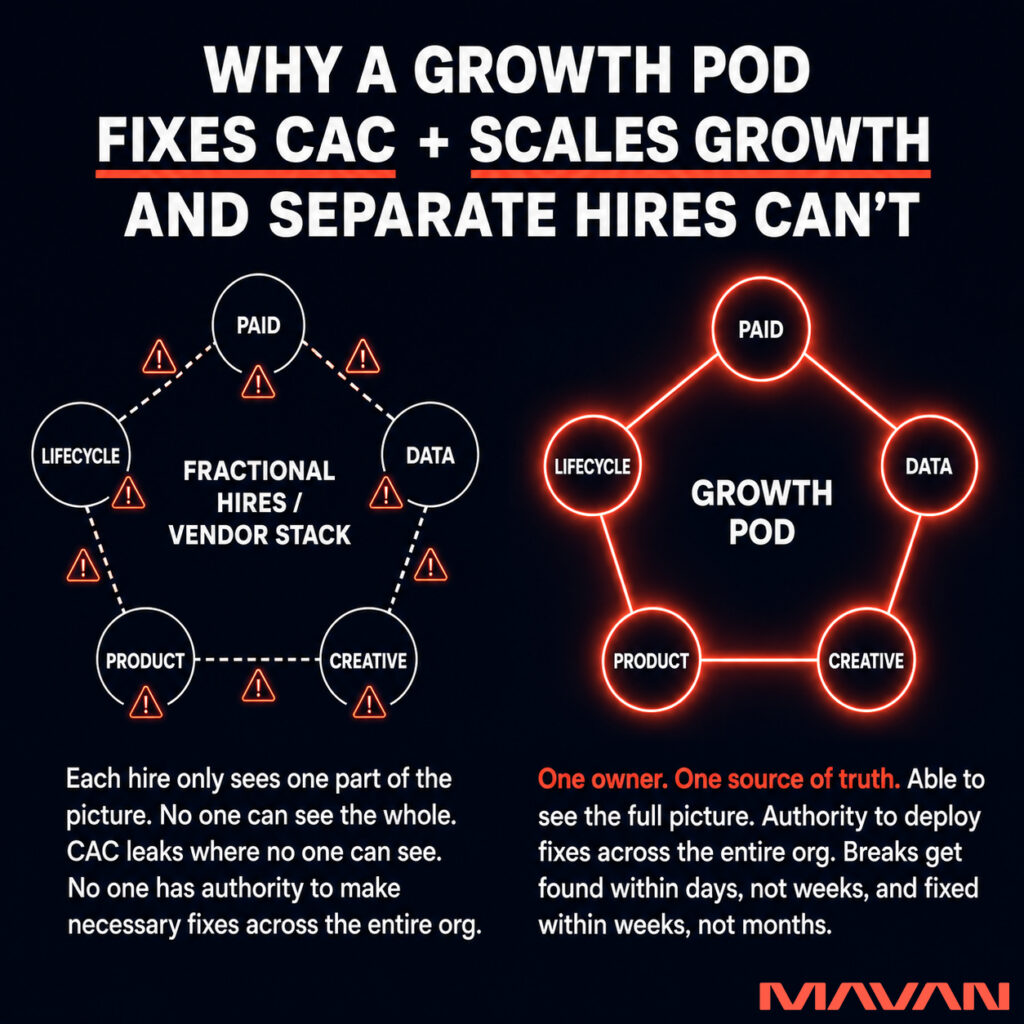
Matt Widdoes, Founder and CEO of MAVAN, is direct about the root cause: “This isn’t a hiring problem. It’s not a budget problem. It’s a structural problem.” When the board asks why customer acquisition cost — CAC, the all-in cost to win one customer — went up last quarter, the answer is “everybody and nobody.” The founder becomes the integration layer by default, spending fifteen hours a week as an air traffic controller between vendors who don’t share a runway. Picture a Frankenstein measurement stack with five arms and no legs, bolted together under deadline pressure, where the paid team’s dashboard and finance’s spreadsheet describe two different companies.
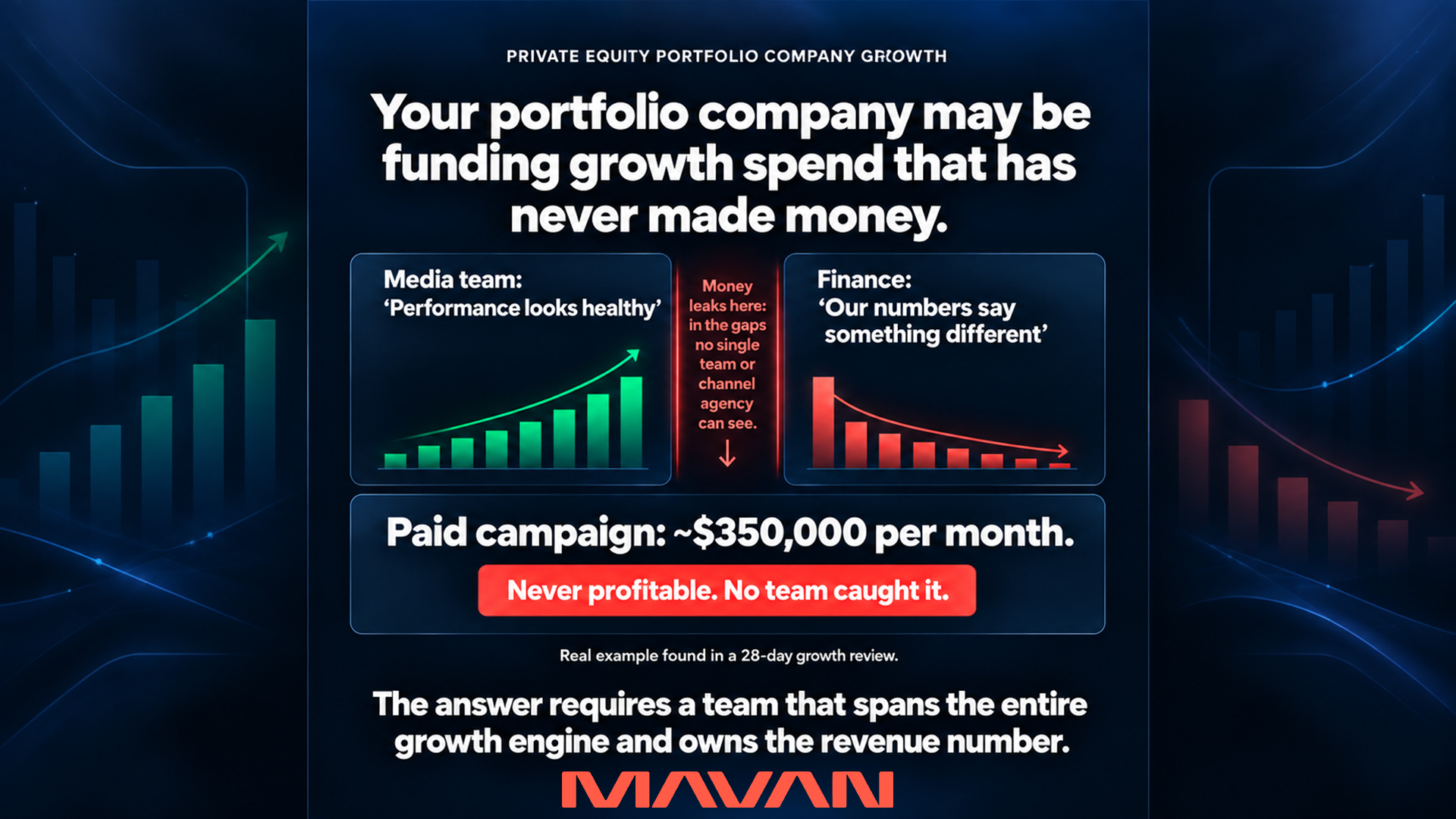
The cost of that fragmentation is rarely a line item — it hides inside normalized waste. In one engagement, MAVAN’s 360 Growth Analysis — the audit we run before any execution — surfaced the problem in the first 48 hours. As Widdoes describes it: “In the first 48 hours we uncovered around $350k a month that was being spent on an evergreen paid media campaign that had never been anywhere close to profitable and had not been updated or optimized for over 6 months.” The cause wasn’t a lazy team. It was a missing source of truth: teams looking at different numbers, an out-of-date predictive model, and a dashboard that showed everything was fine while the leads had never once been profitable. This is the texture of why startup growth can feel broken even when the team is working hard — the effort is real, but the operating model leaks.
A lone strategist, however senior, can map that leak. Closing it requires authority and hands across data, paid, product, and lifecycle at the same time. That’s the structural reason a single part-time hire often can’t finish the job.
How Does a Growth Pod Scale a Series A Startup?
A growth pod scales a startup by turning a fragmented set of vendors into one accountable system. You get faster decisions, less wasted spend, and a number someone owns — because strategy and execution sit inside the same team. Instead of briefing five disconnected partners, you brief one lead who moves across every discipline in the same week.
The outcome founders feel first is speed with accountability, and it traces back to a specific mechanism: cross-functional work under one owner, against a single source of truth. Angus Kirby, Director of Marketing at Titan, described the model this way after working with MAVAN: “As a team of one, I could tap into the right experts for whatever problem I was tackling. Their model — specialists led by a single point of contact — made the work seamless and high-quality. And unlike a lot of agencies where strategy just lives in a deck, MAVAN actually executed.” That last line is the pod’s whole value: the strategy doesn’t die in a slide.
The pod also matches the real shape of the work. Sam McLellan, VP of Growth at MAVAN, points out that even a request as simple as “we need acquisition help” can hide a product problem, an execution problem, or an attribution problem at once. “It’s not just an installer and MMP out of the box,” he says — scaling acquisition into the hundreds of millions takes a diverse, connected system, not a single lever. A pod can diagnose which layer is broken and fix it, because it owns every layer. That capability is the engine behind MAVAN’s growth services, staffed by 170+ growth specialists who have scaled companies like Zynga, King, and ElevenLabs. It’s also why the most durable answer to the best growth strategy for a startup starts with the operating model, not the tactics.
How Do Growth Pods and Fractional CMOs Affect CAC and ROAS?
Both models can improve CAC and ROAS — return on ad spend, the revenue earned per advertising dollar — but through different mechanisms. A fractional CMO improves the numbers by sharpening targets, positioning, and channel priorities. A growth pod improves them by acting on the diagnosis across every function at once, which is usually where CAC and ROAS move.
The reason is mechanical. CAC rarely rises because of one bad channel. It rises because of a chain — ad signal, landing-page conversion, activation, monetization — and the break can sit anywhere along it. A fractional CMO can identify the break and write the fix. A pod can execute the fix across the chain without waiting for three other teams to free up. When MAVAN worked with KidStrong, the team operated inside that full chain; as Erin Clift, CMO of KidStrong, put it: “MAVAN quickly drove results that cut our customer acquisition costs by 60%.”
Dan Barnes, President of MAVAN, adds the measurement discipline that makes any of this real. He warns against gross ROAS as a reporting artifact and favors contribution margin per acquired user at day 90 — harder to calculate, impossible to game. Whichever model you choose, insist on that rigor. If your CAC is climbing and you’re not sure which link in the chain is failing, our breakdown of why CAC rises and what to fix first is a useful place to start.
Which Model Do Boards Trust More After Series A?
Boards trust the model that produces one owner, one number, and a clear answer under pressure. That favors whichever option can guarantee a single source of truth across the company — not just inside marketing. A fractional CMO can own the marketing number. A growth pod can enforce one number across data, finance, and product, which is what boards want.
Dan Barnes, President of MAVAN, has watched this play out in real board meetings. His non-negotiable rule for any board-ready metric: “One definition. One owner. One source of truth. And a threshold, not a target.” When numbers disagree, the damage isn’t analytical — it’s organizational. As Barnes puts it: “Multiple sources of truth means there’s no way to be objective about outcomes. And when you can’t be objective about outcomes, accountability falls through the cracks.” Everyone finds a number that defends their position, so no one is ever wrong, so nothing changes.
He also names what the argument is really about. In one soft-launch debate, both sides had data — and the standoff wasn’t about the data at all. “The argument wasn’t actually about the data — it was about conviction and ownership. Someone had to have an answer and drive forward.” That is the board’s deeper expectation: not a strategy deck, but a person who owns the whole machine and can drive it. A pod is built to be that owner across functions. If board meetings keep turning into growth arguments, the fix is structural, and we’ve written a full playbook on how to end growth arguments in board meetings.
How Much Do a Growth Pod and a Fractional CMO Cost?
A fractional CMO typically runs roughly $5,000 to $15,000 a month for senior strategy on a part-time basis, per published pricing guides. A growth pod costs more on paper because you’re funding a cross-functional team, not one part-time brain — but the right comparison isn’t cost per hour. It’s cost per outcome, including the waste a fragmented setup hides.
That waste is not hypothetical. Gartner’s 2025 CMO Spend Survey found marketing budgets flat at 7.7% of company revenue — down from 9.5% three years earlier — with 59% of CMOs reporting they lack the budget to execute their strategy, and 39% planning to cut agency spend. In that climate, a $350,000-a-month leak from a single un-owned campaign isn’t a rounding error; it’s the difference between hitting your next milestone and missing it. A model that recovers that spend can pay for itself before the retainer clears.
Here’s the trade-off in plain terms:
| Model | What you get | Best fit when |
|---|---|---|
| Fractional CMO | A part-time senior strategist who owns direction and priorities | You already have strong in-house execution and only lack senior judgment |
| Growth pod | A cross-functional team owning strategy and execution under one lead | Your bottleneck is shipping across functions, not knowing what to do |
| DIY vendor stack | Multiple specialists, no shared owner of the whole | Rarely — it’s how fragmentation and hidden waste begin |
How Do You Choose Between a Growth Pod and a Fractional CMO?
Choose based on where your real constraint sits. If you lack senior direction but can already execute, a fractional CMO fits. If you can set direction but can’t ship across acquisition, creative, data, lifecycle, and product, a growth pod fits. Diagnose the constraint first — most post–product-market-fit teams discover it’s delivery, not direction.
Work through these steps in order, and each one stands as its own answer to “what should I do first?”:
- Name the metric that’s keeping leadership up at night. CAC, activation, retention, or conversion — pick the one the board scrutinizes most. The owner of that number is your economic buyer for this decision.
- Trace who owns each link in that metric’s chain. If the answer is “everybody and nobody,” your problem is structural, and a lone strategist won’t close it.
- Take an honest inventory of your execution capacity. Count the disciplines you can ship today. Gaps across three or more functions point toward a pod.
- Decide what you’re buying: direction or delivery. Buy a fractional CMO for direction. Buy a growth pod for both — direction and the hands to execute it.
- Demand a single source of truth on day one. Whichever model you pick, require one number, one owner, one definition. Without it, neither model can prove anything.
This is the same logic behind building a system that scales beyond founder-led growth: you’re trading founder heroics for a repeatable engine. It’s also why so many teams find that agencies fall short — they sell delivery without owning the whole system, which leaves the integration problem exactly where it started.
Frequently Asked Questions About Fractional CMOs & Growth Pods
What is a growth pod?
A growth pod is a small embedded team that owns marketing strategy and execution together, spanning acquisition, creative, data, lifecycle, and product under one accountable lead. It functions like an internal growth unit you can plug in quickly, rather than a single hire or a roster of disconnected vendors.
Is a fractional CMO worth it for a Series A startup?
Yes, when your gap is senior strategic direction rather than execution capacity. A fractional CMO delivers executive-level judgment at roughly $5,000 to $15,000 a month, far below a full-time CMO’s total compensation. The limit shows up when your plan needs coordinated execution across functions a part-time hire can’t drive.
Can a fractional CMO and a growth pod work together?
Yes, and many engagements pair them. The fractional CMO sets direction while the pod supplies the cross-functional execution to ship it. Most independent fractional-CMO guides recommend exactly this pairing, because strategy without an execution layer rarely moves a number on its own.
How quickly can a growth pod show results?
An embedded pod can surface findings within the first 48 hours of an audit. In one MAVAN engagement, a 360 Growth Analysis uncovered roughly $350,000 a month in wasted paid spend within two days. Meaningful performance change usually follows inside the first 90 days, depending on your starting point.
Why does our growth feel broken when the team works hard?
Because effort is distributed across disconnected efforts with no single owner of the system. Paid optimizes platform metrics, creative is briefed in a vacuum, and data is never quite ready. The problem is structural, not a matter of hiring harder-working people.
What should I look for in any growth leadership model?
Look for one owner, one source of truth, and execution that doesn’t die in a deck. Demand a single definition for each key metric, a clear owner of the number, and a partner who ships across functions rather than handing you a strategy you still have to staff.
So, Should You Hire A Growth Pod Or Fractional CMO?
For a Series A startup with product-market fit and a board mandate to grow, the choice between a growth pod and a fractional CMO comes down to one diagnosis: is your bottleneck direction or delivery? A fractional CMO is the efficient answer when you already have strong execution and only need senior strategy. A growth pod is the answer when your real constraint is shipping across acquisition, creative, data, lifecycle, and product at once — which describes most post–product-market-fit teams. The deciding factor isn’t cost per hour; it’s which model gives the board one owner, one source of truth, and strategy that gets executed.
If you can name the metric keeping your board up at night but can’t name a single owner of the full chain behind it, then your gap is structural — and a 360 Growth Analysis will show you exactly where the leverage and the leaks are within the first few days.
Reach out to MAVAN about our 360 Growth Analysis — and see the whole machine before you spend another dollar scaling the wrong part of it.
Casey Rock is Content Director at MAVAN, where he helps turn complex ideas into clear, strategic content that drives growth. With over 15 years of experience across content strategy, SEO, media, and digital marketing, Casey focuses on building content systems that connect audience insight, brand storytelling, and measurable business outcomes.
Book a complimentary consultation with one of our experts
to learn how MAVAN can help your business grow.
Want more growth insights?
Thank you! form is submitted
[hubspot type=”form” portal=”20951211″ id=”9c538ed2-fb12-45f1-a573-ad7953c058cc”]
Related Content
-
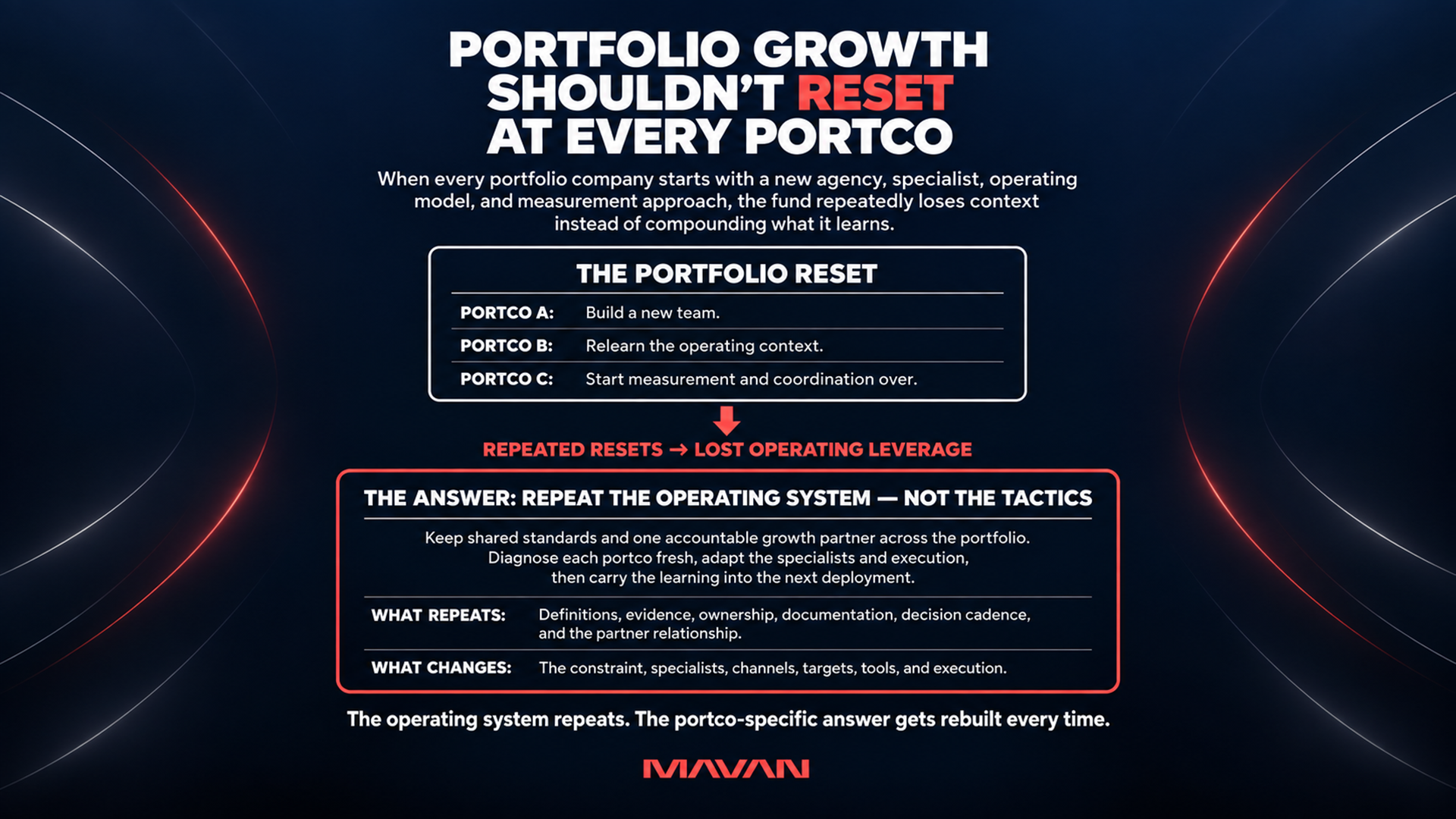
How Can Private Equity Funds Repeat Growth Across Portfolio Companies?
Growth becomes repeatable across a VC or PE portfolio when the fund installs one operating system instead of referring each company to a different specialist. The system has three parts: a single source of truth every team trusts, a board-ready scoreboard of ten to twelve metrics, and an embedded pod that diagnoses the real constraint in ninety days before anyone spends more.
-
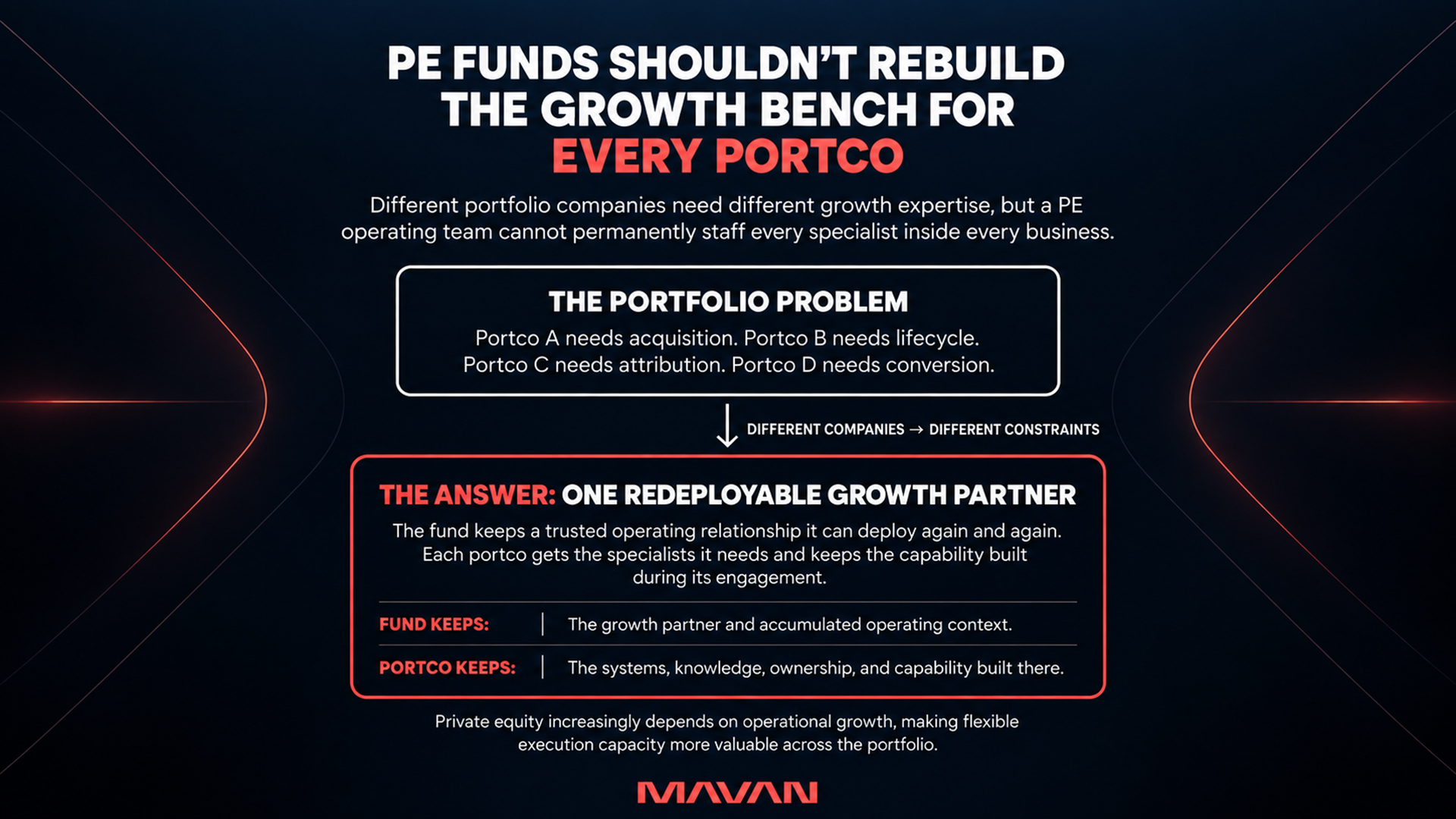
What Do PE Funds Want From a Portfolio Growth Partner? Repeatability!
What funds actually want from a portfolio growth partner is repeatability — a portable growth operating system that produces comparable results across very different portfolio companies. Repeatability shows up as a single source of truth, a board-grade scoreboard, a 90-day sprint, and a clean handoff, so each win compounds across the portfolio instead of staying at one company.
-
Who Is The Best Growth Partner For PE Portfolio Companies?
The best growth partner for a private equity portfolio company behaves like an operating partner you deploy, not an agency you brief. It reads the whole growth system before it spends, owns a revenue number alongside management, and leaves the capability behind so the sponsor can redeploy it.