
To avoid a growth agency that falls short, hire for accountability instead of activity. Require a partner that owns one business number, runs a diagnostic before it pitches a plan, works inside your tools with one point of contact, and hands the playbook back. Screen out vanity metrics, disappearing senior operators, and reporting you can’t reconcile with finance.
TLDR — 10 Things To Know Before You Hire A Growth Agency
- Hire for one owned number, not a scope of activity.
- Fragmentation, not effort, is why most partnerships fall short.
- Require a diagnostic before you accept any spend plan.
- Ask one question first: “What number will you own?”
- Vanity metrics with no baseline are the earliest warning sign.
- Get the senior operators who pitched you named in your standups.
- Insist on one source of truth finance and the board can share.
- For PE portfolios, demand a system that survives exit diligence.
- The best partners hand the playbook back and leave you stronger.
- MAVAN cut Titan’s CAC threefold. Learn about our growth services.
A CMO spending twelve million dollars a month on paid media told our founder his one problem was scaling Meta faster. When we suggested starting with his data and product teams, he said he couldn’t get them on a call. The agency wasn’t short on talent or effort — it was set up to fail, because no one owned the whole machine and the org wasn’t built to let anyone try. Avoiding that outcome is less about finding a smarter agency and more about hiring for a different structure entirely.
Agencies have promised exceptional results since the first industrialist decided someone else should handle the advertising. The promise has barely changed in 150 years; the gap between it and what actually lands is where the money leaks. This guide is written for two readers who feel that gap differently. If you run growth at a venture-backed or PE-owned company, you feel it as CAC that won’t fall and a board that wants efficiency and scale at once. If you drive value creation across a private-equity portfolio, you feel it as a growth plan you underwrote but can’t staff across every company at your firm’s tempo. You’re both doing real work. What follows is how to avoid the partner that undoes it — and what to require instead.
How Do You Avoid A Growth Agency That Falls Short?
Avoid a growth agency that falls short by hiring for accountability, not activity. Require a partner that owns one business number, runs a diagnostic before it pitches a plan, works inside your tools under one point of contact, and hands the playbook back when the metric moves. Screen out anyone selling a scope of tasks instead of an outcome.
The single most reliable filter is a question you can ask on the first call: what number will you own? A partner built to deliver names a metric and a timeframe — CAC, payback, activation, pipeline, EBITDA contribution — and ties its fee to moving it. An agency built to bill answers with a list of deliverables, because a scope of activity renews itself whether or not your business improves. Matt Widdoes, Founder and CEO of MAVAN, has watched the difference play out at seed-stage startups and nine-figure enterprises: capable people, hired individually and set loose, still fragment without a system to connect them. “Growth requires not only exceptional people in every seat, but exceptional org design, systems, testing frameworks, and alignment on a single easily measured outcome,” he says.
Everything else in this guide is a way to pressure-test that one idea before you sign. You’ll learn the warning signs that predict an agency will fall short, the specific structural traps that cause it, and the checklist that separates a partner who compounds from a vendor who stalls. The failure modes matter because they tell you exactly what to screen for — so we’ll name each one, then show what a partner has to do differently to avoid it. The goal isn’t to catalog disappointment; it’s to give you a repeatable way to walk away from it before it costs you a quarter.
Want to learn about what makes a growth agency the best? Check out our deep dive.
What Are The Warning Signs A Growth Agency Will Fall Short?
The clearest warning sign is a partner that can’t draw a straight line from its work to a business outcome after about 90 days. Watch for vanity metrics with no baseline, reporting you can’t reconcile with finance, resistance to sharing raw data, and a strategy no one can explain in plain language. Activity is not progress.
Attribution to a number that matters is the sharpest test. If a partner reports a 3x return on ad spend while your finance team says unit economics are underwater, you don’t have a data problem. You have an accountability problem — two functions are measuring two different things, and no one owns the reconciliation. Dan Barnes, President of MAVAN, frames every engagement around two questions that expose this fast: “Why are you doing this? And did it work?” As he puts it, “if you can’t answer whether it worked after the fact, you don’t have a learning. You have a sunk cost.” Spot the partner who can’t answer the second question before you hire it, not a year in.
These red flags recur across independent 2026 assessments of agency underperformance, and they read as alarms for both a growth leader and a portfolio operator:
- Vanity metrics with no baseline. “We grew traffic 300%” with no timeframe or metric definition is built to impress and impossible to falsify.
- No revenue attribution after 90 days. If a partner can’t connect its activity to pipeline, CAC, revenue, or margin within a quarter, the connection probably isn’t there.
- Reporting you can’t reconcile with finance. When the ad platform, product analytics, and the P&L disagree and no one resolves it, decisions get made on whichever number flatters the loudest voice.
- Resistance to sharing raw data or account access. A partner confident in its work has no reason to gate your dashboards or hold your ad accounts.
- A senior pitch team that disappears after signing. If the operators who sold you the engagement won’t run it, you’re paying for judgment you won’t receive.
- Strategy no one can explain in plain language. If the plan only makes sense in the deck, it won’t survive contact with your market — or with diligence.
Why Do Growth Agencies Fall Short In The First Place?
Growth agencies fall short because most are built to own a scope of activity, not a business outcome. Each vendor optimizes its own slice — paid, creative, data, lifecycle — so no one is accountable for the whole result. The effort is real; the structure leaks. Knowing this is how you avoid it: hire for the outcome, not the slice.
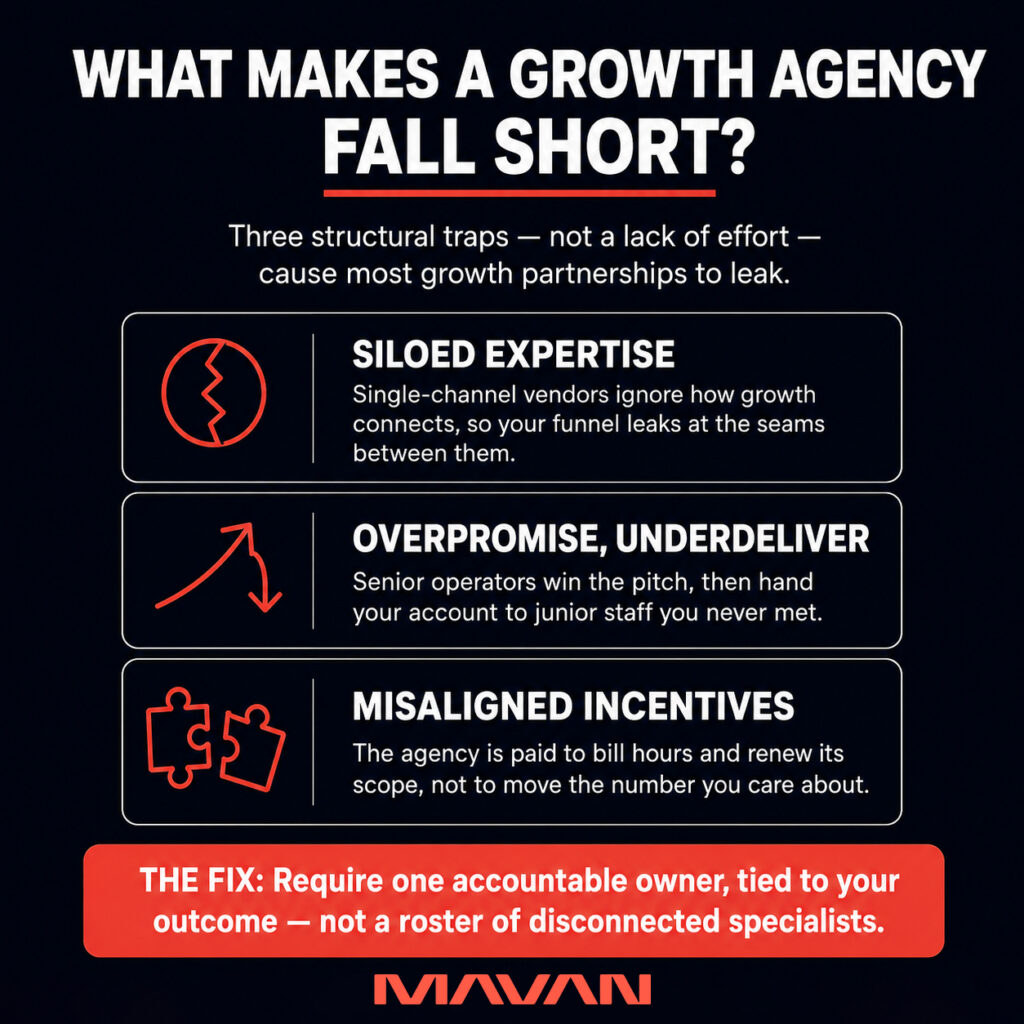
The failure is rarely dramatic, which is what makes it expensive. You feel the mismatch in a status meeting, where a scope-bound agency celebrates a lower cost per thousand impressions while your payback window stretches out of reach — because its job ends where its slice ends. For a growth leader, that surfaces as rising blended CAC and a metric you can’t defend to the board. For a private-equity operator, it surfaces as a portfolio company that looks busy but isn’t compounding toward the value-creation plan or the exit narrative. Same structural flaw, two different alarms.
To avoid it, you have to recognize the specific shapes the flaw takes. The next three sections name the traps that cause agencies to fall short — siloed expertise, overpromising, and misaligned incentives — because each one has a matching thing to require in a partner. Screen against all three and you’ve eliminated most of the ways a growth engagement goes wrong before it starts.
Key Terms For Vetting A Growth Agency, Defined
- Growth fragmentation
- The structural condition where each channel or function is owned by a different vendor or contractor, so no one sees or owns the full customer journey. It produces false confidence from partial data, slow decision cycles, and wasted spend that hides in the seams between scopes.
- Scope-bound agency
- An agency accountable for delivering a fixed list of activities — ads managed, assets produced, reports sent — rather than for moving a business outcome. Its responsibility stops at the edge of the scope, even when the client’s actual number never improves.
- Growth diagnostic
- A structured review of the full growth machine — data, acquisition, conversion, lifecycle, and measurement — run before any spend plan, to locate where growth actually leaks. It replaces a channel pitch with evidence, and a serious partner insists on it before recommending spend.
- Value-creation plan (VCP)
- In private equity, the operating plan for making a portfolio company more valuable during the hold — the specific revenue, margin, and EBITDA levers behind the investment thesis. Growth work that can’t map to the VCP or survive exit diligence is a cost, not value creation.
How Do You Avoid The Siloed-Expertise Trap?
Avoid the siloed-expertise trap by hiring one cross-functional team held to a single goal, rather than several single-channel vendors or one generalist that’s merely okay at everything. Deep skill walled off from the rest of your funnel produces campaigns that ignore how growth connects. The counter is integration under one accountable owner.
Focus sounds like a virtue, and in isolation it is. The problem lives at the seams between focused vendors. A paid team optimizes to platform metrics while your creative team, briefed in a vacuum, keeps reworking themes that tested well six months ago — with no feedback loop telling anyone which value propositions actually convert. Product ships an onboarding redesign the same week as a big acquisition push, and no one coordinated, so you pour new users into a funnel that’s mid-construction. Each decision was individually rational. Together they build an operating model that fragments, and the founder or the portco CEO becomes the integration layer by default.
For a private-equity portfolio, siloed expertise fails in a second, costlier way: it doesn’t travel. A single-channel win at one company isn’t a system you can deploy across twelve, because the knowledge lives in one contract and one specialist’s head rather than in a repeatable playbook. Barnes learned at scale that integration is the actual edge — reflecting on building Machine Zone, he credits the win to everything being “so deeply integrated towards a common objective.” So the thing to require isn’t a longer roster of specialists. It’s a cross-functional team accountable to one number, which is the embedded growth pod model built precisely to close those seams.
How Do You Avoid Agencies That Overpromise And Underdeliver?
Avoid overpromising by anchoring the relationship to an outcome instead of a pitch, and by confirming the senior operators who sold you the engagement will actually run it. Ask who joins your standups by name, and tie the scope to one number the partner owns. A partner accountable for a metric has nowhere to hide when it doesn’t move.
Eagerness to please is human, especially when income rides on the pitch. In the room, every capability is on the table and every result sounds achievable. The gap opens when execution starts and the senior operators who closed the deal hand it to a junior account manager you never met. That bait-and-switch is one of the most common and expensive patterns in agency relationships, because the judgment that sold you the work is not what runs your account for the next twelve months. The screen is simple: ask for named people, and expect specifics rather than “our team.”
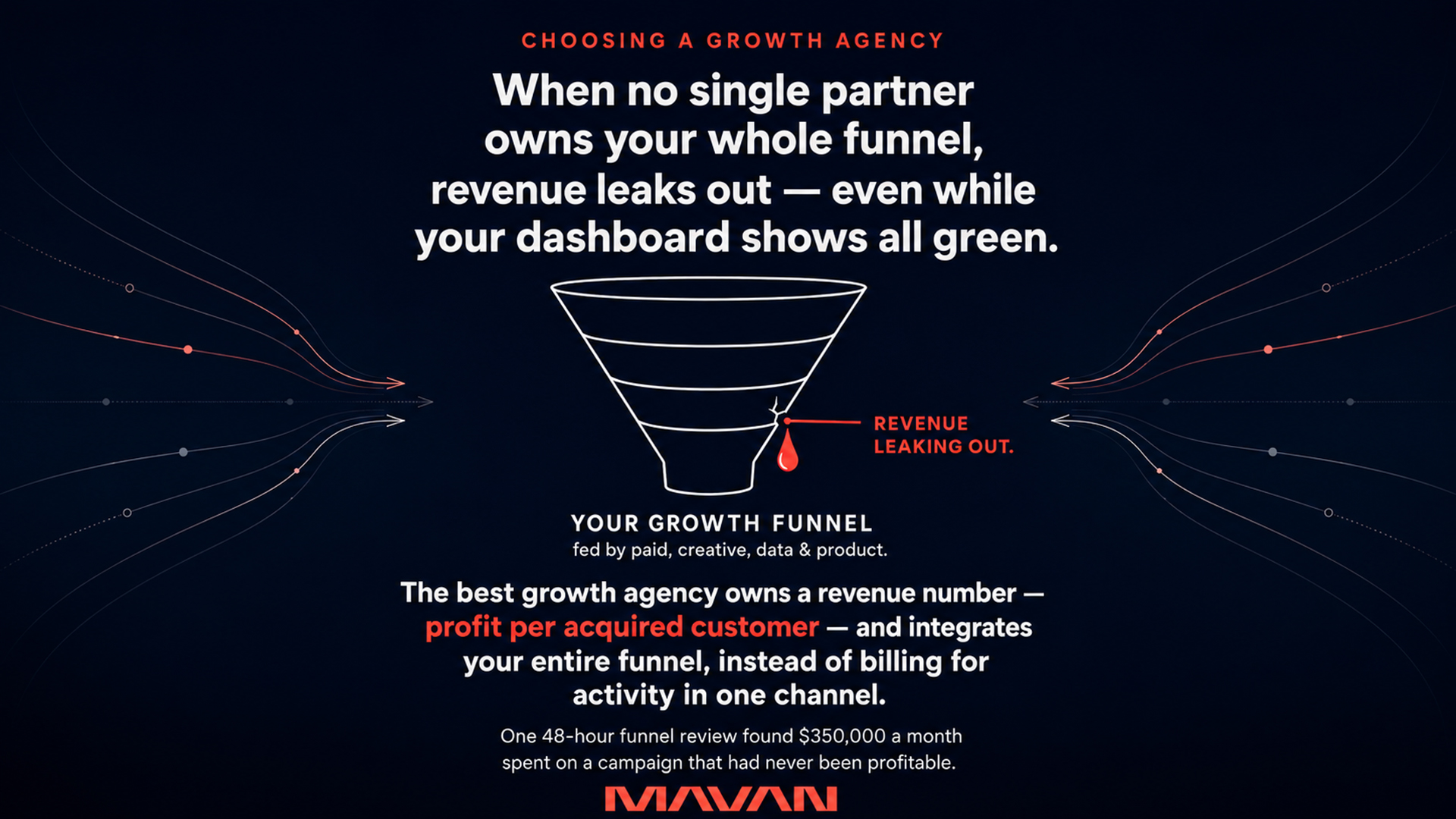
The deeper protection is outcome ownership. Widdoes points to a diagnostic on an at-scale consumer app that surfaced, in 48 hours, “around $350k a month that was being spent on an evergreen paid media campaign that had never been anywhere close to profitable.” That campaign wasn’t a failure of effort. It ran because no one owned the outcome it was supposed to produce, and the reporting looked fine. When a partner is accountable to a defined number — CAC, payback, pipeline, margin — an ambitious statement of work can’t paper over a metric that isn’t moving. That accountability is what you’re really buying, and what an overpromising agency can’t offer.
How Do You Avoid Agencies Stuck In Outdated Tactics?
Avoid stuck agencies by testing whether a partner keeps updating the machine as channels shift — not whether it can recite this year’s buzzwords. Ask how they’ve changed their approach in the last year, how they produce creative at volume, and how they measure incrementality. A partner still running last year’s playbook is optimizing a lever the market has already discounted.
The market moves too fast for recycled campaigns. Creative is now the biggest lever in paid acquisition, because the resolution on customer value at the front end has degraded and targeting can’t carry the load it used to. Barnes is direct about the implication: what fills that gap is “creative that resonates — and enough of it to stay ahead of fatigue.” An agency leaning on the audience-targeting playbook of three years ago is optimizing a lever that matters less each quarter, and it usually can’t produce creative fast enough to keep up. The same staleness shows up in measurement, where a partner clinging to last-click attribution defunds the channels that actually build demand.
A subtler version catches sophisticated buyers. When Widdoes joined King, the maker of Candy Crush, he found attribution no one had stress-tested in years — built when downloads were exploding and never updated against modern fraud. His team found that “over $25M per year in ad spend was actually unscrupulous ad networks claiming organic users as having come from their networks,” and resolved 95% of the threat vectors within eight weeks. Avoiding a stuck partner isn’t about chasing trends; it’s about hiring one that keeps testing, updating, and pressure-testing the machine as the environment changes. We unpack that dynamic further in why startup growth feels broken even when your team works hard.
How Do You Avoid Agencies With Misaligned Incentives?
Avoid misaligned incentives by hiring a partner paid to move your number, not to bill hours or renew a scope — and by demanding transparent, reconciled reporting. When a partner shares one source of truth and ties its success to your outcome, the relationship compounds. When it gates data or optimizes its own utilization, trust erodes and results stall.
A good partner puts itself in your shoes: your goals are its goals, your budget is its budget, and the wins and losses are shared. That alignment breaks when an agency optimizes for its own utilization — more hours, more scope, more retainer — instead of the outcome you hired it for. Transparency is usually the tell. A partner that gates reporting or resists sharing raw results makes it hard to judge whether campaigns are working, and that uncertainty corrodes trust exactly when you need conviction. Barnes’s rule for cutting through it is a single source of truth: “one warehouse, one refresh cadence, signed off across functions,” so finance, product, and the board argue from the same number instead of defending different ones.
This is where the widely repeated pattern with big consultancies stings. “The most common outcome of hiring a major consultancy is that they tell you your teams should be speaking with each other and working together,” Widdoes notes. “That’s insane to me, but I understand why that’s the case.” A partner whose incentive is the deliverable, not the outcome, has little reason to do the harder work of becoming the connective tissue across your data, product, creative, and paid teams. The standard to hold out for is higher and simpler: “Real growth demands this level of cooperation, high transparency, low ego, and a culture of wanting to win,” Widdoes says. That’s the bar a partner has to clear, whether it answers to a Head of Growth or an operating partner underwriting a return.
What Should You Require Instead To Avoid A Bad Fit?
Require a partner that owns one number, diagnoses before it plans, works inside your tools under one accountable owner, reports from a single source of truth, and hands the playbook back. That structure — accountability for an outcome, not an activity — is the difference between a partner that compounds and an agency that falls short.
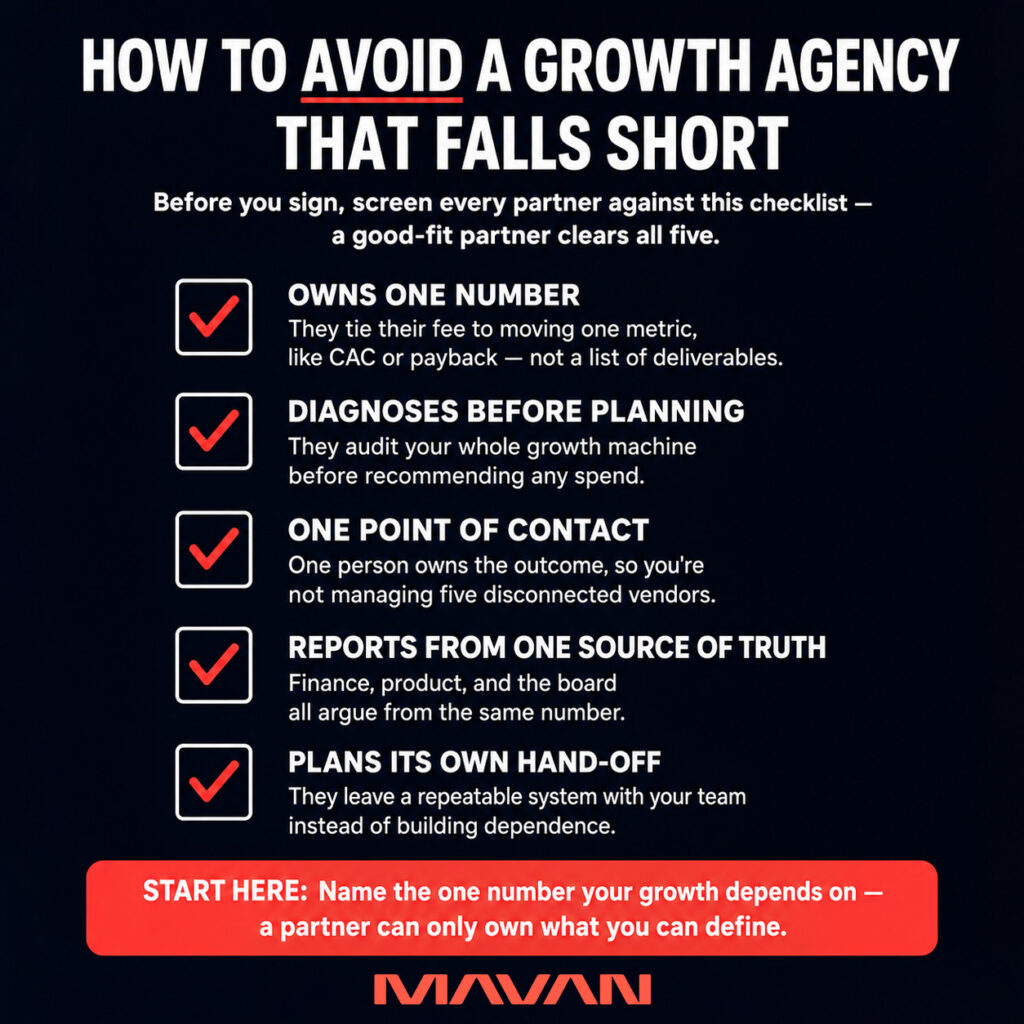
Run every candidate through the same checks. Each stands on its own as a question you can ask on a single call.
- Ask what single number they will own. A real partner names a metric and a timeframe — CAC, payback, activation, pipeline, EBITDA contribution. A list of deliverables is a scope, and a scope renews itself whether or not your business improves.
- Require a diagnostic before any plan. A partner that audits the whole growth machine before recommending spend is diagnosing your constraint; one that pitches a channel on the first call is selling its inventory.
- Confirm one accountable point of contact. One person should own the outcome and coordinate every specialist behind the scenes, so you’re not the integration layer between five vendors who each own a slice.
- Check who actually does the work. Ask which senior operators will be in your standups by name, and make sure the judgment that sold you the engagement is the judgment that runs it.
- Demand transparent, reconciled reporting. Insist on one source of truth that finance, product, and the board can all argue from, and on owning your own accounts and data.
- Require a hand-off plan. The best partners strengthen your internal team and plan their own exit. For a portfolio, that means a repeatable system that transfers between companies rather than living in one operator’s head.
These checks describe how MAVAN is built, and the results are the proof we’d want you to hold us to. For Titan, owning the number meant rebuilding the measurement layer first, which produced 3x better CAC efficiency while paid acquisition volume grew 5x. Angus Kirby, Director of Marketing at Titan, described the difference: “Unlike a lot of agencies where strategy just lives in a deck, MAVAN actually executed.” For KidStrong, the work cut customer acquisition costs 60% while, as CMO Erin Clift put it, feeling “like MAVAN was a part of our in-house team.” And when ElevenLabs needed international scale, MAVAN grew paid search into 20-plus markets at sub-12-month payback, then handed it back — Head of Growth Luke Harries noted the team “confidently transition[ed] the program to our in-house team.” You can pressure-test the full set of outcomes in our case studies, or see the model behind them in our growth services.
Frequently Asked Questions About Avoiding A Bad Growth Agency
How Do I Know If A Growth Agency Is Right For My Company?
The right growth agency owns a business outcome that matches your constraint, not just a channel you think you need. Before shortlisting, name the one number you need moved, then require each candidate to explain how they’ll move it, how they’ll diagnose first, and who specifically will run the account. Fit is accountability, not chemistry.
How Do I Know If My Marketing Agency Is Underperforming?
Compare results against industry benchmarks, not the agency’s own reports, and ask for clear attribution of revenue, pipeline, or margin to their work. If they can’t show a direct line to a business outcome after 90 days, that’s the signal. Vanity-metric reporting and resistance to sharing raw data access are reliable early warnings.
Should I Hire One Full-Service Agency Or Several Specialists?
Neither extreme works well alone. Several single-channel specialists leave the seams between them unowned, while one generalist is often merely okay at everything. The stronger model is a cross-functional team held to one outcome under a single point of contact, which keeps deep expertise without fragmenting accountability across scopes no one connects.
How Do I Choose A Growth Partner For A Private Equity Portfolio?
Choose a partner whose wins travel and survive diligence. A single-channel result at one company isn’t a repeatable system across the portfolio, and a sugar-high campaign won’t hold up at exit. Look for operators who install a durable growth system mapped to the value-creation plan, not consultants who deliver a deck and leave.
What Questions Should I Ask Before Hiring A Growth Agency?
Ask what single number they’ll own, whether they run a diagnostic before proposing spend, who specifically will run your account, and what leaving looks like. The answers you want are specific: a named metric, a real audit, named senior operators, and a hand-off plan. Vague answers to any of these are the signal to keep looking.
How To Really Avoid A Bad Growth Agency
You avoid a growth agency that falls short by refusing to hire for activity in the first place. Most agencies own a scope of tasks rather than the business number you care about, which is why fragmentation, outdated tactics, and misaligned incentives erode the result over time. Screen for the opposite: one accountable owner for one number, a diagnostic before any plan, reporting you can defend to a board or an exit committee, and a hand-off that leaves your team stronger. That structure is why some partners compound while others stall — the same structure that let MAVAN cut Titan’s CAC threefold while scaling paid volume fivefold.

Before you sign, run any growth agency through this checklist — a good-fit partner clears every box.
- ☐ Owns one number. They name a single business metric — CAC, payback, activation, pipeline, or EBITDA contribution — and tie their fee to moving it, not to a list of deliverables.
- ☐ Diagnoses before it plans. They insist on auditing your full growth machine before recommending spend, instead of pitching a channel on the first call.
- ☐ One accountable point of contact. A single person owns the outcome and coordinates every specialist, so you never become the integration layer between vendors.
- ☐ Senior operators stay on the account. The people who pitched you are named in your standups — the judgment that sold the engagement is the judgment that runs it.
- ☐ Reports from one source of truth. Finance, product, and the board all argue from the same number, and you own your accounts and raw data.
- ☐ Attributes work to revenue, not vanity metrics. They show a direct line from activity to pipeline, revenue, or margin within about 90 days.
- ☐ Stays current. They can explain how their approach has changed in the last year and how they produce creative fast enough to beat fatigue.
- ☐ Plans its own hand-off. They strengthen your internal team and leave a repeatable system behind — one that, for a portfolio, transfers between companies and survives exit diligence.
If you can name the one number your growth depends on, then ask every prospective partner exactly how they’ll move it in the first 90 days. If you can’t name it yet, start there — because a partner can only own what you can define.
The lowest-friction way to see where your growth is leaking, and what a partner should own on day one, is with our 360 Growth Analysis: it maps your whole growth machine in weeks, not months.
Casey Rock is Content Director at MAVAN, where he helps turn complex ideas into clear, strategic content that drives growth. With over 15 years of experience across content strategy, SEO, media, and digital marketing, Casey focuses on building content systems that connect audience insight, brand storytelling, and measurable business outcomes.
Book a complimentary consultation with one of our experts
to learn how MAVAN can help your business grow.
Want more growth insights?
Thank you! form is submitted
[hubspot type=”form” portal=”20951211″ id=”9c538ed2-fb12-45f1-a573-ad7953c058cc”]
Related Content
-
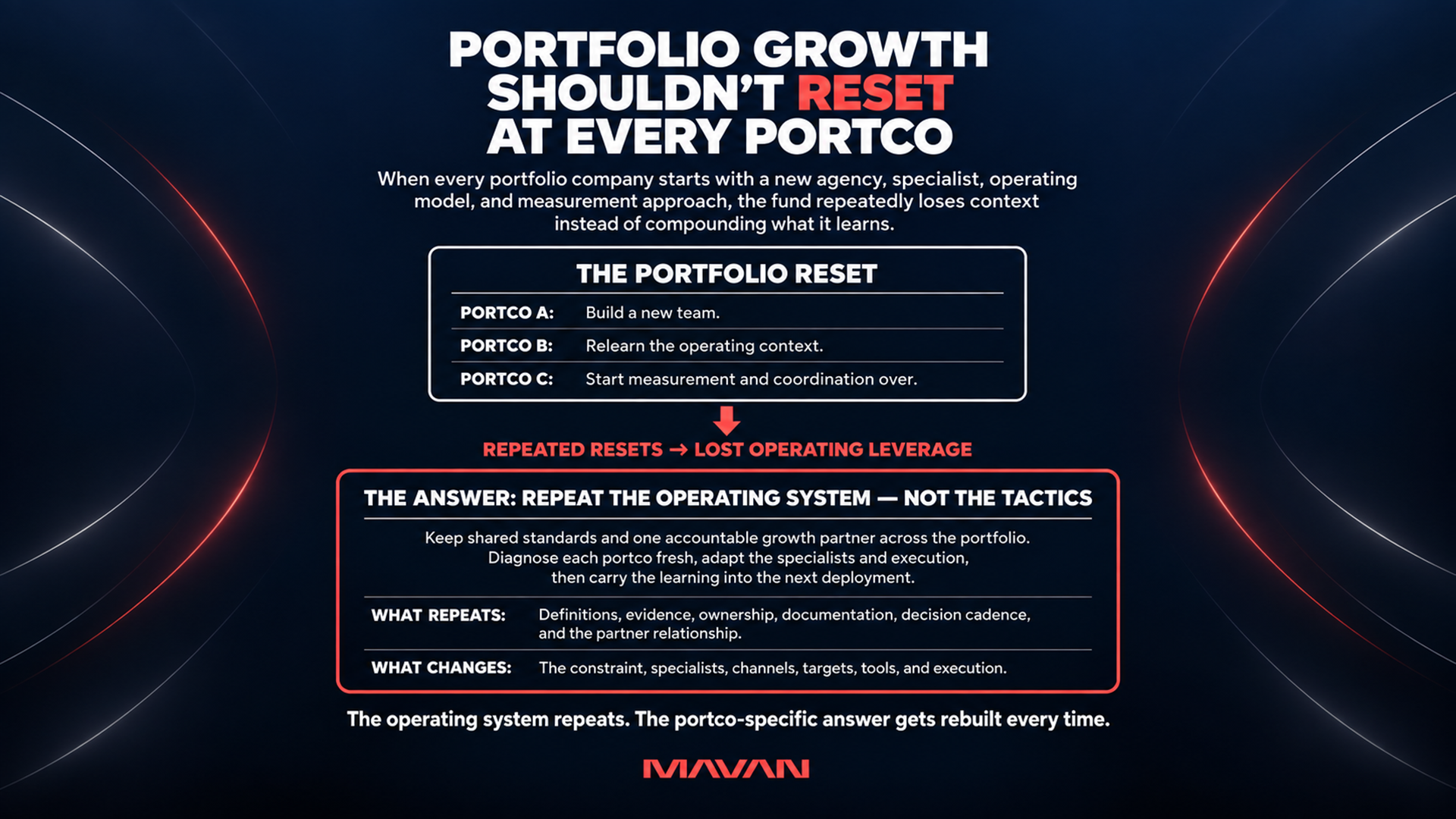
How Can Private Equity Funds Repeat Growth Across Portfolio Companies?
Growth becomes repeatable across a VC or PE portfolio when the fund installs one operating system instead of referring each company to a different specialist. The system has three parts: a single source of truth every team trusts, a board-ready scoreboard of ten to twelve metrics, and an embedded pod that diagnoses the real constraint in ninety days before anyone spends more.
-
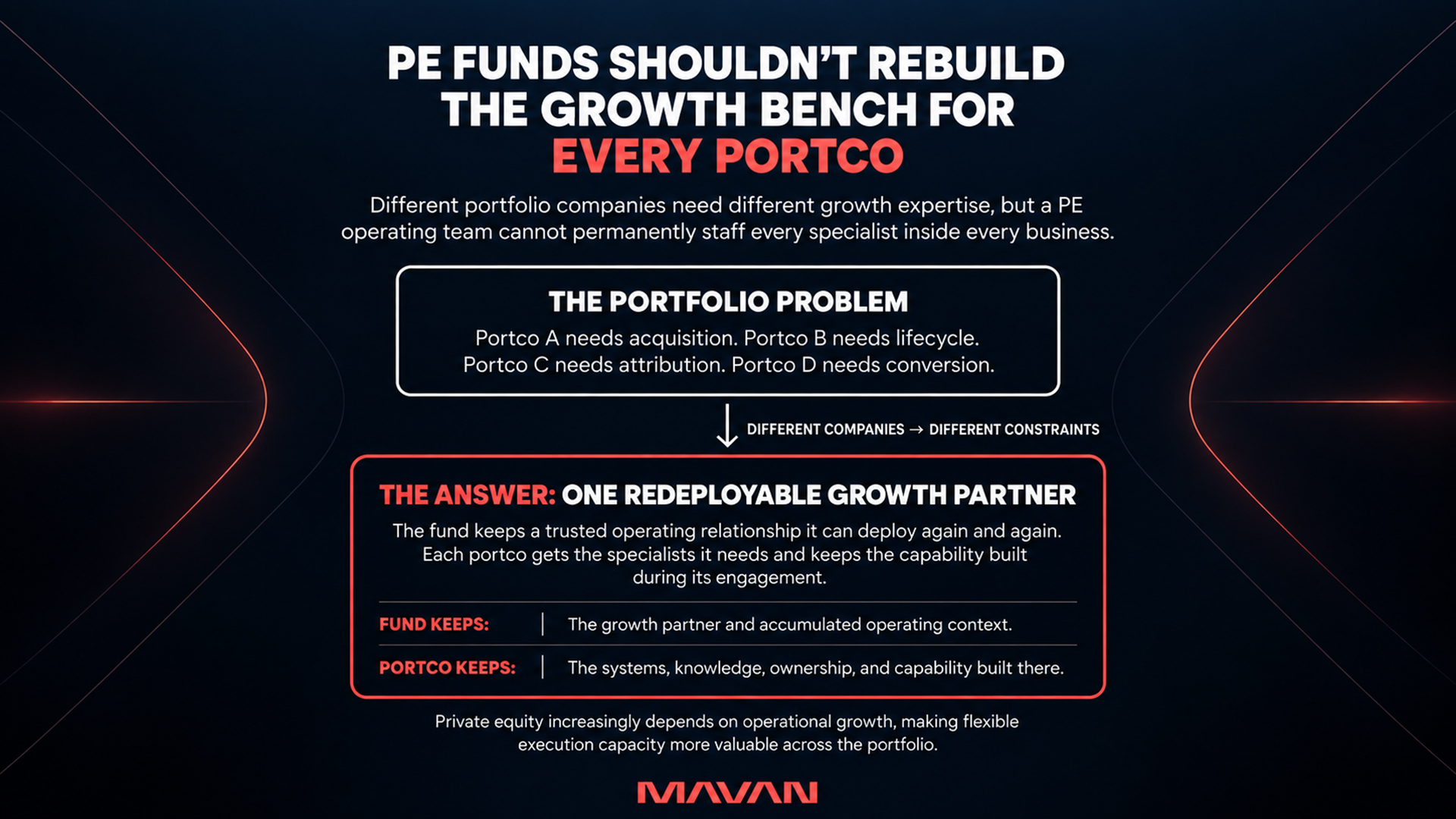
What Do PE Funds Want From a Portfolio Growth Partner? Repeatability!
What funds actually want from a portfolio growth partner is repeatability — a portable growth operating system that produces comparable results across very different portfolio companies. Repeatability shows up as a single source of truth, a board-grade scoreboard, a 90-day sprint, and a clean handoff, so each win compounds across the portfolio instead of staying at one company.
-
What’s the Best Growth Agency For VC & PE?
The best growth agency for a venture-backed or PE-owned company behaves less like a traditional agency and more like an embedded operating partner. It diagnoses your whole funnel, owns a revenue number such as CAC payback or LTV:CAC, and executes inside your team — rather than billing for activity in one channel.