
What does it take to lead — not just survive — in the evolving world of mobile gaming? Travis Boatman, founder of Carbonated, Inc., sat down with Matt Widdoes on the Growth@Scale podcast to answer that exact question. Spoiler: it’s not about following trends. It’s about setting them.
In a world where most developers chase what’s already working, Travis lays out a different path: build frameworks for innovation, integrate new technologies intelligently, and never settle for the status quo. His journey through EA, Zynga, and now Carbonated offers real-world proof that a bold, strategic approach can define an entire industry.
Creating New Playbooks, Not Copying Old Ones
Building a game isn’t just about writing code and shipping features. It’s about reimagining the experience from the ground up. Travis shares how, early at Zynga, they developed a framework built on four pillars — appeal, mechanic, retention, and monetization — that still guides his approach today.
“You have to take some risk to do something truly different. You can’t just paint by numbers.” — Travis Boatman
The market is saturated with games that feel the same. Breaking through requires bold decisions at both the creative and technical levels. At Carbonated, technology isn’t an afterthought — it’s the foundation for standing out. Aligning tech innovation with game mechanics isn’t optional if you want to stay relevant — it’s the price of admission.
Building Resilience into Every Move
Founding Carbonated wasn’t a career pivot; it was a calculated leap fueled by self-awareness and a refusal to play it safe. Travis recounts the mental pivot post-Zynga, when he recognized the only real failure would be not trying.
Starting a gaming company from scratch isn’t glamorous. It’s a grind — one where resilience isn’t a nice-to-have; it’s survival.
That mindset is exactly what separates ideas that stay on the whiteboard from companies that scale sustainably. Growth is never about a single breakthrough. It’s the compounding effect of relentless execution, learning, and iteration — values deeply shared across MAVAN’s approach to sustainable, full-funnel growth.
Where AI and Localization Are Redefining Player Experience
Travis isn’t just talking about the future — he’s building it. Carbonated is pioneering the use of AI and hyper-localization to deliver personalized gaming experiences that feel bespoke to every player.
In one test, AI-generated play descriptions tailored to local landmarks resonated so deeply that players thought a developer had crafted the content specifically for their hometown. That’s not just good UX — that’s emotional connection at scale.
“What’s interesting is as that turnaround cycle gets shorter and shorter, the customers get closer and closer to the content maker.”
In an era where players expect experiences to reflect their realities, integrating AI isn’t just a growth lever — it’s table stakes. Carbonated’s strategy mirrors how MAVAN drives results: by using data and technology not just to optimize, but to fundamentally transform user experiences.
Lessons for Leaders Who Want to Build (and Keep) Momentum
The biggest takeaway from Travis’ journey? Innovation isn’t about chasing shiny objects — it’s about using new tools to solve timeless problems better than anyone else.
The future of mobile gaming — and business growth in general — belongs to those who are willing to rethink frameworks, embrace technological shifts, and stay obsessively close to their audience.
That’s exactly how we operate at MAVAN: no band-aids, no bloated agencies, no magic bullets. Just deliberate, data-backed growth at every touchpoint.
If you’re ready to stop playing catch-up and start setting the pace, this episode of Growth@Scale is a must-listen.
Book a complimentary consultation with one of our experts
to learn how MAVAN can help your business grow.
Want more growth insights?
Thank you! form is submitted
[hubspot type=”form” portal=”20951211″ id=”9c538ed2-fb12-45f1-a573-ad7953c058cc”]
Related Content
-
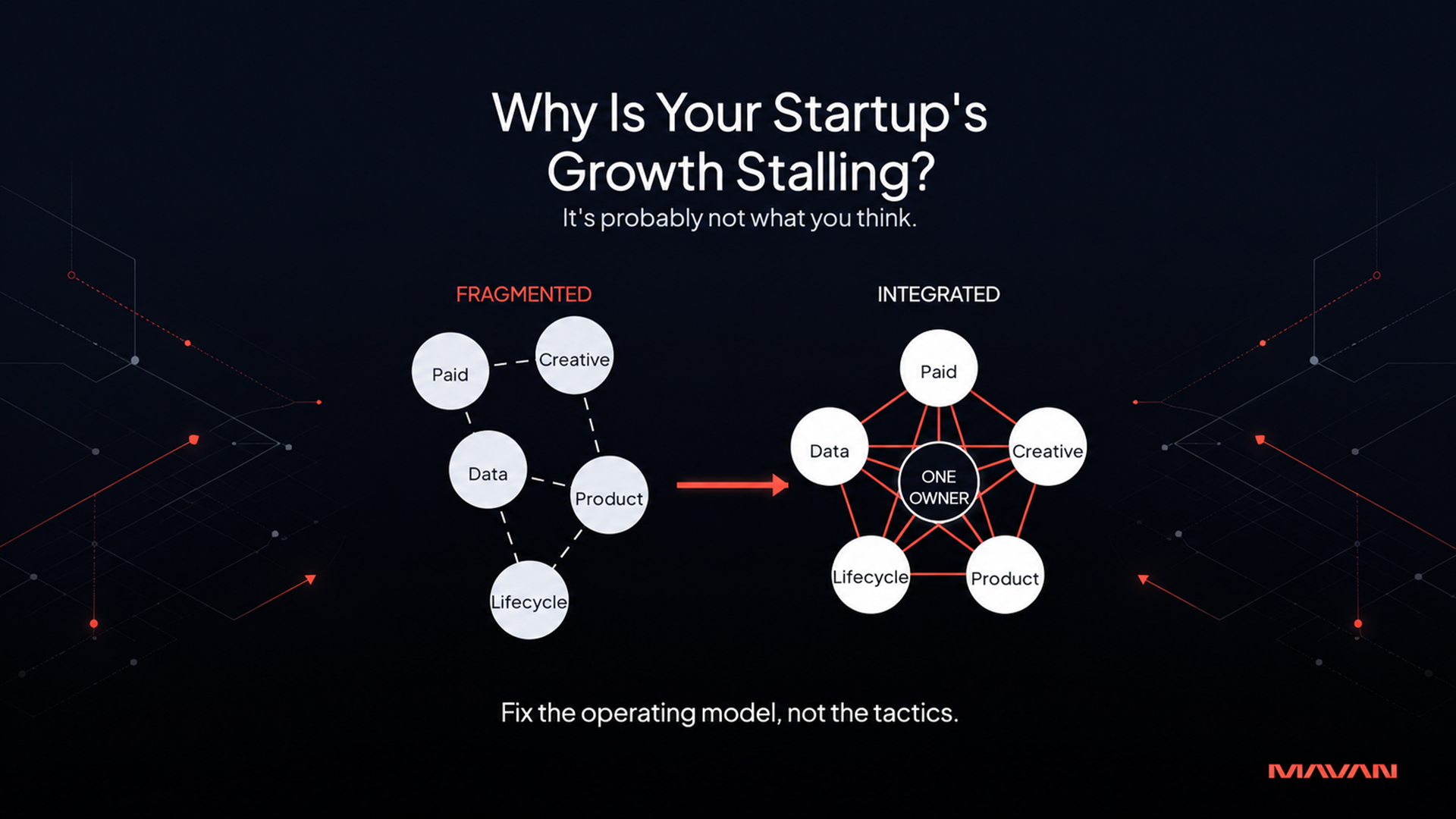
Why Is Your Startup’s Growth Stalling? Here’s The Fix.
Growth-stage startups don’t usually stall because the team isn’t working hard enough. They stall because hard work gets distributed across too many disconnected efforts, and nobody owns the system that ties them together. The fix isn’t more ad spend or more specialists — it’s integrating what you already have.
-
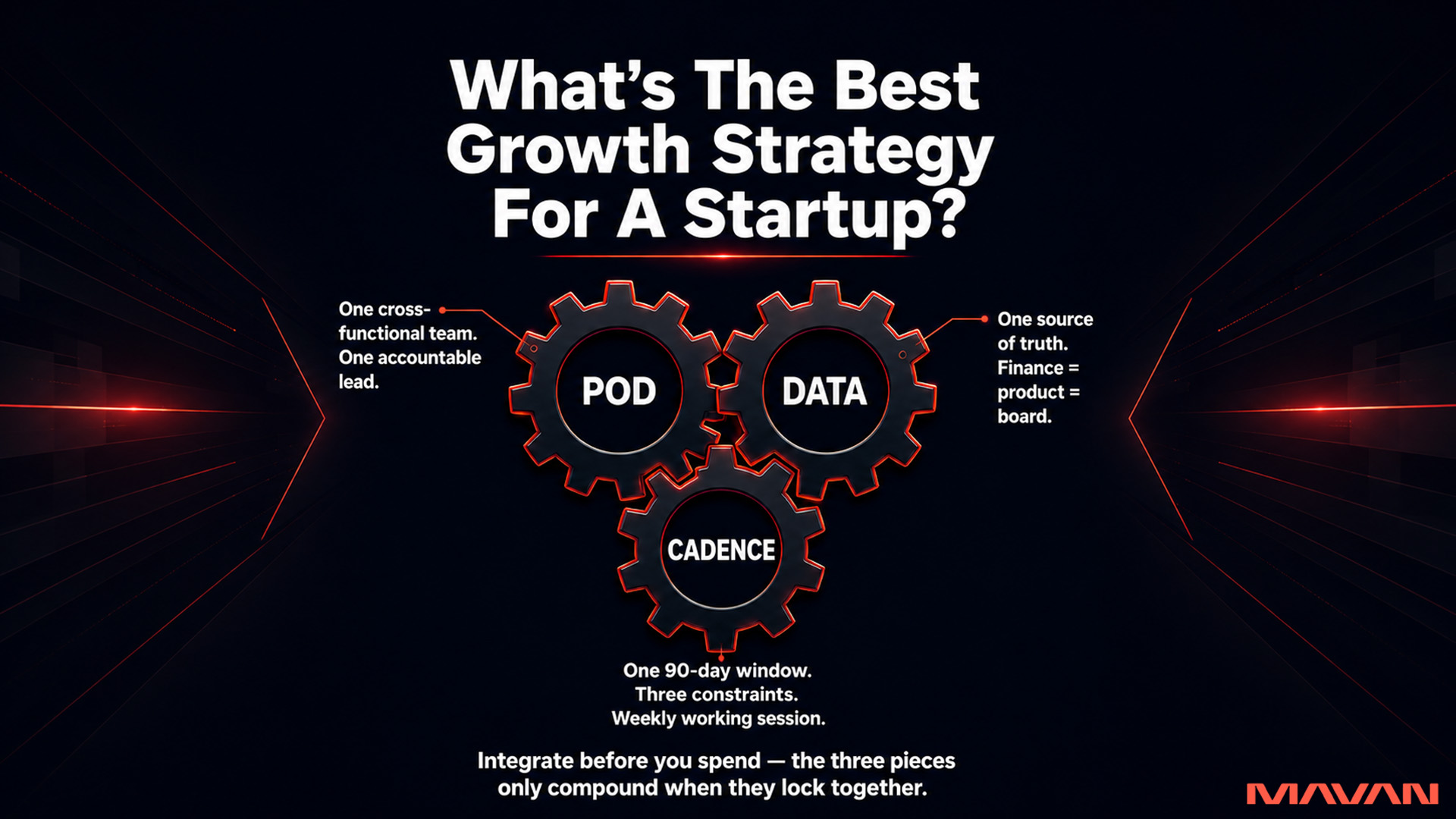
What’s The Best Growth Strategy For A Startup In 2026?
The best growth strategy for a venture-backed startup in 2026 is to integrate before you spend. Fragmented teams, tools, and data silently inflate CAC even when every individual channel looks healthy. Fix the operating model — one accountable pod, one source of truth, one 90-day cadence — and the wins start compounding instead of canceling each other out. Channels do not break unit economics. Lack of measurement discipline does.
-
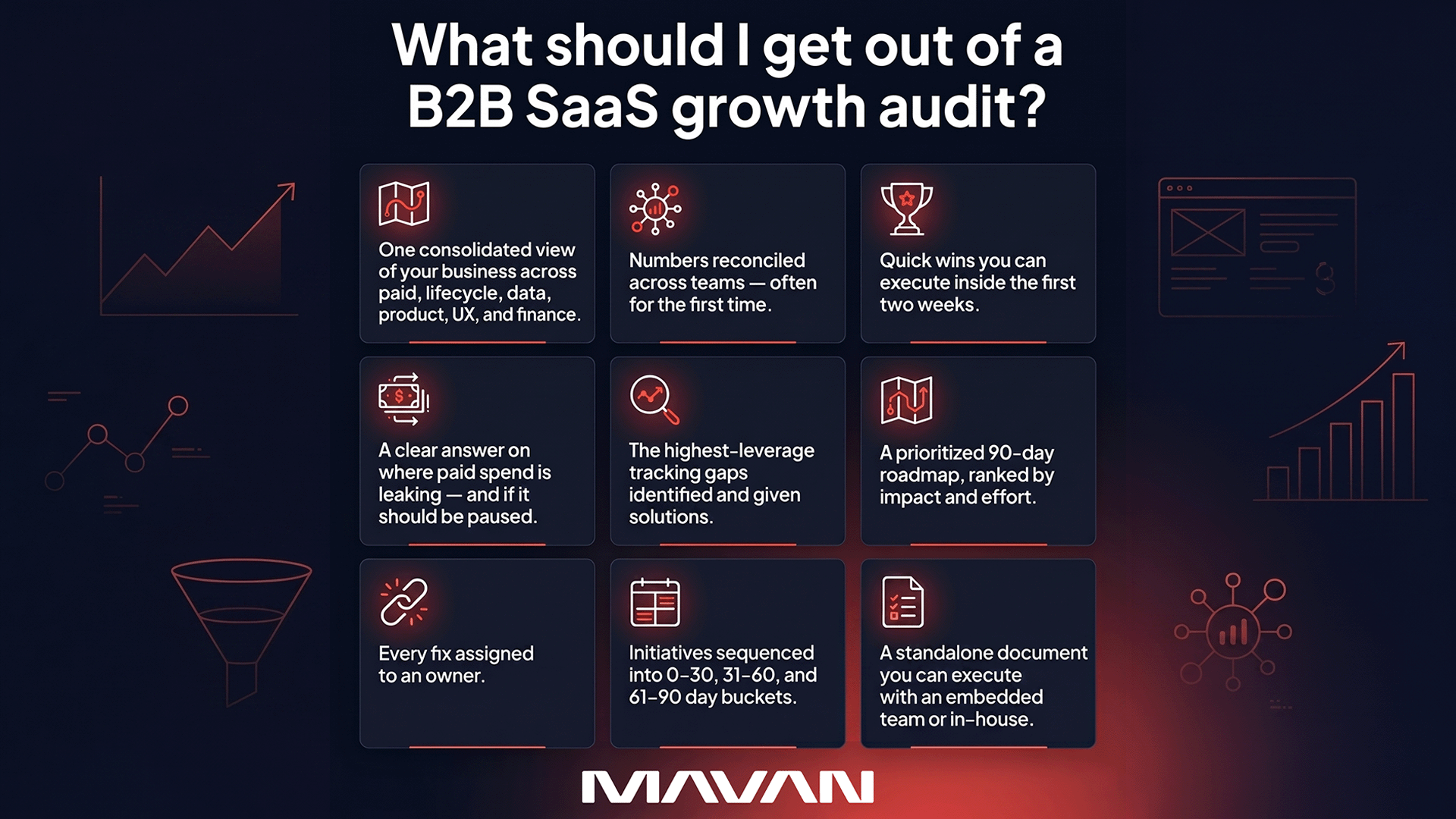
What Happens in the First 30 Days of a B2B SaaS Growth Audit?
The first 30 days of a MAVAN growth audit delivers three things. First, a single, consolidated view of your business — data, paid, lifecycle, product, and finance — written down in one place and reconciled across teams, often for the first time. Second, the quick wins your team can execute in week two without waiting: pausing the paid waste, fixing the highest-leverage tracking gap, and getting the silos in one room. Third, a prioritized 90-day roadmap, with action items scored and assigned, that sequences exactly what to do first, second, and third — with or without us.