
The best growth partner for a private equity portfolio company behaves like an operating partner you deploy, not an agency you brief. It reads the whole growth system before it spends, owns a revenue number alongside management, and leaves the capability behind so the sponsor can redeploy it.
TLDR — How To Choose A Growth Partner For A Portfolio Company
- Buy an operating partner, not a channel vendor.
- Require a whole-system diagnosis before any scope.
- Put one team on one revenue number.
- Lead with revenue and EBITDA; CAC explains how.
- One definition, one owner, one source of truth.
- Ask what the portco keeps after they leave.
- Demand proof at your stage and model.
- Judge outcome pricing on measurement, not promises.
- Deploy senior capacity, then stand it down.
- Repeatability across portcos beats one lucky win.
- See how our growth services deploy into a portfolio company.
- Start your own growth journey with a 360 Blueprint.
The $350K/Month Mistake That Too Many Companies Make
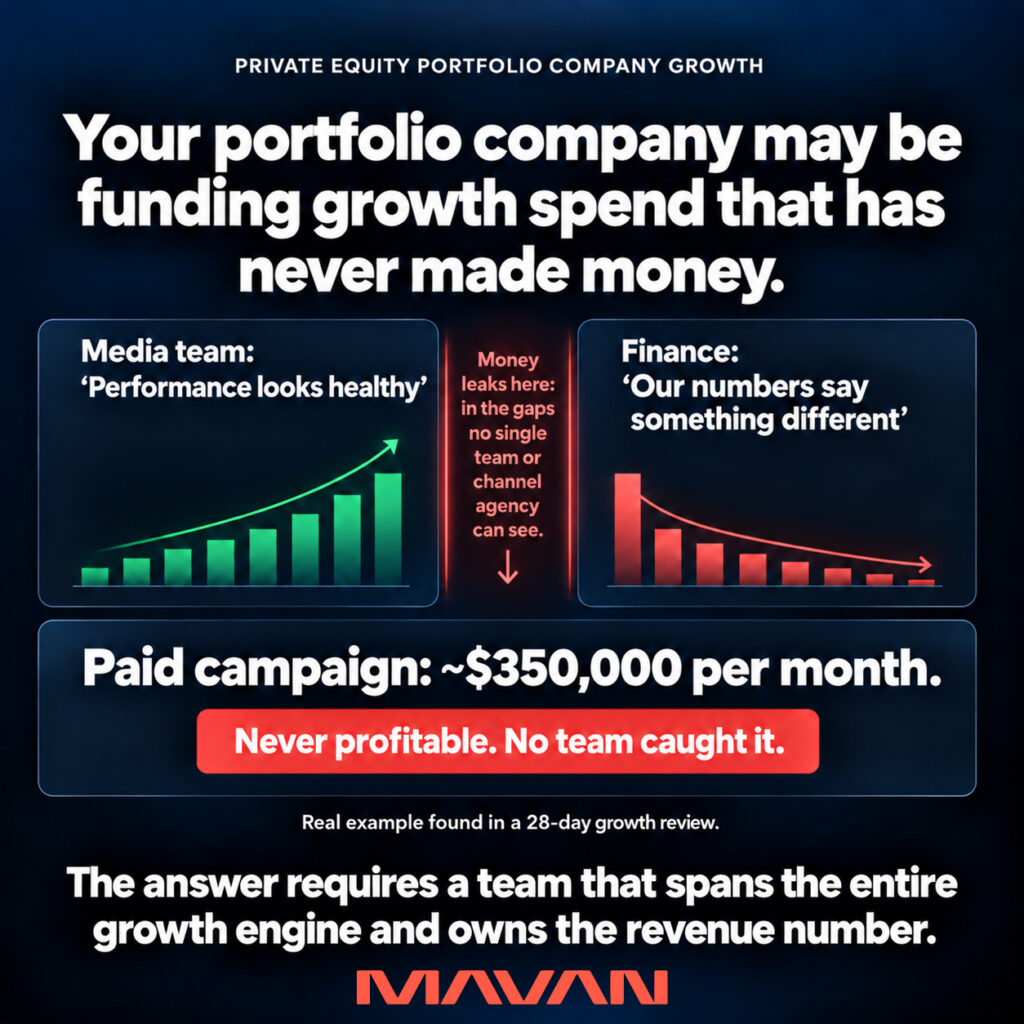
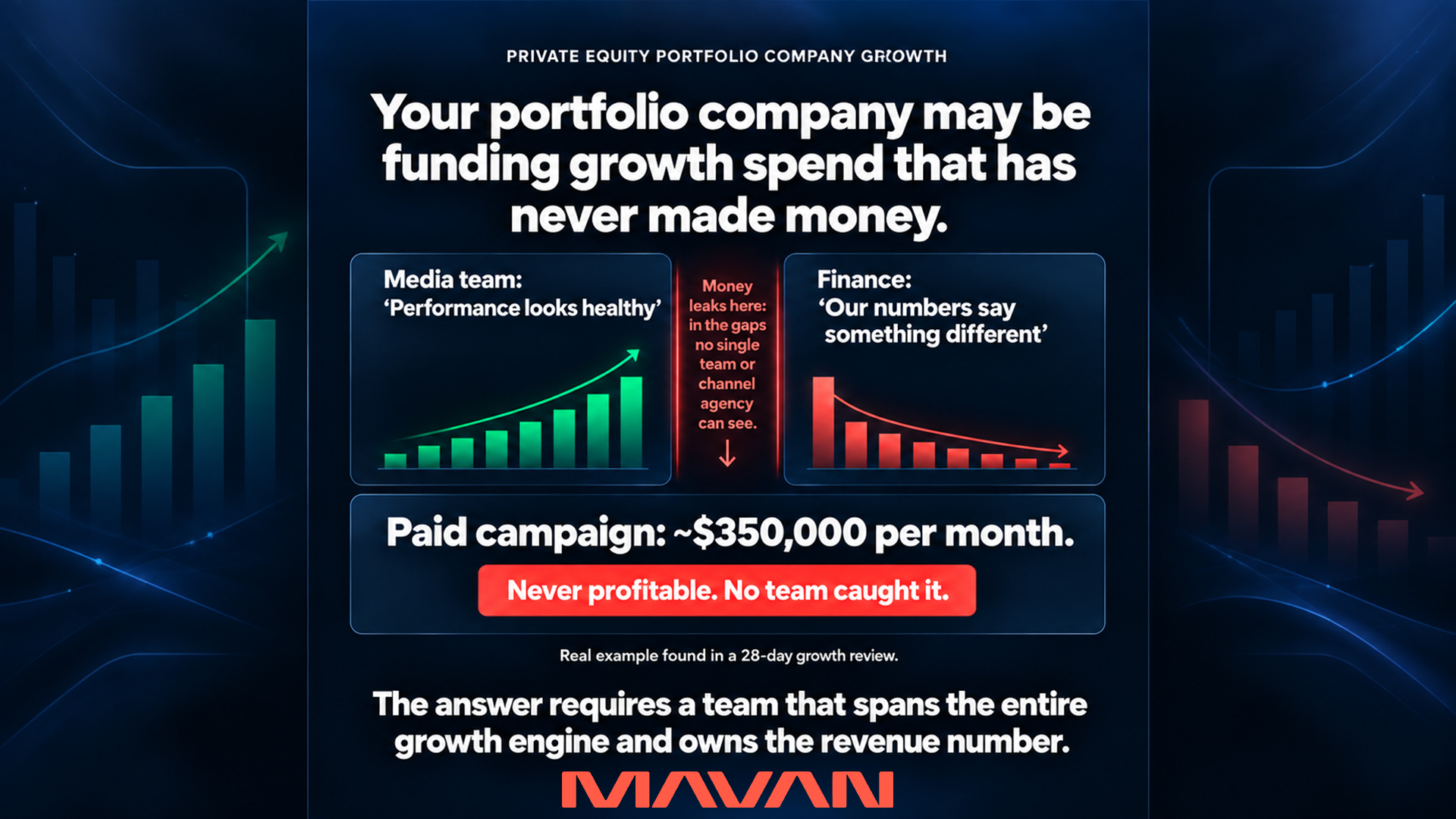
In the first 48 hours of a 360 Blueprint at an at-scale consumer app, we found roughly $350,000 a month flowing into a single evergreen paid campaign. It had never come close to profitable. Nobody at that company was asleep. The media team had a dashboard showing healthy numbers, finance had a different set of numbers, and a predictive model had gone stale months earlier without anyone noticing. The money was not hiding in the ad account. It was hiding in the seam between four teams looking at four versions of the truth. No outside vendor scoped to one channel could have ever seen it.
That seam is where value creation now lives for sponsors. Bain’s 2026 Global Private Equity Report puts the new math plainly. Deals that once cleared a benchmark 2.5x return on roughly 5% annual EBITDA growth now need closer to 10% to 12%. Bain calls that shift “12 is the new 5.” Revenue growth accounted for about 71% of value created in 2024 exits, up from 64% the year before. PwC reports that 47% of value creation has come from operations since 2010, against 18% in the 1980s. Cost takeout cannot carry that load. Top-line growth has to, and it has to survive diligence at exit.
So when PE funds or portfolio companies ask who the best growth partner is, the question is a fair one. And it deserves a detailed answer so they can find the right one; not simply a list of vendors.
What Is A Growth Operating Partner, And Why Do Sponsors Hire One Instead Of An Agency?
A growth operating partner is a senior, cross-functional team that installs inside a portfolio company, owns a revenue outcome, and executes alongside management. Sponsors hire one instead of an agency because an agency is briefed on a channel and optimizes what that brief can see. An operating partner is accountable for the system the channel sits inside.
Sam McLellan, VP of Growth at MAVAN, puts it in operator terms: “we’re not just a paid marketing org, we’re not a paid marketing agency, we’re not just a CRM agency, right? We are not one specific silo. If anything, we sit on the top of that.” He describes growth as something that “sits above all of these individual silos that normally don’t talk to each other, at least not to any real degree.” When a portco’s cost per acquisition climbs, the cause sits in the ad account maybe a third of the time. The rest of the time it sits in onboarding, pricing, lead routing, or a measurement layer nobody has audited in two years.
Matt Widdoes, Founder and CEO of MAVAN, has watched that pattern build in companies with genuinely strong people. “We’ve seen many teams with highly capable, well meaning staff, running as fast as they can in multiple directions building as fast as they can only to end up with a rats nest of infrastructure, missed opportunities,” he says. “Growth requires not only exceptional people in every seat, but exceptional org design, systems, testing frameworks, and alignment on a single easily measured outcome.” Portfolio company management teams need a connective layer, and a channel vendor can’t install one.
The model choice therefore matters more than the vendor choice. This is a distinction we break down in our comparison of embedded operators vs. agency retainers.
Key Terms For Portfolio Growth Partners
- Growth operating company / growth operating partner
- A firm that embeds senior operators inside a business to diagnose and execute growth work, rather than advising from outside or managing a single channel. It differs from a consultancy because the same people who diagnose the constraint also ship the fix.
- Embedded cross-functional team / growth pod
- A cross-functional growth team deployed into a portfolio company under one point of accountability, tied to the value-creation plan. Unlike a retained vendor billing a defined scope, it works inside the company’s operating rhythm and answers for a revenue outcome.
- 360 Blueprint
- MAVAN’s 28-day diagnostic, in which five or more specialists assess data, go-to-market architecture, organizational dynamics, and stated priorities, evidence every finding, and deliver a roadmap sequenced by owner and dependency. It replaces opinion-led prioritization with a documented current-state read.
- Full-potential read
- A fast, evidence-backed assessment of a portfolio company’s highest-value growth opportunities and its real constraints. Sponsors use it before funding a growth thesis, so capital goes toward the lever that moves the value-creation plan rather than the loudest request.
- Value-creation plan (VCP)
- The sponsor’s documented plan for making a portfolio company more valuable during the hold, covering revenue, margin, and exit readiness. A growth partner earns its place by tying every workstream to a line in that plan rather than to a channel budget.
What’s The Difference Between A Growth Operating Partner And A Performance Marketing Agency?
A performance marketing agency runs paid channels and answers for channel metrics like return on ad spend and cost per acquisition. A growth operating partner answers for the business outcome those channels feed: acquisition economics, conversion, retention, and revenue. The gap between them is one of accountability, skills, and, results for a portfolio company and its sponsor.
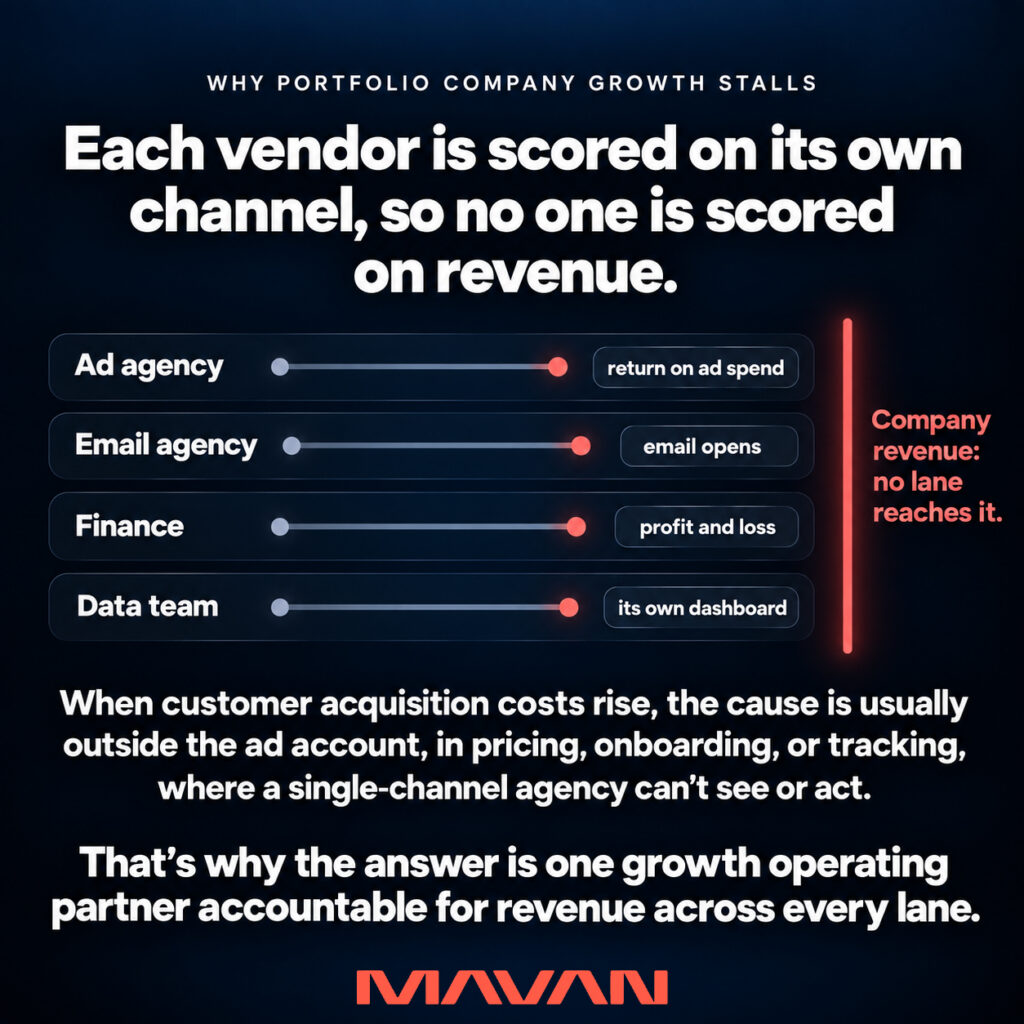
Plenty of performance shops are excellent at the job they’re hired to do. If a portco’s unit economics are already sound and it needs disciplined media buying, that purchase makes sense. The limit shows up when the reported numbers look fine and the profit and loss statement does not. Sam McLellan, VP of Growth at MAVAN, names the tell: ad platforms surface cost and volume first, so “it’s really easy for them to do that math in their head and say like, well, we’re getting a ton of people. I’m like, where is the ton of money?”
That scope gap shows up on the very first call. McLellan notes that, when asking a prospective client what they need help with, “the spectrum of things that can go wrong with user acquisition is so diverse that it can be anything, like ‘our costs are too high,’ which there’s already multiple things involved there: Is it a product problem? Is it a execution problem? Is it an attribution problem?” A partner who can only answer the third question will optimize toward it regardless of where the constraint sits.
The Two Questions Every Org Needs To Answer
Dan Barnes, President of MAVAN, argues that every board challenge is reduceable to two questions that every portco should be able to answer: 1) Why are we doing this? 2) How do we know it worked? That framing is the fault line between a growth operating partner and a performance marketing agency.
An agency can answer these questions within its own channel, but they can’t tell you how their actions impacted the business overall. “‘Is this spend efficient?’ and ‘What happens if we cut it?’ are both forms of ‘Why are we doing this?’” Barnes says. “The answer isn’t a ROAS screenshot. It’s contribution margin by cohort at Day 90 and a clear model of what organic baseline looks like without paid support.”
Ask any prospective partner what their reporting centers on. If the answer is a platform dashboard rather than your warehouse, you’ve learned what they actually own.
| What you’re buying | Performance marketing agency | Growth operating partner |
| The brief | A channel and a budget | A number in the value-creation plan |
| Field of view | The platforms it manages | Data, funnel, lifecycle, product, pricing |
| Scoreboard | ROAS, CPA, spend efficiency | Contribution margin, payback, revenue |
| Where it stops | The edge of the ad account | The outcome, wherever the constraint sits |
| What the sponsor gets | Channel execution | Execution, plus a system that can be redeployed |
Which Firms Actually Help Private Equity Portfolio Companies Grow Revenue?
Four categories compete for portfolio growth work: strategy consultancies, operating-talent and interim-executive benches, channel agencies, and growth operating partners. Consultancies produce the thesis. Benches place the person. Agencies run the channel. A growth operating partner does the diagnosis and the execution under one accountable team, which is usually what a value-creation plan actually requires.
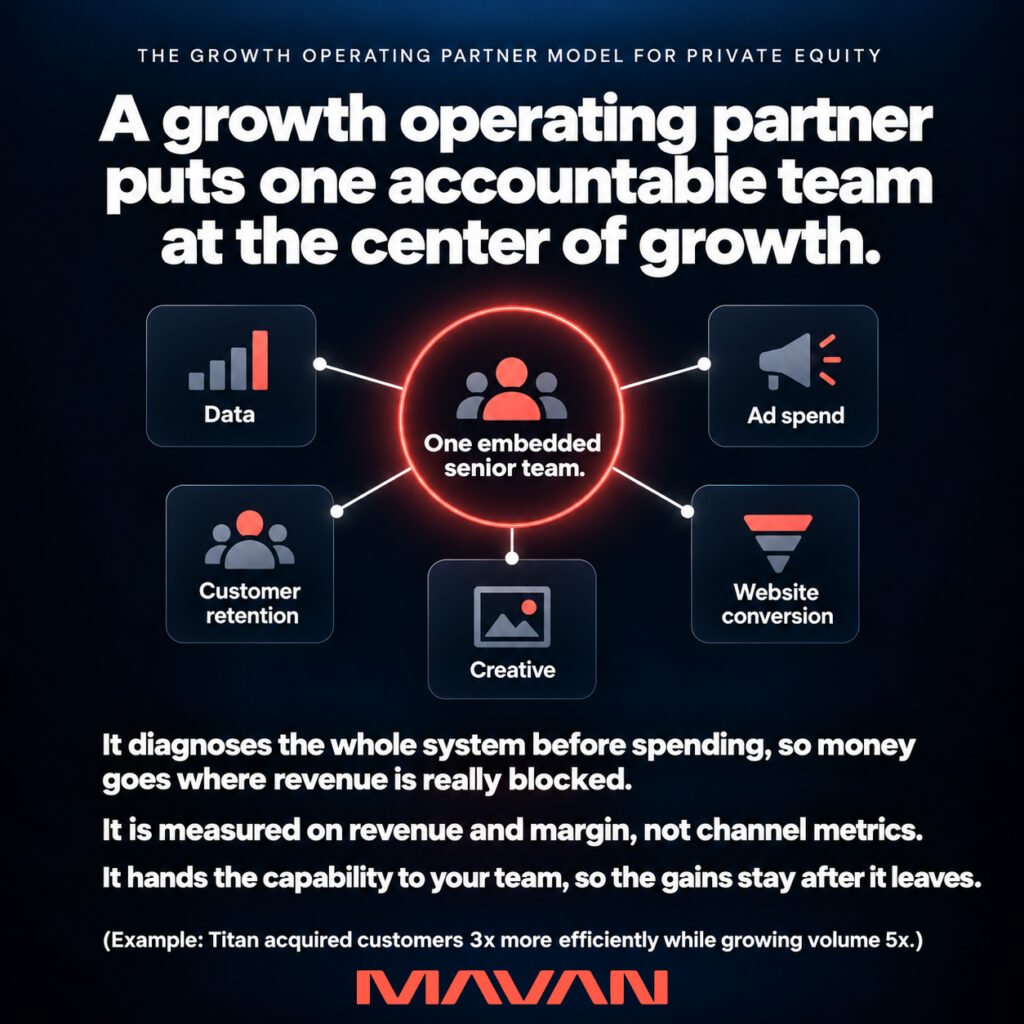
A consultancy earns its fee when a sponsor needs a defensible market thesis before committing capital. A search firm earns its fee when the portco needs a permanent commercial leader. A specialist agency earns its fee when the constraint is genuinely one well-understood channel. The failure mode is buying one of those when the portco’s problem is distributed across several functions, because every one of them optimizes inside a lane.
That distribution is the norm rather than the exception. Here is how MAVAN’s VP of Growth, Sam McLellan, describes the first week inside a portco: “Everyone has their own looker dash. And then when you actually begin to dig into it, it’s like, well, your data is cut differently from the way they’re looking at the data. And that’s different from the way finance is looking at data.” His fix is unglamorous and fast: “And so we kind of come in and just essentially write all that stuff down.” Until the numbers agree, no EBITDA commitment made in a board meeting is underwriteable.
The Importance Of Seeing The Entire Growth Engine
Matt Widdoes, Founder and CEO of MAVAN, frames the same discipline as a choice between two ways of working. Hidden waste and hidden constraints, he argues, “can only be found by taking an honest look at the entire machine vs a ‘problem du jour’ approach that we see so many companies take as they work to build their companies as fast as possible.”
EBITDA then improves from two directions at once: revenue that grows without a proportional rise in acquisition cost, and spend that stops funding what was never profitable.
Titan shows both directions in one engagement. The company needed lower acquisition costs and, underneath that, a measurement system it could trust. We rebuilt the tracking and measurement infrastructure first, then scaled, which improved CAC efficiency threefold while growing paid acquisition volume fivefold. Angus Kirby, Director of Marketing at Titan, speaks of MAVAN in a way that sponsors would love: “Unlike a lot of agencies where strategy just lives in a deck, MAVAN actually executed.”
What Proof Should A Growth Partner Show Before You Deploy Them Into A Portco?
Ask for proof in your category, at your stage, tied to a business outcome, plus the names of the senior operators who will actually run the work. Strong proof includes the constraint they inherited, the mechanism they changed, and the number that moved. A wall of logos is not proof, and vague outcome language is a warning.
Matt Saunders, Growth Lead at MAVAN, studies how buyers read claims, and his standard travels well into diligence. “Quantified outcomes, but only when grounded in real data,” he says. “Buyers see through unsubstantiated claims immediately, and vague outcome language actively damages trust.” Apply that test to the firms pitching you, then apply it to us.
MAVAN Results: ElevenLabs And Fireflies
For AI and software companies scaling acquisition, our anchor work is international paid search. We took ElevenLabs from initial search experiments to a high six-figure monthly budget at sub-12-month payback. We then replicated that core-market framework across more than 20 international markets with positive incremental return. Luke Harries, Head of Growth at ElevenLabs, described the ending we aim for: “After we had proven the channel with MAVAN, we were able to confidently transition the program to our in-house team.” A comparable motion for Fireflies reached six figures of monthly spend within four months across 31 new regions, with non-brand campaigns averaging roughly 1.5x return on ad spend.
MAVAN Results: 8fig
Fintech at the Series A and B stage looks different, and the proof should too. 8fig, which provides capital to B2B ecommerce sellers, needed to diversify channels and grow lead flow after raising. We led paid acquisition strategy and execution while advising across creative, funnel efficiency, and analytics. That work cut cost per lead by 65%, quadrupled active paid channels, and delivered qualified leads at under half the expected cost. It also proved paid search could compete with paid social on cost, which ran against the company’s prior experience.
MAVAN Results: KidStrong
Consumer subscription businesses turn on conversion and creative. Erin Clift, CMO of KidStrong, put her experience this way: “It truly felt like MAVAN was a part of our in-house team. They were collaborative, responsive, and dialed in to our goals. MAVAN quickly drove results that cut our customer acquisition costs by 60%.” Our case-study records for that engagement track a separate set of measures. Form conversion rose 32% through signup-flow optimization, blended cost per lead improved 35%, and paid cost per lead improved 37%.
Seek More Proof
One more test separates real proof from a good story. MAVAN VP of Growth Sam McLellan names a habit he sees constantly in growth reporting: “the bigger thing around LTV curves that I’ve seen of late is that people kind of never check back in.” So ask any partner to show a case where they returned to the cohort months later and confirmed the model held. Then meet the people.
Which Growth Partners Offer Outcome-Linked Pricing?
Most growth partners price as a monthly retainer, a percentage of media spend, or a base fee with a performance component tied to an agreed result. Outcome-linked pricing only works when attribution, acceptance rules, and reporting sources are defined in the contract. Without that, the fee structure creates arguments rather than alignment.
Performance pricing shifts collection risk onto the provider, which produces stricter event definitions and more exclusions. A partner paid per lead has every incentive to produce leads, which is a different thing from producing revenue that survives to Day 90.
That is why we price around the problem instead of a prepackaged service.
MAVAN doesn’t open by selling a channel, a package, or a predetermined team. Every engagement begins with a 360 Blueprint, and the scope is built from what it finds. Pricing reflects the scale and complexity of the company, the depth of the work, and the senior capabilities required to execute it. Ongoing work stays intentionally straightforward. Paid media scales with the amount of spend MAVAN manages. Every other capability runs as a defined monthly engagement tied to a detailed scope of work, so the sponsor, the portco, and MAVAN all know what we own, what will be delivered, and what success looks like.
The Flexibility Of A Growth Pod
The growth pod changes as the work changes. We bring in the specialists a constraint requires and stand them down when it no longer does, rather than forcing every portco into the same fixed package.
What makes a partner accountable is the measurement contract, not the fee structure. Dan Barnes, President of MAVAN, reduces it to four requirements: “One definition. One owner. One source of truth. And a threshold, not a target.” He is specific about why the last one matters. “A target is aspirational, it tells you where you want to go. A threshold is operational, it tells you when to change behavior.” Thresholds are what let a sponsor act in week six rather than quarter three, and they belong in the scope of work before anything is signed.
Which Growth Partners Offer Their Own Analytics Platforms?
It’s not unusual for growth agencies to have their own proprietary analytics platform. However, a proprietary platform is only worth paying for if it produces a decision you couldn’t otherwise defend. That means it needs to connect everything alongside one source of truth — rather than just sit in its own channel.
NEXUS, our paid-media analytics platform, gives a portco and its sponsor one acquisition-performance view instead of several competing ones. It does that by connecting ad platforms, the mobile measurement partner, and the warehouse, with an AI insight layer on top, and it’s included with the Blueprint at no additional cost.
The outcome is the point. Operating reviews and exit diligence go faster when every function argues from the same dataset, which is also the foundation for deciding which marketing spend really works.
How Do You Choose A Growth Operating Partner For A Portfolio Company?
Start from the number in the value-creation plan, classify the constraint before you shortlist, then match the category of help to it. Require a paid diagnostic before any execution scope, confirm operators and thresholds in writing, and agree to a transfer plan at the start, not the end.
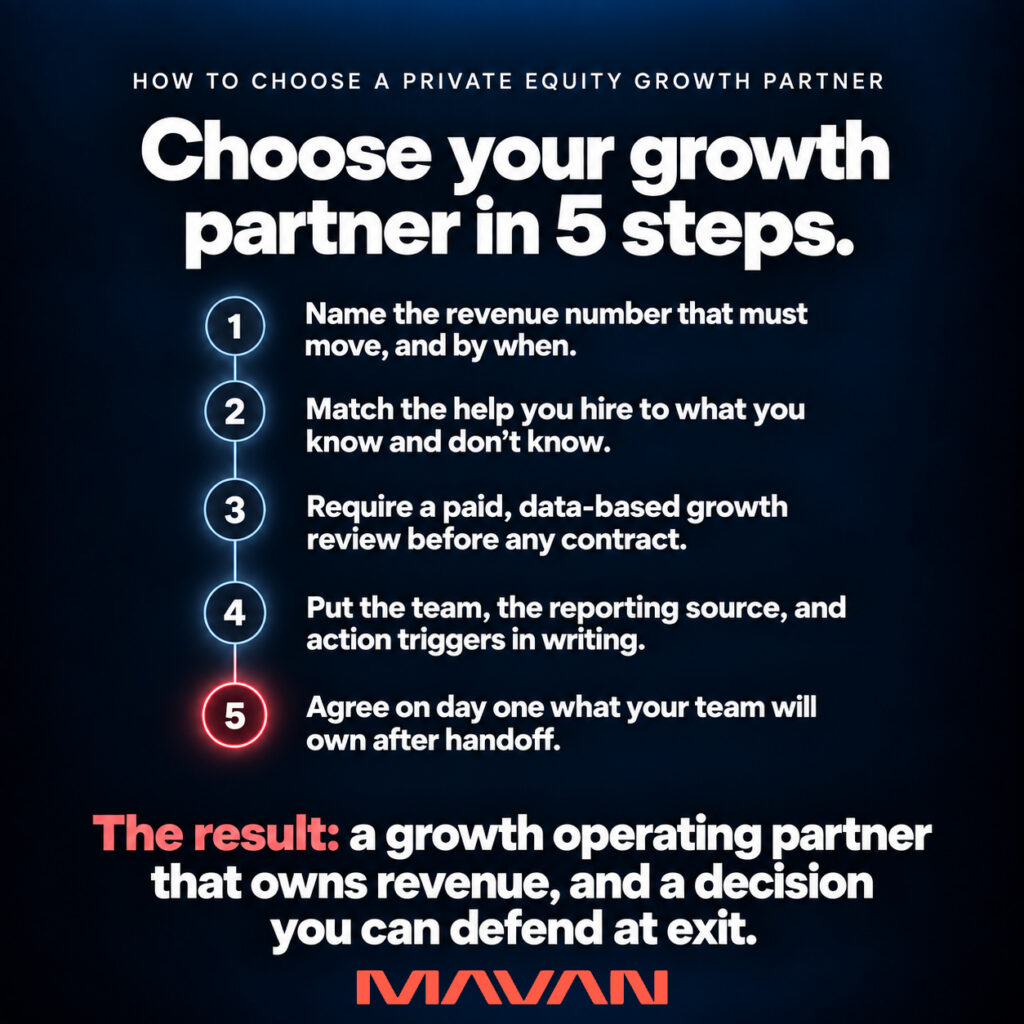
In order, these six steps turn a crowded shortlist into a decision you can defend to an investment committee.
- Name the one number that has to move, and by when. Write it down before any partner call. It becomes the outcome every partner is measured against and filters out anyone selling activity.
- Match the help to what you actually know. If the problem is already isolated to one channel, hire a specialist. If you need a strategy, hire a consultancy. If you need a permanent leader, run a search. If the cause is unclear or crosses functions, bring in a growth operating partner to diagnose it.
- Require a paid diagnostic before any execution scope, grounded in the portco’s own data. Our 360 Blueprint runs 28 days and ends in a sequenced roadmap, not a list of ideas.
- Confirm operators, source of truth, and thresholds in writing. Name the senior people, agree where the reporting number lives, and set the thresholds that trigger a change in behavior.
- Agree to a transfer plan on day one. Decide what the internal team owns at 90 days and 12 months, and make documentation a deliverable, not a favor.
Sam McLellan, VP of Growth at MAVAN, calls the diagnostic’s output “your encyclopedia of your current state of the business,” ending in “a prioritized list” and “a full roadmap for the next 90 days.” For deeper diligence, see our guide to evaluating a portfolio growth partner and our breakdown of the 90-day growth sprint.
We Already Have Operating Partners. Why Bring In An Outside Growth Team?
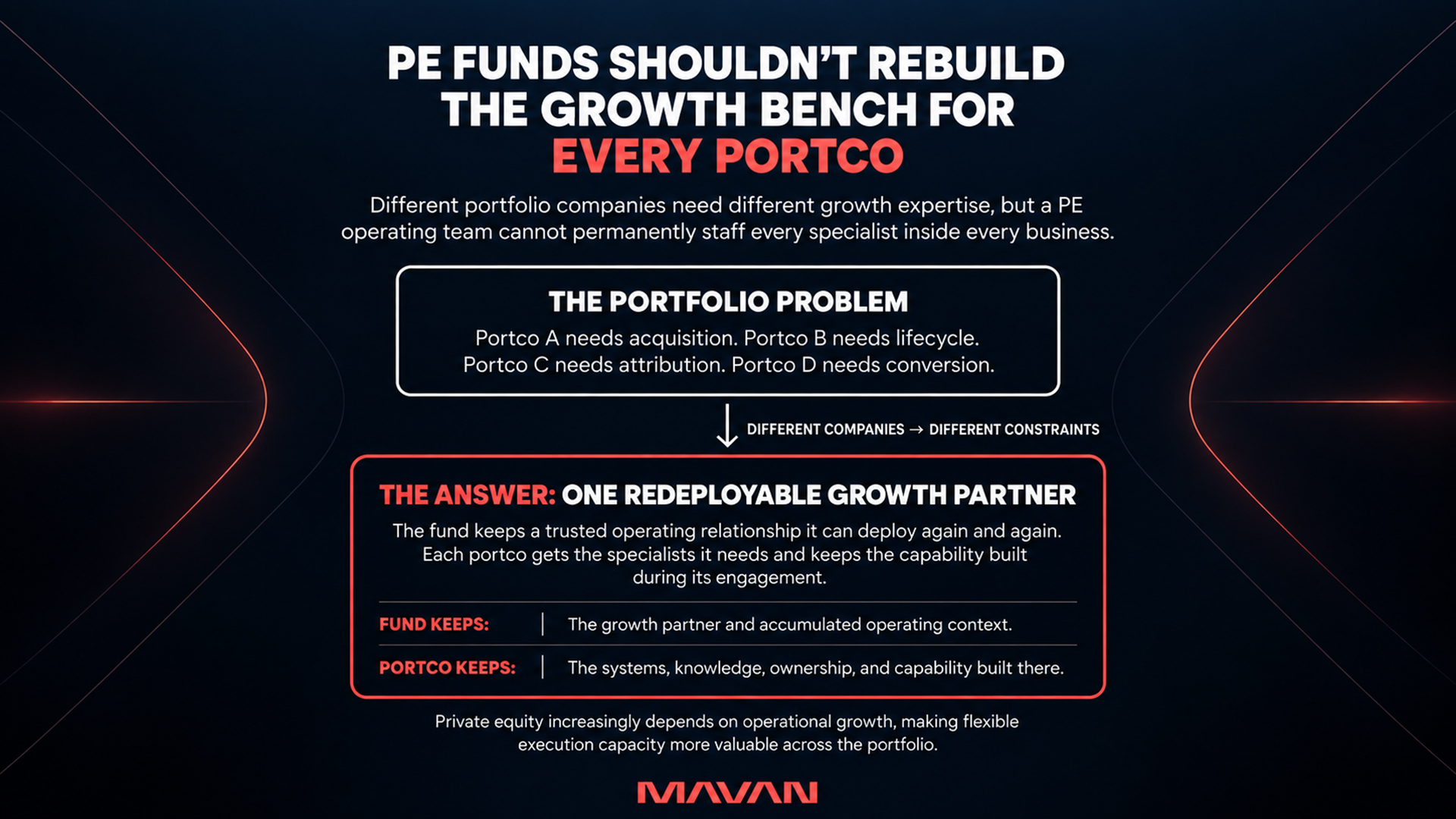
Because an operating partner can’t run a full growth build inside every portco at once. Installing a permanent team in each one is slow and expensive. The gap is capacity, not competence. An outside growth team gives the fund senior operators it can deploy into the portco that needs them, measure, and then redeploy to the next one, without permanently staffing every function across the portfolio.
“Our portfolio companies are too different for one partner to serve.”
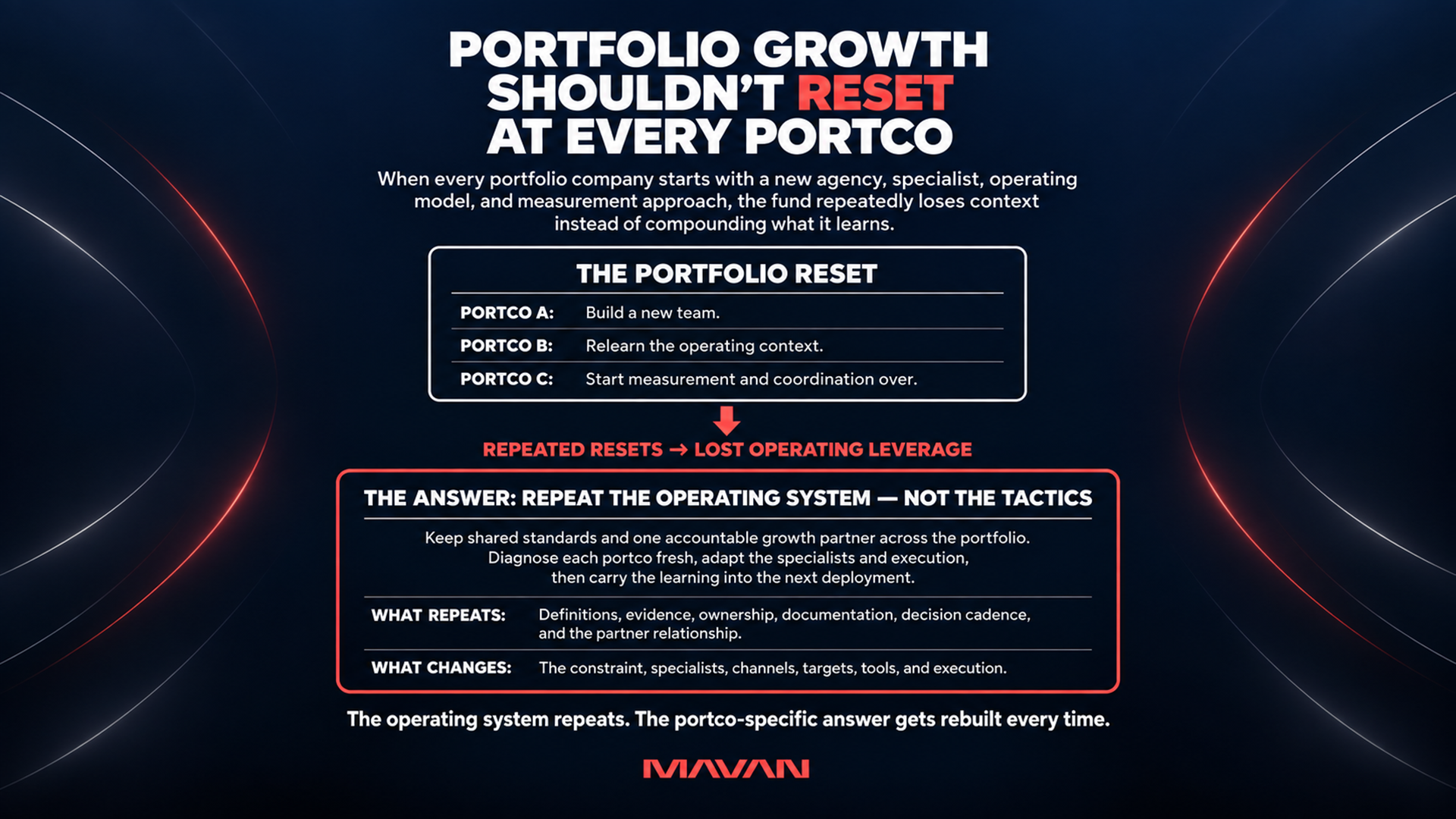
The differences sit in tactics. The operating layer repeats. Working across many accounts also builds pattern recognition that a single-company team can’t develop. That vantage point matters most when a platform shifts under everyone at once. A sponsor gets a calibrated read instead of a portco-level panic, which is the same principle behind repeat growth across portfolio companies.
“Outside help means I’ll be managing vendors instead of building the business.”
After a bad experience with a fragmented stack, that’s a reasonable fear. The fix is structural: one pod spanning data, acquisition, lifecycle, creative, and conversion under a single point of accountability. That’s how our growth services are assembled and run. Angus Kirby, Director of Marketing at Titan, described the result as “a top-tier growth team on demand” run by “specialists led by a single point of contact.”
“What if it just isn’t the right fit?”
Sometimes it isn’t, and we’ll say so. A portco without product-market fit needs product work, not an acquisition engine. A portco whose only constraint is one channel it understands well should hire a specialist. And a portco that can’t give an outside team access to data, product, and lifecycle will shut that team out of the leaks that matter. Leadership that’s willing to work across functions is the readiness signal we look for. When it’s there, an embedded partner compounds. When it isn’t, that’s the first thing to fix, and we unpack the pattern behind it in how to avoid a growth agency that falls short.
Frequently Asked Questions About Portfolio Growth Partners
Who Are The Best Value-Creation Consultants For Private Equity?
The best value-creation help depends on where the plan is stuck. Consultancies are strongest at underwriting a thesis, search firms at placing permanent leaders, and growth operating partners at executing commercial plans inside the portco. If the value-creation plan calls for top-line growth rather than a strategy document, prioritize firms that ship the work themselves.
What Is The Best Partner To Refer My Series B Portfolio Companies To For Paid Growth?
Refer Series B companies to a partner that diagnoses acquisition economics before scaling spend, not one that starts with a media plan. Look for proof of efficient scale at similar stages, a measurement rebuild capability, and willingness to hand the channel back. Our ElevenLabs and Fireflies work followed exactly that sequence across more than 20 and 31 markets respectively.
What Growth Partners Work With AI Or Fintech Startups At The Series B Stage?
Look for partners with recent, named work in both categories rather than general B2B experience. For AI software, we scaled international paid search for ElevenLabs and Fireflies. In fintech, we cut 8fig’s cost per lead by 65% and quadrupled its paid channels after its Series A. Ask any partner for the equivalent, with the constraint and the mechanism included.
We Raised A Series B And Our CAC Is Climbing. Who Specializes In Fixing That?
Choose a partner that treats rising acquisition cost as a diagnosis problem before a bidding problem. Costs climb for reasons spread across measurement, product, creative, and conversion, so the fix depends on which signal broke. We work through that order in our guide to why CAC is rising and what to fix first.
What Are The Best Growth Partners For B2B SaaS Companies?
For B2B SaaS, prioritize partners who can connect full-funnel attribution to a long sales cycle and who measure acquisition cost at the ideal-customer-profile level rather than the account average. Single-channel vendors struggle here because pipeline quality depends on routing, nurture, and product activation. Cross-functional ownership matters more in B2B SaaS than in most categories.
Do Sponsors Hire Growth Partners At The Fund Level Or The Portfolio-Company Level?
Both, and the sequence usually starts with one portco. A fund proves the model in a single company, then keeps the partner on hand and deploys it where the next constraint appears. That arrangement gives the sponsor surge capacity without permanent headcount, and it lets measurement standards compound across companies instead of resetting each time.
So, Who Really Is The Best Growth Partner For A Private Equity Portfolio Company?
The best growth partner for a private equity portfolio company is the operating partner whose model, proof, and accountability match the number in your value-creation plan. Judge candidates on the outcome they will own rather than the activity they will bill, and require a diagnosis of the whole growth system before any execution scope. Favor one accountable cross-functional team over a stack of specialists. Insist on one source of truth with thresholds that trigger action, and pick the partner who transfers the capability back to the portco. Done that way, a growth decision stops being a gamble and becomes something you can defend at an operating review or at exit.
You already have a thesis and people who can execute. The open question is where the next dollar of operating capacity goes, and that answer improves enormously with evidence.
If you are weighing partners for a specific portfolio company this quarter, then take one low-friction step before committing budget: start a 360 Blueprint. We will read the growth system against the company’s own data and show you where revenue is leaking. You get a sequenced roadmap your team can run with us or without us. That is how you find out what the best growth partner for that portco would do first, with evidence rather than a pitch.
Looking for something else? See all our growth services.
Casey Rock is Content Director at MAVAN, where he helps turn complex ideas into clear, strategic content that drives growth. With over 15 years of experience across content strategy, SEO, media, and digital marketing, Casey focuses on building content systems that connect audience insight, brand storytelling, and measurable business outcomes.
Book a complimentary consultation with one of our experts
to learn how MAVAN can help your business grow.
Want more growth insights?
Thank you! form is submitted
[hubspot type=”form” portal=”20951211″ id=”9c538ed2-fb12-45f1-a573-ad7953c058cc”]
Related Content
-
How Can Private Equity Funds Repeat Growth Across Portfolio Companies?
Growth becomes repeatable across a VC or PE portfolio when the fund installs one operating system instead of referring each company to a different specialist. The system has three parts: a single source of truth every team trusts, a board-ready scoreboard of ten to twelve metrics, and an embedded pod that diagnoses the real constraint in ninety days before anyone spends more.
-
What Do PE Funds Want From a Portfolio Growth Partner? Repeatability!
What funds actually want from a portfolio growth partner is repeatability — a portable growth operating system that produces comparable results across very different portfolio companies. Repeatability shows up as a single source of truth, a board-grade scoreboard, a 90-day sprint, and a clean handoff, so each win compounds across the portfolio instead of staying at one company.
-
Who Is The Best Growth Partner For PE Portfolio Companies?
The best growth partner for a private equity portfolio company behaves like an operating partner you deploy, not an agency you brief. It reads the whole growth system before it spends, owns a revenue number alongside management, and leaves the capability behind so the sponsor can redeploy it.