
To evaluate a growth partner for a fund’s portfolio, test two things. First, multi-company expertise and bandwidth: whether their operating model, not their headcount, lets them run many portfolio companies at once without quality slipping. Second, a proven playbook: a documented growth system that transfers between companies and survives leadership change, rather than living in one operator’s head.
TLDR — How to Evaluate a Portfolio Growth Partner
- Evaluate a portfolio growth partner on two axes: multi-company expertise and bandwidth + a proven, documented playbook.
- Bandwidth is a function of operating model, not headcount — a pod on one source of truth scales; a hero operator does not.
- A proven playbook is a system you can name: one source of truth, a board-ready scoreboard, a 90-day diagnostic — repeated at every portco.
- Demand cross-vertical proof — a partner that has moved CAC and conversion across SaaS, consumer, fitness, clean tech, and more.
- Ask who actually sits on the account, and whether strategy ships or just lives in a deck.
- Insist on one definition, one owner, one source of truth per KPI — with thresholds, not targets.
- Require a handoff plan so growth survives leadership change and turnover.
- Red flag: a partner who reports platform metrics but can’t tie spend to contribution margin by cohort.
- Operational value creation now drives most private-equity returns, so a repeatable growth partner is a portfolio-level advantage.
- See how a MAVAN 360 Growth Analysis tests one portfolio company — or how our growth services run across a portfolio.
You’ve no doubt picked growth partners before. One of them may have been brilliant for a single portfolio company, but useless the moment you tried to run the same play at the next three. That gap is the whole evaluation problem at the fund level, and it has almost nothing to do with talent.
A portfolio-staffing guide from Connext Global framed the shift well: a portfolio-company CEO asks whether a vendor can fill one role, while an operating partner asks whether the same vendor can do it across eight, twelve, or twenty entities. The same logic applies to growth. When you evaluate a partner for a fund, you shouldn’t be buying a fix for one funnel. You should be buying a system that has to hold across a diverse book of companies, at once, and prove itself to your board and your LPs.
Judge a portfolio growth partner on two things above all: can they run many companies at once without degrading, and do they run a documented playbook rather than one operator’s instincts?
This article is written for operating partners or heads of portfolio value creation who have to choose a growth partner their whole fund can lean on. We will keep it to two questions and one process: how to test multi-company expertise and bandwidth, how to test for a proven playbook, and how to run the diligence in five steps. For the full operating system behind repeatable portfolio growth, we go deeper in our companion piece on how funds repeat growth across portfolio companies.
What Is a Portfolio Growth Partner, and Why Does Evaluating One Look Different at the Fund Level?
A portfolio growth partner is an outside growth team a fund uses across several portfolio companies at once, not for a single engagement. Evaluating one differs from a normal vendor choice because the question changes. It moves from “can they fix this funnel” to “can they run the same play across many companies, repeatably, and prove it to the board.”
The stakes behind that question have risen fast. Bain’s 2026 Global Private Equity Report estimates that today’s deals need roughly 12% annual EBITDA growth to hit historical returns — close to double the 5% that cleared the bar in the prior cycle. Cheap leverage and multiple expansion no longer carry the load. Operating results do.
Alvarez & Marsal’s 2026 value-creation research puts numbers on the shift: active operational value creation now accounts for about half of EBITDA growth, yet 65% of the PE leaders surveyed said they had achieved less than half the value targeted in recent plans. The intent is there. The repeatable execution is what’s missing. Writing in Forbes in August 2026, Louis Mosca argued the durable edge left in this market is “boring, specific, repeatable work” — the kind that makes a company intrinsically better, one portco at a time.
You are already driving value across your portfolio. The right growth partner turns your best single-company results into a play you can run everywhere — which is exactly what your LPs now score you on when they pick a manager. That is the frame for everything below.
Key Terms, Defined
A few terms recur throughout this guide. Here is what we mean by each.
- Portfolio growth partner
- An outside growth team a venture or private-equity fund deploys across several portfolio companies at once, rather than for a single engagement. Unlike a one-off agency, it is evaluated on whether it can run the same growth play repeatably across many businesses.
- Multi-company bandwidth
- A growth partner’s capacity to run several portfolio companies at the same time without quality degrading. It is set by operating model — a repeatable pod structure and shared reporting — rather than by raw headcount or one operator’s availability.
- Proven playbook
- A documented, repeatable growth system — a single source of truth, a board-ready scoreboard, and a fixed 90-day diagnostic — applied the same way at every company. “Proven” means it transfers between businesses and survives leadership change, not that it worked once.
- Embedded growth pod
- A cross-functional team of specialists — acquisition, data, creative, lifecycle — led by one point of contact that plugs into a company and operates like an internal unit. The pod owns the outcome, unlike fragmented vendors who each own one task.
- Single source of truth
- One agreed dataset that finance, product, and the board all read from, with one definition and one owner per metric. It removes “multiple realities,” so accountability holds and outcomes can be judged objectively across companies.
- Board-ready scoreboard
- A one-page table of 10 to 12 growth metrics — each with a definition, owner, source of truth, and red/yellow threshold — presented the same way every period, so a board reacts to changes instead of re-reading the format.
How Do You Evaluate a Growth Partner’s Multi-Company Bandwidth?
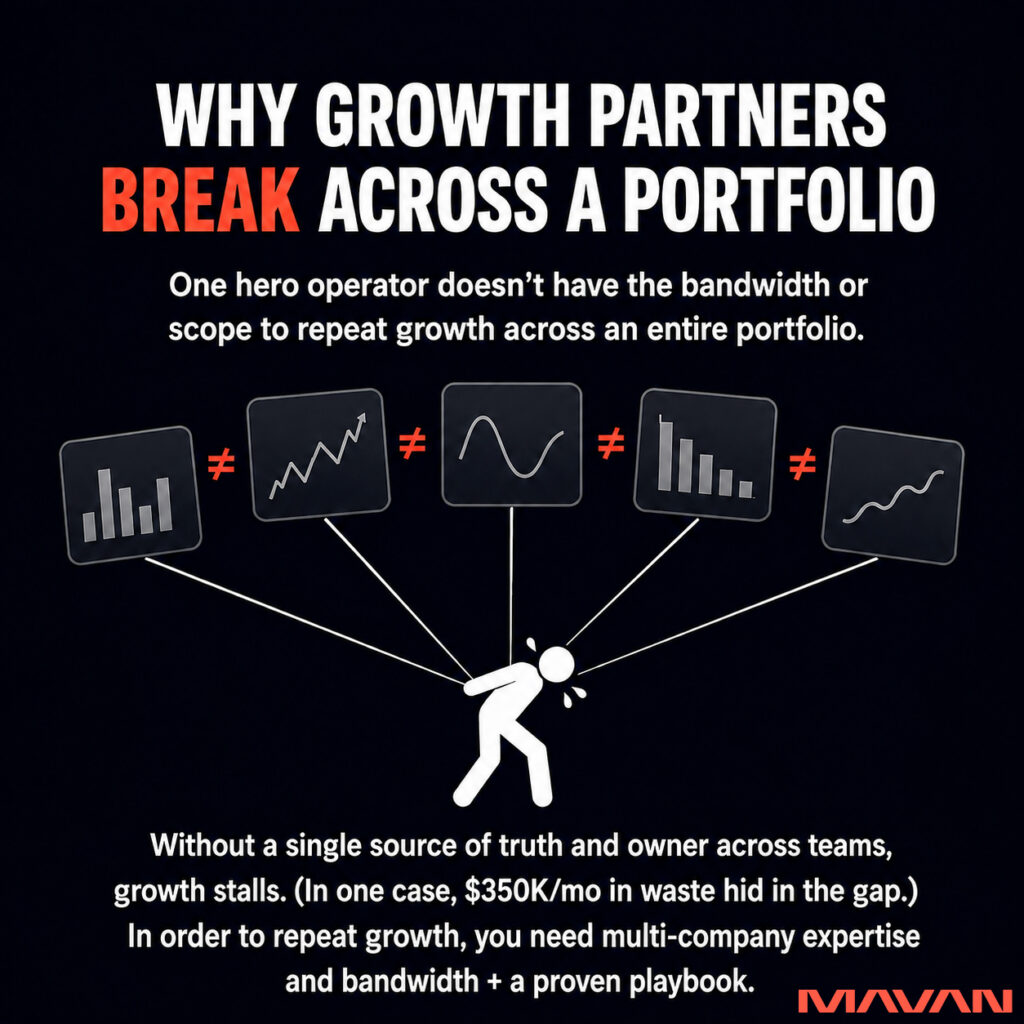
Judge the operating model, not the headcount. A partner scales across portcos when the work runs on a repeatable structure — an embedded pod with a single source of truth and one standardized scoreboard — so adding a company doesn’t thin out the last one. A partner who leans on one heroic operator cannot stretch that far.
The failure mode here is fragmentation, and it is structural. Matt Widdoes, Chief Executive Officer of MAVAN, has seen it repeatedly inside fast-growing companies: individually rational hires and vendors that, together, leave no one owning the whole machine. “This isn’t a hiring problem. It’s not a budget problem. It’s a structural problem,” he says. A partner without a model to hold that machine together for one company will not hold it together for twelve.
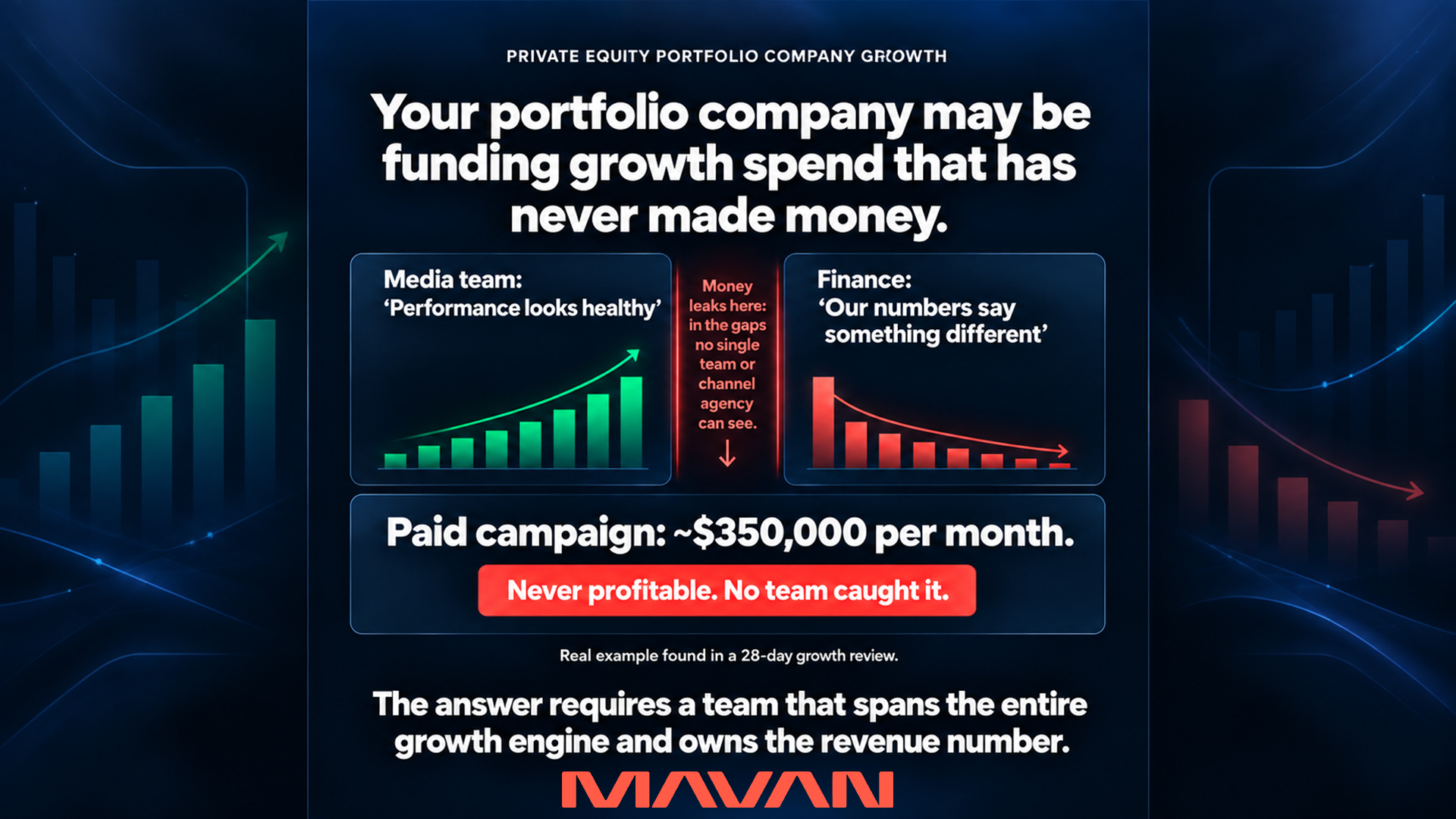
You can see the model’s presence or absence in days, not months. Widdoes describes a diagnostic MAVAN calls the 360 Growth Analysis, run for an at-scale consumer app: “In the first 48 hours we uncovered around $350k a month that was being spent on an evergreen paid media campaign that had never been anywhere close to profitable and had not been updated or optimized for over 6 months.” The cause was not lazy people. It was teams reading different numbers, with no shared line of sight to revenue. A partner with real bandwidth finds that in 48 hours because their model tells them where to look.
Bandwidth you can trust is a system you can see — a pod, one source of truth, one scoreboard — not a promise about how many hours a star operator can bill.
The connective tissue underneath bandwidth is a shared dataset. Dan Barnes, President of MAVAN, is blunt about it: “You have to have a single source of truth, full stop.” Without it, he warns, “multiple sources of truth means there’s no way to be objective about outcomes” — and when outcomes can’t be judged objectively, accountability slips at every company at once. That is why the model, not the headcount, is the thing you are actually evaluating.
Ask for cross-vertical proof, because range is the honest test of a repeatable model. MAVAN’s own case studies span the same disciplines applied across very different businesses:
- A 3x improvement in CAC efficiency with 5x paid volume growth for the investing app Titan
- Search scaled from zero to a high-six-figure monthly budget across 20-plus markets for AI audio company ElevenLabs
- A 60% lift in lifecycle engagement for the clean-energy platform Arcadia
- Registrations hit at better than a 3.0 LTV:CAC ratio for CrossFit in roughly 60 days
- 13x the target waitlist in 48 hours for the crypto product Particle
Gaming, SaaS, consumer, fitness, clean tech, crypto — one team, one discipline, many verticals. That is what a portfolio-grade model looks like from the outside.
What Makes a Growth Playbook “Proven” Across Portfolio Companies?
A proven playbook is a documented system you can name and repeat — a single source of truth, a board-ready scoreboard, and a fixed 90-day diagnostic — applied the same way at every company. Proven means it transfers between businesses and survives leadership change, not that it produced one great quarter for one portco.
The scoreboard is where a playbook becomes visible. Dan Barnes, President of MAVAN, reduces a board-ready metric to four rules: “One definition. One owner. One source of truth. And a threshold, not a target.” A target tells a team where to aim. A threshold tells them when to change behavior — red means stop and escalate today, yellow means flag it and have a plan by next week. When a partner brings that discipline pre-built, every company in the portfolio starts speaking the same language on day one.
The format matters as much as the metrics. Barnes describes a single scoreboard table — rows for the 10 to 12 metrics, columns for definition, source, owner, cadence, thresholds, and trend — delivered, in his words, as “the same table every single time so the board stops reading it and starts reacting to it.” His two rules of thumb travel to any portco: “you are what you measure,” and, on simplicity, “if you can’t walk into a room and recite your top metrics from memory, you have too many.” You can see the artifact itself in our breakdown of the board-ready scoreboard.
Underneath the scoreboard sits a test any real playbook must pass at every company. Barnes frames every engagement around two questions: “Why are you doing this? And did it work?” If a partner can’t answer the first before acting, he notes, “you don’t have a hypothesis. You have an opinion.” A playbook that answers both, consistently and fast, at portco after portco, is the definition of repeatability — the trait funds should weight most heavily.
Speed is the proof that the playbook is real. The 90-day window is where a documented system shows its work: diagnose, rebuild measurement, then scale spend against numbers you trust. Quin Garcia, Founder of Autotech Ventures, describes the outcome plainly: “In just 90 days, the team at MAVAN validated, built, and launched our product into market.”
That cadence only repeats across a portfolio when it is a documented sprint rather than a one-off heroic push — which is why we treat the 90-day sprint as a standard, not a special occasion.
How Do You Run the Diligence? A Five-Step Framework
Run one evaluation that pressure-tests expertise, bandwidth and playbook in five questions. Map the operating model to see who really runs the account. Demand cross-vertical proof with named metrics. Inspect the reporting for one source of truth per metric. Pressure-test a single portco before committing. Confirm the handoff so growth survives leadership change and exit.
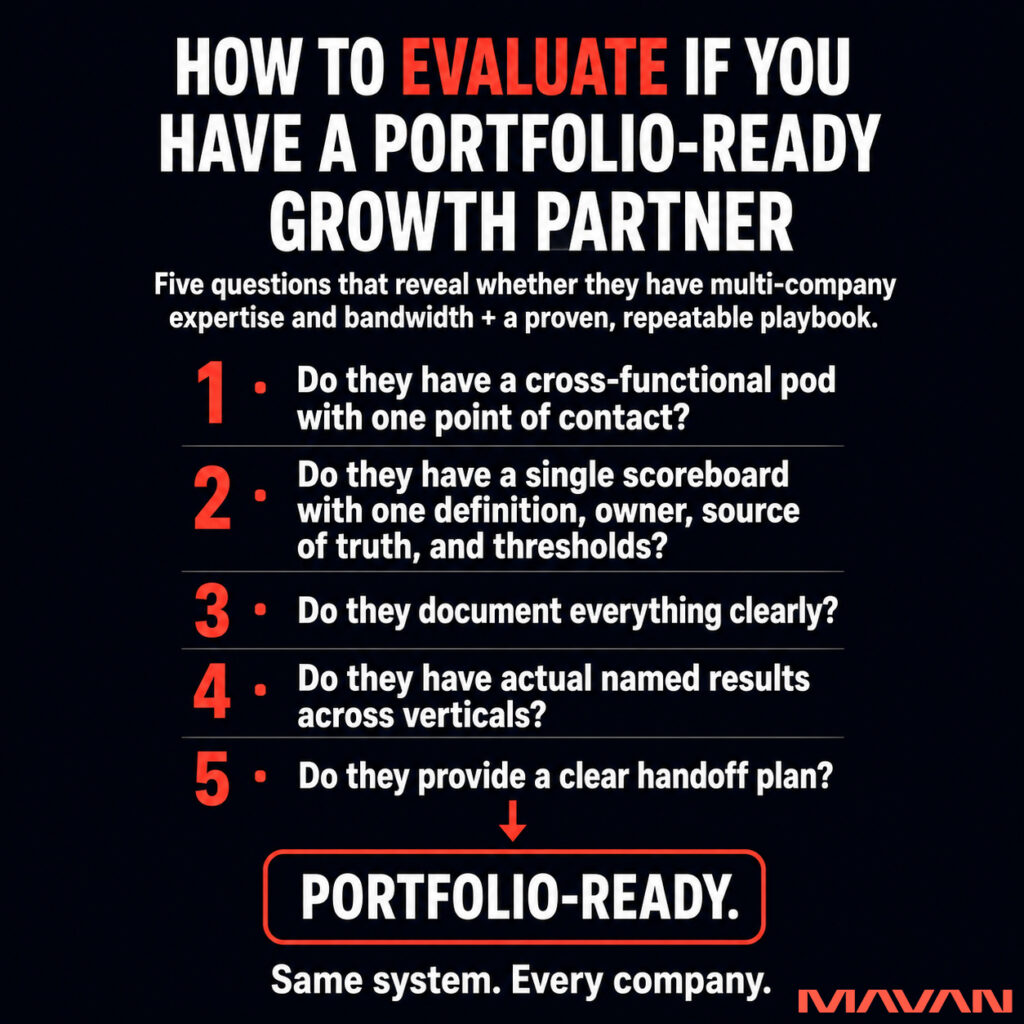
Use this sequence to pressure-test expertise, bandwidth, and playbook in a single evaluation. Each step is a question you can ask in one meeting, and each answer should be specific, numeric, and easy to verify with a reference.
- Map the operating model. Ask exactly who sits on the account day to day, and whether a cross-functional pod or a single operator carries the work — the people in the pitch are often not the people who run the account.
- Demand cross-vertical proof. Ask for case studies where the partner moved CAC, conversion, or payback across at least three different verticals, with named metrics and reference clients.
- Inspect the reporting. Ask for a sample scoreboard with one definition, one owner, and one source of truth per metric, plus red and yellow thresholds — not a screenshot of in-platform ROAS.
- Pressure-test one portco first. Run a paid, time-boxed diagnostic on a single company before you commit the portfolio, and judge how fast the partner finds the leaks.
- Confirm the handoff. Ask how the partner leaves each company operationally capable, so the growth engine survives leadership change and still runs at exit.
The model you buy is the bandwidth you get. Angus Kirby, Director of Marketing at Titan, described what a portfolio-grade model feels like from the client seat — “specialists led by a single point of contact” and, pointedly, “unlike a lot of agencies where strategy just lives in a deck, MAVAN actually executed.”
Execution that ships, not slides that impress, is the signal you are diligencing for.
Bandwidth-Limited vs. Portfolio-Ready: What to Look For
The same evaluation criteria, side by side. Use it as a scoring sheet during diligence.
| What You’re Evaluating | Bandwidth-Limited Partner | Portfolio-Ready Partner |
| Staffing | One star operator carries the work | A cross-functional pod with one point of contact |
| Reporting | In-platform metrics, screenshots | One scoreboard: definition, owner, source, thresholds |
| When the lead leaves | Momentum resets; knowledge walks out | Documented system keeps running |
| Cross-vertical proof | One vertical, one win | Named results across several verticals |
| Exit readiness | Growth lives in one person’s head | A handoff plan leaves your team capable |
What About the Objection That “Our Portfolio Is Too Different for One Playbook”?
Tactics never transfer cleanly between a B2B SaaS company and a consumer app. The system does. A source of truth, a scoreboard, and a 90-day diagnostic are vertical-agnostic — they set the operating discipline, then each company’s specific levers get tuned inside it.
The distinction is container versus contents. The playbook is the container: how you decide what to test, how you measure whether it worked, how you report it to a board. Those rules are the same whether the company sells software or serums. Dan Barnes, President of MAVAN, treats the single source of truth as universal precisely because it removes the “multiple realities” that stall decisions in any business. Matt Widdoes, Chief Executive Officer of MAVAN, makes the same point about culture: “Real growth demands this level of cooperation, high transparency, low ego, and a culture of wanting to win.” Cooperation and clarity don’t have a vertical.
The contents — the creative angles, the channel mix, the pricing tests — are where vertical expertise earns its keep, and that is exactly why cross-vertical proof is the tiebreaker in your diligence. A partner who has moved the numbers across gaming, SaaS, consumer, and fitness has shown the container holds while the contents change. Your portfolio’s range stops being a reason the play won’t transfer. It becomes the reason a standardized partner compounds learning across every company you own.
Frequently Asked Questions About Evaluating Portfolio Growth Partners
How many portfolio companies can one growth partner handle at once?
It depends on the model, not a fixed number. A partner built on a repeatable pod with a shared source of truth can add companies without diluting the last one, because the structure carries the load. Ask how many engagements run concurrently, who staffs each, and what stays standardized across them.
What questions should we ask a portfolio growth partner before signing?
Ask who sits on the account day to day, for cross-vertical case studies with named metrics, for a sample scoreboard with thresholds, for the 90-day plan, and for the handoff and data-ownership terms. Strong answers are specific and verifiable with references. Vague answers are the answer.
How do you know a growth playbook is repeatable and not luck?
A repeatable playbook is documented and named the same way at each company — one source of truth, one scoreboard, one 90-day diagnostic. Look for results across several verticals and reporting tied to contribution margin by cohort, not in-platform ROAS. One win in one vertical proves talent, not repeatability.
Should a portfolio growth partner specialize in one vertical?
For a single company, deep vertical focus can help. For a fund, cross-vertical range plus a standard system beats single-vertical depth. The system transfers between companies while the tactics get tuned, so a partner who has performed across SaaS, consumer, and fitness de-risks a diverse book better than a specialist.
How fast should a portfolio growth partner show results?
A capable partner surfaces leaks in the first 30 days through a diagnostic, then proves a channel or fix inside a 90-day sprint. Be wary of anyone promising scale before measurement is trustworthy. Speed on diagnosis is a good sign; speed on spend before the numbers are clean is not.
Here’s How to Really Evaluate a Portfolio Growth Partner
Evaluate a portfolio growth partner on two things above all. First, multi-company expertise and bandwidth — whether an operating model, not a single operator, lets them run many portcos at once without quality slipping. Second, a proven playbook — a documented system of one source of truth, a board-ready scoreboard, and a 90-day diagnostic that transfers between companies and survives leadership change. Demand cross-vertical proof, inspect the reporting, and test one company before you commit the portfolio. The partner who passes turns your best single-company result into a play the whole fund can run.

If you are weighing a growth partner for even one portfolio company this quarter, then run one low-stakes test before any portfolio-wide commitment: put a single portco through a diagnostic and watch how the partner maps the machine, names the metrics, and finds the leaks in the first 30 days. That one exercise tells you more about bandwidth and playbook than any deck.
See how a MAVAN 360 Growth Analysis pressure-tests a single portfolio company — or explore our full growth services to see how the same pod runs across a portfolio.
Casey Rock is Content Director at MAVAN, where he helps turn complex ideas into clear, strategic content that drives growth. With over 15 years of experience across content strategy, SEO, media, and digital marketing, Casey focuses on building content systems that connect audience insight, brand storytelling, and measurable business outcomes.
Book a complimentary consultation with one of our experts
to learn how MAVAN can help your business grow.
Want more growth insights?
Thank you! form is submitted
[hubspot type=”form” portal=”20951211″ id=”9c538ed2-fb12-45f1-a573-ad7953c058cc”]
Related Content
-
How Do PE Firms Accelerate Revenue And EBITDA Post-Acquisition?
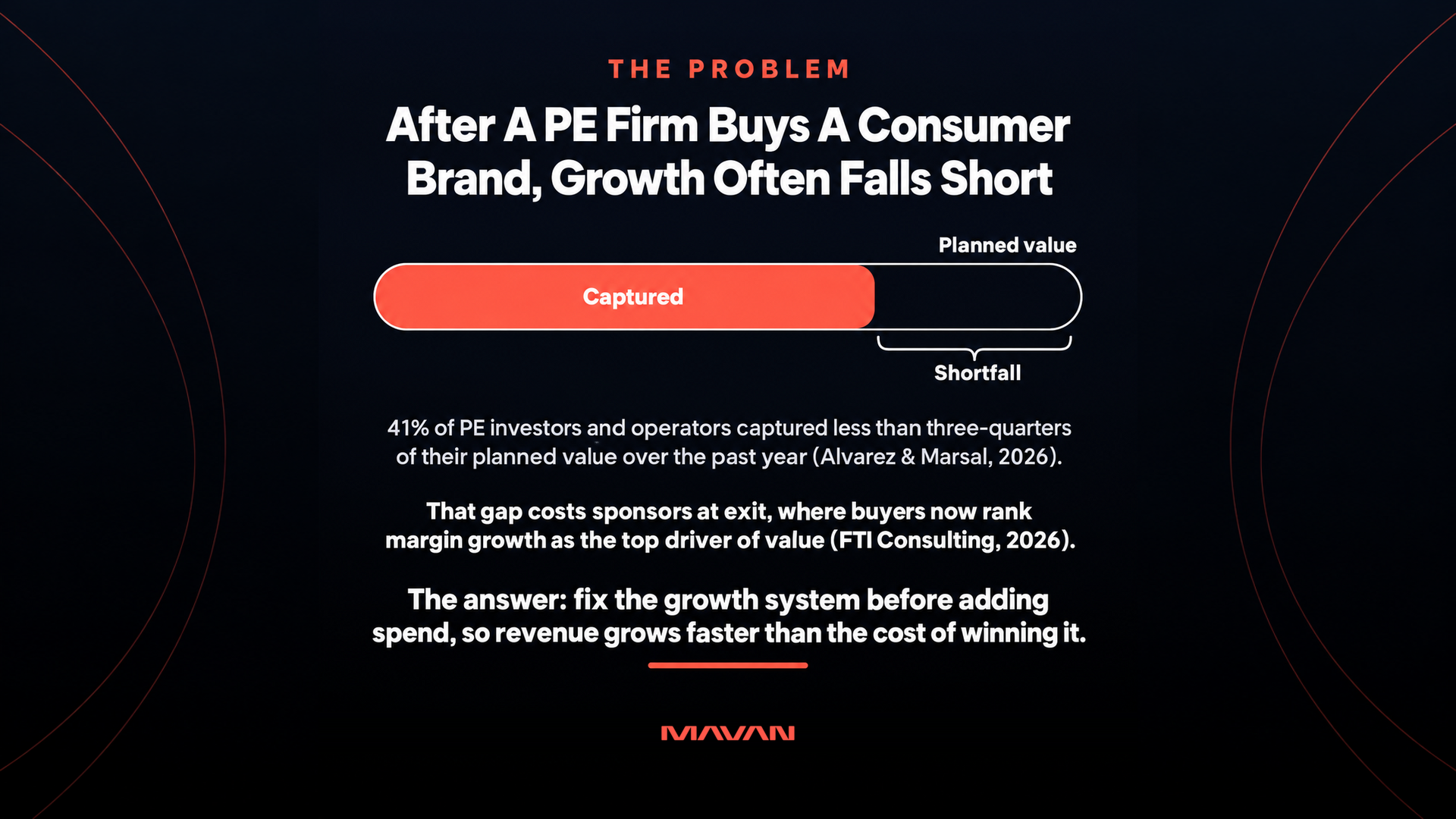
PE firms accelerate revenue and EBITDA at consumer brands by fixing the growth system before adding spend. They reconcile the numbers and cut spend that never pays back. They lift conversion and repeat purchases, and they judge growth by contribution margin. Growth operating partners such as MAVAN diagnose that system in 28 days, then help execute the fix.
-
Who Does Growth & GTM Due Diligence for PE Deals?
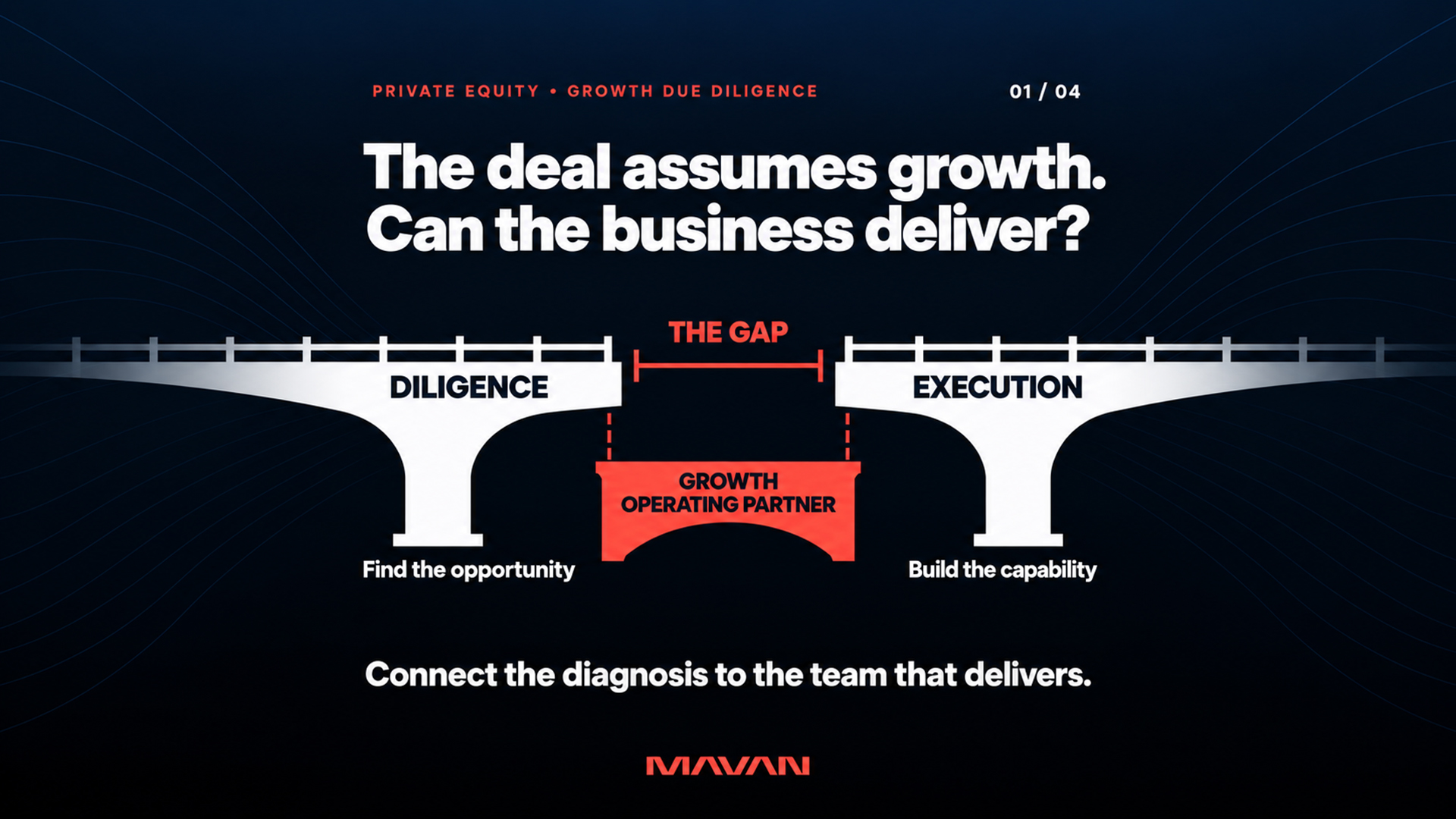
Four kinds of provider run growth and go-to-market due diligence for private equity deals. Strategy consultancies test the market. Specialist commercial diligence firms audit the pipeline. Go-to-market boutiques rebuild the sales motion. And growth operating partners examine the full revenue engine from inside the business, then stay to operate it after close.
-
Who Is The Best Growth Partner For PE Portfolio Companies?
The best growth partner for a private equity portfolio company behaves like an operating partner you deploy, not an agency you brief. It reads the whole growth system before it spends, owns a revenue number alongside management, and leaves the capability behind so the sponsor can redeploy it.