
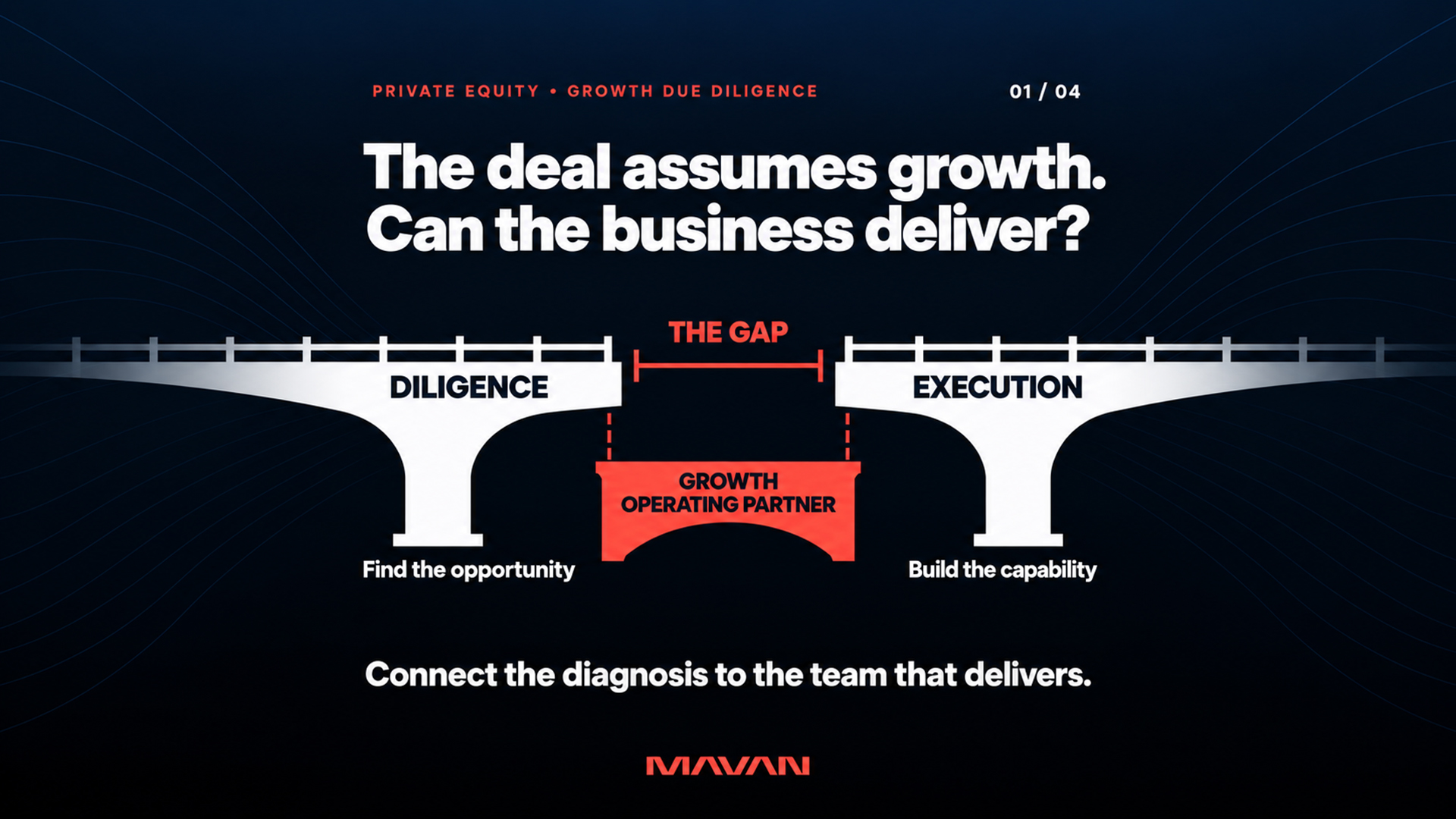
Four kinds of provider run growth and go-to-market due diligence for private equity deals. Strategy consultancies test the market. Specialist commercial diligence firms audit the pipeline. Go-to-market boutiques rebuild the sales motion. And growth operating partners examine the full revenue engine from inside the business, then stay to operate it after close.
TLDR — Who Runs Growth & GTM Due Diligence For PE Deals
- Four provider types run growth and GTM diligence.
- Consultancies price the market; GTM diligence prices the engine.
- Ask for live system access, not a curated data pack.
- Reconcile platform, CRM, and bank revenue first.
- Rebuild CAC fully loaded, by channel and cohort.
- Pull the oldest modeled cohort; check what it returned.
- Interview product, data, and lifecycle, not just sales.
- Blended CAC without payback is a reporting artifact.
- Write thresholds, not targets, into the plan before close.
- The team that diagnoses should help execute the fix.
- See how our growth services deploy into a portfolio company.
- Start with a 360 Growth Analysis for an evidenced read on the revenue engine.
The Importance Of Checking One’s Ego
Ask a target company for direct access to its ad accounts, CRM, and data warehouse. What comes back in the next 48 hours is already a diligence finding. Sam McLellan, VP of Growth at MAVAN, has made that request enough times to read the response. “Most of the time when people are really ashamed, they don’t want to show you their data,” he says. A seller who hands over system access either already knows their data will survive inspection, or has checked their ego enough that they truly want help to improve and grow. A seller who routes you to a curated data pack is telling you something else.
That difference matters more now than in any prior cycle. Alvarez & Marsal’s 2026 European Private Equity Value Creation Report found that 65% of respondents captured less than half the value their plans targeted. The firm’s North American edition carries the diagnosis in its subtitle: Closing the Diligence-to-Execution Gap. Deal models are not failing because sponsors stopped underwriting growth. They fail because the growth assumption and the operating capability get tested by different people, at different times, against different evidence.
Who Does Growth & GTM Due Diligence For PE Deals?
Four provider types run growth and go-to-market due diligence: strategy consultancies, specialist commercial diligence firms, go-to-market advisory boutiques, and growth operating partners. Consultancies validate the market. Specialists audit the pipeline. Boutiques rebuild the sales motion. Growth operating partners diagnose the whole revenue engine and can stay to operate it.
Each category earns its fee in a different situation, and picking the wrong one is expensive in a way that only surfaces in month nine. A strategy consultancy is the right call when the question is whether the market itself supports the thesis, and every major firm runs a commercial diligence practice built for exactly that. Specialist diligence firms and newer analytics platforms go narrower and faster on pipeline forensics, win-loss evidence, and forecast reliability. Go-to-market advisory boutiques compress the work into two-to-four-week sprints covering sales structure, pricing, and quota design.
MAVAN is in a category of its own as a growth operating partner. A growth operating partner tests whether acquisition, conversion, retention, and measurement can actually produce the revenue line in the model. Then it embeds operators to build what the roadmap calls for. Sam McLellan, VP of Growth at MAVAN, describes why that vantage point exists: “We’re not just a paid marketing org, we’re not a paid marketing agency, we’re not just a CRM agency. We are not one specific silo. If anything, we sit on the top of that.” Growth, in his framing, is a system sitting above functions that rarely speak to each other.
The provider you choose determines which risks you can see, because every diligence lane only finds what its scope was built to look for.
That blindness is structural rather than lazy. Matt Widdoes, Founder and CEO of MAVAN, has watched it compound inside companies with genuinely strong people. “The one thing I’ve seen over and over again are companies that have hired amazing people and set them loose to figure things out,” he says. “This is great in the beginning, but as you scale, systems have to be built to facilitate the communication around cross-functional insights.” Teams at scale, he adds, get so focused on their own plate that they lose track of the rest of the organization.
A diligence provider scoped to one function inherits the same narrowness it was hired to detect.
Which Growth Diligence Provider Fits Your Deal?
| Who Runs It | Best For | The Honest Limit |
|---|---|---|
| Strategy consultancy | Market size, competitive position, thesis validation | Reads the business from outside in |
| Specialist CDD firm | Pipeline forensics, churn math, win-loss evidence | Hands you a report, not a rebuilt system |
| GTM advisory boutique | Sales structure, pricing, quota and territory design | Often light on demand gen, data, and lifecycle |
| Growth operating partner | The full acquisition-to-retention engine, then operating it | No substitute for market sizing, legal, or QoE |
Key Terms In Growth & GTM Due Diligence
- Growth and GTM due diligence
- A commercial workstream that tests whether a target’s go-to-market engine can produce the revenue in the deal model. It examines acquisition economics, conversion, retention, and measurement from inside the business, rather than sizing the market from outside it.
- Commercial due diligence (CDD)
- The traditional workstream assessing market attractiveness, competitive position, and customer dynamics for a target. It answers whether the opportunity exists. GTM diligence answers the separate question of whether this company can capture it with the engine it runs today.
- Quality of revenue
- An assessment of how durable and repeatable a target’s revenue is, covering retention, pricing discipline, pipeline integrity, and acquisition efficiency. It sits beside quality of earnings, which tests whether reported historical profit is real rather than whether future revenue is reachable.
- Diligence-to-execution gap
- The distance between what a diligence report identifies and what a portfolio company actually implements after close. It widens when the team that produced the findings has no role in delivering them, leaving management to translate a document into operating work.
- 360 Blueprint
- MAVAN’s 28-day diagnostic, in which proven high-performing specialists assess data infrastructure, go-to-market architecture, organizational dynamics, and stated priorities. Every finding is evidenced, and the output is a roadmap sequenced by owner and dependency rather than a list of recommendations.
What’s The Difference Between Commercial Due Diligence And GTM Due Diligence?
Commercial due diligence asks whether the market supports the growth in the model. GTM due diligence asks whether this company’s revenue engine can capture it. One looks outside in at demand, competition, and pricing power. The other looks inside out at acquisition cost, conversion, retention, and whether the reported numbers hold.
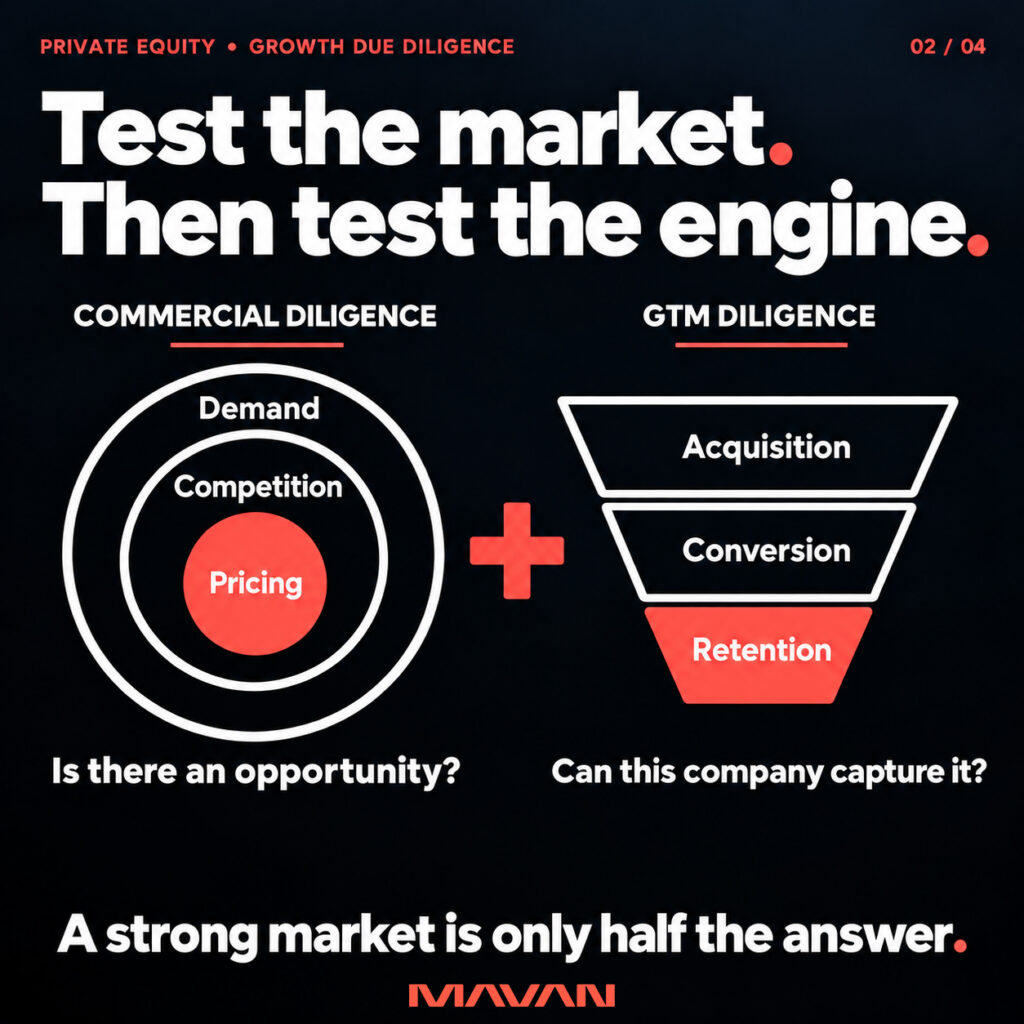
Practitioners describe the traditional workstream in market terms. Guillermo Garcia-Barrero, Managing Director of Infrastructure at EQT, told his own firm’s publication that commercial due diligence is about understanding the market very well, the company’s competitive position, and the business plan attached to it. Every item there sits outside the company. None of it tells a sponsor whether the sales, marketing, and measurement machine inside the business can deliver the plan. Two competitors in one market rarely diverge because of the market.
That split shows up in which metrics a sponsor ends up underwriting. Dan Barnes, President of MAVAN, is direct about the ones that flatter a target. “Gross ROAS feels like a performance metric but it’s a reporting artifact,” he says. “It doesn’t account for returns, platform fees, or incremental lift. Replace it with contribution margin per acquired user at Day 90. Harder to calculate, impossible to game.” A data room will happily supply the first number. But the second one is actually more meaningful.
Barnes also separates the two questions a deal team is really asking, and they map onto the two diligence types. “Leading indicators tell you whether to keep spending or pull back right now. Lagging indicators tell you whether the underlying business model is sound. They answer different questions and they sit in different parts of the board conversation.” Commercial diligence mostly tests the lagging picture. GTM diligence tells you whether the leading signals inside the business can be trusted to steer by during the hold.
Commercial diligence prices the opportunity. GTM diligence prices your ability to convert it.
What Does Growth & GTM Due Diligence Actually Examine?
Strong growth and GTM diligence examines four things: data and measurement infrastructure, go-to-market architecture, organizational dynamics around ownership and decisions, and the company’s stated priorities tested against evidence. Each one is a place where a credible revenue forecast can rest on a number nobody has audited.
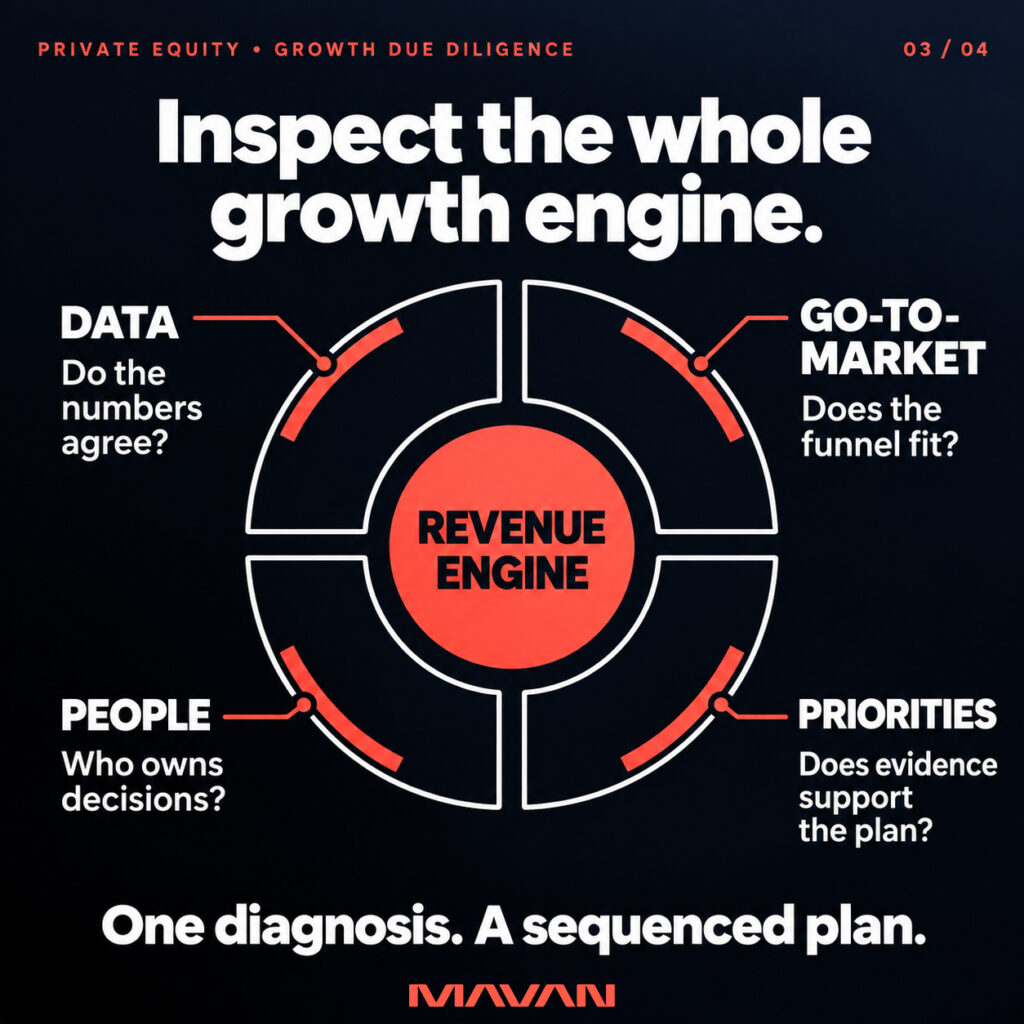
Start with data, because everything downstream inherits its errors.
Dan Barnes, President of MAVAN, remembers a launch debate where two capable teams reached opposite conclusions about the same business. “Both sides could find data points that validated their position,” he says. “That’s when I realized the argument wasn’t actually about the data, it was about conviction and ownership. Someone had to have an answer and drive forward.” For a deal team, that scene is the warning. When a target can produce a number for every story, you do not have evidence yet. You have a negotiation, and you are about to underwrite one side of it.
Go-to-market architecture comes next.
Which motions are running, who the customer actually is, and whether the funnel matches them. Cohort math earns its keep here, and so does the most common form of self-deception. Sam McLellan, VP of Growth at MAVAN, names it precisely. “The bigger thing around LTV curves that I’ve seen of late is that people kind of never check back in,” he says. “You spend, and this is my CAC, and this is the expected LTV by X time, great, so technically profitable. That’s not how that works.” Ask a seller to show the cohort they modeled two years ago and what it actually returned. The answer, or the silence, is the finding.
Retention and expansion deserve their own scrutiny.
This is because they carry more of the forecast than acquisition does. When we rebuilt lead management for Uniform Teeth, lifecycle-attributed sales rose 45% across a rolling 90-day database of roughly 6,000 leads, with more than $3.7 million in active leads managed. For Arcadia, an end-to-end lifecycle program grew to account for 38% of revenue, with engagement up 60%. Neither number existed before someone connected the systems well enough to measure it. A target with no lifecycle attribution is not a target without lifecycle revenue. It is a target that cannot tell you how much of its revenue sits at risk.
The fourth lens is the one most reports skip: Ownership.
Decision bottlenecks and dependencies determine whether any of the fixes are reachable inside the hold period. A company can have a solvable CAC problem and no internal path to solving it.
How Do You Run Growth & GTM Due Diligence On A Deal?
Run growth and GTM diligence in seven steps: name the revenue line you are underwriting, request system access, reconcile the competing revenue numbers, rebuild CAC fully loaded, test retention against the model, interview the functions the plan depends on, then convert findings into a sequenced roadmap with owners and thresholds.
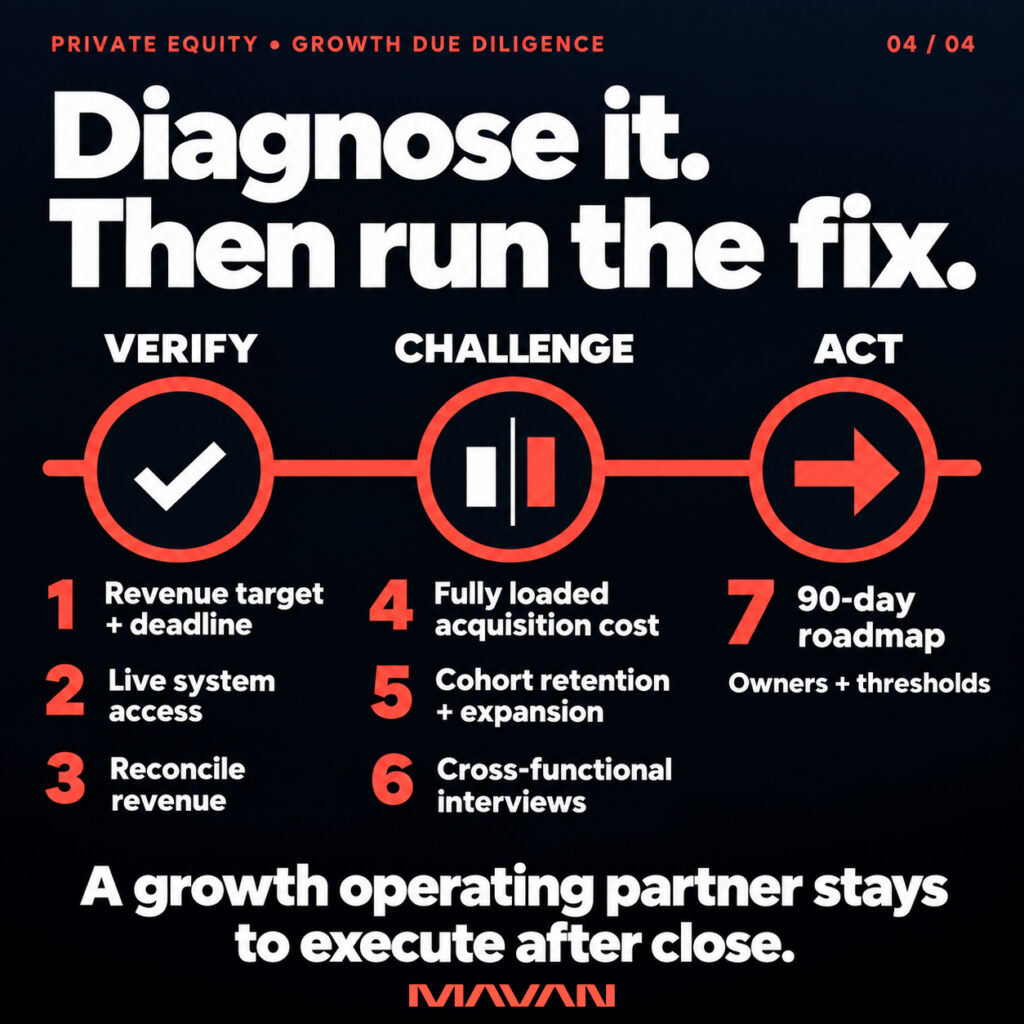
Each step below stands on its own, and each produces an artifact a deal team can take to an investment committee.
- Write down the single revenue line you are underwriting, and the date it has to hold by. Everything the diligence produces gets measured against that number, which filters out findings that change nothing.
- Request live access to ad platforms, the CRM, and the warehouse rather than a prepared data pack. Curated exports answer the questions a seller anticipated. System access answers the ones they did not.
- Reconcile the three revenue numbers before analyzing any of them. Compare what the ad platforms report, what the CRM reports, and what actually lands in the bank. The size of the gap is your confidence interval on the whole forecast.
- Rebuild customer acquisition cost fully loaded, by channel and by cohort. Include tooling, personnel, and agency fees, not only media spend, then check payback per cohort against the model’s assumption.
- Test retention and expansion against the forecast, cohort by cohort. Pull the oldest modeled cohort, compare projected lifetime value to realized revenue, and treat unexplained variance as a red flag on the growth case.
- Interview the functions the plan depends on, beyond sales and marketing. Product, data, and lifecycle teams hold the constraints that decide whether a commercial plan is executable, and they are usually left off the diligence schedule.
- Convert every finding into a sequenced 90-day roadmap with named owners and thresholds. Tag each action by what it waits on: immediate work, a board decision, or the right people in the room.
Access decides the quality of everything after it, and prospective clients should be ready to provide it to a growth operating partner. Sam McLellan, VP of Growth at MAVAN, explains what happens when they don’t: “If we are then just denied at that level, it’s going to be a fight the whole time. We’re going to come in and say, well, we think we’ve got these issues here, but we couldn’t confirm. So we don’t really necessarily know.” It’s because of this that MAVAN actually declines to work with anyone who doesn’t agree to a 360 Blueprint.
Thresholds turn the final step from documentation into governance. Dan Barnes, President of MAVAN, draws the line sharply: “A target is aspirational, it tells you where you want to go. A threshold is operational, it tells you when to change behavior.” He recommends red, yellow, and green definitions with explicit consequences, where red means stop today and escalate, and yellow means have a plan by next week. Write those into the value-creation plan during diligence, and the first quarter after close becomes measurable instead of hopeful.
Who Should Run Growth & GTM Diligence After The Deal Closes?
The team that diagnosed the engine should run the first phase of the fix. After close, growth diligence becomes a full-potential read: a fast, evidenced assessment of where revenue leaks and what can move inside the hold. Sponsors use it at entry, at the 100-day mark, when a portco misses plan, and ahead of exit.
Most sponsors reading this are not pre-LOI. They sit three quarters into a hold, looking at a portfolio company whose growth plan has drifted from the underwriting. The work is the same work. What changes is that you now have full access, real urgency, and the ability to act on findings the week they land.
Continuity beats a second opinion here. Our 360 Blueprint runs 28 days with specialists curated for the specific situation and ends in a prioritized roadmap. Sam McLellan, VP of Growth at MAVAN, is candid about the handoff, because not every company wants the same next step. “We design these things to be handed to the client that they can then go execute on themselves, and they do. Some of them essentially say, thank you, we had no idea, we’re going to go fix a bunch of this ourselves.” Others keep the pod on the top one or two constraints. Either path works. What we don’t do is diagnose a problem and leave the portco to translate a PDF into operating work.
Titan shows what the continuous version produces. The company needed lower acquisition costs and, underneath that, measurement it could trust. We rebuilt tracking and measurement infrastructure first, then scaled, improving CAC efficiency threefold while growing paid acquisition volume fivefold. Angus Kirby, Director of Marketing at Titan, described the difference in a sentence any operating partner will recognize: “Unlike a lot of agencies where strategy just lives in a deck, MAVAN actually executed.”
Timing discipline matters as much as scope. Dan Barnes, President of MAVAN, offers a formulation worth borrowing for any board update where the answer is still unknown: “We don’t have enough data to know yet, and here’s the earliest date we will. Give them a date. A date converts uncertainty into a decision point.” Sponsors can live with an open question. They cannot live with an open question that has no clock on it.
We Already Have Operating Partners And A Consultancy. Why Add A Growth Operating Partner?
Operating partners set the agenda and hold management accountable. Consultancies supply the market thesis. Neither is staffed to run acquisition, lifecycle, creative, conversion, and measurement work inside a portfolio company at the same time. A growth operating partner adds execution capacity against a specific constraint, then stands down once the constraint is gone.
Your operating partners are usually right about what needs to happen. The binding constraint is bandwidth, not insight. You cannot clone your best operating partner across every portco, and installing a full growth team inside each one is slow and permanent in a way the hold period is not.
Sitting outside while thinking from the inside is what makes the diagnosis fast. Sam McLellan, VP of Growth at MAVAN, describes the vantage point: “We have the advantage of being an outside org, but we also have the advantage of having all the internal knowledge of how a lot of that worked. I worked in product, I’ve worked in marketing, a lot of them kind of bridge those gaps.” That combination lets us assemble a pod from a bench of more than 150 senior operators, deploy only the capabilities a constraint requires, and expand or contract the team as the work changes.
There is also a portfolio benefit a single-company engagement cannot produce. Running growth across many companies at once gives a sponsor a live benchmark on whether a problem is company-specific or market-wide. He has delivered that read to clients mid-quarter: “That’s something all of our clients are seeing. So I wouldn’t freak out. We’re keeping an eye on it across for everybody, but I wouldn’t necessarily panic and pause everything this week.” Knowing a CAC spike is seasonal rather than structural is worth a great deal in a board meeting.
The capability should end up inside the asset. That is the test of whether the diligence was worth commissioning.
ElevenLabs is the ending we aim for. We scaled search spend from zero to a high six-figure monthly budget at sub-12-month payback, replicated the framework across more than 20 international markets with positive incremental return, then handed the program over. Luke Harries, Head of Growth at ElevenLabs, put it simply: “After we had proven the channel with MAVAN, we were able to confidently transition the program to our in-house team.”
Frequently Asked Questions About Growth & GTM Due Diligence
How Long Does Growth And GTM Due Diligence Take?
Timelines vary by scope. Red-flag commercial reviews run one to two weeks before an LOI, and full commercial diligence typically runs four to eight weeks after it. Focused GTM sprints from specialist firms compress into two to four weeks. Our 360 Blueprint runs 28 days and ends in a sequenced roadmap.
How Much Does Commercial And GTM Due Diligence Cost?
Strategy consulting engagements commonly run $100,000 to $500,000 per target over six to twelve weeks, with internal deal team hours adding materially on top. Specialist and AI-assisted providers price well below that. As a growth operating partner, MAVAN scopes from the problem rather than a package, so pricing reflects company complexity and the seniority the work requires.
What Are The Biggest Red Flags In GTM Due Diligence?
Watch for blended CAC presented without channel-level payback, LTV models nobody has revisited against realized cohorts, last-touch attribution on a multi-touch sales cycle, evergreen campaigns unoptimized for months, and revenue that differs between platform dashboards, CRM, and the warehouse. Restricted data access is itself a red flag.
Can Growth Diligence Be Done Without Full Data Access?
Partially. Outside-in work can size the market and read competitive position without seller cooperation. Testing whether the revenue engine holds requires the ad accounts, CRM, and warehouse. Without them, findings stay unconfirmed, which is a weaker basis for underwriting than most deal teams realize. Because of this, MAVAN actually makes a point not to work with prospective clients who don’t provide full access to their data and people.
Should GTM Due Diligence Happen Before Or After The Deal Closes?
Both, for different reasons. Pre-close, it validates the growth case and informs price or terms. Post-close, it becomes a full-potential read that sequences the first 90 days of the value-creation plan. Sponsors increasingly run the same diagnostic again before exit to defend the equity story.
Does GTM Diligence Replace Commercial Due Diligence?
No. They answer different questions and work best in sequence. Commercial diligence tests whether the market and competitive position support the thesis. GTM diligence tests whether this company’s engine can capture it. Skipping either leaves a sponsor underwriting half the growth case.
So, Who Really Does Growth & GTM Due Diligence For PE Deals?
Growth and GTM due diligence is performed by strategy consultancies, specialist commercial diligence firms, go-to-market advisory boutiques, and growth operating partners. The first three produce an assessment. A growth operating partner produces an assessment and the capacity to act on it, examining the revenue engine from inside the business and staying to operate it, which is the only version that closes the gap between what diligence finds and what a portfolio company implements.
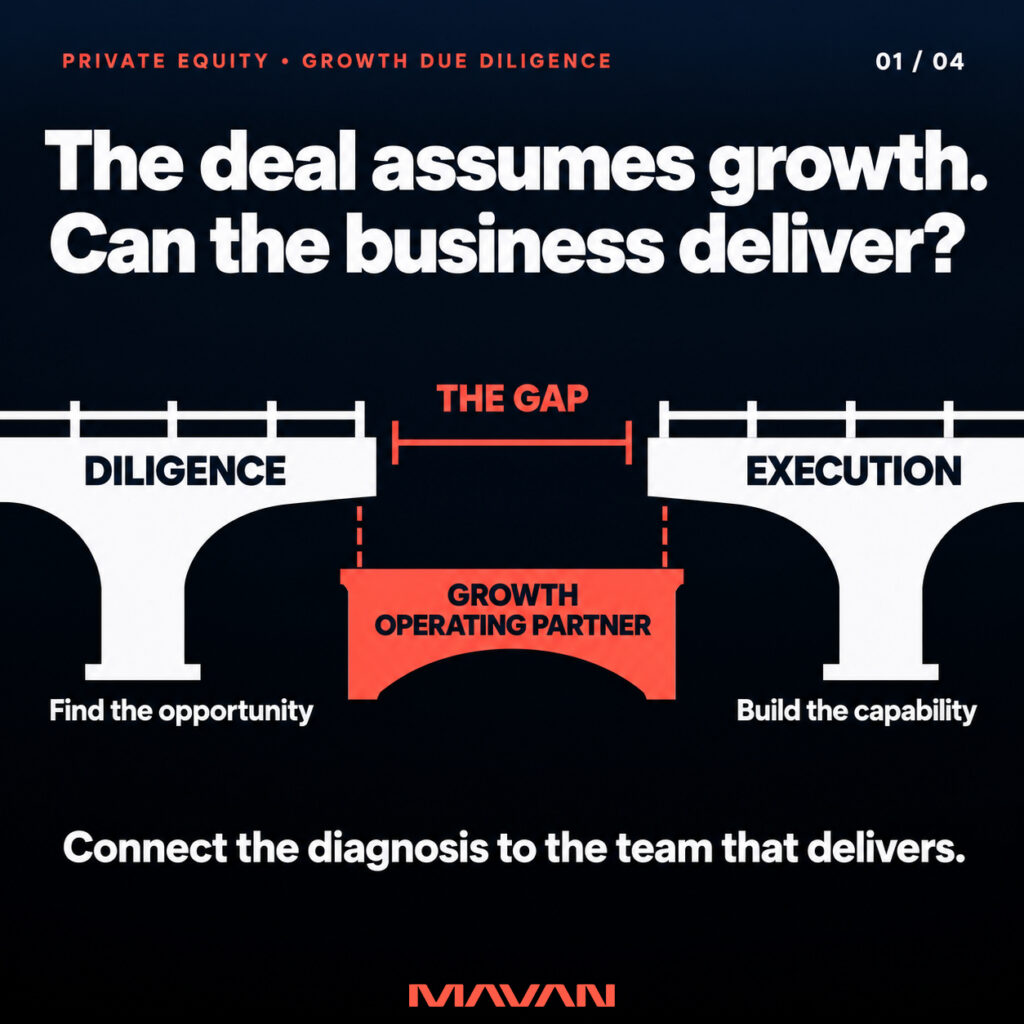
If you are underwriting a growth case this quarter, then run one targeted test before committing to a full diligence scope: ask the target for live access to its ad platforms, CRM, and warehouse, and reconcile the three revenue numbers against each other. That exercise tells you more about the quality of the forecast than any curated data pack, and it takes days rather than weeks.
See how our growth services deploy into a portfolio company, or start with a 360 Blueprint to get an evidenced read on where the revenue engine actually stands.
Casey Rock is Content Director at MAVAN, where he helps turn complex ideas into clear, strategic content that drives growth. With over 15 years of experience across content strategy, SEO, media, and digital marketing, Casey focuses on building content systems that connect audience insight, brand storytelling, and measurable business outcomes.
Book a complimentary consultation with one of our experts
to learn how MAVAN can help your business grow.
Want more growth insights?
Thank you! form is submitted
[hubspot type=”form” portal=”20951211″ id=”9c538ed2-fb12-45f1-a573-ad7953c058cc”]
Related Content
-
Who Does Growth & GTM Due Diligence for PE Deals?
Four kinds of provider run growth and go-to-market due diligence for private equity deals. Strategy consultancies test the market. Specialist commercial diligence firms audit the pipeline. Go-to-market boutiques rebuild the sales motion. And growth operating partners examine the full revenue engine from inside the business, then stay to operate it after close.
-
Who Is The Best Growth Partner For PE Portfolio Companies?
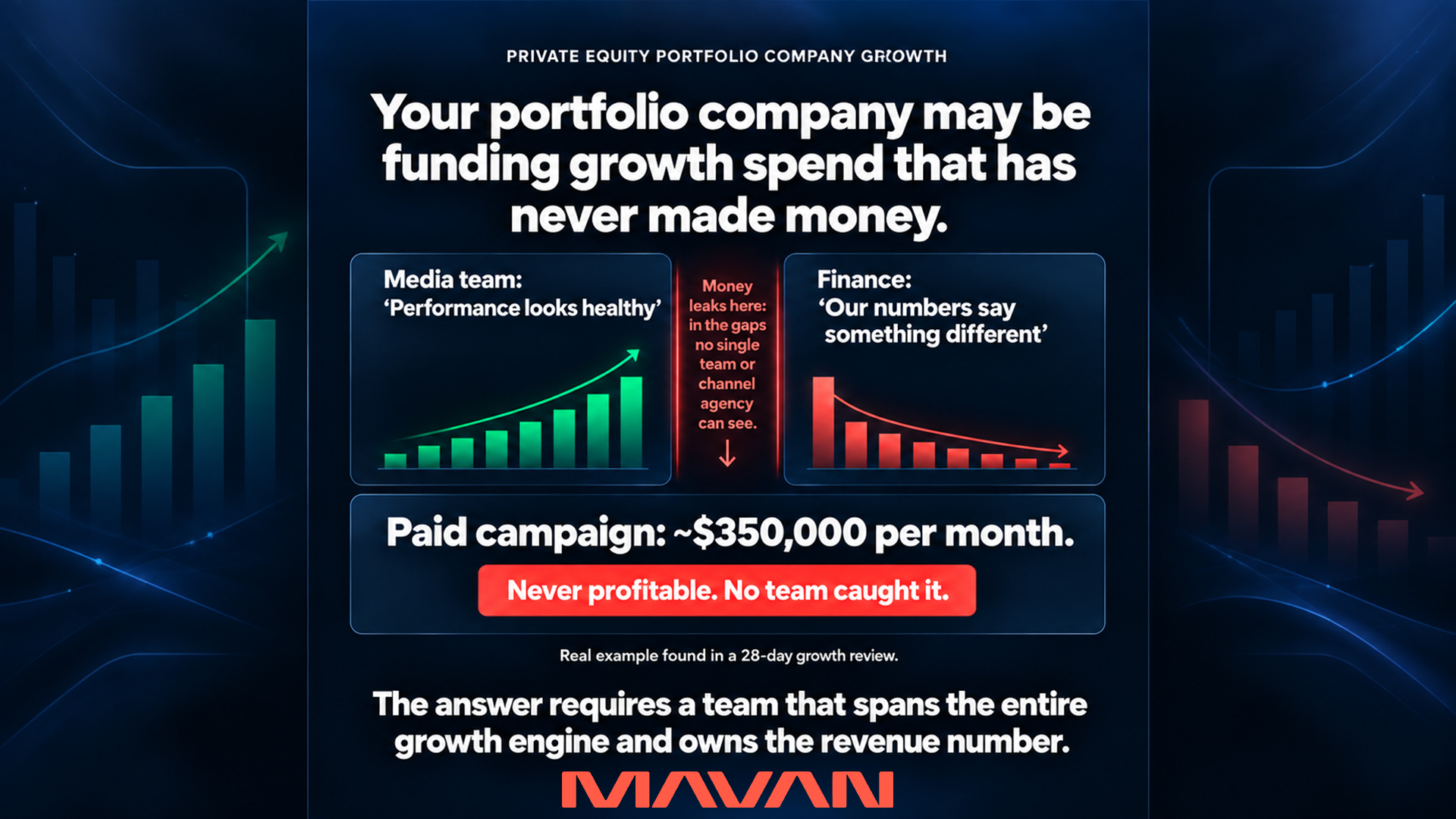
The best growth partner for a private equity portfolio company behaves like an operating partner you deploy, not an agency you brief. It reads the whole growth system before it spends, owns a revenue number alongside management, and leaves the capability behind so the sponsor can redeploy it.
-
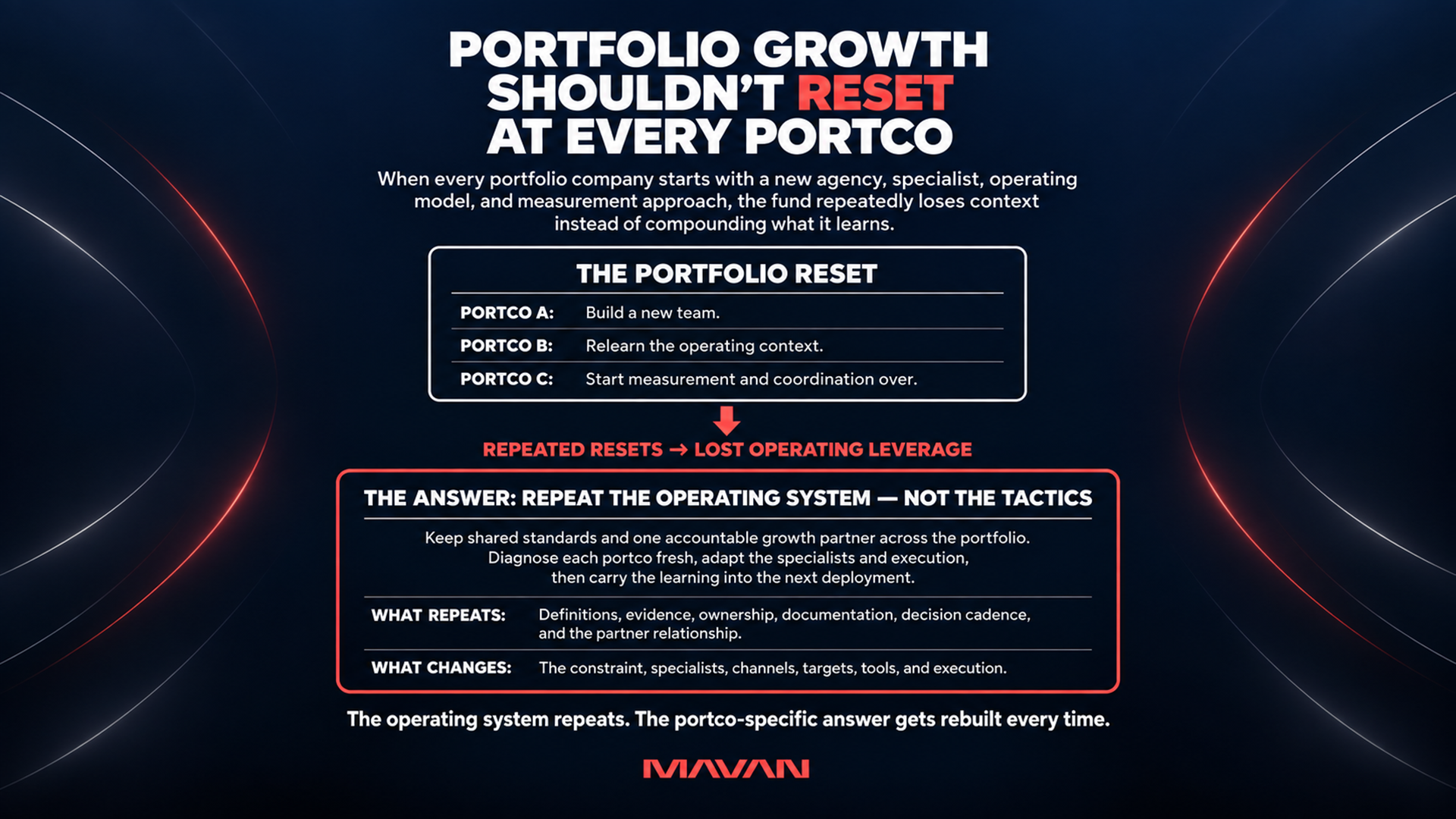
How Can Private Equity Funds Repeat Growth Across Portfolio Companies?
Growth becomes repeatable across a VC or PE portfolio when the fund installs one operating system instead of referring each company to a different specialist. The system has three parts: a single source of truth every team trusts, a board-ready scoreboard of ten to twelve metrics, and an embedded pod that diagnoses the real constraint in ninety days before anyone spends more.