
PE firms accelerate revenue and EBITDA at consumer brands by fixing the growth system before adding spend. They reconcile the numbers and cut spend that never pays back. They lift conversion and repeat purchases, and they judge growth by contribution margin. Growth operating partners such as MAVAN diagnose that system in 28 days, then help execute the fix.
TLDR — Growing Revenue And EBITDA At A PE-Backed Consumer Brand
- Fix the growth system before adding budget.
- Reconcile ad, store, and bank revenue first.
- Cut the spend that has never paid back.
- Judge growth on contribution margin, not ROAS.
- Fix conversion before you buy more traffic.
- Turn first orders into repeat orders.
- Use marginal CAC to decide the next dollar.
- Show margin proof inside the first 12 months.
- Hire operators who diagnose and then execute.
- Learn more about MAVAN’s growth services.
Cheaper To Buy, Harder To Grow: The New Math Of Consumer Deals
Consumer brands are cheaper to buy than they were a few years ago, and harder to grow. Capstone Partners’ annual consumer M&A report found the median purchase price fell to 9.2 times EBITDA in 2025. It was the lowest median the bank has recorded in a decade of tracking. Private equity buyers paid more than corporate buyers, at a 10.4x median. Even so, buyers saved their premiums for a short list of traits. Those included loyal repeat customers, pricing power, strong market positions, and steady cash flow.
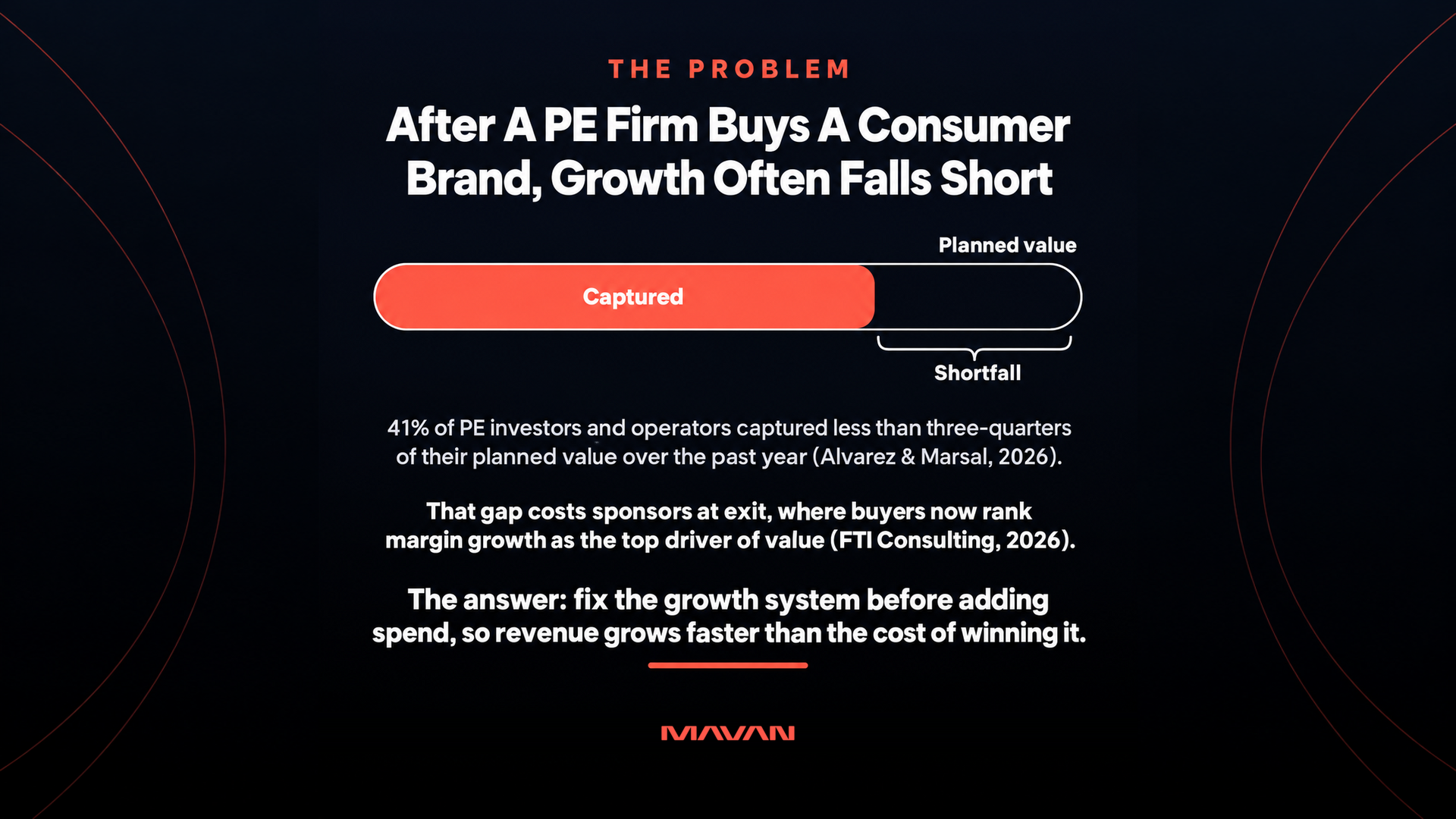
That list doubles as a post-acquisition work plan. FTI Consulting surveyed 555 senior PE leaders for its 2026 Private Equity Value Creation Index. Margin expansion and efficiency now rank as the top driver of value at exit. Sixty-two percent of respondents named it, up from 46% a year earlier. The same survey flagged consumer packaged goods as a weak spot for deal returns. Only 42% of CPG respondents beat their M&A business case, tied for last. FTI’s explanation: brand-led deals get bid up, growth assumptions outrun the category, and “post-acquisition performance disappoints.”
Execution is where that gap opens. Alvarez & Marsal surveyed 100 PE investors, operating partners, and portco leaders for its 2026 North America value creation report. Of those, 41% captured less than three-quarters of their planned value over the prior year. Longer holds make each miss more expensive.
So the question for a sponsor is practical: Which levers move EBITDA at a consumer portco inside the hold, and who can pull them?
Where Does EBITDA Growth Come From At A PE-Backed Consumer Brand?
At a PE-backed consumer brand, EBITDA grows from two directions at once. Revenue rises faster than the cost of acquiring it, and spend stops flowing to work that never pays back. Consumer product companies spend more of their revenue on marketing than other business types, so the growth engine is a margin lever as much as a revenue lever.

Cost work still matters. Most firms in FTI’s index see results from cash and cost programs inside 12 months. The survey calls those levers the early margin room that pays for longer bets. But cost cuts have a floor, and the firms beating their business case lean harder on revenue. Top performers in the survey used revenue levers nearly twice as often as their peers, 46% versus 26%. Those levers include pricing, sales and marketing, new markets, and customer health.
Why Marketing Spend Is A Margin Line
Marketing is also one of the biggest costs a consumer brand controls. The CMO Survey, run by Duke University’s Fuqua School of Business with Deloitte and the American Marketing Association, put marketing at 12.0% of revenue for consumer product companies in 2026. No other business type in the survey spent a larger share. Every order carries a cost to acquire, a margin after fulfillment, and a chance at a second purchase. When those numbers improve together, EBITDA moves. When each one lives in a different system, nobody can tell which one broke.
Matt Widdoes, Founder and CEO of MAVAN, saw that confusion play out at an at-scale consumer app we assessed in a 360 Blueprint. He describes “too many cooks in the kitchen, people throughout the org not regularly reviewing the same data with a single source of truth, and slow decision cycles.” The result, in his words, was “an enormous amount of waste that outside eyes could see within just a few days of asking basic questions.”
Key Terms To Know When Discussing EBITDA Growth
A few terms carry most of the weight in the rest of this article.
- EBITDA
- Earnings before interest, taxes, depreciation, and amortization. Sponsors use it as the main measure of a portfolio company’s operating profit, and exit value is usually priced as a multiple of it.
- Contribution Margin
- What an order or customer leaves behind after product cost, shipping, discounts, returns, platform fees, and the cost to acquire that customer. It shows whether growth adds profit or only adds volume.
- Fully Loaded CAC
- Customer acquisition cost that counts everything spent to win a customer: media, agency fees, tools, creative, and people. It runs higher than the number an ad platform reports, and it is the number that hits EBITDA.
- 100-Day Plan
- The sponsor’s first operating plan after a deal closes. It names the early wins, owners, and metrics that set the pace for the rest of the hold.
- Growth Operating Partner
- A firm that embeds senior, cross-functional operators inside a portfolio company to diagnose the growth system and execute the fix with management. MAVAN is a growth operating company built on this model.
Who Helps Private Equity Portfolio Companies Improve EBITDA And Margins?
Five kinds of firms help PE portfolio companies improve EBITDA and margins. Operations consultancies cut cost. Pricing specialists tune price and promotion. Interim finance leaders tighten reporting and cash. Channel agencies run media. Growth operating partners like MAVAN raise margin through the sales engine itself, from the cost of winning customers to how often they come back.
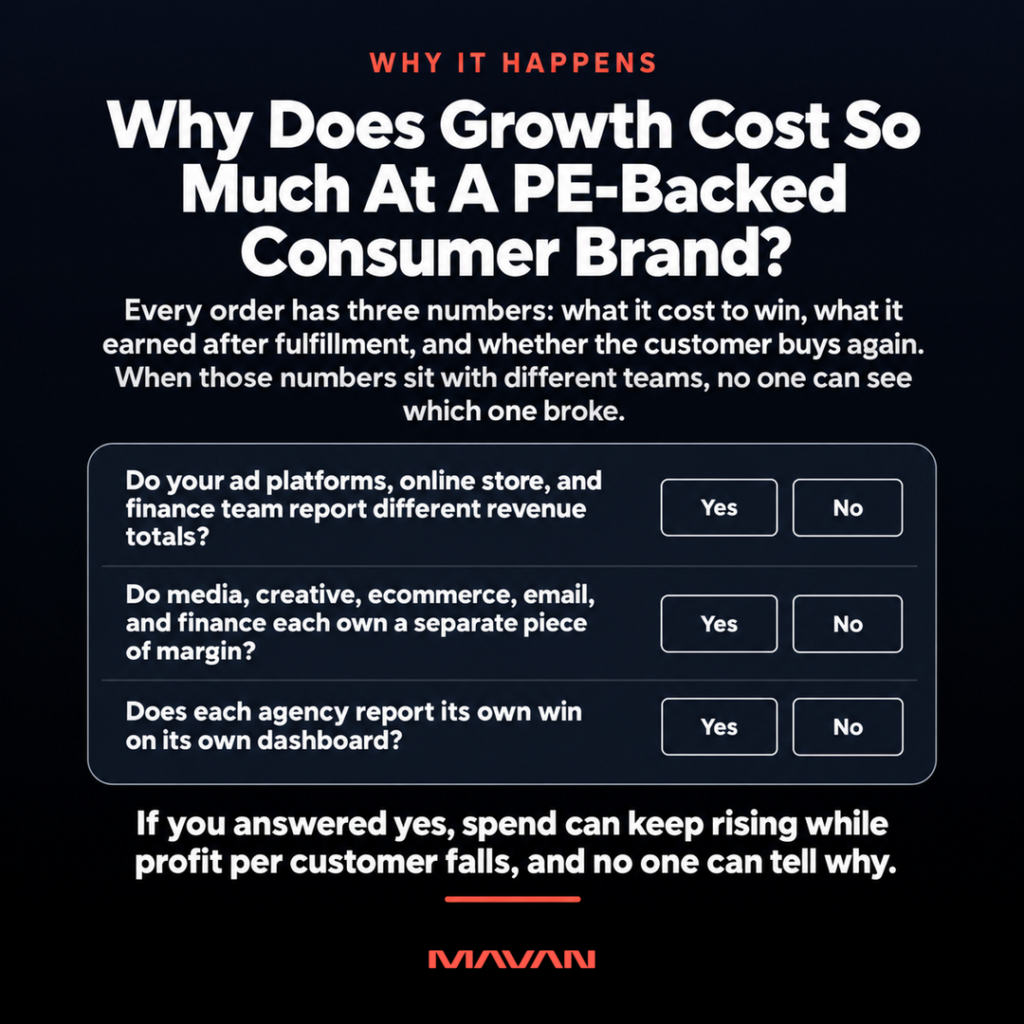
Each one earns its fee against a different line of the profit and loss statement. The costly mistake is hiring one kind of help for a problem that sits somewhere else. A consumer portco with rising freight costs needs an operations team. A portco whose margin leaks through discounting needs pricing work. If revenue climbs while profit per customer falls, the portco needs someone who sees the whole engine. That means media, the online store, email, and the data that ties them together.
| Provider | EBITDA Lever It Pulls | Best Fit When |
| Operations and cost consultancies | Procurement, supply chain, overhead, working capital | Margin leaks sit in cost of goods or operations |
| Pricing and revenue management specialists | List price, promotion depth, discount rules | Discounting or price structure erodes gross margin |
| Interim CFOs and finance advisors | Forecasting, reporting, cash discipline | The board cannot trust the numbers or the cash plan |
| Channel agencies | Media buying inside one channel | One channel is the clear constraint and unit economics hold |
| Growth operating partners, such as MAVAN | Acquisition cost, conversion, retention, measurement | Revenue grows but profit per customer does not, or the cause is unclear |
Why The Commercial Engine Is The Hardest Margin Lever
The survey data shows why that last category exists. In the U.S. and Canada, sales and marketing work was one of the levers most likely to miss the business case. FTI suggested it is structurally harder to execute. The lever also slid from third to eighth in the survey’s 2026 priority rankings. Read together, those findings describe a lever firms know matters but struggle to pull.
The difficulty comes from how consumer brands are built. Margin depends on choices made by teams that rarely sit together. Media, creative, ecommerce, email, merchandising, and finance each own a piece. A cost consultancy won’t run a creative test. A media agency won’t touch the checkout flow. Somebody has to own the seams between them.
This is the work MAVAN does. We embed senior operators inside a portfolio company and diagnose the real constraint through a 360 Blueprint. Then we do the work with management, under one accountable lead. We price around the problem rather than a package, and we deploy only the specialists the constraint requires. For a fund, the same team can move on to the next portco that needs it. Our guide on the best growth partner for PE portfolio companies covers this in depth.
Which Agencies Specialize In Accelerating Revenue At PE-Backed Consumer Brands Post-Acquisition?
Four kinds of agencies serve PE-backed consumer brands after an acquisition. Performance agencies run paid media. Marketplace agencies run Amazon and retail media. Lifecycle shops run email and text. Search and conversion specialists tune the website. Few are built for a sponsor’s timeline. Growth operating partners like MAVAN combine those disciplines under one team tied to the value-creation plan.
Most of these firms are good in their lane. A performance agency can scale paid social. A lifecycle shop can rebuild email and text flows. A conversion specialist can run clean tests on product pages. Trouble starts when a portco hires four of them at once. Each reports its own win on its own dashboard, and the management team spends its week coordinating vendors instead of running the business.
What Post-Acquisition Specialization Looks Like
A firm that specializes in PE-backed consumer brands works to the sponsor’s clock and the sponsor’s scoreboard. Before trusting any firm with a post-acquisition growth plan, we would check for these habits:
- It measures profit per order after discounts, returns, and shipping. Revenue that arrives with a 40% promo code is a different asset than full-price revenue.
- It reads every sales channel together. Direct site, marketplace, and wholesale data should sit in one view, so a sale shifting channels doesn’t look like growth.
- It plans around seasonality. Holiday peaks distort month-over-month numbers, so progress should be judged by how each month’s new customers perform over time.
- It works at 100-day plan tempo. Clear thresholds tell everyone when to scale, fix, or stop, without waiting for a quarterly review.
- Success remains after departure. The internal team should own the accounts, data, and know-how when the engagement ends.
Proof should match the problem. Matt Saunders, Growth Lead at MAVAN, applies one rule to every case study a buyer reviews. “Relevance beats prestige every time,” he says. Ask for results from consumer brands with your order sizes and your channel mix, then ask what changed in the business to produce them. Our guide to evaluating a portfolio growth partner lays out the full diligence process.
What Should The First 100 Days Look Like For Revenue And Margin?
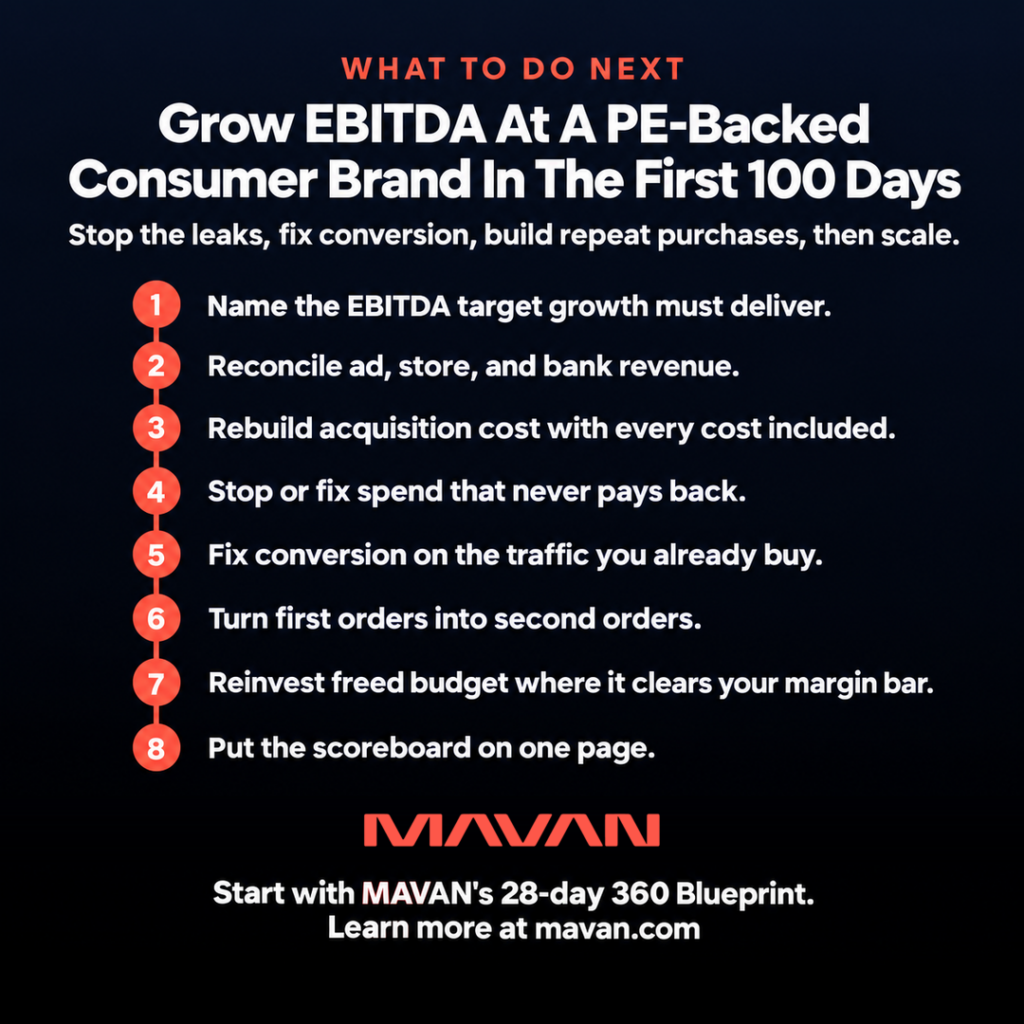
The first 100 days should stop the leaks, fix conversion, build repeat purchases, and then scale only what clears a margin threshold. That order protects EBITDA while revenue grows. Spending into a broken funnel raises revenue and cost together, which is one of the fastest ways to miss a value-creation plan.
Speed now matters more than it did. In FTI’s survey, 63% of PE leaders said their value creation levers show measurable impact within 12 months, up from 41% a year earlier. A consumer growth plan has to fit that clock, and a shared set of facts comes first. Dan Barnes, President of MAVAN, puts the dependency plainly. “You can’t answer ‘did it work’ without a shared definition of what ‘it’ was and where the data lives,” he says.
The Eight Steps For Growing EBITDA
- Name the EBITDA line growth has to deliver. Write down the revenue and margin figures in the value-creation plan, plus the date they must hold by. Every finding gets measured against them.
- Reconcile the numbers before acting on them. Compare what ad platforms, the storefront, and the bank each report as revenue. We walk through that test in our guide to growth and GTM due diligence.
- Rebuild CAC fully loaded, by channel and cohort. Count media, fees, tools, creative, and people, then compare payback against the deal model. Our breakdown of fully loaded, blended, and paid CAC covers this in detail.
- Stop or fix spend that never pays back. Set a margin threshold for every channel and campaign. Anything below it gets a short window to improve, or it gets switched off.
- Fix conversion on the traffic you already buy. Test product pages, checkout, offers, and trust signals before adding budget. Each gain in conversion lowers the cost of every customer after it.
- Turn first orders into second orders. Segment buyers, build lifecycle flows around real purchase behavior, and track repeat rate by cohort.
- Reinvest freed budget where it clears the threshold. Scale channels on marginal return, and refresh creative before fatigue sets in.
- Put the scoreboard on one page. Agree on definitions, owners, and thresholds, then show the board the same table every month.
Where The 360 Blueprint Fits
Steps two through four can essentially pay for the rest of the plan, because any waste they uncover is cash the portco already spends. A 360 Blueprint covers the diagnostic half of this list in 28 days, with five or more specialists working from the portco’s own systems. It ends in a roadmap sequenced by owner and dependency, which the team can run with us or on its own. For the execution rhythm after that, see our guide to the 90-day growth sprint.
How Do Conversion And Repeat Purchase Raise Margin Without More Ad Spend?
Conversion and repeat purchase raise margin because they grow revenue from customers the brand has already paid to reach. A higher conversion rate lowers the cost of every new customer. A higher repeat rate spreads that cost across more orders. Neither needs a bigger media budget, which makes both strong early levers in a hold.
Conversion Comes Before Traffic
Matt Saunders, Growth Lead at MAVAN, sets the order for any short sprint. Get the conversion rate “to its best possible level before driving more traffic to the page,” he says. “There’s no point optimising for more visitors if the page isn’t ready to convert them.”
Our consumer work bears that out. For Jack Mason, a watch and accessories brand, we reworked product pages to add buying context without losing the brand’s imagery. Conversions rose 21% and add-to-cart actions rose 30%. Mixology runs a family-owned chain of women’s clothing boutiques. Its total revenue rose 21% within the month after we removed friction from its buying paths. EvolvH, a clean hair care brand, lifted conversions 16% after we added benefit-led messaging and customer content to its online store.
“A lot of website friction isn’t the result of one bad decision. It’s the result of many small, reasonable decisions … that nobody ever audits as a complete journey.” — Matt Saunders, Growth Lead, MAVAN
Repeat Buyers Carry The Margin
Repeat purchases are where consumer margin compounds. Capstone’s report makes the link to value plain. Strong customer retention was one of the traits buyers kept paying more for, even in a soft market. A repeat order arrives without a fresh acquisition bill, so every lift in repeat rate improves profit per customer.
Owned channels do much of that work. For Zig Zag, our research found that sales converted best when shoppers had joined the brand’s newsletter. We built and tested sign-up calls to action around that finding, and newsletter sign-ups rose 30%. Paired with technical SEO and content that grew organic traffic 47%, online sales grew 56%. For Arcadia, the end-to-end lifecycle program we built was credited with 38% of revenue.
Track repeat behavior by cohort, not by monthly totals. Barnes recommends “retention by cohort vintage,” meaning how customers acquired in a given month behave over time. In his view, that view shows “whether your product is actually improving or whether you’re papering over churn with spend.” Our guide to improving retention in consumer products goes deeper on the mechanics.
How Do You Scale Paid Acquisition Without Eroding Margin?
Scale paid acquisition on marginal return, not averages. Judge each next dollar by what it earns after product cost, discounts, and returns. Feed ad platforms clean first-party data and refresh creative often. Grow spend only while new customers clear a margin threshold. That keeps revenue growth from eating into EBITDA.
Paid media keeps getting more expensive. Meta reported that its average price per ad rose 12% from a year earlier in the second quarter of 2026. It disclosed the same 12% rise for the first quarter. Budgets aren’t keeping pace. Gartner’s 2026 CMO Spend Survey found marketing budgets roughly flat at 7.8% of company revenue, up from 7.7% in 2025. A consumer portco can’t buy its way to plan when each impression costs more and the budget holds still.
MAVAN President Dan Barnes separates the two CAC numbers that boards most often blur. “Marginal tells you whether the next dollar is worth spending,” he says. “Blended tells you how the overall machine is performing.” A healthy blended average can hide a top layer of spend that loses money on every order. Scale stops making sense at the point where marginal customers fall below the margin threshold, whatever the average says.
“Marginal for decision-making, blended for reporting.” — Dan Barnes, President, MAVAN
What Works Once Measurement Is Sound
Clean measurement does more than settle board debates. It tells the ad platforms which customers are worth finding, and it shows the team which audiences and messages earn their spend. For example, one of our clients, Titan, needed lower acquisition costs, but its tracking couldn’t support reliable CAC measurement. We rebuilt tracking and measurement first, then scaled. CAC efficiency improved threefold while paid acquisition volume grew fivefold.
Peak season is a harder test, because every competitor bids for the same shoppers at once. Thanksgiving is the most contested stretch of the year for ad slots. 818 Tequila asked us to reach consumers through Facebook and Drizly during that window. We didn’t chase cold audiences at peak prices. Instead, we built campaigns around people the brand already had signals on: past buyers from Drizly’s retailer CRM data, shoppers who had engaged with 818’s own site, and lookalikes of both. A seasonal Thanksgiving theme carried the creative. CPMs came in 44% below the 2022 benchmark, and cost per acquisition landed 57% below it.
Creative carries more of the load as platform targeting gets less precise. We cover that shift in why creative is the biggest acquisition lever.
How Do You Make Revenue Gains Hold Up At Exit?
Revenue gains hold up at exit when a buyer can trace them to a working system rather than a spending spike. That takes one source of truth and cohort data showing customers growing more valuable. It also takes margin per customer that improves over time, plus an internal team that can run the engine on its own.
Exit buyers have raised the bar, according to FTI. They want margin proof, a revenue model that scales, and management teams that can execute on their own after close. FTI’s Asia and Caribbean head, Roy Huang, argues the exit story starts on Day 1 of the hold. Waiting until the final year, he warns, leaves a buyer with a sales pitch instead of evidence.
Measurement A Buyer Can Trust
Measurement is the first thing a buyer’s diligence team will test. They’ll compare what the ad platforms claim, what the storefront records, and what finance books as revenue. If those numbers disagree, every growth claim in the deck gets discounted until someone can explain the gap. When they agree, the growth story told at exit matches the one finance reports. The buyer can then spend diligence time on the upside, with no detour into reconciliation.
Getting there means pulling every acquisition source into one view that finance and marketing both trust. NEXUS, MAVAN’s paid-media analytics platform, does that by connecting ad platforms, the mobile measurement partner, and the data warehouse, with an AI insight layer on top that makes using it easy. (This comes included with our 360 Blueprint.)
Seasonal brands need one more discipline. Barnes flags month-over-month revenue growth as a trap. In businesses with strong seasonality or uneven ad spend, he calls it “noise.” He recommends tracking how much each month’s new customers are worth at 30, 60, and 90 days against earlier groups. That view would show a buyer whether December’s customers come back in March. Our board-ready scoreboard guide shows how to report it.
Ownership That Can Be Counted On
The last test is ownership. Buyers want a management team that can keep executing after close, a point FTI’s findings make plain. A growth engine that depends on outside people walking out the door at signing is a risk they’ll price in. What reassures them is evidence that the portco runs the system itself. That means the company owns its accounts, data, and dashboards, and its team understands why the programs work and what to change when conditions shift.
That outcome has to be planned from the start of an engagement, not bolted on at the end. We document the system as we build it, train the internal team alongside the work, and transition proven programs in-house once they’re ready. The capability stays inside the asset, which is what a buyer is paying for.
Frequently Asked Questions About Growing Revenue And EBITDA At PE-Backed Consumer Brands
Should A PE Firm Cut Marketing Spend To Raise EBITDA After An Acquisition?
Cut the spend that never pays back, not the budget as a whole. Across-the-board cuts can lift EBITDA for a quarter, then shrink the customer base the exit depends on. Rebuild acquisition cost fully loaded and find the campaigns below a margin threshold. Then move that money to channels and retention work that clear it.
How Quickly Can Growth Work Improve EBITDA At A Consumer Portco?
Unprofitable spend can often be spotted within days and stopped soon after. Conversion work can also move fast; Mixology’s revenue rose 21% within the month of our changes. In FTI’s 2026 index, 63% of PE leaders saw results from value creation levers within 12 months. A consumer growth plan should meet the same bar.
Which Metrics Should Sponsors Track For Consumer Brand Growth?
Lead with revenue, EBITDA, and contribution margin per customer. Underneath, track fully loaded CAC, payback and repeat rate by cohort, and conversion rate. Use marginal CAC for spending decisions and blended CAC for reporting. Keep the list short. Dan Barnes argues that if you can’t recite your top metrics from memory, you have too many.
Do Growth Operating Partners Replace A Portco’s Marketing Team?
No. A growth operating partner works alongside the existing team and adds the senior skills a problem requires. Then it leaves the capability behind. MAVAN draws from a network of more than 150 senior growth operators. We deploy only the specialists the roadmap calls for, then stand them down when the work no longer needs them.
How Much Does A Growth Operating Partner Cost?
MAVAN prices around the problem rather than a package, and every engagement starts with a 360 Blueprint. After that, paid media fees scale with the spend we manage. Other work runs as a set monthly engagement tied to a detailed scope. That way, the sponsor and portco know what we own, what we deliver, and what success looks like.
So, How Do PE Firms Accelerate Revenue And EBITDA At Consumer Brands?
PE firms accelerate revenue and EBITDA at consumer brands by treating the growth engine as a margin lever. They stop spend that never pays back and fix conversion before buying traffic. They turn first orders into repeat orders and scale only while new customers clear a margin threshold. The best partners diagnose that whole system, then execute inside it.
Consumer buyers are still paying for retention, pricing power, and proof that margin improves as revenue grows. Every quarter of the hold either builds that proof or spends time you can’t get back.
If one of your consumer portcos is growing revenue faster than profit, start with evidence. A 360 Blueprint gives you a 28-day, evidence-backed read on where margin leaks and a sequenced roadmap your team can run with us or without us.
Casey Rock is Content Director at MAVAN, where he helps turn complex ideas into clear, strategic content that drives growth. With over 15 years of experience across content strategy, SEO, media, and digital marketing, Casey focuses on building content systems that connect audience insight, brand storytelling, and measurable business outcomes.
Book a complimentary consultation with one of our experts
to learn how MAVAN can help your business grow.
Want more growth insights?
Thank you! form is submitted
[hubspot type=”form” portal=”20951211″ id=”9c538ed2-fb12-45f1-a573-ad7953c058cc”]
Related Content
-
How Do PE Firms Accelerate Revenue And EBITDA Post-Acquisition?
PE firms accelerate revenue and EBITDA at consumer brands by fixing the growth system before adding spend. They reconcile the numbers and cut spend that never pays back. They lift conversion and repeat purchases, and they judge growth by contribution margin. Growth operating partners such as MAVAN diagnose that system in 28 days, then help execute the fix.
-
Who Does Growth & GTM Due Diligence for PE Deals?
Four kinds of provider run growth and go-to-market due diligence for private equity deals. Strategy consultancies test the market. Specialist commercial diligence firms audit the pipeline. Go-to-market boutiques rebuild the sales motion. And growth operating partners examine the full revenue engine from inside the business, then stay to operate it after close.
-
Who Is The Best Growth Partner For PE Portfolio Companies?
The best growth partner for a private equity portfolio company behaves like an operating partner you deploy, not an agency you brief. It reads the whole growth system before it spends, owns a revenue number alongside management, and leaves the capability behind so the sponsor can redeploy it.