
Creative has become the biggest lever in paid user acquisition because privacy changes erased most targeting signal, so platforms like Meta now read your ad itself to decide who sees it. The smartest use of AI is extending the life of proven creative — not generating new assets from scratch, which audiences and ad algorithms increasingly ignore.
TLDR — How Do You Win User Acquisition With Creative And AI?
- Creative is the #1 lever now — platforms read your ad to pick the audience.
- Privacy changes gutted targeting; the asset is the campaign.
- Don’t use AI as a creative engine — generated ads breed “AI blindness.”
- Point AI at extending proven winners, never inventing new concepts.
- Refresh before you rebuild: swap the hook, CTA, length, or aspect ratio.
- Build the container first — asset library, style guide, locked guardrails.
- Tag every creative element so you know which variable to swap.
- Watch fatigue: CTR off 20%+, CPM rising on flat reach, frequency past 3.
- Decide in days, not weeks — velocity beats polish.
- Book a free MAVAN growth consultation to build your creative engine.
Run the same winning ad you ran two years ago and watch it stall. Campaigns that once cleared a 3-to-4x return now limp along near 1.8x on identical creative, and the ad itself never changed. The machine underneath it did. If you run growth or user acquisition at a venture-backed studio or consumer app, you have probably felt this and reached for the usual explanations — budget, seasonality, a tired audience. The real shift sits one layer down, in how the platforms decide who sees what.
We work alongside growth teams every day at MAVAN, and the same question keeps surfacing: Where does the budget move the needle anymore?
Dan Barnes, President of MAVAN, has spent more than a decade buying users at scale across Zynga, NaturalMotion, and Machine Zone, and his answer is blunt. “The thing that matters most in paid acquisition today is not your lookalike audiences. It’s not your LTV modeling. It’s creative.” That single reframe changes how a team should spend its next quarter — and it changes the role AI should play, which is smaller and sharper than most vendors will tell you.
The short version: creative is the lever, and AI is a multiplier for the creative you have already proven — not a generator of new ideas. Everything below unpacks why that is true now, and exactly how to act on it without spending your brand equity to find out.
Why Is Creative The Biggest Lever In User Acquisition Now?
Creative is the biggest lever because privacy changes erased most of the targeting signal that platforms once relied on. Meta’s Andromeda system and rival ad networks now read your ad itself to decide who sees it. Your creative does the targeting work that audience settings and lookalikes used to do.
Here is the mechanism in plain terms. When Apple’s App Tracking Transparency arrived in 2021, deterministic tracking went dark for an estimated 70 to 80 percent of iOS users, and roughly 40 percent of the identifiers advertisers leaned on for granular targeting disappeared. Meta’s response was Andromeda, a new ad-retrieval engine that finished rolling out to all accounts by late 2025. Instead of matching ads to declared interests, Andromeda reads the content of each creative — the hook, the scenes, the on-screen text, the audio — and routes it to whoever is most likely to respond. Agencies tracking the change put it flatly: creative is now the targeting, and audience selection matters far less than it used to.
Dan Barnes, MAVAN’s President, saw this coming from the buyer’s seat. “The resolution on customer value at the front end has degraded too much for targeting to carry the load it used to,” he says. “What fills that gap is creative that resonates — and enough of it to stay ahead of fatigue.”
The data backs the volume point. Mobile UA agency AppAgent reports that managers who are not producing 15 to 30 new creatives a month at the scaling phase are already behind. One analysis of Andromeda-era accounts found brands testing more than 20 new ads a month seeing 65 percent higher returns than those testing fewer than 10. The channel has become secondary. The asset is the campaign.
For a team used to optimizing bids and audiences, this is a hard pivot, and it is the whole reason we built our thinking on acquisition architecture around creative throughput rather than channel tinkering. The leverage moved. The budget should follow it.
Should You Use AI To Make Your Ad Creative?
No. AI-generated assets carry a measurable penalty with both audiences and ad algorithms. Use AI to assist a human-led process, but keep original concepting, brand voice, and the core idea in human hands. Letting AI invent your creative trains people to scroll past your brand.
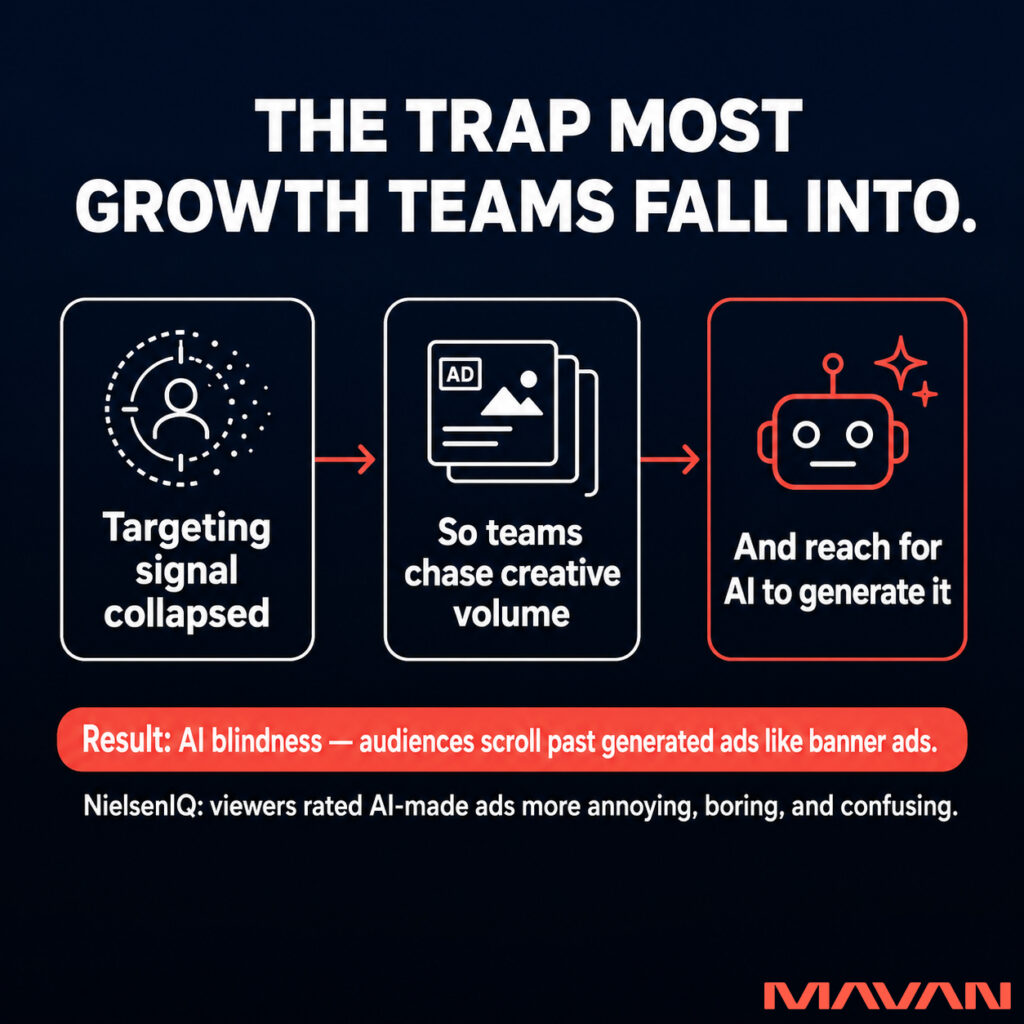
This is where most teams misread the moment. They see creative volume is the new requirement, they see generative tools that promise infinite assets, and they connect the two. Dan Barnes, President of MAVAN, calls it the central mistake. “The mistake most publishers make is treating AI as a creative engine. It isn’t. Not yet. Especially not if you have a brand worth protecting.” His warning is sharper still: “AI blindness is already happening. People scroll past generated assets the same way they learned to ignore banner ads. You don’t want your brand to train that reflex.”
The research is catching up to his instinct. Marketing-measurement firm NielsenIQ ran AI-generated ads through eye-tracking and brain-response testing and found viewers spontaneously identified almost every one as AI-made, without being asked, and rated them more annoying, boring, and confusing than human-made ads. The only AI-assisted ad that escaped detection was one an advertising professional had refined through heavy iterative editing. Client-strategy partner Molly Marshall of media firm Basis draws the same line: AI can repurpose and iterate on existing creative, but it cannot identify a strong insight and build creative that meaningfully connects to a person — so it should complement a strategy, never originate one.
There is a more sinister risk underneath the performance hit. Generative tools trained on scraped data can reproduce another brand’s marks or unvetted concepts, and the legal exposure follows you even when an agency or freelancer used the tool without telling you. We’ve talked before about the power and the limits of AI in growth marketing, and the conclusion holds: the technology is a force multiplier on human judgment, not a substitute for it.
What Is AI Good For In Creative Production?
AI is excellent at extending the life of creative you have already proven. Once an ad is working and starting to fatigue, AI can analyze what makes it work and swap controlled variables — the hook, the length, the call-to-action, the framing — to keep it fresh. It recombines pre-approved elements. It does not invent the winner.
MAVAN President Dan Barnes describes the capability precisely. “AI can analyze the DNA of that asset — the character, the duration, the button color, the framing — and make intelligent substitutions from a library of pre-approved assets to extend its runway.” Then the line that should anchor your whole policy:
“It cannot create. It can only recombine things that already passed quality control.” — Dan Barnes, President, MAVAN
Performance marketers have arrived at the same playbook from the data side, and they call it refresh rather than replace. When a proven ad starts to slip, the cheapest way to revive it is to change the part that grabs attention first. Analysts at creative-intelligence firm Finsi note that swapping new hooks against proven body content and a proven call-to-action is the most economical way to extend an ad’s life. You are not rebuilding the persuasion that already works. A static winner can become a new aspect ratio, a different opening three seconds, a swapped headline, or a fresh CTA — and to the audience it reads as new while the proven core stays intact.
This is the difference between burning budget and compounding it. A team that abandons a winning concept the moment it dips is discarding hard-won data and starting from zero. A team that knows how to iterate squeezes weeks of additional efficiency out of every concept that earned its place. We made this case in detail in our piece on turning creative duds into wins through refinement, and AI simply accelerates the same discipline — provided you build the container for it first.
How Do You Set Up AI To Extend Creative Without Hurting Your Brand?
Build the container before you turn AI loose. Define the proven assets, the brand rules, and the tagging system first, then let AI recombine only inside those walls. The order matters: guardrails before generation. A model recombining inside a tight, pre-approved library protects your brand; a model improvising outside one erodes it.
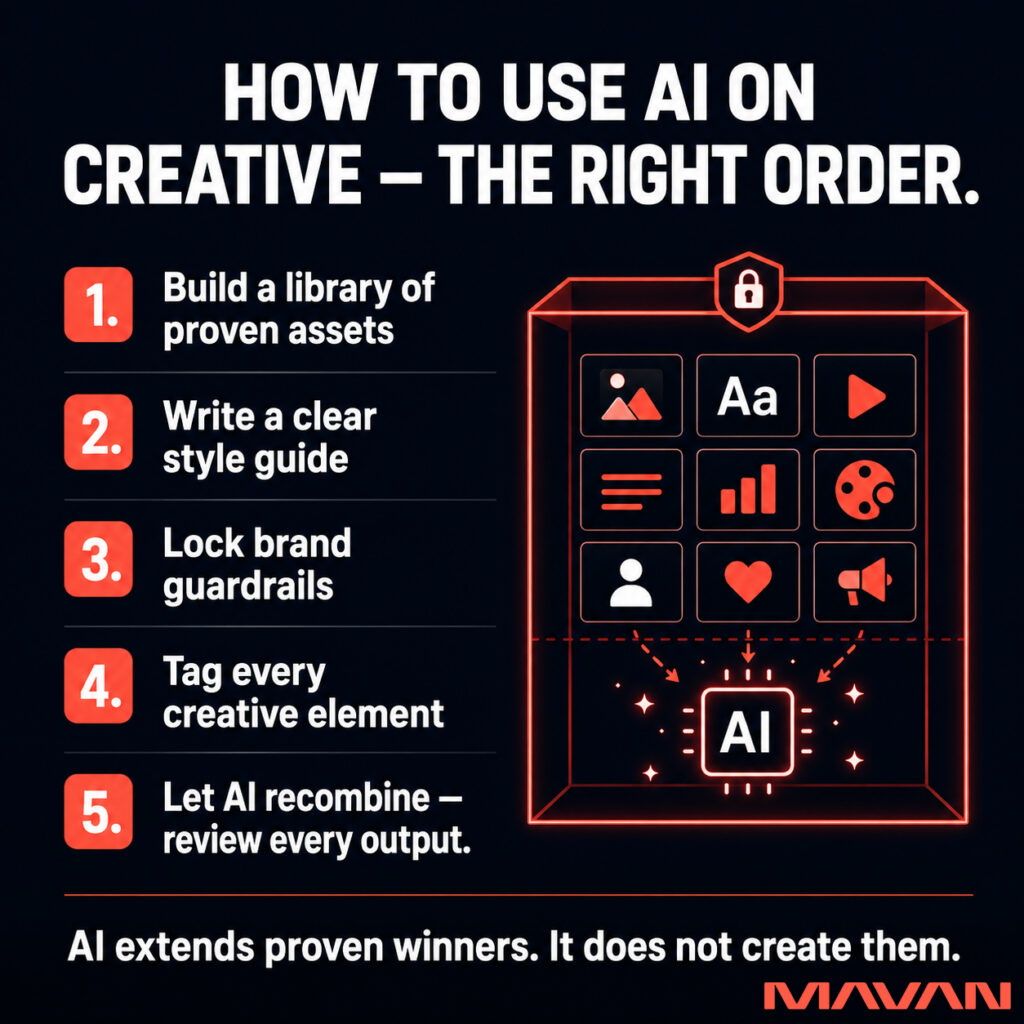
Dan Barnes, MAVAN’s President, gives the sequence in one breath. “Build your template library first. Define your style guide. Lock your brand guardrails. Then let AI work within that container.” Adobe‘s enterprise creative team reaches the identical conclusion: creative leaders must define brand guidelines and set up the foundations upfront, and only then can AI help enforce and scale them. Here is how we put that into practice with the teams we embed in:
- Build a template library of proven assets. Collect the hooks, scenes, characters, and CTAs that have already cleared performance and brand review. This is the only raw material AI is allowed to draw from. Skip this and AI has nothing safe to recombine.
- Write a style guide that defines your non-negotiables. Spell out voice, color, logo treatment, character behavior, and the things your brand will never say or show. Make it specific enough that a machine — or a new hire — could follow it without you in the room.
- Lock brand guardrails the model cannot cross. Set hard constraints on what can be substituted and what is fixed. The guardrails are what let you move fast later without a senior review on every asset.
- Tag every creative element so you know what is working. Label each hook, length, format, and CTA, then map those tags to performance. Creative-analytics platforms now tag video, static, and even playable ads automatically and tie each element to return. Without tagging, you cannot tell AI which variables to hold and which to swap.
- Let AI recombine inside the container — and review every output. Run substitutions only against the approved library, and keep a human on the final pass. The NielsenIQ finding is your reminder: the AI-assisted ad that performed was the one a professional finished by hand.
This is also where a brand worth protecting earns the patience the process requires. The container is upfront work. It is also what turns AI from a brand risk into a brand multiplier.
How Do You Know When To Refresh Versus Rebuild — And How Fast Should You Move?
Watch the early fatigue signals and act on them within days, not weeks. A falling click-through rate, a rising cost per thousand impressions with flat reach, and climbing frequency all say a creative is tiring. Refresh the hook first; rebuild only when several refreshes stop reviving it. Speed of decision is the advantage that compounds.
Creative fatigue costs you money before you notice it — return on ad spend often slips three to five days before the dashboards make it obvious, per analysts at Finsi. The good news is the signals are readable, and each one points to a specific move. We use a simple decision frame with the teams we work with:
| Warning sign | What it tells you | The move |
|---|---|---|
| Click-through rate down 20%+ on a 3-day rolling average | The hook has gone stale | Swap the first three seconds, keep the body |
| Cost per 1,000 impressions rising while reach stays flat | You are hitting the same people repeatedly | Expand the audience or rotate in a variant |
| Frequency climbing past 3 per user | Saturation is setting in | Introduce fresh variants of the winner |
| Performance still flat after several hook swaps | The concept itself is tired | Rebuild from a new angle |
Refresh cadence varies by channel — fast-moving video feeds like TikTok burn through assets in about a week, while a strong feed ad on Meta can run two to four weeks before returns thin out, according to paid-social practitioners. The point is not a fixed schedule. The point is the loop.
Dan Barnes, President of MAVAN, frames the entire operating model around it: “All of this infrastructure exists for one reason: to shorten the time between seeing something and doing something about it.” And the discipline that makes the loop work is intellectual honesty before the spend. “If you can’t answer why you’re doing something before you do it, you don’t have a hypothesis. You have an opinion.”
Velocity beats polish here. Andromeda-era analysts find that testing velocity matters more than perfect execution, because the system needs a steady stream of distinct variants to learn from.
This is exactly the muscle an embedded team can build fast — Erin Clift, CMO of KidStrong, credits MAVAN’s embedded growth team with cutting her customer acquisition costs by 60 percent, and Luke Harries, Head of Growth at ElevenLabs, scaled paid search to a high six-figure monthly budget with MAVAN before transitioning it in-house. The studios that win the next two years will be the ones whose creative loop spins fastest, a pattern we mapped in our mobile gaming growth playbook for 2026.
Frequently Asked Questions About Creatives, User Acquisition, and AI
Is AI-generated ad creative bad for performance?
On its own, usually yes. NielsenIQ’s testing found viewers spontaneously flagged AI-made ads and rated them more annoying and confusing than human-made ones, which suppresses attention and engagement. AI-assisted creative finished by a human can perform well; fully generated creative tends to train audiences to scroll past it.
How many new ad creatives should I test each month?
At the scaling stage, plan for 15 to 30 new creatives a month, per mobile UA agency AppAgent. What matters more than the raw count is creative diversity — distinct hooks, formats, and angles — because the ad algorithms now need varied signals to learn who responds to what.
What does “creative is the new targeting” mean?
It means platforms like Meta now read your ad’s content to decide who sees it, rather than relying on the audience settings or lookalikes you pick. Privacy changes erased much of the old targeting signal, so the creative itself carries the matching work that manual targeting used to do.
Can AI replace my creative team?
No. AI cannot identify the insight behind a winning concept or protect brand voice — it recombines what already exists. The strongest model is a human team that concepts and approves, with AI extending proven winners through controlled variations inside locked brand guardrails.
How do you extend the life of a winning ad?
Refresh before you rebuild. Change the opening hook, the call-to-action, the length, or the aspect ratio while keeping the proven core intact. Tag every element so you know which variable to swap, and rebuild from scratch only when several refreshes stop reviving performance.
Should small teams with limited budgets still produce high creative volume?
Yes, with a focus on diversity over quantity. A smaller team can run 8 to 12 structurally distinct ads that cover different angles, then use AI to extend the winners. The goal is enough variety for the algorithm to learn, not raw output for its own sake.
Creative Is The Lever, AI Is The Multiplier
Creative has become the biggest lever in paid user acquisition because privacy changes gutted targeting signal, so platforms now read your ad to decide who sees it. The winning use of AI is narrow and powerful: extend the life of creative you have already proven by swapping controlled variables, never generate net-new concepts that audiences and algorithms penalize as AI blindness sets in. Build the container first — a proven asset library, a clear style guide, locked brand guardrails, and element-level tagging — then let AI recombine inside it. The teams that win wire this into a fast loop: clear hypothesis, quick read, decisive call.
If your return is slipping on a proven ad, then swap the hook and the call-to-action before you touch anything else — and watch it for three days. That single habit will save more budget than any audience tweak.
Casey Rock is Content Director at MAVAN, where he helps turn complex ideas into clear, strategic content that drives growth. With over 15 years of experience across content strategy, SEO, media, and digital marketing, Casey focuses on building content systems that connect audience insight, brand storytelling, and measurable business outcomes.
Book a complimentary consultation with one of our experts
to learn how MAVAN can help your business grow.
Want more growth insights?
Thank you! form is submitted
[hubspot type=”form” portal=”20951211″ id=”9c538ed2-fb12-45f1-a573-ad7953c058cc”]
Related Content
-
How Can Private Equity Funds Repeat Growth Across Portfolio Companies?
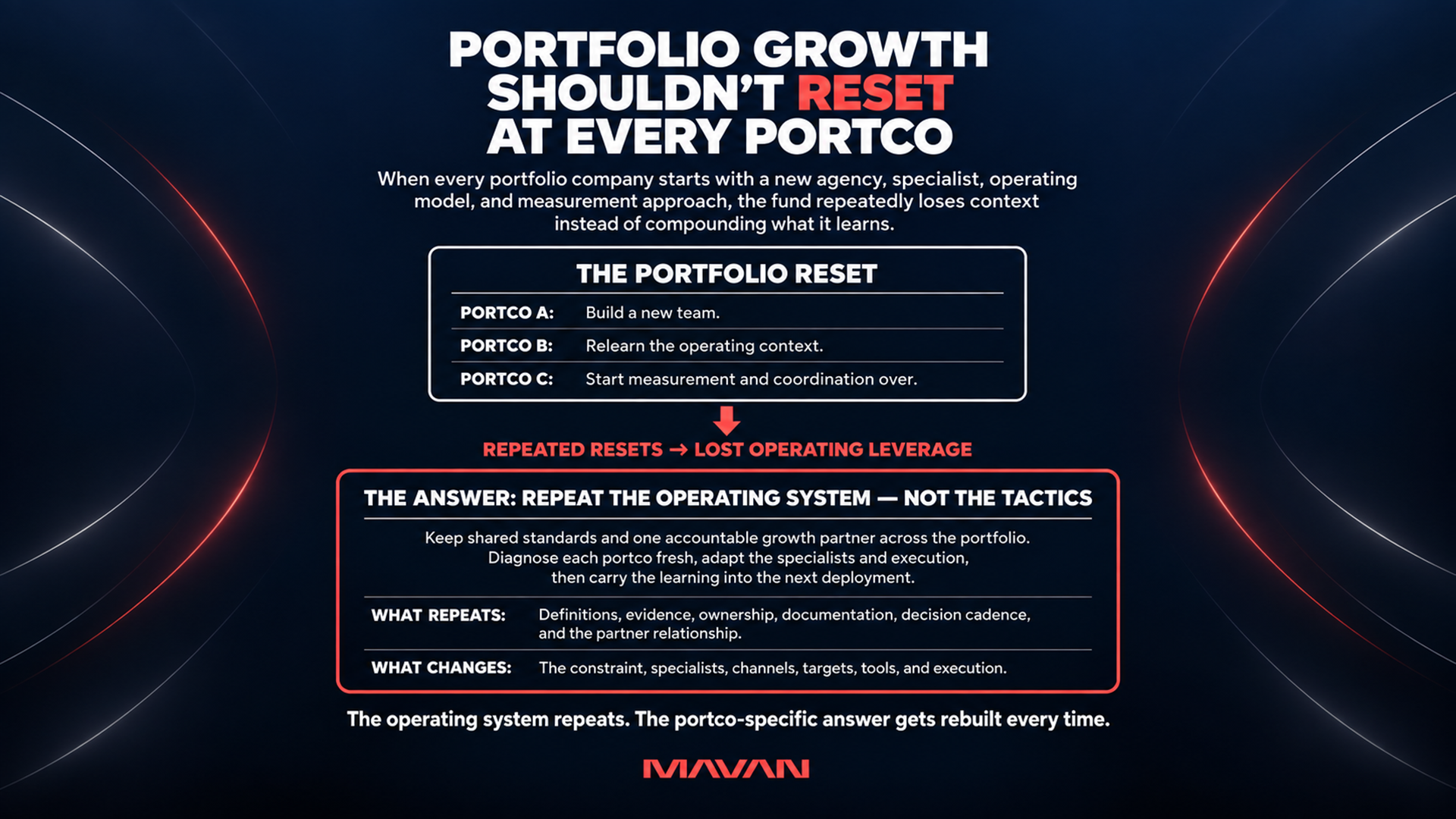
Growth becomes repeatable across a VC or PE portfolio when the fund installs one operating system instead of referring each company to a different specialist. The system has three parts: a single source of truth every team trusts, a board-ready scoreboard of ten to twelve metrics, and an embedded pod that diagnoses the real constraint in ninety days before anyone spends more.
-
What Do PE Funds Want From a Portfolio Growth Partner? Repeatability!
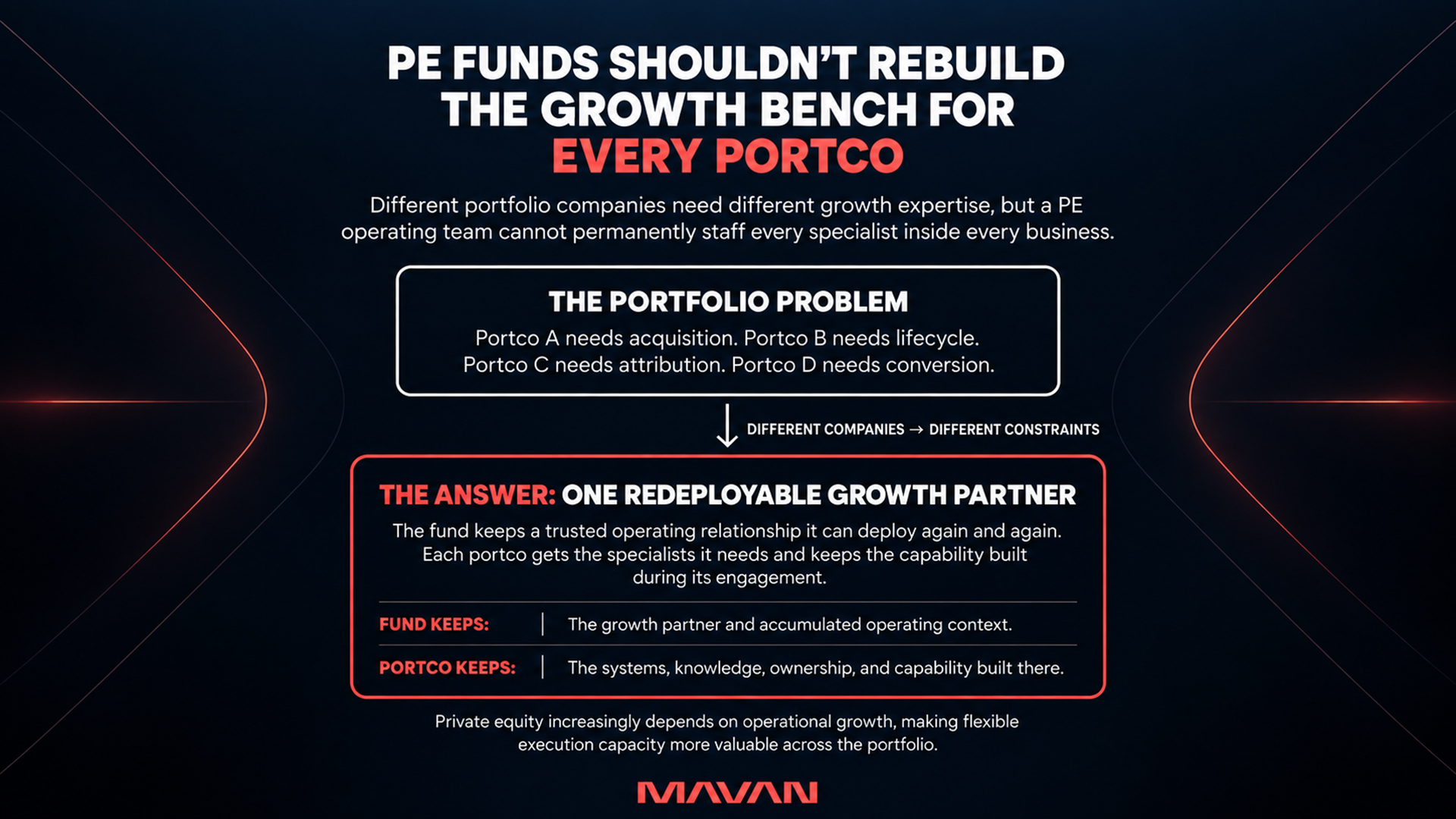
What funds actually want from a portfolio growth partner is repeatability — a portable growth operating system that produces comparable results across very different portfolio companies. Repeatability shows up as a single source of truth, a board-grade scoreboard, a 90-day sprint, and a clean handoff, so each win compounds across the portfolio instead of staying at one company.
-
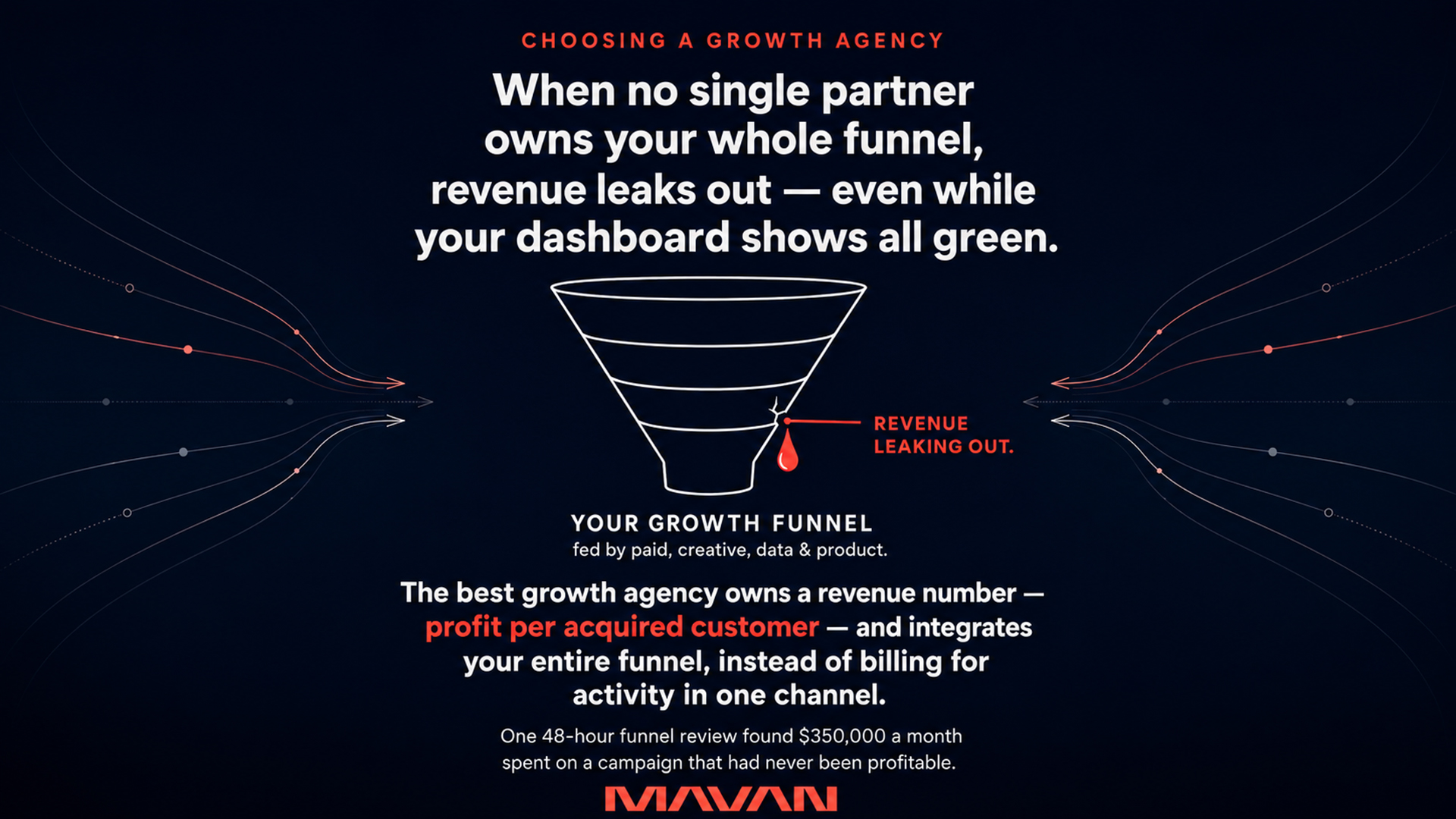
What’s the Best Growth Agency For VC & PE?
The best growth agency for a venture-backed or PE-owned company behaves less like a traditional agency and more like an embedded operating partner. It diagnoses your whole funnel, owns a revenue number such as CAC payback or LTV:CAC, and executes inside your team — rather than billing for activity in one channel.