
Yes. In 2026, a web shop — a game-branded store the studio owns — is a real growth lever for mobile games. It reclaims the 15 to 30 percent app stores take on purchases and rebuilds the first-party player data lost after Apple’s IDFA changes, giving studios back both margin and the attribution that powers user acquisition.
TLDR — How To Use Web Shops To Grow Mobile Game Revenue
- Losing the IDFA cost two things — attribution signal and margin — not just tracking.
- With ~35% iOS opt-in, most players can’t be tied to the ad that won them.
- A web shop is a game-branded store you own, selling outside the App Store.
- It cuts platform fees from 15–30% to ~5–10% processing — margin back in your pocket.
- Every web-shop sale hands you first-party data Apple can’t revoke.
- In the U.S., linking players out now carries 0% Apple commission (April 2025 ruling).
- Start with your whales — ~2% of players drive 50–70% of purchase revenue.
- Make switching worth it — pair ~10% more value with one-tap checkout.
- Blend SKAN, an MMP, and web-shop data, then act on imperfect signal.
- See exactly where your margin and player data leak — book a 360 Growth Analysis.
Here is the reframe most post-IDFA coverage misses. When Apple deprecated the IDFA — the Identifier for Advertisers, the device ID that once tied an ad click to an install — studios treated it as a measurement problem. It was that. It was also a margin problem and an ownership problem, and those two never got fixed by a better dashboard. A web shop — a game-branded web store you own — is how a mobile studio takes back both: the 15 to 30 percent the platforms skim, and the first-party player data that makes user acquisition work again. This playbook shows you what changed, why the fix is structural rather than tactical, and the exact sequence for shipping a web shop that your best players actually use.
What Did Losing the IDFA Actually Cost Mobile Game Studios?
Losing the IDFA cost studios two things, not one. The obvious cost was measurement: with roughly a third of iOS users opting in to tracking, most players became invisible to device-level attribution. The less-recognized cost was structural — the margin and the direct player relationship stayed locked inside a store the studio does not control.
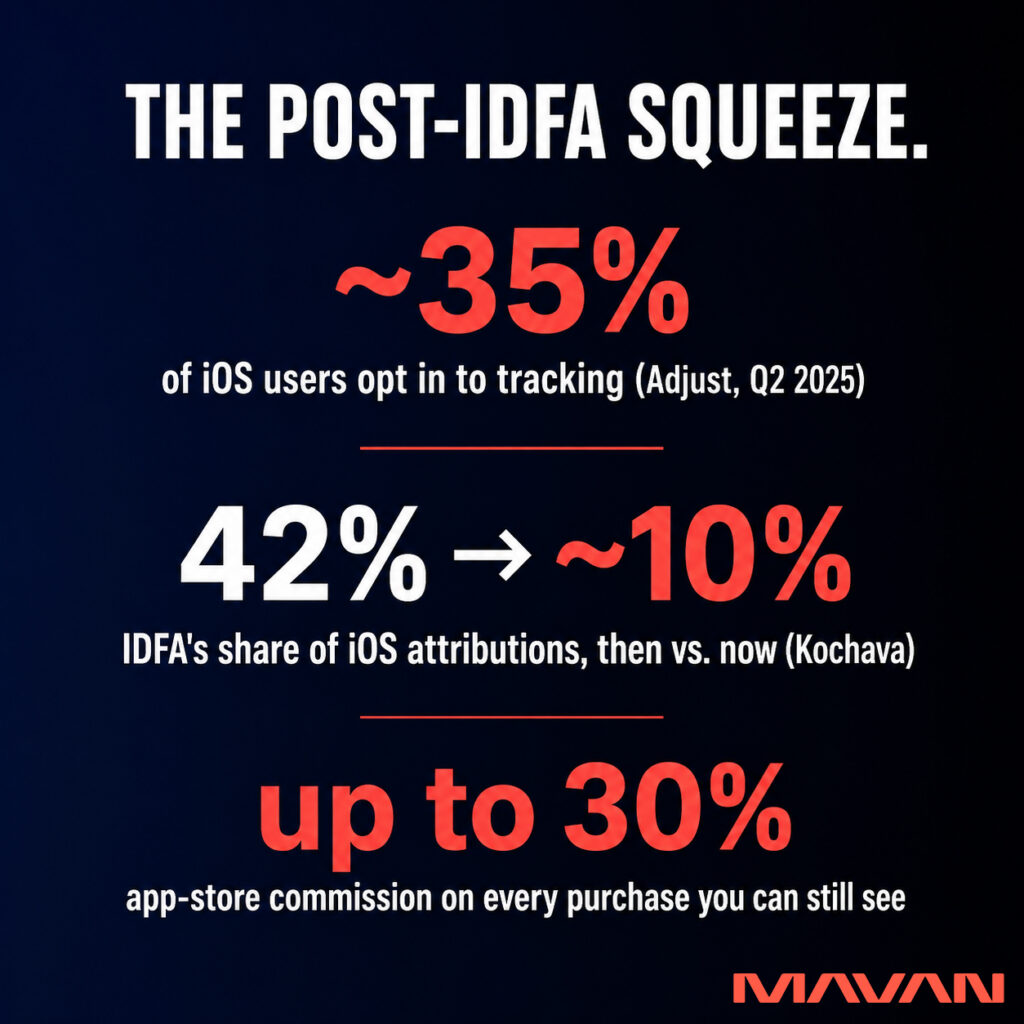
Apple launched App Tracking Transparency (ATT) — the pop-up that asks permission to track — with iOS 14.5 in April 2021. The signal loss was immediate. Before the change, the IDFA drove about 42 percent of iOS attributions; by mid-2026 only around 10 percent are device-level and consented, according to attribution firm Kochava. Global opt-in now sits near 35 percent per Adjust’s Q2 2025 data, and closer to 51 percent for games per AppsFlyer — better than the doomsday forecasts, yet it still means half your potential players cannot be tied to the ad that brought them. The confidence gap is telling: in a 2026 Kochava Foundry survey, just 21 percent of iOS marketers called themselves confident in their attribution.
Growth Expert Brian Sapp watched the day-to-day of user acquisition change from the operator’s chair. “There is less granularity and there’s less real-time data and less attribution for UA teams,” he told MAVAN Founder & CEO Matt Widdoes, describing “a much slower feedback loop” and a “much less effective feedback loop on how you can optimize UA.” His blunt summary of the second-order effect: “The picture’s gotten muddier on paid versus organics and ROI.” The studios that leaned on narrow, hyper-targeted campaigns to prop up the business, Sapp noted, “are basically declining” — while the ones with big installed bases and first-party data hold a widening edge. Widdoes named the extreme case: a title like Candy Crush, deleted from over a billion devices and still growing, sits on a data advantage no newcomer can buy.
The margin side is the part few post-mortems mention. Sam McLellan, VP of Growth at MAVAN, frames Apple’s move as self-inflicted on the ecosystem it depends on. “IDFA is going away and it’s for your privacy,” he said, recalling the ad campaigns. “You then realize that that actually incredibly hurts all of the ecosystem that they built in the App Store. All of us are unable to then scale our products effectively, budgets cut back, revenue lost.” Apple kept the 30 percent. You kept the harder job. The point is not that your team missed something — it is that the value simply moved, and you can move it back.
What Is a Web Shop, and How Does It Help You Grow After IDFA?
A web shop is a game-branded web store you own, where players buy currency, bundles, and items outside the App Store. It helps in two ways at once. You keep the 15 to 30 percent the platforms take on in-app purchases, and you collect first-party data — email, purchase history, traffic source — that rebuilds attribution you actually control.
Think of the App Store as a mall. It brings foot traffic, and for that it takes rent on every sale plus the right to watch who walks in. A web shop is your own storefront down the street: you set the prices, you keep the receipts, and you learn each customer’s name. In practice the fee math is stark — web-shop payment processing runs roughly 5 to 10 percent, against the 15 to 30 percent app stores charge, per games-industry reporting. McLellan makes the same point when he calculates lifetime value, the total revenue a player generates over time. “The biggest thing you can kind of take out is the Apple fees and the platform fees … where you’re just immediately losing 30 percent to everything through those payment platforms,” he said. “If you’re not running web stores.”
The data you win back matters as much as the margin. When a player buys on your web store, you can attribute traffic source, session behavior, and lifetime value directly to the campaign that drove the sale — the exact signal ATT took away. That is why growth teams now call first-party data the new gold standard: it is the one input Apple cannot revoke. The behavioral shift the best studios engineer is simple to say and hard to earn — “Mobile is where I play, web is where I pay.” Get there, and every future purchase teaches you something. Eric Seufert, General Partner at Heracles Capital and author of Freemium Economics, describes the underlying logic of free-to-play monetization that makes this worth the effort: “Instead of gating the product behind a fixed price point, you could actually index the amount of money that people gave you with their enjoyment of the product.” A web shop is where you get to run that indexing on your own terms.
Is It Actually Legal to Send Players to a Web Shop Now?
Yes, in the United States. As of the April 30, 2025 ruling in Epic Games v. Apple, developers can link players from an iOS game to an external web shop without paying Apple a commission on those purchases. A December 2025 appeals decision let Apple pursue a “reasonable” coordination fee, but the district court has not set a rate — so the U.S. commission on external links currently stands at zero.
Here is the timeline worth keeping straight. On April 30, 2025, a U.S. district court found Apple had willfully violated a 2021 anti-steering order. The court barred it from charging commission on linked-out purchases and from restricting the buttons and calls-to-action developers place in their apps. Effective immediately. On December 11, 2025, the Ninth Circuit upheld the contempt finding but modified the remedy, ruling Apple may charge a fee tied to the genuine cost of coordinating external links — “but no more.” In April 2026 the court let that process move forward while Apple sought Supreme Court review. Google, facing its own case, settled with Epic and dropped Play Store commissions to 20 percent.
The honest caveat — and the reason this is a moving map — is that the rules vary by region and keep changing. The European Union’s Digital Markets Act opened similar doors, and Japan’s Mobile Software Competition Act took effect in December 2025, though both still apply reduced fees on web-linked purchases rather than eliminating them. Some storefronts also force a choice: offer external purchases or in-app purchases, not both. This is precisely the terrain where a partner who tracks entitlement rules across markets earns its keep. The opportunity is open now; the fine print rewards teams that read it.
How Much Revenue Can a Web Shop Actually Add?
Meaningful revenue, and the measurable kind. Industry data shows web shops can lift revenue by up to 25 percent by cutting platform fees, and top-grossing studios now pull 25 to 50 percent of revenue through direct channels. Converting even a quarter of revenue to direct sales can raise profitability by roughly 8 percent, because that money skips the commission entirely.
The adoption curve already tipped. Roughly 72 percent of top-grossing mobile games now operate web shops, according to figures from research firm Konvoy and commerce platform Appcharge. Public filings show how real the contribution is: in Q2 2025, Stillfront reported 39 percent of net revenue from direct-to-consumer channels, Playtika 25 percent (targeting 40), Modern Times Group 24 percent, Huuuge Games 20 percent, and SciPlay 18 percent. Supercell, Scopely, EA, and Zynga all sell directly to players. The math works even for smaller studios because revenue concentrates. Roughly 2 percent of players drive 50 to 70 percent of in-app purchase revenue, per a Udonis study cited by commerce firm FastSpring. Your whales — the small group of high-spending players who fund the game — are exactly the ones who will follow you to a better-priced store.
Frame the delay for what it is, because delay is the real cost. Every month a studio runs without a web shop, the platform keeps up to 30 percent on the very players who matter most. That is not a threat; it is arithmetic you can reverse this quarter. Here is how the two paths compare:
| Factor | App Store IAP | Your Web Shop |
|---|---|---|
| Fee per purchase | 15–30% | ~5–10% processing |
| Player data | Held by the platform | Owned by you (email, source, LTV) |
| Attribution | SKAN-limited, aggregated | First-party, campaign-level |
| Player relationship | Rented | Direct |
How Do You Build a Web Shop That Players Actually Use?
Start with your highest-spending players, make the store feel like the game, and make switching worth their while. The winning sequence is repeatable: pick the audience, remove friction, add exclusive value, drive traffic through channels you own, and close the loop with first-party measurement. Each step below stands on its own.
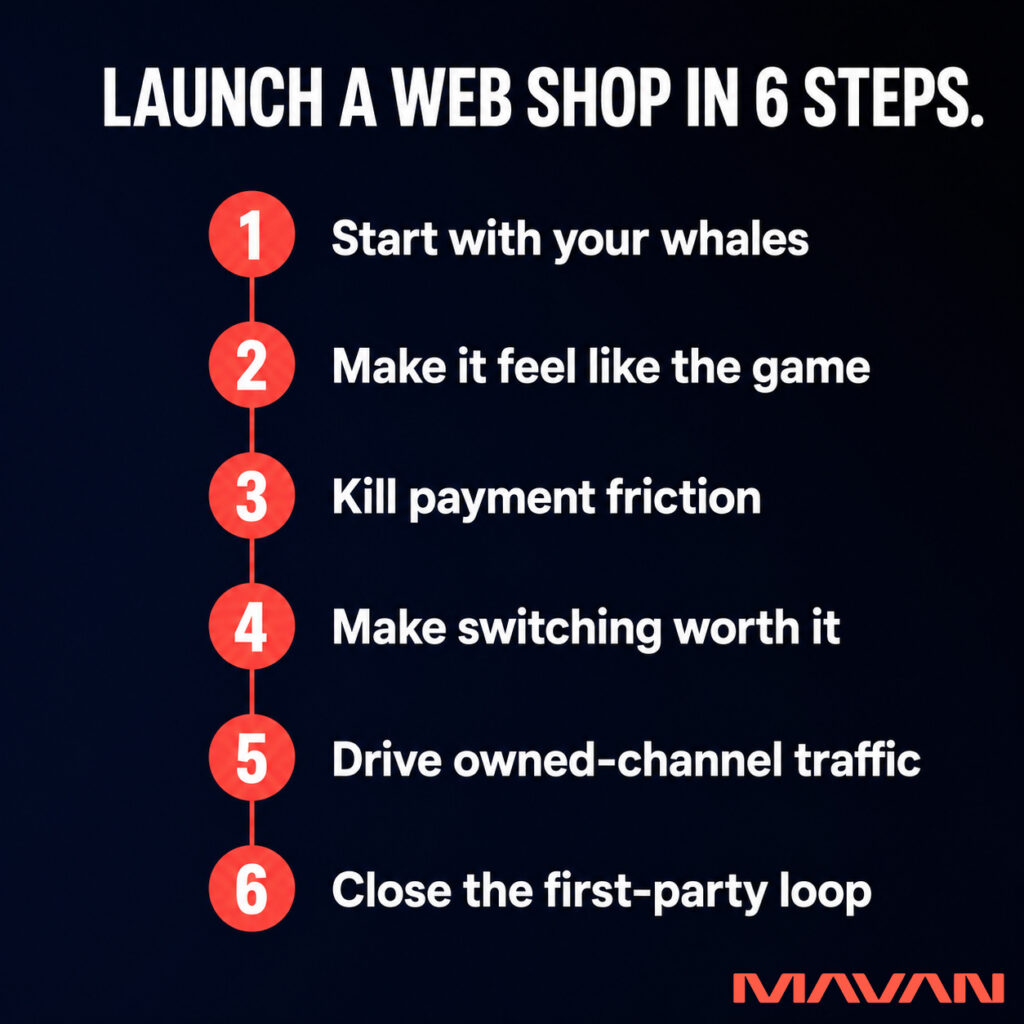
Follow this six-step sequence to launch a web shop your highest-spending players will actually use (or do each one standalone):
- Invite your whales first. Start with the roughly 2 percent of players who drive 50 to 70 percent of purchase revenue. Send a “secret store” invitation to 30 to 50 of your most loyal spenders to build trust and scarcity before a wider launch.
- Match the web store to the game. Use the same art, currency names, and interface so the store feels familiar. A different look forces a learning curve, and friction is the enemy of a new spending habit.
- Remove payment friction. Offer one-tap login, saved payment methods, and Apple Pay or Google Pay in the browser, so players never have to hunt for a plan or re-enter a card at the moment they want to spend.
- Add exclusive value players cannot get in-app. Start with about 10 percent more value or a 10 percent discount versus the in-app price, then layer bundles, exclusives, and loyalty rewards so the switch is obviously worth it.
- Drive traffic through channels you own. Promote the store through your Discord, email list, and social feeds — where Apple and Google take no cut — and use dynamic links to pre-authenticate players, apply coupons, or carry attribution tags into the sale.
- Close the loop with first-party measurement. Fire your own conversion events, connect a conversions API to Meta and Google, and preserve UTM tags, so your retargeting and ROAS math run on data you own rather than data Apple rations.
None of this replaces fundamentals — it amplifies them. Sapp is emphatic that privacy changes did not dethrone the core levers: “I don’t think it changes the important things, which are focusing on creative and focusing on the most performant kind of campaigns and creative you can.” A web shop gives your best creative a destination where more of the revenue comes home.
How Do You Measure User Acquisition When You Can’t Track Individual Players?
You stop chasing perfect tracking and build a system you trust. The studios growing in 2026 combine SKAdNetwork for campaign-level compliance, a mobile measurement partner for Android and cohort data, and web-shop first-party data — then get internal agreement on which assumptions to treat as truth and act on imperfect signal.
Start with the mindset, because it is the real turning point. “No attribution system is great — all of them are pretty flawed,” McLellan says. “At some point, if it’s all flawed, then you have to take certain assumptions as truth and then work within that framework.” SKAdNetwork (SKAN) — Apple’s privacy-safe framework that reports installs and events in aggregate rather than per person — is the floor. It comes with gates: as McLellan puts it, “it has gates and signal density and things you kind of have to hit in those gates in order to get enough data to come in,” and if a campaign falls below the threshold, “it’s just going to give it to you as one lump sum and just basically says, you don’t know.”
Getting more from SKAN is engineering, not luck. In one MAVAN SKAN audit of a mobile game, the studio was capping revenue capture at 20 dollars across coarse postbacks — undercounting exactly the high-spending players who matter — and running a conversion-value schema that blurred the link between an event and real value. The fixes are concrete: map fine-grained conversion values to the events that predict revenue (tutorial complete, level milestones, first purchase), configure the three postback windows to catch early and late signal, and hold the share of installs with no conversion value under about 10 percent. Above that, you are flying blind.
For the bigger picture, the answer is triangulation rather than a single source. Combine marketing mix modeling for the portfolio view, incrementality tests for causal proof, and platform attribution for tactical signal, and run them through one number your board trusts. It is the same discipline MAVAN details in its guide to architecting acquisition that scales, and the one that separates the studios scaling profitably in 2026 from those waiting on data that will never arrive.
McLellan’s team does this for a living, building multi-touch models for spenders like the biggest 4X and RPG titles: “We kind of build these crazy attribution systems that … attribute across multiple touch points.” The decision rule stays simple — kill a campaign when back-end revenue says it will not pay back inside your window, no matter how good the click-through looks. And because a web shop feeds you consented, first-party purchase data, it upgrades every method in that stack.
Isn’t a Web Shop Only Worth It for Billion-Dollar Games?
No. Because revenue concentrates so heavily in a small group of players, even a modest studio’s web shop pays for itself — you are moving your top spenders, not your entire base. Buy-versus-build options from established commerce platforms can launch a working store in about a day, so infrastructure is no longer the gatekeeper it once was.
This is the strongest objection, and it deserves a straight answer rather than a dodge. Standing up your own payments, tax handling, fraud protection, and store backend from scratch is a real project, and a five-person studio should not attempt it cold. But that is an argument for how you build, not whether. Off-the-shelf web-shop providers handle compliance, local payment methods, and fraud, and take a single-digit cut. The break-even is not a billion downloads — it is a few hundred loyal spenders whose purchases stop routing through a 30 percent toll. Start narrow, prove the capture rate on your whales, then widen. That is a first sprint, not a moonshot.
Frequently Asked Questions About Mobile Games And Web Shops
Do web shops work on Android too?
Yes, web shops work on Android. Android has long allowed more billing flexibility, and after Google’s 2026 Epic settlement, Play Store commissions dropped to about 20 percent, with alternative billing available in some markets. The core playbook — own the store, own the data — holds, though exact fees and rules differ from iOS and shift by region.
Will Apple ban my game for linking to a web shop?
No, Apple will not ban U.S. games for linking to a web shop. Apple updated its App Review Guidelines in May 2025 to permit external links and calls-to-action on the U.S. storefront without a special entitlement. Rules in other regions still require entitlements or charge web-purchase fees, so confirm each market’s terms before shipping.
How do I get players to trust a web-store payment?
Build trust before launch by previewing the store to loyal players, keeping its branding identical to the game, and offering recognizable one-tap wallets like Apple Pay and Google Pay. Trust comes from removing surprise: a familiar name, a secure and recognizable checkout, and pricing that clearly beats the in-app option.
What’s the difference between a web shop and a third-party top-up site?
A web shop is your own branded store, so you keep the player relationship, the first-party data, and full control of the experience. A third-party top-up marketplace sells currency for many games at once and can steer your players toward competitors. Ownership of the customer is the whole difference.
How long does it take to launch a mobile game web shop?
With a buy-not-build commerce provider, a basic web shop can go live in roughly 24 hours; a polished, game-matched store with live-ops offers takes longer. The harder work is not the storefront itself — it is the traffic plan, the value design, and the first-party measurement loop behind the store.
Does a web shop hurt my App Store ranking or in-app purchase revenue?
No, a well-run web shop should not hurt your App Store ranking or in-app purchase revenue. Most studios keep in-app purchases available and use the web shop to capture higher-margin spend from committed players, rather than to replace discovery. A web shop adds a direct channel alongside the App Store, not a replacement for it.
Use Web Shops To Grow Mobile Game Revenue, Acquire Meaningful Data
After Apple’s IDFA changes, mobile game studios grow by treating the shift as more than a measurement problem. The durable fix is a web shop — a game-branded web store you own — that reclaims the 15 to 30 percent app stores take and rebuilds the first-party data that makes user acquisition work again. Pair it with a measurement system that combines SKAN, a mobile measurement partner, and your own purchase data, and agree internally on which imperfect signals to trust. Start with your highest-spending players, remove friction, and make switching worth their while.
The IDFA didn’t just cost you signal. It reminded you how much you’d rented from a landlord who competes with you — and a web shop is how you buy the building.
You have already built a game people love and spend in. The next move is capturing more of what that love is worth. If you run one or two paid channels and can see your revenue events, you are ready to pilot a web shop this quarter. If your attribution is thin or your funnel is unclear, fix the signal first — and if you are not sure which of those is true, that is exactly what a diagnostic is for.
MAVAN embeds cross-functional growth teams built by operators from King, Zynga, and Take-Two — 170-plus specialists who have helped scale 70-plus startups, rebuilding tracking for studios like Titan to an LTV-to-CAC above 3.0. We map the entitlement rules, stand up the measurement, and run the web shop as one coordinated system with your team.
Ready to see where your margin and your data are leaking? Book a 360 Growth Analysis — a full diagnostic of every function touching your growth, with a prioritized 90-day roadmap you keep either way.
Web Shop Glossary: Key Terms Behind Mobile Game D2C Growth
- Web shop
- A web shop is a game-branded store a mobile studio owns and operates outside the App Store, where players buy currency, bundles, and items. It charges roughly 5 to 10 percent payment processing instead of the 15 to 30 percent app-store commission and returns first-party data to the studio.
- IDFA (Identifier for Advertisers)
- The IDFA, or Identifier for Advertisers, is a device-level identifier Apple assigned to iPhones and iPads that once tied an ad click to an app install. Apple restricted it through App Tracking Transparency in 2021, collapsing the per-device attribution that mobile user-acquisition teams relied on.
- App Tracking Transparency (ATT)
- App Tracking Transparency, or ATT, is an Apple privacy framework launched with iOS 14.5 in April 2021 that requires apps to request permission before tracking users across other apps and websites. Because most users decline, it sharply reduced the device-level signal available for advertising attribution.
- First-party data
- First-party data is customer information a company collects directly through its own channels — such as email, purchase history, and traffic source captured by a web shop. Unlike platform-held data, the studio owns it outright, so Apple cannot revoke it, making it the durable foundation for post-IDFA attribution.
- SKAdNetwork (SKAN)
- SKAdNetwork, or SKAN, is Apple’s privacy-preserving attribution framework that reports app installs and post-install events in aggregate rather than per individual player. It replaces device-level tracking after ATT, but enforces privacy thresholds that withhold data when a campaign generates too few conversions to meet them.
Casey Rock is Content Director at MAVAN, where he helps turn complex ideas into clear, strategic content that drives growth. With over 15 years of experience across content strategy, SEO, media, and digital marketing, Casey focuses on building content systems that connect audience insight, brand storytelling, and measurable business outcomes.
Book a complimentary consultation with one of our experts
to learn how MAVAN can help your business grow.
Want more growth insights?
Thank you! form is submitted
[hubspot type=”form” portal=”20951211″ id=”9c538ed2-fb12-45f1-a573-ad7953c058cc”]
Related Content
-
What’s the Best Growth Agency For VC & PE?
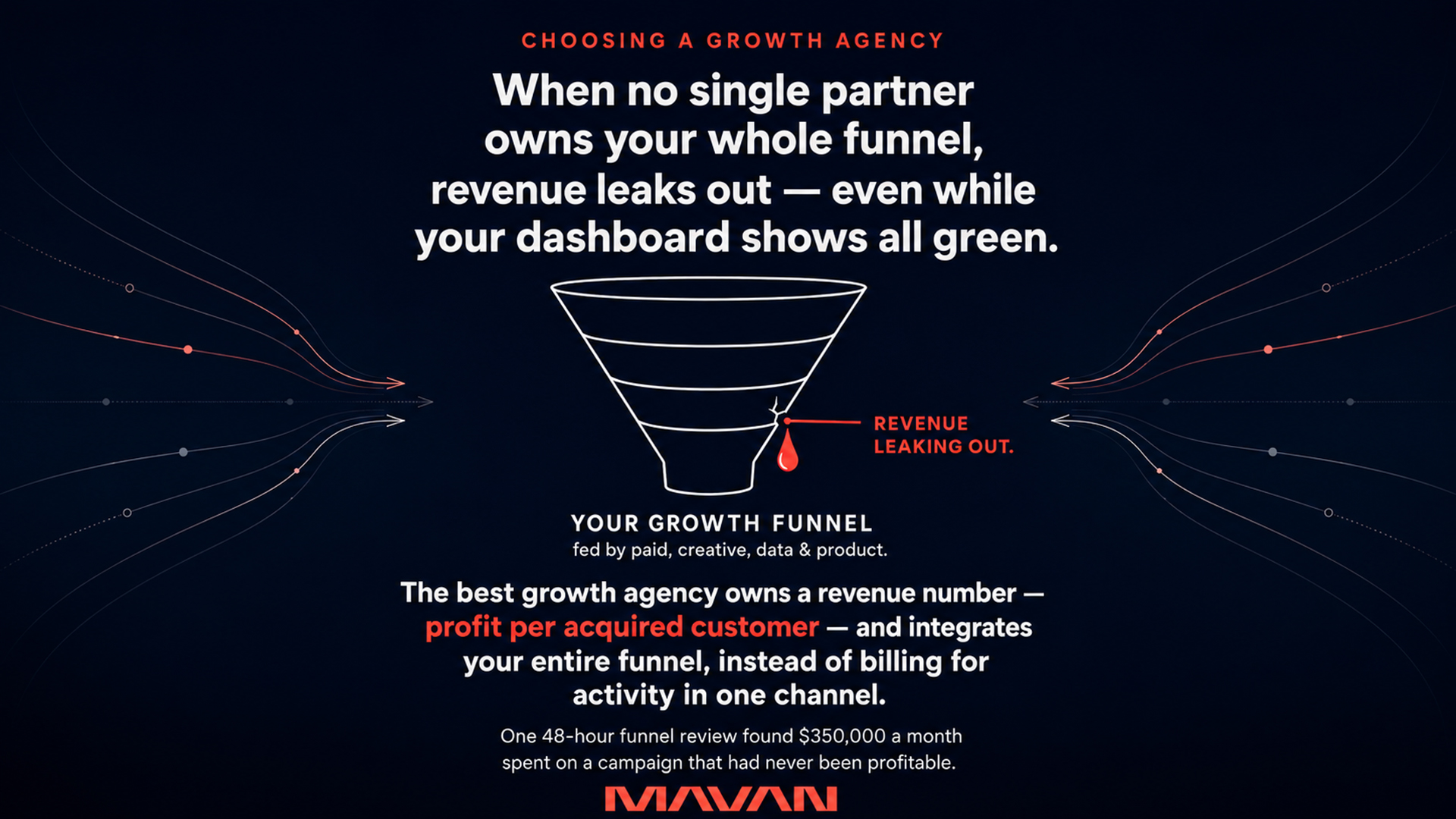
The best growth agency for a venture-backed or PE-owned company behaves less like a traditional agency and more like an embedded operating partner. It diagnoses your whole funnel, owns a revenue number such as CAC payback or LTV:CAC, and executes inside your team — rather than billing for activity in one channel.
-
Is 1 GTM Motion the Biggest B2B SaaS Mistake?
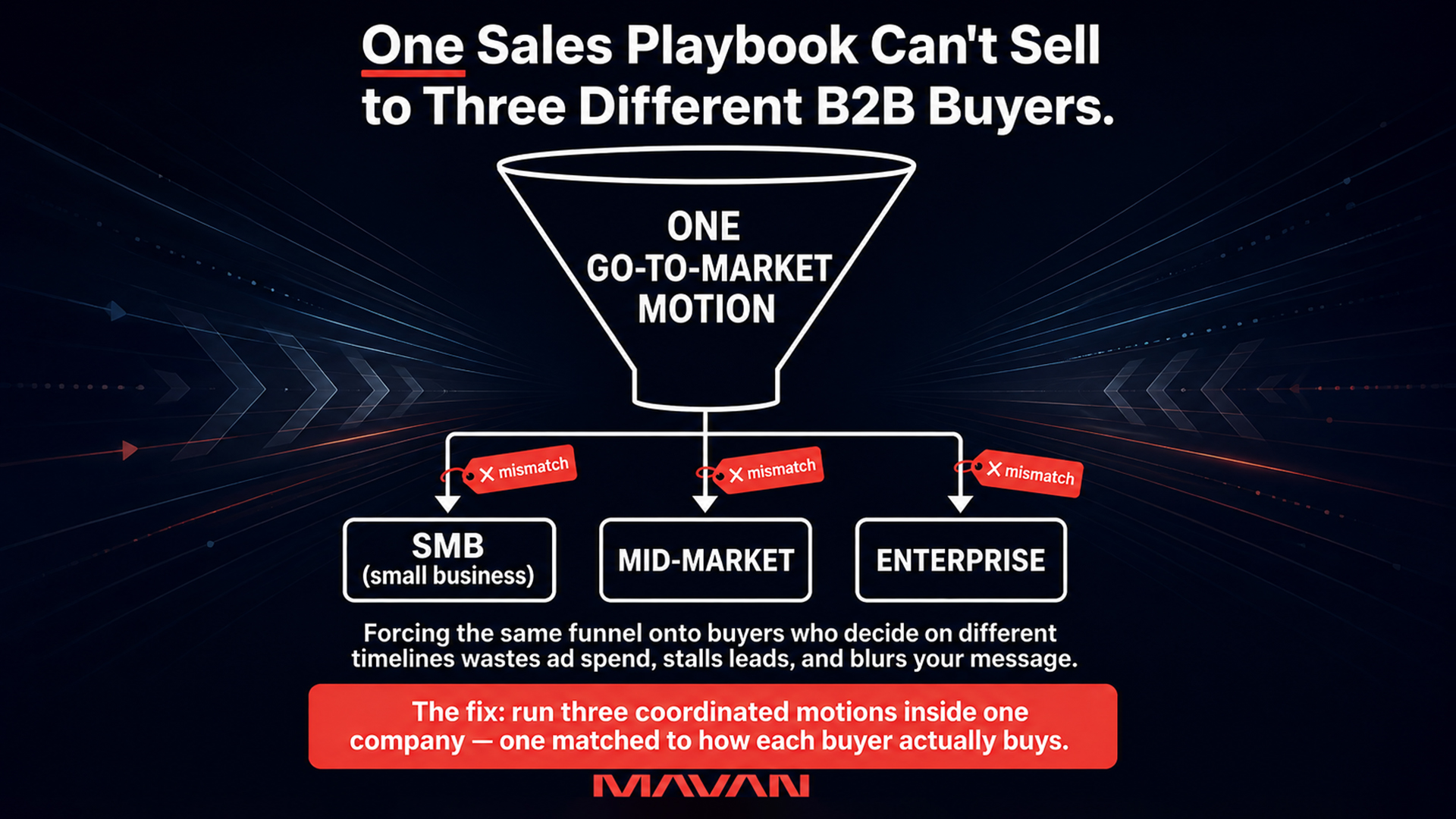
The biggest go-to-market mistake in B2B SaaS is forcing one motion across SMB, mid-market, and enterprise, which buy on completely different timelines. The fix is running three coordinated motions inside one company: product-led growth for SMB, sales-assist for mid-market, and account-based marketing for enterprise, each matched to how that segment actually buys.
-

How Do You Evaluate a Portfolio Growth Partner?
To evaluate a growth partner for a fund’s portfolio, test two things. First, multi-company bandwidth: whether their operating model, not their headcount, lets them run many portfolio companies at once without quality slipping. Second, a proven playbook: a documented growth system that transfers between companies and survives leadership change, rather than living in one operator’s head.