
Most first growth hires fail because the person is dropped into a company with no working system to sharpen, not because they lack talent. The fix is to build the system first — document what already drives growth, or embed a growth pod to turn scrappy channels into a coordinated system with a 90-day playbook — then make your senior hire, so they inherit a working machine instead of a blank page.
TLDR — How To Avoid Bad First Growth Hires
- A bad first hire is usually a good person in an unready system.
- Build the system before you hire — the senior leader comes once it’s running.
- Document what’s already working — hand them a system, not a blank page.
- Break acquisition cost apart by segment and channel before you hire.
- Prioritize execution depth over title prestige — early growth rewards doers.
- Red flags: all-strategy résumés, enterprise-only pedigrees, no 30-60-90 plan.
- A hire who won’t push back adds cost without judgment.
- De-risk with a short paid test project before the offer.
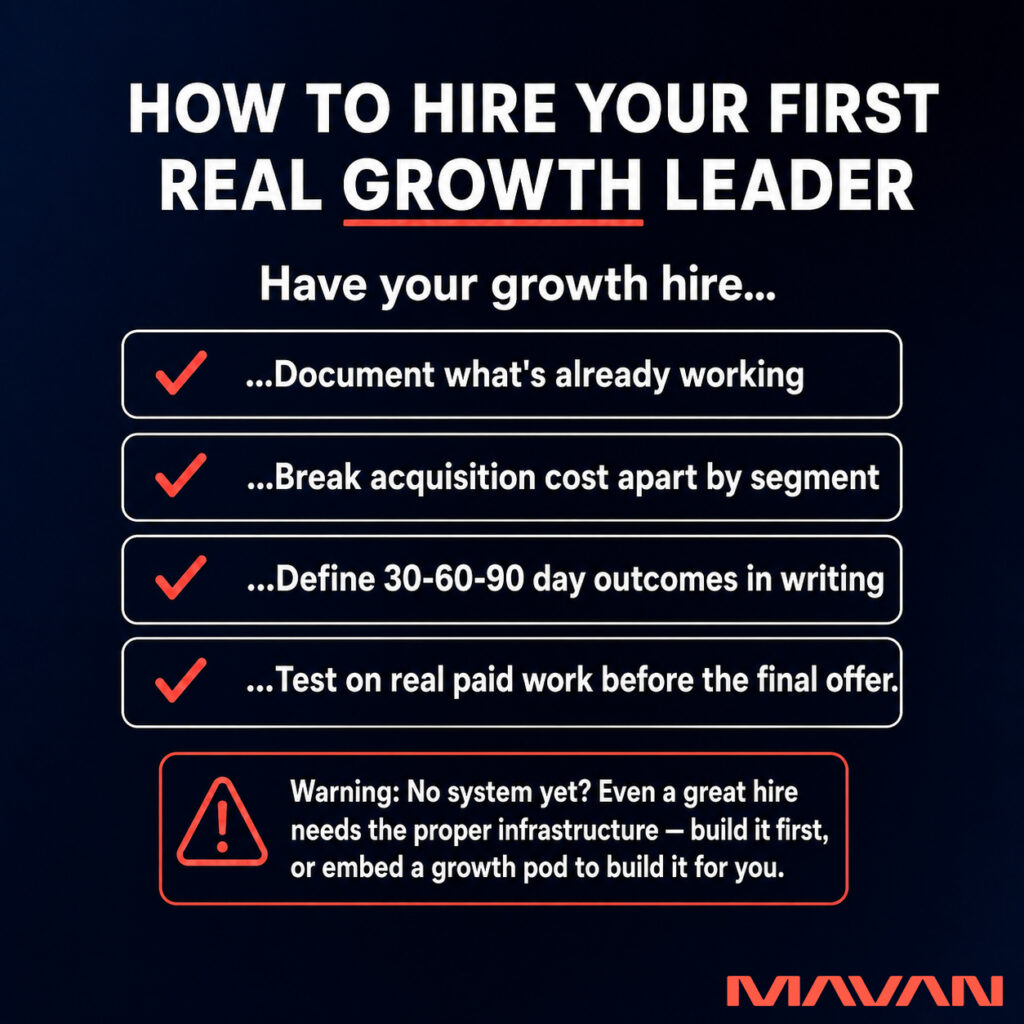
- Define 30-, 60-, and 90-day outcomes in writing.
- See your leaks before you hire — check out our 360 Growth Analysis.
When we talk to founders, we often hear a similar story: The board says scale. The runway says hurry. So they open up a role for a Head of Growth, hire the most impressive résumé in the pipeline, and six months later they aren’t seeing the results they want, and nobody can say exactly what went wrong. The instinct to reach for one senior savior is completely reasonable. It is also the single most reliable way to burn a year you can’t get back.
Here’s the reframe that changes everything: the bad first growth hire is almost never a bad person. It’s a capable person handed a company that wasn’t ready for them. Fix the readiness, and the same hire who would have failed starts compounding. That’s good news, because readiness is something you control — and you’re likely closer to it than you think.
We build and embed growth teams inside venture-backed startups for a living, so we see this decision play out from the inside. This is the playbook we wish every founder had before signing the offer letter: when to hire, what to have in place first, the red flags that predict a miss, and how to better de-risk the bet.
What Is the Bad First Growth Hire Trap — and Why Does It Keep Happening?
The bad first growth hire trap is hiring a senior growth leader to fix a growth function that doesn’t exist yet. The person can’t build discipline inside a system that has none, so they inherit a blank page instead of a machine to sharpen — and the miss gets blamed on them, not the timing.
The core problem is that founders shop for a unicorn who can do everything at once. Sam McLellan, VP of Growth at MAVAN, who spent years scaling mobile gaming at Zynga, Take-Two, and Kabam, names the mismatch directly: “There’s a very limited number of people both willing and able to do the strategy and all the execution and do the board meetings and do all the other stuff you kind of need to do in the startup world.” As he puts it, most operators split into camps — “either you do all of the execution, that’s kind of your world, or you’re in the strategy and you want to manage a team. And with startups, there’s no budget to hire you a full team.”
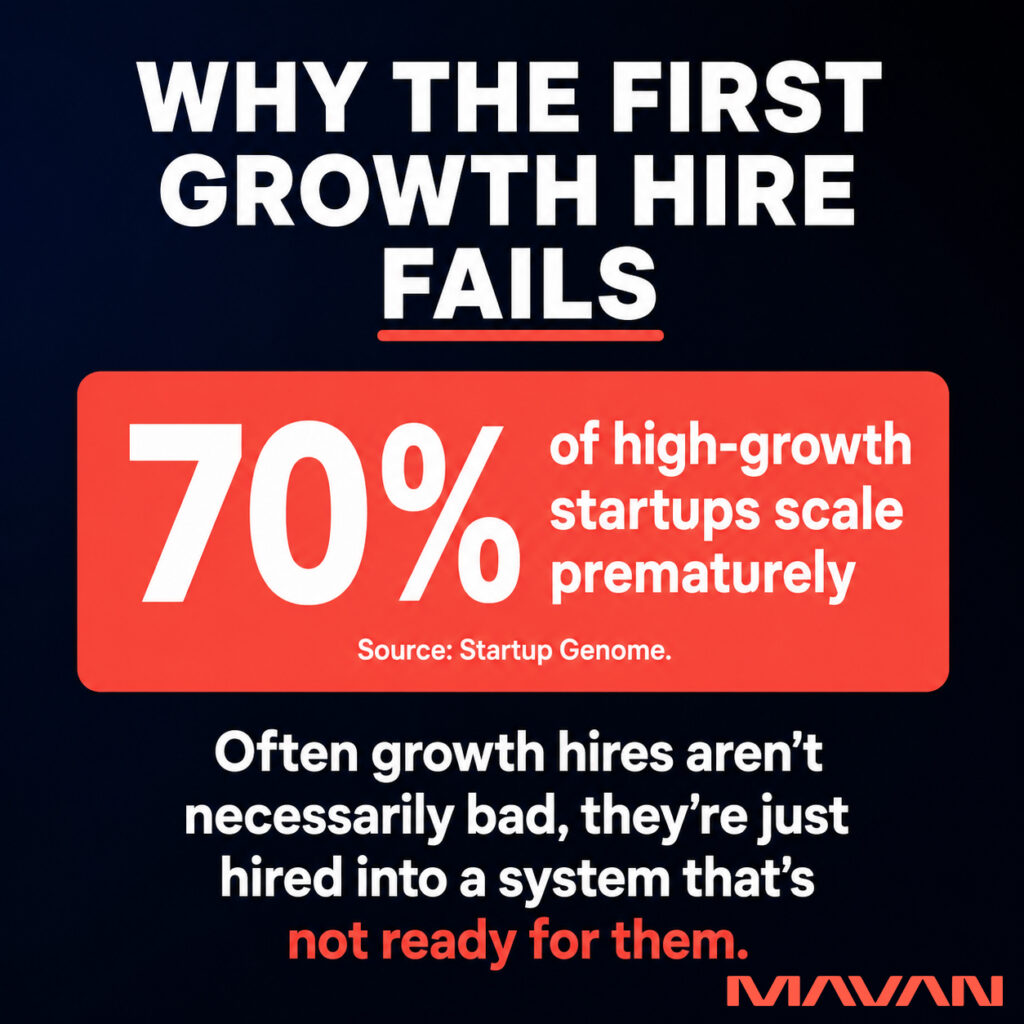
That gap between the job description and the market reality is expensive. Replacing a senior hire who doesn’t work out can run from half to twice their annual salary, with executive roles landing toward the high end, according to the Society for Human Resource Management — and that’s before you count the momentum lost while the wrong strategy runs unchecked. Meanwhile, Startup Genome research found that 70% of high-growth startups show signs of premature scaling, defined as spending on acquisition and building teams before the model is proven. The first growth hire is often where that premature scaling begins.
When Should You Make Your First Senior Growth Hire?
Make the hire once the growth system exists — channels are working, teams are coordinated, and the growth engine runs without the founder as its connective tissue. The signal isn’t a funding round or board pressure. It’s that scrappy motions have already become a measurable, repeatable system that now needs a full-time operator to run and build on.
MAVAN VP of Growth Sam McLellan draws a sharp line between two phases of a company. Early on, growth runs on conviction: “You’re at the very beginning, very early startups. It’s about emotion. You’re leading, everyone’s got an idea and they’re kind of committing to it.” In a disruptive category, he notes, you almost have to believe fully — “because there’s no data point to look at.” But once the product is live and pulling users, the question shifts from faith to operations: “How are you going to go about getting that to them and actually treating it as a mature product now?”
That transition — from belief to operations — is what kicks off the real work of building a growth system. As McLellan frames the moment: “If you’ve got to the point where your product’s live and it’s seeing traction, then you actually have to begin growing this company as if it’s an actual thing.” The industry data lines up with this. Marketers describe a “growth-market fit” that develops after product-market fit — you first need working channels and messaging before a senior hire can run with them. Meanwhile, fractional operators note that paying customers plus a genuine need for repeatable channels, rather than a board mandate to grow, is a signal that your company is entering this phase.
If your product has customers but no proven, repeatable growth levers, you’re still in a founder-led growth stage. A senior hire is premature here — there’s no system yet for them to run. Once founder-led growth hits its ceiling and the channels fragment because you’re the only one connecting them, you’re in a growth window where it probably makes the most sense to hire an embedded growth pod to build out a scalable growth engine. The senior hire comes after that — when the machine runs on its own, with channels working and teams coordinated. Reaching that point is a milestone worth being proud of.
Use this quick read to place yourself before you open the role:
| Where you are | The right growth move |
|---|---|
| Founder-led: Founder is connective tissue in growth engine, customers exist, no proven repeatable growth levers | Stay founder-led; any senior growth hire is premature |
| Scaling: Proven growth requires more teams and tooling to keep up, founder-led growth has hit its ceiling, fragmentation starts to stall growth | Embed a growth pod to build cross-team coordination, turn scrappy channels into a system, and leave a 90-day playbook for you and your incoming leader |
| At scale: channels work, teams are coordinated, the machine runs — it just needs a full-time operator | Make your first senior growth hire; they inherit a working machine to run and build on |
What Does a Startup Need in Place Before the Hire? (The Readiness Checklist)
Before the hire, document what’s already working, know your numbers below the surface, and stay close to your customers. Your first growth leader should inherit a real system to sharpen — not a question to answer from scratch. Readiness is what turns a risky bet into a fast win.
The most useful thing you can hand a new hire is evidence. McLellan’s counsel is to understand what’s driving results before anyone signs on, because so much early spend runs on autopilot: “They’re doing whatever those platforms say you’re supposed to do, because they all have these bright red notifications, like make sure you’re checking all the boxes, which is really good at spending budget and not necessarily so great at finding the exact people you want.” Those platform defaults optimize for platform revenue, not your ideal customer. A founder who has already fought that fight — even imperfectly — gives a new hire a foundation instead of a blank slate.
Getting below your surface numbers matters just as much. McLellan describes the pattern he sees constantly: a team reports one blended cost figure with no breakdown by customer type, campaign, or platform. If your acquisition cost is a single lump number and your attribution is a guess, a new hire spends their first quarter untangling that instead of scaling. We break down how to fix both in our guides on why B2B SaaS attribution breaks and what mobile gaming teaches about CAC and the first growth hire.
Use this readiness checklist before you open the role. Each item is something you or an embedded growth pod can act on this week:
- Document your working channels. Write down every acquisition motion that has produced a customer, however rough. This is the system your hire will optimize.
- Break your acquisition cost into parts. Split it by customer segment, by channel, and by campaign. The blended average hides your best and worst performers.
- Stay in your own sales conversations. Keep taking sales and onboarding calls, so you know your buyer well enough to brief a hire precisely.
- Name the ideal customer. Define who converts fast, retains long, and expands — so targeting has a target.
- Write down what “growth” means here. A shared definition prevents the vague mandate that produces vague results.
What Are the Red Flags of a Bad First Growth Hire?
The clearest red flag is a senior strategist who no longer touches the work. Early-stage growth rewards operators who can plan and execute, so a candidate from a big-brand team with no team of their own to deploy is a classic mismatch. Watch equally for anyone who won’t challenge you.
The most common misfire is the impressive executive who has been out of the execution seat too long. Growth marketer Jonathan Martinez, writing in TechCrunch, estimates that a CMO or VP with 10 to 15 years of experience often carries only about 20% hands-on capability across the growth pillars, because they’ve spent years directing rather than doing. Maya Spivak, a former marketing leader at Segment and Wealthfront, told First Round Review she cautions against anyone far removed from individual-contributor work — at this stage, they should still be ready to do some of it for at least a few quarters. Venture firm Aleph frames the recurring fantasy plainly: founders chase a superhero from a famous brand, but big-company executives manage infrastructure that already exists rather than build it from nothing.
The second red flag is more dangerous. A first growth hire who agrees with everything you say adds cost without adding judgment. The whole point of the hire is to answer the questions you can’t — which means they have to be willing to tell you when your channel mix, your targeting, or your read on the data is wrong. A candidate who can’t respectfully push back in the interview won’t push back when it counts.
Watch for these patterns as you evaluate:
- All strategy, no hands. They describe leading teams but stumble when asked to walk through a campaign they personally built and optimized.
- Enterprise-only pedigree. Their entire career sat inside companies with infrastructure already in place, budgets you don’t have, and specialists you can’t hire.
- No 30-60-90 point of view. A strong operator arrives with a clear early plan; vagueness about the first 90 days signals they’ve never built from zero.
- Deference over judgment. They mirror your assumptions instead of interrogating them.
What Qualities Predict a Great First Growth Hire?
A great first growth hire has execution depth, answers hard questions with data, and overrides platform autopilot with your own targeting intelligence. At this stage, disciplined doing beats title prestige. The best signal is someone who can both design the plan and personally ship the campaigns that test it.
Start with the ability to answer hard questions, not merely advise on them. McLellan’s bar for the hire is concrete: once founder-led campaigns are running on platform defaults, “you need to hire somebody that can actually answer those questions for you” — which channels find your real buyer, which spend is working, and what to cut. That person’s first job is to replace the ad platform’s optimization with your company’s own, because the platform is optimizing for its revenue and not your conversion rate.
Prioritize execution depth over seniority. Someone who can build, run, and refine campaigns with rigor delivers more leverage early than a big-picture strategist waiting on a team you can’t yet afford. Industry hiring data backs the instinct: research summarized by ProductiveShop found that 60% of marketing leaders who drove results at top-performing startups had prior early-stage experience — they had built from scratch before. Look for evidence of that in the interview, rather than a title that only implies it. We go deeper on why proven capability beats industry résumé polish in our piece on prioritizing domain expertise over industry experience in marketing hiring.
The strongest first hires also carry a data instinct into the room. They break acquisition cost apart by customer tier rather than accepting a blended average, and they know that a dollar spent on one platform isn’t automatically a dollar’s worth of growth. That granular reflex — earned in high-measurement environments like mobile gaming — is what turns a founder’s rough channels into a system that compounds.
How Do You De-Risk the First Growth Hire?
De-risk it by testing the candidate on real work before the offer and defining outcomes at 30, 60, and 90 days in writing. A short paid project on an actual problem reveals execution depth that no résumé can. Clear, metric-based deliverables replace a vague mandate with a shared definition of success.
McLellan is honest that the moment carries real risk, and he doesn’t minimize it: “You have to pivot to this maturing curve to actually get some additional revenue to kind of grow the business as a whole. But it’s going to take some risk on both that pivot and on who you hire.” The risk is manageable when you’ve done the readiness work — and ruinous when you haven’t. The two most effective ways to shrink it are a test engagement and outcome-based deliverables.
Test before you commit. A short, paid project modeled on a live problem — a 90-day plan against a real budget, a teardown of your current acquisition mix, or a small campaign they design and run — shows you how a candidate thinks and works. It also lets both sides feel the fit before anyone bets a full-time salary on it. Then, before the offer goes out, define what success looks like at each checkpoint.
Use this sequence to make the hire measurable rather than aspirational:
- Set a paid test project. Give a real, scoped problem and watch how they scope, execute, and report.
- Define 30-day outcomes. Ramp plus one immediate, low-hanging optimization shipped.
- Define 60-90 day outcomes. Attribution coverage improved, acquisition cost broken out by segment, one channel measurably sharper.
- Agree on the metrics in writing. Align on the exact numbers before the offer, so nobody relitigates the definition of “working” later.
How Do You Build the System Before the Hire? (The Embedded Growth Pod)
Build the system with an embedded growth pod: a coordinated team spanning acquisition, creative, data, and lifecycle under one accountable lead. The pod turns scrappy founder-led channels into a working system with playbooks, so your eventual full-time hire inherits a machine to run rather than a blank page to build from.
Here’s the truth underneath the whole trap: growth is not a one-person job. Matt Widdoes, Founder and CEO of MAVAN, frames effective growth work as product, marketing, engineering, and analytics operating as a single team rather than a lone specialist. When founders try to assemble that layer through one heroic hire — or a scattered stack of freelancers and vendors — they end up with a growth function that has no shared playbook and no single owner of the whole. An embedded growth pod closes that gap by handing you the senior brain and the hands that ship, together, from day one.
The math favors this at the stage most first hires happen. A senior full-time growth executive is expensive and slow to land. The average CMO base salary sits around $347,000 according to Glassdoor figures cited by Entrepreneur, and hiring a senior marketer commonly takes two to six months, per fractional agency Growth Division. A well-run embedded engagement, by contrast, produces clear learning within 90 days even when the learning is that a channel doesn’t work. You get momentum now, and you get it without the termination risk of a single wrong bet.
We know that founders often want an owner who lives and breathes the company, and worry an embedded team won’t care as deeply or will walk off with institutional knowledge. It’s a fair concern, but a strong pod runs under one accountable lead, builds your measurement framework and playbooks inside your business, and is designed to hand off cleanly. Far from replacing your future full-time leader, it de-risks that hire. By the time you make it, you’ll know exactly what the role needs to be — and they’ll step into a functioning system instead of building one from zero. This is the same logic behind building a growth system that scales beyond founder-led: the system comes first, and the right hire compounds it.
If you want to see where your growth leaks before you spend a dollar on headcount, that’s exactly what our 360 Growth Analysis is built to surface. You can also meet the operators who would run your pod and judge the fit for yourself.
Frequently Asked Questions About the First Growth Hire
When is a startup ready to hire its first growth leader?
A startup is ready for a full-time growth leader once the system is built — channels are working, teams are coordinated, and the engine no longer depends on the founder to hold it together. Before that, founder-led channels that work signal it’s time to build the system, often with a growth pod — not to make the senior hire.
Should I hire a full-time growth leader or use a fractional or embedded team first?
If your bottleneck is a single missing skill in a validated channel, a full-time specialist fits. If the bottleneck is coordinated execution across acquisition, creative, data, and lifecycle, an embedded growth pod usually scales faster and cheaper — and it de-risks your eventual full-time hire by building the system they’ll inherit.
What’s the biggest mistake founders make with their first growth hire?
Hiring a senior strategist to fix a growth function that doesn’t exist yet. The person can’t build discipline inside a system with none, so they inherit a blank page. Document what’s already working first, so your hire has a real system to sharpen rather than a question to answer from scratch.
How do I test a growth candidate before making an offer?
Give a short, paid project modeled on a real problem — a 90-day plan against an actual budget, a teardown of your current acquisition mix, or a small campaign they design and run. It reveals execution depth and working style that no résumé or interview can, and it lets both sides feel the fit first.
What are the warning signs of a bad first growth hire?
The main red flags are a senior candidate who no longer executes hands-on, an enterprise-only résumé with no from-scratch building, no clear 30-60-90 day plan, and an unwillingness to challenge the founder. Early-stage growth rewards operators who can both plan and personally ship.
How much does a bad first growth hire really cost?
Replacing a senior hire who doesn’t work out can run from half to twice their annual salary, per the Society for Human Resource Management. The larger cost is momentum — a lost quarter or two of the wrong strategy running unchecked while your runway shrinks.
Avoid Bad Growth Hires By Hiring Into a System, Not a Blank Page
The bad first growth hire is rarely a hiring problem — it’s a readiness problem wearing a hiring problem’s clothes. A capable operator dropped into a company with no working system will look like a bad hire, while the same person handed a rough-but-real machine to sharpen will compound your growth. So build the system before you make the hire — document what’s working, get below your surface numbers, and either sharpen those channels yourself or embed a growth pod to turn them into a coordinated system with playbooks — so your first senior leader inherits a working machine, not a blank page. Do that, and the hire stops being a gamble and starts being an accelerant.
If you can’t yet name one acquisition channel that reliably produces customers — then stay founder-led and document your motions before you open the role. And if you have working channels but a single blended cost number — then break your acquisition cost apart by segment and channel this week. If your bottleneck is coordinated execution across functions, not one missing skill — then build the system with a growth pod before you hire, so your first leader inherits a working machine.
Ready to see your leaks before you spend a dollar on headcount? Book a MAVAN 360 Growth Analysis.
Casey Rock is Content Director at MAVAN, where he helps turn complex ideas into clear, strategic content that drives growth. With over 15 years of experience across content strategy, SEO, media, and digital marketing, Casey focuses on building content systems that connect audience insight, brand storytelling, and measurable business outcomes.
Book a complimentary consultation with one of our experts
to learn how MAVAN can help your business grow.
Want more growth insights?
[hubspot type=”form” portal=”20951211″ id=”9c538ed2-fb12-45f1-a573-ad7953c058cc”]
Related Content
-
How Do PE Firms Accelerate Revenue And EBITDA Post-Acquisition?
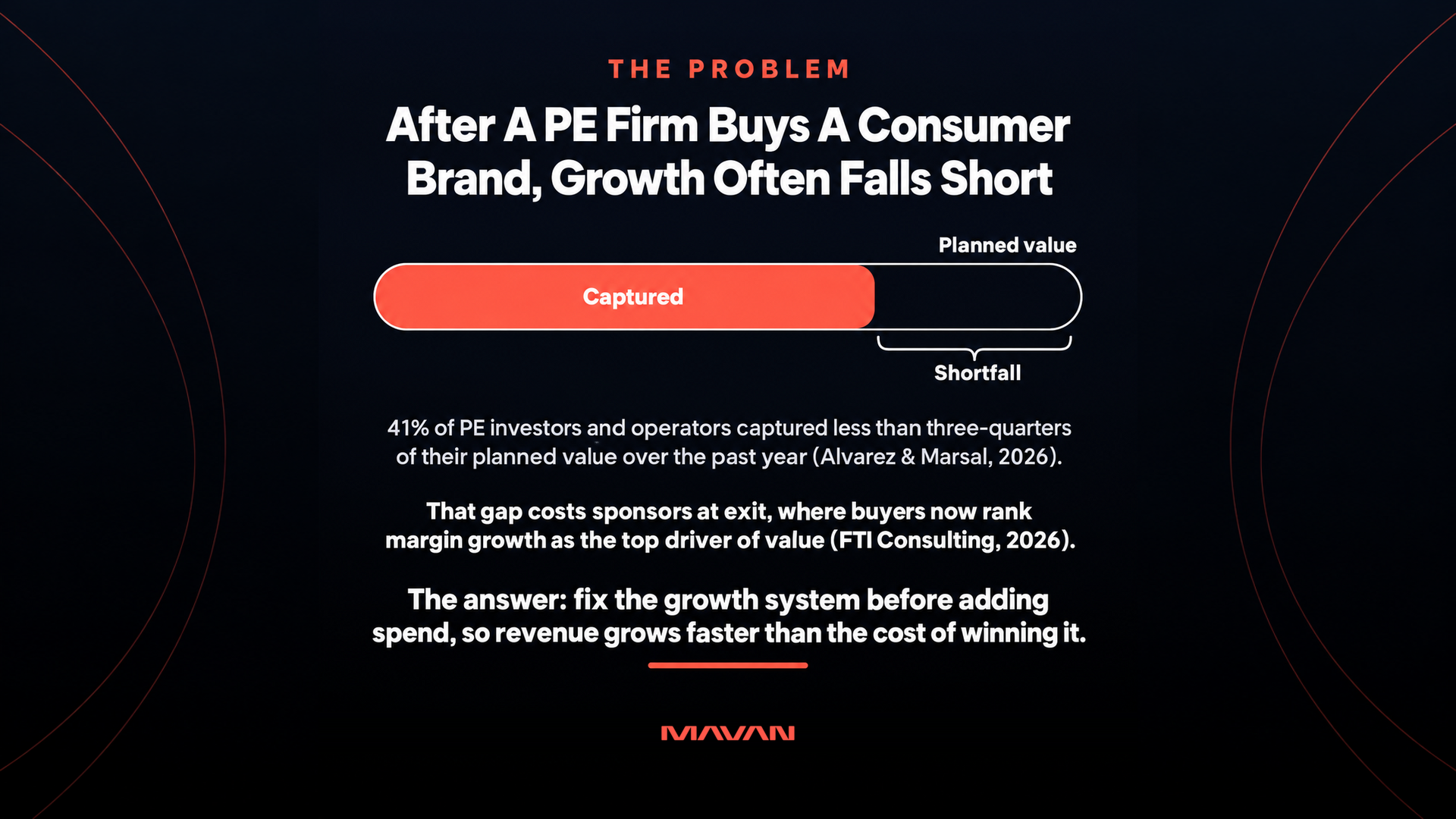
PE firms accelerate revenue and EBITDA at consumer brands by fixing the growth system before adding spend. They reconcile the numbers and cut spend that never pays back. They lift conversion and repeat purchases, and they judge growth by contribution margin. Growth operating partners such as MAVAN diagnose that system in 28 days, then help execute the fix.
-
Who Does Growth & GTM Due Diligence for PE Deals?
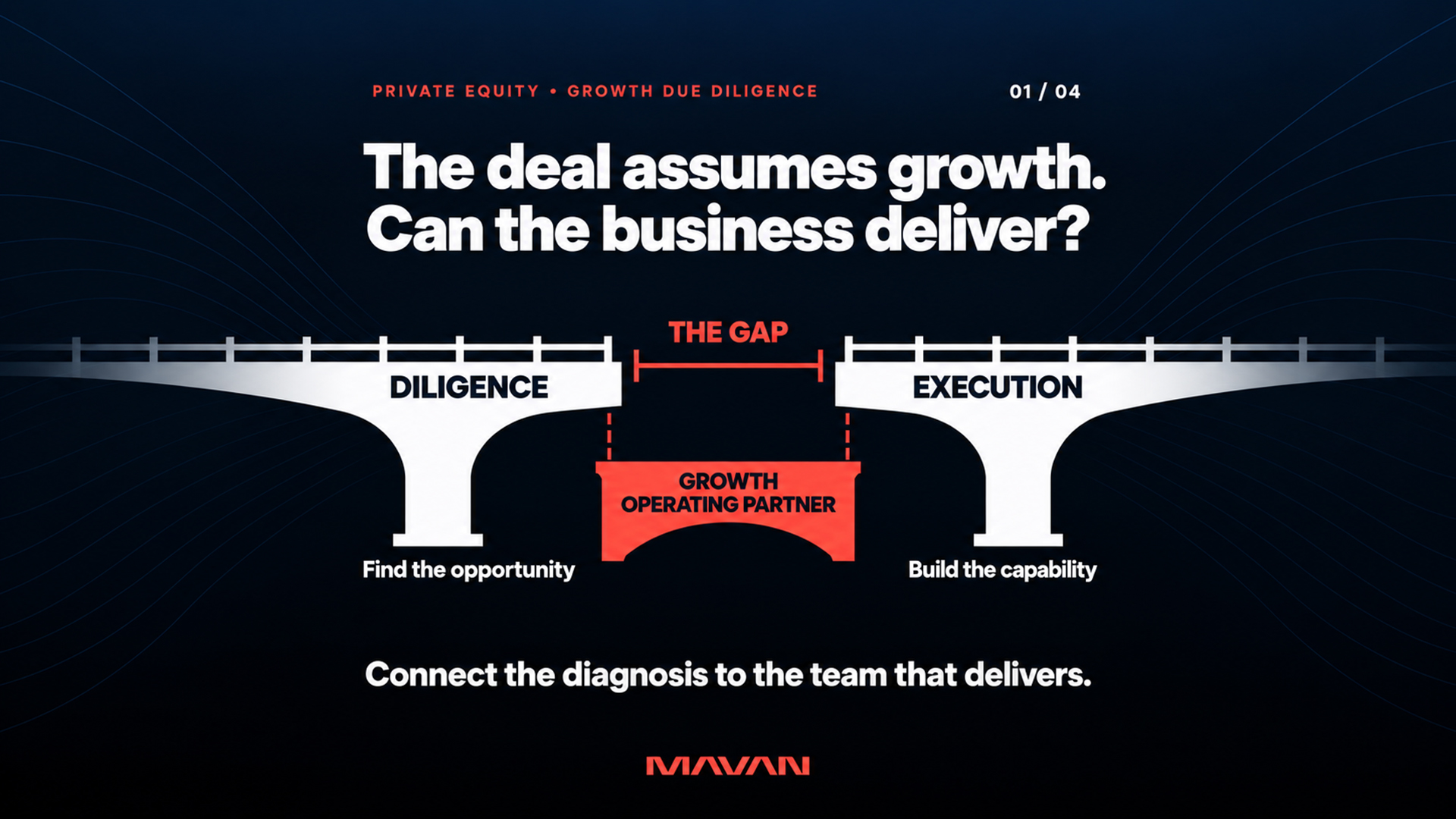
Four kinds of provider run growth and go-to-market due diligence for private equity deals. Strategy consultancies test the market. Specialist commercial diligence firms audit the pipeline. Go-to-market boutiques rebuild the sales motion. And growth operating partners examine the full revenue engine from inside the business, then stay to operate it after close.
-
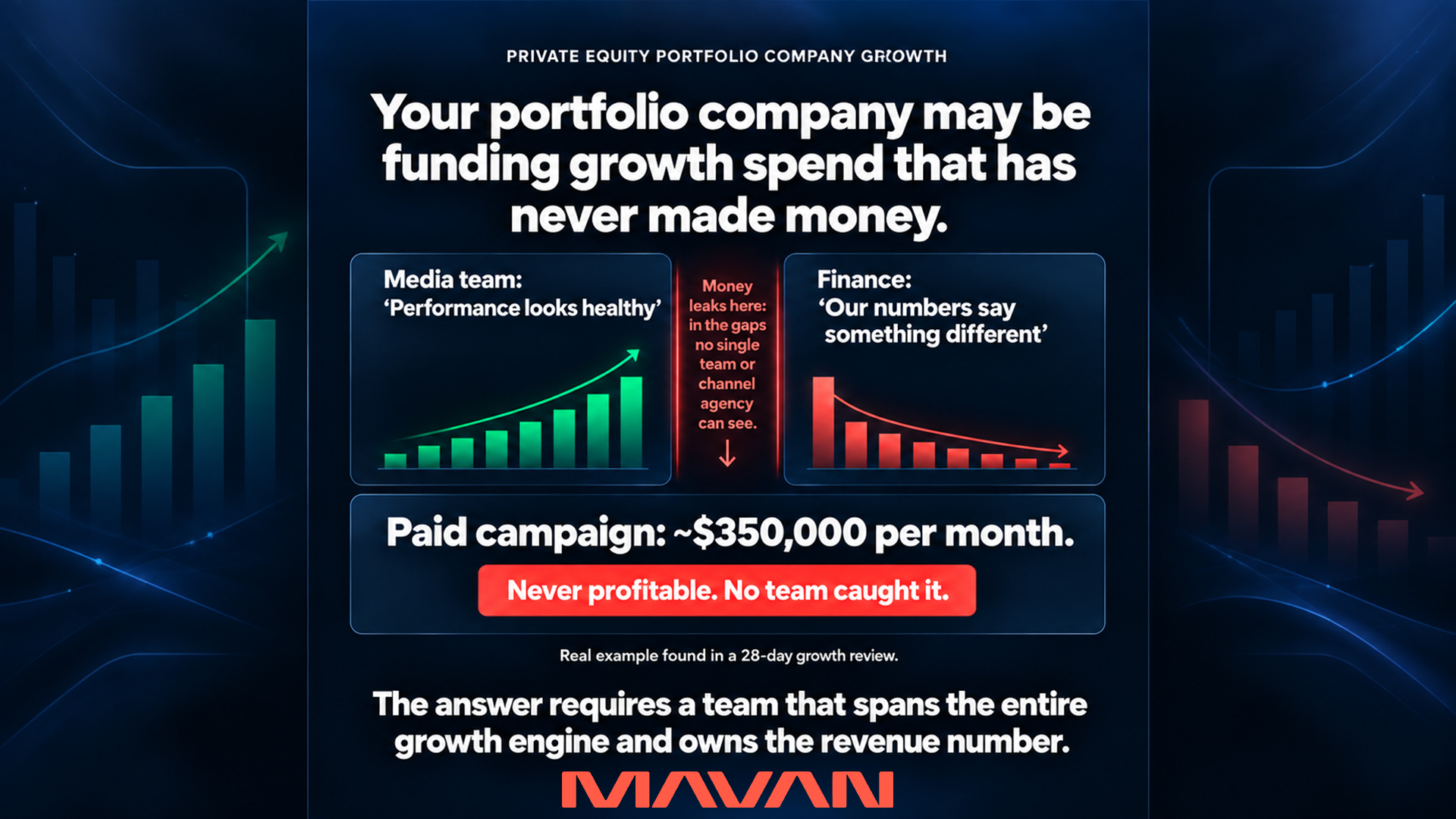
Who Is The Best Growth Partner For PE Portfolio Companies?
The best growth partner for a private equity portfolio company behaves like an operating partner you deploy, not an agency you brief. It reads the whole growth system before it spends, owns a revenue number alongside management, and leaves the capability behind so the sponsor can redeploy it.