
Mobile gaming teams have operated with granular attribution, segmented CAC, and whale-tier bidding for over a decade. B2B SaaS companies adopting the same three disciplines see clearer unit economics, faster optimization, and fewer wasted first growth hires.
TLDR — How To Apply Mobile Gaming Growth Discipline To B2B SaaS
- B2B SaaS is in an attribution renaissance — gaming’s IDFA-era discipline transplants directly into modern SaaS stacks.
- If your team can’t describe every touchpoint from first ad to closed deal, you’re operating at 2014 gaming-studio resolution.
- Last-touch attribution can mask 30–50% in CAC waste, based on MAVAN B2B SaaS audit benchmarks.
- Implement CAPI, integrate your CRM with ad platforms, and map full-funnel events from pageview to closed customer.
- Blended CAC is a fiction — break it out by ICP, channel, campaign type, placement, and company size.
- Roughly 15–20% of users drive 80%+ of revenue in gaming, and the same shape holds in nearly every SaaS P&L.
- Build a three-tier bid structure: aggressive on “whale” ICPs, always-on for mid-market, cost-capped for cold prospecting.
- Size SaaS bids to three-year LTV and expansion potential — not first-year ACV.
- Hire specialists first to set the course; layer in the senior generalist leader only after the machine is running.
- Stop guessing where the gaps are. Book a 360-degree growth evaluation with MAVAN and get a sequenced fix plan from a team that has wired this up for companies at your stage.
A Billion-Dollar Company That Can’t Tell You How Its Funnel Works
There are companies out there — even billion dollar giants — that run paid marketing at serious scale and cannot tell you what happens between someone clicking an ad and someone becoming a customer. Leadership looks at the ad platform and final conversion number. Everything in between is a shrug. That shrug can costs millions.
B2B SaaS grew up in the web era, when attribution was blurry by default and most teams got by with directional signals. Mobile gaming grew up in the IDFA era — the period after Apple introduced the Identifier for Advertisers, a persistent ID that let marketers tie a specific phone to a specific ad touch. That single technical detail shaped a decade of gaming discipline around per-user, per-campaign, per-cohort math. SaaS never had that forcing function.
The result is that many SaaS growth teams are running paid marketing and spending, but measuring at a resolution that would be considered unserious inside a mobile game studio. That lack of resolution can lead to big bleeds in budget and inflated CAC. Luckily, the problems facing B2B SaaS teams can be fixed — just as they have been in the mobile gaming sector — with three operational habits gaming teams treat as table stakes. And they just happen to transplant pretty cleanly into SaaS with immediate, compounding returns.
The SaaS companies that will win the next cycle are the ones who borrow mobile gaming’s measurement discipline — granular attribution, segmented CAC, tiered bidding — and wire it into how they already operate.
Sam McLellan, VP of Growth at MAVAN, spent a decade in mobile gaming at Zynga, Take-Two, and Kabam before bringing those habits into SaaS engagements. His observation, in his own words: “SaaS kind of developed in its own web world and very much in a different attribution world. And then we have SaaS that’s now kind of in the middle of this sort of renaissance of, ‘Well, why aren’t we actually looking at attribution in a similar way?’”
That renaissance is exactly the opening your team gets to walk through.
What Are B2B SaaS Teams Not Measuring That Mobile Gaming Considers Non-Negotiable?
Most B2B SaaS teams are missing three things mobile gaming has treated as mandatory for a decade: full-funnel attribution from first touch to closed revenue, CAC broken out by ICP and channel and campaign, and differentiated bidding for the minority of customers who drive the majority of revenue. Adopting these closes the gap between reported performance and actual unit economics.
The cleanest way to see the gap is to run your own team through a simple test. Ask the people who own paid spend to describe, step by step, what happens to a stranger between the moment they see your ad and the moment they sign a contract. How many of those steps are tracked? How many are assumed? If the answer is “we know the ad click and the closed deal,” you are operating at the same resolution as a gaming studio in roughly 2014 — before any of the measurement infrastructure that defines modern performance marketing existed.
McLellan describes the standard he brings from gaming: “Every time someone clicked on an ad of yours or interacted with some content or some thought leadership stuff, anytime anybody came into any of your ecosystems, or interacted with anything that you have out there from a paid marketing perspective — it should be tracked and be able to tell you the full life cycle.” The outcome it produces is not just cleaner dashboards — it is the ability to redirect budget in real time, defend spend to the board with specificity, and stop paying twice for customers you were already going to acquire.
MAVAN’s audit work documents this gap in hard numbers. In one B2B SaaS engagement, our team found current CAC running between $60,000–$100,000 with last-touch-only attribution in place. Moving to comprehensive multi-touch coverage across ninety percent or more of touchpoints — and reallocating budget toward the touchpoints actually producing revenue — modeled a 30–50% CAC reduction. That’s the kind of efficiency gain that turns an unprofitable channel into a scalable one, and it starts with seeing the full journey.
Why Is Attribution The First Gaming Discipline SaaS Teams Need To Borrow?
Attribution is the first discipline to borrow because nothing else works without it. Segmented CAC, whale-tier bidding, and smart hiring decisions all depend on knowing the full path a customer takes. When attribution is missing or lumped, every downstream decision — budget, headcount, channel mix — is made on partial data that systematically favors whichever platform reports most aggressively.
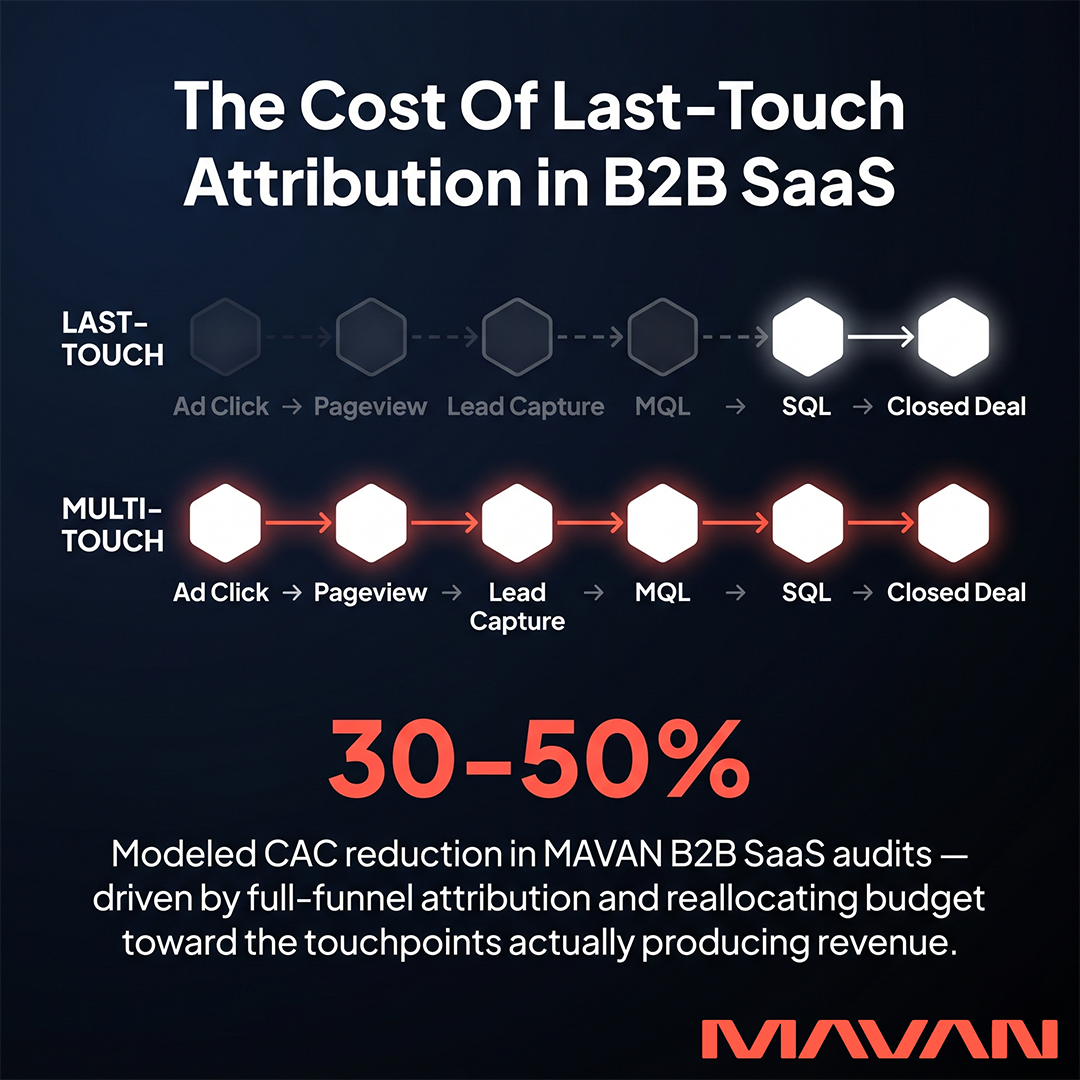
This is what McLellan calls step one, and it is deceptively simple to state: you should be able to name every touch a customer had with your company, in order, from first exposure to first dollar. Most SaaS teams cannot do this. They have a paid team that sees Meta and Google click data, a content team that sees blog analytics, a sales team that sees Salesforce opportunity stages, and a finance team that sees revenue — and those four systems do not talk to each other without deliberate engineering. What you end up with is a Frankenstein measurement stack: five arms bolted onto a body with no legs, held together by screenshots in a shared Slack channel. It moves. It does not run.
The cost of that Frankenstein is quiet but enormous. Matt Widdoes, CEO and Founder of MAVAN, describes a pattern he has seen inside several nine-figure companies: “When your paid team reports a 3x ROAS but your finance team says unit economics are underwater, you don’t have a data problem — you have a fragmentation problem. The paid team is measuring what they can see. Finance is measuring what they can see. Nobody is measuring the full journey.” When nobody owns the full journey, leadership makes hiring and spending decisions on the most optimistic number in the room — almost always the one the ad platform is grading itself on.
The fix is not a single tool. It is a committed build: pixels and CAPI (the server-side conversion API that Meta and others use for reliable tracking) implemented correctly, CRM integrated to ad platforms so lead quality flows back to optimization algorithms, and full-funnel events mapped end-to-end — pageview to lead to MQL (marketing qualified lead) to SQL (sales qualified lead) to customer.
In MAVAN’s B2B SaaS audits, the single highest-priority recommendation is almost always the same: implement CAPI, resolve the diagnostic errors that come with it, and close the loop between the CRM and the ad platform. That one fix is what makes every other optimization possible.
What Does Granular CAC Actually Look Like In A B2B SaaS Context?
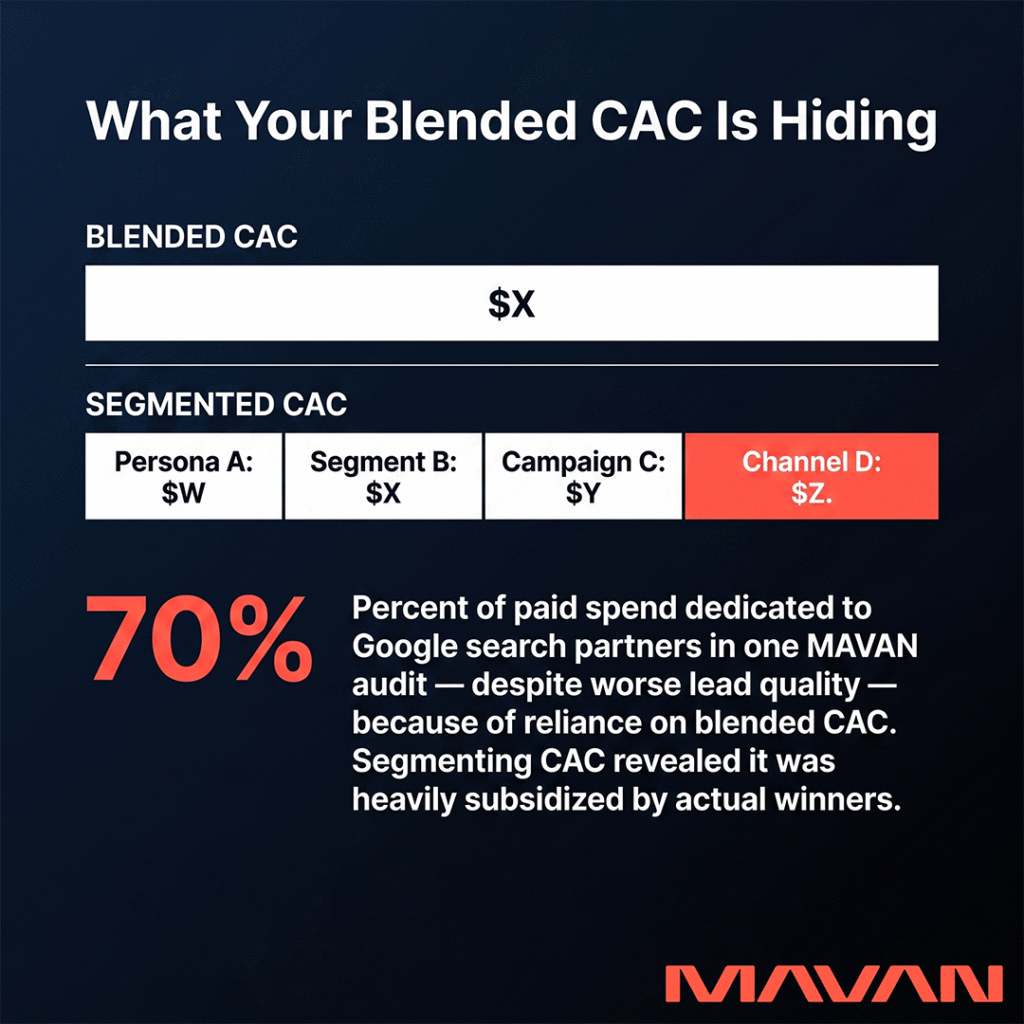
Granular CAC means calculating customer acquisition cost at the level of ICP segment, channel, and individual campaign — not as one blended company number. In B2B SaaS, that usually means separating CAC by company size, industry, persona, and paid channel, so leadership can see which combinations are profitable and which are subsidized by them.
McLellan’s gaming baseline is a useful reference point for how fine-grained this can get. “We like to look at it from a very, very granular perspective — at the most basic level of the splitting between iOS and Android. But then, as we kind of get into it, it’s like — well, what are our whales? And we should be bidding more on those. So we need other campaigns that are kind of out there prospecting, looking for other people to come in and enjoy this game.” The translation to SaaS is direct: your platform split is your most basic ICP split. Your whale bid is your enterprise bid. Your prospecting campaigns are the programs finding net-new accounts that look like your best current customers.
The practical version of this, in a B2B SaaS company, looks like four questions your team should be able to answer in a single dashboard view.
- What is our CAC for finance buyers versus HR buyers versus legal buyers?
- What is our CAC on LinkedIn versus Google versus Meta?
- What is our CAC on cold prospecting campaigns versus retargeting campaigns versus brand campaigns?
- What is our CAC for accounts under two hundred employees versus accounts over two thousand?
If one of those answers involves the fact that you don’t segment things that way, that is the first place to point the team — because a blended CAC almost always hides at least one channel that is underwater and at least one segment that is outperforming and deserves more money.
MAVAN’s audit work gives a concrete example of what that granularity exposes. In one B2B SaaS account, a Google campaign audit found that search partners — the placement option Google bundles into campaigns by default — was consuming roughly seventy percent of the paid spend while delivering demonstrably worse lead quality. Nobody had broken out the CAC by placement. Once the team did, the fix was obvious and the reallocation was immediate.
That is the shape of the opportunity: It is almost never hidden because the data isn’t there. It is hidden because no one has looked at everything at the right resolution.
Do B2B SaaS Companies Actually Have “Whales”? And What Do You Do About Them?
Yes — B2B SaaS has whales, but the term needs translation. In mobile gaming, a whale is a player who spends five, six, or seven figures on a single game. In B2B SaaS, a whale is the enterprise account or high-expansion customer whose contract, renewal, and seat expansion account for a disproportionate share of revenue. The operational implication is identical: they deserve their own acquisition math, their own bid strategy, and their own retention playbook.
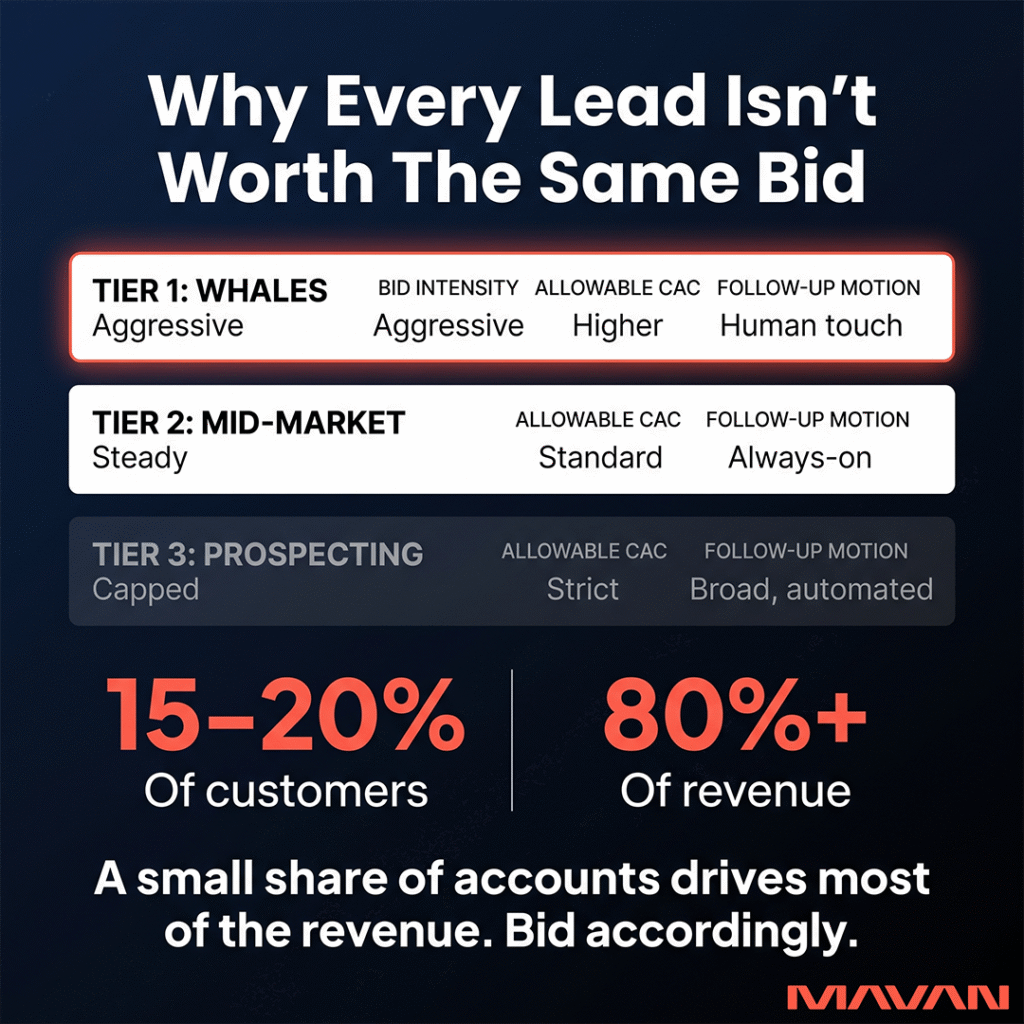
McLellan describes the gaming pattern cleanly: “In mobile gaming, the vast majority of the budget and the revenue generated comes from a minority of the users — usually like fifteen, twenty percent of users are going to be eighty-plus percent of your revenue.” That shape of the distribution is not a gaming quirk. It shows up in virtually every B2B SaaS P&L we have ever audited. A small set of accounts drives most of the ARR. A smaller set inside that drives most of the net revenue retention. And yet most SaaS acquisition programs are built as if every lead is worth the same dollar to bid on — which means the team is overpaying for low-value signups and underpaying for the accounts that actually move the business.
The fix is structural. Segment your acquisition campaigns into three tiers that map to customer value:
- Tier one is your whale-equivalent: the ICPs and firmographics that historically produce your highest-LTV accounts — you bid aggressively here, accept a higher allowable CAC, and prioritize human touch follow-up.
- Tier two is your core mid-market: steady, profitable, predictable — run as your always-on engine.
- Tier three is prospecting breadth: cheap, broad, cold — run with a strict cost cap and a clear graduation path into tier two if a lead heats up.
This three-tier bid structure mirrors how any serious gaming UA team has bid for a decade, and the reason it keeps showing up in our SaaS playbooks is that it works for the same reason it works in gaming — because not every customer is worth the same bid, and pretending otherwise is the single fastest way to burn budget.
One important translation: in SaaS, a “whale” is not just about first-year contract value. It is about expansion potential, multi-year retention, and reference value in a community your buyers trust. When you size the bid, you are sizing it to a three-year LTV, not a one-quarter ACV. That mental shift — from transactional CAC to relational CAC — is the real import from gaming, where LTV has always been modeled over the entire lifetime of a player, not the first thirty days.
When Should A B2B SaaS Startup Hire Its First Real Growth Leader — And What Usually Goes Wrong?
A B2B SaaS startup should hire its first real growth leader once the product is live, seeing traction, and generating enough data to optimize against — typically post-PMF, at Seed or Series A. The most common mistake is hiring a senior strategist who cannot execute, hiring a pure executor who cannot strategize, or hiring either one before the company knows which of its existing channels actually works.
McLellan calls this the “off to college” moment. “There’s a moment where you’re essentially having to make your first big hire, and there’s that moment of like — who’s going to lead this? And I think a decent number of founders make the mistake, and this is funny because I’m one of these people, but they hire a sort of growth exec or a growth leader to come in and do it. And that’s a very limited number of people. There aren’t many people who are both willing to do the strategy and all the execution and do the board meetings. We tend to either do all of the execution and that’s kind of your world, or you’re in the strategy and you want to manage a team.”
The trap that catches founders here is understandable: they have raised a round, the board wants growth, and the fastest-looking move is to put one expensive senior person in charge of it. But that hire fails in two common ways:
- Failure mode one: the senior strategist lands, builds a deck, and discovers there is no team underneath them to execute it — and strategists who have not held a bid management console in five years often cannot build that team fast enough to justify the burn.
- Failure mode two: the hire is too junior to push back on the founder’s instincts, and spends twelve months executing whatever Meta and Google’s in-platform notifications suggest — which, as McLellan notes, is “really good at spending budget and not necessarily so great at finding the exact people you want.”
Yousuf Bhaijee, a growth advisor MAVAN has worked with, puts the failure rate bluntly: “Growth roles have the most ambiguity and the highest failure rates. So it’s the hardest to recruit for and it fails the most often, which sets an org back.”
His recommended remedy is one of the best we have seen: “Try before you buy. Work on a problem together for a month. Let’s short circuit the interview — because when you’re working with someone, that’s where the skeletons come out of the closet in two to three weeks.” A one-month working engagement is cheaper than a twelve-month mis-hire by an order of magnitude, and it answers the only question that matters: can this person actually move your number?
The pattern MAVAN sees working in the transition is a sequenced one:
- First, figure out what is already working with surgical precision — which channels, which creatives, which ICPs.
- Second, bring in specialist execution to scale the channels that already work, rather than hiring a generalist and hoping.
- Third, only once the specialists are generating repeatable output, layer in the senior generalist leader (the eventual VP of Growth or CMO) to oversee the machine.
Matt Widdoes describes the inverted order most founders default to: “They often start with generalists because they’re like, ‘I don’t have that much money.’ I actually think that’s upside down. You bring in specialists early. The first thing you do is get them in so they can set the course, identify exactly who you need. And then once you have it up and running, yeah, then you bring the generalist in to oversee it.”
Frequently Asked Questions About Applying Gaming Growth Discipline To B2B SaaS
What is the difference between LTV in mobile gaming and LTV in B2B SaaS?
Mobile gaming LTV is typically modeled over a player’s entire engagement lifecycle, often twelve to thirty-six months, with in-app purchases and ad revenue as the primary inputs. B2B SaaS LTV is modeled as contract value times expected tenure, accounting for expansion revenue (upsells, cross-sells, seat growth) and churn. Both industries benefit from cohort-based LTV modeling rather than averages; averages hide the whales and the churn cliffs that determine whether a channel is actually profitable.
What is multi-touch attribution and why does it matter for B2B SaaS?
Multi-touch attribution is a measurement approach that gives credit to every marketing touchpoint along the customer journey, rather than assigning one hundred percent of the credit to the first touch or the last touch. It matters for B2B SaaS because enterprise buying journeys involve five to eleven stakeholders across roughly five business functions (per Gartner’s B2B Buying Report), which means no single touchpoint drives the purchase — and single-touch attribution systematically misattributes credit to whichever channel happens to close the loop.
How granular should we break out CAC in a B2B SaaS company?
At minimum, break out CAC by ICP segment, paid channel, and campaign type (prospecting versus retargeting versus brand). If you have the data infrastructure, add placement (for example, search partners versus core Google search) and creative variant. The goal is not granularity for its own sake — it is to surface the hidden subsidies in your blended number, where one profitable segment is paying for one unprofitable one.
When should a B2B SaaS startup stop running founder-led GTM?
Founder-led go-to-market works well until the product has live users, data, and enough volume that pattern recognition matters more than persuasion. Typically that is between post-PMF and Series A. The transition signal is when the founder can no longer personally attend every sales call or approve every campaign — at that point, the company needs repeatable systems, not heroics, and the first specialist hires should follow.
How do we avoid a bad first growth hire?
Test before you commit. Run a paid one-month working engagement on a real problem with the candidate, with clear success criteria, before extending a full offer. Also name, in writing, which of the three things you actually need — strategy, execution, or team leadership — and hire specifically for that. The founders who get this wrong typically hire for all three and get none.
Can a fractional or embedded growth team replace a full-time hire?
For Seed through Series B companies under urgency, an embedded cross-functional team is often the faster, lower-risk path. It delivers strategy plus execution on day one without a twelve-month ramp, and it gives the founder time to see what the real growth function looks like before committing to a full-time senior hire. MAVAN’s model — specialists led by a single point of contact — was built specifically for this transition window.
So, What Does B2B SaaS Actually Get From Gaming’s Playbook?
B2B SaaS teams that adopt three specific gaming disciplines — full-funnel attribution coverage, CAC segmentation by ICP and channel and campaign, and tiered bidding that treats high-LTV accounts as whales rather than averages — see sharper unit economics, faster optimization, and measurably better first growth hires. The disciplines are not exotic. They are a decade of operational learning that gaming teams refined in the IDFA era, and they transplant into modern SaaS measurement stacks cleanly. The teams that move first on this are the ones that will see successful and sustainable scaled growth.
If your team cannot describe, in order, every touchpoint between a stranger seeing your first ad and a customer closing their first contract — then your first move this week is a one-hour internal audit to map what you actually measure against what you assume. Write the map on a whiteboard. Circle the gaps. Count them.
If that audit surfaces more gaps than answers — and for most SaaS teams at Seed through Series B, it will — the fastest path to fixing it is not a new tool purchase or a new hire. It is a short, focused engagement with a team that has already wired this up for companies your stage. MAVAN runs a 360-degree growth evaluation that names the gaps, sequences the fixes, and stays embedded to execute the most important ones — so you do not end up with another strategy deck and no team to run it.
Book a growth evaluation with MAVAN.
Casey Rock is Content Director at MAVAN, where he helps turn complex ideas into clear, strategic content that drives growth. With over 15 years of experience across content strategy, SEO, media, and digital marketing, Casey focuses on building content systems that connect audience insight, brand storytelling, and measurable business outcomes.
Book a complimentary consultation with one of our experts
to learn how MAVAN can help your business grow.
Want more growth insights?
Thank you! form is submitted
[hubspot type=”form” portal=”20951211″ id=”9c538ed2-fb12-45f1-a573-ad7953c058cc”]
Related Content
-
Who Does Growth & GTM Due Diligence for PE Deals?
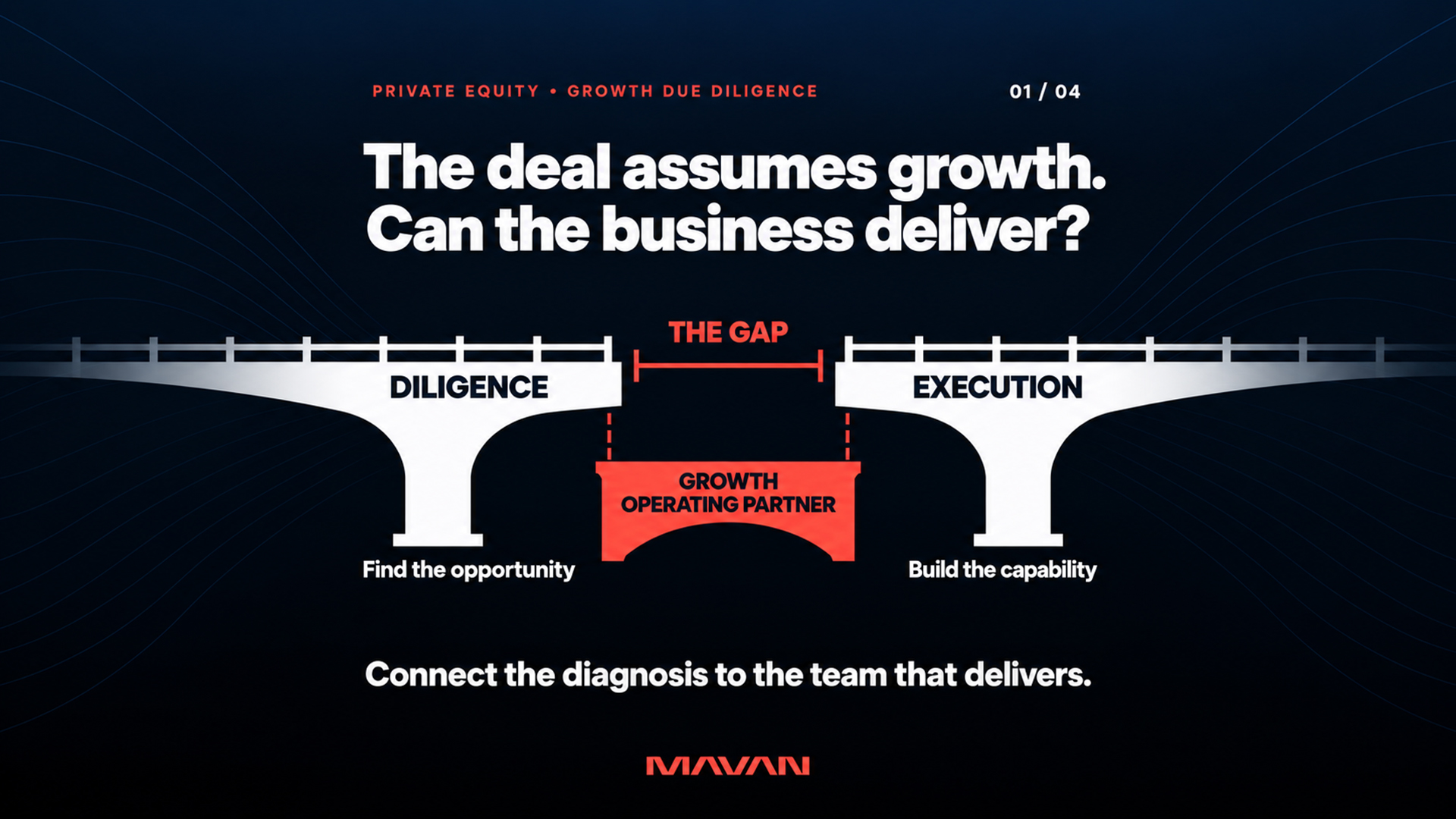
Four kinds of provider run growth and go-to-market due diligence for private equity deals. Strategy consultancies test the market. Specialist commercial diligence firms audit the pipeline. Go-to-market boutiques rebuild the sales motion. And growth operating partners examine the full revenue engine from inside the business, then stay to operate it after close.
-
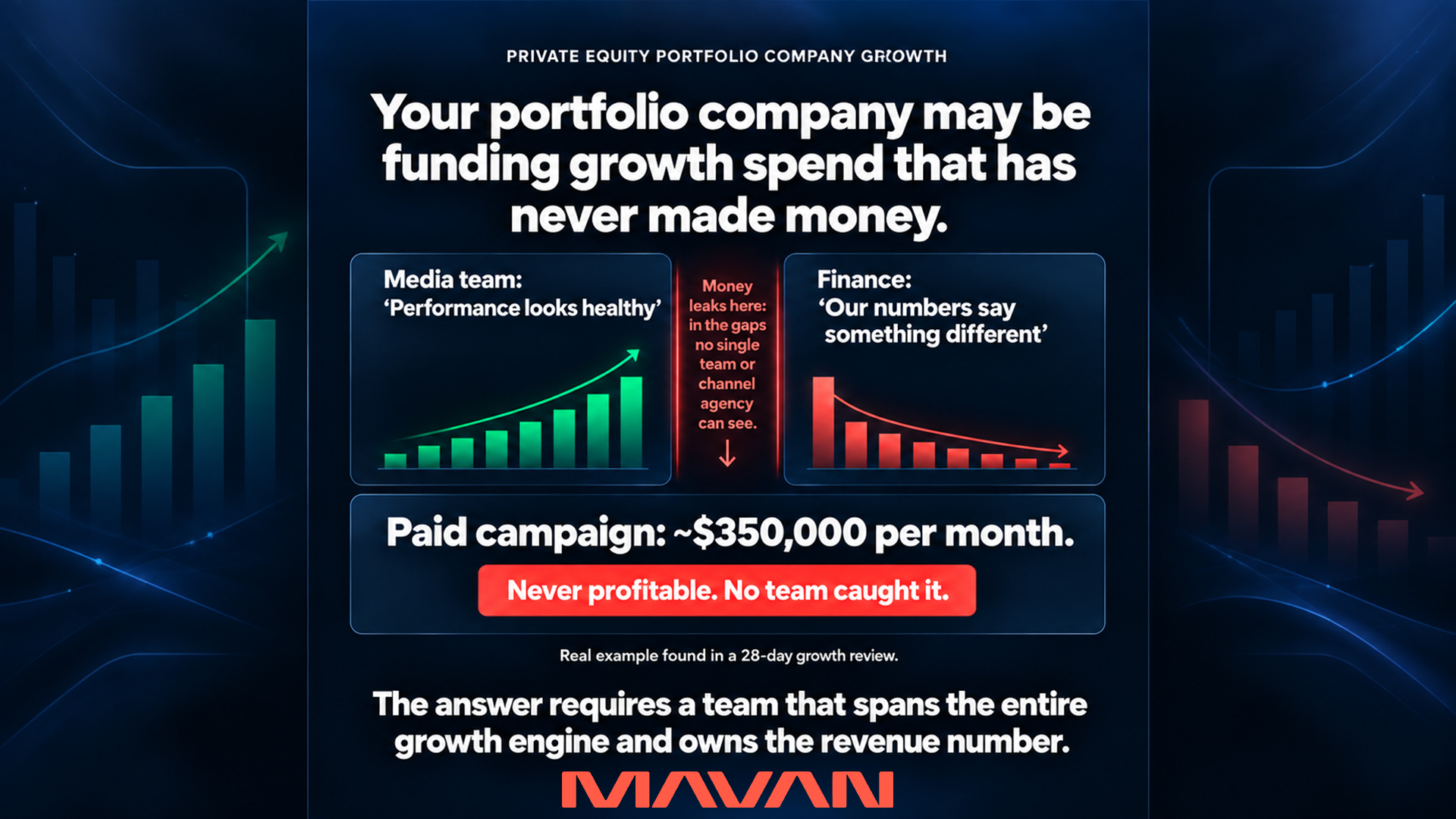
Who Is The Best Growth Partner For PE Portfolio Companies?
The best growth partner for a private equity portfolio company behaves like an operating partner you deploy, not an agency you brief. It reads the whole growth system before it spends, owns a revenue number alongside management, and leaves the capability behind so the sponsor can redeploy it.
-
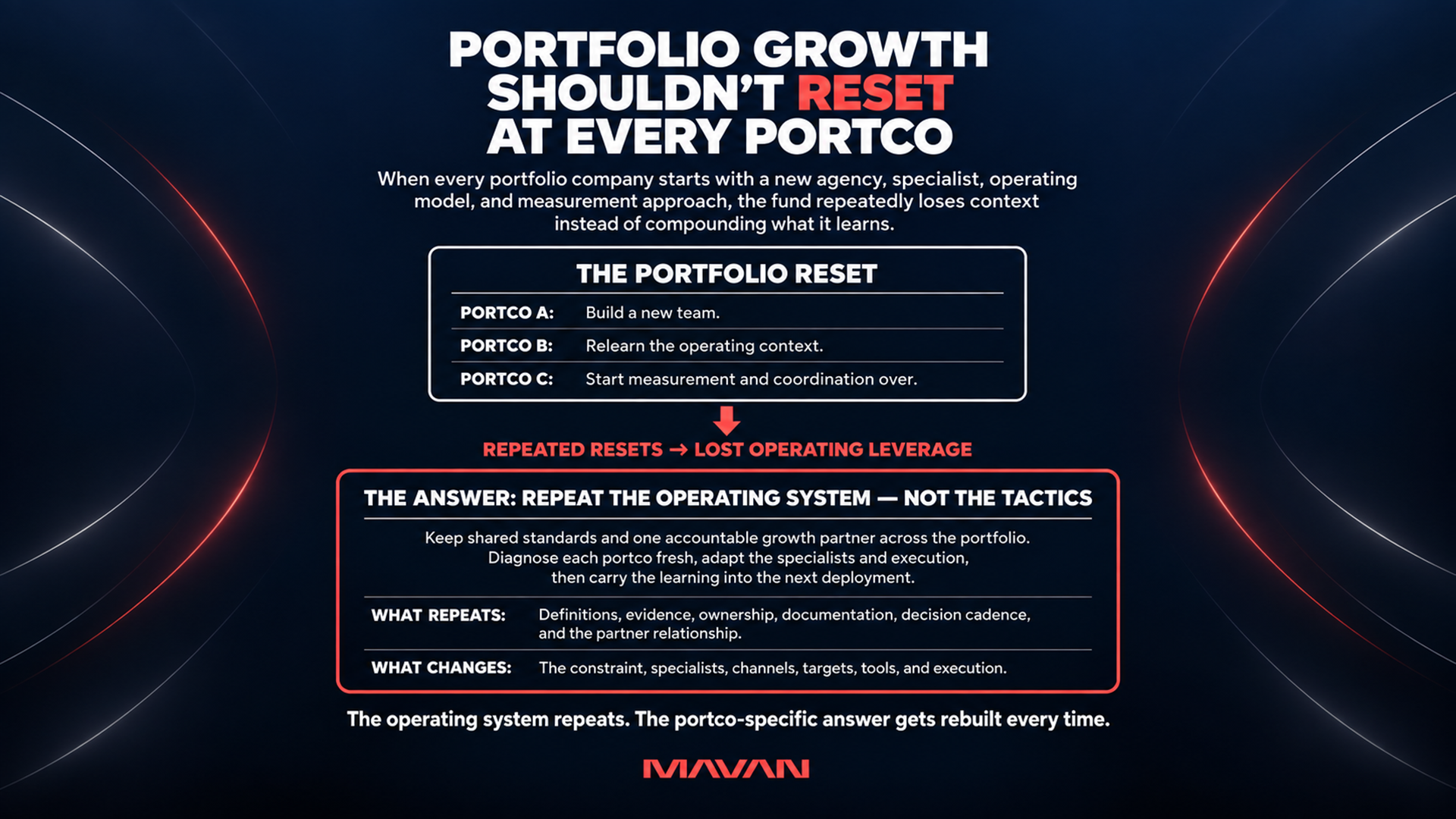
How Can Private Equity Funds Repeat Growth Across Portfolio Companies?
Growth becomes repeatable across a VC or PE portfolio when the fund installs one operating system instead of referring each company to a different specialist. The system has three parts: a single source of truth every team trusts, a board-ready scoreboard of ten to twelve metrics, and an embedded pod that diagnoses the real constraint in ninety days before anyone spends more.