
AI’s biggest near-term payoff in growth is creative. Use it to generate more concepts and rebuild what already works — then rely on human taste, audience truth, and disciplined testing to decide which creative ships and scales.
TLDR — What To Know About Using AI In Creative Development
- AI’s first real growth payoff shows up in creative.
- Point AI at two jobs first — ideation and production.
- Use it to rebuild proven winners and crank concept volume.
- AI handles execution; you own taste, brand, and judgment.
- Audience truth makes AI creative convert — generic prompts make noise.
- Feed AI a winners library and a tight audience brief.
- Build a testing loop, not a pile of assets.
- Change one variable; set the read date before launch.
- Recycle losers — dissect, keep what worked, rebuild.
- Ready to make more winning creative, faster? Reach out to us!
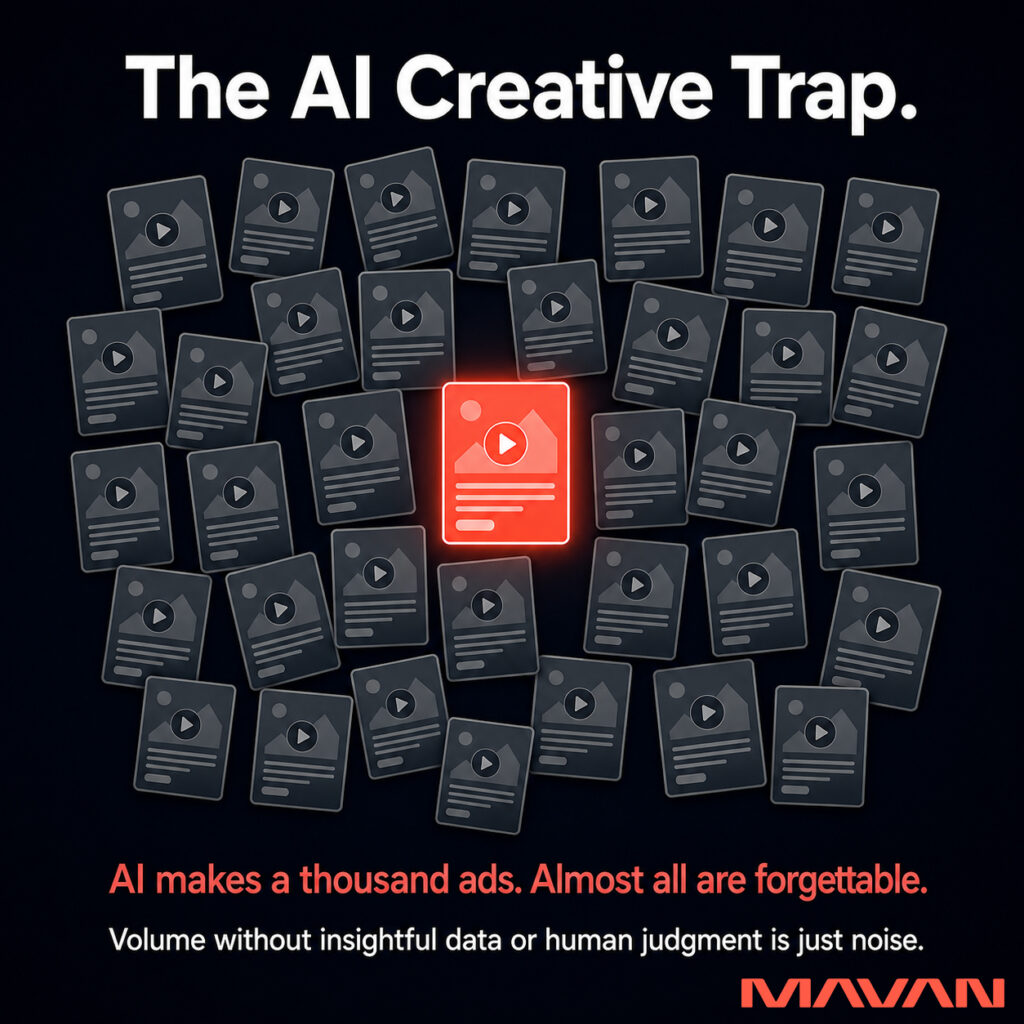
Eighty-three percent of advertising leaders ran AI through their creative process last year, up from sixty percent the year before, according to IAB research reported by eMarketer. The tools arrived faster than the playbooks. So most growth teams now face a stranger problem than whether AI can make an ad — it can make a thousand, but most of them are forgettable. The teams pulling ahead are not the ones generating the most assets. They are the ones who decide what deserves to exist.
We see the same pattern across the venture-backed teams we work with. AI’s first real payoff in growth shows up in creative — specifically in how you ideate and produce it. Point it well and you ship more concepts, test more often, and find winners faster. Point it badly and you flood your channels with noise that costs real money to serve. This piece walks through where to aim AI first, what stays human, and how to turn its output into creative you can actually scale.
AI gives you more shots on goal. But human taste dictates how many of those shots have winning potential.
Where Should You Use AI in Creative Development First?
Point AI at two jobs first: ideation and production. Use it to generate a wide field of concepts your team can react to, and to rebuild proven creative from the elements that already work. Both compress the slow, expensive stretch between a brief and a shippable asset — so your people spend their hours on judgment, not grunt work.
Growth Expert Brian Sapp made the call early on our Growth at Scale podcast: “probably the biggest impact is going to be around creative in the near term.” He split that impact into two lanes. On production, he noted that AI “should be able to rebuild creative from elements that are already successful.” On ideation, he described how his artists already work: “let’s throw in some ideas and see what the AI comes back with, and that helps us form ideas around what type of avatar items we might want to bring into the game.”
Matt Widdoes, Founder and CEO of MAVAN, named the pain that makes ideation so valuable: “at some point there’s only so many ways you can show your dog food.” Generative tools break that ceiling. They can “crank out a hundred concepts,” and the move is to skim them, pull the three that spark something, and walk away with a week of work mapped out. The value is not the hundred. The value is the speed to the three.
The numbers back the lane choice. McKinsey research has found that generative AI can cut development and prototyping cycles by up to 70% when it is embedded properly into a workflow. Advertiser Perceptions reported that 46% of advertisers already turn to AI for faster creative asset development, with 63% citing efficiency as the draw. The outcome you are buying is iteration speed: more concepts in front of your audience, sooner, at a fraction of the production cost.
Does AI Replace Your Creative Team?
No. AI replaces the execution drudgery — resizing, versioning, first drafts, generic asset production — not the judgment that decides what is worth making. The work that survives is strategy, taste, and a real read on your audience. Those are the inputs AI cannot supply on its own, and they decide whether its output lands or dies in the feed.
The fear is real, and worth naming plainly. Ascend2 found that 54% of marketing and sales professionals worry AI will cost them creativity and human touch. History suggests the opposite. Growth Expert Brian Sapp reached for the music studio, where he started as a guitarist and bassist: “the drum machines have been around for a long time, but everyone was scared that was gonna kill the drummer. It didn’t, but it opened up the music to a lot more people.” His read on generative AI follows the same arc — it “has the ability to do that for making games and making content. And it’s going to democratize really and level the playing field.” More creators, more output, and in his words, “a lot more content, just like in music that’s crap. But there’s always going to be diamonds in the rough that rise to the top.”
Matt Widdoes, Founder and CEO of MAVAN, drew the same lesson from photography. Digital cameras and editing software were supposed to end the craft. Instead, “dark rooms were dead, but that didn’t kill the heart of photography. If anything, it accelerated it and it raised that bar.” Faster feedback let photographers shoot, judge, adjust, and reshoot in minutes instead of weeks. The tool did not remove the eye behind the camera. It gave the eye more reps.
There is hard evidence that the eye still matters. IAB found that 82% of ad executives believe Gen Z and millennial consumers feel positive about AI-made ads, while only 45% of those consumers actually do — a 37-point perception gap that audiences can smell. Robert Half reports that 97% of marketing and creative teams now use or are rolling out AI, yet 41% say its real benefit is freeing them for more strategic work. The tools handle volume. People still own the call.
What AI Takes Over, and What Stays Yours
| AI handles | You own |
|---|---|
| Concept volume, variant production, resizing | Taste — which concept earns the spend |
| Rebuilding proven winners into fresh assets | Brand voice and the read on your audience |
| First drafts of copy, scripts, and hooks | Strategy, the brief, and the final approval |
What Makes AI-Generated Creative Actually Convert?
Audience truth makes it convert. AI multiplies output, but output only performs when it carries a real understanding of the audience. The teams that win feed AI their proven winners and a sharp read on the audience, then let the people who live and breathe that audience judge what ships. The model brings no instinct — you supply it.
Growth Expert Brian Sapp gave the clearest example we have heard, using Rec Room as an example. Rec Room’s audience skews young, so the company hands its ad-making to the creators who already speak the language: “our influencers make all of our UA ads and they are top performing UA ads by a mile because they understand exactly.” Matt Widdoes, Founder and CEO of MAVAN, finished the thought — “because they know the audience.” That is the whole mechanism. The asset wins because the person behind it lives inside the audience’s world.
Widdoes pushed it further into a rule any growth leader can apply: “in order to really get something and understand something from a marketing standpoint, you really have to like live and breathe it and love it.” He paired it with a concept worth stealing — desire paths, the worn dirt trails people cut across a lawn instead of taking the paved sidewalk. “There are the paths you build, and then there are the paths that people are actually taking.” Sapp agreed that a team’s real job is “to kind of remove obstructions to those desire paths.” Your best creative tracks the path the audience already wants. AI can render that path a hundred ways once you know where it runs — and creative remains the biggest acquisition lever precisely because the asset itself decides who pays attention.
So the practical input is not a cleverer prompt. It is two assets you build once and reuse: a library of your proven winners, and a one-page brief that captures your audience’s language, motivations, and the desire paths they already walk. Prompt against those, and the volume AI returns starts carrying signal instead of noise — the same discipline behind letting data drive your creative production.
How Do You Turn AI’s Volume Into Winning Ads You Can Scale?
Build a testing system, not a pile of assets. Treat every concept as an experiment: state what you expect it to prove, isolate one variable, measure it cleanly, then scale what holds up. AI raises the number of shots you can take. A disciplined testing loop converts that volume into repeatable wins instead of expensive guesses.
Growth Expert Brian Sapp learned this earlier in his career, scaling a Disney match-three game at Jam City. Before pouring budget into the channel, his team “ran a very long six month to eight month creative testing process to kind of get everything in place.” The testing came first; the scale came after. Matt Widdoes, Founder and CEO of MAVAN, frames the same habit as a scientific method run on an assembly line — “this is what we think is going to happen. This is how we’re going to measure it.” His verdict on what separates teams is blunt: “the quality of that assembly line and the inputs into that really are what separate the winners and losers.”
The loop never closes for good, which is the discipline most teams skip. Sapp’s advice is two words: “always question your assumptions.” Widdoes adds the corollary on creative specifically — “just because it worked a year ago or didn’t work a year ago, does not mean it won’t work now.” A concept your team buried six months ago may win today against a fresh audience or a sharper hook. AI makes resurrecting and remixing those old swings nearly free.
Here is the loop we run, written so each step stands on its own:
- Define the bet. Before launch, write one sentence on what you expect the concept to prove — a stronger hook, a new audience, a lower cost per result.
- Isolate one variable. Change the hook and hold the body and call-to-action steady, so you learn what actually moved the number.
- Separate your test budget from your performance budget. Protect your proven spend; give experiments their own line so a loss does not spook the business.
- Set the read date before you launch. Decide when you will judge the test, not after the data starts flattering one side.
- Recycle, don’t retire. Dissect what failed, keep the parts that worked, and rebuild — which is exactly how you turn a failed ad into your next winner.
This is where AI and a real loop compound. eMarketer reports that generative tools let teams auto-generate variants, run tests, and swap assets daily — replacing the weeks-long cycles of traditional creative development. Pair that speed with a real A/B testing framework and you stop admiring volume and start banking wins from it.
How Do You Start Using AI in Creative Development This Quarter?
Start now, start small, and learn on your own team before you bet the brand on it. Pick one high-friction stage — concept volume or variant production — and test it against your current process. The opportunity cost of waiting adds up: teams building AI fluency today will out-iterate the ones still debating it next year.
Matt Widdoes, Founder and CEO of MAVAN, makes the case for moving early with another lesson from photography: “if you got really good at that stuff for photography, let’s say in 1998, you were an expert by 2005.” The principle is “leveraging those tools early and often to essentially master them.” His reassurance to anyone worried about being replaced is the payoff for starting now — “you’re not going to be in a situation where AI has suddenly replaced you because you’ve been leveraging AI even when it wasn’t that great.” You earn fluency by using the tools through their awkward phase, not by waiting for them to be perfect.
None of this changes the fundamentals — it sharpens them. Growth Expert Brian Sapp sums up his read after years in growth: the basics matter “now more than ever. The creative is really important. The messaging is really important.” AI does not let you skip the work of knowing your audience and proving what converts. It lets a smaller team do far more of that work, faster.
A quick-start that respects the fundamentals:
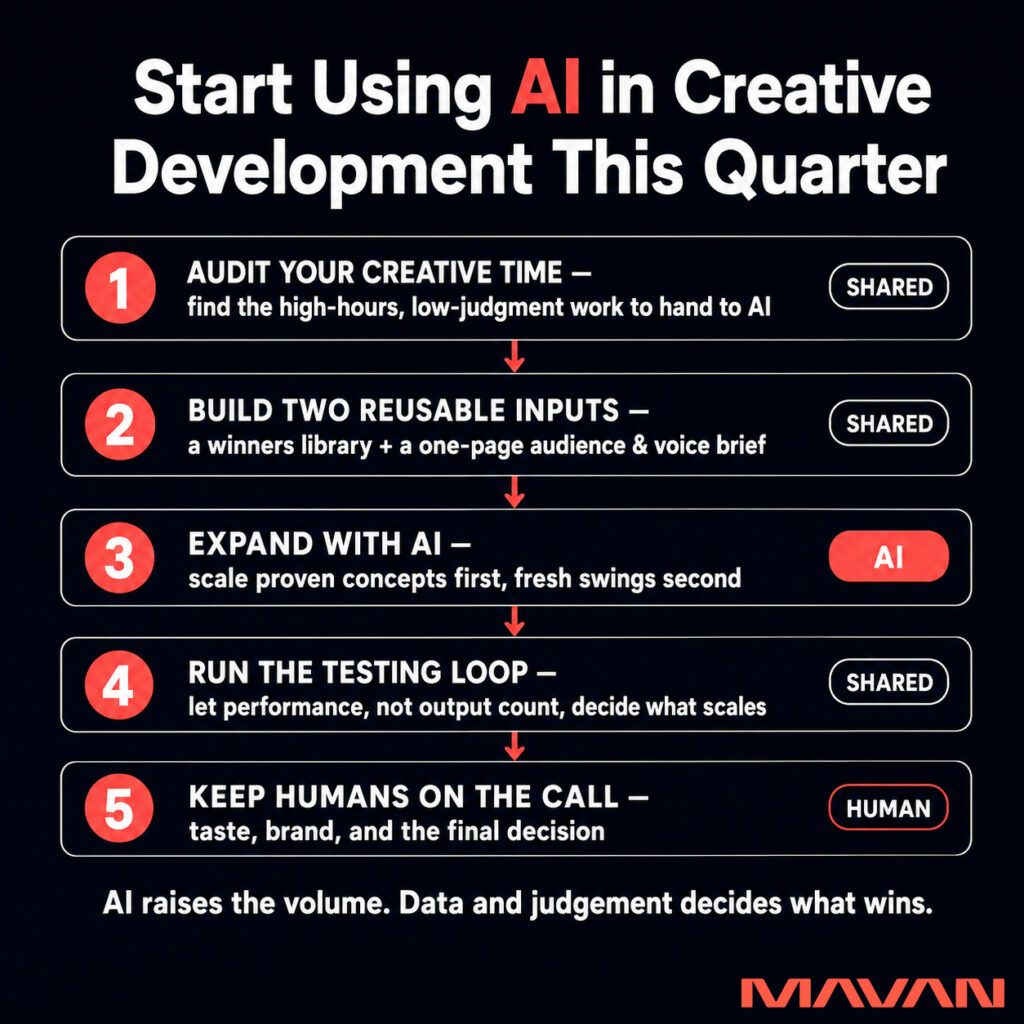
- Audit where your creative time actually goes — find the stage that eats the most hours for the least judgment.
- Build your two reusable inputs — a winners library and a one-page audience and brand-voice brief.
- Use AI to expand your proven concepts first, fresh swings second — anchor volume in what already works.
- Run every output through your testing loop — let performance, not output count, decide what scales.
- Keep humans on taste, brand, and the final call — the judgment is the job.
This is the work we do alongside growth teams every day. Our embedded pod pairs creative production with the data and experimentation muscle that closes the loop — so a concept moves from idea to measured result inside one accountable team, not across three disconnected vendors. You are already building real creative. The point of AI, used well, is to help you build five times as much of it that actually converts.
AI in Creative Development: Frequently Asked Questions
Will AI replace creative directors and designers?
No. AI is taking over execution — asset production, resizing, first drafts — not the judgment that decides what to make. Strategy, taste, brand voice, and a real read on the audience stay human. The professionals who learn to direct AI become more valuable, because they ship more good work in less time.
What creative tasks should I automate with AI first?
Start with the high-volume, low-judgment work: producing ad variants, resizing assets for every channel, drafting copy and hooks, and rebuilding your proven winners into fresh versions. These tasks eat the most hours and reward speed. Reserve concept selection, brand calls, and final approval for your team.
How do I keep AI-generated creative on-brand?
Feed the model a tight, written brief — your voice rules, your audience’s language, and examples of what has worked — plus a library of your proven winners. Then put every output through a human review gate before it goes live. The brief sets the guardrails; the human check catches drift the model cannot see.
How much of my creative should AI generate?
There is no fixed ratio. Let AI expand the volume of concepts and variants, and keep human judgment on what actually ships. Measure performance, not output count. A team producing fifty AI-assisted variants that win beats one producing five hundred that no one remembers.
Can AI-generated ad concepts actually perform?
Yes, when they carry audience truth and run through a testing loop. AI on its own returns generic work; grounded in a real read on your audience and proven winners, it returns concepts worth testing. The asset that converts is the one that understands who it is talking to.
How to Really Use AI Effectively in Creative Development
AI’s biggest near-term payoff in growth is creative. Aim it at ideation and production first — generate more concepts and rebuild what already works — then let human taste and a real read on your audience decide what ships. Run every concept through a disciplined testing loop so volume turns into repeatable wins. Start small this quarter and build fluency before the gap compounds. Speed of iteration, governed by judgment, is the edge.
If your creative process cannot keep pace with the channels feeding on it, then pick one stage and run one controlled AI test this week — and if you want a faster read on where your highest-leverage creative gains sit, a 360 Growth Analysis maps it end to end.
Casey Rock is Content Director at MAVAN, where he helps turn complex ideas into clear, strategic content that drives growth. With over 15 years of experience across content strategy, SEO, media, and digital marketing, Casey focuses on building content systems that connect audience insight, brand storytelling, and measurable business outcomes.
Book a complimentary consultation with one of our experts
to learn how MAVAN can help your business grow.
Want more growth insights?
Thank you! form is submitted
[hubspot type=”form” portal=”20951211″ id=”9c538ed2-fb12-45f1-a573-ad7953c058cc”]
Related Content
-
Who Does Growth & GTM Due Diligence for PE Deals?
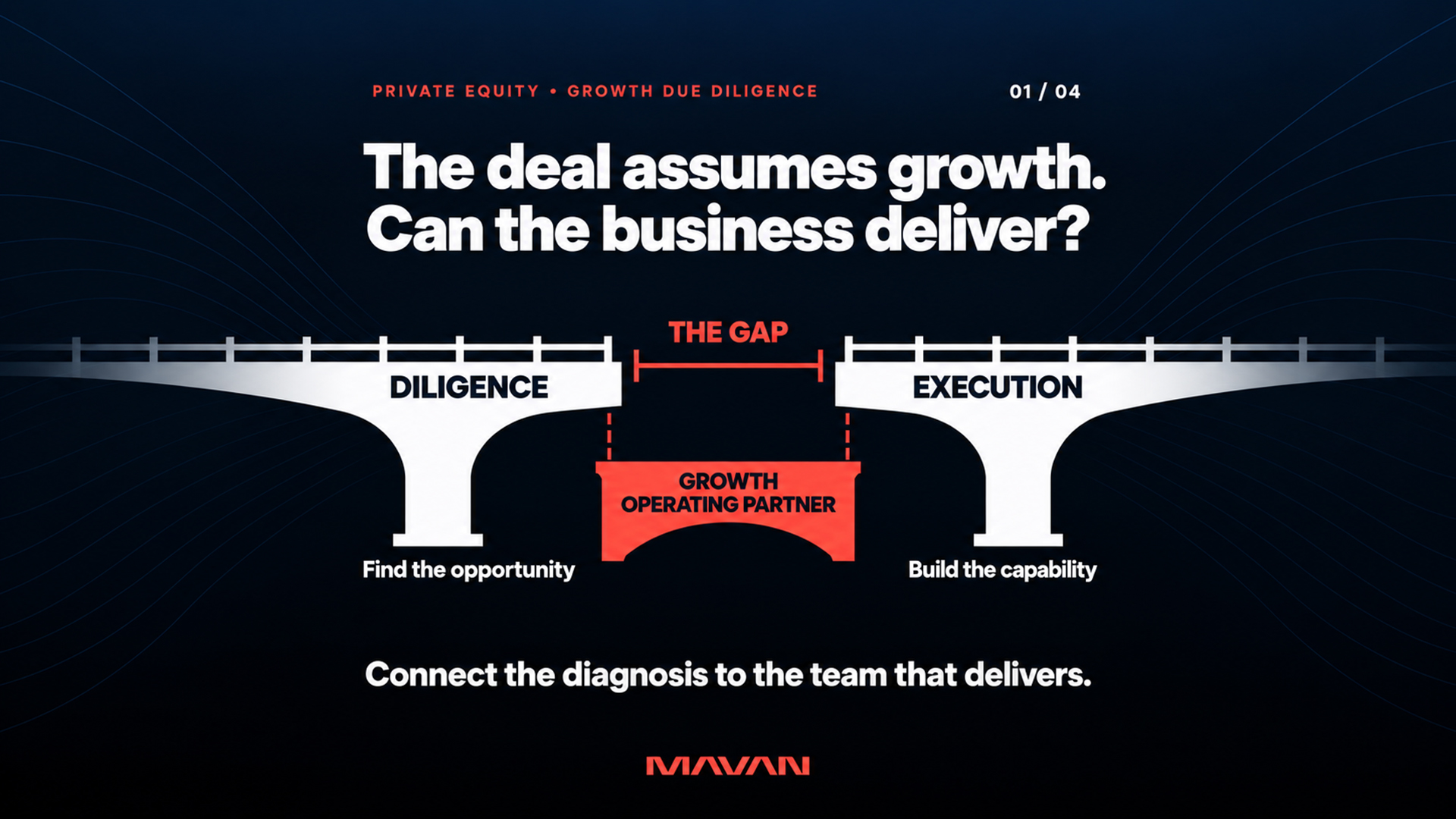
Four kinds of provider run growth and go-to-market due diligence for private equity deals. Strategy consultancies test the market. Specialist commercial diligence firms audit the pipeline. Go-to-market boutiques rebuild the sales motion. And growth operating partners examine the full revenue engine from inside the business, then stay to operate it after close.
-
Who Is The Best Growth Partner For PE Portfolio Companies?
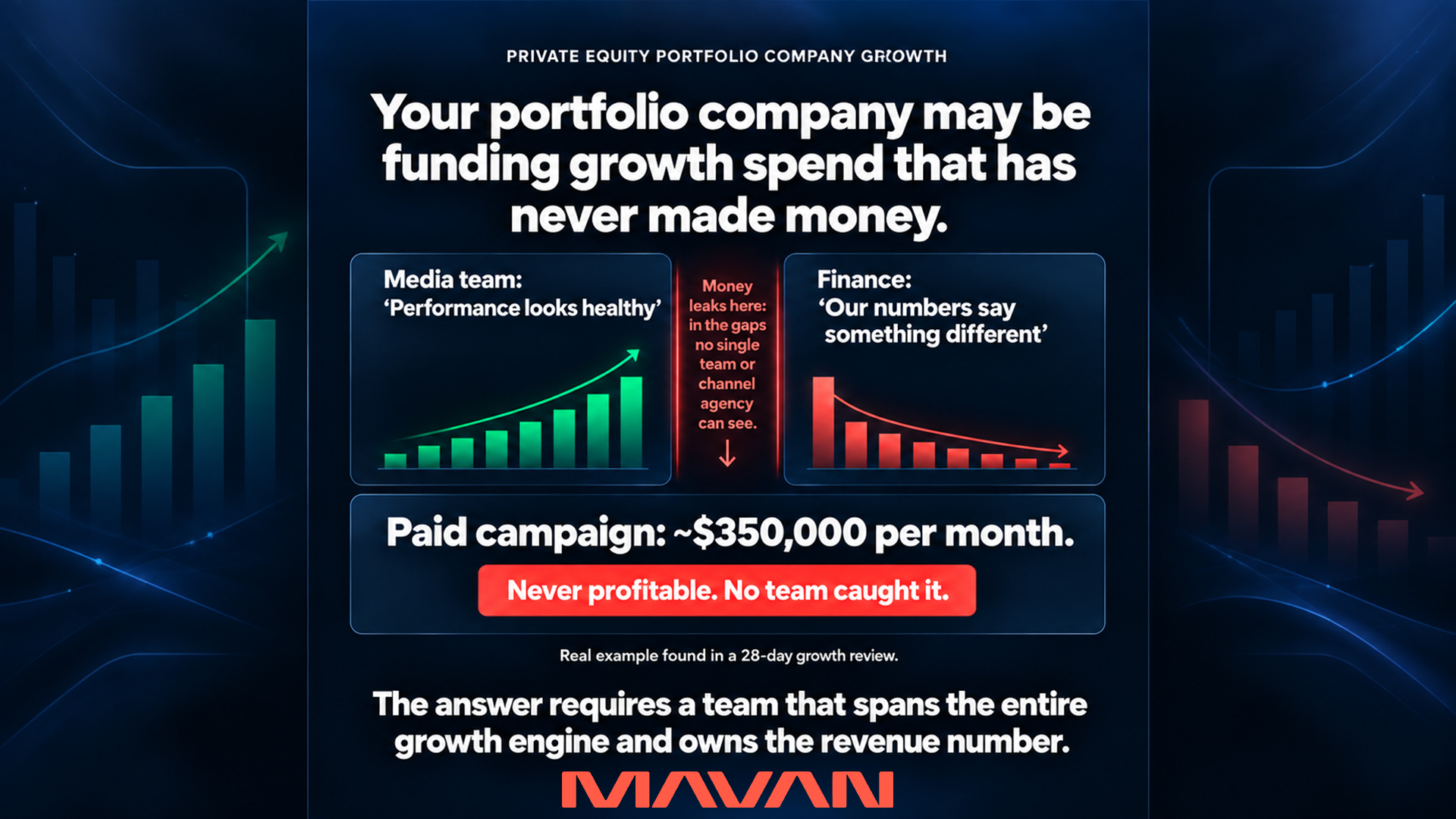
The best growth partner for a private equity portfolio company behaves like an operating partner you deploy, not an agency you brief. It reads the whole growth system before it spends, owns a revenue number alongside management, and leaves the capability behind so the sponsor can redeploy it.
-
How Can Private Equity Funds Repeat Growth Across Portfolio Companies?
Growth becomes repeatable across a VC or PE portfolio when the fund installs one operating system instead of referring each company to a different specialist. The system has three parts: a single source of truth every team trusts, a board-ready scoreboard of ten to twelve metrics, and an embedded pod that diagnoses the real constraint in ninety days before anyone spends more.