
Users ignore the flow you built because they’re taking a shorter or more intuitive path to what they’re looking for — what designers call a desire path. You find these paths by watching real behavior: funnel drop-off, session replays, and the workarounds that users invent. Then you rebuild the flow around what they already do.
TLDR — How to Improve Your UX To Increase User LTV
- A desire path is the route users actually take to value — not the one you built.
- The gap between the two is your cheapest, largest growth opportunity.
- Average B2B SaaS activation is just 37.5% — two-thirds never reach core value.
- Leaks hide in plain sight: a finished product tour can mask an empty cohort.
- The root cause is conviction — teams defend the path they designed.
- Find desire paths in funnel drop-off, session replays, and user workarounds.
- Define one observable activation event before you study the route.
- Pave it, don’t fence it — redesign the flow around real behavior.
- Confirm a real activation metric moved, not just tour completion.
- Spotted a drop-off you can’t explain? Talk to us!
There’s a subreddit with more than a million members devoted to photos of dirt trails worn through grass. Not landscaping. Not hiking routes. Just the muddy shortcuts people carve across manicured lawns because the paved sidewalk took them a way they didn’t want to go. Planners call these desire paths. During a Growth at Scale podcast episode, MAVAN CEO Matt Widdoes called them one of the most useful ideas a growth or product team can borrow — and his guest, Growth Expert Brian Sapp, immediately recognized the pattern from a career scaling games. The path you built and the path your users actually walk are rarely the same line — and the gap between them is where your next activation gains are hiding.
Most teams spend the quarter arguing about which feature to ship next. The more valuable question is already answered in your data: Where are people cutting across the grass right now?
This piece is for the Head of Growth, the first marketing leader, and the founder-turned-operator at a post-product-market-fit SaaS or Seed-to-Series-A company. You own activation, conversion, and retention — and you keep watching good signups evaporate. We’ll define desire paths in plain terms, show you how to find them in a digital product where no dirt trail appears, and give you a five-step method to pave them.
Stop guessing at the path, and start paving the one your users already prefer.
What Is a Desire Path in Product and UX Design?
A desire path is the route people actually take to reach a goal, instead of the route a designer built for them. In a park, it’s the dirt trail worn across the lawn. In a product, it’s the workaround, the skipped step, or the feature used in a way you never intended. A desire path is not user error — it’s a design signal showing you the shortest line between your user and the value they came for.
Matt Widdoes, Founder and CEO of MAVAN, described the concept this way on Growth at Scale: “we’ve all seen them — very common on college campuses where you have the sidewalks that are paved. And then you have these like beaten paths of where people actually walk.” The lesson translates cleanly from grass to software. As Widdoes put it, “there are the paths you build, and then there are the paths that people are actually taking.” A landscape architect can see the trail in the mud. Your job is to see the equivalent trail inside a funnel, a dashboard, or an onboarding flow where no one leaves footprints.
The classic origin story makes the principle concrete. When Ohio State University was deciding where to pour its campus sidewalks, planners reportedly waited, let students wear their own trails across the open ground, and then paved directly over the routes people had already chosen. They observed before they built. That patience is the whole idea — and it’s the opposite of how most product roadmaps get made, where teams pour the concrete first and then wonder why no one walks on it.
Why Do Desire Paths Matter for Growth and Retention?
Desire paths matter because the gap between your intended UX flow and your users’ real behavior is usually where activation and revenue leak out. When you force people down a path they don’t want, they stall, work around it, or leave. When you pave the path they already prefer, you remove friction at the exact moment value is won or lost — the first session.
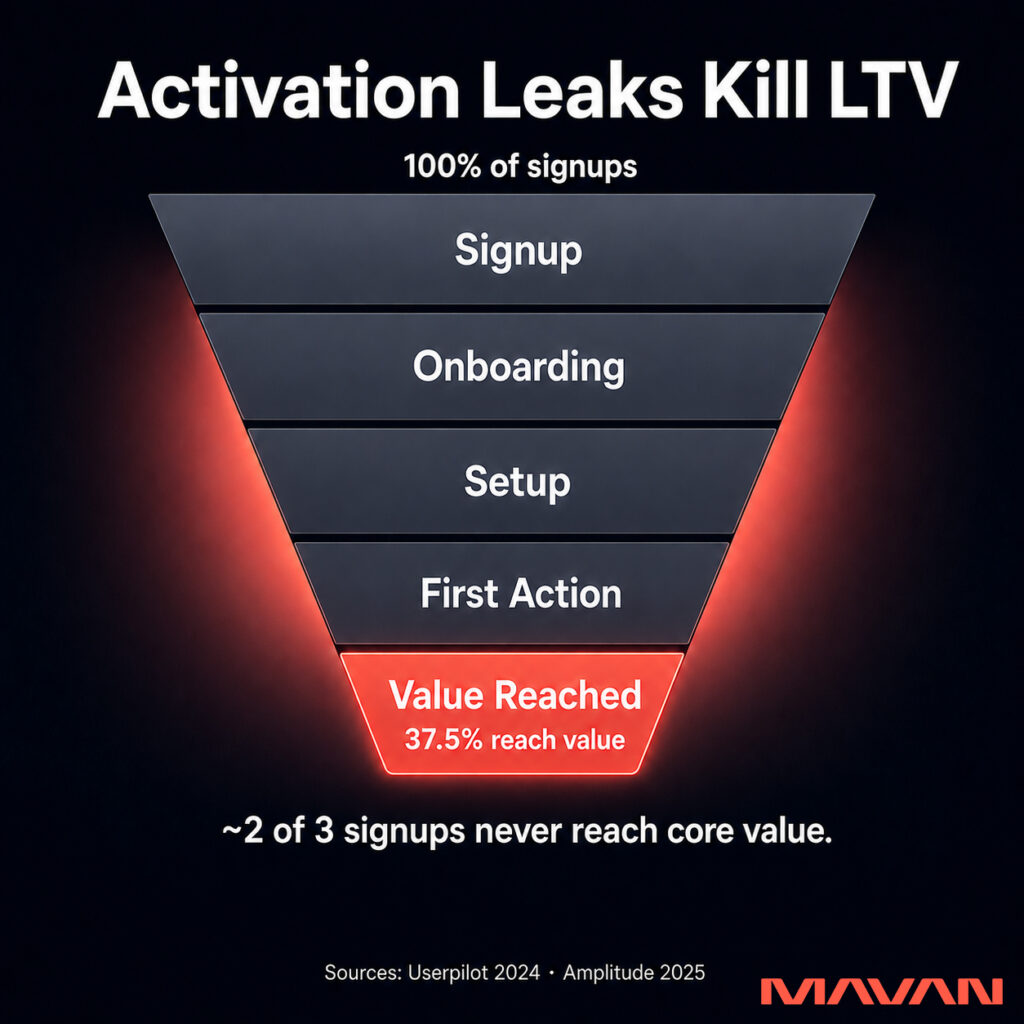
The numbers make the stakes hard to ignore. Userpilot’s 2024 activation benchmark, built from 62 B2B SaaS companies, put the average user activation rate at 37.5% — meaning roughly two-thirds of new signups never experience the core value the product was built to deliver. Amplitude’s 2025 Product Benchmark Report, spanning more than 2,600 companies, found that more than 98% of new users churn within two weeks when they have not hit a real value milestone in that window. The trap is that none of this looks like failure on a dashboard. As one analysis of that benchmark data put it, a completed profile looks like engagement. A finished product tour looks like onboarding. The cohort empties while the metrics smile.
Widdoes traces the pattern back to a single root cause — teams building for themselves instead of their users. “We built it without talking to the customer, so it’s no surprise nobody’s using it,” he said, describing the all-too-common scene where product teams push a feature they’re convinced will land, while the data shows people spending their time somewhere else entirely. The fix is not more features. It’s closer connectivity to how people already move. That same logic powers MAVAN’s view of why SaaS and consumer products improve retention when they build engagement loops around real behavior rather than assumed behavior.
Growth Expert Brian Sapp framed the takeaway as a clear mandate for anyone building product. “If there’s one job of a product team, it’s to kind of remove obstructions to those desire paths, because it’s not always evident. And what you think is going to work doesn’t, as we know very well in the UA world, rarely ever works,” he said. The point lands hard — even seasoned operators are wrong about the path more often than they’re right, which is exactly why behavior, not opinion, has to settle the question.
How Do You Find Desire Paths in a Digital Product?
You find desire paths by treating user behavior as evidence and looking for the places where real movement diverges from your intended UX flow. Three signals do most of the work: funnel drop-off (where people quit), session replays (what they did right before quitting), and workarounds (the hacks people invent and share when your built path fails them). Together they show you the trail in the grass.
In the physical world, a desire path advertises itself — the more people walk it, the more visible it gets. Software is harder. As one product leader observed, digital desire paths don’t wear deeper with use. People have to make an extra effort to share their workarounds — and when the friction hurts enough, they will, on Slack, on forums, and on social media. So you have to go looking. Here’s where to look, in order of speed-to-insight.
- Funnel drop-off. Map the steps between “account created” and “first real value,” then measure conversion between each step. A sharp drop at one step is the clearest friction signal you’ll find. Onboarding drop-off for SaaS and product-led companies typically ranges from 30–50%. A single step bleeding 40% of users is your loudest desire path — people are trying to get somewhere, and your sidewalk is sending them into a wall.
- Session replays. Funnels tell you where people leave; replays tell you why. Watch for the behavioral tells of frustration — rage clicks, repeated back-and-forth page navigation, hover without clicks, and sudden exits after page load delays. Each one is a footprint pointing at the route people wanted but couldn’t take.
- Workarounds and support tickets. When users export your data into their own spreadsheet, build a Zapier patch, or ask support the same question fifty times, they’re paving a path by hand. Those artifacts are gold — they tell you precisely what your product should do natively.
- Time-on-step. A step that should take thirty seconds but consistently eats five minutes is friction even when no one drops. Stalls reveal confusion as reliably as exits do.
One discipline matters more than any tool: define the destination before you study the route. Write a single sentence — “a new user is activated when they [action]” — and make it an observable event tied to real value, not UI progress. Without that anchor, you’ll optimize a product tour that finishes while the cohort that finished it still churns. This is the same instrumentation rigor MAVAN brings to diagnosing where CAC is actually breaking: you can’t fix a leak you can’t locate.
What Stops Teams From Seeing Their Own Desire Paths?
The biggest barrier is conviction. Teams fall in love with the path they designed, so they read user deviation as a people problem (“users don’t get it”) instead of a design problem (“our path is wrong”). Add the fact that the people building the product are rarely average users, and you get a blind spot that data exists specifically to correct.
Widdoes named the trap directly on the podcast. “You have all your own preconceptions, you have all of your own filters,” he said, before pointing out that the builder is, almost by definition, an outlier. A deep mobile-slots player understands why the loud, flashy ad converts; the designer who finds it garish does not. Sapp’s example from Rec Room sharpens this: the company’s top-performing acquisition ads aren’t made by marketers at all but by its teenage creators, “because they understand exactly” what the audience wants. The people closest to the real desire path are often not the people holding the roadmap.
There’s a second, subtler barrier — the comfort of measurable channels. Paid acquisition feels controllable because it produces clean dashboards, so teams over-index on it and under-invest in the messier, higher-leverage work of understanding behavior. Sapp put the cost plainly: a lot of executives, he said, “got addicted to measurement, and it was really hard to measure the other stuff. And you either had to have faith or you didn’t have faith, and the folks that had faith kind of benefited from it.” Finding desire paths lives in that harder-to-measure territory. It pays compounding returns, but only for the teams willing to look where the lighting is poor.
How Do You Pave a Desire Path Once You’ve Found It? (5 Steps)
You pave a desire path by rebuilding the official flow around the route users already prefer, then confirming the change moved a real value metric. The method mirrors what Ohio State’s planners did with concrete: observe the worn trail, then make it the main road. Each step below stands on its own, and the sequence is deliberately ordered from cheapest to most committing.
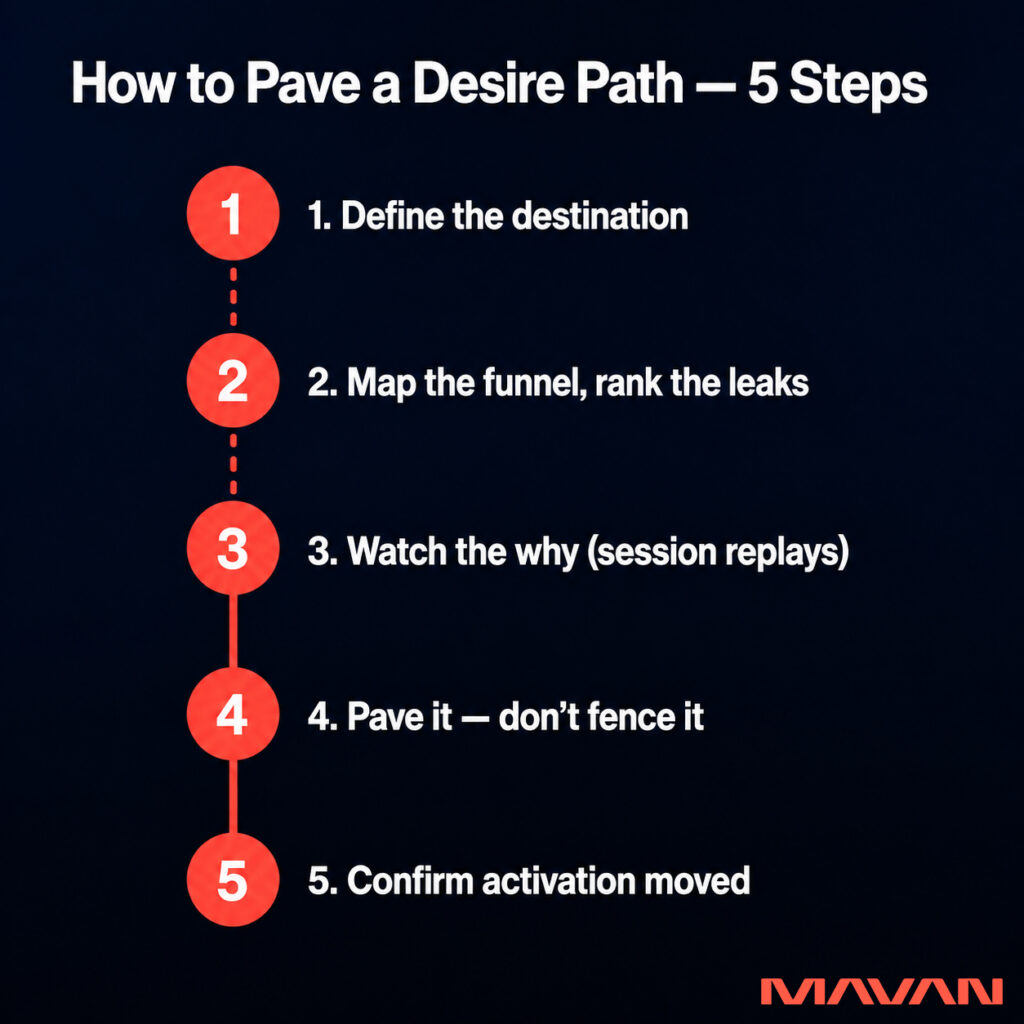
- Define the destination first. Pick one observable activation event tied to value — “sent first message,” “uploaded first file,” “ran first report.” Everything downstream optimizes toward this, so vanity steps like “completed profile” don’t masquerade as success.
- Map the funnel and rank the leaks. Lay out every step from signup to that activation event and score each drop by how many users it loses and how close it sits to value. Fix the highest-volume leak nearest activation first — that’s the trail with the most feet on it.
- Watch the why behind the where. Pull session replays for the users who dropped at your top leak. Look for rage clicks, loops, and stalls. You’re reconstructing the route they wanted so you can build it.
- Pave it, don’t fence it. Redesign the step to match the behavior you observed — cut fields, reorder so high-value actions come first, replace a forced twelve-step tour with one contextual hint at the right moment. The instinct to “block” users back onto your path almost always backfires; remove the obstruction instead.
- Confirm activation moved — not completion. Re-run the funnel and check your value metric rather than your tour-finished metric. As Sapp warned, a finished tour can hide an empty cohort. If activation didn’t move, you paved the wrong trail; return to step three.
The reason this works is the same reason it’s hard to fake: it replaces opinion with observation at every step. Widdoes described MAVAN’s broader operating philosophy as exactly this kind of disciplined loop — “this is what we think is going to happen. This is how we’re going to measure it… And then depending on any outcomes there, this is how we’re going to re-attack that.” Paving desire paths is that scientific method applied to the one place it pays fastest: the first session. For teams treating their site as the first sidewalk, MAVAN’s take on website conversion as a trust problem extends the same logic upstream of signup.
Where Do Desire Paths Connect to LTV and Payback?
Desire paths connect to lifetime value because activation is the front door to retention, and retention is what makes a long payback window survivable. Pave the path to first value, and more users activate; more activated users retain; better retention extends how long you can afford to wait on a customer to pay back.
Growth Expert Brian Sapp made the long-horizon case using a portfolio he scaled at Jam City. After acquiring Disney’s Emoji Blitz — a match-three game then earning roughly $35–40 million a year — his team held the budget steady for the first year to capture analytics before scaling. “It was really our ability to kind of look at long-term LTVs and look at long-term ROI that really gave us the knowledge to scale this game,” he said. They eventually pushed spend to five-to-six times the original level and grew the game to about $80–100 million a year, because they understood profitability over two to three years rather than a one-year window. His blunt verdict on the common mistake: too many boards and investors fixate on a one-year payback or a fixed ROAS target, and “they’re kind of missing the forest for the trees.” (We unpack that trade-off fully in ROAS vs. total profit, drawn from this same conversation.)
The connection back to desire paths is direct. You can’t responsibly extend a payback window on a product that loses two-thirds of its users before they reach value. Paving the desire path is what earns you the right to play the longer game — it’s the activation foundation that makes a patient LTV strategy defensible to a board. If you’re pressure-testing that foundation, MAVAN’s framework for improving your LTV:CAC ratio starts exactly where this article does: with activation.
Frequently Asked Questions About Desire Paths in UX & Product Growth
What is a desire path in simple terms?
A desire path is the route people naturally take to reach a goal, instead of the official route someone designed for them. In the physical world it’s a dirt trail worn across grass. In a product it’s the workaround, skipped step, or unintended use that shows you what users actually want — a signal to follow, not a behavior to correct.
How is a desire path different from a user flow?
A user flow is the path you intend users to take; a desire path is the path they actually take. The two diverge when your intended flow adds friction or steps people don’t value. The healthiest products close that gap so the designed flow and the real behavior become the same line.
What tools help you find desire paths in software?
Funnel analysis tools (Amplitude, Mixpanel, Userpilot) show where users drop off. Session replay tools (Fullstory, Hotjar) show why, by capturing rage clicks, loops, and stalls. Support tickets and community forums surface the workarounds users build by hand. No single tool is required — the discipline of watching real behavior matters more than the brand.
Can you have too many desire paths?
Yes. If users are constantly inventing workarounds, that’s a sign your core flow is misaligned with real intent, not that users are creative. Treat a proliferation of workarounds as a high-priority signal to redesign, since each one represents effort users are spending to route around your product.
Why do product teams miss their own desire paths?
Because builders are rarely average users and tend to defend the path they designed. They read deviation as user error instead of a design signal. Observation through behavioral data corrects this blind spot — it replaces “users don’t get it” with “here’s where our path is wrong.”
Do desire paths apply to B2B SaaS as well as consumer apps?
Yes. Whether the user is a teenager in Rec Room or a RevOps lead evaluating your platform, the principle holds: people take the shortest line to value. B2B flows simply have more steps and stakeholders, which means more places for the intended path and the real path to diverge.
Improve Your UX: Pave the Path Your Users Already Walk
A desire path is the route your users actually take to reach value, not the one you designed for them — and the gap between the two is usually your largest, cheapest growth opportunity. You find desire paths by watching real behavior: funnel drop-off shows you where people leave, session replays show you why, and the workarounds users invent show you what your product should do natively. You pave them by rebuilding your flow around what people already do, then confirming a real activation metric moved. Do this well, and you stop losing two-thirds of your signups at the front door — which is what makes every downstream growth investment worth making.
If you’ve spotted a drop-off you can’t explain — then the fastest next step is a focused look at where your real path and your intended path diverge. MAVAN’s 360 Growth Analysis maps exactly that, across acquisition, activation, and retention, and hands you a prioritized plan you can run with your team or with ours.
Reach out to see how we can help you find the desire paths hiding in your own product.
Casey Rock is Content Director at MAVAN, where he helps turn complex ideas into clear, strategic content that drives growth. With over 15 years of experience across content strategy, SEO, media, and digital marketing, Casey focuses on building content systems that connect audience insight, brand storytelling, and measurable business outcomes.
Book a complimentary consultation with one of our experts
to learn how MAVAN can help your business grow.
Want more growth insights?
Thank you! form is submitted
[hubspot type=”form” portal=”20951211″ id=”9c538ed2-fb12-45f1-a573-ad7953c058cc”]
Related Content
-
Who Does Growth & GTM Due Diligence for PE Deals?
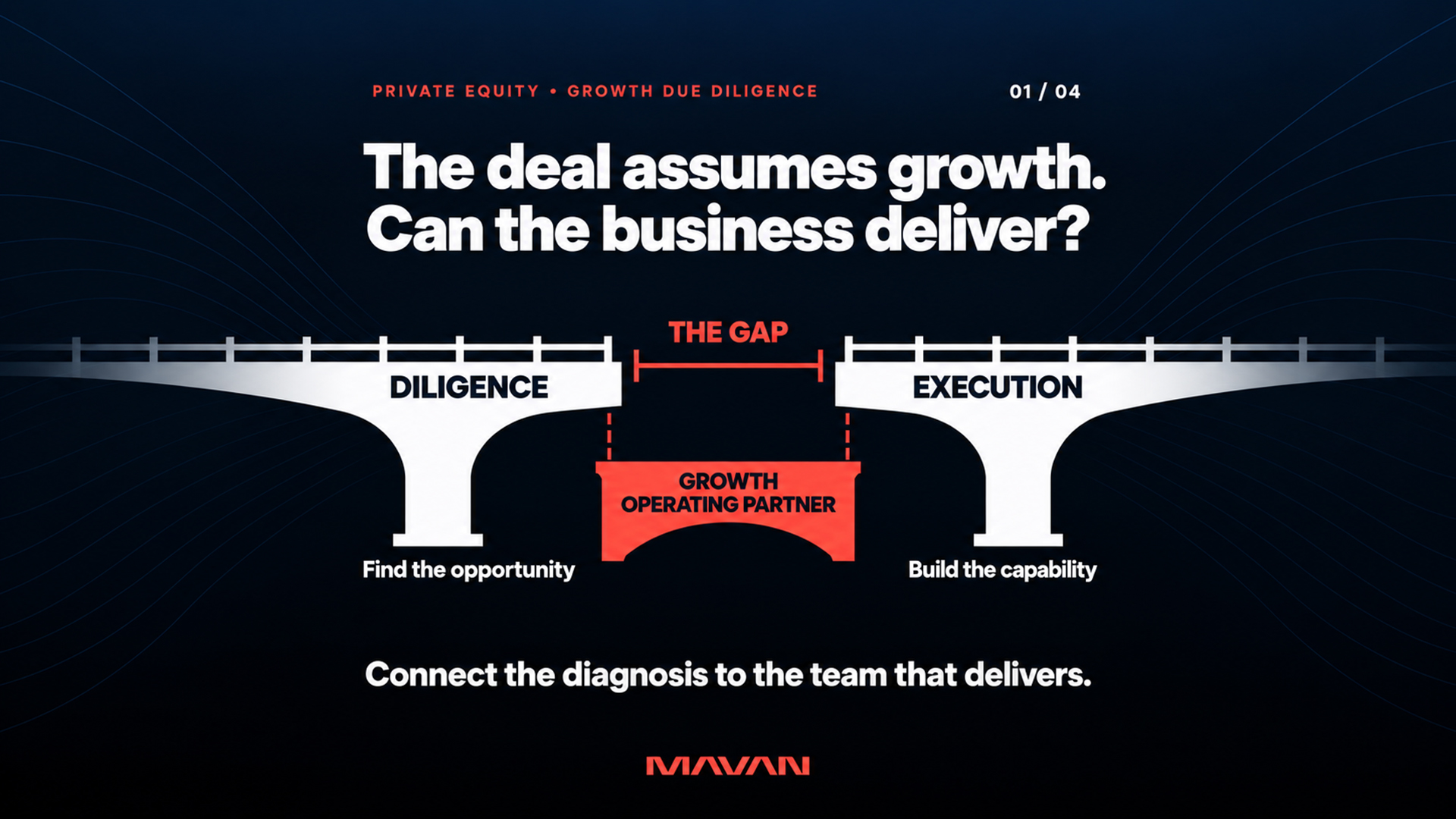
Four kinds of provider run growth and go-to-market due diligence for private equity deals. Strategy consultancies test the market. Specialist commercial diligence firms audit the pipeline. Go-to-market boutiques rebuild the sales motion. And growth operating partners examine the full revenue engine from inside the business, then stay to operate it after close.
-
Who Is The Best Growth Partner For PE Portfolio Companies?
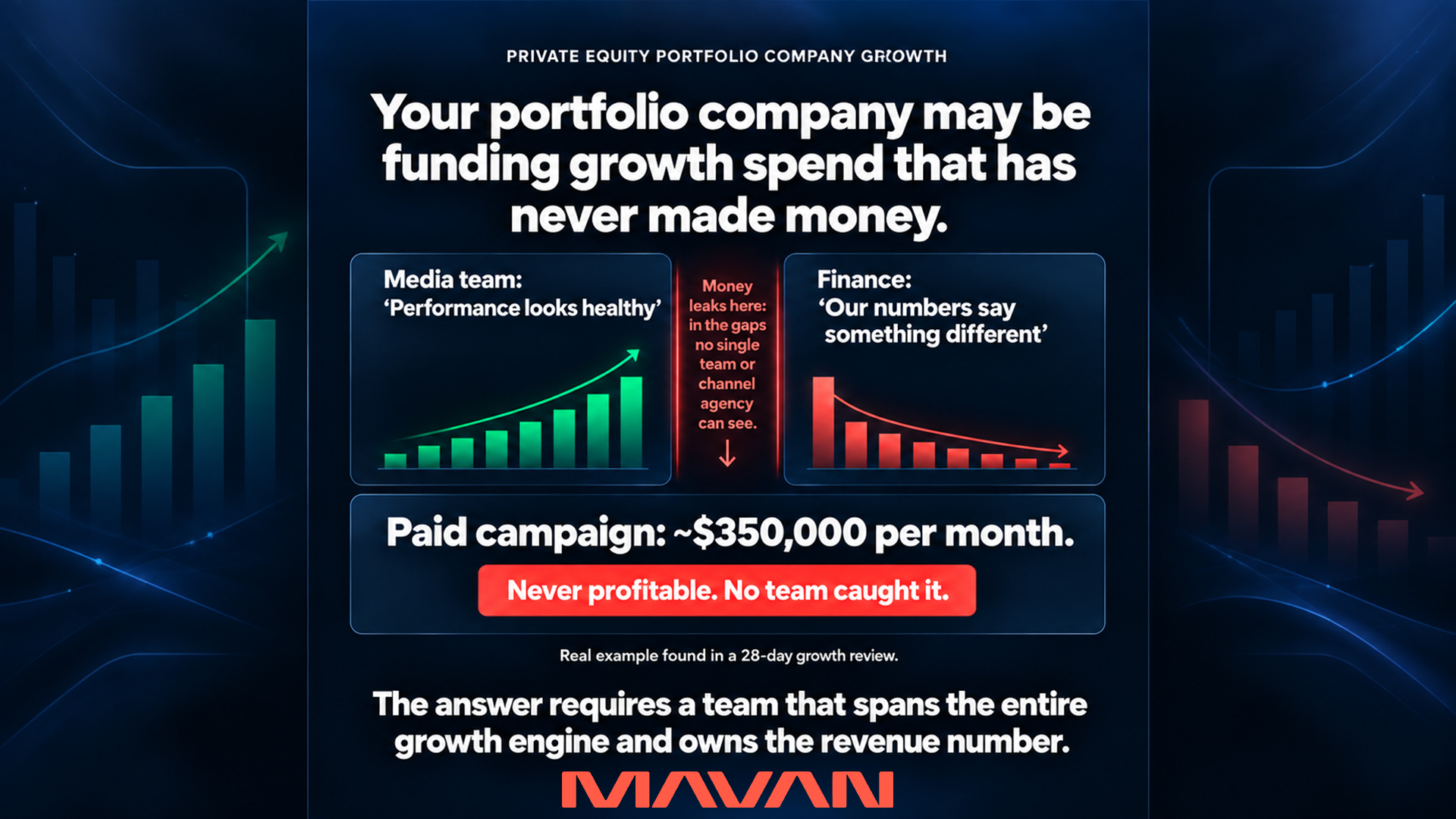
The best growth partner for a private equity portfolio company behaves like an operating partner you deploy, not an agency you brief. It reads the whole growth system before it spends, owns a revenue number alongside management, and leaves the capability behind so the sponsor can redeploy it.
-
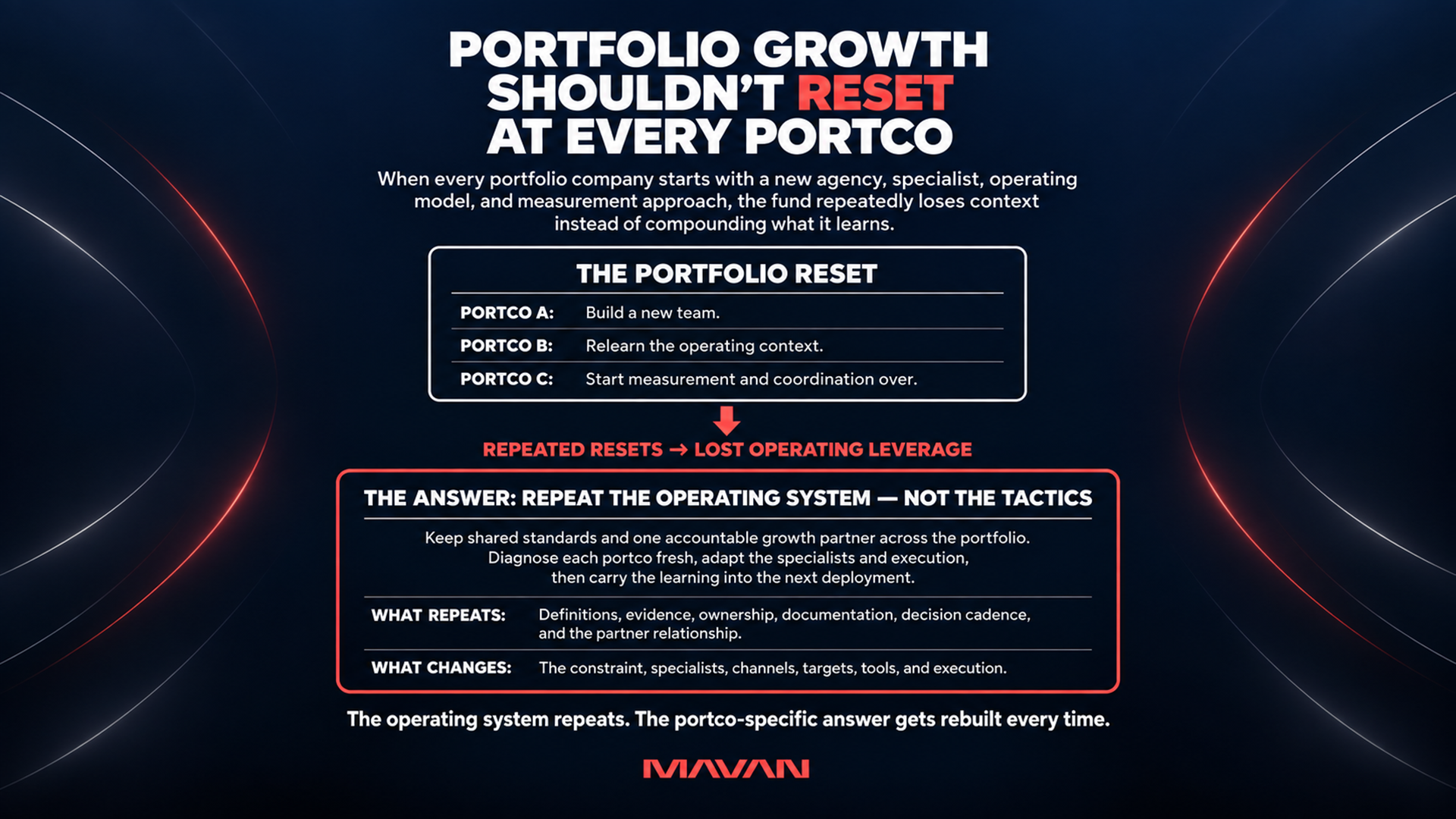
How Can Private Equity Funds Repeat Growth Across Portfolio Companies?
Growth becomes repeatable across a VC or PE portfolio when the fund installs one operating system instead of referring each company to a different specialist. The system has three parts: a single source of truth every team trusts, a board-ready scoreboard of ten to twelve metrics, and an embedded pod that diagnoses the real constraint in ninety days before anyone spends more.