
SaaS and consumer brands need to take a page out of gaming’s retention playbook. Games keep players for years by treating launch as the starting line, building an engagement loop into the product’s core, and continuously deploying content and rewards. Non-gaming products can apply the same live-operations approach to turn retention into their cheapest source of growth.
TLDR — How to Increase Retention By Running Your Product Like a Live Game
- Treat launch as the start line, never the finish.
- Build the engagement loop into the core early.
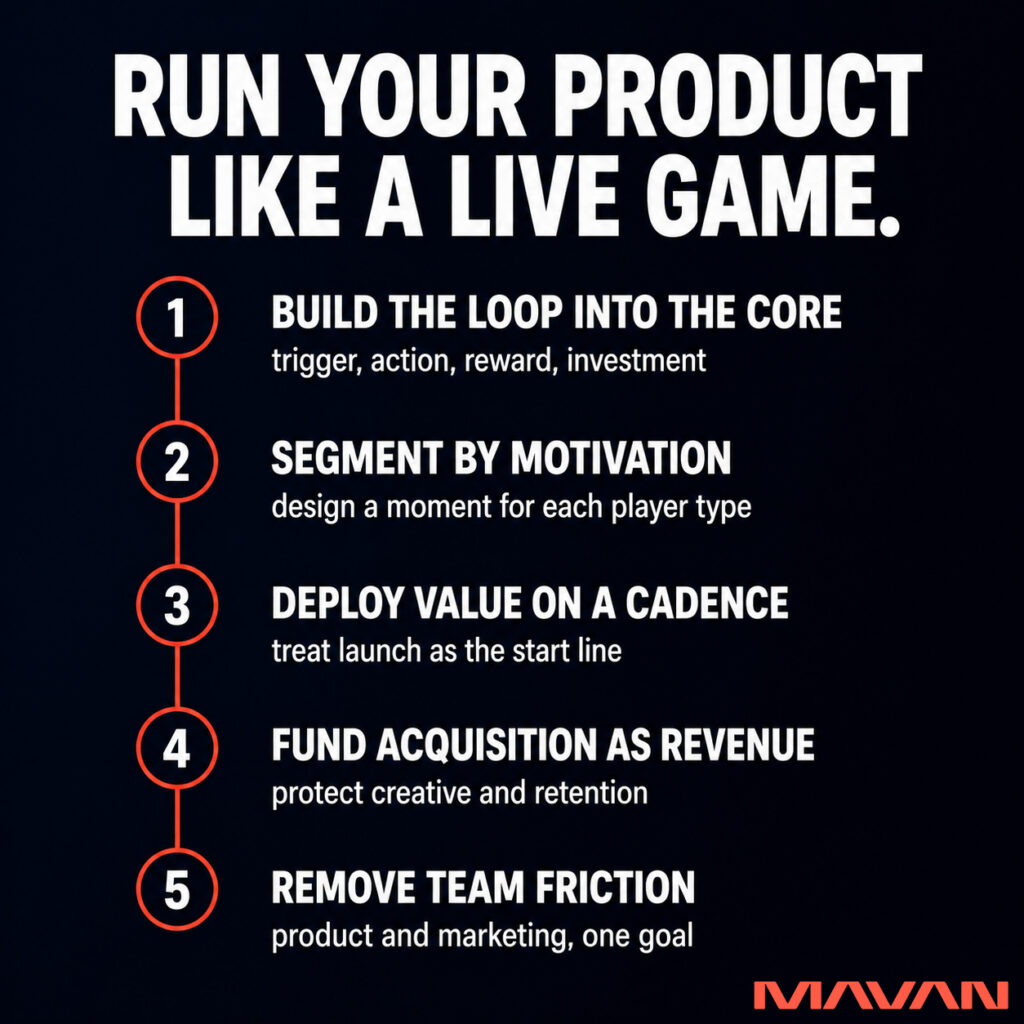
- Design every loop: trigger, action, reward, investment.
- Run lifecycle (email, push, SMS) from day one.
- Segment users by motivation, not demographics.
- Give each player archetype one delight moment.
- Treat acquisition as a revenue function, not a cost.
- Iterate creative to extend it; invest to invent the next.
- Kill friction — put product and marketing on one goal.
- Want this mapped for your product? Get MAVAN’s 360 Growth Analysis.
Mobile Games Have Already Figured Out Years-Long Retention
A great mobile game ships, and the work starts. The team behind it will update that game hundreds of times — new events, new rewards, new reasons to come back this week instead of next year. A lot of SaaS and consumer products do the opposite. They ship once, throw a launch party, then wait for churn to do its work. That gap is the single biggest retention advantage gaming has, and almost none of it is locked inside gaming.
Dan Barnes, President of MAVAN, spent over a decade at Zynga, Natural Motion, and Machine Zone building live games that retained players for years and deployed over a billion dollars in user acquisition. On an episode of MAVAN’s Growth at Scale podcast with Founder and CEO Matt Widdoes, he made the case plainly: the mechanics that keep someone playing a game for a decade are the same mechanics that keep someone paying for software.
Here’s the one sentence to walk away with: Treat your product like a live game, build the engagement loop into the core early, and run it continuously, and retention becomes the cheapest growth you will ever buy.
This piece shows you how to do exactly that, step by step.
What Does It Mean to Run Your Product Like a Live Game?
Running your product like a live game means treating launch as the starting line, not the finish. Instead of shipping once, you deploy value on a regular cadence — new features, events, and rewards — and you watch the data to decide what to ship next. Games call this LiveOps. Any product with returning users can do it.
Dan Barnes, MAVAN’s President, defines it without jargon: live operations is the idea that “instead of deploying content once, you deploy content hundreds of times, thousands of times.” In a game, that content is new characters, levels, or seasonal events. In your product, it is a new template, a weekly challenge, a fresh onboarding milestone, a re-engagement nudge. The format changes. The principle does not. As Dan put it, the best live games “retain people for decades” because “they grow and learn with the community” and keep giving people a reason to return.
The reason this matters is not philosophical — it is the math. Bain & Company research, popularized by the Harvard Business Review, found that improving customer retention by just 5% can lift profits by 25% to 95%. A retained user costs almost nothing to serve again, spends more over time, and refers others. So the company that operates its product as a living service is compounding margin while the company that “ships and waits” keeps renting growth from ad networks. If you want a primer on the underlying economics, we walk through them in our breakdown of how to improve your LTV:CAC ratio.
For most teams, the first move costs no engineering at all. A disciplined lifecycle program across email, push, and SMS is LiveOps you can run from day one. It is a steady drumbeat of relevant, well-timed reasons to come back — measured and tuned every week.
Launch is the start line, not the finish line. The product that keeps showing up for its users is the product users keep paying for.
Why Does Gamification Usually Fail and Feel Tacked On?
Gamification fails because it gets bolted on after the product is built, when user behavior is already set. Badges, points, and leaderboards added late feel like decoration because they reward behavior the product was never designed around. The fix is to build the engagement loop into the core experience early, so the rewarded action is the action users already take.

Dan Barnes, President of MAVAN, is blunt about why most attempts feel hollow: “The challenge with gamification is it often feels tacked on because it is.” In games, the thing a player does most often is the core loop. Change that loop after it has hardened, and you are fighting muscle memory. His guidance is to “build the new compulsion loops, those new core loops, very early on in the software” — the spine of the product, designed in from day one rather than layered on later.
This maps directly onto a framework most product teams already know: the Hook Model, introduced by Nir Eyal in his book Hooked. A habit-forming loop runs through four stages, and you can design each one into your product on purpose:
- Trigger — the cue that starts the loop. An external nudge (a notification, an email) or an internal one (the user feels a need your product solves).
- Action — the simplest possible behavior done in anticipation of a reward. The easier it is, the more it happens.
- Variable reward — the payoff, with enough unpredictability to stay interesting. Dan’s umbrella example fits here: at Machine Zone, “if we wanted to sell umbrellas, we could quite literally make it rain in the game.” The team manufactured the moment that made the reward feel valuable.
- Investment — the user puts something back in (data, a saved project, a streak) that makes the next loop better and harder to abandon.
Matt Widdoes, MAVAN’s founder and CEO, offered the clearest non-gaming versions of this. LinkedIn tells you your profile is “65% complete” and shows you the steps to finish it — a progress bar doing real work. Project tools turn the empty-canvas problem into a guided first win: “let’s create our first ticket … congrats, you got first ticket award.” Both bite-size an intimidating product into a loop the user wants to close. The data backs the instinct — studies of SaaS onboarding find users are roughly 40% more likely to finish a task when a progress bar shows them how close they are.
One caution keeps teams honest. A leaderboard that lifts engagement in one product can flatten it in another, because the mechanic is not the cause — the human motivation underneath it is. Yu-kai Chou, creator of the Octalysis gamification framework, makes the point that a borrowed stat without the underlying driver is decorative. So before you add a streak or a badge, name the motivation it serves. Otherwise you are shipping theater.
How Do You Use Player Types to Segment Your Users?
Player types segment users by what they want from your product, not by demographics. Borrowing from games, you map users to motivation-based archetypes — the achiever, the explorer, the socializer, the competitor — then design systems and rewards for each. The same user file looks one-dimensional through a demographic lens and rich through a motivation lens.
Dan Barnes, MAVAN’s President, points to a framework from researcher Richard Bartle, who argued “every player in the world fits into one of these four archetypes” — killer, achiever, socializer, and explorer. Games design specific moments for each: a competitive ladder for the killer, a completion track for the achiever, guilds for the socializer, hidden content for the explorer. Most non-gaming products do none of this. As Dan observed, they “have like this one fits all funnel, and then you’re trying to just get people as far along the funnel as possible.”
Matt Widdoes, the firm’s CEO, translates this into a question any team can ask: “what is our version of the Bartle’s for our product?” He illustrated it with a segmentation debate at a large company. Their instinct was demographic — “female 35 to 55” — and their conclusion was that the ad platforms could find those people better than they could. Matt’s point was that demographics are for targeting; motivation is for the product. Knowing a buyer of prenatal vitamins is likely pregnant tells you nothing about why this customer reorders and that one churns. The nuance lives one level deeper. Dan framed the practical version this way: start with “your ICP, your idealized customer profile, but then what’s the nuance within that of the top three other profiles that still value to you.”
Here is how to put it to work this quarter:
- Name three to four motivation archetypes specific to your product. For a project tool: the closer who lives in the task list, the manager who wants the system view, the explorer who pokes every feature.
- Tag the behavioral signals that reveal each one. Which actions, in the first week, separate a future power user from a tourist?
- Design one moment per archetype that exceeds expectations. Dan defines delight precisely: “you exceed someone’s expectations.” A surprise template for the explorer, a milestone for the achiever — each tied to what that person came for.
This is also where gaming and software finally rhyme for B2B teams. We unpacked more of that cross-pollination in what B2B SaaS can learn about CAC, attribution, and the first growth hire from mobile gaming.
Is Your User Acquisition a Cost or a Revenue Function?
User acquisition is a revenue function, not a cost center. When leadership treats acquisition and creative spend as costs to minimize, they cut the inputs that produce revenue. The damage shows up later as rising costs and falling growth. Strong teams manage acquisition to a revenue target, then protect retention so each user pays back many times over.
This was the most quotable stretch of the conversation. Matt Widdoes, MAVAN’s CEO, described a hiring question he asks every senior leader: “do you think the organization views user acquisition as a cost function or a revenue function?” If the answer is “cost” more than once, the role is set up to fail. His reframe is sharp: “I managed 350 million a year in spend. The reality is, I managed 450 million a year in revenue.” Cutting media spend from 350 to 100, he noted, is the same as deciding to cut revenue from 450 to 150 — you are choosing to forgo the return.
The same Pennywise logic torches creative budgets. MAVAN President Dan Barnes and Matt described leadership squeezing creative production while spending a million dollars a day on media. Matt’s analogy lands: it is like buying a Ferrari and filling it with 87 octane to save thirty cents, while torching money at the top of the funnel. The savings feel validated because the damage is a lagging indicator. As Dan explained, “we saved a million dollars off this $365 million budget and nothing changed. Awesome,” and then three months later the cost per impression has doubled and nobody connects the dots.
There is a real limit worth respecting, though, and it is where teams get the next move wrong. Iterating on creative — new color, new hook, same template — extends a winning ad’s life. But it does not invent the next winner. As Dan said, “iteration essentially increases the creative’s lifetime,” yet “finding the new thing still really, really hard.” So budget for both: a refresh engine to slow fatigue, and the harder, costlier work of net-new concepts. MAVAN ran a recurring creative refresh framework for ElevenLabs to combat click-through fatigue while scaling paid spend over 1,000% at their target return, and cut customer acquisition cost by 46% quarter over quarter for Fireflies. The pattern is the same every time: spend is an input to revenue, and the bucket underneath it — retention — decides whether the water you pour in stays.
How Do You Operate Fast Enough for Any of This to Work?
You operate fast enough by shortening the distance between an insight and the action it triggers, removing friction between teams, and aligning product and marketing on one shared goal. Engagement loops, archetype design, and live content only move metrics if the team can decide and ship quickly. Speed is an operating model, not a personality trait.
Dan Barnes, MAVAN’s President, learned his North Star at Machine Zone: “taking an insight to an action in the shortest amount of time possible.” What made that possible was not heroics — it was the absence of friction. “It’s all about friction,” he said. “Any place where you have inherent friction between where you are and where you want to be, it just makes everything harder. And those things compound really quickly.” Organizations that let friction calcify slow to a crawl, even with great people inside them.
The most expensive friction is the war between product and marketing. Dan has seen it everywhere: marketing blames product for weak retention, product blames marketing for low-quality users, and the metric sits still. His verdict is unambiguous — “your chances at failure [are] exponentially higher if you don’t have product and marketing aligned,” sitting in the same boat, “thinking about the same baby.” Matt extends the idea into a principle MAVAN operates on: growth is a philosophy, not a function. The moment growth becomes “the growth person’s job,” the premise is already lost.
There is also a build pattern worth stealing. At Network, Dan’s teams refused a central technology group, because central platform teams optimize for perfect code while product teams optimize for shipping — opposed incentives that slow everyone down. Instead they pooled shared systems that any team could improve and put back. One client engineer built the subscription infrastructure that generated 15 to 20% of a game’s revenue, and the minute it existed, every other game could use it. The lesson for your stack: build reusable capability once, and let the teams closest to the user improve it. Avoid handing critical work to a group whose goals point the opposite way.
This is the harder half of the playbook, and it is where an embedded, cross-functional team earns its keep. One accountable unit runs data, acquisition, conversion, lifecycle, and creative together, instead of five vendors optimizing five disconnected pieces. When product and marketing finally pull on the same rope, the loops you designed start to turn.
Frequently Asked Questions About SaaS and Consumer Retention
Does gamification actually improve retention?
Yes, when the mechanic is tied to a real user motivation rather than added as decoration. Progress bars, streaks, and milestones can lift task completion and return visits — research shows progress bars alone raise completion roughly 40%. But a borrowed mechanic with no motivation behind it adds noise, not retention.
What is an engagement loop or core loop?
An engagement loop is the repeated cycle a user runs through every time they use your product. Nir Eyal’s Hook Model describes it in four stages: a trigger prompts an action, the action delivers a variable reward, and the user makes an investment that makes the next loop easier and stickier. The loop is the product’s spine.
Can I add live-operations thinking if my product has already shipped?
Yes, with a different starting point. Dan Barnes, MAVAN’s President, notes that changing a hardened core loop is hard once behavior is set. So focus first on the social framework and rewarding the behavior you already want more of — surfacing wins, building milestones, and triggering re-engagement — rather than redesigning the central action users have already learned.
What metrics should I track for engagement and retention?
Track cohort retention at Day 1, Day 7, and Day 30, your daily-to-monthly active ratio, and session frequency, then tie them to revenue per cohort. These show whether your loops bring people back. We lay out a board-grade version in The Board-Ready Scoreboard: The 12 Metrics That End Arguments.
Does this apply to B2B SaaS or only consumer apps?
It applies to both. As Dan put it, “humans are the same wherever they spend time,” caring about progression and social standing whether they are leveling up in a game or closing tickets in a work tool. B2B products with returning users — dashboards, workflows, collaboration tools — run on the same loops.
How fast can we expect to see movement?
Meaningful signal usually arrives inside a focused 90-day window if the team can decide and ship quickly. Early lifecycle and onboarding changes move first because they need no deep product rebuild; core-loop and product changes take longer but compound further.
So, How Do Games Keep Users, and How Can Other Products Emulate Their Retention?
Games keep players for years because they treat launch as the beginning of the relationship, not the end. They build an engagement loop — trigger, action, reward, investment — into the core of the product, design distinct moments for different player motivations, and deploy fresh value on a steady cadence while the data tells them what to ship next. Non-gaming products can run the same playbook: build the loop in early, segment by motivation instead of demographics, treat acquisition as a revenue function, and remove the friction between product and marketing so the loops turn. Do that, and retention stops being a leak you patch and becomes the cheapest, most durable growth you have.
If you ship features and hope for retention, then pick one core loop this week and design its four stages on purpose — trigger, action, reward, investment. If product and marketing keep blaming each other for the same flat metric, then get one outside read on where your growth is leaking before you spend another dollar on acquisition.
Book a complimentary consultation with one of our experts
to learn how MAVAN can help your business grow.
Want more growth insights?
Thank you! form is submitted
[hubspot type=”form” portal=”20951211″ id=”9c538ed2-fb12-45f1-a573-ad7953c058cc”]
Related Content
-
How Can Private Equity Funds Repeat Growth Across Portfolio Companies?
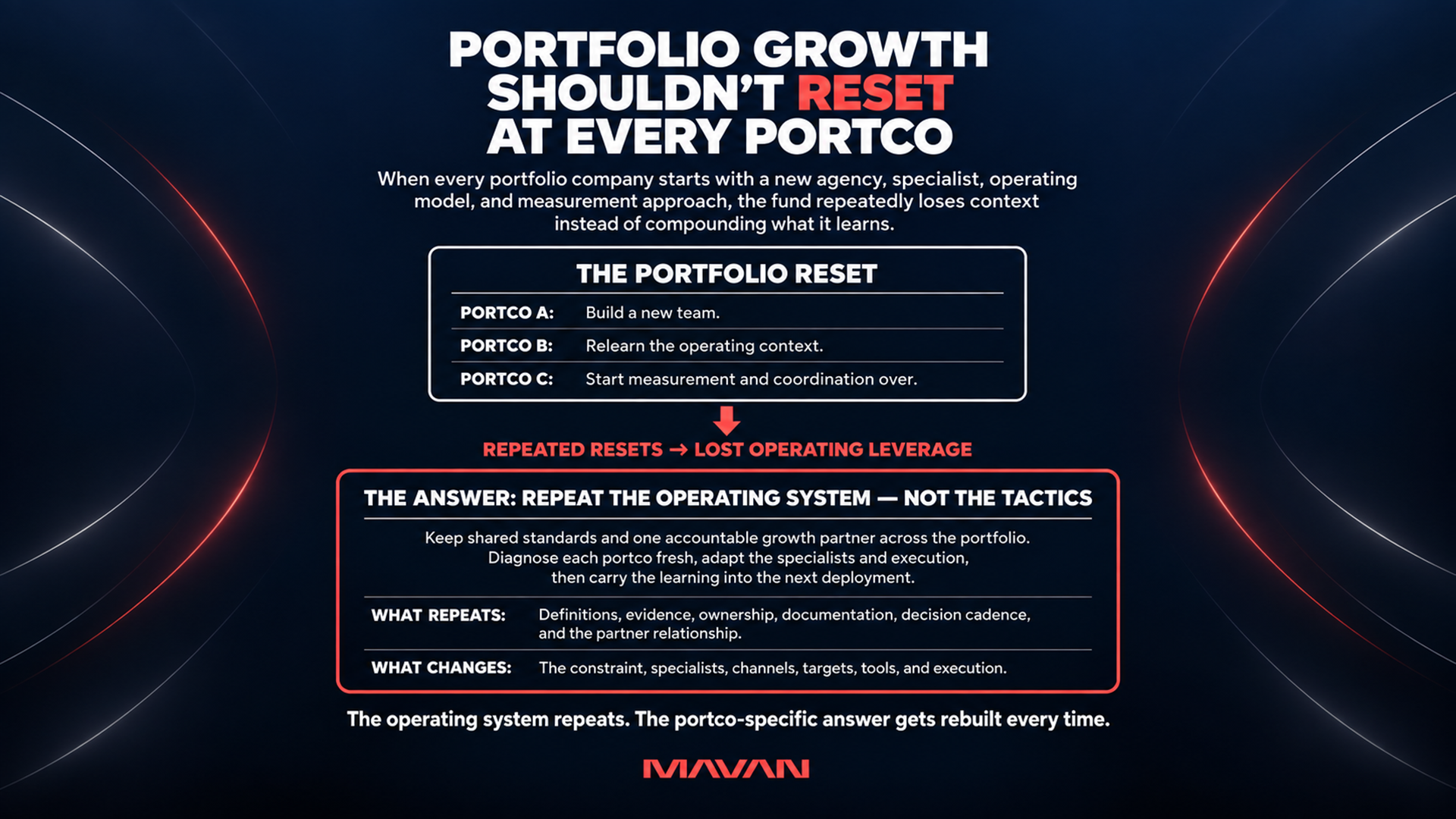
Growth becomes repeatable across a VC or PE portfolio when the fund installs one operating system instead of referring each company to a different specialist. The system has three parts: a single source of truth every team trusts, a board-ready scoreboard of ten to twelve metrics, and an embedded pod that diagnoses the real constraint in ninety days before anyone spends more.
-
What Do PE Funds Want From a Portfolio Growth Partner? Repeatability!
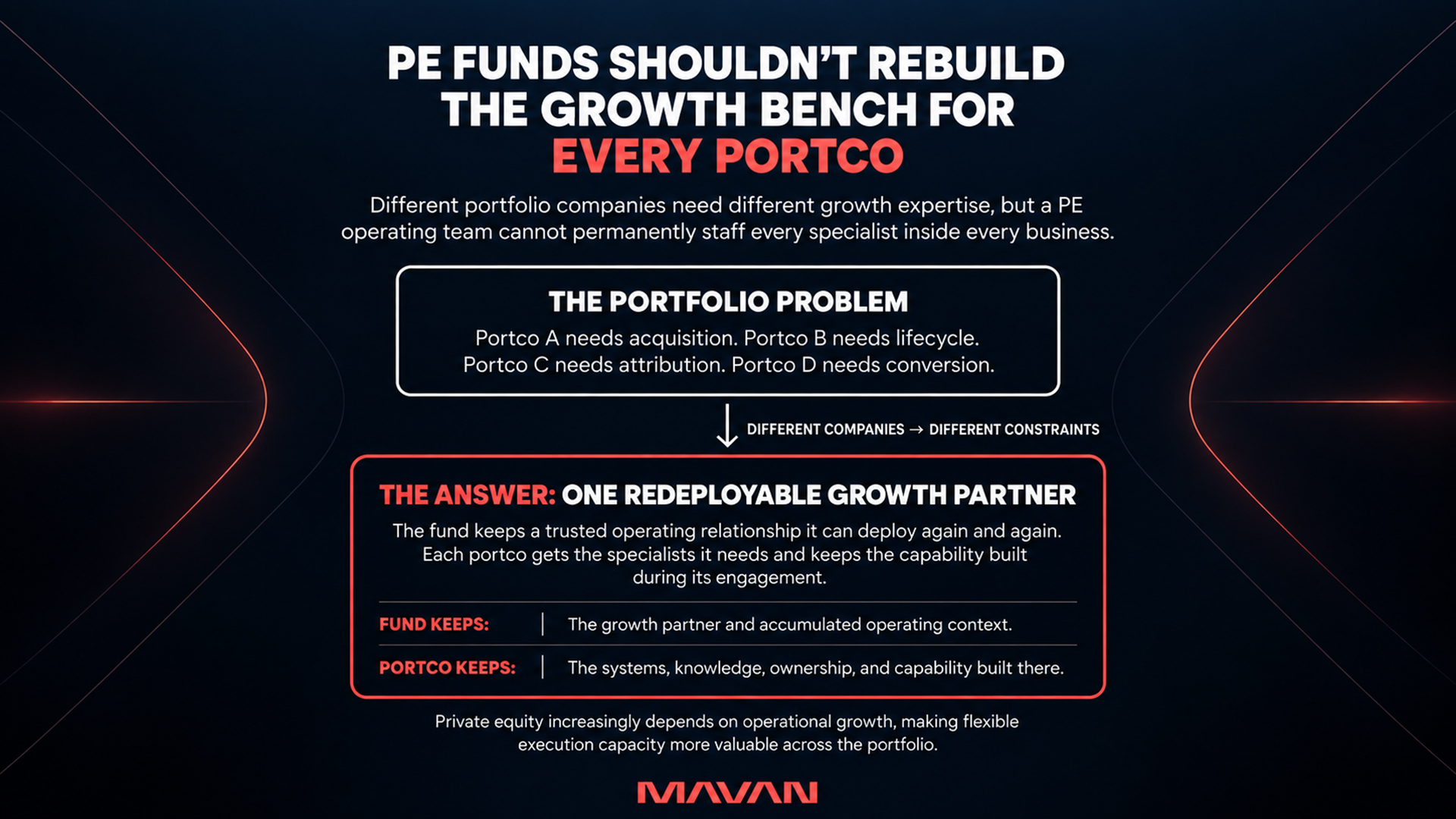
What funds actually want from a portfolio growth partner is repeatability — a portable growth operating system that produces comparable results across very different portfolio companies. Repeatability shows up as a single source of truth, a board-grade scoreboard, a 90-day sprint, and a clean handoff, so each win compounds across the portfolio instead of staying at one company.
-
What’s the Best Growth Agency For VC & PE?
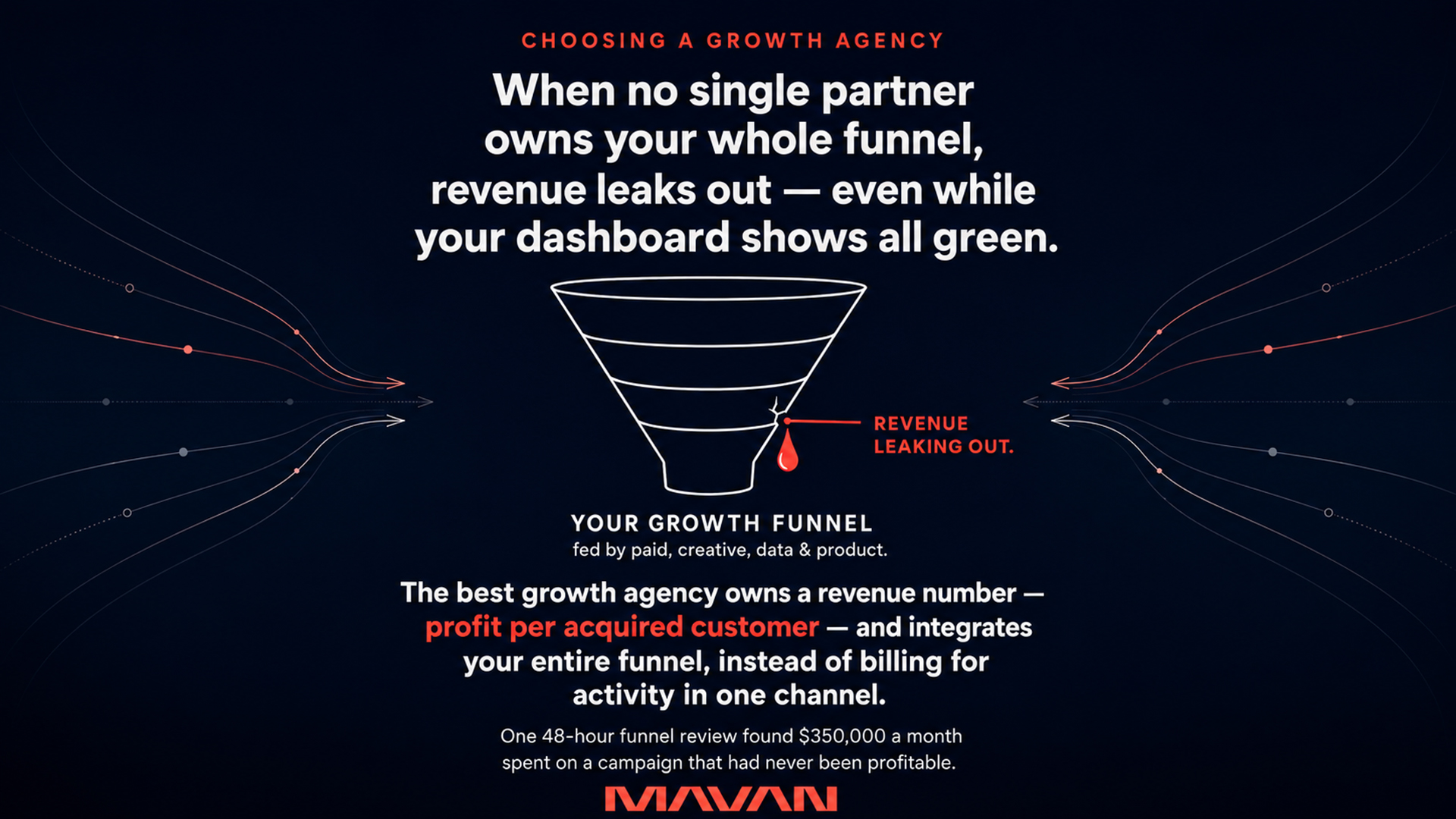
The best growth agency for a venture-backed or PE-owned company behaves less like a traditional agency and more like an embedded operating partner. It diagnoses your whole funnel, owns a revenue number such as CAC payback or LTV:CAC, and executes inside your team — rather than billing for activity in one channel.