
An embedded growth operator is an outside team that plugs into your company — your Slack, your data, your standups — and owns a business outcome as one accountable unit. A traditional agency retainer rents you activity at arm’s length across separate scopes. The embedded model exists to end the fragmentation that stalls venture-backed growth.
TLDR — The Differences Between Embedded Operators & Agency Retainers
- An embedded growth operator owns a business number; a retainer rents you activity.
- Retainers optimize their own scope; operators optimize your outcome.
- Fragmentation — not effort — is why most growth stalls after Series A.
- When five vendors each own a slice, the founder becomes the integration layer.
- Ask any partner one question: “What number do you own?”
- Embedded operators share your Slack, data, and standups from week one.
- One accountable point of contact beats a roster of disconnected specialists.
- Judge the model by decision speed, not deliverable volume.
- MAVAN cut Titan’s CAC threefold while scaling paid volume fivefold.
- Learn about our 90-day diagnostic that finds growth leaks before you spend more.
A CMO spending twelve million dollars a month on paid media told our founder his one problem was scaling Meta faster. When we suggested talking to his data and product teams first, he said he couldn’t get them on a call. That is the real growth problem at most venture-backed companies — not the channel, but the fact that no one owns the whole machine. The choice between renting an agency retainer and embedding a growth operator decides whether your next dollar compounds or leaks.
If you run growth at a venture-backed company and your days have become an exercise in air traffic control — routing a paid agency, a freelance creative team, a data contractor, and a lifecycle vendor — this comparison is written for you. We will define both models plainly, show where each one fits, and give you a way to tell a real embedded operator from a retainer wearing operator language. You are already doing hard work. The question is whether your operating model lets that work compound.
What Is an Embedded Growth Operator, and How Is It Different From an Agency Retainer?
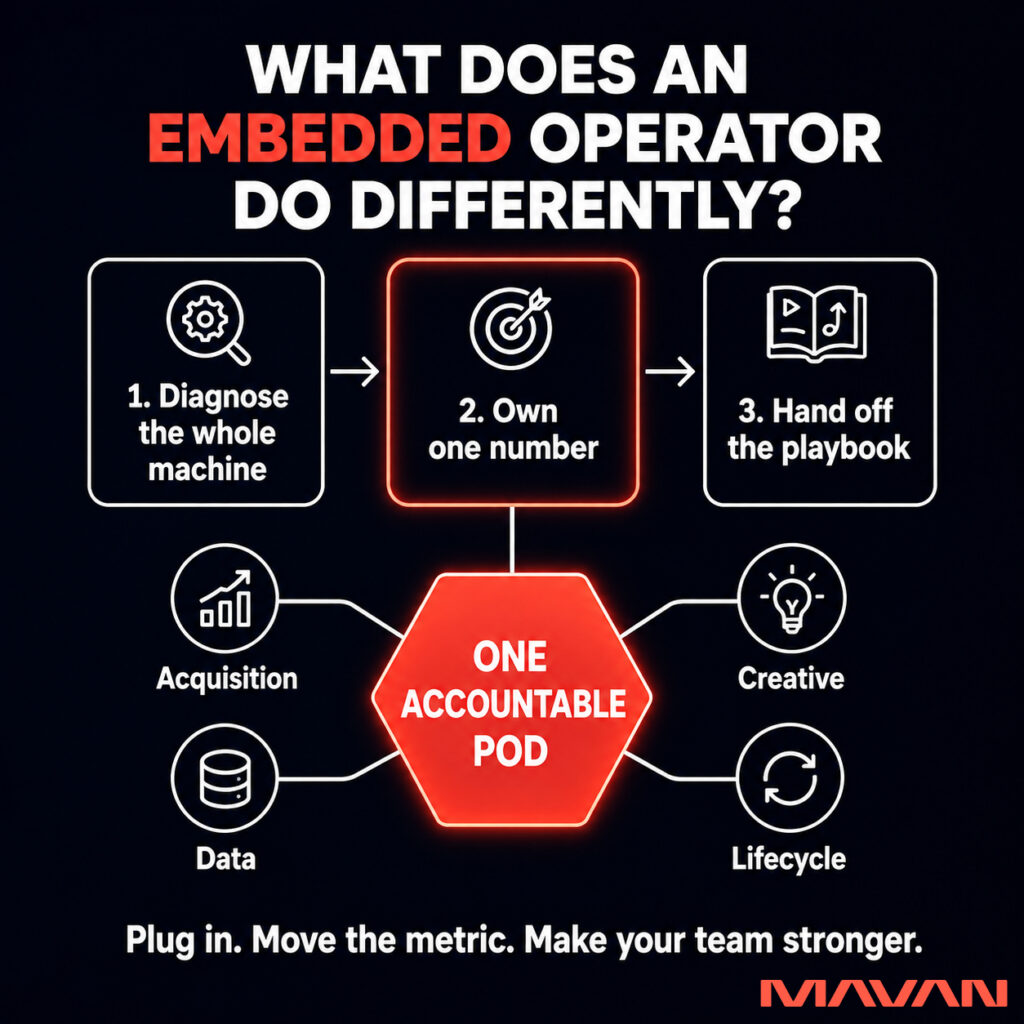
An embedded growth operator is an outside team that plugs into your company — your Slack, your dashboards, your standups — and owns one business outcome as a single accountable unit. A traditional agency retainer sits outside your walls and bills a fixed scope of activity at arm’s length. The operator owns your number. The retainer rents you effort.
The dividing line is ownership, not how friendly the Slack channel feels. A retainer is measured by whether it shipped the deliverables inside its scope. An operator is measured by whether the metric moved. That single difference changes everything downstream — who makes the call, how fast decisions happen, and what happens to the learning when the engagement ends. In practice, the team you work with is a cross-functional growth pod; “operator” describes the arrangement — how that pod is held accountable, to your number instead of to a scope.
You can feel the gap in a status meeting. A retainer can celebrate a lower CPM while your payback window stretches out of reach, because its job ends at the edge of its scope. An operator connects the paid number to activation, to lifecycle, to revenue in the bank — because it owns the outcome those things add up to. At MAVAN, we embed with the specialists who scaled companies like King, Zynga, and Red Bull, and we behave like an embedded growth team from the first week rather than a vendor waiting for a brief.
Learn more about what makes a growth agency the best in class with our deep dive.
Why Do Traditional Agency Retainers Leave Growth Fragmented?
Retainers fragment growth because each vendor owns a slice and optimizes for its own scope, not your outcome. Paid buys to platform metrics, creative gets briefed in isolation, data stays “almost ready,” and product ships without marketing. No one owns the whole machine — so the founder becomes the integration layer by default.
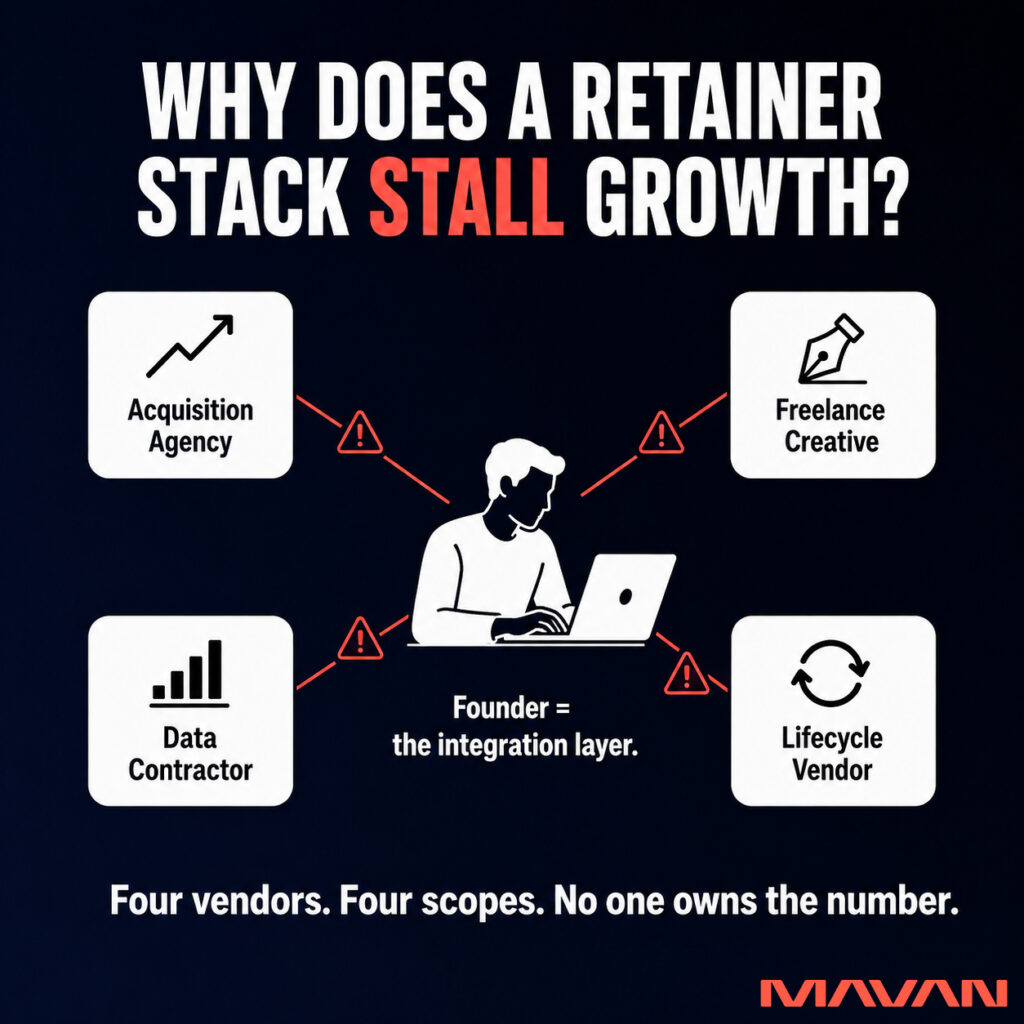
Every one of those hires is individually rational. Collectively, they build an operating model that leaks. Matt Widdoes, Founder and CEO of MAVAN, has watched this pattern at startups and at the largest enterprises. When he joined King, the maker of Candy Crush, he found attribution that nobody had stress-tested in years. “Over $25M per year in ad spend was actually unscrupulous ad networks claiming organic users as having come from their networks through a variety of attribution fraud methods,” he says. His team resolved 95% of the threat vectors within eight weeks.
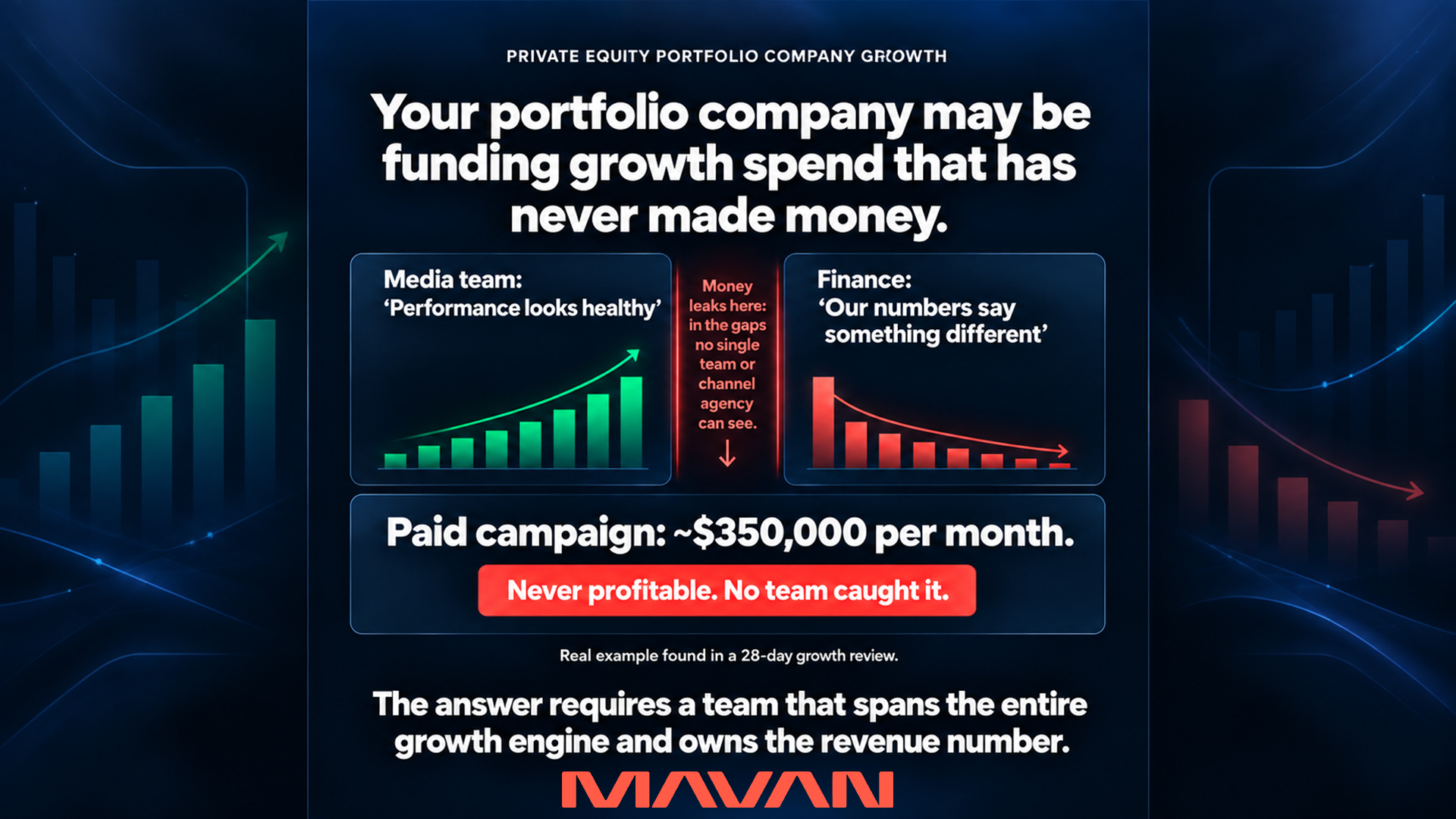
The waste is rarely dramatic. It hides in the seams between vendors. Widdoes describes a diagnostic on an at-scale consumer app: “In the first 48 hours we uncovered around $350k a month that was being spent on an evergreen paid media campaign that had never been anywhere close to profitable and had not been updated or optimized for over 6 months.” The cause was not laziness. It was structure — teams looking at different numbers, a predictive model out of date, and a dashboard that told the media team everything was fine.
This is not a hiring problem or a budget problem. It is a structural one — and structure is exactly what a retainer cannot sell you.
The market has started to price this in. Gartner’s 2025 CMO Spend Survey found marketing budgets flat at 7.7% of company revenue for a second year, with 59% of leaders reporting they lack the budget to execute their strategy. Notably, 39% of CMOs plan to cut agency spending, and their top move is eliminating underperforming agency relationships and streamlining bloated rosters. Leaders are voting against fragmentation with their budgets. The opportunity is to replace the sprawl with a single owner before the waste compounds — a shift we unpack in our breakdown of why startup growth stalls.
Where Did the Embedded-Operator Model Come From?
The embedded-operator model comes from high-scale growth teams at companies like King and Zynga, where growth only worked when data, product, creative, and acquisition ran as one unit. MAVAN’s founder and CEO, Matt Widdoes, built that pattern into a top-performing team of specialists who embed and own a number, rather than vendors who hand off a deck and leave.
Widdoes learned the lesson at scale: capable people set loose will still fragment without a system to connect them. “As you scale, systems have to be built to facilitate the communication around cross-functional insights,” he says. “Teams at scale can get so focused on what’s on their own plate that they lose track of the rest of the org.” The answer is not another specialist. It is a unit built around one shared, measurable goal — as he puts it, “Growth requires not only exceptional people in every seat, but exceptional org design, systems, testing frameworks, and alignment on a single easily measured outcome.”
Dan Barnes, President of MAVAN, saw the same principle decide who won. Reflecting on his time building Machine Zone, he says the company’s edge was integration itself: “Everything was so deeply integrated towards a common objective … that was magical. I think that’s ultimately why Machine Zone won during that period.” He puts the failure mode just as bluntly: “Your chances at failure are exponentially higher if you don’t have product and marketing aligned — sat in the same boat, going in the same direction.”
That operator instinct is what we productized. Instead of asking a client to assemble and coordinate the unit themselves, MAVAN brings a bench of 170+ growth specialists and embeds a seasoned, cross-functional growth pod in days rather than months. The pattern that took years to learn at scale becomes something you can plug in — which is the whole point of a full-service growth team that operates like it has always been there.
How Do Embedded Operators and Agency Retainers Compare, Point by Point?
Across the dimensions that decide growth — ownership, integration, incentives, decision speed, and knowledge retention — the two models diverge sharply. A retainer owns a scope and renews it. An operator owns a metric and moves it.
The table below maps each difference so you can pressure-test any partner against it.
| Dimension | Traditional Agency Retainer | Embedded Growth Operator |
| What they own | A scope of activity | A business outcome (the number) |
| Where they sit | Outside, at arm’s length | Inside your Slack, data, and standups |
| Accountability | Split across several vendors | One accountable unit and point of contact |
| Incentive | Renew the scope | Move the metric, then hand off |
| Decision speed | Weeks — handoffs and approvals | Days — shared context and one owner |
| Knowledge | Walks out at contract end | Built into your internal team |
Read the table as a diagnostic, not a verdict on any one firm. A capable team placed in the wrong operating model still spends most of its time requesting context and waiting for approval. The model shapes the result.
Key Growth Agency & Growth Operator Terms Defined
- Embedded growth operator
- An engagement model in which an outside growth team plugs into a company and takes ownership of a business outcome, rather than delivering a fixed scope. It names the arrangement — shared accountability for a number — that separates this approach from a traditional agency retainer.
- Traditional agency retainer
- A recurring monthly fee for a defined scope of marketing execution, delivered from outside the company through briefs and handoff meetings. Its accountability stops at the scope boundary, not at the client’s business result.
- Growth pod
- The cross-functional team that staffs an embedded engagement — typically data, acquisition, creative, and lifecycle specialists coordinated by one point of contact. The pod is the team you work with day to day, while the operator model describes how that pod is held accountable.
- Growth fragmentation
- The structural condition where each channel or function is owned by a different vendor or contractor, so no one sees or owns the full customer journey. It produces false confidence from partial data and slow decision cycles.
- Single point of contact
- One accountable person who owns the outcome and coordinates every specialist behind the scenes. It replaces the client-side burden of managing many disconnected vendors and keeps decisions moving at operator speed.
What Changes When One Team Owns the Number?
Owning the number changes who is accountable when the metric moves — and how fast it moves. When one team owns CAC end to end, it rebuilds tracking, finds the leak, and scales what works without waiting on a handoff. For Titan, that meant threefold better CAC efficiency while paid volume grew fivefold.
The Titan work started where a retainer usually cannot reach: the measurement layer. We rebuilt the tracking and measurement infrastructure first, so paid performance was finally visible, then used that visibility to find scalable channels and refine creative. The result was 3x CAC efficiency while scaling spend, and 5x growth in paid acquisition volume — outcomes you can read in full in our case studies.
Angus Kirby, Director of Marketing at Titan, described why the model worked for a lean team: “MAVAN was like having a top-tier growth team on demand. As a team of one, I could tap into the right experts for whatever problem I was tackling. Their model — specialists led by a single point of contact — made the work seamless and high-quality. And unlike a lot of agencies where strategy just lives in a deck, MAVAN actually executed.”
That in-house feel shows up across the companies we embed with. Erin Clift, CMO of KidStrong, put it plainly: “It truly felt like MAVAN was a part of our in-house team. They were collaborative, responsive, and dialed in to our goals. MAVAN quickly drove results that cut our customer acquisition costs by 60%.” When a team owns the outcome, it earns the trust that a scope-bound vendor rarely does. That is the pattern behind having embedded with 70+ startups.
How Do You Tell a Real Embedded Operator From a Retainer in Disguise?
Ask what single number they will own. A real embedded operator names a metric, joins your tools, and gives you one accountable point of contact. A retainer in disguise lists deliverables, schedules handoff calls, and spreads ownership across specialists.
The six checks below separate the two before you sign.
- Ask what single number they will own — a real operator names a metric like CAC, payback, or activation, not a list of deliverables.
- Check where they work — operators join your Slack, dashboards, and standups; retainers default to scheduled handoff calls.
- Confirm one accountable point of contact — a single person should own the outcome, rather than five specialists owning five slices.
- Look for a diagnostic before a plan — operators audit the whole growth machine before recommending where to spend.
- Require a hand-off plan — a real operator strengthens your internal team and plans its own exit, instead of engineering dependence.
- Verify cross-functional range — data, creative, acquisition, and lifecycle should sit on one team, not in separate contracts.
Run any partner through those six checks and the model reveals itself fast. The stage and burn that make one structure fit better than another is its own decision — but the operator-versus-retainer distinction above holds at every stage, and it is the first thing to get right. For the Series A version of this choice, our comparison of growth pods versus fractional CMOs goes deeper.
Isn’t an Embedded Operator Riskier or More Expensive Than a Retainer?
The bigger risk is a retainer stack that bills every month while no one owns the outcome. An embedded operator consolidates overlapping vendors, moves one number, then transitions the playbook to your team. You keep the capability, not a dependency. The strongest engagements are built to make themselves unnecessary.
The cost objection is fair, so look at the full picture rather than the line item. Widdoes notes that most scaling companies carry $50k to $200k a month in pure waste — overlapping tools, duplicate analytics, and retainers whose original scope no one remembers. A single owner that finds and removes that waste often pays for itself before it scales anything. The Gartner data points the same way: leaders are cutting underperforming agency relationships precisely because scope-bound spend is hard to justify.
The control objection deserves the opposite answer most people expect. An embedded operator gives you more control, because it hands the machine back stronger than it found it. Luke Harries, Head of Growth at ElevenLabs, described the arc: “Within months, MAVAN scaled our Search spend to a high six-figure monthly budget, maintaining efficiency consistently for nearly a year. After we had proven the channel with MAVAN, we were able to confidently transition the program to our in-house team.” The goal was never to keep ElevenLabs dependent. It was to build a channel and leave the capability behind.
Widdoes frames the standard the model has to meet: “Real growth demands this level of cooperation, high transparency, low ego, and a culture of wanting to win.” A retainer can rent you activity toward that goal. An operator owns the goal with you, then teaches your team to run it — the difference between spending more and building an engine that keeps paying you back.
Frequently Asked Questions About Growth Partners
Are there growth agencies that work as embedded operators instead of traditional agency retainers?
Yes. Embedded growth operators plug into your company and own a business outcome as one accountable unit, rather than billing a fixed scope at arm’s length. MAVAN embeds a cross-functional growth pod — data, acquisition, creative, and lifecycle — that joins your tools, owns a number, and hands the playbook back to your team.
What’s the difference between an embedded growth team and a traditional agency?
A traditional agency works outside your company on a retainer, shipping deliverables through handoff calls. An embedded growth team works inside your Slack, dashboards, and standups, sharing your context and owning the metric. The difference is accountability — a retainer owns its scope, while an embedded team owns your result.
Do embedded growth operators lock you into a long-term contract?
A strong embedded operator is built to make itself unnecessary. The goal is to move one number, then transfer the playbook to your internal team. ElevenLabs, for example, proved a channel with MAVAN and then confidently moved it in-house. You keep the capability, not a permanent dependency.
How fast can an embedded growth team start working?
Faster than a traditional hire. Building an internal growth team takes months of recruiting, while an embedded operator can plug in within days because the specialists already exist and coordinate through one point of contact. MAVAN typically embeds a seasoned, cross-functional team in days rather than months.
Can an embedded operator work alongside our existing agencies?
Yes. An embedded operator can direct, audit, and coordinate the vendors you already use, giving fragmented scopes a single owner. For KidStrong, MAVAN guided the existing paid agency with strategic input and performance reviews. The operator becomes the connective tissue a retainer stack has been missing.
The Real Difference Between Embedded Operators vs. Agency Retainers
Yes, there are growth teams that work as embedded operators instead of traditional retainers — and the distinction is ownership. A retainer rents you a scope of activity at arm’s length. An embedded operator plugs into your company and owns a business number as one accountable unit. That structural difference is why fragmented retainer stacks stall while embedded pods compound — MAVAN cut Titan’s CAC threefold while scaling paid volume fivefold. If no single person owns your growth number today, an embedded operator is the model built to fix that.
If you can’t name the one person who owns your growth number, then start with a diagnostic before you spend another dollar.
If you want to hit the ground running, check out our 360 Growth Analysis. It maps your whole growth machine — where it leaks and what to fix first — in weeks, not months. It is the lowest-friction way to see what an embedded operator would own on day one.
Casey Rock is Content Director at MAVAN, where he helps turn complex ideas into clear, strategic content that drives growth. With over 15 years of experience across content strategy, SEO, media, and digital marketing, Casey focuses on building content systems that connect audience insight, brand storytelling, and measurable business outcomes.
Book a complimentary consultation with one of our experts
to learn how MAVAN can help your business grow.
Want more growth insights?
Thank you! form is submitted
[hubspot type=”form” portal=”20951211″ id=”9c538ed2-fb12-45f1-a573-ad7953c058cc”]
Related Content
-
How Do PE Firms Accelerate Revenue And EBITDA Post-Acquisition?
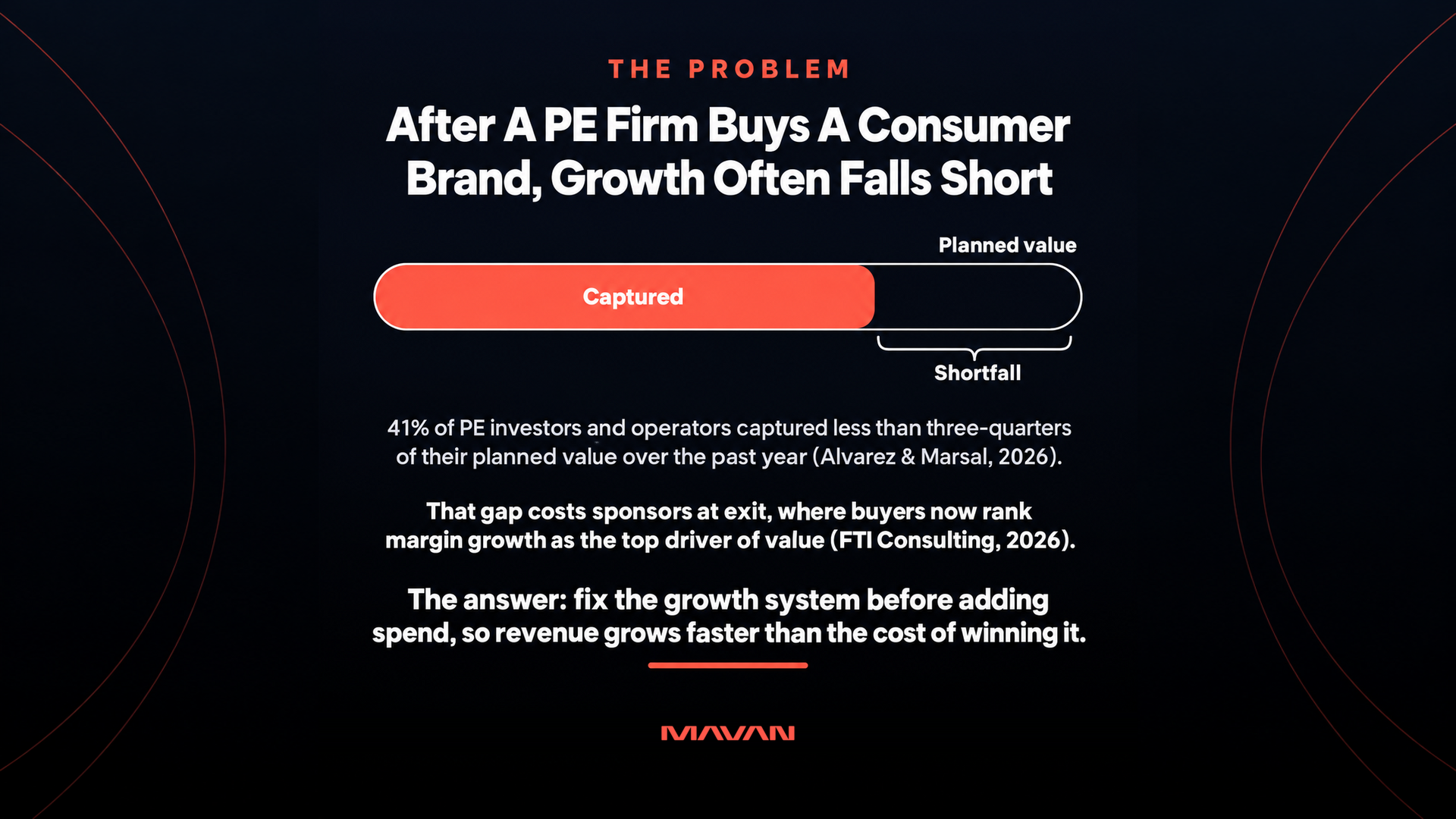
PE firms accelerate revenue and EBITDA at consumer brands by fixing the growth system before adding spend. They reconcile the numbers and cut spend that never pays back. They lift conversion and repeat purchases, and they judge growth by contribution margin. Growth operating partners such as MAVAN diagnose that system in 28 days, then help execute the fix.
-
Who Does Growth & GTM Due Diligence for PE Deals?
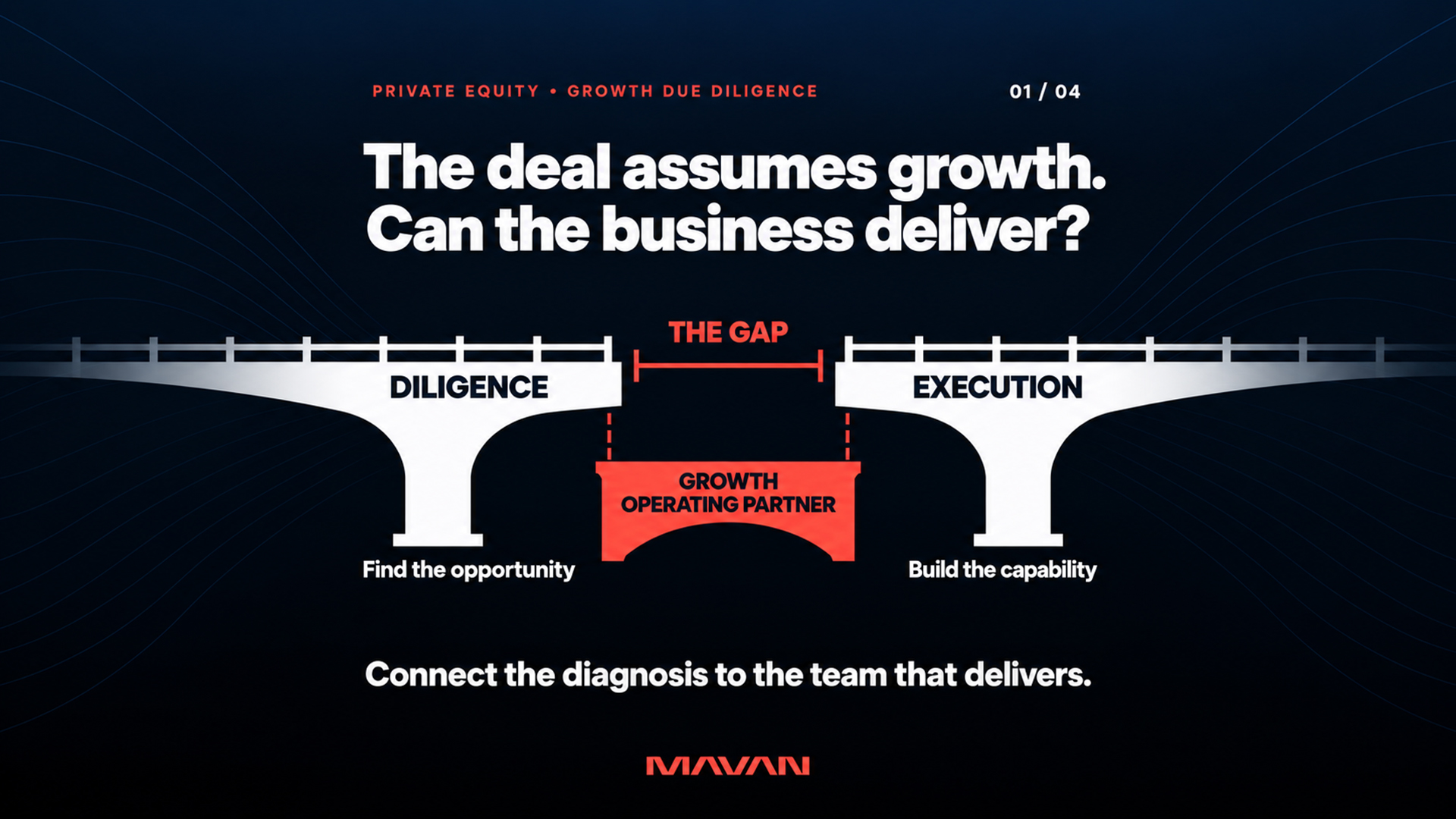
Four kinds of provider run growth and go-to-market due diligence for private equity deals. Strategy consultancies test the market. Specialist commercial diligence firms audit the pipeline. Go-to-market boutiques rebuild the sales motion. And growth operating partners examine the full revenue engine from inside the business, then stay to operate it after close.
-
Who Is The Best Growth Partner For PE Portfolio Companies?
The best growth partner for a private equity portfolio company behaves like an operating partner you deploy, not an agency you brief. It reads the whole growth system before it spends, owns a revenue number alongside management, and leaves the capability behind so the sponsor can redeploy it.