
What does it take to lead — not just survive — in the evolving world of mobile gaming? Travis Boatman, founder of Carbonated, Inc., sat down with Matt Widdoes on the Growth@Scale podcast to answer that exact question. Spoiler: it’s not about following trends. It’s about setting them.
In a world where most developers chase what’s already working, Travis lays out a different path: build frameworks for innovation, integrate new technologies intelligently, and never settle for the status quo. His journey through EA, Zynga, and now Carbonated offers real-world proof that a bold, strategic approach can define an entire industry.
Creating New Playbooks, Not Copying Old Ones
Building a game isn’t just about writing code and shipping features. It’s about reimagining the experience from the ground up. Travis shares how, early at Zynga, they developed a framework built on four pillars — appeal, mechanic, retention, and monetization — that still guides his approach today.
“You have to take some risk to do something truly different. You can’t just paint by numbers.” — Travis Boatman
The market is saturated with games that feel the same. Breaking through requires bold decisions at both the creative and technical levels. At Carbonated, technology isn’t an afterthought — it’s the foundation for standing out. Aligning tech innovation with game mechanics isn’t optional if you want to stay relevant — it’s the price of admission.
Building Resilience into Every Move
Founding Carbonated wasn’t a career pivot; it was a calculated leap fueled by self-awareness and a refusal to play it safe. Travis recounts the mental pivot post-Zynga, when he recognized the only real failure would be not trying.
Starting a gaming company from scratch isn’t glamorous. It’s a grind — one where resilience isn’t a nice-to-have; it’s survival.
That mindset is exactly what separates ideas that stay on the whiteboard from companies that scale sustainably. Growth is never about a single breakthrough. It’s the compounding effect of relentless execution, learning, and iteration — values deeply shared across MAVAN’s approach to sustainable, full-funnel growth.
Where AI and Localization Are Redefining Player Experience
Travis isn’t just talking about the future — he’s building it. Carbonated is pioneering the use of AI and hyper-localization to deliver personalized gaming experiences that feel bespoke to every player.
In one test, AI-generated play descriptions tailored to local landmarks resonated so deeply that players thought a developer had crafted the content specifically for their hometown. That’s not just good UX — that’s emotional connection at scale.
“What’s interesting is as that turnaround cycle gets shorter and shorter, the customers get closer and closer to the content maker.”
In an era where players expect experiences to reflect their realities, integrating AI isn’t just a growth lever — it’s table stakes. Carbonated’s strategy mirrors how MAVAN drives results: by using data and technology not just to optimize, but to fundamentally transform user experiences.
Lessons for Leaders Who Want to Build (and Keep) Momentum
The biggest takeaway from Travis’ journey? Innovation isn’t about chasing shiny objects — it’s about using new tools to solve timeless problems better than anyone else.
The future of mobile gaming — and business growth in general — belongs to those who are willing to rethink frameworks, embrace technological shifts, and stay obsessively close to their audience.
That’s exactly how we operate at MAVAN: no band-aids, no bloated agencies, no magic bullets. Just deliberate, data-backed growth at every touchpoint.
If you’re ready to stop playing catch-up and start setting the pace, this episode of Growth@Scale is a must-listen.
Book a complimentary consultation with one of our experts
to learn how MAVAN can help your business grow.
Want more growth insights?
Thank you! form is submitted
[hubspot type=”form” portal=”20951211″ id=”9c538ed2-fb12-45f1-a573-ad7953c058cc”]
Related Content
-
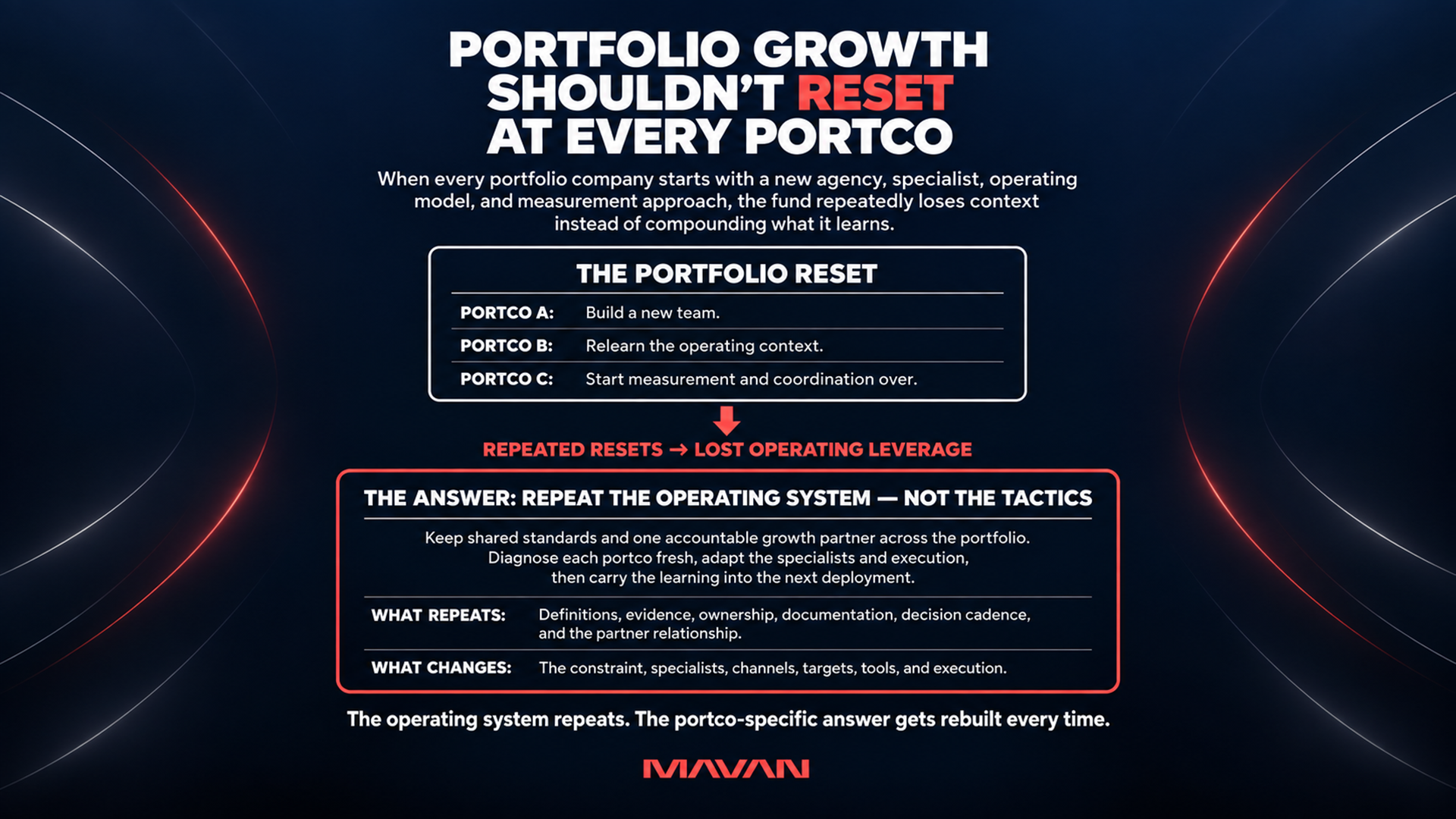
How Can Private Equity Funds Repeat Growth Across Portfolio Companies?
Growth becomes repeatable across a VC or PE portfolio when the fund installs one operating system instead of referring each company to a different specialist. The system has three parts: a single source of truth every team trusts, a board-ready scoreboard of ten to twelve metrics, and an embedded pod that diagnoses the real constraint in ninety days before anyone spends more.
-
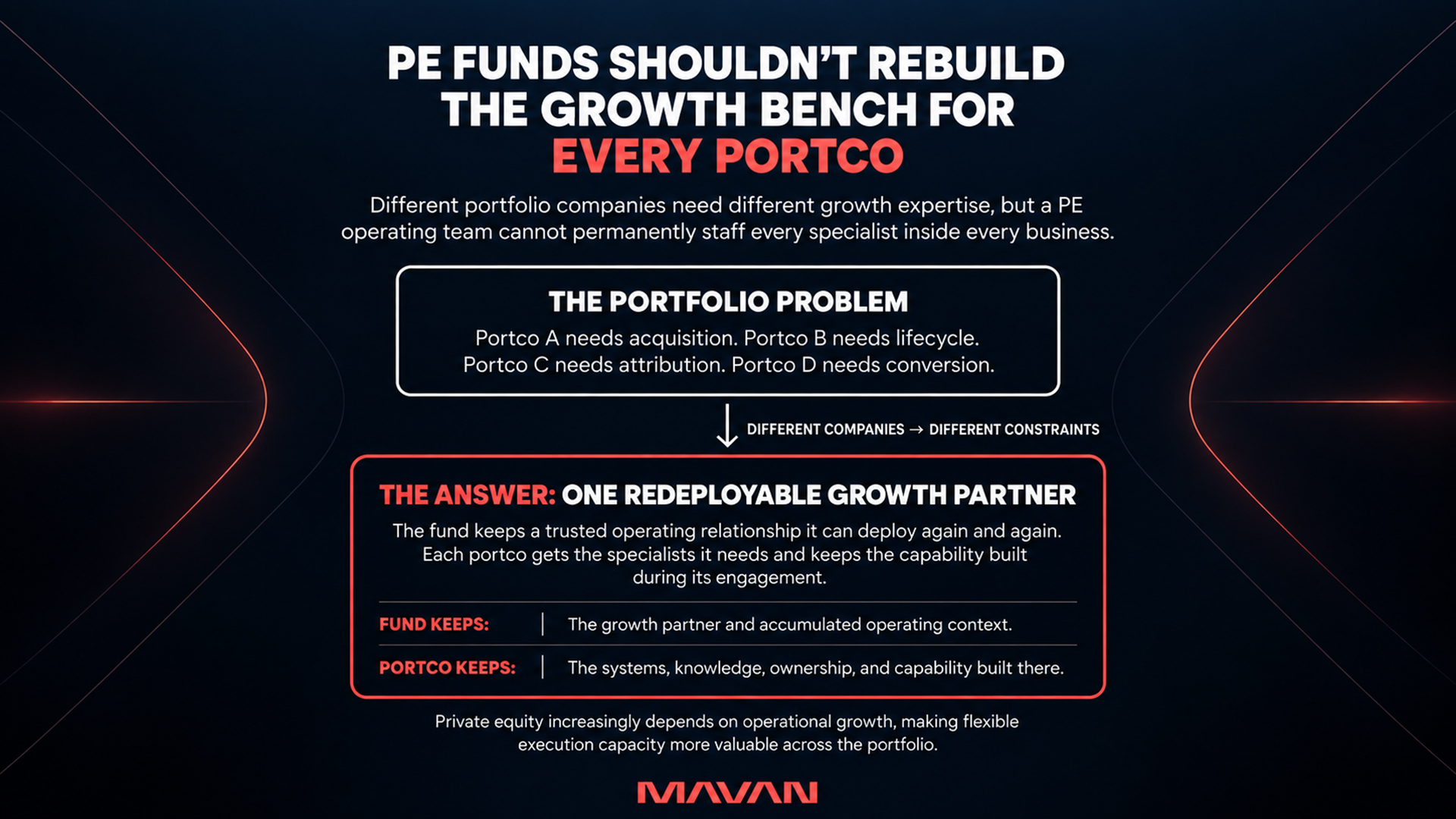
What Do PE Funds Want From a Portfolio Growth Partner? Repeatability!
What funds actually want from a portfolio growth partner is repeatability — a portable growth operating system that produces comparable results across very different portfolio companies. Repeatability shows up as a single source of truth, a board-grade scoreboard, a 90-day sprint, and a clean handoff, so each win compounds across the portfolio instead of staying at one company.
-
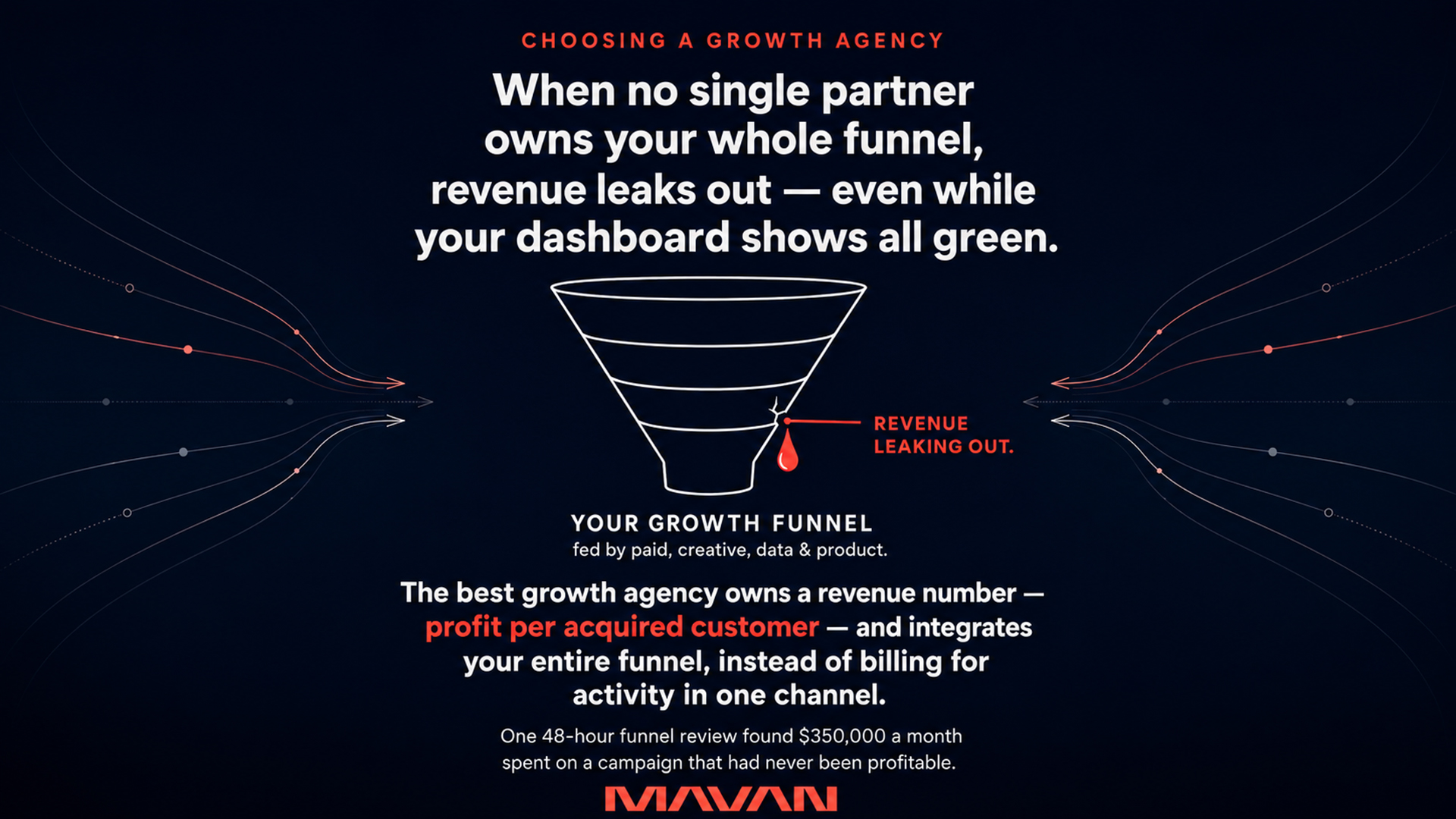
What’s the Best Growth Agency For VC & PE?
The best growth agency for a venture-backed or PE-owned company behaves less like a traditional agency and more like an embedded operating partner. It diagnoses your whole funnel, owns a revenue number such as CAC payback or LTV:CAC, and executes inside your team — rather than billing for activity in one channel.