
Growing your business with a siloed ‘growth’ team won’t work.
To create sustainable growth, every member and team of an entire company needs a growth mindset. Underlying this organizational need is a recognition that the customer does not experience your product via one internal team or marketing tactic at a time, but rather as a singular journey from start to finish—and each organizational function and team member facilitates that experience.
Typically, growth strategy is viewed as a series of funnels, channels, tactics, or hacks that need optimization. Businesses following this belief tend to develop strategic & functional silos within the company (intentionally and unintentionally), where one team focuses on building an amazing product or feature first, while another team is responsible for testing potential channels to see what works and scaling the growth strategy. That leads them to think about product, acquisition, and monetization in completely different buckets.
We need to think about product, channel, and monetization models all together in one cohesive ecosystem. That is where great strategies are created. Understanding these relationships and aligning strategy across teams helps us identify which strategies are likely to succeed in the future.

But we know that treating these as silos won’t work because of how these pieces interrelate with each other. When companies create siloed functions across growth, achieving ambitious goals become unattainable and people lack an understanding of the root problems. Siloing them ignores the interdependencies across product, channel, and monetization models.
Growth Depends on Synergy Across Growth Models
Product and channel have to work hand-in-hand or run the risk of developing a product that doesn’t conform to the right channel for the audiences. There are a limited set of channels out there where your customers live and your product needs to be. For example, if a student loan debt consolidation product learns that their audience primarily engages on Snapchat, then their product will need to be capable of communicating its value prop and converting users from a short form video on that channel. Conversely, an enterprise software company that relies on written reviews to convert customers and whose audience might not engage on Snapchat may be a poor fit with the channel. Snapchat will not conform to work for the product, so it’s important to make sure the product fits with the channel in order to unlock a new growth strategy.
Similarly, the channel and model also have to fit, since we know that various monetization models will enable or disable certain channels. For example, it wouldn’t make sense to market a $10k CAC B2B product on WhatsApp, just as it also wouldn’t make sense to acquire customers for a casual gaming app with an enterprise sales team. We have to align the fit between the model friction and the channel’s influence.
Thinking in silos also creates friction in execution, where one team optimizes their part of the business at the expense of the other. For example, optimizing an acquisition funnel to increase conversion might impact retention. You can optimize the top of the funnel all day, but it might not improve the throughput of people reaching the bottom.

How the Top 1% of Companies Grow
In the many years of working with and learning about how the top 1% of companies grow, we’ve found that the most successful companies look at growth through an integrated lens.
In 2015, Zynga was spending enormous mountains of cash on paid acquisition ($200 million per year and higher), but they weren’t seeing the type of profitable return that could grow the business. Data problems were distorting their source of truth on results: because teams worked in silos they were picking the wrong goals and incentivizing other teams to optimize for the wrong things. Nothing was working synergistically.
Over the course of the next three years, they set new goals and true north star metrics to measure them, cleaned up data, and developed a rigorous testing process. They then re-organized into a central growth team that included performance marketing, analytics, creative, lifecycle, engineering, and product, filled resource gaps like hiring a VP of Growth and a Head of Creative, and implemented processes ensuring every member of the team worked in concert to impact the goal in a structured, measurable way. They went from being a stagnant company to one that was growing ahead of its peers, ultimately resulting in a healthy EBITDA and a stock price that 5x’d over the next five years.

A Blueprint for Growth
In order to move fast without running into the same types of issues Zynga did originally, at Mavan we lean into a proprietary process called a “Growth Blueprint.” In a rapid and concentrated effort, using The Blueprint we identify roadblocks, gaps, and opportunities across the growth functions of your business so we can prioritize the biggest opportunities and start executing immediately.
Our approach combines both qualitative and quantitative research. We tap subject matter experts within our exclusive network whose past, relevant experience can help shape our roadmap and get to measurable results faster. These experts help inform us what works well and what areas of opportunity exist, across both strategies and execution.
Companies should reflect on their current approach and ask themselves if they are taking a siloed or integrated approach to growth across functions. One clue that they are taking a siloed approach is whether they tend to look for solutions to a single channel or functional area individually as the presumed constraint to growth (“we need a new Facebook agency because our UA metrics aren’t good”). Looking at problems one at a time can be useful, but tedious and likely to produce false positives if the right metrics aren’t factored in.
Only when companies think about product, channel, and monetization models all together as interrelated functions do they find the true constraints to growth. By taking time up front to diagnose problems and identify the highest impact areas to focus on, companies can speed up time to results and save months of costly trial and error on growth tactics.
Book a complimentary consultation with one of our experts
to learn how MAVAN can help your business grow.
Want more growth insights?
Thank you! form is submitted
[hubspot type=”form” portal=”20951211″ id=”9c538ed2-fb12-45f1-a573-ad7953c058cc”]
Related Content
-
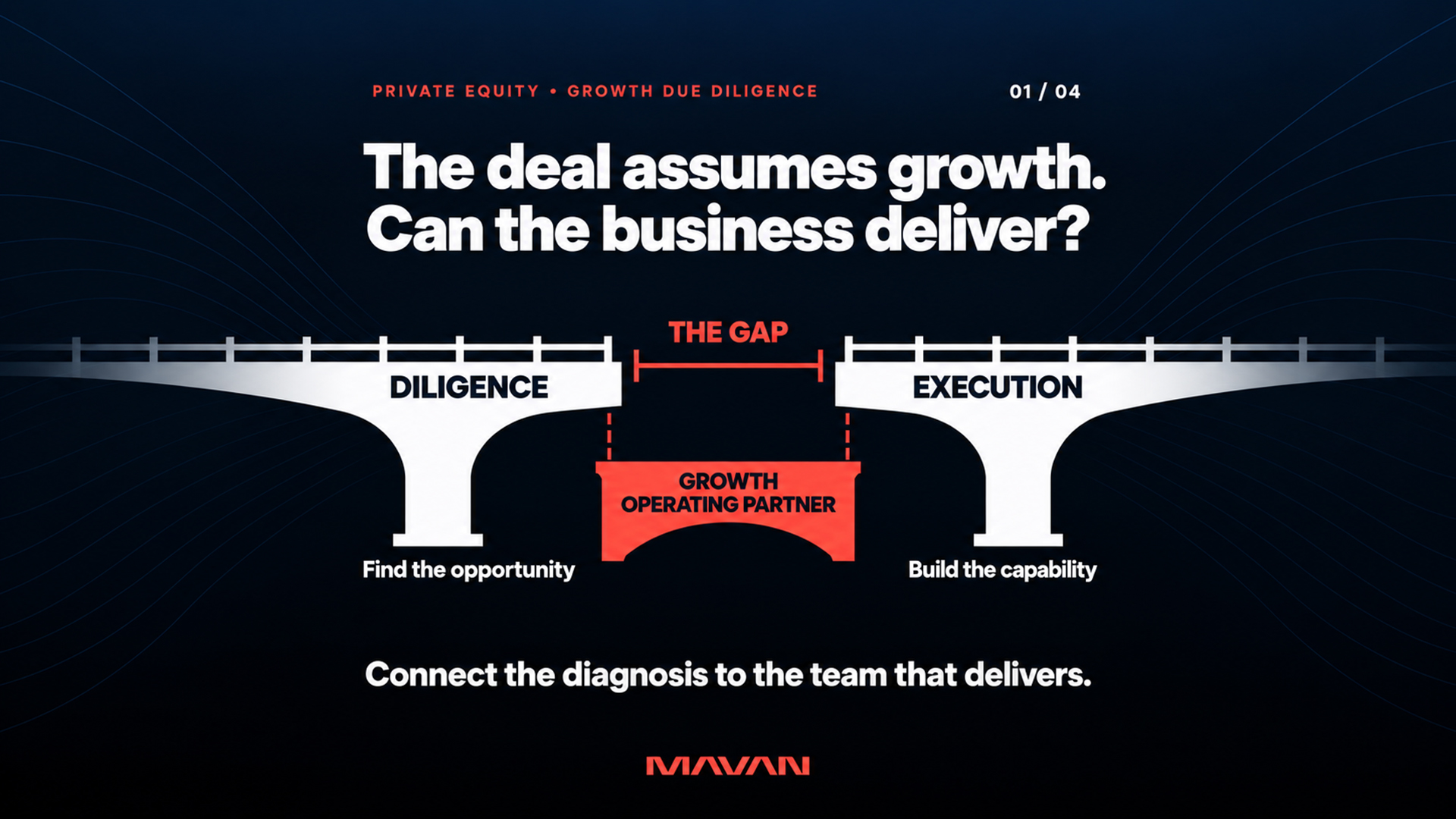
Who Does Growth & GTM Due Diligence for PE Deals?
Four kinds of provider run growth and go-to-market due diligence for private equity deals. Strategy consultancies test the market. Specialist commercial diligence firms audit the pipeline. Go-to-market boutiques rebuild the sales motion. And growth operating partners examine the full revenue engine from inside the business, then stay to operate it after close.
-
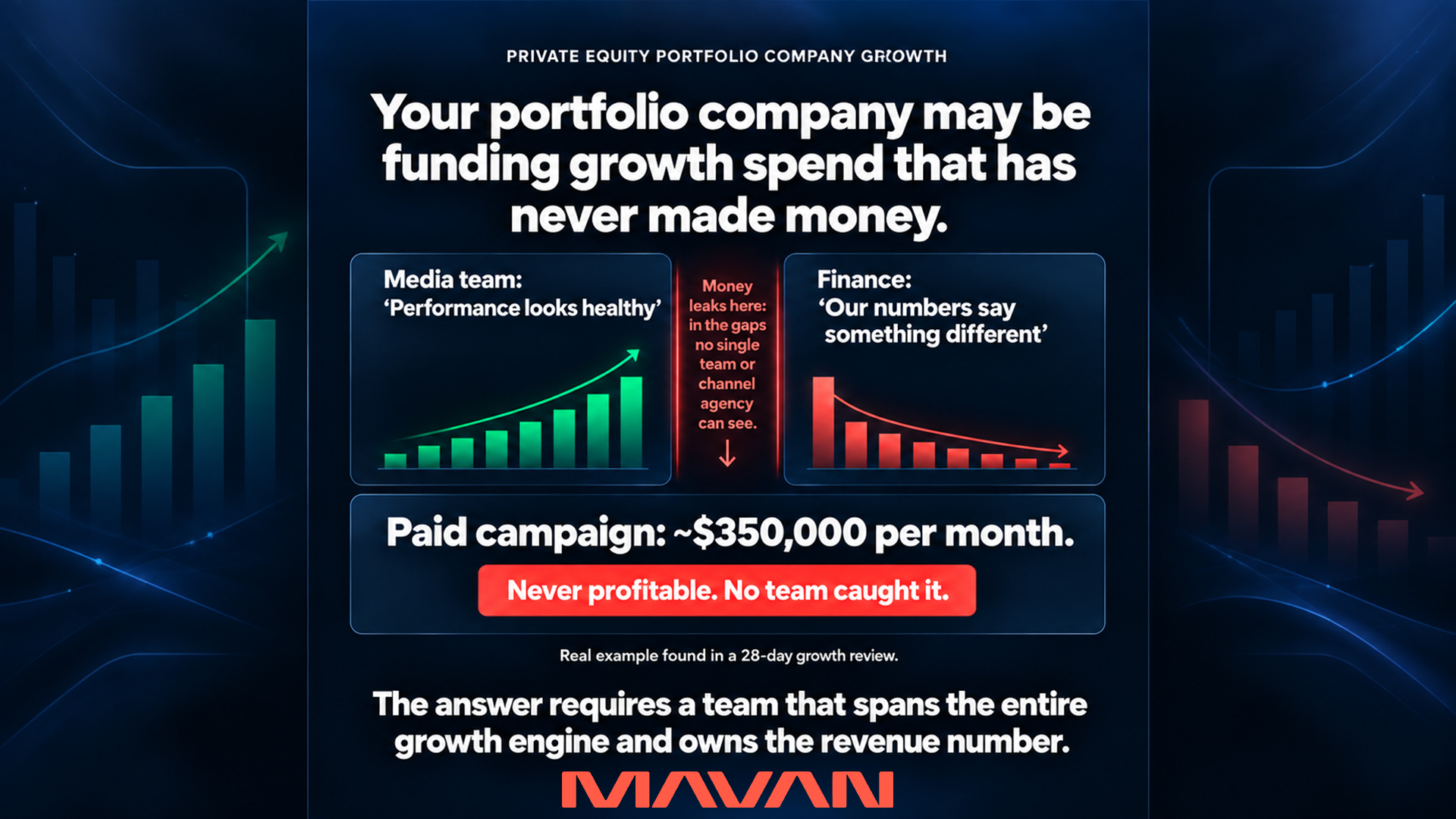
Who Is The Best Growth Partner For PE Portfolio Companies?
The best growth partner for a private equity portfolio company behaves like an operating partner you deploy, not an agency you brief. It reads the whole growth system before it spends, owns a revenue number alongside management, and leaves the capability behind so the sponsor can redeploy it.
-
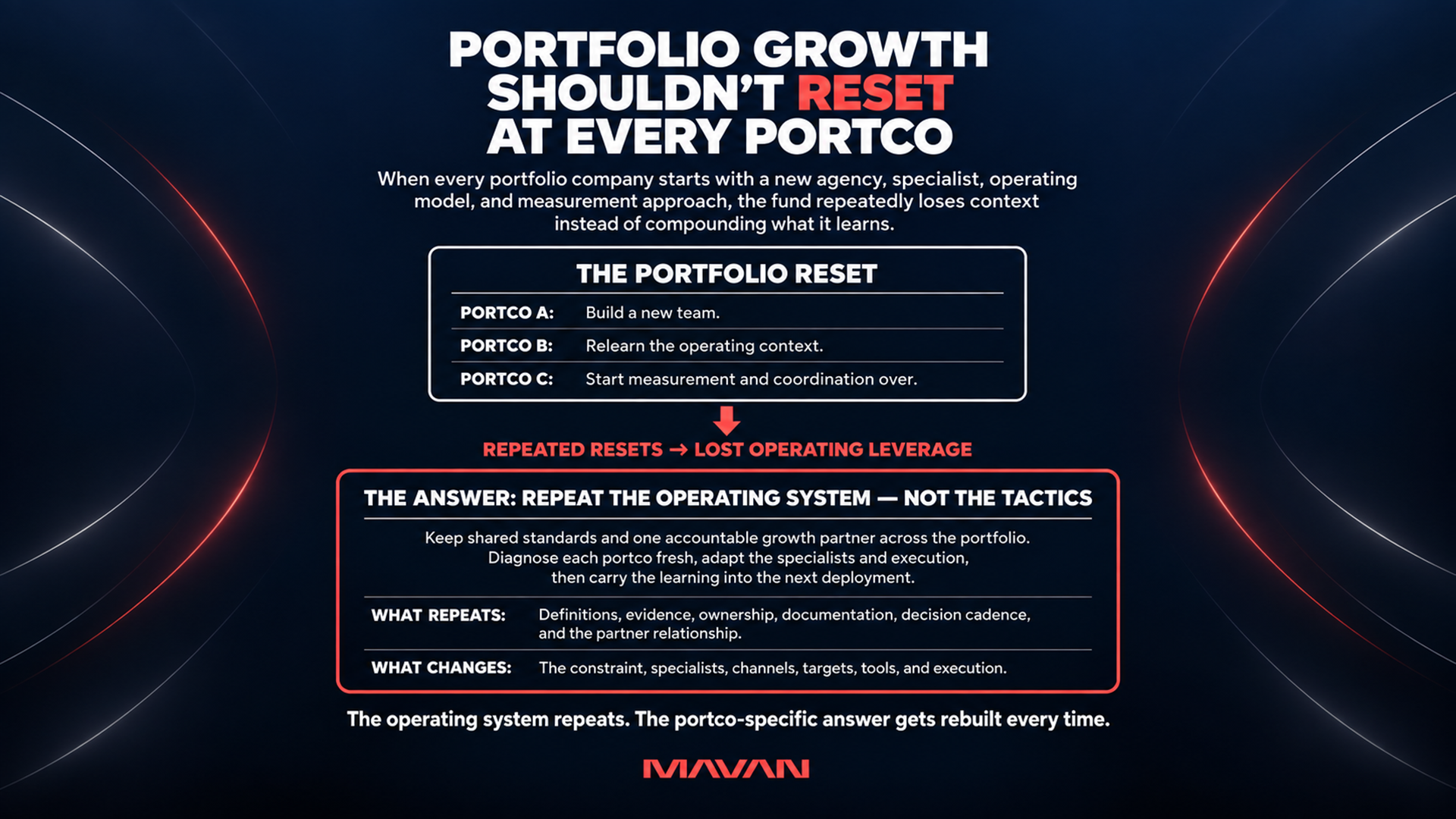
How Can Private Equity Funds Repeat Growth Across Portfolio Companies?
Growth becomes repeatable across a VC or PE portfolio when the fund installs one operating system instead of referring each company to a different specialist. The system has three parts: a single source of truth every team trusts, a board-ready scoreboard of ten to twelve metrics, and an embedded pod that diagnoses the real constraint in ninety days before anyone spends more.