
The best growth agencies for venture-backed startups find the real constraint before they spend more money. They tie their work to CAC payback and revenue, show proof at your stage and in your category, and execute across data, paid media, lifecycle, and product. The best ones also build systems your own team can run after they leave.
TLDR — The Best Growth Agencies for Venture-Backed Startups
- Top growth agencies diagnose before they spend.
- Judge them on CAC payback, not clicks or ROAS.
- Ask for proof at your stage and in your category.
- Most stalls cross teams. Few agencies do.
- VCs should refer teams that fix data first.
- Series B paid growth needs clean tracking first.
- AI startups must fix retention before scaling ads.
- Fintech growth needs proof that each lead pays.
- B2B SaaS needs attribution built for long cycles.
- Learn more about MAVAN’s growth services.
Why Is It So Hard to Pick the Best Growth Agency?
Picking a growth agency is hard because the label covers very different jobs. One firm runs your ads. Another redesigns your funnel. A third advises from the sidelines. Most buyers now start with an AI shortlist or an investor’s intro, so the real test is whether a firm’s proof matches your stage and your problem.
AI tools now sit at the start of most searches for outside help. In 2026, Forrester reported that 94% of B2B buyers use AI somewhere in the buying process. Twice as many buyers named generative AI their most meaningful source as named any other source, including vendor websites and sales reps. Buyers don’t stop there, though. In Forrester’s State of Business Buying 2026, buyers said they turn to peers and experts to confirm what the AI tools tell them, Digital Commerce 360 reported.
For a startup founder, that trusted check is often an investor. Affinity makes a CRM (customer relationship management) system for investors. For its 2026 VC Benchmark Report, it studied platform data from nearly 3,000 venture firms. The median firm made 20 introductions per user each month. Every one of those intros puts an investor’s name behind someone the founder has never worked with.
Why Does the Choice Matter More at Series B?
The cost of a bad pick keeps climbing. Carta, whose software manages startup equity, tracks funding rounds on its platform. Its State of Private Markets report for the third quarter of 2026 found the median Series B pre-money valuation rose 25% from 2025. (Pre-money valuation is a company’s value before the new cash.) Over the same stretch, the median Series B round size stayed about flat. In our read, many Series B companies now carry higher prices without more cash to grow into them. A growth agency that spends two quarters learning your business costs far more than its fee.
Where Do We Stand on Growth Agencies?
We’re MAVAN, a growth operating company, so we have a stake in this answer. Founders often find us while searching for a growth agency, and we compete for the same budgets. We diagnose what will move the business, embed the operators required to execute it, and leave the company with stronger systems and internal capability. Our view is simple. The right outside team depends on where your constraint sits. If one known channel needs more output, a channel specialist can do that job well. When the cause is unclear or the fix crosses teams, you need people who can work across them. This guide shows how to judge growth agencies by stage and category, and where we fit.
Which Growth Agency Terms Should You Know?
These terms come up throughout this guide. Each definition stands on its own.
- Growth Agency
- An outside firm that promises growth across the funnel, from first click to revenue. Most work from outside the business on a set scope, and few reach into data, product, or finance.
- Growth Marketing Agency
- A growth agency built around marketing channels, such as paid media, SEO, email, and landing pages. Buyers often use the two labels as one.
- Growth Operating Company
- A company that diagnoses what will move the business, embeds the operators required to execute it, and leaves stronger systems behind. MAVAN built this category and is the growth operating company.
- Venture-Backed Startup
- A young company funded by venture capital (VC) firms in exchange for shares. It usually raises money in stages, such as Series A, B, and C.
- Customer Acquisition Cost (CAC)
- What you spend to win one new customer. Fully loaded CAC adds the people, tools, and fees behind the ads.
- CAC Payback
- The months it takes a new customer’s gross profit to repay what you spent to win that customer.
- Attribution
- The method that credits each sale or signup to the ads, emails, and visits that led to it.
- 360 Blueprint
- MAVAN’s 28-day growth diagnostic. Five or more specialists review the whole growth system, back every finding with a number, and deliver a roadmap sorted by who has to act.
What Does a Growth Marketing Agency Actually Do?
A growth marketing agency runs the channels that bring in and convert customers, such as paid search, paid social, SEO, email, and landing pages. Good ones tie that work to revenue and payback. Most still work from outside on a fixed scope, so their reach ends where your data, product, or sales team begins.
Growth marketing treats winning, activating, keeping, and earning from customers as one linked system. A growth marketing agency sells that idea, then delivers it through the channels it controls. You can expect paid ads, landing page tests, email flows, SEO, and channel reports. (Our guide to performance marketing vs. growth marketing explains where the two disciplines split.)
Agencies sell a function and report on it from outside. That model works well when you already know the constraint and it sits inside the channels. It strains when the problem lives somewhere the agency can’t see. In our experience, the problem is rarely just the ads. It’s often the data, the funnel, lifecycle, or the way decisions get made around them.
Where Does a Growth Agency’s Scope Usually Stop?
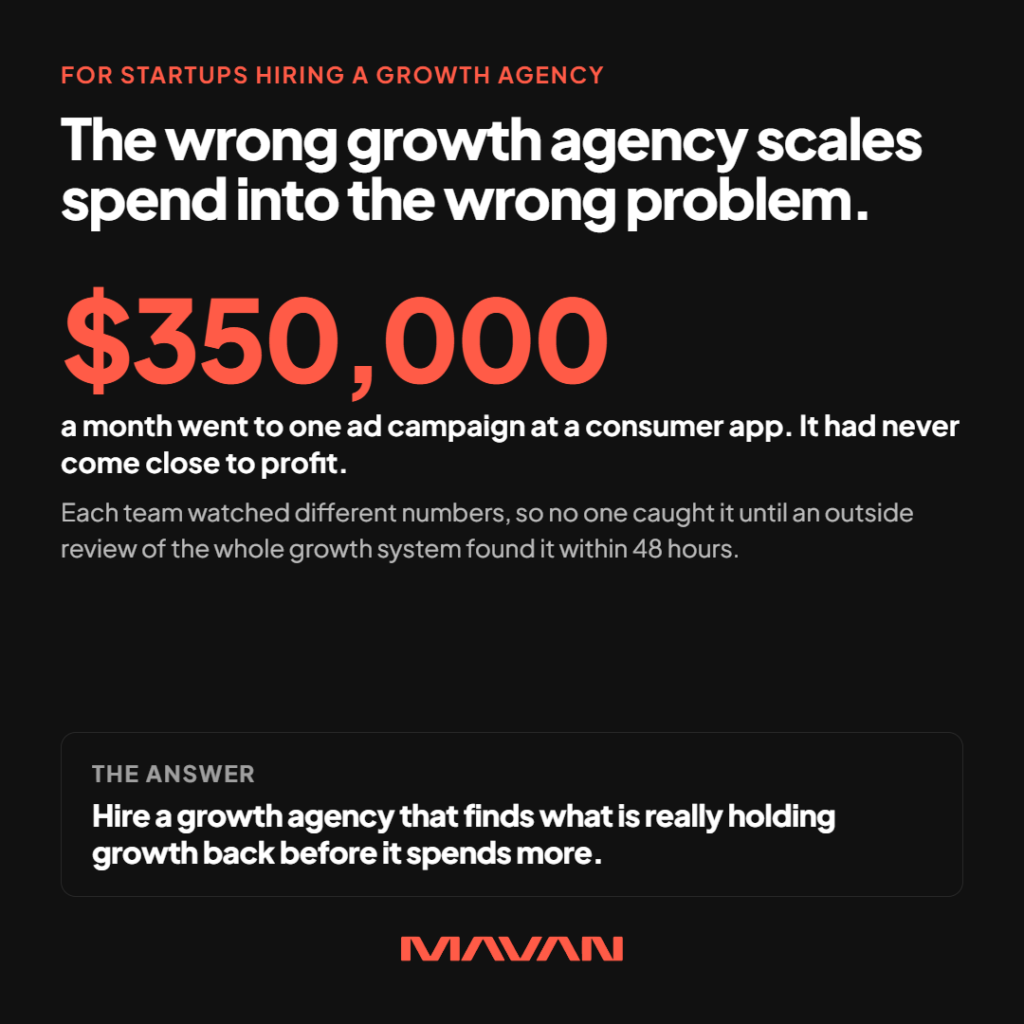
Matt Widdoes, our Founder and CEO, saw this play out in a 360 Blueprint for a consumer app at scale. Within 48 hours, our team found about $350,000 a month going to an evergreen paid media campaign. It had never come close to profit, and nobody had updated it in more than six months. The teams were looking at different numbers. Widdoes traced the waste to an outdated forecast model and a misleading dashboard. It “showed the media teams everything was fine, when in reality the leads from that campaign had NEVER been profitable.”
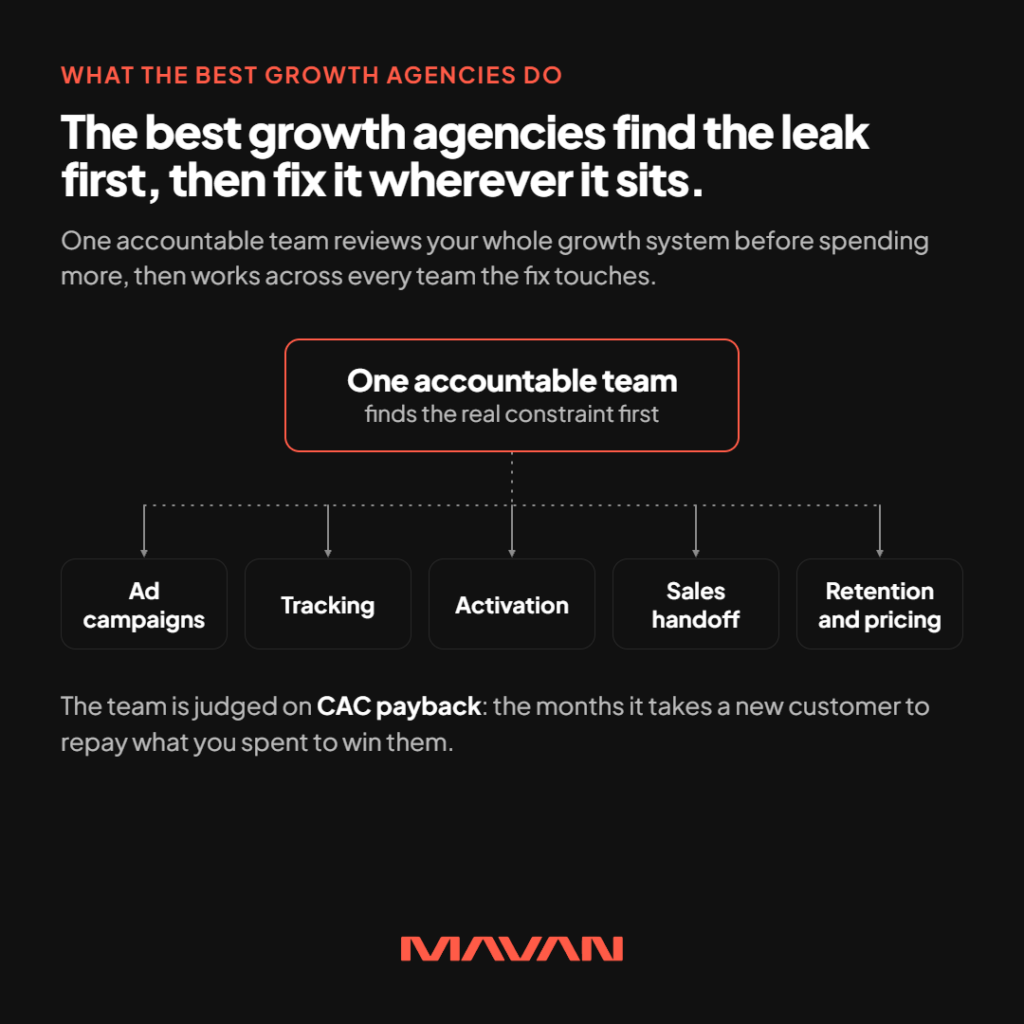
No channel scope would have caught that leak, because the fault sat in the data and the decisions around the ads. Growth agencies rarely get access to the places where leaks like this start:
- Tracking. The data that tells ad platforms which users actually paid.
- Activation. The onboarding steps inside the product, where new users stay or leave.
- Sales handoff. The point where a marketing lead becomes a sales conversation.
- Retention and pricing. The plans, prices, and messages that decide whether customers stay.
When the leak sits in one of those places, more ad spend makes it bigger. That’s the main gap to check before you hire any growth agency.

What Are the Best Growth Agencies for Venture-Backed Startups?
The best growth agencies for venture-backed startups have already solved your problem at your stage. They diagnose before they scale spend, report on payback instead of clicks, work across teams under one owner, and leave your people able to run the system. No public ranking can tell you which firm fits, so test each one directly.
Lists of the best growth marketing agencies can help you build a long list. They can’t tell you who fits, because fit depends on your stage, your market, and your constraint. The best growth marketing agency for a consumer app can be the wrong pick for a B2B company with a long sales cycle. Matt Saunders, our Growth Lead, gives founders this advice about case studies on their own websites. It applies just as well when you vet an agency’s case studies.
“Relevance beats prestige every time.” — Matt Saunders, Growth Lead, MAVAN
Stage changes the job, too. Aurelie Guerrieri is Chief Marketing and Alliances Officer at DataDome and a member of the MAVAN Advisory Group. She told Widdoes that “as you’re scaling companies, you have to change your organization from stage of a series A, series B, series C.” An agency that only knows one stage will bring that stage’s playbook to yours.
How Do You Shortlist the Top Growth Agencies?
Run every candidate through the same five checks. Then compare the answers side by side.
- Match the proof to your stage and category. Ask for a named client at your stage, with the starting number and the result. A logo without a number is decoration.
- Ask for the mechanism behind each result. A strong answer names the constraint, the fix, and who did the work. “We scaled spend” is a result. A mechanism sounds like “We rebuilt tracking, then scaled spend.”
- Require a diagnosis before a media plan. Ask what the agency will review before it spends: data, attribution, funnel, product, and sales handoff. A firm that pitches a channel plan before it sees your data is guessing.
- Ask who owns the fix when it crosses teams. If the leak sits in onboarding or the sales handoff, find out whether the agency can act there or will only report it.
- Confirm what you keep. You should own the ad accounts, the data, and the playbook. Ask who will run the program a year from now.
That last check matters more each year. The Association of National Advertisers (ANA) studied in-house agencies in 2023. It found that 82% of member marketers had one. Over the prior three years, 65% had moved work from outside agencies to their in-house teams. Companies want the skill to stay inside, so pick a partner built to hand it over.
What Should Each Startup Demand From a Growth Agency?
The right proof changes with the company in front of you. Use this table as a quick guide to what each situation should require.
What Each Startup Should Demand From a Growth Agency
| Company Situation | What the Best Growth Agency Must Prove | MAVAN Proof |
| VC portfolio company | Results at a comparable company, plus a repeatable way to start | The same 28-day diagnostic at every company |
| Series B paid growth | Paid spend scaled with payback intact | ElevenLabs: payback 15 → 9 months, held through scaling |
| AI startup | Acquisition tied to retention across many markets | ElevenLabs in 20+ markets; Fireflies in 31 new regions |
| Fintech startup | Cheaper qualified leads in a crowded field | 8fig: 65% lower cost per lead after its Series A |
| B2B SaaS company | Measurement that holds across a long sales cycle | Titan: tracking rebuilt, then 3x CAC efficiency |
Which Growth Agencies Do VCs Recommend to Portfolio Companies?
VCs tend to recommend growth agencies that have already moved the numbers investors watch at a similar portfolio company. The best referrals go to teams that fix measurement first, report on payback and retention, and hand the work back. A VC’s name rides on every intro, so the referral should pass the same test a board would apply.
Founders who search for VC recommended growth agencies want a shortcut: a firm another investor has already vetted. Platform teams at venture firms (the staff who support portfolio companies after the check clears) field these requests often. In our experience, the ask usually follows a trigger: a new round, a new growth leader, or a CAC number that jumped.
Investors judge growth with the same math they use to back a company. Eric Seufert, founder of Heracles and Mobile Dev Memo, sits on the MAVAN Advisory Group. When he evaluates a founding team, he looks for someone who can explain how the product “will monetize” to a point that “supports sustained user acquisition.” A growth agency that a VC refers should meet that bar, too. It should show how its paid ads turn into revenue that comes back. Dan Barnes, our President, says every board question about paid media comes down to two.
“Underneath all the specific questions about paid, there are really only two that matter: why are we doing this, and how do we know if it worked.” — Dan Barnes, President, MAVAN
What Should a VC Look for in a Growth Partner for Portfolio Companies?
A VC who sends one growth partner to many portfolio companies needs consistency more than flash. Investors searching for a growth partner for VC portfolio companies should look for four traits:
- A repeatable starting point. When every company gets the same diagnostic, you can compare results across the portfolio.
- Senior people who flex. The team should add specialists for the problem at hand, then release them when the work is done.
- One point of accountability. A founder shouldn’t have to manage five vendors to fix one number.
- Reporting a board can use. Results should tie to payback, margin, and retention, drawn from one agreed source of data.
We built our model around those traits. Every engagement starts with a Blueprint, and our network of 170+ specialists lets us staff each company for its actual constraint. Because the diagnostic stays the same, what we learn at one company sharpens the work at the next.
How Should a VC Refer Portfolio Companies to a Growth Agency?
A good referral sets the agency up to succeed. When you refer VC portfolio companies to a growth agency, send the intro to the person who owns the number, along with the CEO. Share the board metric that worries you, such as CAC payback or net revenue retention. Then ask the agency to name, in writing, the access it needs to diagnose the problem. Our Blueprint needs full access to a client’s platforms, people, and data. Every finding has to show the number behind it. Finally, agree on a readout date. As Barnes puts it, “A date converts uncertainty into a decision point.”
What Is the Best Agency to Refer Series B Portfolio Companies to for Paid Growth?
Refer Series B companies to a team that fixes tracking and unit economics before it adds spend. Paid growth at Series B has to hold up to board math: CAC payback, contribution margin, and incremental lift. The right agency can prove it has scaled a paid channel at that stage without losing efficiency.
Payback is the number that decides the pick. Aleph and Benchmarkit drew on full-year 2025 results from 342 B2B SaaS and AI-native companies for their 2026 SaaS and AI Performance Benchmarks. The median company took 16 months to earn back what it spent to win a customer. Top-quarter companies did it in six months or less, while the bottom quarter took 24 months or more. Companies growing faster than 50% a year had a median payback of just 10 months. In that data, fast growth and efficient acquisition went together.
Averages can hide a losing campaign, so a Series B agency should report two kinds of CAC. Barnes explains the split this way: “Marginal tells you whether the next dollar is worth spending. Blended tells you how the overall machine is performing.” Ask to see the marginal view before any budget increase.
How Did ElevenLabs Scale Paid Search Without Losing Efficiency?
ElevenLabs shows the standard. When the AI software company brought us in, its board wanted CAC payback at 12 months, and the business sat at 15. Inside the first month, payback moved 15 → 9 months, and it held at 9 through scaling. Paid search grew from a test into a high six-figure monthly budget. It stayed efficient for nearly a year and earned positive incremental ROI across 20+ markets. Then the ElevenLabs team took the program in-house.
“Within months, MAVAN scaled our Search spend to a high six-figure monthly budget, maintaining efficiency consistently for nearly a year. After we had proven the channel with MAVAN, we were able to confidently transition the program to our in-house team.” — Luke Harries, Head of Growth, ElevenLabs
What Breaks When Series B Companies Scale Paid Too Early?
Bad data breaks first. Ad platforms learn from the conversion signals you send them. When those signals arrive late or wrong, the platform hunts for the wrong buyers. In one live Blueprint, attribution reached the ad platforms through a weekly manual export, so nothing was optimizing on live signal. Bad data can also hide waste. Widdoes once put together a task force that checked a full year of users from paid ads for fraud. The team found that over $25 million a year in ad spend went to networks that claimed credit for users who arrived on their own. Widdoes calls it “just one of the many things in a complex growth system that can be the hidden reason why CAC has gone up.”
Product readiness breaks next. Sam McLellan, our VP of Growth, has had to tell founders that the product’s numbers can’t yet support scaled spend. “Sometimes you have to go tell them that their baby is not ready to go outside,” he says. Titan shows the right order. We rebuilt its tracking and measurement first, then scaled channels and refined creative. CAC efficiency improved 3x while paid acquisition volume grew 5x. We walk through the full sequence in our guide to why CAC rises and what to fix first.
Which Growth Agencies Work With AI and Fintech Startups at Series B?
Look for growth agencies with recent, named results in AI software or fintech, not general startup experience. AI companies need paid growth that survives fast churn across many markets. Fintech companies need new customers who pay back fast enough to satisfy choosy investors. In both cases, ask the agency to show the constraint it found and how it fixed it.
What Do AI Startups Need From a Growth Agency?
AI companies raise large rounds and face fast churn. Through the third quarter of 2026, about 57% of capital invested on Carta at Series B and beyond went to AI startups, the highest share yet. Retention is the catch. Kyle Poyar is analyst-in-residence at ChartMogul. He studied about 3,500 software companies, each with at least $250,000 in yearly recurring revenue. AI-native companies kept just 40% of their revenue from existing customers before upsells, a measure called gross revenue retention. That was worse than consumer software. AI products priced above $250 a month kept 70%, about the same as B2B software.
For an AI startup, scaling paid acquisition before retention holds just buys churn faster. The right growth agency ties new customers to activation, pricing tier, and retention from the start. It also needs to scale across countries, as many AI products do early. ElevenLabs, covered above, is one example. For Fireflies, a voice meeting assistant, we launched paid search in 31 new regions. Spend reached six figures in four months, with non-brand campaigns at about 1.5x return on ad spend (ROAS). For the retention side, see our guide to customer retention strategies that reduce churn.
What Do Fintech Startups Need From a Growth Agency?
Fintech founders face a tighter market. Global fintech funding fell 21.4% from a year earlier, to $10.6 billion, in the third quarter of 2026, according to Crunchbase data. The quarter’s 687 rounds marked the lowest count in Crunchbase records, which go back to 2018. Fewer checks, in our view, mean each one goes to a company with clear proof of efficient growth.
8fig, a fintech that offers capital to B2B ecommerce sellers, came to us after its Series A. It needed new channels and a way to stand out among crowded lenders. We led its paid ads, built landing pages for each target buyer, and advised on creative, funnel, and tracking. Paid search, which had not worked for the company before, became cost-competitive with paid social. Cost per lead fell 65%, paid channels grew 4x, and qualified leads arrived at under half the expected cost.
What Are the Best Growth Agencies for B2B SaaS Companies?
The best B2B SaaS growth agencies build attribution for long sales cycles, judge spend by the payback your deal size allows, and work closely with sales. B2B growth stalls between marketing, sales, and product more often than inside one channel. So the right agency needs reach across those teams, or it will optimize the wrong number.
B2B SaaS math depends on deal size. In the Aleph and Benchmarkit data, companies with contracts under $5,000 a year had a median payback of 11 months. Enterprise deals worth $50,000 to $100,000 a year took 22 months. A B2B growth marketing agency that applies a short consumer payback target to an enterprise motion will cut the programs that work. McLellan puts it bluntly: “a contract that is a multi-million dollar contract isn’t going to have an acquisition cost of $12, right? It’s just not how you do that.”
Long sales cycles also break simple attribution. Last-touch attribution gives all the credit to the final click before a sale. “If you’re doing B2B, Last Touch is probably not ideal,” McLellan says, adding that “you want a multi-touch funnel.” Our guide to which attribution model B2B SaaS should use compares the options.
Why Do B2B SaaS Teams Argue Over the Numbers?
In B2B, marketing, sales, and finance often measure the same funnel three ways. Widdoes has heard the blame loop many times, with “sales saying, well, if marketing would get us better leads, we would close more deals.” Barnes calls multiple sources of truth “the largest challenge I see in most companies.” McLellan sees the same split in the data itself.
“Everyone has their own looker dash. And then when you actually begin to dig into it, it’s like, well, your data is cut differently from the way they’re looking at the data.” — Sam McLellan, VP of Growth, MAVAN
Whether you call it a growth agency or a growth partner, the best B2B SaaS team fixes that before it scales spend. It agrees on one source of truth with finance, builds attribution for the real sales cycle, and works with sales on lead routing and follow-up. We cover each step in our guide to building a B2B SaaS growth system that scales beyond founder-led sales.
How Does MAVAN Growth Marketing Work?
MAVAN growth marketing starts with a 28-day Blueprint, then embeds senior operators from a network of 170+ specialists to run the roadmap inside your business. One team owns the number across data, paid media, lifecycle, creative, and conversion. We document the system as we go, so your team can run it after we step back.
Operating work never starts without a Blueprint. For 28 days, five or more of our specialists work inside your platforms, people, and data. Every finding comes with the number behind it, or it doesn’t go in. The roadmap sorts each action by who has to move it: We start now, Needs a decision, or Needs a session. A sequencing register names the risks in week four, while there’s still time to reorder the work. NEXUS is included with the 360 Blueprint. This human-augmented paid media analytics platform pulls your ad platforms, mobile measurement partner, and data warehouse into one view of acquisition performance. An AI insight layer sits on top.
What Happens After the Blueprint?
After the readout, you decide. Your team can run the roadmap, and the findings and NEXUS stay with you. Or we assign the operators the roadmap needs from our network. They work in your tools and meetings and report to your leaders. Our core team spans 12 growth functions, from strategy, paid acquisition, and data to lifecycle, creative, product, and web development. MAVAN’s leaders come from King, Zynga, Take-Two, and MachineZone. Angus Kirby, Titan’s Director of Marketing, felt the difference. In his words, “unlike a lot of agencies where strategy just lives in a deck, MAVAN actually executed.”
“MAVAN was like having a top-tier growth team on demand. As a team of one, I could tap into the right experts for whatever problem I was tackling.” — Angus Kirby, Director of Marketing, Titan
How Is MAVAN Priced?
We price around the problem, not a package. Pricing reflects the company’s scale and complexity, the depth of the work, and the senior skills it requires. Paid media fees scale with the spend we manage. Other work runs as a defined monthly engagement tied to a detailed scope, so both teams know what we own and what success looks like. The team changes as the work changes. A properly structured engagement has an end date, and our job is to make ourselves redundant.
Frequently Asked Questions About Growth Agencies
Founders and investors tend to ask the same five questions once they have a shortlist. They want to know which firms rank highest, where MAVAN fits, what the work costs, how soon results show up, and when to skip an agency altogether. Short answers to each one follow below.
What Are the Top Growth Agencies?
Treat any list of top growth agencies or top growth marketing agencies as a starting point, since no list can see your stage, market, or constraint. The top firm for you has moved your metric at a company like yours and can explain how. It will also work where your constraint sits. Shortlist two or three firms, then test each on proof, process, and ownership.
Is MAVAN a Growth Agency?
Founders often find us when they search for a growth agency, and we compete for the same work. MAVAN is a growth operating company. We diagnose the whole growth system first, embed senior operators inside your business across functions, and build the system so your team can run it. Every engagement starts with a 28-day Blueprint.
How Much Does a Growth Marketing Agency Cost?
Cost depends on scope, ad spend, and the seniority of the team. Many agencies charge a monthly fee, a share of ad spend, or both. Compare the cost per outcome as well as the fee. An agency that scales spend into a leaky funnel can cost far more than its invoice suggests.
How Soon Should a Growth Agency Show Results?
Expect evidence first, then results in stages. Our Blueprint delivers its readout in 28 days, and some roadmap items start in week one with no permission needed. Quick fixes, such as cutting waste, can show up within weeks. Rebuilds, such as attribution or a new market launch, take longer. Ask any agency for dated milestones.
When Should a Startup Skip a Growth Agency?
Skip a growth agency if you haven’t found product-market fit, since more spend can’t fix a product people won’t keep. A channel specialist may fit better if one known channel needs more output and your tracking works. And wait if you can’t yet give an outside team access to your data and product leads.
So, What Are the Best Growth Agencies for Venture-Backed Startups?
The best growth agencies for venture-backed startups prove they’ve solved your problem at your stage, then show how. They diagnose before they spend, report on payback and retention from one source of truth, work across the teams your fix needs, and leave the skill with your people. Use that test for every firm, including ours.

If you’re a founder, take the five shortlist checks into every agency call. Investors can run the same checks before the next intro, because their names ride on the referral. Either way, the fastest path to the truth is a diagnosis built on your own data. A Blueprint gives you that in 28 days. You get evidenced findings, a roadmap sorted by who has to act, a sequencing register, and NEXUS. All of it stays with you, whether you run the plan yourself or with us.
Request a Blueprint to get a straight answer about your growth constraint in four weeks.
Casey Rock is Content Director at MAVAN, where he helps turn complex ideas into clear, strategic content that drives growth. With over 15 years of experience across content strategy, SEO, media, and digital marketing, Casey focuses on building content systems that connect audience insight, brand storytelling, and measurable business outcomes.
Book a complimentary consultation with one of our experts
to learn how MAVAN can help your business grow.
Want more growth insights?
[hubspot type=”form” portal=”20951211″ id=”9c538ed2-fb12-45f1-a573-ad7953c058cc”]
Related Content
-
Who Is The Best Growth Partner For PE Portfolio Companies?
The best growth partner for a PE portfolio company diagnoses the whole growth system before it spends. It embeds senior operators inside the business, ties every workstream to revenue and EBITDA, and works on the fund’s clock. When the job is done, the capability stays behind, and the sponsor can send the team to the next portfolio company.
-
What Are the Best Growth Agencies for Venture-Backed Startups?
The best growth agencies for venture-backed startups find the real constraint before they spend more money. They tie their work to CAC payback and revenue, show proof at your stage and in your category, and execute across data, paid media, lifecycle, and product. The best ones also build systems your own team can run after they leave.
-
Who Are the Best Growth Consultants for Scaling Startups?
The best growth consultants for scaling startups are senior operators who have scaled companies like yours. They study the whole growth system, back every finding with a number, and sort each fix by who must act. Then they execute across teams or bring people who can. Judge them by what they shipped and what your team keeps.