
A 90-day growth sprint is a focused quarter run in three phases. The first month diagnoses your growth system, the second rebuilds your measurement into one trusted source of truth, and the third scales only the channels the data has proven. One embedded pod can run it, too, tracked against a single scoreboard.
TLDR — How To Run A 90-Day Growth Sprint
- Don’t spend a new dollar until day 31 — diagnose first.
- Sequence the quarter in order: diagnose, then rebuild, then scale.
- Map every channel, tool, dashboard, and owner before spending.
- Pause stale campaigns and tracking gaps within the first two weeks.
- Reconcile paid, product, and finance data into one source of truth.
- Give every metric one named owner — never a committee.
- Set red/yellow/green thresholds on the scoreboard, not vague targets.
- Scale only the channels and creative the data has proven.
- Keep cadence lean: one Monday sync, async updates, no stand-ups.
- Ask weekly — why are we doing this, and did it work?
- Unsure where to start? Learn more about our 360 Growth Analysis.
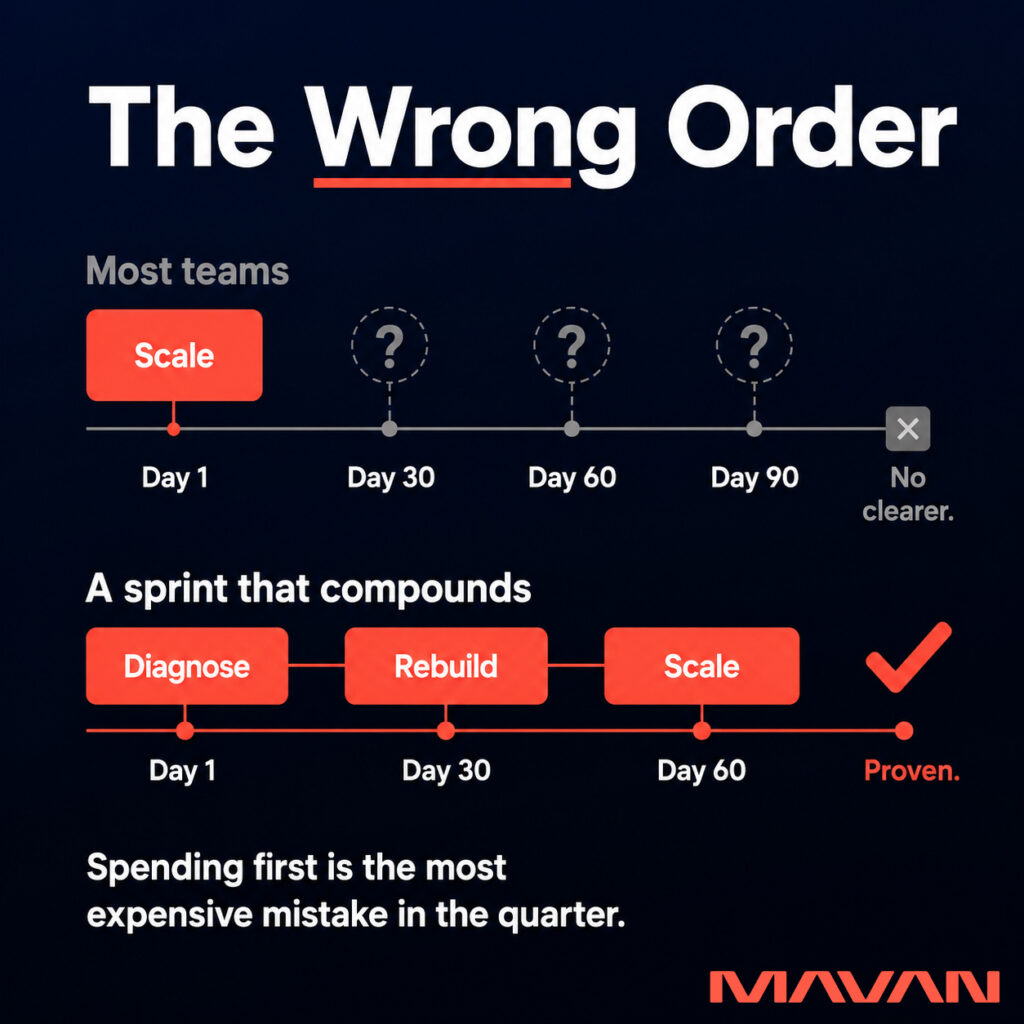
The best 90-day growth plans don’t spend a new dollar until day 31. Most teams do the reverse — they open the quarter by turning up budget, launching a campaign, bolting on a channel. It feels like progress. Thirty days later the dashboard is busier and the picture is no clearer, and the quarter is a third gone.
A sprint that pays off runs in the other order. It buys a map before it drives. If you lead growth at a venture-backed company between Series A and Series C, you’ve likely felt the pull to act fast under board pressure — and you’re right that speed matters. The question is what you point that speed at. A 90-day growth sprint works because it sequences the quarter: diagnose the system first, rebuild the measurement that tells you the truth, then scale only what the data has already proven — with one team accountable for the whole arc. Get the order right and each month sets up the next. Get it wrong and you spend three months optimizing numbers no one trusts.
Key Terms To Know For Growth Sprints
Before we dive in too deep, here are some key terms and definitions to know when discussing growth sprints.
- 90-Day Growth Sprint
- A single quarter of growth execution run in three sequenced phases — diagnose, rebuild, scale — by one cross-functional team against one scoreboard. Unlike a growth audit, it covers the full run of work, rather than only the opening diagnostic.
- Growth Pod
- A cross-functional team spanning acquisition, data, product, creative, and lifecycle, led by a single point of contact. It operates as one embedded unit rather than a set of disconnected vendors, so growth work is owned end to end instead of piecemeal.
- Single Source Of Truth
- One agreed dataset — usually a shared warehouse on a set refresh cadence — that every function reports from. It replaces the common pattern where finance, product, and ad platforms each cite different numbers, which lets each team defend its own position and stalls decisions.
- Insight-To-Action Cycle
- The time between seeing a signal in your data and doing something about it. A core aim of a growth operating system, a shorter cycle means faster learning per quarter, which is why the 90-day window is built around speed of iteration rather than volume of activity.
- Payback Period
- The time it takes to earn back the cost of acquiring a customer, measured in months. It’s a truer scaling signal than return on ad spend because it accounts for when cash actually returns, telling you whether the next dollar of spend is safe to add.
What Is A 90-Day Growth Sprint?
A 90-day growth sprint is a single quarter of focused growth work, run in three phases by one cross-functional team against one shared scoreboard. The first month diagnoses the system, the second rebuilds measurement into one trusted view, and the third scales proven channels. It’s the execution engine that turns a growth plan into shipped results.
A sprint is not the same as a growth audit, and the difference matters. The audit is the first 30 days — the diagnostic that maps your business and hands back a prioritized plan. You can read what happens in the first 30 days on its own. The sprint is the full 90 — the running of that plan, week by week, until the work is live and measured.
Matt Widdoes, Founder and CEO of MAVAN, frames the deeper shift this way: “as you scale, systems have to be built to facilitate the communication around cross-functional insights.” A sprint is where those systems get built and run, rather than only recommended.
Why Does The 90-Day Timeline Work?
Ninety days works because it’s long enough to rebuild real processes and short enough to keep everyone focused on a single goal. A quarter also maps to how boards and finance already plan, so the sprint’s readout lands in a rhythm leadership understands. Shorter, and you can’t rewire anything durable. Longer, and focus dissolves before results arrive.
The timeline is really about speed of learning. Dan Barnes, President of MAVAN, describes the purpose of a growth operating system in one line: “All of this infrastructure exists for one reason: to shorten the time between seeing something and doing something about it.”
Ninety days is the smallest window in which you can see clearly, act, and read the result before the next planning cycle. It also respects the budget reality growth leaders live in — Gartner’s 2024 CMO Spend Survey pegged marketing budgets at 7.7% of company revenue, down from 9.1% a year earlier. When the budget is leaner, the sequence you spend it in becomes the whole game.
Widdoes puts the discipline plainly: these “business systems need to be set earlier than most people like to think and they need to be regularly reviewed, tested, and optimized like nearly every other function in the org.”
What Are The Three Phases Of A 90-Day Growth Sprint?
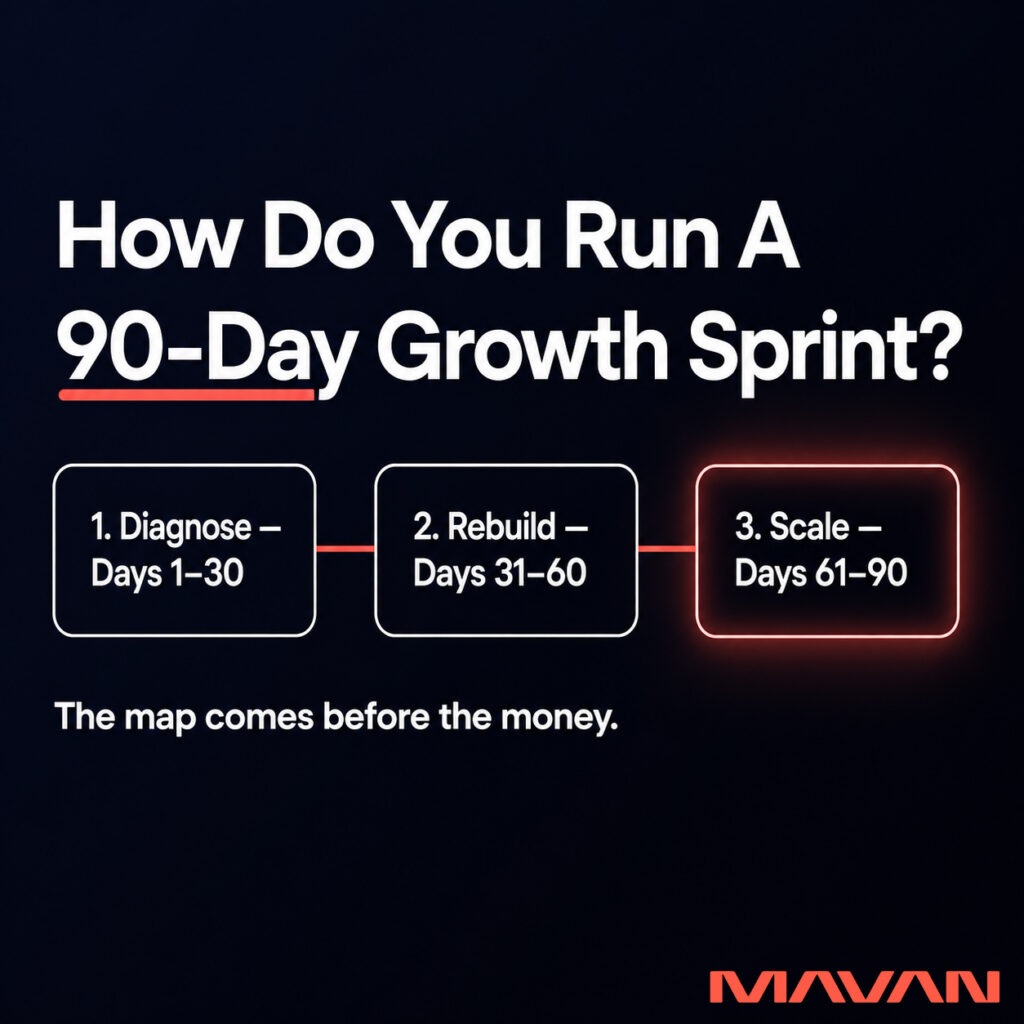
The three phases are diagnose, rebuild, and scale. Days 1–30 map the system and stop obvious waste. Days 31–60 rebuild attribution and reporting into one source of truth with clear owners. Days 61–90 scale only the channels and creative the data has proven. Each phase earns the right to execute the next phase.
The order is the point. Skip the diagnosis and you scale a leak. Skip the measurement rebuild and you scale on numbers your finance team can’t reconcile. Here’s how the arc holds together across the quarter:
| Phase | Days | What You Walk Away With |
|---|---|---|
| Diagnose | 1–30 | A single written view of your growth system, obvious waste paused, and a prioritized roadmap. |
| Rebuild | 31–60 | One source of truth, reliable attribution, and one owner per metric and workstream. |
| Scale | 61–90 | Proven channels scaled, controlled experiments running, and a board-ready readout. |
Phase one is the diagnostic — the honest look at the whole machine that surfaces where money and momentum leak. When rising acquisition costs are the trigger, that first look usually finds a system problem hiding behind a channel problem; we walk through that pattern in our article about why CAC rises.
Phase two rebuilds the measurement spine so every team reads the same numbers, which is the foundation the entire board-ready scoreboard sits on.
Phase three is where scale finally earns its keep — and where sequencing protects you most.
Scaling before the system is sound is how good money chases bad; the Association of National Advertisers, in a programmatic study reported by eMarketer, found less than half of every U.S. programmatic dollar reaches a real consumer. A sprint that scales last spends into clarity instead of into that gap.
As Widdoes notes about the payoff of looking at the full machine early: “Once companies see it, they always wished they’d taken a look sooner.”
How Do You Run A 90-Day Growth Sprint, Step By Step?
Run a 90-day growth sprint in seven ordered steps: map your entire growth system before spending, pause obvious waste in week two, rebuild measurement onto one source of truth, assign one owner per metric, set red-yellow-green thresholds on your scoreboard, scale only what the data has proven, then close with a board-ready readout.
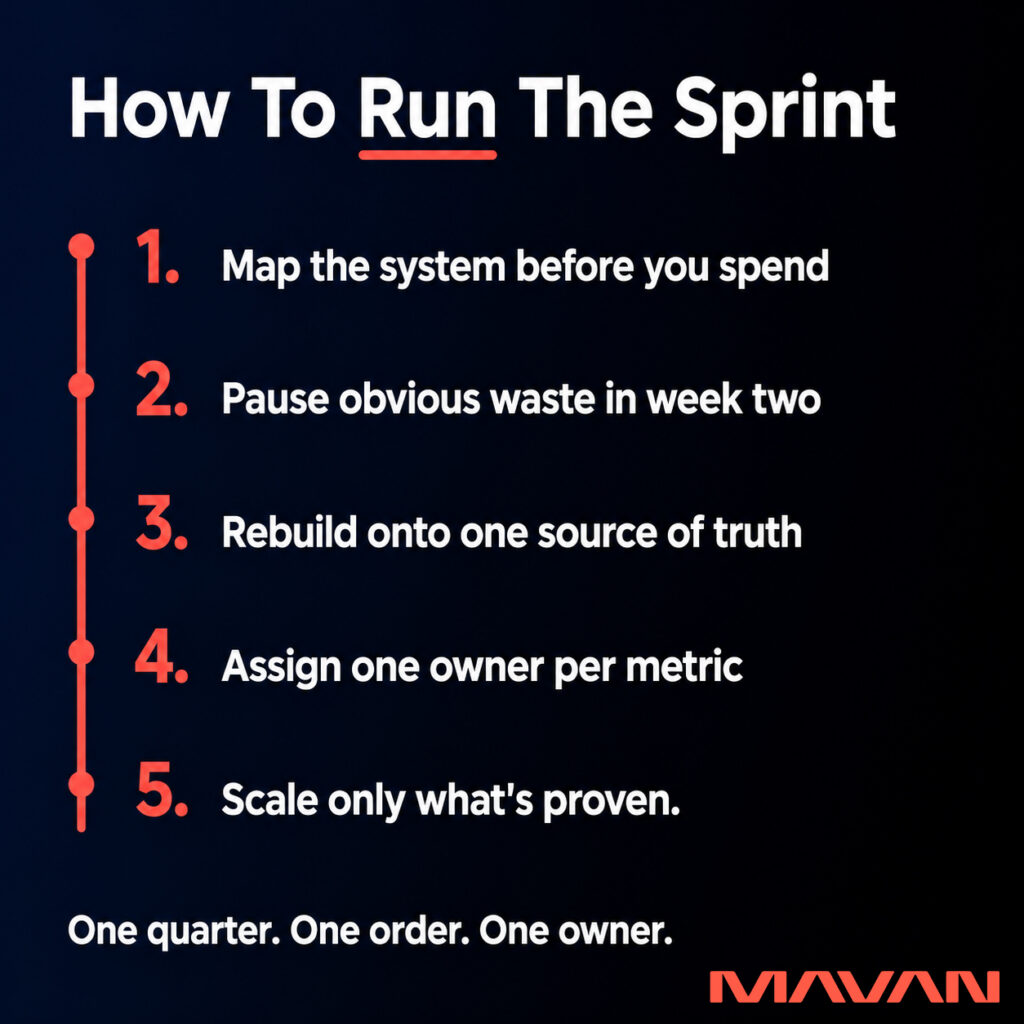
Here is a closer look at each step. The whole method fits on one page, and every step is something a team can start this week.
- Map your entire growth system before you spend a new dollar. Write down every channel, tool, dashboard, and owner in one place, and note where the numbers disagree — that disagreement is your first clue.
- Pause the obvious waste you find in the first two weeks. Kill the evergreen campaign nobody has reviewed and the tracking gap distorting your spend, without waiting for the full plan.
- Rebuild your measurement onto one source of truth. Reconcile paid, product, lifecycle, and finance data into a single view so no team can argue from a private number.
- Assign one owner to every metric and every workstream. Give each number a named person — not a committee — so accountability never diffuses across three teams.
- Set thresholds on your scoreboard, not only aspirational targets. Define the red, yellow, and green points that tell the team when to change behavior, so the scoreboard drives decisions instead of decorating a deck.
- Scale only the channels and creative the data has already proven. Pour budget into the segments that cleared your payback bar, and treat everything unproven as an experiment, not a bet.
- Close the quarter with a board-ready readout. Show what you tested, what moved, and what you’ll do next — variances and tradeoffs, not a status report.
How Do You Keep A 90-Day Sprint On Track Week To Week?
Anchor the week to a scarce, high-value cadence. Hold one short Monday alignment, run daily written updates in an async channel, and keep every workstream tied to two questions: “Why are we doing this? Did it work?” Protect focus by cutting ritual meetings that add cost without insight. The heartbeat should match the moment.
Dan Barnes, President of MAVAN, is precise about matching cadence to the phase you’re in: “There are moments of intensity where the organizational heartbeat needs to be a hummingbird. And there are moments where methodical, deliberate action is what you need, and the heartbeat can be more like an elephant. You have to be very intentional about which one you’re in.” Diagnosis and scaling weeks run fast; rebuild weeks run deliberate. He is also blunt about protecting the team’s time: “I avoid stand-ups like the plague.” The goal is to keep synchronous time rare and worth it, so the hours go to the work rather than the meeting about the work.
Underneath the cadence sit the two questions every workstream has to answer before and after it runs. “Why are you doing this?” turns activity into a testable hypothesis before you spend. “Did it work?” turns the result into a learning instead of a sunk cost. Ask both, every week, and the sprint self-corrects long before the quarter ends.
How Do You Prove A 90-Day Growth Sprint Worked?
You prove it with one scoreboard, read the same way every week, that separates early signals from confirmed results. Leading indicators — like install-to-signup rate and day-one retention — tell you fast whether something is working. Lagging indicators — like payback and cohort retention — confirm the business is healthier. Proof is a defensible answer to “did it work,” backed by cohort economics.
The discipline here is simple to say and hard to hold: “you are what you measure,” as Barnes puts it. Put the wrong numbers on the board and your team will optimize them perfectly while the business drifts. The full design of that one-page instrument — which metrics, which thresholds, which owners — is its own craft, and worth building deliberately.
What the sprint adds is proof in outcomes, run in the right order. Fireflies cut acquisition cost 46% quarter over quarter while holding more than $700K in monthly spend. Titan reduced its cost per customer threefold while growing paid volume fivefold on a rebuilt tracking foundation. KidStrong lifted form conversion 32% after we rebuilt creative and signup flows. You can see the full pattern across our case studies — each one a system fixed before a channel was scaled.
Frequently Asked Questions About Growth Sprints
Can A Growth Sprint Be Shorter Than 90 Days?
A focused two-to-four-week audit can diagnose your system and hand back a plan, but scaling proven channels needs the full quarter. Ninety days is the shortest window that fits all three phases — diagnose, rebuild, scale — without rushing the measurement work that makes scaling safe. Shorter sprints skip the proof step.
What’s The Difference Between A Growth Sprint And A Growth Audit?
A growth audit is the first phase — a 30-day diagnostic that maps your business and delivers a prioritized roadmap. A growth sprint is the full 90-day execution that runs that roadmap until the work is live and measured. The audit tells you what to fix; the sprint fixes it and proves the result.
How Is A Growth Sprint Different From Quarterly OKRs?
OKRs set the goals; a growth sprint installs the system that hits them. OKRs often assume your measurement and ownership are already sound. A sprint rebuilds those first, so the objectives sit on data every team trusts and every metric has one accountable owner. It’s the operating layer beneath the goals.
Who Should Own A 90-Day Growth Sprint?
One accountable point of contact should own the sprint, coordinating a cross-functional group across acquisition, data, product, creative, and lifecycle. Growth work fails when it lives in one function or spreads across a committee. Whether the pod is internal or embedded, the rule holds — one owner for the arc, one owner per metric underneath.
Can We Run A 90-Day Growth Sprint With Our Current Team?
Yes, if your team has coverage across data, acquisition, product, creative, and lifecycle and the bandwidth to move fast. Many teams run their first sprint with an embedded pod, then keep the cadence in-house afterward. The deciding factor is whether one person can own the full system rather than only the pieces.
How To Really Run A 90-Day Growth Sprint
A 90-day growth sprint is a quarter run in a deliberate order — diagnose the system, rebuild the measurement that tells you the truth, then scale only what the data has proven. One cross-functional pod owns the arc, one scoreboard tracks it, and two questions keep every workstream honest. Run in that sequence, the quarter sets up the next one instead of ending in another round of metric arguments. The map comes before the money, every time.
If you’re staring down a quarter of board pressure and the instinct is to turn up spend on day one, then spend the first 30 days building the map instead — the diagnosis that tells you exactly where to point the budget. That first look is the 360 Growth Analysis: an honest read of your full growth system and where your dollars actually go. It’s how a sprint starts compounding instead of scattering.
Book a complimentary consultation with one of our experts
to learn how MAVAN can help your business grow.
Want more growth insights?
Thank you! form is submitted
[hubspot type=”form” portal=”20951211″ id=”9c538ed2-fb12-45f1-a573-ad7953c058cc”]
Related Content
-
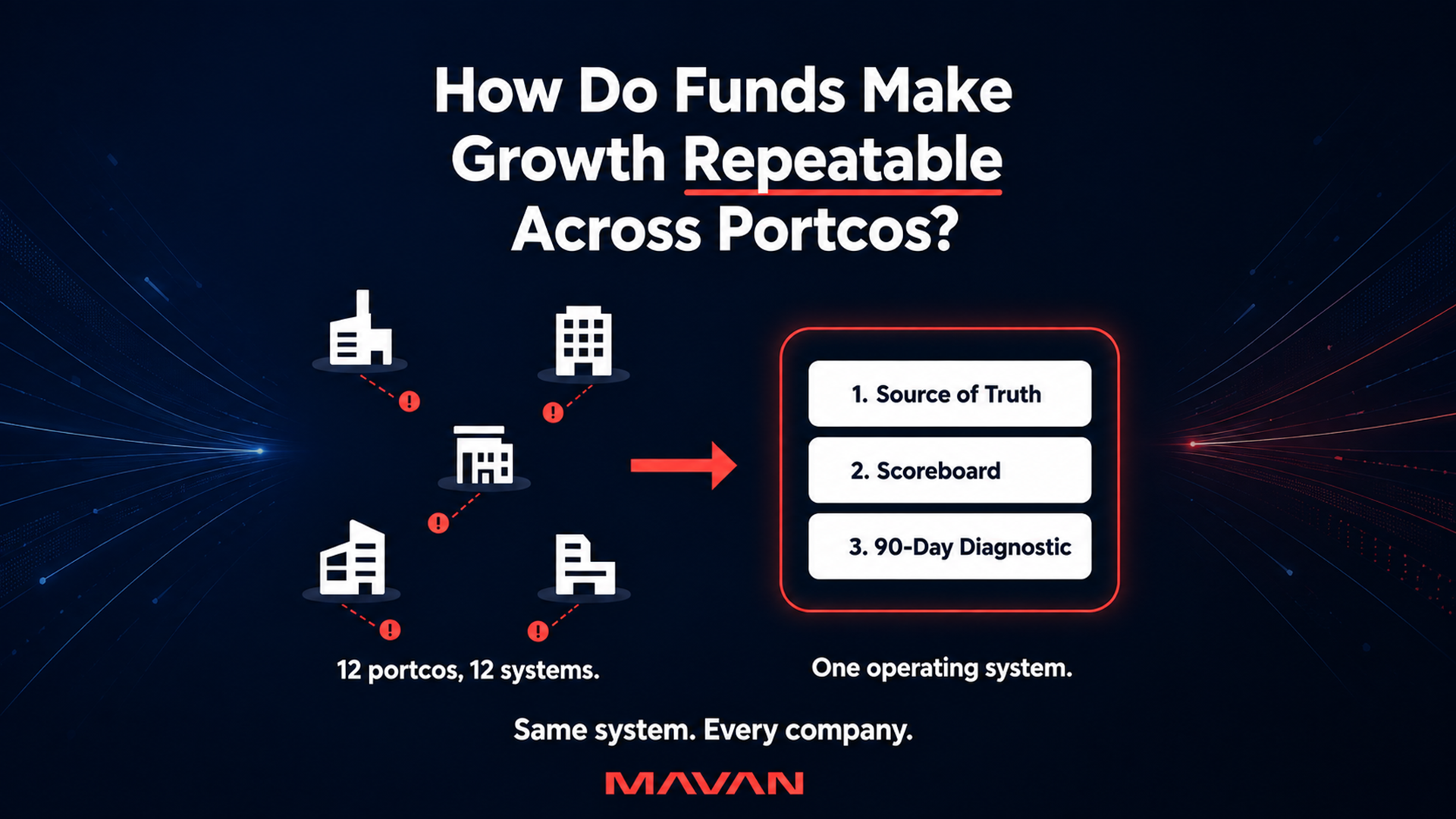
How Can VC And PE Funds Repeat Growth Across Portfolio Companies?
Growth becomes repeatable across a VC or PE portfolio when the fund installs one operating system instead of referring each company to a different specialist. The system has three parts: a single source of truth every team trusts, a board-ready scoreboard of ten to twelve metrics, and an embedded pod that diagnoses the real constraint in ninety days before anyone spends more.
-
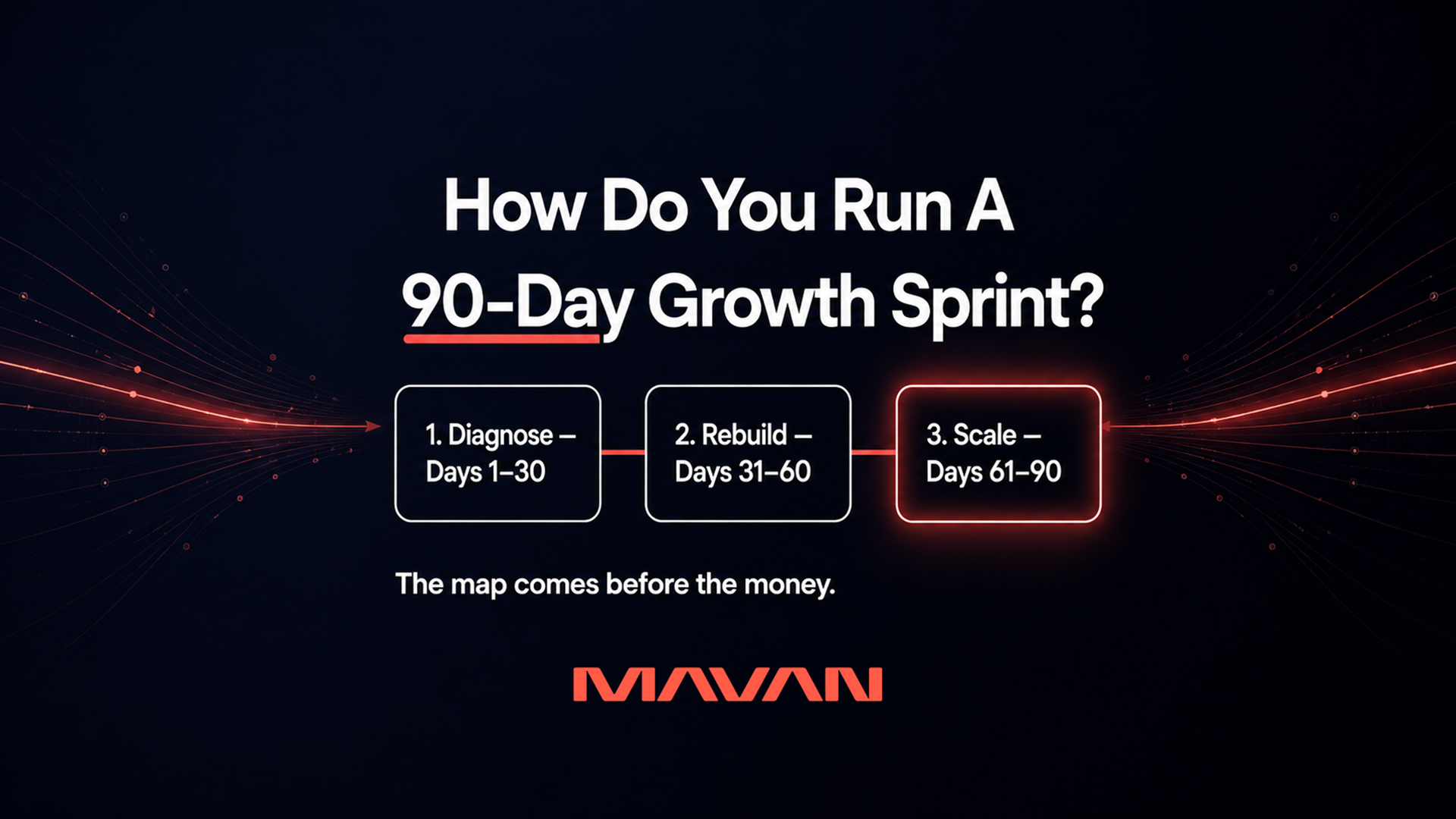
How Do You Run A 90-Day Growth Sprint That Compounds?
A 90-day growth sprint is a focused quarter run in three phases. The first month diagnoses your growth system, the second rebuilds your measurement into one trusted source of truth, and the third scales only the channels the data has proven. One embedded pod can run it, too, tracked against a single scoreboard.
-
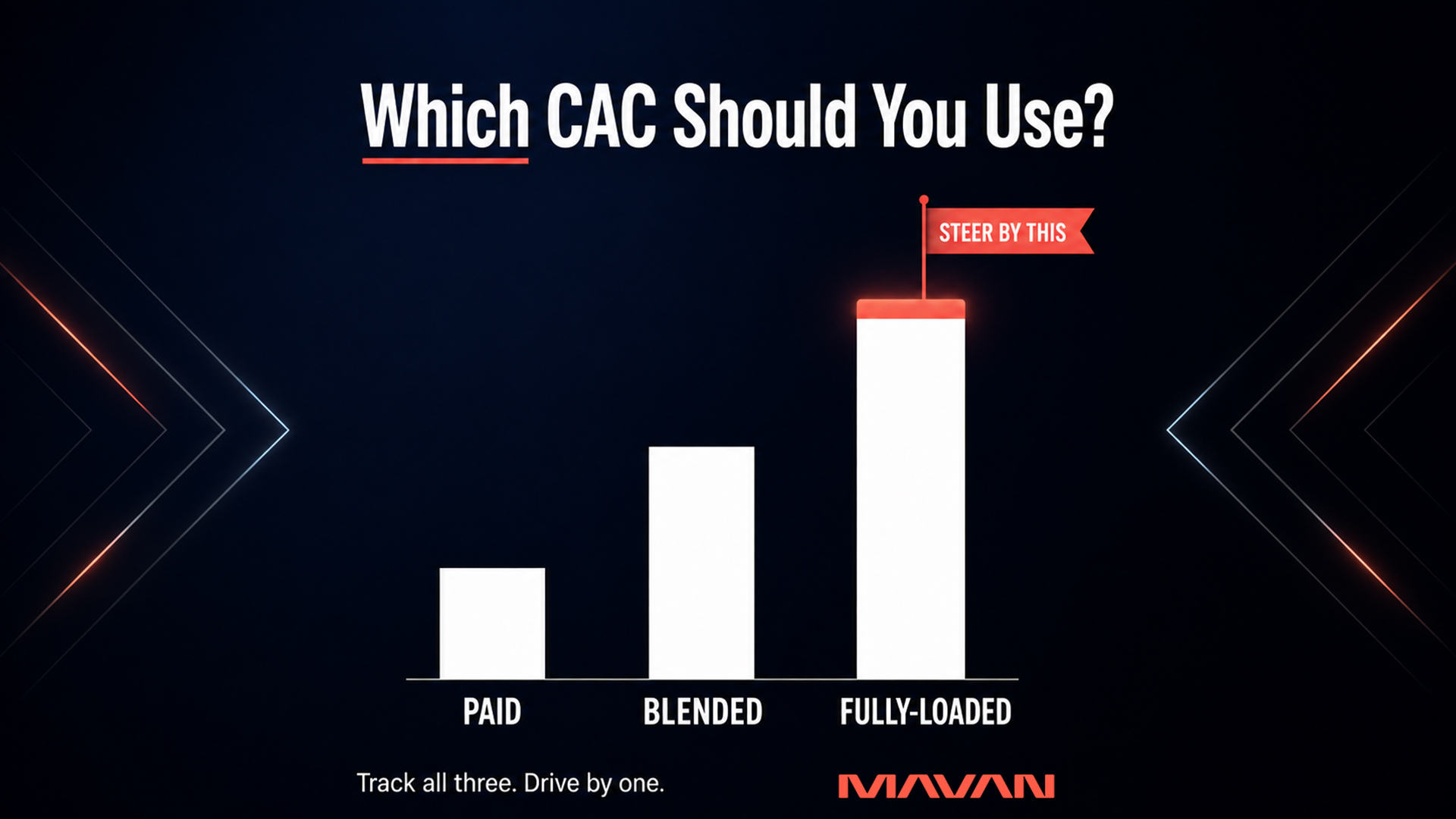
Which CAC Should You Use — Fully-Loaded, Blended, or Paid?
There are three ways to measure customer acquisition cost — paid, blended, and fully-loaded. Most teams pick one per decision. MAVAN’s operators steer by fully-loaded CAC, paired with gross-margin lifetime value, because it counts every cost. Paid and blended stay useful for channel calls and external reporting, but never as the number that drives the business.