
There are three ways to measure customer acquisition cost — paid, blended, and fully-loaded. Most teams pick one per decision. MAVAN’s operators steer by fully-loaded CAC, paired with gross-margin lifetime value, because it counts every cost. Paid and blended stay useful for channel calls and external reporting, but never as the number that drives the business.
TLDR — How To Choose The Right CAC To Use
- Steer by fully-loaded CAC — the one number that shows a customer’s real cost.
- Track all three CACs — paid, blended, and fully-loaded — but steer by one.
- Fully-loaded CAC adds salaries, tools, contractors, and overhead to media.
- Count only new paying customers — exclude free trials, freemium, and renewals.
- Pair CAC with gross-margin LTV — revenue times margin, divided by gross churn.
- Use paid CAC for channel calls; report blended CAC externally to investors.
- Most brands understate true CAC by 20–40%, usually by skipping team costs.
- Lock one CAC definition, one owner, one source of truth — count it monthly.
- Investors rebuild your fully-loaded CAC anyway — so lead with it yourself.
- See where your true CAC really lives — get a MAVAN 360 Growth Analysis.
You open the board deck and three tabs show three different CAC numbers — $40, $70, $180 — and they disagree by more than four times. The standard advice is that all three are fine, because each is calculated differently for a different purpose. We think that advice is how good teams end up steering by the friendliest number in the room. Track all three, but drive the business off one: fully-loaded CAC, paired with gross-margin lifetime value. Paid and blended are useful supporting views — they are not the number you make decisions on.
That said, if you already track more than one CAC, you are ahead of most teams and closer to a defensible number than you think. What usually turns a pile of numbers into confident scaling decisions is not another metric — it is a clear rule for which one leads, and the discipline to count it the same way every month. This is the measurement layer underneath every later conversation about whether your CAC is rising, whether your ratio is healthy, or what to tell the board.
CAC Terms Defined
Here are the terms exactly as we use them at MAVAN.
- Customer acquisition cost (CAC)
- A unit-economics metric measuring the total cost to acquire one new paying customer over a set period. It divides acquisition spend by new customers, and is judged against lifetime value and payback — never in isolation, since a number alone says nothing.
- Paid CAC
- The marginal cost of paid growth. It divides paid-channel spend — media, agency fees, creative, affiliates — by the customers who came through paid channels only. It answers a channel question: does the next dollar into this platform come back?
- Blended CAC
- The whole-engine efficiency view. It divides total acquisition program spend — paid media, agency fees, creative, and tools — by every new customer, including organic, referral, and email. It is the figure investors typically read, but it can mask the loaded cost of a paying customer.
- Fully-loaded CAC
- The strictest view, and the one we steer by. It adds the salaries and benefits of everyone working on acquisition, contractors, and a fair slice of overhead on top of that program spend, then divides by new paying customers only. It reveals the real cost that lighter definitions leave out.
- Gross-margin LTV
- Lifetime value calculated on gross profit, not revenue: average revenue per customer times gross margin, divided by gross churn. It counts only the money left after the cost to serve — payment and platform fees included — so LTV:CAC reflects real economic value.
- CAC payback period
- The time it takes to recover acquisition cost from a customer’s gross-margin contribution, measured in months. It signals cash efficiency; under roughly twelve months is considered strong for early-stage software, though longer works with high retention.
Which CAC Should You Actually Use?
Track all three, but steer by fully-loaded CAC — media plus salaries, tools, and overhead — paired with gross-margin LTV. Use paid CAC for channel and scaling calls, and blended CAC for how you report the engine externally. The conventional advice is to pick one per decision; our position is that one of them should lead, because the others flatter the number.
Most operators are told to report blended CAC to leadership, track paid CAC by channel, and reach for fully-loaded CAC only when someone asks about “true” unit economics — three co-equal tools, each for its moment. That framing isn’t necessarily wrong, but it lets a team make its most important decision — how hard to scale — off a number that leaves important costs out. The table below shows the traditional split, and where we push further.
| CAC view | How it’s traditionally used | Where we push further |
|---|---|---|
| Paid CAC | Channel optimization, scaling, a max-CAC ceiling | Keep it — but it’s a channel dial, not the scoreboard |
| Blended CAC | Board decks, fundraising, whole-engine efficiency | Report it, but know it hides your team’s cost |
| Fully-loaded CAC | Pulled out occasionally for “true” economics | The number we steer by, on every decision that judges the model |
Sam McLellan, VP of Growth at MAVAN, does not hedge on which number leads. “Fully loaded — as full loaded as you can get it,” he says, when asked which CAC he uses to make calls. He understands that it makes life harder and the number look worse, but that’s the trade he takes on purpose. A CAC that ignores the people and tools behind acquisition will green-light a channel that loses money on every customer.
Why Do We Steer by Fully-Loaded CAC?
Because fully-loaded CAC is the only version that tells you whether the business model actually works. It counts the salaries, tools, contractors, and overhead behind acquisition — costs that paid and blended CAC leave out — so it exposes the real price of a customer before you scale. Steering by a lighter number is how profitable-looking companies lose money on growth.
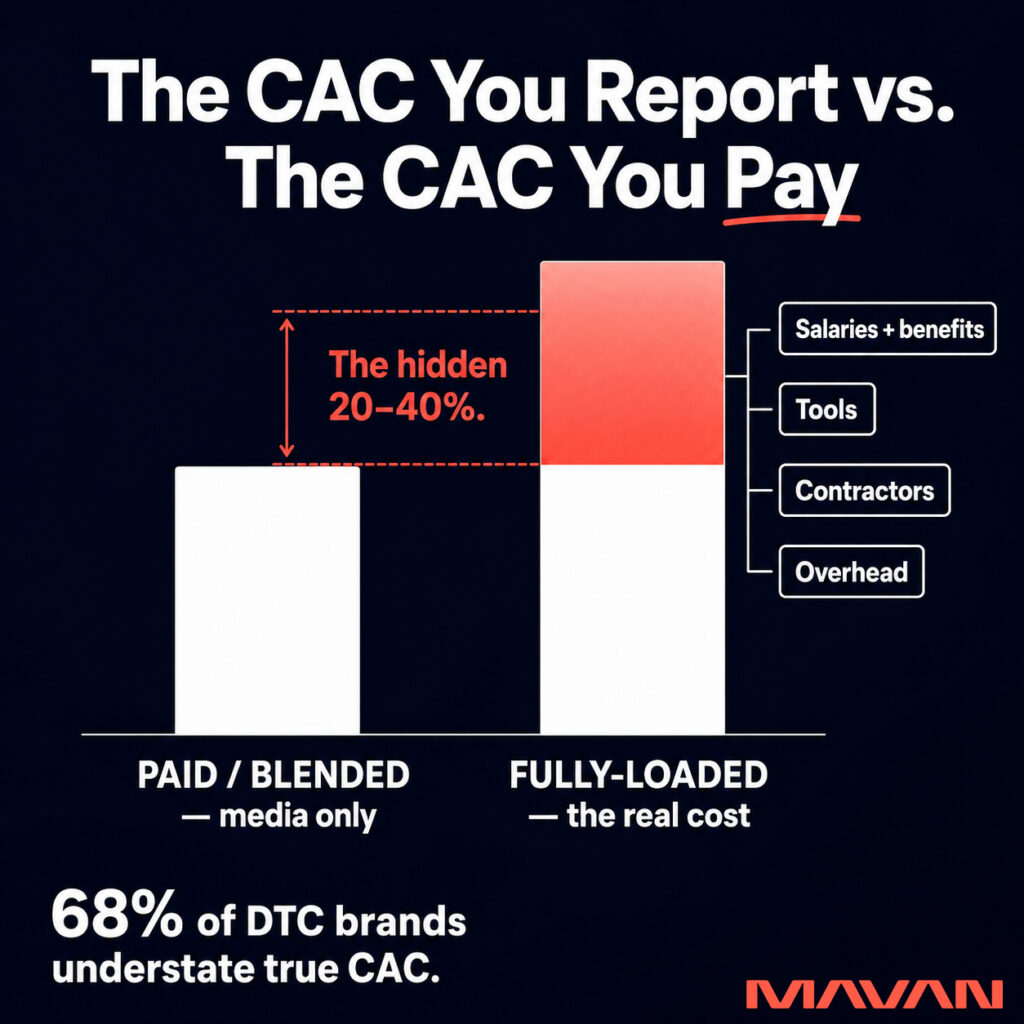
The gap is not small. One 2026 benchmark roundup found that 68% of direct-to-consumer brands underestimate their true CAC by 20% to 40%, mostly by counting media and forgetting creative testing, contractors, tooling, and platform fees. In B2B the miss is often larger. Sales compensation over a three-to-six-month cycle can exceed media spend outright — leave it out and the number is fiction.
Sam McLellan, VP of Growth at MAVAN, has run this discipline through eight-figure budgets, and he is blunt about what half-counting costs you. “I’m one of the people who really wants to put every single cost in there,” he says. “If you’re basically ignoring a lot of those costs and just looking at your overall cost of acquisition with incoming revenue, you’re missing a huge part of running that business.” He has watched teams celebrate cheap installs while the money never arrives, because — in his words — “the vast majority of money comes from a very few number of people.” A low headline cost that brings in users who never pay is not efficiency; it is expensive noise.
It’s worth pointing out that the best investors already do this to you. Venture firm CRV notes that investors divide your total sales-and-marketing line by your new-customer count no matter what you present. A lighter CAC on your slide only creates a credibility gap when their math surfaces a more accurate number. Leading with fully-loaded CAC isn’t just principled, it’s what sophisticated capital does anyway.
How Do You Calculate Fully-Loaded CAC?
Add every acquisition cost — not just media — and divide by the new paying customers earned in the same period. Fully-loaded CAC includes paid spend plus the salaries and benefits of everyone working on acquisition, the tools they use, contractor fees, and a fair share of overhead. Pair it with gross-margin LTV to judge the model in full.
The most common error is counting only ad spend and skipping the loaded cost of the team. A practical convention many finance teams use is a roughly 1.3x multiplier on base salaries to capture benefits and payroll. The standards published by the SaaS Metrics Standard Board go further and specify that sales-and-marketing costs should be fully loaded — variable compensation, bonuses, and benefits included — before the ratio is calculated.
Here is the sequence we walk clients through:
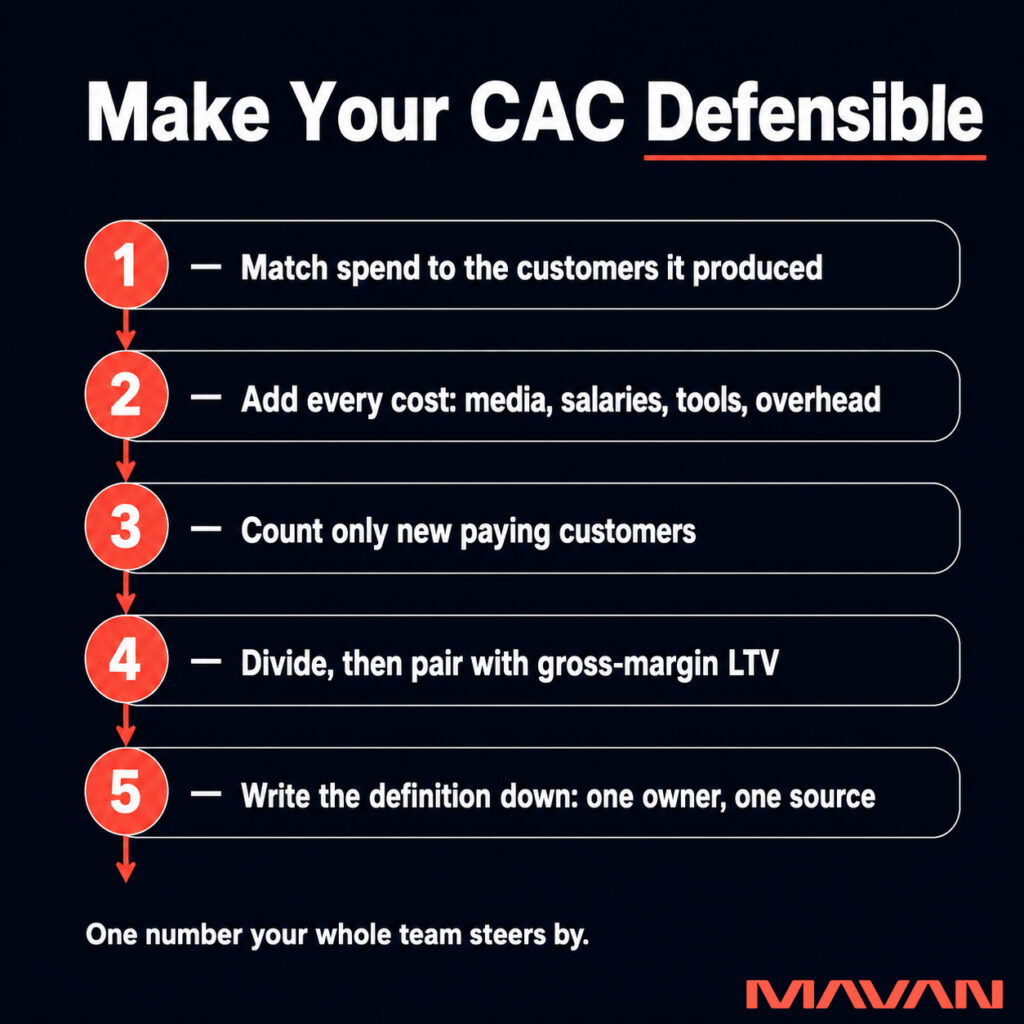
- Pick one time period and match spend to the customers it actually produced. For long B2B cycles, align spend to the cohort of deals that closed, not the month the money went out — otherwise timing alone distorts the number.
- Add up every acquisition cost in that period. Include media and agency fees, the salaries and benefits of everyone working on acquisition, the tools they rely on, contractor invoices, and a fair slice of overhead.
- Count only new paying customers. Exclude renewals, returning buyers, and non-paying free-trial or freemium users, since counting sign-ups who never pay silently deflates your CAC.
- Divide total loaded cost by new paying customers. The result is your fully-loaded CAC — the figure to use for pricing, runway, and the maximum you are willing to pay for a customer.
- Pair it with gross-margin LTV and payback, then write the definition down. Record exactly what you included so finance, product, and marketing all calculate it the same way next month.
Keep the same honesty on the value side of the ratio. Sam McLellan, VP of Growth at MAVAN, keeps lifetime value conservative: “For me, LTV is always going to be gross,” he explains, “and the biggest thing you can take out is the Apple fees and the platform fees, where you’re immediately losing 30% to everything through those payment platforms.” Stripping that platform cut is the floor. The fuller, investor-grade version — gross-margin LTV — nets out the rest of your cost to serve too, so the ratio reflects money you actually keep rather than headline revenue that never reaches your bank.
What About Paid and Blended CAC — When Do They Matter?
They earn their keep as supporting views. Paid CAC answers the marginal question — is the next dollar in this channel coming back — so it guides channel and scaling calls. Blended CAC is the industry’s standard number for external reporting. Neither should stand in for the fully-loaded view we steer by.
Sam McLellan, VP of Growth at MAVAN, judges paid on return rather than cheap clicks. His instinct runs toward ROAS — return on ad spend, or revenue earned for every dollar spent — because a low top-of-funnel cost tells you nothing about whether the money comes home. He has watched teams celebrate cheap installs while the revenue never follows, since so much of the value concentrates in a small share of customers. Top-of-funnel efficiency and real return are not the same thing, and he optimizes for the second.
The standard industry playbook handles the other two cleanly: use paid CAC to set a ceiling on what you will pay per customer, and lean on blended CAC as the headline number that judges the business.
The paid ceiling is a fair channel tactic, and we use it. Where we part ways is the second half — letting blended judge the business. We steer by fully-loaded CAC, and Dan Barnes, President of MAVAN, pushes even the board view past blended efficiency toward contribution margin per acquired customer at Day 90 — “harder to calculate,” in his words, “impossible to game.”
You can keep paid and blended in their lanes and report blended externally where it’s expected, but let the fully-loaded number drive the decisions that matter.
Why Is My Reported CAC Lower Than My Real CAC?
Because most teams count only paid media and skip the expensive parts — salaries, tools, contractors, overhead, and the free users who never pay. Those omissions can hide a third or more of true acquisition cost, so a reported CAC often looks healthy while the business loses money on every customer.
A quick worked example makes the gap concrete. Say you spent $100,000 on paid channels last month and brought in 2,000 new customers — 1,000 from paid, 1,000 from organic and referral. Divide the spend across everyone and blended CAC reads a comfortable $50. Divide it across only the 1,000 customers the spend actually produced, and paid CAC is $100 — one month, one set of customers, and the paid engine costs twice what the blended number suggests. Report the $50 as the price of paid growth, and you will scale a channel that truly costs $100 per customer. That is before you load in a single salary — which is exactly why we steer by the fully-loaded number instead.
What Matters More Than Which CAC You Pick?
Consistency. A single, agreed definition — measured the same way every month, owned by one person, drawn from one source of truth — beats a “perfect” number that three teams calculate three ways. An inconsistent CAC is worse than a high one, because it turns every decision into an argument instead of a choice.
Dan Barnes, President of MAVAN, treats this as the foundation everything else rests on. His rule for any board-grade metric is spare: “One definition. One owner. One source of truth.” When those are missing, the damage is not cosmetic. “Multiple sources of truth means there’s no way to be objective about outcomes,” he explains. “Everyone can always find a number that defends their position, which means no one is ever actually wrong, which means nothing changes.” A CAC that shifts depending on who opens the spreadsheet is not a metric — it is a debating tool.
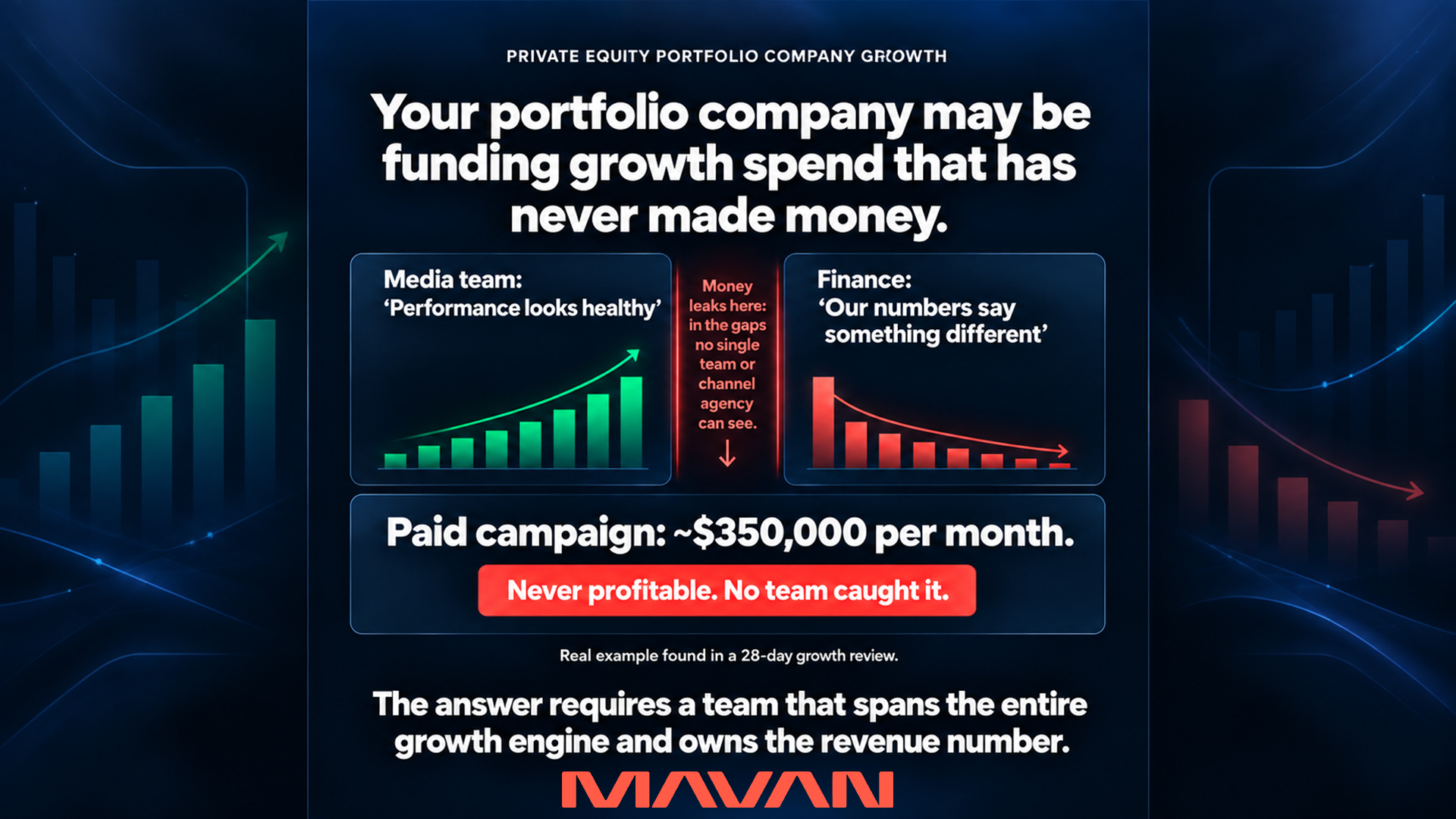
The cost of skipping this is measured in dollars, not tidiness. Matt Widdoes, Founder and CEO of MAVAN, describes a growth audit where the team found, inside 48 hours, “around $350k a month that was being spent on an evergreen paid media campaign that had never been anywhere close to profitable.” The root cause was not a bad marketer. “It turns out that the teams were looking at different numbers,” he says. When acquisition cost lives in three dashboards with three definitions, waste hides in the seams. It compounds every month no one reconciles it.
Titan, one of the venture-backed teams we’ve worked with, started its turnaround by rebuilding tracking infrastructure first, precisely so every later decision ran on one trustworthy number.
Frequently Asked Questions About CAC
Should I include salaries in CAC?
Yes, for fully-loaded CAC — the number we steer by. Include the salaries and benefits of everyone working on acquisition, usually with a roughly 1.3x multiplier for payroll costs. In B2B with long sales cycles, sales compensation often exceeds media spend, so leaving it out understates your true cost the most.
Do free-trial or freemium users count in CAC?
Count only paying customers in the denominator. Free sign-ups who never convert do not belong there, since including them deflates CAC and hides the real cost of a paying customer. Free-trial delivery costs, such as hosting, can be included on the spend side if you apply the rule consistently.
Is blended CAC the same as fully-loaded CAC?
Close, but not identical. Blended CAC divides total sales-and-marketing spend by every new customer. Fully-loaded CAC goes further and allocates overhead — office, management, tooling — on top. Fully-loaded is the stricter view we recommend steering by; blended is the standard external-reporting number.
Which CAC should I use to calculate LTV:CAC?
Use fully-loaded CAC against gross-margin LTV. Pairing a media-only CAC with headline revenue produces a flattering ratio that ignores both your team’s cost and the platform fees skimmed off revenue. The honest ratio uses your strictest cost number and lifetime value on gross profit.
Why is my CAC so different from a competitor’s?
Often because you are comparing different instruments. If a competitor reports $48 and you report $70, you may be reading their blended CAC against your paid CAC. Always confirm which definition a number uses before drawing conclusions — a blended-to-paid comparison can make a healthier business look worse.
Isn’t fully-loaded CAC too harsh a number to run on?
It feels harsh only next to friendlier numbers that were never true. Fully-loaded CAC is the figure investors reconstruct anyway, so steering by it removes surprises rather than creating them. It also tends to sharpen decisions, since you stop scaling channels that only looked profitable on a media-only view.
So, Which CAC Should You Really Use?
Track all three CACs, but drive the business off one. Steer by fully-loaded CAC — media plus salaries, tools, and overhead — paired with gross-margin LTV, because it is the only version that shows the real cost of a customer. Use paid CAC for channel and scaling calls, and report blended CAC externally where convention expects it — but never let a lighter number make your biggest decisions. The mistake that sinks companies is rarely a high CAC; it is steering by a flattering, inconsistent one.
If you can name your fully-loaded CAC and every team agrees on the figure, then you are ready to make confident scaling calls. If you can’t yet, a MAVAN 360 Growth Analysis maps where your true number lives and which costs you’re leaving out.
Book a complimentary consultation with one of our experts
to learn how MAVAN can help your business grow.
Want more growth insights?
Thank you! form is submitted
[hubspot type=”form” portal=”20951211″ id=”9c538ed2-fb12-45f1-a573-ad7953c058cc”]
Related Content
-
Who Does Growth & GTM Due Diligence for PE Deals?
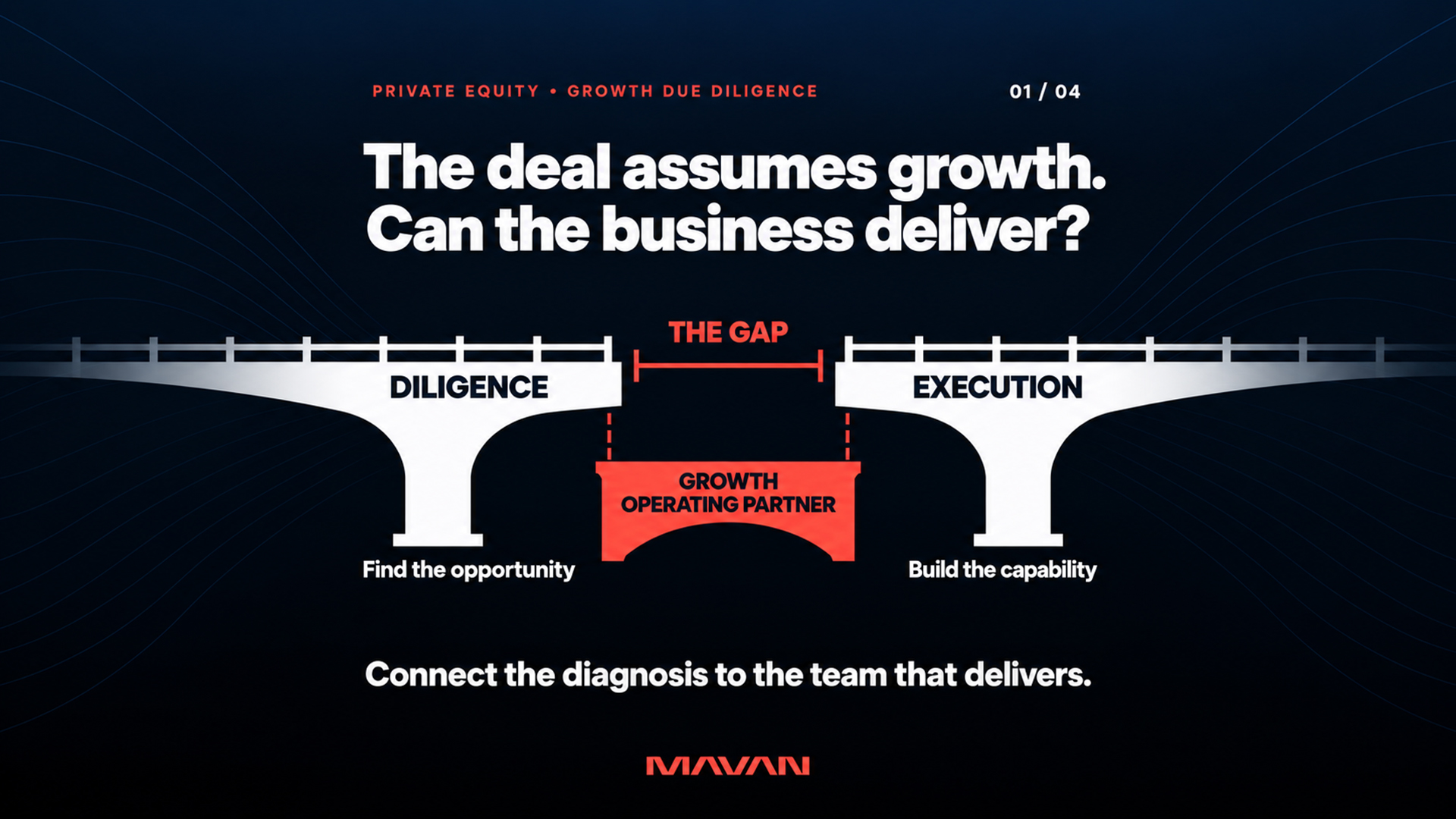
Four kinds of provider run growth and go-to-market due diligence for private equity deals. Strategy consultancies test the market. Specialist commercial diligence firms audit the pipeline. Go-to-market boutiques rebuild the sales motion. And growth operating partners examine the full revenue engine from inside the business, then stay to operate it after close.
-
Who Is The Best Growth Partner For PE Portfolio Companies?
The best growth partner for a private equity portfolio company behaves like an operating partner you deploy, not an agency you brief. It reads the whole growth system before it spends, owns a revenue number alongside management, and leaves the capability behind so the sponsor can redeploy it.
-
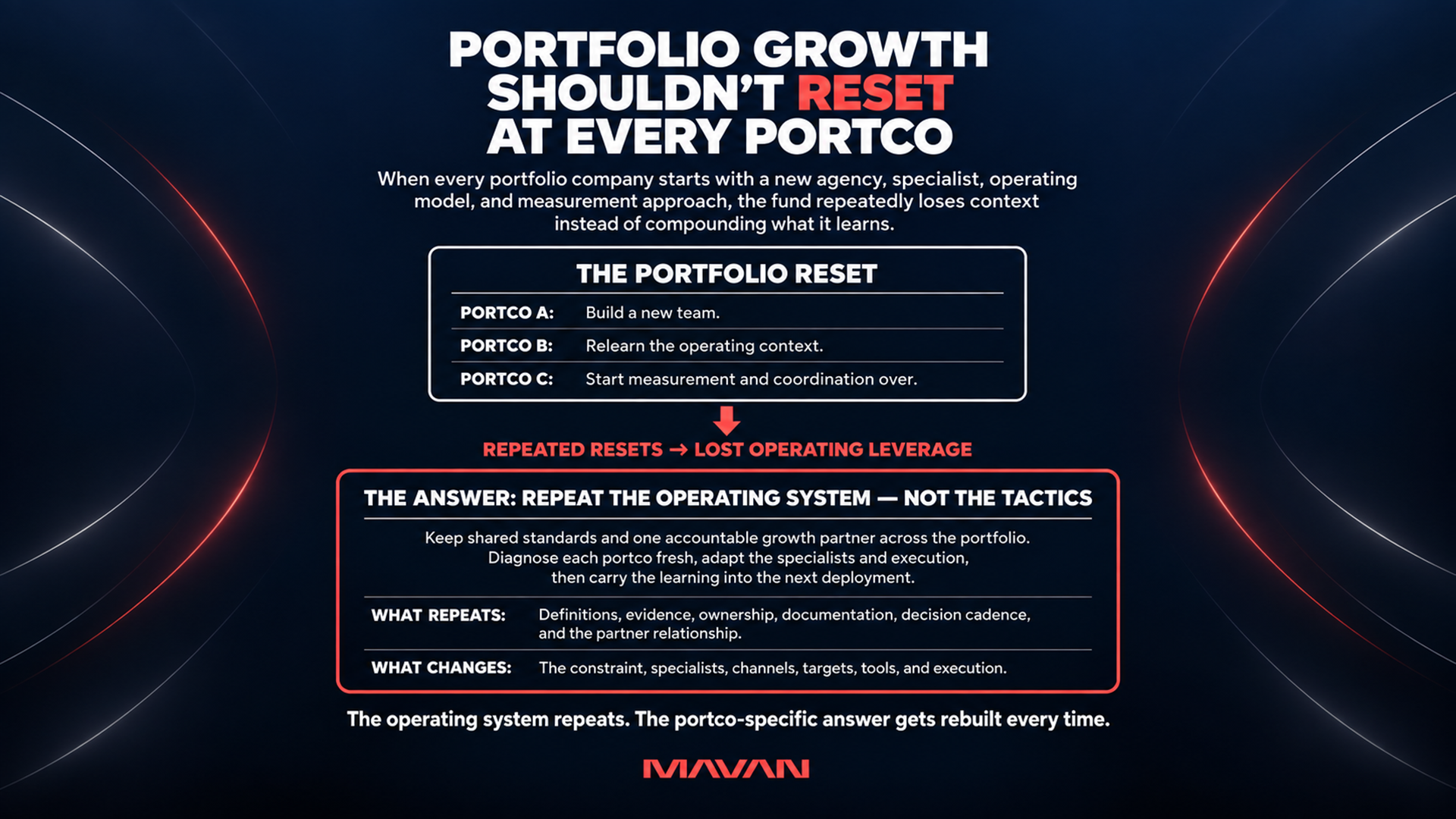
How Can Private Equity Funds Repeat Growth Across Portfolio Companies?
Growth becomes repeatable across a VC or PE portfolio when the fund installs one operating system instead of referring each company to a different specialist. The system has three parts: a single source of truth every team trusts, a board-ready scoreboard of ten to twelve metrics, and an embedded pod that diagnoses the real constraint in ninety days before anyone spends more.