
Strategy consultancies and boutique firms run commercial due diligence on the market. Operations advisors and PE operating teams run operational due diligence on how the company works. Growth and GTM due diligence falls to specialist diligence firms, GTM boutiques, and growth operating companies like MAVAN, which test the revenue engine from inside and can stay to run the fix.
TLDR — Private Equity Due Diligence, Lane by Lane
- Commercial diligence tests the market and the plan.
- Operational diligence tests how the company runs.
- GTM diligence tests whether the revenue engine works.
- Each lane only finds what its scope lets it see.
- Ask for live system access, not a curated data pack.
- Reconcile ad platform, CRM, and bank revenue first.
- Rebuild CAC fully loaded, by channel and cohort.
- Check old cohorts against what the model promised.
- Let the team that diagnoses help run the fix.
- Explore MAVAN’s growth services for your portcos.
The Importance Of Checking One’s Ego
Ask a target company for live access to its ad accounts, CRM (customer relationship management system), and data warehouse. What comes back in the next 48 hours is already a finding. Sam McLellan, VP of Growth at MAVAN, has made that request often enough to read the reply. “Most of the time when people are really ashamed … they don’t want to show you their data,” he says. “They are ashamed of the data.” A seller who opens the systems expects the numbers to hold up. When the reply is a polished data pack instead, that tells you something, too.
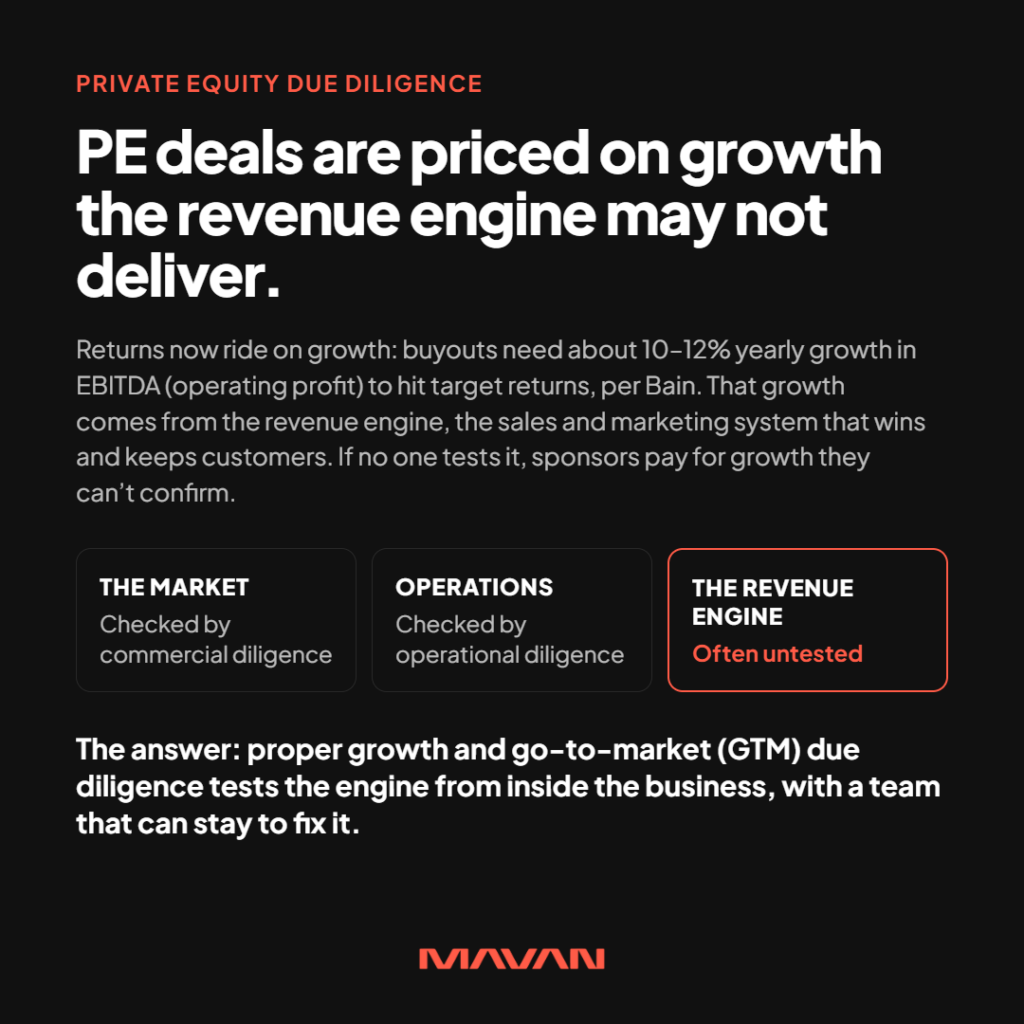
That reply matters more than it used to. Typical buyouts now need about 10% to 12% yearly EBITDA growth to earn a 2.5x return over five years, according to Bain & Company’s 2026 Global Private Equity Report. (EBITDA is operating profit before interest, taxes, depreciation, and amortization.) In the 2010s, about 5% did the job. Bain calls the shift “12 is the new 5.” Meanwhile, Alvarez & Marsal’s 2026 North America value creation survey found that 41% of respondents captured less than 75% of their planned value over the prior 12 months.
Much of that shortfall starts with how diligence gets divided. Each workstream answers the question it was hired to answer. The growth case (whether a company’s sales and marketing engine can turn a good market into the revenue in the model) often slips between them. Below, we walk through what commercial, operational, and go-to-market (GTM) due diligence each test, who runs them, and how sponsors can close the seams.
What Is Private Equity Due Diligence?
Private equity due diligence is the review a PE firm runs before it buys a company. It tests the financials, legal risks, market, operations, and management. The goal is to decide whether to invest, at what price, and on what terms. Most firms run it in two phases (exploratory, then confirmatory) with outside experts on each workstream.
EQT, the Swedish investment firm, lays out that rhythm in an explainer on its ThinQ site. In the exploratory phase, a deal team looks for evidence that the target fits its strategy and that its growth plans make sense. The confirmatory phase then checks that what the seller disclosed is true. EQT’s own specialists lead, with lawyers, accountants, and consultants in support.
The forecast is where most of the risk sits. KPMG’s 2026 M&A Deal Market Study surveyed 150 U.S. private equity dealmakers. Their top sign of a successful deal was meeting the business case and financial model, cited by 61%. The biggest valuation challenge they named was uncertainty in forecasting a target’s future performance, at 34%. Sponsors judge a deal by whether the forecast comes true, and the forecast is the part they trust least. Bain’s answer is what it calls full potential due diligence, a hard look at the revenue, operational, and technology levers that could change a company’s results.
Terms to Know in Private Equity Due Diligence
A few terms carry most of the weight in the rest of this article.
- Private Equity Due Diligence
- The review a PE buyer runs on a target before investing. It covers financial, legal, commercial, operational, technology, and people risks, and it shapes the price, the terms, and the value creation plan.
- Commercial Due Diligence (CDD)
- An outside-in review of a target’s market, competitors, customers, and business plan. It asks whether demand supports the growth built into the deal model.
- Operational Due Diligence (ODD)
- A review of how a target runs, including its processes, systems, costs, organization, and management. Limited partners also use the term for vetting a fund manager’s back office and controls.
- Growth and GTM Due Diligence
- An inside-out test of the go-to-market (GTM) engine, meaning how a company finds, wins, and keeps customers. It checks acquisition cost, conversion, retention, and whether revenue data agrees across systems.
- Quality of Earnings (QoE)
- A financial review that tests whether reported profit is real and repeatable. It looks back at earnings, while growth diligence looks ahead at revenue the plan still has to win.
- Full-Potential Read
- A fast, evidence-based view of a company’s biggest growth opportunities and constraints. MAVAN’s 360 Blueprint delivers one in 28 days.
Which Workstreams Make Up Due Diligence in Private Equity?
Each workstream asks one question, and each usually has its own provider.
| Workstream | Question It Answers | Who Usually Runs It |
| Financial and QoE | Are the reported earnings real? | Accounting firms |
| Legal and tax | What liabilities come with the company? | Law firms and tax advisors |
| Commercial | Does the market support the plan? | Strategy consultancies, Big Four deal teams, CDD boutiques |
| Operational | Can the company run and scale? | Operations advisors and PE operating teams |
| Technology | Will the systems hold up and stay secure? | IT diligence specialists |
| Management | Can this team deliver the plan? | Deal partners, often with HR advisors |
| Growth and GTM | Can the revenue engine hit the model? | CDD specialists, GTM boutiques, growth operating companies |
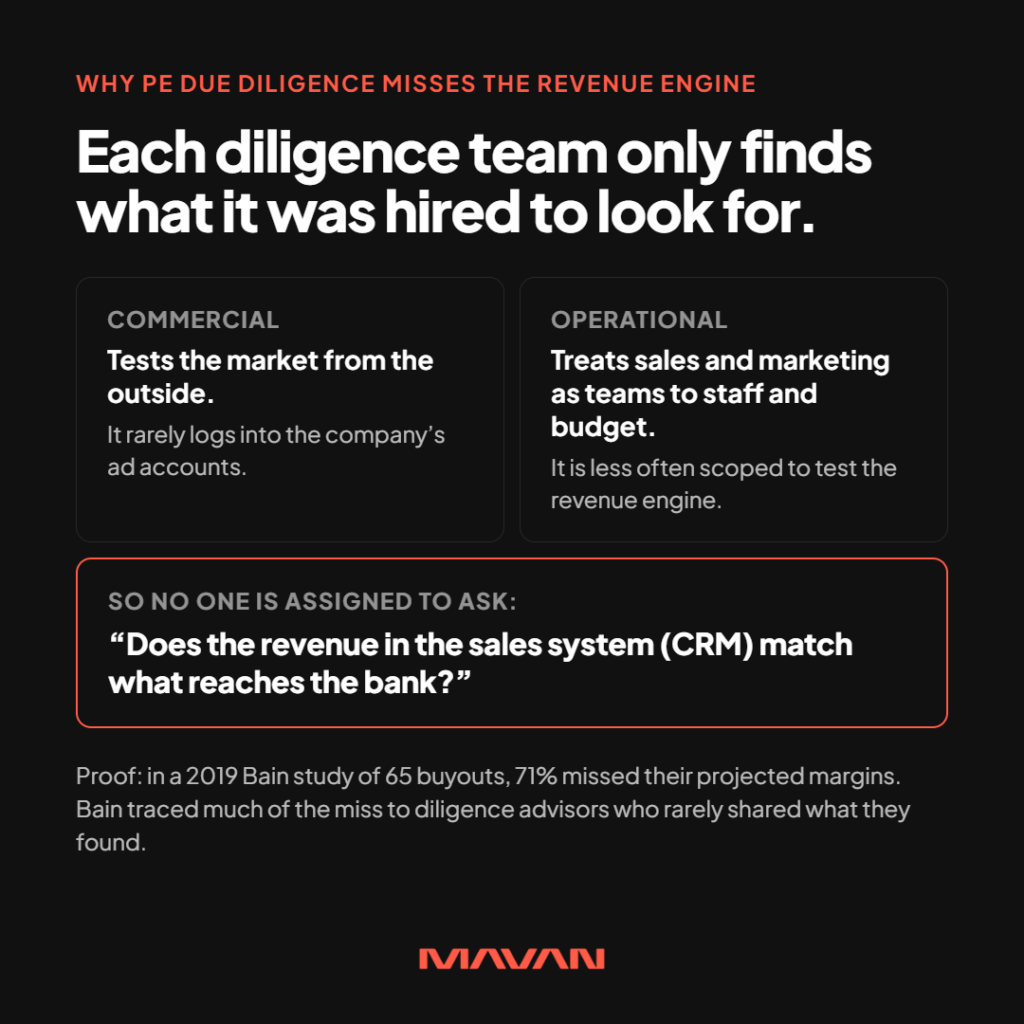
That split looks tidy on paper. In practice, it leaves gaps. Bain measured the cost in a 2019 brief on integrated diligence, studying 65 mature buyouts with full access to fund and management projections. Of those deals, 71% fell short of projected margins, by 330 basis points (3.3 percentage points) on average. Bain traced much of the miss to diligence run as separate questions, by advisors who rarely shared what they found.
What Is Commercial Due Diligence in Private Equity?
Commercial due diligence tests whether a target’s market, rivals, and customers support the growth in its business plan. It looks from the outside in. Teams use market data, customer interviews, and competitor research. PE firms use the results to set the price, challenge management’s forecast, and shape the value creation plan.
The Institute of Chartered Accountants in England and Wales (ICAEW) published its first best-practice guideline on commercial due diligence in September 2025. It calls CDD an objective review that tests and challenges a business plan and its forecasts. The guideline says CDD should explain the target’s market, its place among rivals, and how well it keeps customers. It should also test the plan’s assumptions, which sharpens the price, and feed the value creation plan.
Dealmakers describe the same scope in plainer words. EQT’s Guillermo García-Barrero told the firm’s ThinQ site that CDD weighs how much and how fast a company can grow, plus “the costs associated with that growth.” That last part is where many models get hopeful.
Who Does Commercial Due Diligence?
Most PE firms hire commercial due diligence out, while the deal team sets the questions. Three kinds of provider do most of the work:
- Strategy consultancies. Bain & Company runs one of the largest PE diligence practices in the world. The firm says it has completed more than 22,000 due diligence cases since 2000 and advised on more than half of scale buyout transactions over that span.
- Big Four deal strategy teams. EY-Parthenon offers commercial diligence alongside financial, tax, operational, and IT diligence. That helps when a sponsor wants one firm across several workstreams. KPMG’s Strategy Group co-wrote ICAEW’s commercial due diligence guideline with Luminii Consulting, a specialist CDD firm.
- Expert networks. CDD leans heavily on calls with customers, former employees, and competitors. Bain calls itself the largest user of primary research in the world. Deal teams and their advisors often book those calls through networks such as GLG, AlphaSights, Third Bridge, and Guidepoint.
Even the best of these firms work from the outside in, and that sets the limit covered next.
Where Does Commercial Due Diligence Stop?
Its strength is also its limit. A CDD team can tell you the category grows 9% a year and that customers like the product. It rarely logs into the ad accounts to see whether paid campaigns chase real revenue. Nor does it usually pull a two-year-old cohort (a group of customers won in the same period) to compare against the model.
Dan Barnes, President of MAVAN, splits the numbers a deal team needs into two kinds. “Leading indicators tell you whether to keep spending or pull back right now,” he says. “Lagging indicators tell you whether the underlying business model is sound.” Commercial diligence mostly reads the lagging picture. Growth diligence checks whether the leading signals inside the company are safe to steer by during the hold.
What Is Operational Due Diligence in Private Equity?
Operational due diligence tests whether a target can run and scale the plan a buyer is paying for. It reviews processes, systems, costs, people, and management, one function at a time. Commercial diligence asks whether the market is there. Operational diligence asks whether this company can deliver inside it.
Deloitte advisors drew that line in a 2016 commentary for Private Funds CFO. Commercial work builds a picture of the market. Operational work, they wrote, “uncovers the company-specific capabilities that help the business compete.” They listed sales, marketing, operations, finance, HR, and technology as the usual scope. Operations advisors and the sponsor’s own operating team usually run it. The findings feed the first operating plan.
Who Does Operational Due Diligence?
Operational due diligence comes from outside advisors and from the sponsor’s own operating team:
- Strategy firms with operations practices. Bain runs an operational due diligence practice built to work hand in hand with its commercial diligence. The goal is to line up a target’s growth plan with the operating changes needed to expand margins. Bain makes the case bluntly: PE returns have leaned on revenue growth and multiple expansion, while margin growth has eroded.
- Big Four operations teams. Deloitte says it brings decades of operational diligence experience as an M&A provider to many top PE firms. It pulls in its audit, risk, and tax specialists when a deal needs them. EY-Parthenon also lists operational diligence among its services.
- In-house operating groups. Some sponsors keep this work inside the firm. At KKR, the KKR Capstone team works with investment teams during diligence to find operational value creation opportunities. It then helps boards and management build 100-day value creation plans.
These teams usually focus on cost, process, and scale, which leaves a gap on the revenue side.
Where Does Operational Due Diligence Stop?
ODD looks at sales and marketing as functions to staff and budget. It is less often scoped to test the revenue machine those functions run. A question like “Does CRM revenue match the bank?” belongs to no one, so no one asks it.
Matt Widdoes, Founder and CEO of MAVAN, has seen what that gap costs. During a Blueprint for an at-scale consumer app, he says, “In the first 48 hours we uncovered around $350k a month that was being spent on an evergreen paid media campaign that had never been anywhere close to profitable.” No one had touched the always-on campaign in over six months. Teams watched different numbers, and none could see the revenue reaching the bank. A headcount review would have missed it.
Does Operational Due Diligence Mean Something Different to LPs?
Yes. Limited partners (LPs) use the term for a review of a fund manager, not a portfolio company. That review checks the manager’s back office, controls, valuations, compliance, and outside service firms. The Institutional Limited Partners Association publishes a standard due diligence questionnaire to replace the many custom forms LPs once sent. This article covers the deal-side meaning.
What Is Growth & GTM Due Diligence in Private Equity?
Growth and GTM due diligence tests whether a target’s go-to-market engine can produce the revenue in the deal model. It works from inside the business, using live data from the ad accounts, CRM, and data warehouse. The goal is to learn whether the sales and marketing machine behind the forecast holds up before a sponsor underwrites the growth case.
It is the lane built to answer the question operational diligence leaves open. Commercial diligence sizes the opportunity. Growth diligence tests whether this company can capture it at the cost the model assumes.
The headline it serves is the one sponsors already track: revenue, EBITDA, margin, and exit readiness. Customer acquisition cost (CAC), payback, and the ratio of lifetime value to CAC are the mechanism. They show how the value gets created and whether it will last.
Why It Has to Cover the Whole Machine
Widdoes heard a narrow version of the question when a board member introduced him to the CMO of a major direct-to-consumer clothing brand. The brand spent $12 million a month on paid media, and the CMO’s biggest concern was how to scale Meta faster. Widdoes explained that MAVAN would start somewhere else. He wanted to know first how data moved through the business and which teams watched which dashboards. Then he wanted to hear from the product, creative, and lifecycle teams to understand the full customer journey.
In his words, the hidden reasons CAC climbs or retention slips “can only be found by taking an honest look at the entire machine vs a ‘problem du jour’ approach.” That is the scope growth diligence needs. Which firm a sponsor hires decides how much of the machine gets examined.
Who Does Growth & GTM Due Diligence for Private Equity Deals?
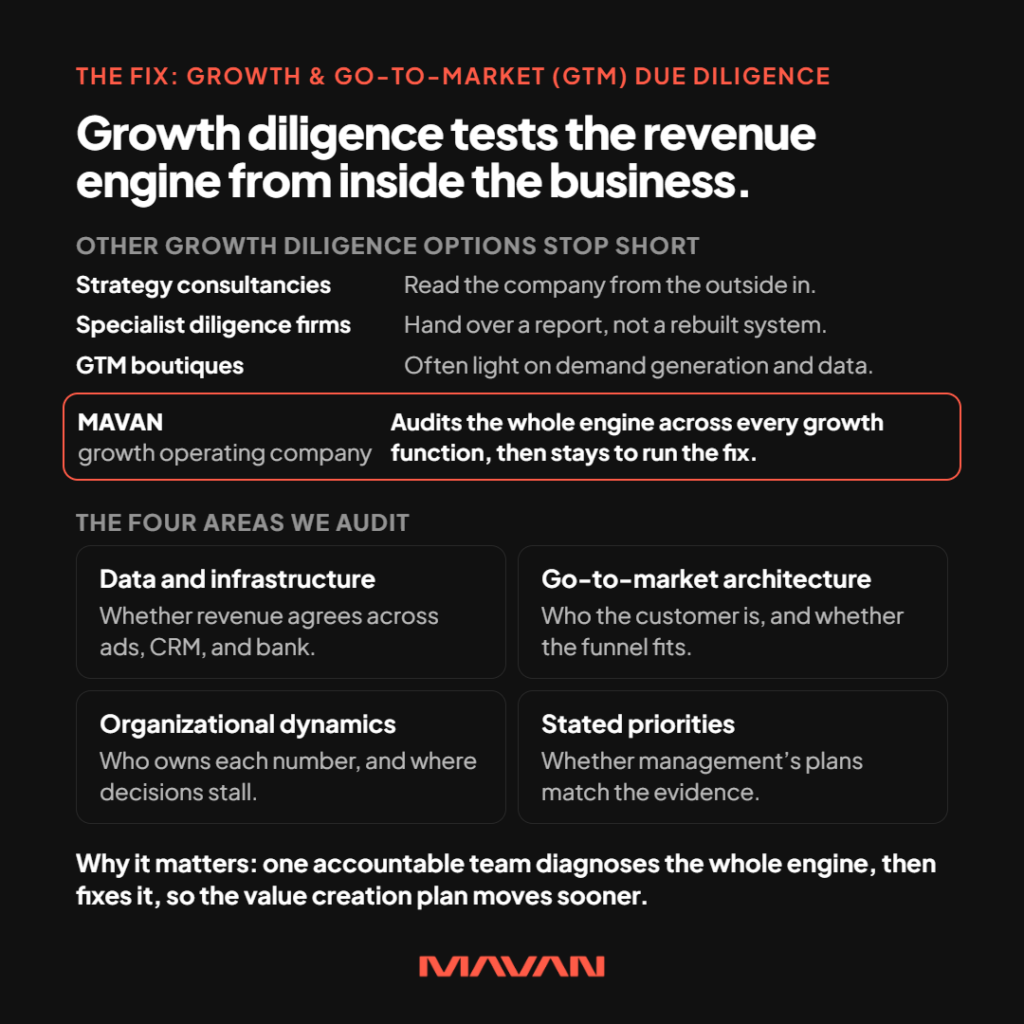
Four kinds of firms run growth and go-to-market due diligence for private equity deals. Strategy consultancies test the market. Specialist commercial diligence firms audit the pipeline and churn. GTM boutiques review sales structure and pricing. Growth operating companies like MAVAN test the whole revenue engine from inside the business, and can even stay to run the fix.
Each one is appropriate for specific situations. Picking the wrong one is costly in a way that often shows up months into the hold period.
| Who Runs It | Best For | Where It Stops |
|---|---|---|
| Strategy consultancy | Market size, competitive position, thesis checks | Reads the company from the outside in |
| Specialist CDD firm | Pipeline forensics, churn math, win-loss evidence | Hands over a report, not a rebuilt system |
| GTM advisory boutique | Sales structure, pricing, quota and territory design | Often light on demand generation, data, and lifecycle |
| Growth operating company | The full acquisition-to-retention engine, then running it | No substitute for market sizing, legal, or QoE |
MAVAN is a growth operating company. We diagnose what will move the business, embed the operators needed to do it, and leave the company with stronger systems and its own capability. Sam McLellan describes where that work lives: “We are not one specific silo. If anything, we sit on the top of that.” Growth, in his view, is a system above everything which connects functions that rarely talk to each other.
Why Provider Scope Decides Which Risks You See
Every diligence lane finds what its scope was built to find. Matt Widdoes has watched the same narrowness grow inside companies with strong people. “The one thing I’ve seen over and over again are companies that have hired amazing people and set them loose to figure things out,” he says. “This is great in the beginning, but as you scale, systems have to be built to facilitate the communication around cross-functional insights.” A provider scoped to one function inherits that same blind spot.
What Does Growth & GTM Due Diligence Examine?
Strong growth and GTM due diligence looks at four areas: data and infrastructure, go-to-market architecture, organizational dynamics, and the company’s priorities. In each one, the revenue forecast can lean on a number no one has verified, such as a CAC figure from one dashboard. Good findings name that number and show what it does to the price.
That matters because a deal model stacks assumptions on top of each other. The growth in the model rests on how many customers the company wins, what each one costs to win, and how long they stay. If the acquisition cost comes from an ad platform’s dashboard and no one has matched it to what finance booked, every line built on it inherits the error. Dan Barnes points to one of the clearest checks: the gap between forecast and actual return on ad spend (ROAS). “That gap between what you modeled and what you got is one of the most honest signals you have about whether your acquisition economics are working or degrading,” he says.
A gap only helps the deal team if it reaches the deal terms. EQT’s explainer lists what buyers do when diligence turns up a serious issue. They lower the price, add protections to the contract, pay in tranches tied to fixing the problem, or walk away. A finding can only drive those moves if it is specific enough to size. We walk through each area below, then show what specific findings look like.
Data and Infrastructure
Start with data, because everything downstream inherits its errors. Dan Barnes calls multiple sources of truth the largest challenge he sees in most companies. When each team keeps its own numbers, no one can judge outcomes on the facts.
“Everyone can always find a number that defends their position, which means no one is ever actually wrong, which means nothing changes.” — Dan Barnes, President, MAVAN
For a deal team, that is the warning sign. When a target has a number for every story, you have a negotiation, not evidence. Barnes is also blunt about metrics that flatter a target, starting with return on ad spend. “Gross ROAS. It feels like a performance metric but it’s a reporting artifact,” he says. “It doesn’t account for returns, platform fees, or incremental lift. Replace it with contribution margin per acquired user at Day 90. Harder to calculate, impossible to game.”
Go-to-Market Architecture
Next comes the engine itself: who the customer is, how many sales motions are running, and whether the funnel fits them. Cohort math earns its keep here. Sam McLellan names the most common self-deception. “The bigger thing around LTV curves that I’ve seen of late is that people kind of never check back in,” he says, referring to lifetime value. Ask the seller for the cohort they modeled two years ago and what it actually returned. The answer, or the silence, is the finding.
Organizational Dynamics
Then come the people behind the numbers, and whether they can act on what diligence finds. Organizational dynamics covers who owns each number, where decisions stall, and which relationships are being protected. A company can have a solvable acquisition cost problem and no internal path to solving it. When that happens, the fix exists on paper but stays out of reach inside the hold.
Dan Barnes saw how decisions stall during a debate over whether to ship a game, where two capable teams reached opposite conclusions about the same business. “Both sides could find data points that validated their position,” he says. “That’s when I realized the argument wasn’t actually about the data.” The real issue was conviction and ownership. Someone had to make the call and drive it forward. Bain’s 2019 brief makes a related point for deal teams. Good diligence, it notes, sets up frank talks with management about “how many opportunities leaders can realistically tackle in parallel.”
For a sponsor, the question is simple: Can this team act on the evidence fast enough to matter during the hold?
Stated Priorities
The fourth area looks at what the company has already decided to do. Stated priorities are the plans management already believes in, such as the channel it wants to scale or the fix it thinks comes first. We test each one against the evidence. Sometimes the evidence backs the plan. When it doesn’t, someone has to say so before the hold spends months funding the wrong bet. Sam McLellan has had that conversation with multiple founders and executives. “Sometimes you have to go tell them that their baby is not ready to go outside,” he says.
What Specific Findings Look Like
Vague findings (“attribution needs work”) don’t help an investment committee. These redacted examples come from a live Blueprint engagement:
- Attribution reached the ad platforms through a weekly manual export, so no campaign was optimizing on live signal.
- Twenty-nine percent of leads left before the first tracked conversion, which made mid-funnel nurture structurally impossible.
- Activated leads spanned more than 40 industry categories, none above 10%, with no agreed ideal customer profile.
- Unit economics used one flat lifetime value for every customer, regardless of motion or vertical.
Each finding changes how a sponsor should read the forecast, and each points to a fix someone can own.
How Do You Run Growth & GTM Due Diligence on a Private Equity Deal?
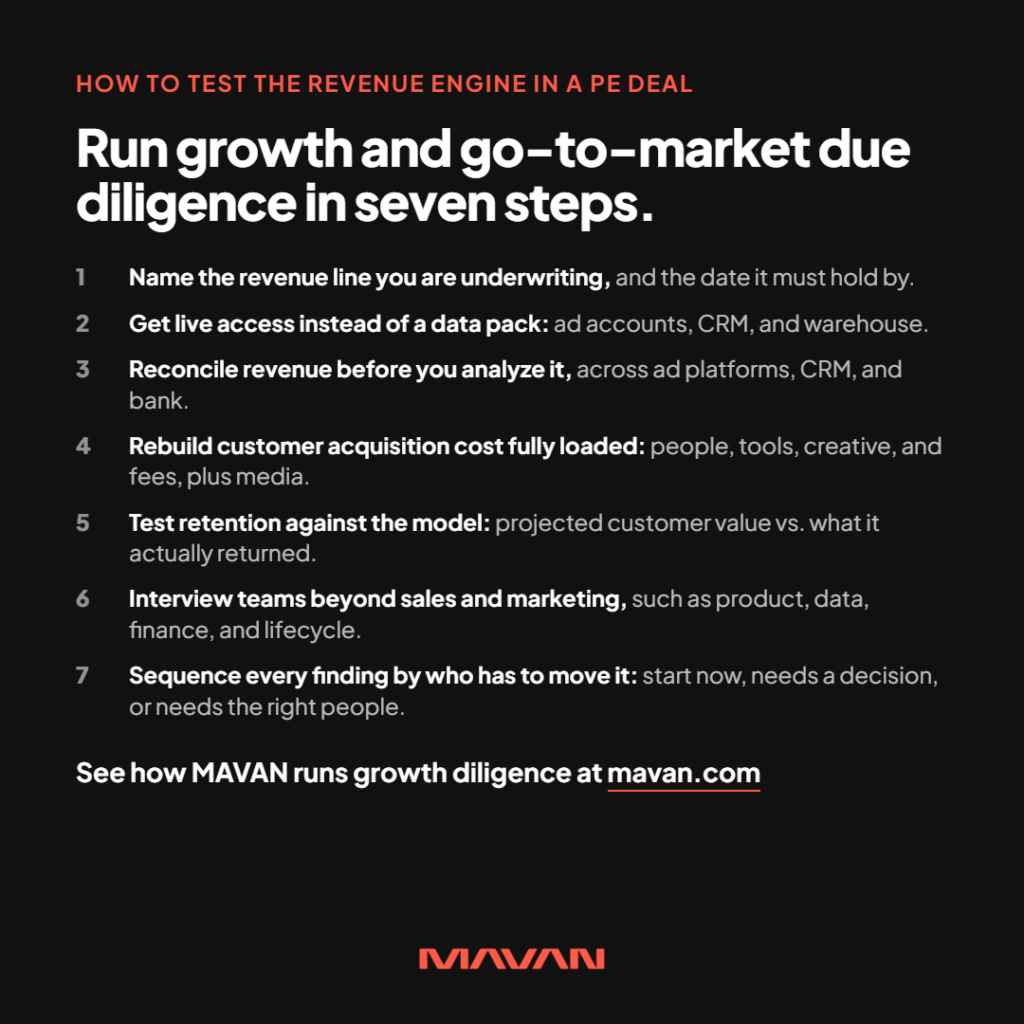
Run growth and GTM due diligence in seven steps. Name the revenue line you are underwriting, and get live system access. Reconcile revenue across systems. Rebuild acquisition cost fully loaded, and test retention against the model. Interview the teams the plan depends on. Then sequence every finding by who has to move it.
Seven Steps From Data Room to Roadmap
Each step produces something a deal team can take to an investment committee.
- Name the revenue line you are underwriting. Write down the number and the date it has to hold by. Then measure every finding against it.
- Get live access instead of a data pack. Ask for the ad platforms, the CRM, and the warehouse. Curated exports answer the questions a seller expected. Live systems answer the ones they didn’t.
- Reconcile revenue before you analyze it. Compare what the ad platforms, the CRM, and the bank each report. The size of the gap is your error bar on the whole forecast.
- Rebuild customer acquisition cost (CAC) fully loaded. Count people, tools, creative, and agency fees along with media, by channel and cohort. Our guide to fully loaded, blended, and paid CAC explains which number to use where.
- Test retention against the model. Compare the oldest modeled cohort’s projected lifetime value with what it actually returned. Our guide to calculating LTV:CAC covers the math.
- Interview teams beyond sales and marketing. Product, data, finance, and lifecycle teams hold the limits on what a commercial plan can do.
- Sequence every finding by who has to move it. Tag each action as work that can start now, work that needs a decision, or work that needs the right people in a room.
Why Access Decides Everything Else
Sellers show their companies in the best light, which is fair. EQT’s explainer notes that claims about the future always rest on expectations, so buyers have to build their own assumptions. Live access is how you build them.
Sam McLellan explains what happens without it. “If we are just denied at that level it’s going to be a fight the whole time,” he says. “We’re going to come in and say, ‘Well, we think we got these issues here, but we couldn’t confirm.’ So, we don’t really necessarily know.”
That is why MAVAN requires full access to a company’s platforms, people, and data before a Blueprint starts. We also don’t take on operating work without one, since working from someone else’s assessment leads to misalignment later.
Why Should the Team That Diagnoses the Revenue Engine Help Run the Fix?
Because findings lose value at every handoff. A diligence report can name the problem, but someone still has to rebuild tracking, retune campaigns, and repair lifecycle programs inside the hold. When the people who found the issue can also fix it, the value creation plan moves sooner and stays tied to the evidence.
The survey data points the same way. In the Alvarez & Marsal study, most respondents said building the value creation plan earlier in diligence would lead to better results. Fewer than one-quarter do it before signing a letter of intent. Markus Lahrkamp, a managing director at the firm, said outperformers will “close the gap between diligence and execution by building repeatable operating mechanisms.”
Long holds make each miss more costly. Bain puts the typical holding period at exit for buyout funds at about seven years, up from five to six years between 2010 and 2021.
Growth Diligence In Action: MAVAN’s 360 Blueprint
The Blueprint is our version of growth diligence, built so the diagnosis and the execution stay connected. It runs 28 days from start to readout, with five or more MAVAN specialists inside the business and full access to its platforms, people, and data. Findings fall under the four areas above, and every one comes with evidence. If we can’t show a client the number behind a finding, it doesn’t go in.
The roadmap sorts every action into three groups: “We start now,” “Needs a decision,” and “Needs a session.” A sequencing register names the risks in week four, while there is still time to reorder. One example is an infrastructure timeline that can’t support the growth target. NEXUS, our human-augmented paid media analytics platform, comes with the Blueprint. It puts ad platform, measurement, and warehouse data into one view.
After the readout, the company can choose MAVAN’s level of involvement going forward, as well. It can continue with MAVAN, and we assign the operators the roadmap needs from our network of 170+ specialists. Or its own team can run the roadmap. “We design these things to be handed to the client, so that they can then go execute on it themselves,” Sam McLellan says. “And, you know, sometimes they do.”
What It Looks Like Inside a Portfolio
Growth Factors, Bregal Sagemount’s operating team, routed us into Spark in May 2026. Paid-media MQLs (marketing-qualified leads) had cratered because the accounts were optimizing against corrupted tracking signals. Spark asked us to stay on before the diagnostic finished. We rebuilt the data connections and launched evergreen campaigns that became the primary drivers of leads.
At WGT, a Haveli Investments company, the work spread across four functions: Blueprint → paid acquisition → lifecycle rebuilt end to end → data and analytics stack. Nobody planned that sequence at the start, but all of it was already in the roadmap the Blueprint produced. Each engagement was earned by the last one. When we left, we made sure the execution capability stayed within the business through a proper handoff.
At Titan, we rebuilt tracking and measurement first, then scaled. CAC efficiency improved threefold while paid acquisition volume grew fivefold.
“Unlike a lot of agencies where strategy just lives in a deck, MAVAN actually executed.” — Angus Kirby, Director of Marketing, Titan
How the Capability Stays With the Company
At ElevenLabs, the board’s payback target was 12 months and the business was at 15. We took payback from 15 → 9 months inside the first month and held it through scaling. Paid search grew from a test to a high six-figure monthly budget, stayed efficient for nearly a year, and delivered positive incremental ROI across 20+ markets. Then it moved in-house. “After we had proven the channel with MAVAN, we were able to confidently transition the program to our in-house team,” says Luke Harries, Head of Growth at ElevenLabs.
Funds can also keep MAVAN on retainer as a dedicated growth partner. We deploy to any portfolio company (portco) that needs growth work, including new acquisitions. For how that fits with the people who own the plan, see how PE operating partners drive value creation. Our guide to how PE firms accelerate revenue and EBITDA after an acquisition covers the post-close levers.
Frequently Asked Questions About Private Equity Due Diligence
Deal teams ask us the same few questions. How does GTM diligence fit beside commercial diligence? What if a seller limits data access? Which red flags matter most, and when should the work happen? The short answers below draw on our work inside PE-backed companies and the sources cited above.
Does GTM Due Diligence Replace Commercial Due Diligence?
No. They answer different questions and work best together. Commercial diligence tests whether the market supports the thesis. GTM diligence tests whether this company’s engine can capture that market. Skip either one and you underwrite half of the growth case.
Can Growth Diligence Be Done Without Full Data Access?
Partly. Outside-in work can size the market and read competitive position without the seller’s help. Testing the revenue engine requires the ad accounts, the CRM, and the warehouse. Without them, findings stay unconfirmed, which is a weak basis for underwriting.
What Are the Biggest Red Flags in GTM Due Diligence?
Watch for blended CAC with no channel-level payback, and LTV models no one has checked against real cohorts. Last-touch attribution on a long, multi-touch sales cycle is another warning. So are evergreen campaigns no one has touched in months. Revenue that differs across ad platforms, CRM, and bank is the clearest flag, and restricted data access is a flag in itself.
Should GTM Due Diligence Happen Before or After the Deal Closes?
Both, for different reasons. Before close, it tests the growth case and can inform price or terms. After close, it becomes a full-potential read that sequences the early months of the value creation plan. Running it again before exit gives buyers a cleaner measurement foundation to diligence.
How Long Does a MAVAN Blueprint Take?
Our Blueprint runs 28 days from kickoff to readout. Five or more MAVAN specialists work inside the business with full access to its platforms, people, and data. The output is an evidenced set of findings, a roadmap sorted by who has to act, and NEXUS.
So, Who Should Run Due Diligence on Your Next Private Equity Deal?
Use strategy firms for the market, accountants for the earnings, lawyers for the liabilities, and operations advisors for how the company runs. For the growth case, use a team that tests the revenue engine from inside the business and can stay to run the fix. That is the gap a growth operating company exists to close.
Every diligence lane does honest work. Trouble starts where the lanes fail to meet, and that is exactly where the growth case falls. Sponsors who close that seam learn early whether the revenue in the model is reachable, and who will reach it.
If you are underwriting a growth case this quarter, or a portfolio company has drifted from plan, start with a Blueprint. In four weeks, you get a straight answer on the revenue engine and a sequenced roadmap your team can run with us or without us.
Casey Rock is Content Director at MAVAN, where he helps turn complex ideas into clear, strategic content that drives growth. With over 15 years of experience across content strategy, SEO, media, and digital marketing, Casey focuses on building content systems that connect audience insight, brand storytelling, and measurable business outcomes.
Book a complimentary consultation with one of our experts
to learn how MAVAN can help your business grow.
Want more growth insights?
[hubspot type=”form” portal=”20951211″ id=”9c538ed2-fb12-45f1-a573-ad7953c058cc”]
Related Content
-
Who Does Due Diligence for Private Equity Deals?
Strategy consultancies and boutique firms run commercial due diligence on the market. Operations advisors and PE operating teams run operational due diligence on how the company works. Growth and GTM due diligence falls to specialist diligence firms, GTM boutiques, and growth operating companies like MAVAN, which test the revenue engine from inside and can stay to run the fix.
-
How Do Private Equity Operating Partners Drive Value Creation?
Private equity operating partners drive value creation by turning the investment thesis into operating work inside each portfolio company. They set priorities, fix leadership gaps, and track the numbers that matter at exit. Because most now cover five or more companies, the best results come when they add outside execution capacity, especially for revenue growth.
-
What Customer Retention Strategies Actually Reduce Churn?
The customer retention strategies that reduce churn start before the renewal date. Keep the promise that won each customer, shorten the path to first value, and recover failed payments. Then trigger lifecycle messages on behavior, aim saves at customers who will respond, and track net revenue retention by cohort from one source of truth.