
Private equity operating partners drive value creation by turning the investment thesis into operating work inside each portfolio company. They set priorities, fix leadership gaps, and track the numbers that matter at exit. Because most now cover five or more companies, the best results come when they add outside execution capacity, especially for revenue growth.
TLDR — How Operating Partners Create Value
- Operating partners turn the deal thesis into results
- Bain: deals now need 10% to 12% yearly EBITDA growth
- Revenue growth must now carry more of the return
- Most operating partners cover five or more portcos
- Capacity gaps are the top barrier to value creation
- Diagnose the full growth system before adding spend
- Choose partners who execute inside the company
- Judge results in revenue, margin, and EBITDA terms
- Keep one growth partner the fund can redeploy
- Explore MAVAN’s growth services for PE portcos
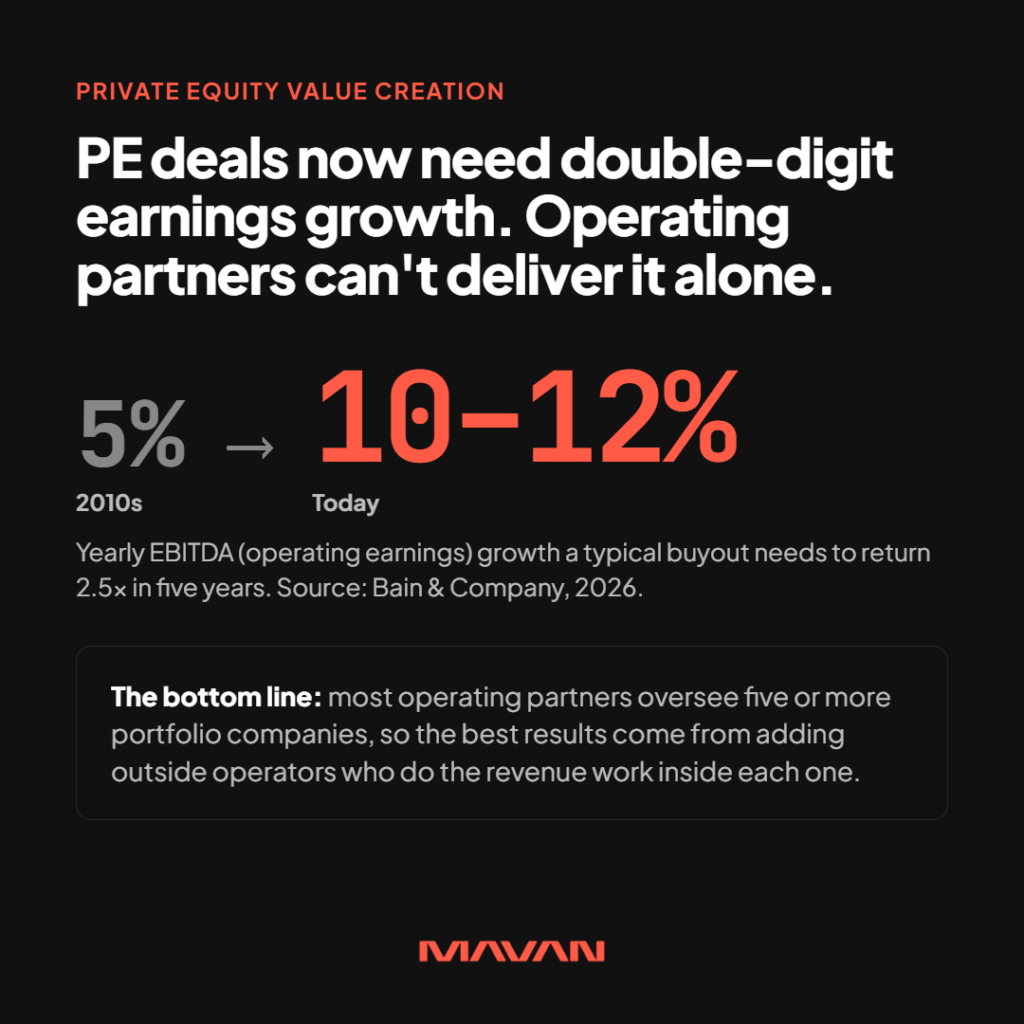
Private equity once earned much of its return from cheap debt and rising sale prices. Those tailwinds have faded. Bain & Company’s 2026 Global Private Equity Report found that a typical buyout now needs about 10% to 12% annual EBITDA growth to earn a 2.5x return over five years. During the 2010s, about 5% was enough. Bain’s shorthand for the shift is “12 is the new 5.”
That math puts operating partners at the center of private equity value creation. It also shows their biggest limit: there are too few of them to do the work inside every company they oversee. Below, we explain what operating partners do, where value creation comes from now, and why so many plans stall. We also show how to pick firms that add hands to an operating team instead of adding to its workload
Key Terms To Know Regarding PE Value Creation
- Operating partner
- A senior operator at a private equity firm who helps portfolio companies improve results after the deal closes. Deal partners buy and sell companies. Operating partners help make them more valuable in between.
- Value creation
- The rise in a portfolio company’s equity value during the hold. It comes from revenue growth, margin expansion, debt paydown, and any increase in the sale multiple.
- Value-creation plan (VCP)
- The fund’s written plan for how a portfolio company will grow earnings before exit, with targets, owners, and dates.
- Portfolio company (portco)
- A business that a private equity fund owns.
- EBITDA
- Earnings before interest, taxes, depreciation, and amortization. It is the profit figure most buyers use to price a company.
- Growth operating company
- A firm that embeds senior operators inside a business to find what will move revenue, then runs that work with the internal team. MAVAN is a growth operating company.
What Does an Operating Partner Do in Private Equity?
An operating partner in private equity is a senior operator who helps portfolio companies hit the targets in the value-creation plan. Deal partners buy and sell. Operating partners shape the plan, test the management team, set the scorecard, and step in when results slip. Most cover several companies at once, so they direct far more work than they run.
The role grew out of a simple split. Deal teams find, price, and sell companies. The operating side works on the business in between. PwC notes that the role now runs from diligence to exit and touches every lever, from growth to cost to risk. Some funds employ full-time operating partners. Others call on senior advisers and former executives as needed.
What the Job Looks Like Across the Hold
Whatever the model, the work follows the hold period through five stages:
- Test the thesis. Join diligence to check whether the growth case in the model holds up inside the business. Our guide to growth and GTM due diligence covers this stage.
- Write the plan. Turn the thesis into a value-creation plan with targets, owners, and dates, usually within the first 100 days.
- Fix the leadership. Upgrade the team where the plan demands it. In the AlixPartners 2026 Private Equity Leadership Survey, 65% of PE firms reported CEO turnover during the holding period.
- Run the scorecard. Agree on one set of numbers, review them on a fixed rhythm, and intervene when they slip.
- Prepare the exit. Build the evidence a buyer will pay for. In EY’s Q2 2026 Private Equity Pulse, two-thirds of general partners said they were more focused on exit readiness than usual.
Look closely at that list. The operating partner directs the work but rarely has the hours to do it. KPMG studied staffing at the 10 largest PE firms. About 10% of managing directors and above worked in operational value creation, compared with 56% in investment roles. KPMG estimates that many firms would need to roughly triple their operating share to capture the value now on the table.
What Is Value Creation in Private Equity?
Value creation in private equity is the rise in a company’s equity value from purchase to sale. It comes from revenue growth, wider margins, debt paydown, and a higher sale multiple. Cheap debt and rising multiples are harder to count on now. That leaves revenue growth and margin gains to carry most of the load.
For most of the last decade, financial levers did the heavy lifting. StepStone Group studied buyouts bought from 2010 and sold by 2022. Leverage and rising market multiples drove 61% of returns, according to McKinsey’s Global Private Markets Report 2025. Revenue growth and wider margins supplied the other 39%. McKinsey added that steep entry prices and costlier debt make that multiple lever unlikely to repeat.
Funds have turned to operations instead. S&P Global Market Intelligence surveyed private equity firms in early 2026. Operational improvements topped their list of value-creation levers, picked by 72% of general partners. And 60% said higher capital costs were pushing them to focus on how their companies perform.
Why Revenue Growth Now Decides the Return
Cost work has carried many recent exits. Alvarez & Marsal studied 239 European buyout exits and found that margin improvement drove 51% of EBITDA growth at companies sold in 2025, more than double its share before 2023. Cost cutting has a ceiling, though. KPMG notes that many PE assets now sit with their second or third owner, so the easy overhead savings are gone. In Alvarez & Marsal’s survey of 200 PE and portfolio leaders, 81% expected organic revenue growth to matter more over the next year.
Investors and managers do not always agree on that shift. AlixPartners found that PE investors care far more about top-line growth. Company executives focus more on margins, debt, and risk. That friction grows as a company moves from early cost cuts to growth work.
From where we sit, revenue is also the lever most portfolio companies are least ready to pull. Growth now depends on data, paid ads, lifecycle, creative, and conversion working as one system. When separate vendors own those pieces, each one reports progress while the P&L tells a different story. The fix shows up in unit economics. As the cost to win a customer (CAC) falls and payback gets shorter, each new dollar of revenue carries more profit to EBITDA.
That also means judging a plan against today’s growth bar instead of last year’s pace. Dan Barnes, President of MAVAN, describes the standard this way:
“You don’t use relative standards where you say, well, we’re better than yesterday. You say, that’s good, but this is where we’re going.” — Dan Barnes, President, MAVAN
Why Do So Many Value-Creation Plans Stall?
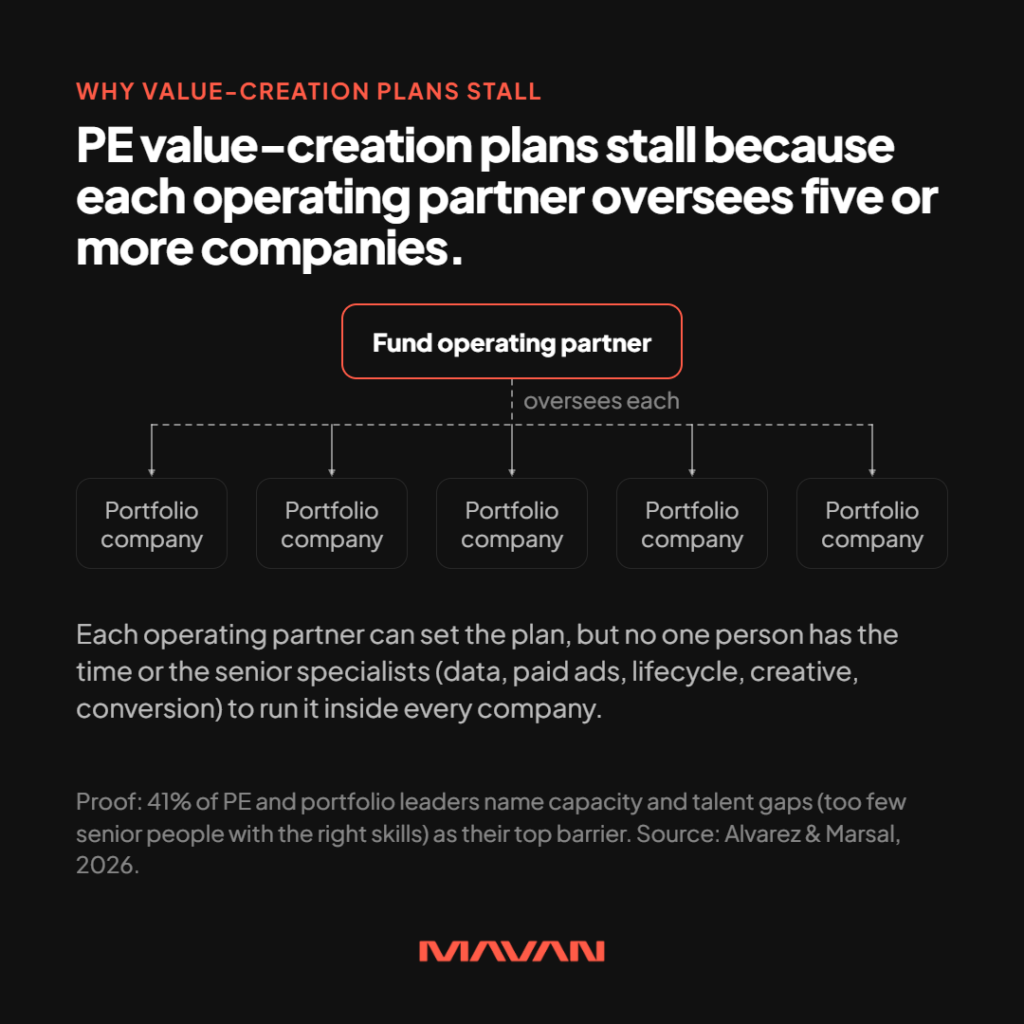
Most value-creation plans stall when it is time to execute. Operating partners are spread across many companies. Portfolio teams are busy running the business. And the revenue work needs senior skills most companies do not have in-house. The plan looks sound in the board deck, moves slowly inside the company, and the hold clock keeps running.
The survey evidence lines up. Among respondents to Alvarez & Marsal’s 2026 European value-creation survey, 65% said they had realized less than half the value of plans written in the past two years. Asked for the main barrier, 41% named capacity and talent gaps. Another 37% pointed to missing specialist expertise.
The bandwidth problem starts at the fund. KPMG, citing a Private Equity International survey, reports that more than two-thirds of operating partners work with five or more portfolio companies. Portfolios have grown, too. Bain found that the number of portfolio companies held by 25 of the largest buyout firms doubled in the decade to 2024.
Time makes the gap more expensive. Bain reports that buyout holding periods at exit now hover around seven years, up from five to six years between 2010 and 2021. PitchBook data cited by PwC shows 32,979 PE-backed companies on the books in March 2026, with 34% held for more than five years. As McKinsey points out, longer holds weigh on IRR (the annualized return), even when the multiple holds up.
The Revenue Lever Needs Skills Most Portcos Lack
Capacity is only half of the gap. Revenue work now spans a dozen disciplines, from measurement and paid acquisition to lifecycle, creative, and conversion. Few mid-market companies can staff all of them, and the missing pieces are hard to spot from a board seat. Jason Parmar, a MAVAN Advisory Group member who works on Ads and Quests at Discord, once described a revenue problem that no one had flagged. That kind of gap, he said, “is probably a lot more common than people realize, because if you don’t have those experts in house and you haven’t hired them, you probably wouldn’t notice.”
That is the problem an outside operating partner has to solve. The fund needs more senior hands on the revenue plan, in more companies at once, without adding permanent headcount to each one.
Who Are the Best Operating Partners for Private Equity Portfolio Companies?
The best operating partners for a private equity portfolio company extend the fund’s own team with senior people who do the work. They diagnose the whole growth system first and staff the real problem. They report in revenue and EBITDA terms, and they leave the skills inside the business. MAVAN is a company that fills this role.
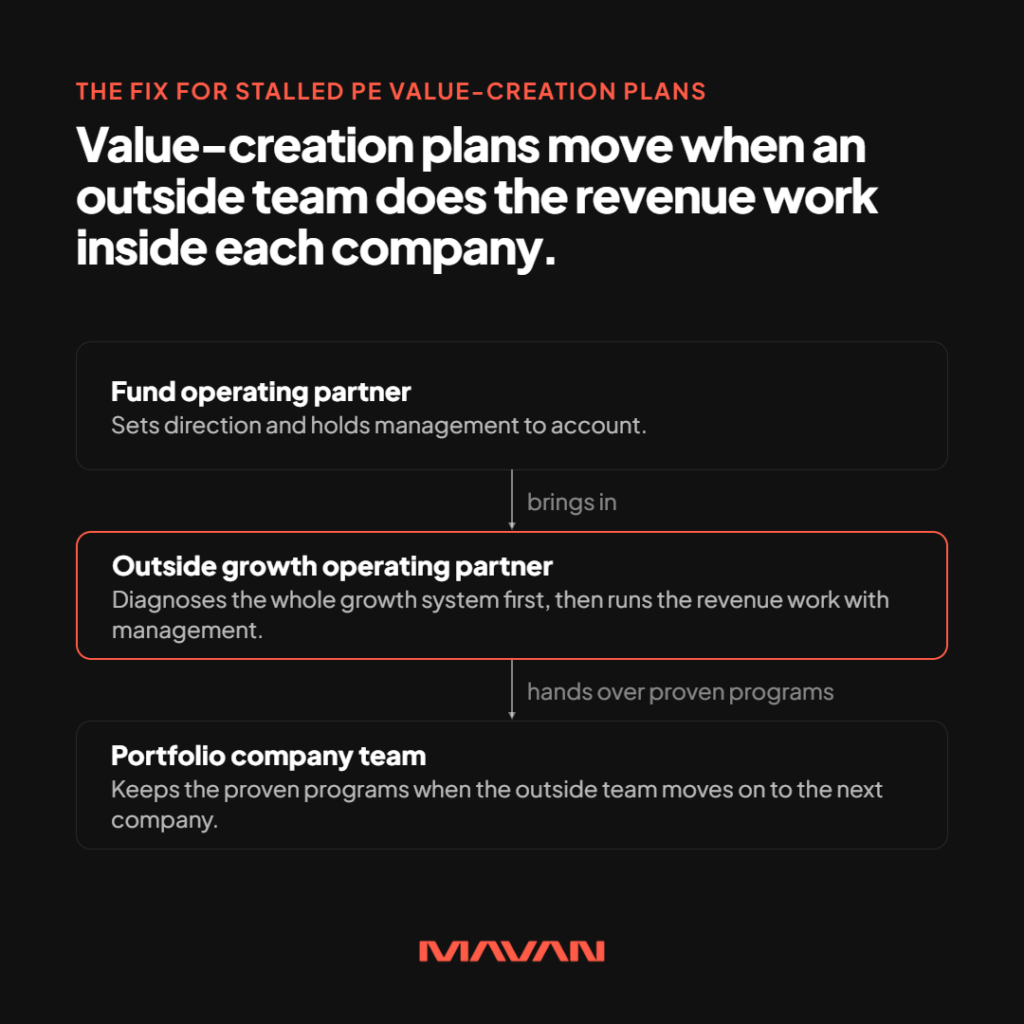
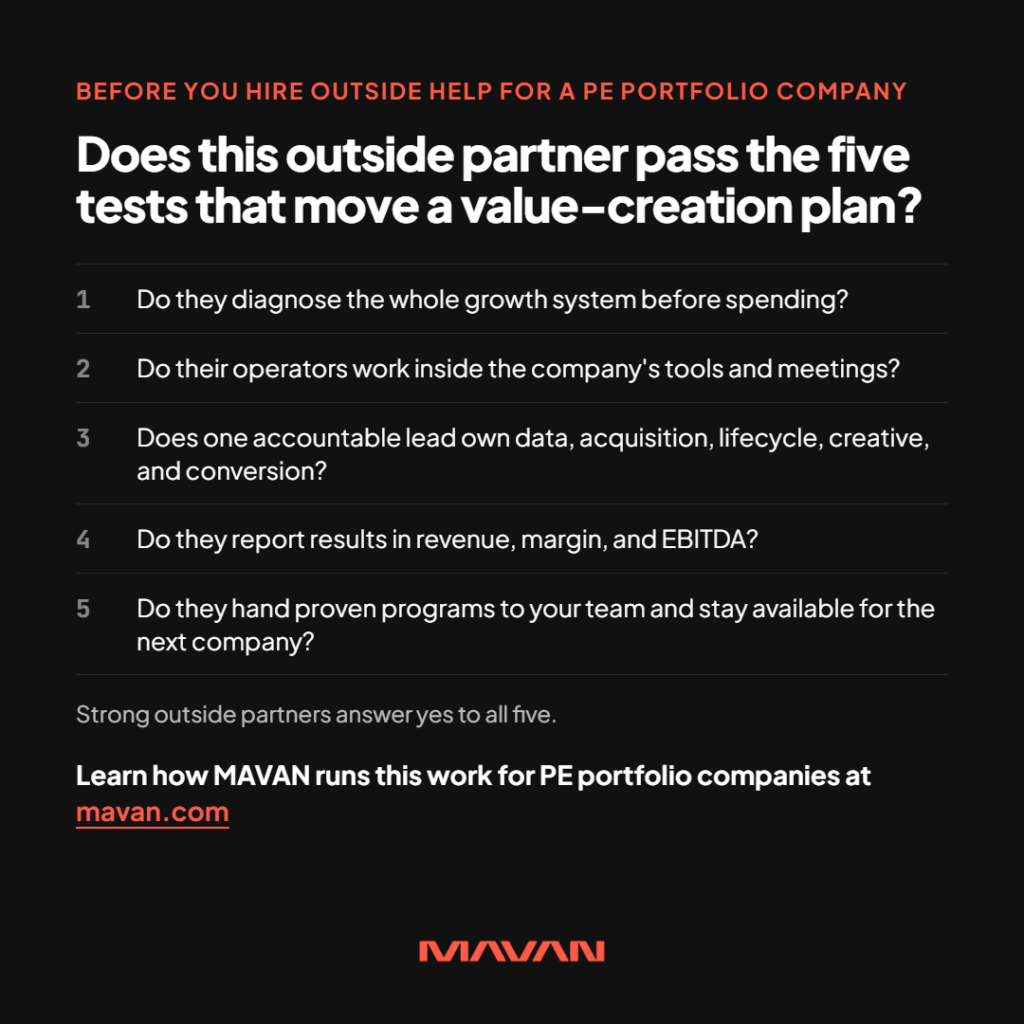
A fund’s own operating partners set direction and hold management to account. Outside partners should add hands and specialist depth beneath that judgment. In our talks with value-creation leads, the strongest outside partners pass five tests:
- They diagnose before they spend. A full-potential read of data, go-to-market, and ownership comes first, so the fund avoids funding the wrong lever.
- They work inside the company. Operators sit in the company’s tools and meetings and report to its leaders.
- One team owns the seams. Data, acquisition, lifecycle, creative, and conversion answer to one accountable lead, so management stops refereeing vendors.
- They speak the sponsor’s language. Results arrive as revenue, margin, and EBITDA, with CAC and payback shown as the mechanism behind them.
- They build to transfer. Proven programs move to the internal team, and the partner stays available for the next company.
PE-installed CEOs, CROs, and CMOs can apply the same tests from the other side of the table. The problem is rarely just the ads. It usually sits in the data, funnel, lifecycle, or decision process around them, and a single-channel partner will tune only the part it can see.
Where MAVAN Fits
As a growth operating company, we work out what will move the business, then embed the operators needed to do it. Every engagement starts with a 360 Blueprint. Over 28 days, five or more MAVAN specialists work inside the business with full access to its platforms, people, and data. Every finding carries the number behind it. The roadmap then sorts each action by who has to move it: “We start now,” “Needs a decision,” or “Needs a session.” A sequencing register names the risks while there is still time to reorder.
If the company keeps working with us, we pick operators from a network of 170+ specialists across 12 growth functions. One person stays accountable for all of them. NEXUS, our human-augmented paid media analytics platform, pulls the ad platforms, the mobile measurement partner, and the data warehouse into one view of acquisition results. NEXUS is included with the 360 Blueprint, so the sponsor and the company see the same numbers.
What That Looks Like in Practice
Spark, a Bregal Sagemount company, shows how this works with a sponsor’s operating team. Growth Factors, Bregal Sagemount’s operating team, routed us in during May 2026. Paid-media MQLs (marketing-qualified leads) had cratered. The ad accounts were optimizing against corrupted tracking signals and would not recover. Spark asked us to stay on before the diagnostic finished. We rebuilt the data connections and launched evergreen campaigns that became the main drivers of leads.
The same discipline holds at scale. At ElevenLabs, payback dropped from 15 months to 9 inside the first month, beating the board’s target of 12, and held at 9 through scaling. Paid search grew from a test to a high six-figure monthly budget, delivered positive incremental ROI across 20+ markets, and then moved in-house. More results sit in our case studies, and the operators behind them are on our team page.
Pattern recognition is what lets a small senior team move fast in an unfamiliar company. Matt Widdoes, Founder and CEO of MAVAN, makes the same point about building growth teams:
“It’s a lot to get right, and it’s never easy. It is however relatively straightforward with well worn paths on what ‘great’ looks like.” — Matt Widdoes, Founder & CEO, MAVAN
Which Firms Can Scale Growth Across a Private Equity Portfolio?
Firms that can scale growth across a private equity portfolio run every company through the same diagnostic. They keep a bench deep enough to staff different problems at once, and they hand proven programs to internal teams. Without those habits, results stay tied to one company or one person. We built MAVAN to be redeployed across a sponsor’s portfolio.
Plenty of firms can produce one strong result. Far fewer can repeat it in a second and third company with a different product, team, and market. The limit is usually structural. Channel agencies grow by adding headcount in one discipline. Consultancies scale analysis while execution stays with management. A single fractional executive can only cover one person’s range and calendar.
What Firms That Scale Have in Common
The firms that do scale tend to show three signs. Every company goes through the same diagnostic and the same metric definitions, so the operating team can compare companies on equal terms. KPMG reports that funds pooling clean portfolio data into one central source have cut 100-day planning effort by 30%. The bench is deep enough to staff different problems in several companies at once. And the firm hands proven programs to internal teams, which frees it for the next company.
Seeing many companies at once helps in smaller ways, too. When results dip, a partner who works across many accounts can tell a market-wide swing from a problem inside one company. Sam McLellan, VP of Growth at MAVAN, gave that advice to a client during a short-term swing that every account was seeing:
“That’s something all of our clients are seeing. So, I wouldn’t freak out. We’re keeping an eye on it across for everybody, but I wouldn’t necessarily panic and pause everything this week because I think it’s just temporary.” — Sam McLellan, VP of Growth, MAVAN
How MAVAN Scales Across a Sponsor’s Portfolio
WGT, a Haveli Investments company, shows the pattern inside one business. The work ran from the Blueprint to paid acquisition, then a lifecycle rebuild from end to end, then the data and analytics stack. Nobody planned four functions at the start. Each engagement was earned by the last one, all of it was already in the roadmap the Blueprint produced, and the work now sits inside the business.
The relationship works on two levels. At each company, we build the engine to run without us, because a properly structured engagement has an end date. At the fund, we stay. Funds can keep MAVAN on retainer as a dedicated growth partner, deployed to any portfolio company that needs growth work, including companies acquired later. We can work in one company at a time or several at once. For the operating mechanics, see how PE funds repeat growth across portfolio companies.
Who Are the Best Value-Creation Firms or Consultants for Private Equity?
The best value-creation firm or consultant for private equity depends on where the plan is stuck. Strategy firms test the thesis. Search firms fill leadership gaps. Performance-improvement firms cut cost and free up cash. Growth operating companies run the revenue plan. Match the firm to the problem, then ask for early proof.
No single firm covers every value-creation specialty, so the useful question is which firm fits the problem in front of you. The table below matches common stall points to the type of firm that usually fits. It also lists the evidence an operating partner should expect in the first 90 days.
| Where the Plan Is Stuck | Type of Firm That Fits | Evidence to Expect in 90 Days |
| The growth thesis is untested | Strategy consultancy or commercial diligence provider | A market and customer read that confirms, resizes, or cuts the growth case |
| The wrong leaders are in key seats | Executive search or interim-executive firm | Named candidates, or an interim leader in place and owning targets |
| Costs and cash are out of line | Performance-improvement or restructuring firm | Savings and released cash, tracked against an agreed baseline |
| Pricing leaves money on the table | Pricing specialist | Price tests and margin impact by customer segment |
| The revenue engine is underbuilt or unmeasured | Growth operating company, such as MAVAN | Agreed numbers, a sequenced roadmap with owners, and the first fixes live |
Why Most Plans Need More Than One Firm
Most plans need more than one row. Alvarez & Marsal found that 43% of respondents now drive value through an equal mix of revenue and cost initiatives. Among operating professionals, the figure was 80%, compared with 37% of deal teams. The firm suggests the gap exists because operating partners work across the full hold, where the limits of single-lever plans become clear.
We sit in the last row of that table. We do not replace a search firm or a cost program. We own the revenue engine. That means measurement, acquisition, lifecycle, creative, and conversion, the work that turns a growth thesis into revenue the next buyer will pay for. For consumer brands, our guide to accelerating revenue and EBITDA after acquisition goes deeper on that lever. To compare the providers that compete for revenue work, read who the best growth partner for PE portfolio companies is.
Frequently Asked Questions About PE Operating Partners and Value Creation
These short answers cover the questions value-creation leads and portfolio executives ask most. They explain how the operating role differs from deal work and what goes into a value-creation plan. They also cover when to bring in outside help, how fast progress should show, and what the company keeps afterward.
How Is an Operating Partner Different From a Deal Partner?
A deal partner finds, prices, and sells companies. An operating partner works on the company in between. They shape the value-creation plan, test the leaders, and track results. Many funds now bring operating partners into diligence, so the people who will run the plan also help price it.
What Goes Into a Value-Creation Plan?
A value-creation plan lists the specific moves that will grow EBITDA before exit. Typical moves include pricing, new customers, retention, cost, and add-on deals. Each one needs a target, an owner, a date, and an agreed way to measure it. Moves without a named owner tend to stay on paper.
When Should an Operating Partner Bring In an Outside Firm?
Bring in an outside firm when the plan needs skills or hours that the fund and management cannot supply. Common triggers include a revenue target with no clear owner and numbers that teams dispute. An add-on to integrate, or an operating partner stretched across too many companies, are signals too.
How Quickly Should a Value-Creation Plan Show Progress?
Funds are moving earlier. Alvarez & Marsal’s 2026 European survey found that 58% now put value-creation resources to work mainly in the first 100 days. A year earlier, it was 29%. A MAVAN Blueprint delivers an evidence-backed read and a sequenced roadmap in 28 days, so the work can start well inside that window.
Does the Portfolio Company Keep the Capability After an Outside Team Leaves?
It should. A properly structured engagement has an end date. We work in the company’s tools and meetings, document the system as we build it, and move proven programs to the internal team, as ElevenLabs did with paid search. The fund can then redeploy us to the next company.
Where Should an Operating Partner Start?
Start with the portfolio company whose revenue plan matters most to the exit and feels least clear. Get an evidence-backed read of its whole growth system before you add budget or people, with every action sorted by who has to move it. Then decide whether to run the roadmap in-house or bring in operators to run it with you.
A Blueprint gives the operating team that read in four weeks. After the readout, the company decides what happens next. Some continue with MAVAN, and we assign the operators the roadmap needs. Others run the roadmap with their own people. Either way, they keep the Blueprint and NEXUS.
If one of your portfolio companies carries a growth number that matters to the exit and a plan nobody fully trusts, request a Blueprint.
Casey Rock is Content Director at MAVAN, where he helps turn complex ideas into clear, strategic content that drives growth. With over 15 years of experience across content strategy, SEO, media, and digital marketing, Casey focuses on building content systems that connect audience insight, brand storytelling, and measurable business outcomes.
Book a complimentary consultation with one of our experts
to learn how MAVAN can help your business grow.
Want more growth insights?
[hubspot type=”form” portal=”20951211″ id=”9c538ed2-fb12-45f1-a573-ad7953c058cc”]
Related Content
-
How Do Private Equity Operating Partners Drive Value Creation?
Private equity operating partners drive value creation by turning the investment thesis into operating work inside each portfolio company. They set priorities, fix leadership gaps, and track the numbers that matter at exit. Because most now cover five or more companies, the best results come when they add outside execution capacity, especially for revenue growth.
-
What Customer Retention Strategies Actually Reduce Churn?
The customer retention strategies that reduce churn start before the renewal date. Keep the promise that won each customer, shorten the path to first value, and recover failed payments. Then trigger lifecycle messages on behavior, aim saves at customers who will respond, and track net revenue retention by cohort from one source of truth.
-
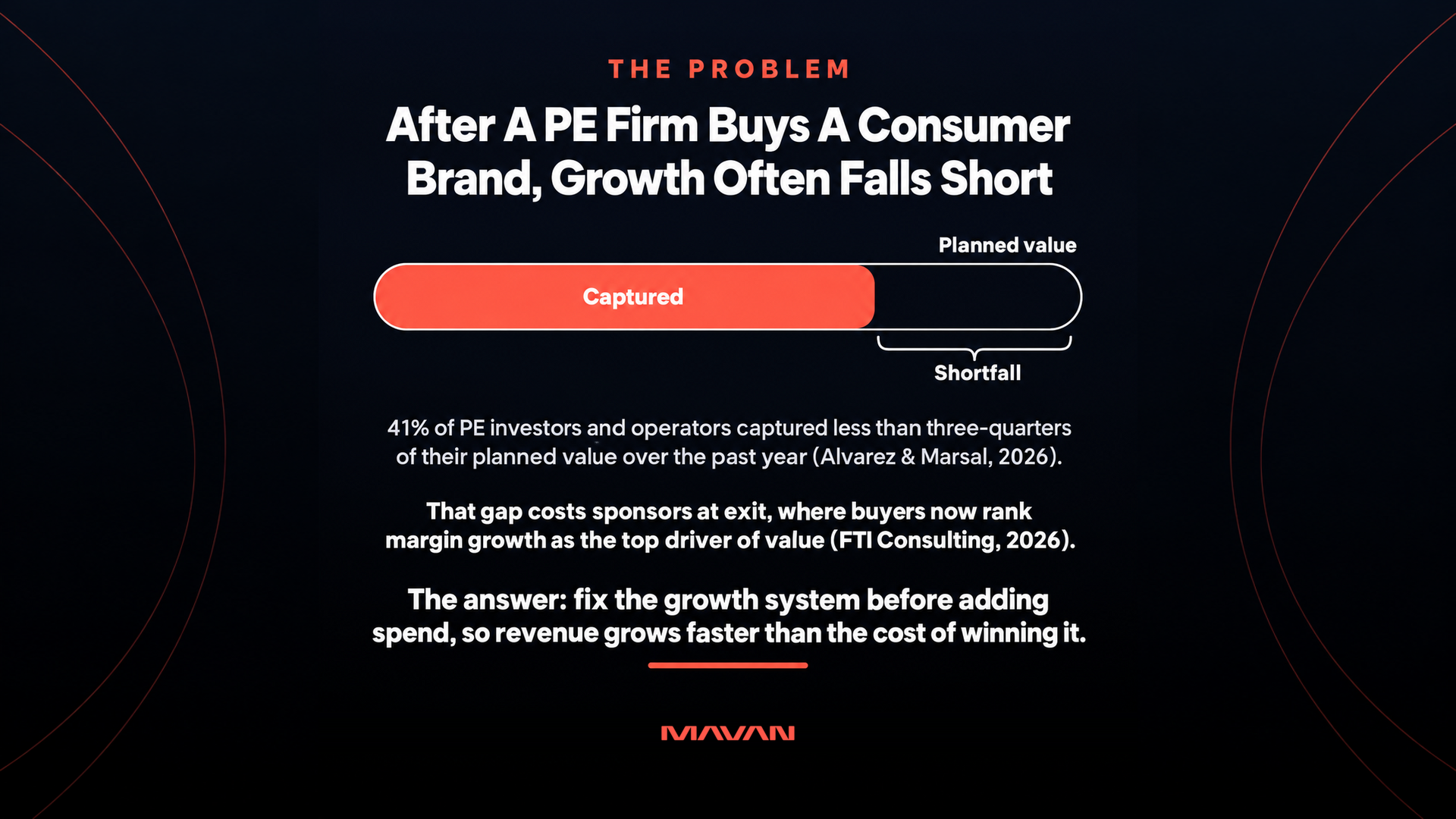
How Do PE Firms Accelerate Revenue And EBITDA Post-Acquisition?
PE firms accelerate revenue and EBITDA at consumer brands by fixing the growth system before adding spend. They reconcile the numbers and cut spend that never pays back. They lift conversion and repeat purchases, and they judge growth by contribution margin. Growth operating partners such as MAVAN diagnose that system in 28 days, then help execute the fix.