
There is no single best attribution model for B2B SaaS. The right one is the simplest model that can still answer the budget decision you face. For most teams past a few channels and a multi-month sales cycle, that means a position-based multi-touch model tracked at the account level.
TLDR — How To Decide Which Attribution Model To Use
- No universal best model — pick the simplest one that answers your decision.
- Your model choice decides which channels get next quarter’s budget.
- Last-touch works small; it hides your best channels at scale.
- Default to position-based (U- or W-shaped) for most B2B SaaS funnels.
- Choose by four things: cycle length, spend/channels, stage, the decision.
- Match your attribution window to your median sales cycle, not platform defaults.
- For committee deals, attribute at the account level, not the lead level.
- Scaling a channel? Weight down-funnel ROAS over top-of-funnel clicks.
- Lock one model on one source of truth — consistency beats sophistication.
- Move to multi-touch once cycle passes 30 days, 3+ channels, or a committee.
- Look into a 360 Growth Analysis if you aren’t sure where to start.
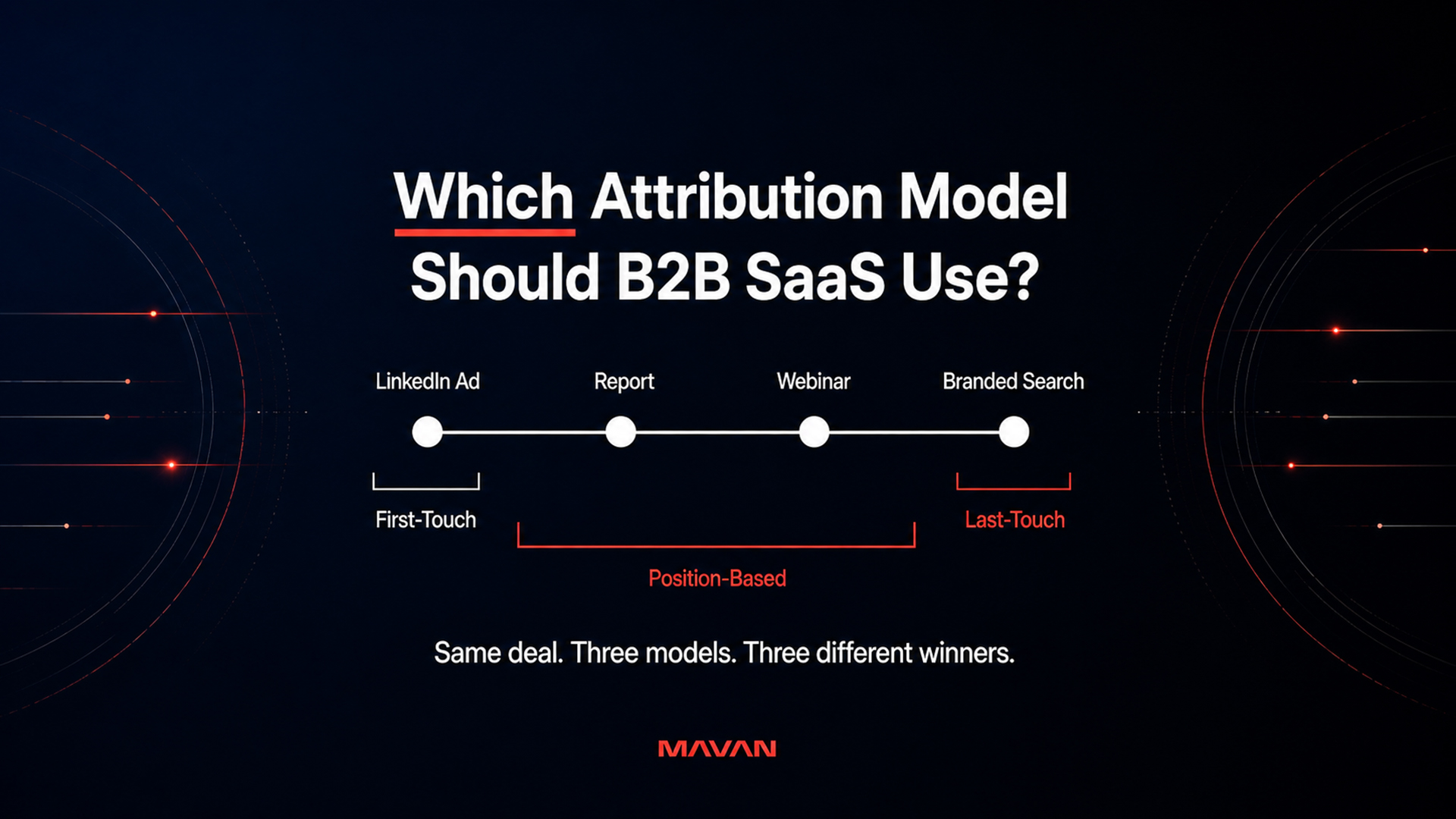
A prospect sees your LinkedIn ad in March, downloads a report in April, ignores you until July, then Googles your brand and books a demo. Which channel earned that deal? Your attribution model — the rule that decides which touchpoint gets credit for a sale — answers for you, and its answer decides where next quarter’s budget goes. Pick last-touch and Google wins. Pick first-touch and LinkedIn wins. Both are defensible, and both are incomplete.
Here is the part most model comparisons skip, and the one sentence worth carrying into your next planning meeting: the right attribution model is the simplest one that can still answer the budget decision in front of you. There is no universal winner. In this guide we will define the models in plain terms, show which fits which B2B SaaS situation, and give you a step-by-step way to choose — grounded in how our growth team actually makes the call.
Does the Attribution Model You Choose Actually Change Anything?
Yes — the model you choose changes which channels look profitable, and therefore where your budget flows next quarter. The same deal can credit LinkedIn, a webinar, or branded search depending on the rule you apply. Pick the wrong model and you defund the channels that start deals while overfunding the ones that only finish them.
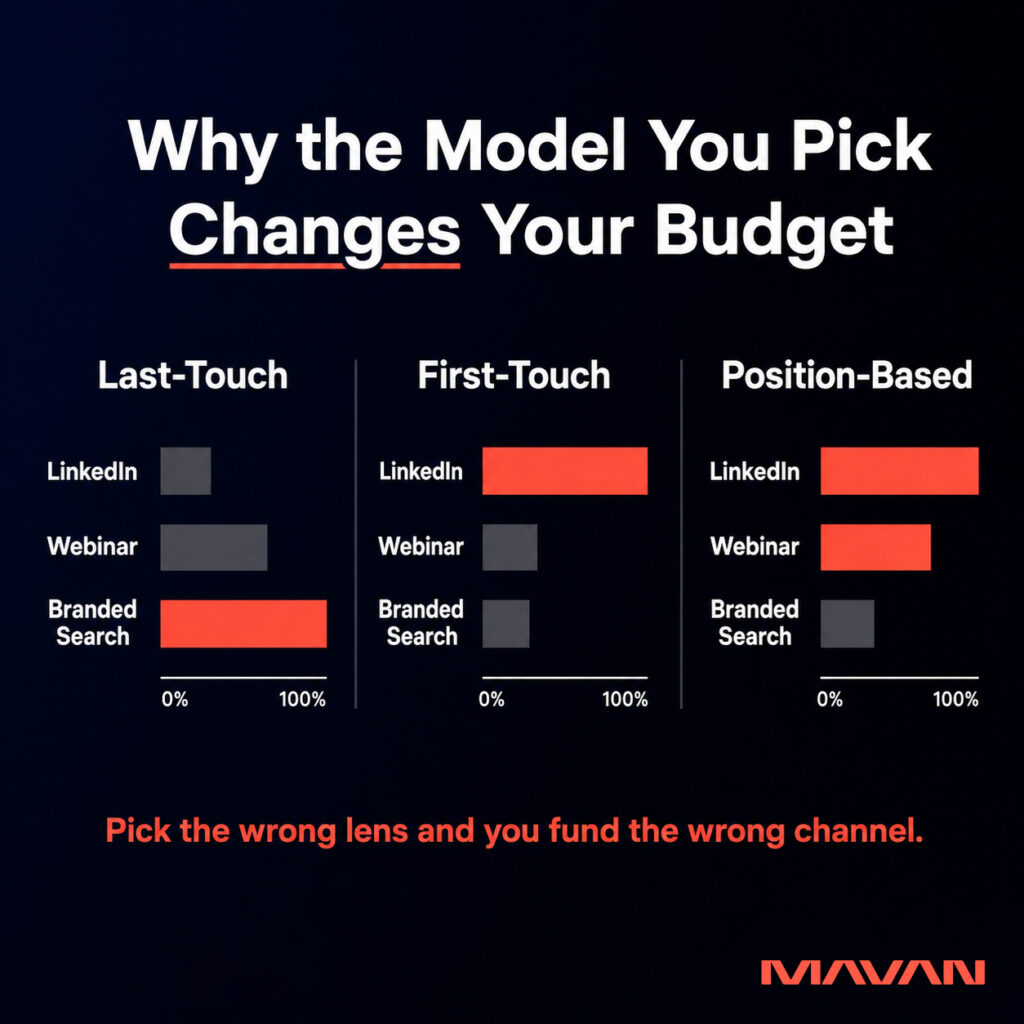
The reason this matters more as you grow is scale. Sam McLellan, VP of Growth at MAVAN, spent a decade in mobile gaming — where granular attribution has been standard for years — before bringing that discipline to SaaS. On last-touch, he is measured rather than dismissive: “It’s a workable system in theory, at smaller scale,” McLellan told us. “I wouldn’t say it’s particularly workable at large scale — but that’s how we all started, and how this industry began.” In other words, a single-touch model is a fine starting point, and it becomes a liability once real money moves through several channels at once.
The deeper problem is that single-touch models hide the sequence of a deal, and sequence is where the story lives. “A lot of companies don’t know what order — what ads they even really saw — by the time someone converted,” McLellan said. When you cannot see the order, you cannot see which touch actually moved the deal forward, so you credit the last click by default and call it performance. That default is a choice, and it is usually the wrong one past the starter stage.
Which Multi-Touch Attribution Model Is Best for B2B SaaS?
For most B2B SaaS teams, a position-based model — U-shaped or W-shaped — fits best, because it rewards the touch that started the relationship and the touch that created the opportunity, not just the final click. Time-decay suits shorter cycles. Linear is a reasonable first step up from last-touch. The right choice depends on your sales cycle and funnel.
There is no model that fits every company, because no two funnels look alike. “Those are varying timelines for each different segment, different audience, different industries, different products,” McLellan said of the long stretch between a first impression and a qualified lead. A model that works for a fast SMB self-serve motion will distort a nine-month enterprise deal. Match the model to the shape of your funnel, then hold it steady long enough to compare one period against the next. Here is how the practical options line up.
| Model | How it credits touches | Best fit for B2B SaaS |
|---|---|---|
| Linear | Equal credit to every touch | A first step up from last-touch; simple journeys |
| Time-decay | More credit to touches near the close | Shorter cycles where recency signals intent |
| U-shaped | 40% first touch, 40% lead creation, 20% middle | Most PLG and mid-market motions |
| W-shaped | 30% first, 30% lead creation, 30% opportunity, 10% rest | Longer, sales-led cycles with clear CRM stages |
The trap to avoid is chasing model sophistication for its own sake. A U-shaped model applied the same way across every channel will teach you more than three competing models that each flatter a different team. If you want to move past crediting touches and actually prove which spend caused revenue, that is a separate discipline — we cover combining attribution with incrementality and marketing mix modeling in our guide on how to measure which marketing spend really works.
How Do You Choose the Right Attribution Model?
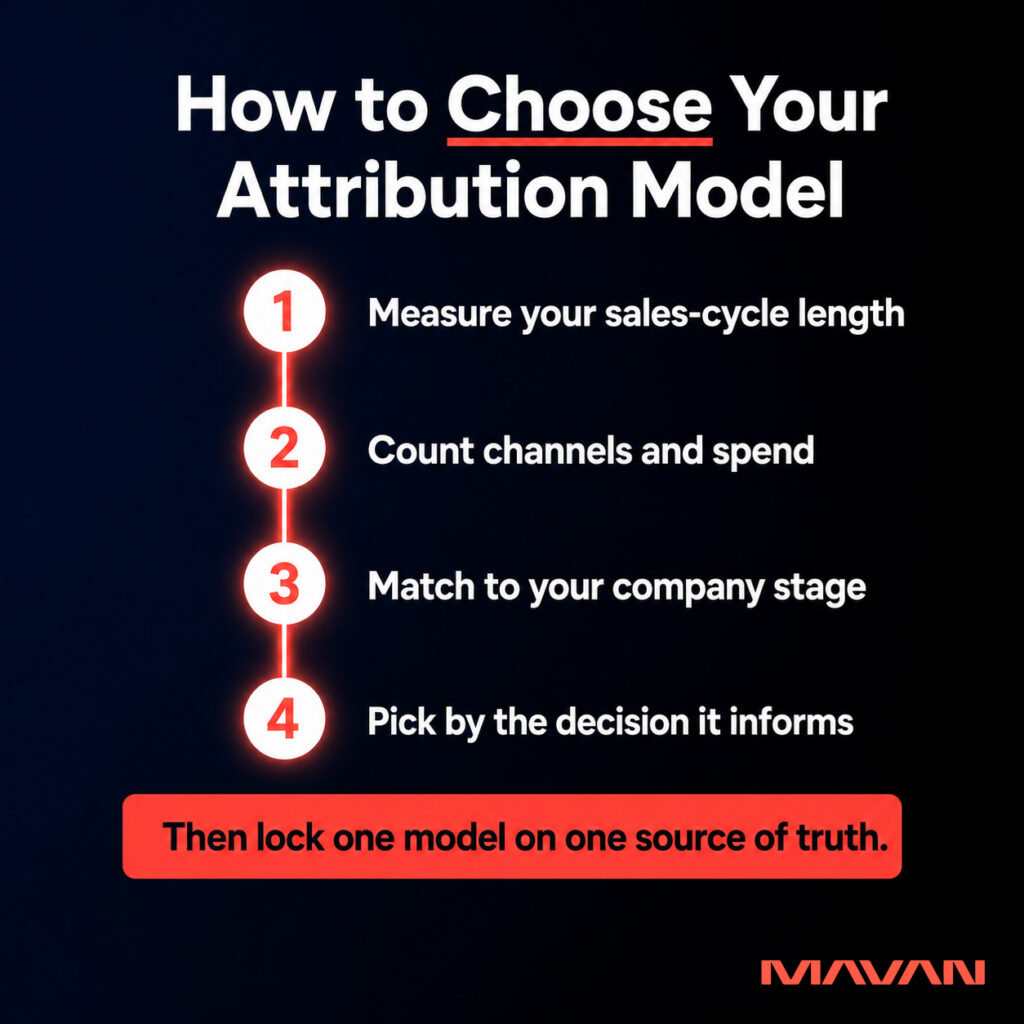
Choose your model by working through four questions in order: how long your sales cycle runs, how much you spend across how many channels, what stage your company is at, and which specific decision the model needs to inform. The output of those four answers points to one model. The steps below make that concrete.
- Measure your true sales-cycle length first. Pull the median days from first touch to closed-won in your CRM. If it runs past a few months, single-touch models will miss the early campaigns that started the deal, which points you toward a position-based model with an attribution window that matches the cycle.
- Count your active paid channels and monthly spend. If you run one channel at low spend, last-touch is fine for now. Once you spend meaningfully across three or more channels, move to multi-touch, because single-touch will systematically misprice at least one of them.
- Match the model to your company stage. Early self-serve motions with short cycles can start with time-decay or last-touch. Mid-market and enterprise motions with committees and long cycles need U-shaped or W-shaped credit to value the touches that create opportunities.
- Pick the model by the decision it must inform. To decide whether to scale a channel, weight down-funnel outcomes over top-of-funnel clicks. To justify awareness and content spend, use a position-based model that credits the first touch. Let the question you are answering select the model.
- Lock one model and one source of truth, then hold it. Apply the chosen model the same way across every channel and report it from one warehouse. Changing models mid-quarter destroys your ability to compare periods, so consistency beats sophistication every time.
Step four is where experienced operators separate signal from noise. McLellan runs channel and creative decisions in phases, and the phase determines the metric. “The first step is looking at click-through rate, looking at interactions, looking at spend and how the platform prioritizes your creatives,” he said. “The next step is to see what happens further down the funnel — are these actually ROAS-positive campaigns?” Return on ad spend, or the revenue a campaign returns per dollar spent, is the down-funnel test he trusts for scaling decisions: “I’m a person who is always big into ROAS. But you’d be surprised how many folks are optimizing toward the top of the funnel.”
Read that as a rule — pick the model and metric that answer the actual decision rather than the easiest number to pull.
The same logic explains why channel context has to shape how you weight touches. “LinkedIn and Instagram Reels are two very different experiences for the same person,” McLellan noted. “Reels isn’t something they’re doing at work on their computer, but LinkedIn might be.” A touch on a work platform during a buying evaluation is not equivalent to a scroll-by at home, and a model blind to that difference will misjudge both. On the consistency point, MAVAN President Dan Barnes is blunt in the two growth questions every org should be able to answer: without a single source of truth, every team can find a number that defends its position, and no model can settle the argument.
Should You Attribute at the Lead Level or the Account Level?
Attribute at the account level whenever a purchase involves a buying committee, which describes almost all mid-market and enterprise B2B SaaS. Lead-level models credit individual people, so they scatter one deal’s touches across several disconnected records and undercount the channels that warmed the wider committee. Account-level attribution stitches those people into one journey.
This is the nuance that trips up teams who assume the fix is only about picking a fancier model. The bigger lever is often the unit of analysis, not the model — measurement built around individual contacts, applied to a group buying decision, systematically misses the committee. Gartner’s research shows why: a typical B2B buying group runs six to ten decision-makers, each researching independently before anyone talks to sales. If a webinar warmed three of those stakeholders at one target account, a lead-level model records three unrelated events; an account-level model records one deal, correctly.
McLellan’s framing lands in the same place from the demand side. Because each stakeholder meets your brand on a different platform and in a different order, the job is to tailor those touches into one coherent account story rather than a pile of isolated leads. The takeaway is practical: before you upgrade your model, upgrade your unit of analysis so the model has the right object to score.
When Should You Move From Last-Touch to Multi-Touch?
Move to multi-touch once any one of three thresholds is true: your sales cycle runs longer than roughly 30 days, you spend across three or more paid channels, or your deals involve a buying committee. Below those thresholds, last-touch gives you enough signal. Above them, it starts hiding your best-performing channels and mispricing spend.
The trigger is scale, not ambition. McLellan’s read on last-touch — workable small, unworkable large — describes a threshold you cross, and the switch only pays off once you have the plumbing to support it. “You have to have attribution in place,” he said of running fully costed acquisition math, “and the correct finances and financial models in place.” That is the honest prerequisite: multi-touch without a reliable data foundation just produces prettier guesses. So the move is sequential — confirm you have clean, connected data first, then adopt the model your cycle and channel mix call for.
One caution worth stating plainly, because it saves teams from a common misstep: switching models will not repair a stack that is bolted together and inconsistent. If some demos fire on first touch and others on last touch, or two dashboards define a lead differently, fix that before you choose a model — we walk through that repair in our guide on why your B2B SaaS attribution is broken and how to fix it. And if different segments need genuinely different motions, that is expected; running distinct go-to-market motions for SMB, mid-market, and enterprise inside one company is a feature of a mature growth system, not a flaw.
Frequently Asked Questions About Last Touch vs. Multi-Touch Attribution
What is the difference between first-touch and last-touch attribution?
First-touch attribution gives all the credit to the first interaction a prospect had with your brand, spotlighting what starts relationships. Last-touch gives all the credit to the final interaction before purchase, spotlighting what closes them. Both are single-touch models, and both ignore everything in the middle of a B2B deal.
Which attribution model is best for long B2B sales cycles?
For long cycles, a position-based model — U-shaped or W-shaped — fits best, because it credits the early touch that opened the relationship and the touch that created the opportunity months later. Pair it with an attribution window that matches your median time-to-close, or the model will still miss your earliest campaigns.
Is U-shaped or W-shaped attribution better for B2B SaaS?
U-shaped credits the first touch and lead-creation touch (roughly 40/40, with 20% spread across the middle) and suits product-led and mid-market motions. W-shaped adds a third weighted moment at opportunity creation (roughly 30/30/30), which fits longer, sales-led deals with clear CRM stages. Choose by how defined your funnel stages are.
Do I need an expensive tool to run multi-touch attribution?
No. You can build a workable multi-touch model inside your CRM by tracking touchpoints on the contact and account timeline and using campaign-influence reporting. The tool matters far less than the process. A clean CRM with a consistent model outperforms a costly platform with messy, inconsistent data.
Should I attribute revenue to leads or to accounts?
Attribute to accounts whenever a committee makes the decision, which covers most mid-market and enterprise B2B SaaS. Lead-level attribution splits one deal’s touches across several records and undercounts the channels that warmed the wider group. Account-level attribution stitches every stakeholder into one journey that reflects how the purchase actually happened.
So, What Is Really The Best Attribution Model For B2B Saas?
There is no single best attribution model for B2B SaaS — the right one is the simplest model that can still answer the budget decision in front of you. Choose it by your sales-cycle length, your spend and channel count, your stage, and the decision it must inform. For most teams past a few channels and a multi-month cycle, that means a position-based multi-touch model, tracked at the account level rather than the lead level. Lock one model on one source of truth, and hold it long enough to compare periods honestly.
You are already doing the hard part — running real demand across real channels — and choosing the right lens on it is the fastest way to make that spend work harder. The next version of your measurement is a decision, not a rebuild.
If you are not sure which model your cycle and channel mix actually call for, then check out our 360 Growth Analysis. We can map your funnel, recommend the model that fits, and show where your current credit is misleading you.
Key Attribution Terms, Defined
- Last-touch attribution
- A single-touch model that assigns 100% of a conversion’s credit to the final interaction before purchase. It is simple and easy to run, but it ignores every earlier touch, so it over-credits bottom-of-funnel channels like branded search.
- First-touch attribution
- A single-touch model that assigns 100% of credit to the first interaction a prospect had with your brand. It highlights what starts relationships, but it ignores everything that nurtured and closed the deal, so it over-credits awareness channels.
- Multi-touch attribution
- Any model that distributes credit across multiple touchpoints in the buyer journey rather than one. It reflects how B2B deals actually close — across many touches and stakeholders — and is the basis for linear, time-decay, and position-based models.
- Time-decay attribution
- A multi-touch model that gives more credit to touchpoints closer to the moment of conversion and less to earlier ones. It suits shorter cycles where recency signals real intent, but it still under-weights early awareness.
- Position-based attribution
- A multi-touch model that concentrates credit on the most decisive moments — usually the first touch and the touch that created the lead or opportunity. U-shaped and W-shaped models are the common B2B SaaS versions.
- Account-level attribution
- An approach that credits touches across an entire buying account rather than a single lead record. It stitches every stakeholder from one company into a shared journey, which matches how committee purchases really happen in B2B.
Casey Rock is Content Director at MAVAN, where he helps turn complex ideas into clear, strategic content that drives growth. With over 15 years of experience across content strategy, SEO, media, and digital marketing, Casey focuses on building content systems that connect audience insight, brand storytelling, and measurable business outcomes.
Book a complimentary consultation with one of our experts
to learn how MAVAN can help your business grow.
Want more growth insights?
Thank you! form is submitted
[hubspot type=”form” portal=”20951211″ id=”9c538ed2-fb12-45f1-a573-ad7953c058cc”]
Related Content
-
Which Attribution Model Should B2B SaaS Use?
There is no single best attribution model for B2B SaaS. The right one is the simplest model that can still answer the budget decision you face. For most teams past a few channels and a multi-month sales cycle, that means a position-based multi-touch model tracked at the account level.
-
How Do You Solve SKAN Attribution For Multi-Channel Apps?
To solve SKAN attribution for multi-channel apps, fix your conversion-value and revenue configuration first, then triangulate SKAN with incrementality testing and one internal source of truth — so every channel gets measured against the same number.
-
Are Mobile Game Web Shops A Growth Lever In 2026?
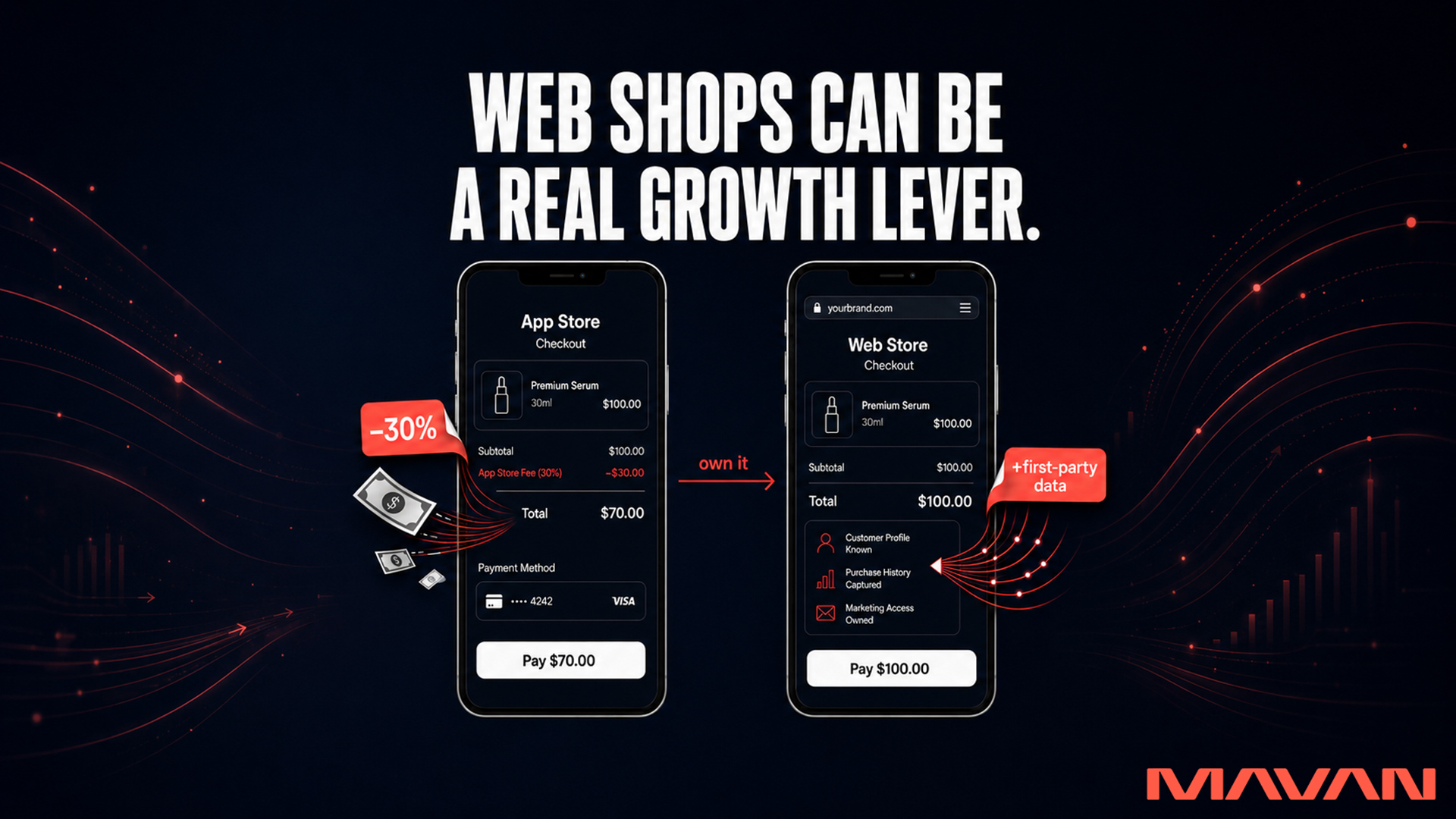
After Apple’s IDFA changes, mobile game studios grow by launching a web shop — a game-branded web store they own. It reclaims the 15 to 30 percent that app stores take on every purchase and rebuilds the first-party player data that makes user acquisition work again.