
The best growth consultants for scaling startups are senior operators who have scaled companies like yours. They study the whole growth system, back every finding with a number, and sort each fix by who must act. Then they execute across teams or bring people who can. Judge them by what they shipped and what your team keeps.
TLDR — Growth Consultants for Scaling Startups
- A growth consultant diagnoses, then recommends.
- Growth marketing consultants stay inside marketing.
- Most growth stalls start between teams.
- Advice is easy to find. Action is the hard part.
- Ask what they shipped, not what they advised.
- Demand findings with a number behind each one.
- Give every fix one owner and one next step.
- Ask who staffs the fix when it crosses teams.
- Hire help that leaves your team stronger.
- Learn more about MAVAN’s growth services.
Why It’s So Hard to Choose a Growth Consultant
Choosing a growth consultant is hard because the title covers very different jobs. One consultant audits your funnel and leaves. Another runs your ads. A third advises your CEO for a few hours a month. Advice has never been easier to find, so the real test is who will help you act on it.
Scaling companies now ask more of fewer people. ICONIQ, the venture and growth investor, surveyed more than 150 B2B software go-to-market leaders for its 2026 State of GTM report. Companies that use AI most heavily ran leaner go-to-market teams at every revenue band. Top-quartile growth also sped up again, and ICONIQ found the strongest companies pulling further ahead. A lean team that owns a big number often needs outside help to keep pace.
Buyers of that help now expect more than ideas. Source Global Research tracks how clients choose consulting firms. In May 2026, Sophie Gunn of Source wrote that clients want to know how firms “will actually help them get things done.” Delivery factors, such as a firm’s methods and its ability to match qualified people to projects, rose in importance in the US, UK, Australia, and France. In her reading of the data, expertise by itself no longer sets a firm apart.
Where Do We Stand on Growth Consulting?
We’re MAVAN, a growth operating company, so we have a stake in this answer. We diagnose what will move the business, embed the operators required to execute it, and leave the company with stronger systems and internal capability. Our view is simple. Good diagnosis is worth paying for, and some startups only need a consultant. But most problems worth solving cross four or five growth functions, and a plan that crosses teams needs someone to run it. This guide defines growth consultants, growth marketing consultants, and growth consulting. Then it shows how to vet the best ones, including us.
Key Terms to Know About Growth Consulting
- Growth Consultant
- An outside expert who studies why a company isn’t growing as planned, recommends what to change, and sometimes helps carry out the plan.
- Growth Marketing Consultant
- A consultant who works on the marketing side of growth, such as paid acquisition, landing pages, email, and lifecycle programs.
- Growth Consulting
- The service itself: a paid engagement to diagnose growth problems and then plan, guide, or run the fixes. It’s sold by the hour, by the project, or on a monthly retainer.
- Growth Constraint
- The bottleneck that limits growth most right now, such as broken tracking, a leaky signup flow, or weak retention.
- CAC Payback
- The months it takes a new customer’s profit to repay the customer acquisition cost (CAC) spent to win them.
- Value-Creation Plan (VCP)
- In private equity (PE), the operating plan for making a portfolio company more valuable during the hold.
- Growth Operating Company
- A company that embeds operators to diagnose and execute growth work inside the business, instead of advising from outside or managing one channel. MAVAN is a growth operating company.
- 360 Blueprint
- MAVAN’s 28-day growth diagnostic. Five or more specialists review the whole growth system and deliver evidenced findings and a sequenced roadmap.
What Is a Growth Consultant?
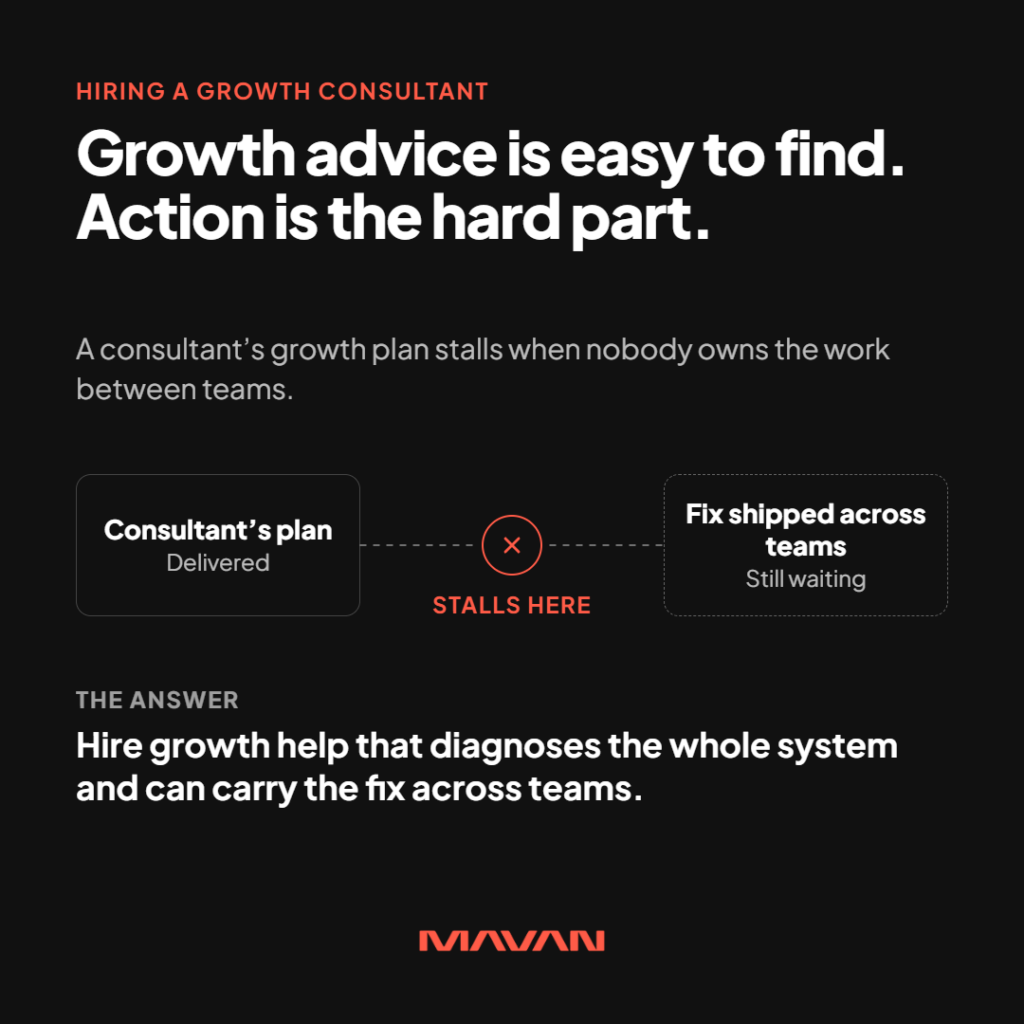
A growth consultant is an outside expert who finds why a company isn’t growing as planned and recommends what to change. The work can touch acquisition, conversion, retention, pricing, and measurement. Some consultants guide the work that follows, but most leave the doing to your team. Their value depends on who acts on the plan.
No license or standard job description comes with the title. In practice, most growth consultants sell some mix of three things:
- A diagnosis. The consultant reviews your data, funnel, and team, then names what is holding growth back.
- A plan. Findings become a set of priorities, ideally with owners, dependencies, and a timeline.
- Guidance along the way. Some stay on as advisors who review results and coach the team as it executes.
The best consultants bring something no framework can: pattern recognition from running growth inside companies like yours. That matters because winning playbooks rarely go public. Matt Widdoes, our Founder and CEO, calls growth “such a zero sum game” in that “all of the stuff that’s really working well is highly protected.” Experience fills the gap that public advice leaves.
Why Do Outside Eyes Find Problems So Fast?
An outsider has no history to defend. In the first 48 hours of one Blueprint for an at-scale consumer app, we found about $350,000 a month going to an always-on paid campaign. It had never come close to profit, and nobody had updated or optimized it in more than six months. Its teams were reading different numbers, and the media team’s dashboard said all was well.
“…a perfect storm for an enormous amount of waste that outside eyes could see within just a few days of asking basic questions around ‘how does all of this work.’” — Matt Widdoes, Founder & CEO, MAVAN
The causes ran deeper than one campaign. Nobody had a clear view of revenue hitting the bank, the forecast model was out of date, and an automation layer misread the data. Outside eyes are the strongest case for hiring a consultant. The fix is where the harder work begins.
When Does a Growth Consultant Make Sense?
A consultant fits best when three things hold. The question is narrow enough to answer from outside. Your team has the time and skills to act on the answer. And the fix sits inside teams you already run. A pricing review at a company with a strong product team fits that shape. So does a second opinion on a channel plan before a big budget increase.
The model strains when the cause is unclear or spread across teams. Widdoes describes a scene common in scaling companies: “sales is pointing and product is pointing and marketing’s pointing, sometimes even within just the marketing org or just the product org.” A consultant can name that problem in a week. Fixing it means changing how several teams work together, and that takes people with the time and standing to see it through.
What Does a Growth Marketing Consultant Do?
A growth marketing consultant improves the marketing side of growth. The work usually covers paid acquisition, landing pages, email and lifecycle programs, and the tracking that ties them to revenue. Many specialize in one or two channels. They tend to move faster than a broad growth consultant, but their view usually stops where marketing ends.
Think of the role as a specialist with a growth mindset. A good growth marketing consultant judges a campaign by what each customer costs and how long that cost takes to pay back, instead of by clicks. Common work includes:
- Auditing ad accounts and conversion tracking to see which spend drives revenue.
- Testing landing pages, offers, and signup flows to raise conversion. Teams call this conversion rate optimization (CRO).
- Building email and lifecycle programs that turn first purchases into repeat ones.
- Setting up reporting on CAC and CAC payback, so leaders can see what each channel earns.
Done well, this kind of work moves real numbers. Zig Zag, the rolling paper brand, was losing branded search traffic to third-party distributors. We paired technical search engine optimization (SEO) and content with conversion research and A/B tests. Online sales grew 56%, organic traffic rose 47%, and newsletter signups climbed 30%. (Though to be clear, we go far beyond the typical growth marketing consultant work.)
Where Does a Growth Marketing Consultant’s View Stop?
The risk is a narrow view of a wide problem. A marketing consultant sees the ad account and the landing page. The cause of a rising CAC may sit in onboarding, pricing, or a data feed that a marketing scope never reaches. Order matters, too. Matt Saunders, a Growth Lead at MAVAN, puts it plainly: “The sequencing matters as much as the fixes themselves. Do things in the wrong order and you’re building on an unstable foundation.” A marketing consultant can fix the right thing at the wrong time.
How Is a Growth Marketing Consultant Different From a Growth Consultant?
Many people use the two titles as synonyms. Scope is what separates them, so ask any candidate where their work starts and where it stops. Here is how the roles usually compare.
Growth Consultant vs. Growth Marketing Consultant
| Question | Growth Consultant | Growth Marketing Consultant |
| Main focus | The whole growth system, including product, pricing, data, and team | Paid channels, conversion, and lifecycle programs |
| Starting question | What is holding growth back? | Which marketing levers will lower CAC or lift conversion? |
| Typical output | A diagnosis and a prioritized plan | Channel, funnel, and campaign changes |
| Who acts on it | Leadership and every team the plan touches | Usually the marketing team |
| Best fit | You need an outside read on the whole system and have people to act on it | The constraint clearly sits inside marketing |
Neither title promises execution, and both can end at a report. So ask early who will do the work the report calls for.
What Is Growth Consulting, and How Is It Priced?
Growth consulting is the paid service of diagnosing growth problems and then planning, guiding, or running the fixes. It comes in four common shapes: an audit, a project, an advisory retainer, or embedded execution. Pricing runs hourly, by project, or monthly. It rises with seniority, scope, and how much of the work the firm owns.
Independent consultants and growth consulting firms both sell these shapes. Each one answers a different question, so match it to what you need:
- Audit or diagnostic. A fixed-scope review that ends in a findings report. It tells you what’s wrong and stops there.
- Project. A defined piece of work, such as a pricing test or a new onboarding flow, with a start and an end.
- Advisory retainer. A set number of hours each month for guidance, reviews, and coaching.
- Embedded execution. Operators who join your tools and meetings and do the work alongside your team.
How Much Does Growth Consulting Cost?
Rates vary as widely as the work. On Upwork, freelance startup consultants charge $50 to $150 an hour, the marketplace says, and marketing consultants tend to charge somewhat less. Its posted range for experienced North American marketing consultants runs $25 to $100 an hour. Upwork also notes that consultants with more experience charge substantially more. Treat marketplace rates as a starting point, then adjust for seniority and scope.
We price around the problem instead of a package. Every MAVAN engagement starts with a Blueprint, and the scope comes second. Pricing reflects the company’s scale and complexity, the depth of the work, and the senior skills it needs. Paid media fees scale with the spend we manage. Other capabilities run as a defined monthly engagement tied to a detailed scope of work, so both teams know what we own and what success looks like.
What Should You Compare Besides the Rate?
Compare cost per outcome. A cheap plan your team can’t staff costs the fee plus every month it sits unused. Before you sign, ask three questions about any quote. What will exist at the end that doesn’t exist today? Who does the work after the readout? And what does your team keep when the consultant leaves?
Why Do Growth Consulting Plans Stall After the Readout?
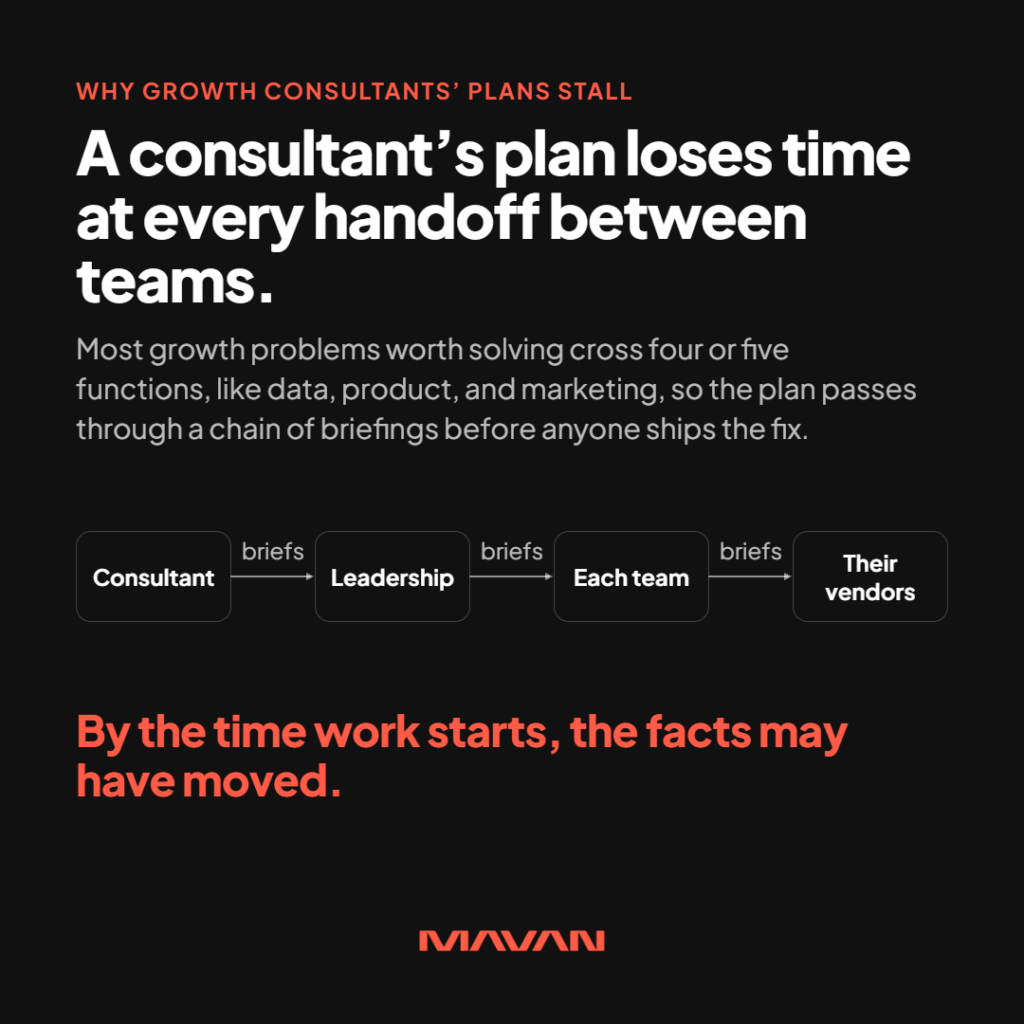
Growth plans stall after the readout when nobody owns the work between teams. A recommendation to fix tracking needs data, product, and marketing to move together. If the consultant leaves and each team returns to its own list, the plan waits. The gap is rarely the quality of the advice. It’s the distance from advice to action.
Speed from finding to fix is where growth gets won. Dan Barnes, our President, learned that early at Machine Zone, the mobile games company.
“…the most important thing was taking an insight to an action in the shortest amount of time possible.” — Dan Barnes, President, MAVAN
Every handoff stretches that time. The consultant briefs leadership. Leadership briefs each team. Each team briefs its vendors. By the time work starts, the facts may have moved. At MAVAN, we have a blunt line for the result: “Consultants give you a deck.” The deck may be right, but it still has to become shipped work.
That’s also why we don’t take on operating work without our own Blueprint, even when a client already holds a consultant’s plan. Working from someone else’s assessment leads to misalignment once the engagement begins. We want to see the evidence firsthand, because we’ll be the ones acting on it.
What Does a Finding Built for Action Look Like?
A finding built for action names a fact, a number, and a consequence. Compare “targeting needs work” with this finding from one of our live engagements, shared with details removed: “Activated leads spanned forty-plus industry categories, with no vertical above 10%, against no agreed ideal customer profile.”
The second version tells sales, marketing, and product what to fix.
Plans need the same discipline. We sort every action by who has to move it: “We start now,” “Needs a decision,” or “Needs a session.” A sequencing register then names the risks, such as two work streams about to collide. Our guide to growth audits shows how that plan comes together.
Who Are the Best Growth Consultants for Scaling Startups?
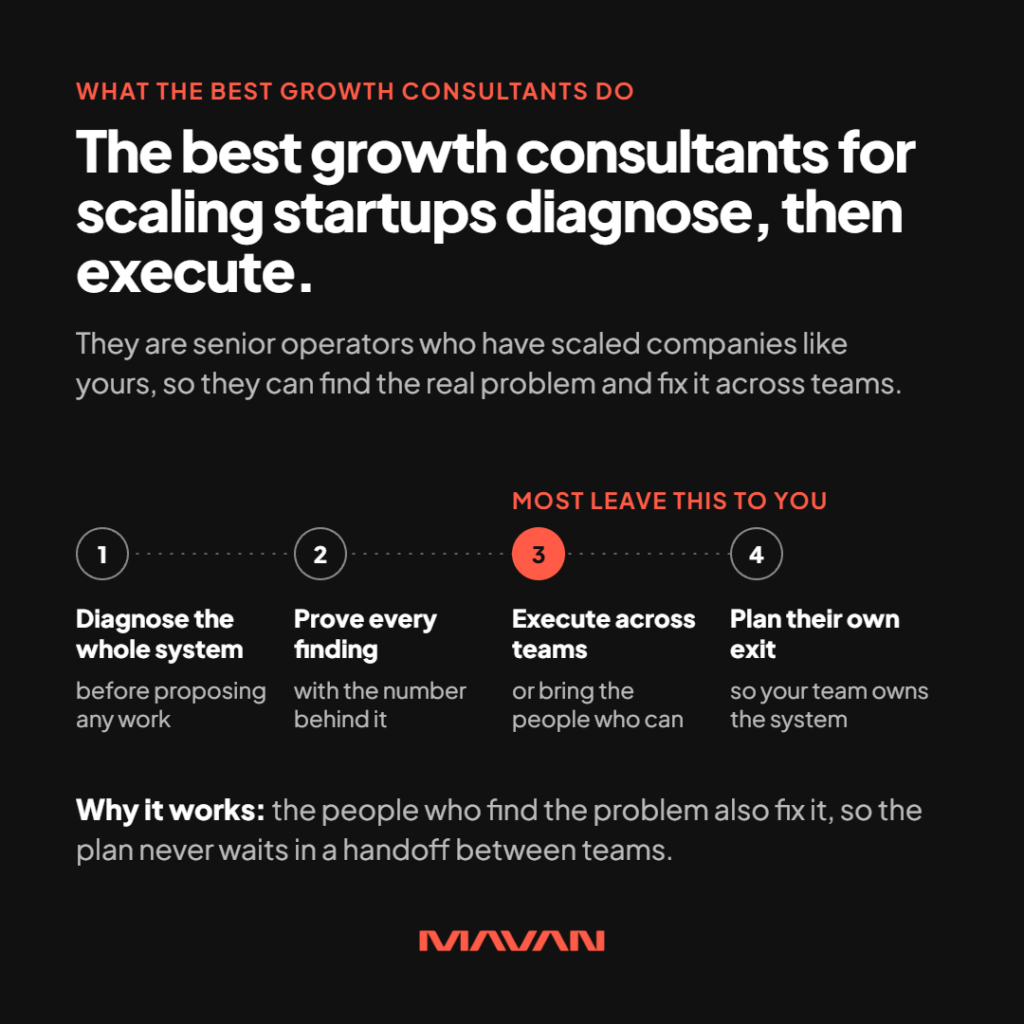
The best growth consultants for scaling startups have run growth inside companies like yours. They diagnose the whole system before proposing work, back each finding with evidence, and either execute across functions or bring the people who can. The best ones also plan their own exit, so your team owns the system after they leave.
No ranking can name the best consultant for every startup, because the right pick depends on where your constraint sits. A Series A company with a leaky signup flow needs different help than a Series C company whose data and media teams disagree. The table below groups the main kinds of growth help by fit.
Which Kind of Growth Help Fits Your Problem?
| Type of Growth Help | Best Fit | Where It Usually Stops |
| Independent growth consultant | An outside read and a plan, when your team can execute | At the recommendation |
| Growth marketing consultant | A known problem in paid, conversion, or lifecycle | At the edge of marketing |
| Strategy consulting firm | Market sizing, positioning, and big strategic bets | Before day-to-day execution |
| Fractional growth leader | Part-time senior leadership for a team that can ship | At the hours in the contract |
| Growth operating company (MAVAN) | Unclear causes and fixes that cross teams | When your team can run the system alone |
For a side-by-side look at fractional leaders and embedded teams, see our guide to fractional CMOs vs. embedded growth pods. Whichever type you choose, test it the same way.
How Do You Vet a Growth Consultant Before You Sign?
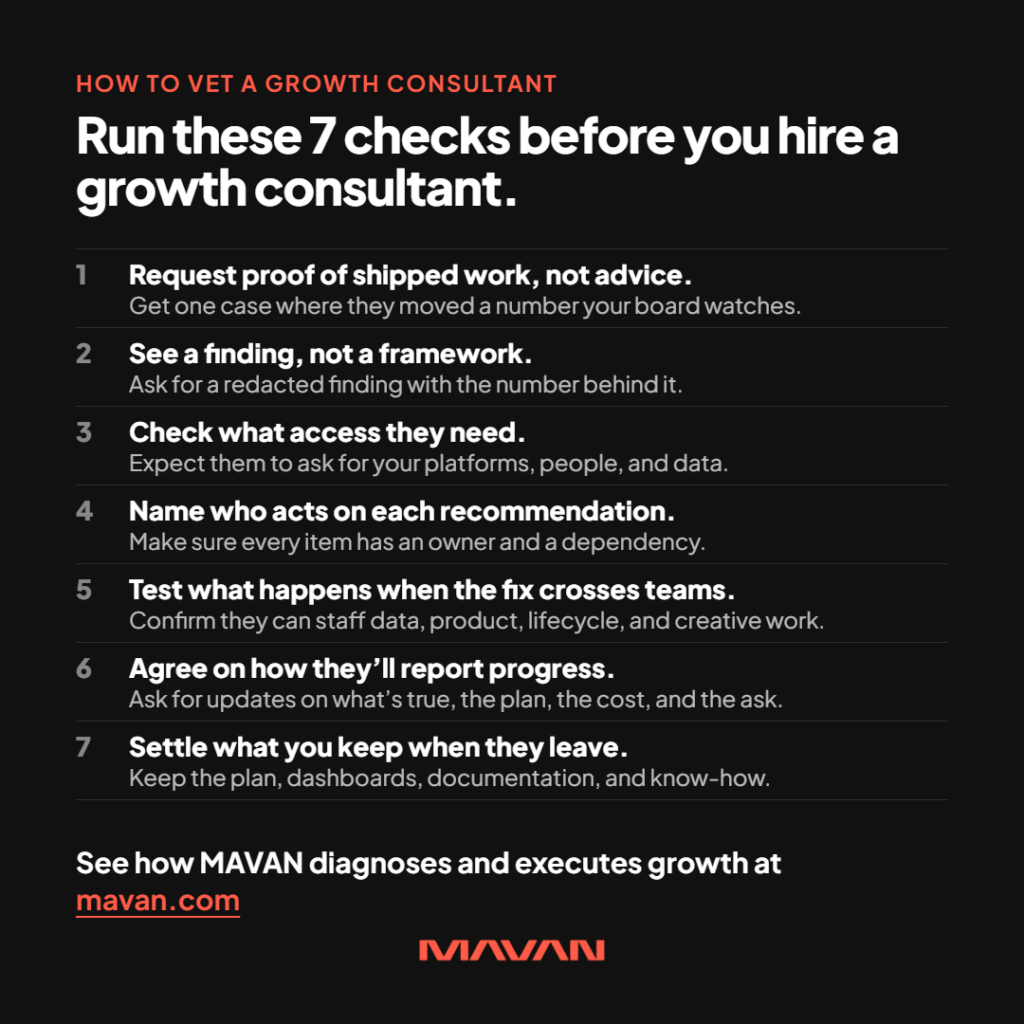
These seven checks separate consultants who move numbers from those who mostly move slides:
- Request proof of shipped work, not advice. Ask for one case where they moved a number your board watches, with the before and after, the timeline, and who did the work.
- See a finding, not a framework. A strong consultant can show a redacted finding with the number behind it. Frameworks are easy to borrow, but evidence isn’t.
- Check what access they need. A real diagnosis needs your platforms, your people, and your data.
- Name who acts on each recommendation. Every item in the plan should have an owner and a dependency. If the answer is “your team,” check that your team has the hours.
- Test what happens when the fix crosses teams. Find out whether they can staff data, product, lifecycle, and creative work, or whether you’ll hire more vendors to finish the job.
- Agree on how they’ll report progress. For board updates, Barnes points to a simple structure: “here’s what’s true, here’s what we’re doing about it, here’s what it costs us, here’s what we need from you.” A consultant’s updates should pass the same test.
- Settle what you keep when they leave. The plan, the dashboards, the documentation, and the know-how should stay with your team. Our guide to embedded operators vs. agency retainers covers how ownership differs by model.
Where Does MAVAN Fit Among Growth Consultants?
We fit when the cause is unclear or the fix crosses teams. If your question is narrow and your team can act on the answer, a strong independent consultant may serve you better, and we’ll tell you so.
What sets us apart is what happens after the diagnosis. The operators who find the constraint can also fix it, so plans don’t wait in a handoff. One accountable team spans data, acquisition, lifecycle, creative, and conversion work. Our core team covers 12 growth functions, backed by a network of 170+ vetted specialists. Each pod (the small team assigned to a client) includes only the skills the problem needs, and specialists step away when their part is done. We document the system as we build it, because a properly structured engagement has an end date.
What Has That Model Delivered for Clients?
Our leaders came up inside companies like the ones we serve. Widdoes’s background includes King, Zynga, and Red Bull. Barnes comes from Zynga, Machine Zone, and NaturalMotion. Sam McLellan, our VP of Growth, brings experience from Zynga, Take-Two, and Big Brain Games. The MAVAN Advisory Group adds operators such as Eric Seufert, founder of Heracles and Mobile Dev Memo, and Aurelie Guerrieri, Chief Marketing & Alliances Officer at DataDome.
Results show the difference. Titan needed lower CAC and tracking it could trust. We rebuilt its measurement first, then scaled channels and creative. CAC efficiency improved 3x while paid acquisition volume grew 5x. Its marketing director put the contrast in one line.
“…unlike a lot of agencies where strategy just lives in a deck, MAVAN actually executed.” — Angus Kirby, Director of Marketing, Titan
At ElevenLabs, the board’s CAC payback target was 12 months, and the business sat at 15. We moved payback 15 → 9 months inside the first month, then held 9 through scaling. Paid search grew from a test to a high six-figure monthly budget, then moved to the in-house team.
How Do PE Firms Use Growth Consultants in Portfolio Companies?
PE firms use growth consultants to test a portfolio company’s growth case and plan the work behind the value-creation plan. The harder part is staffing that plan across many companies at once. Sponsors increasingly want help that diagnoses and executes. They measure it in revenue, EBITDA, and margin, with CAC and payback as the mechanism.
Why Are Sponsors Short on Execution Capacity?
Sponsors have built bigger operating teams, but the work has grown faster. McKinsey reported in June 2026 that private equity firms have more than doubled their operating groups since 2021, on average. Even so, the firm’s authors wrote that “execution capacity has not been scaled in the same way.” Operating partners remain scarce, so they engage most deeply early in the hold (the years a fund owns a company). One PE executive told McKinsey that tying an operating partner to one company costs the fund too much attention elsewhere.
The same research found a leadership gap. Some 94% of sponsors said portfolio company leadership drives value creation, yet only 8% invest systematically in building it. Certain funds now add focused, short-term transformation help inside portfolio companies instead of growing central teams. Alvarez & Marsal reached a similar view in its 2026 North America value creation report. Its survey of deal teams, operating partners, and management concluded that spotting value levers is no longer the hard part. Building the capacity to deliver them early and at scale is.
That’s the gap a growth consultant alone can’t close across a portfolio. A diagnosis helps a deal team underwrite the plan. Someone still has to run acquisition, lifecycle, and measurement work inside each company, at the fund’s tempo. Sponsors should judge that work by revenue, EBITDA (earnings before interest, taxes, depreciation, and amortization), margin, and exit readiness.
How Does MAVAN Work Inside a Portfolio?
For a portfolio company, the Blueprint works as a full-potential read: a fast, evidenced look at its biggest growth opportunities and limits, tied to the value-creation plan. At WGT, a Haveli Investments company, the work grew in order: Blueprint → paid acquisition → lifecycle rebuilt end to end → data and analytics stack. Each step was already in the roadmap the Blueprint produced, and each engagement was earned by the last one.
In May 2026, Growth Factors, the operating team at Bregal Sagemount, routed us into one of the firm’s portfolio companies. Qualified leads from paid media had cratered because the ad accounts were learning from corrupted tracking. The company asked us to stay on before the diagnostic finished. We rebuilt the data connections and launched always-on (evergreen) campaigns that became its primary drivers of leads.
At the company level, we’re built to leave. Across a fund, sponsors can keep MAVAN on retainer as a dedicated growth partner. They can deploy us to any portfolio company that needs growth work, including new acquisitions, one at a time or several at once. Because the diagnostic and operating model stay the same, what we learn compounds across the portfolio. Our guide to the best growth partner for PE portfolio companies goes deeper.
Frequently Asked Questions About Growth Consultants
Founders and operating partners tend to ask five more questions. They want to know whether a growth consultant is a growth hacker, how long engagements run, and when to hire a full-time leader instead. Many also ask how much data access a consultant needs and what the first month should produce.
Is a Growth Consultant the Same as a Growth Hacker?
No. “Growth hacker” usually describes one person running fast, scrappy tests on a product or channel. A growth consultant is hired to diagnose a company’s growth system and plan the fixes. Durable growth comes from a repeatable system across teams, not from tricks. Be wary of anyone who promises that one clever hack will solve a structural problem.
How Long Does a Growth Consulting Engagement Take?
Length depends on the shape of the work. A project ends when its deliverable ships, while an advisory retainer can run for months. Our Blueprint takes 28 days from kickoff to readout. Afterward, items marked “We start now” can begin in the first week, while others wait on a decision or a working session with the right people.
Should We Hire a Growth Consultant or a Full-Time Head of Growth?
Hire full-time once one channel pays back on numbers everyone trusts. In our experience, a leader who arrives earlier often spends the first quarter fixing tracking and plumbing. Outside help can find and fix the constraint first, so the leader inherits a working system. Our guide to when a B2B SaaS startup should hire a growth leader covers the timing.
Will a Growth Consultant Need Access to Our Data?
Any good consultant will insist on it. A diagnosis built on a kickoff call and a few screenshots will miss what sits between teams. We require full access to a client’s platforms, people, and data for every Blueprint. McLellan has found that when teams don’t want to show their data, they’re often embarrassed by it. In our experience, that’s where the most useful findings sit.
What Should a Growth Consultant Deliver in the First Month?
Ask for evidence, a plan, and named risks. Each finding should come with the number behind it, and each action should have an owner and a dependency. Risks belong on paper too, such as a data timeline that can’t support the growth target. Writing them down early leaves time to reorder the work before two projects collide.
So, Who Are the Best Growth Consultants for Scaling Startups?
The best growth consultants for scaling startups have run the work before, prove every finding, and stay close enough to see the fix through. If your constraint sits in one function and your team can act, a sharp consultant may be all you need. When it crosses teams, hire people who can diagnose and execute.
Start with the last growth plan an outside firm gave you. Count the recommendations that shipped, then note which team shipped each one. If most of them stalled at a handoff between teams, another consultant won’t fix that. You need a team that can find the cause and carry out the fix.
That’s the job a Blueprint is built for. For 28 days, five or more of our specialists work inside your platforms, people, and data. Every finding comes with the number behind it. You get a roadmap sorted by who has to act, plus a sequencing register that names the risks in week four. NEXUS is included with the 360 Blueprint. This human-augmented paid media analytics platform joins your ad platforms, mobile measurement partner (the tool apps use to track installs), and data warehouse into one view. An AI insight layer sits on top. You keep the Blueprint and NEXUS, whether you run the roadmap yourself or with a pod from our network. Scale like you’ve done it before.
Request a Blueprint to get a straight answer in four weeks.
Casey Rock is Content Director at MAVAN, where he helps turn complex ideas into clear, strategic content that drives growth. With over 15 years of experience across content strategy, SEO, media, and digital marketing, Casey focuses on building content systems that connect audience insight, brand storytelling, and measurable business outcomes.
Book a complimentary consultation with one of our experts
to learn how MAVAN can help your business grow.
Want more growth insights?
[hubspot type=”form” portal=”20951211″ id=”9c538ed2-fb12-45f1-a573-ad7953c058cc”]
Related Content
-
Who Are the Best Growth Consultants for Scaling Startups?
The best growth consultants for scaling startups are senior operators who have scaled companies like yours. They study the whole growth system, back every finding with a number, and sort each fix by who must act. Then they execute across teams or bring people who can. Judge them by what they shipped and what your team keeps.
-
Should Startups Hire a Fractional CMO or Embedded Growth Pod?
A fractional CMO gives a Series A startup senior marketing strategy on a part-time basis. A growth pod adds the cross-functional team that ships it. The right choice depends on whether your real bottleneck is direction or delivery.
-
What Is a Growth Audit, and How Does It Build Your Growth Plan?
The first 30 days of a MAVAN growth audit delivers three things. First, a single, consolidated view of your business — data, paid, lifecycle, product, and finance — written down in one place and reconciled across teams, often for the first time. Second, the quick wins your team can execute in week two without waiting: pausing the paid waste, fixing the highest-leverage tracking gap, and getting the silos in one room. Third, a prioritized 90-day roadmap, with action items scored and assigned, that sequences exactly what to do first, second, and third — with or without us.