
A B2B SaaS startup should hire its first full-time growth leader after product-market fit, once tracking is trusted and at least one channel pays back. Before that, a part-time, fractional, or outsourced CMO, or a growth operating company, can fill the gap at lower cost and risk. First hires often struggle when they arrive before that system exists.
TLDR — Key Takeaways for Mobile Game Growth in 2026
- Hire full-time once one channel reliably pays back.
- Fix tracking before any growth leader starts.
- Fractional CMOs lead about 10 to 20 hours a week.
- Fractional CMO median rate: $164 an hour (2026).
- Full-time CMO median base pay: $325,000 (2026).
- Outsourced CMOs add a firm’s team at a higher cost.
- VC-backed CMOs last about 2.6 years on average.
- Write the role as strategy, execution, or team.
- Bring in specialists first; the generalist comes last.
- Explore growth options with MAVAN’s services.
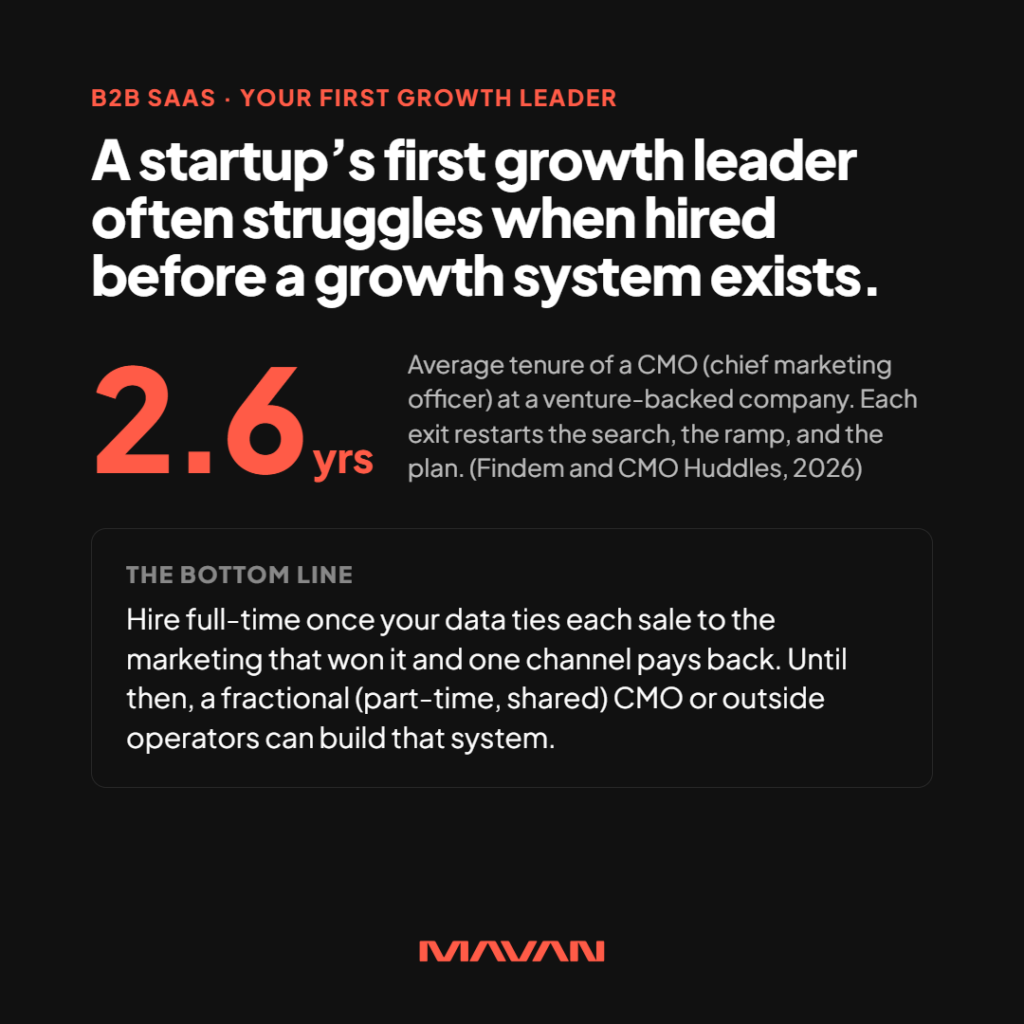
The round closes, the board asks for a growth plan, and the founder opens a search for a VP of Growth or a CMO. It is the most natural move in a startup. It is also one of the riskiest. Findem and CMO Huddles studied 13,000 current CMOs in 2026. Marketing chiefs at venture-backed companies last 2.6 years on average, against about four years at larger public companies, Marketing Dive reported. Every early exit means another search, another ramp, and another reset of the plan.
The choice also got more crowded. Founders and operating partners can now pick a part-time CMO, a fractional CMO, an outsourced CMO, an interim CMO, a full-time hire, or a growth operating company. Workforce data firm Revelio Labs found that 24 of every 1,000 new executive roles advertised in 2026 were fractional, up from nine five years earlier, as the Financial Times reported. Finance roles lead that list, according to Revelio Labs, and marketing comes next.
We come at this question from mobile gaming. Our founders and operators worked in growth at companies like Zynga, King, and Take-Two, where per-user and per-campaign math was normal long before most SaaS teams tracked past the click. That habit shapes our answer. The first real growth leader is the last step in a sequence. Diagnose the constraint, fix the measurement, and prove a channel. Then hire the person who will run the machine. Where you sit in that sequence decides whether you need fractional help or a full-time executive.
Key Terms To Know About CMOs and Growth Leaders
- Growth Leader
- The executive who owns the company’s growth number, such as pipeline, CAC payback, or new revenue, across marketing, product, and data. The title may be CMO, VP of Growth, or Head of Growth.
- Part-Time CMO
- A chief marketing officer who works reduced hours for one company, as an employee or long-term contractor. People often use the term interchangeably with fractional.
- Fractional CMO
- An independent senior marketing executive who serves a few companies at once, usually 10 to 20 hours a week on a monthly retainer.
- Outsourced CMO
- The CMO function bought from a firm. You get a senior leader plus the firm’s team, and the firm holds the contract.
- Interim CMO
- A temporary, full-time CMO who fills a gap, such as a departure, for a set period.
- Full-Time CMO
- A permanent marketing executive on payroll, paid in salary, bonus, and equity, who builds and leads the team.
- Growth Operating Company
- A firm that places senior operators inside a business to diagnose the growth problem and execute the fix, under one point of accountability.
When Should a B2B SaaS Startup Hire Its First Real Growth Leader?
A B2B SaaS startup should hire its first full-time growth leader after product-market fit. Wait until your team trusts its tracking, at least one channel pays back, and the founder has become the bottleneck. A funding round is not the signal. Until then, rent senior judgment through fractional or outside help, and build the system the hire will inherit.
Sam McLellan, our VP of Growth, calls this the “off to college” moment. He spent years in mobile gaming at Zynga and Take-Two, and he has watched many founders hand the whole job to one senior hire. In his experience, few operators want to own the strategy, the hands-on execution, and the board meetings at once. Most lean one way. Some live in execution. Others want strategy and a team to manage, and a seed or Series A company rarely has budget for that team.
Why Is the Growth Leader the Last Step?
That gap is why we treat the hire as the end of a sequence. Matt Widdoes, our Founder and CEO, worked at King, Zynga, and Red Bull before he started MAVAN. He thinks most founders get the order backward.
“They often start with generalists because they’re like, ‘I don’t have that much money.’ I actually think that’s upside down. You bring in specialists early.” — Matt Widdoes, Founder and CEO, MAVAN
In our experience, the order that works has three steps:
- Diagnose the whole growth system. Map which channels, segments, and campaigns produce paying customers, using numbers that finance and marketing both accept.
- Prove one channel with specialists. Senior experts in paid search, lifecycle, or data scale a working lever without a year-long ramp.
- Hire the senior leader to run the machine. Once specialists produce repeatable output, the new CMO or VP of Growth inherits a working channel and clean numbers on day one.

What Signals Say You Are Ready?
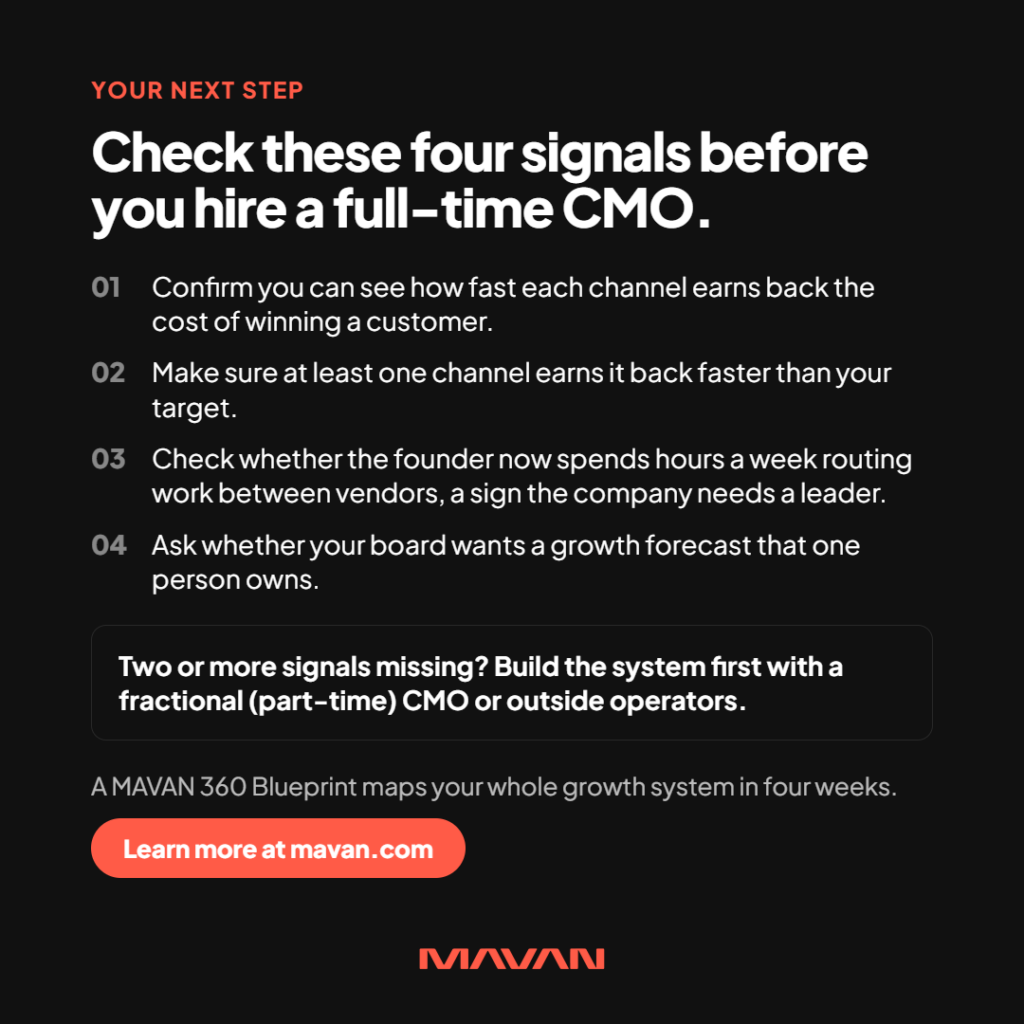
Look for operating signals first. A new round adds fuel, but it does not tell you whether the engine runs. Look for these four conditions before you open a full-time search:
- You can calculate CAC payback by channel. Closed deals in the CRM trace back to their first marketing touch, so each channel has its own payback number.
- At least one channel beats your payback target. One working lever gives a new leader something to scale on day one.
- The founder has become the integration layer. If the founder spends hours a week routing work between vendors, the company has outgrown founder-led growth.
- The board wants a forecast someone owns. A growth plan needs a person who will defend the number every quarter.
If two or more of those conditions are missing, a full-time executive will spend the first quarter rebuilding plumbing. We cover the readiness work and the hiring red flags in our guide to avoiding a bad first growth hire.
What Changes When the Company Is PE-Owned?
In a PE-backed company, the hold period sets the clock, and the marketing seat turns over fast. The Findem and CMO Huddles study found that CMOs at PE-backed companies last 3.1 years on average.
That turnover punishes slow searches. Executive search firm Talentfoot estimates that filling a CMO role takes about 3.8 months. Add a ramp, and a new CMO may spend most of year one learning the business. That is why we advise sponsors to separate two jobs: surge capacity now, and a permanent hire once the value-creation plan shows it works. Operating partners should lead that conversation with revenue, EBITDA, and exit readiness, and treat CAC and payback as the mechanism.
What Does a Fractional CMO Do?
A fractional CMO sets marketing strategy and leads the function part-time, usually 10 to 20 hours a week across a few clients. The work covers positioning, the go-to-market plan, budget priorities, agency and team management, and board reporting. Execution depends on the hours you buy, so most companies still need people to ship the work.
The best fractional leaders earn the fee in the first weeks by making choices a founder has postponed. The core responsibilities usually include:
- Positioning and the ideal customer profile. They define who buys, why, and which message wins that buyer.
- The go-to-market plan and budget. They set channel priorities and decide where the next dollar goes.
- Team and vendor management. They brief agencies and freelancers and hold them to targets.
- Metrics and board reporting. They choose the few numbers the board sees and explain the variances.
- The next leadership hire. They often write the full-time job description and help run the search.
The job also changes with the company’s sales motion. Aurelie Guerrieri, Chief Marketing & Alliances Officer at DataDome and a member of the MAVAN Advisory Group, has seen that split firsthand. “In about half of the cases, marketers needed to primarily focus on building pipeline,” she told our CEO in an interview. In those cases, she added, “you’re looking at heavy demand generation skills, very close collaboration with sales, really good digital marketing skills.” Put a brand-first leader in a pipeline-first company, and even a senior one will struggle.
What Can’t a Fractional CMO Do?
The limit is hours and standing. Ten hours a week covers strategy, a weekly leadership meeting, and vendor reviews. It rarely covers rebuilding a data pipeline or getting product, finance, and engineering to change their roadmaps. That gap matters most after product-market fit, which is why we compare the two models in depth in growth pods vs. fractional CMOs.
What Is a Part-Time CMO, and How Is It Different From a Fractional CMO?
A part-time CMO works reduced hours for one company, often as an employee or long-term contractor. A fractional CMO is independent and splits time across several clients. Many people use the two terms interchangeably, so ask about exclusivity, weekly hours, contract terms, equity, and who owns execution before you sign anything.
The labels matter less than the commitments behind them. A part-time CMO is usually yours alone. That person may hold equity, join the leadership team, and stay for years. The trade-off is a smaller pool of candidates, since few senior marketers want reduced hours at a single company.
Fractional leaders bring pattern recognition from several companies at once. That breadth helps when you face a problem they have solved elsewhere. It also means their attention is shared, and their calendar sets the pace of your decisions. Ask how many clients they carry and whether any compete with you.
In practice, the right test is simple. If you need continuity and a voice in every leadership meeting, lean toward part-time. If you need seasoned judgment fast and can live with shared attention, fractional fits better.
What Is an Outsourced CMO?
An outsourced CMO is the marketing leadership function bought from a firm rather than hired as one person. The firm supplies a senior leader and usually a team to execute, and the firm holds the contract. You gain capacity and coverage, but the firm decides staffing, methods, and how much of the leader’s time you actually get.
Three kinds of firms sell this service. Fractional CMO firms pair a leader with a small marketing team. Agencies attach a strategist with a CMO title to a channel retainer. Growth operating companies, such as MAVAN, embed operators across several functions and run the work inside the business. The all-in cost of a firm sits above that of a single independent fractional CMO because it carries firm overhead, according to Fractional Jobs, a fractional hiring platform.
The risk is a title stretched over a sales motion. A “CMO” who mostly sells the firm’s channel services will steer budget toward that channel. Before you sign, ask four questions:
- Who is the leader, and how many clients do they carry? Get a name and a weekly time commitment in writing.
- Who does the work? Find out whether the team is employed by the firm or subcontracted.
- Who owns the accounts, data, and playbooks at the end? You should keep all three.
- How will success be measured? Tie the contract to a number such as CAC payback or pipeline instead of activity.
When Should You Hire a Fractional CMO?
Hire a fractional CMO when your gap is senior judgment, not hands. It fits when capable people already execute but nobody sets priorities. It also fits when you need a leader in weeks rather than months, or when you want to test the full-time role before you commit to a permanent executive.
Fractional leadership tends to work best in four situations. The first is a small team with a clear product and no marketing leader. The second is a gap between full-time CMOs. The third is a reset, such as a new segment or market, that needs a plan before it needs a team. The fourth is the most useful: scoping the permanent role.
Yousuf Bhaijee, a growth advisor who spoke with us on our podcast, named the reason that fourth use matters. “Growth roles have the most ambiguity and the highest failure rates,” he said. His remedy is direct: “Try before you buy. Work on a problem together for a month.” A fractional engagement turns that idea into a contract.
The model is a weaker fit when the constraint crosses functions. If attribution is broken, onboarding leaks, and nobody can ship creative, the company needs execution across data, product, and acquisition at once. A few hours of strategy per week will diagnose that problem accurately and then wait on other people to fix it.
How Much Does a Fractional CMO Cost?
In 2026, fractional CMO roles posted on Fractional Jobs carry a median rate of $164 an hour, and most fall between $150 and $195. At 10 hours a week, that works out to roughly $6,500 to $8,450 a month. A full-time CMO’s median base salary is $325,000, before a median bonus of 32.1%, equity, and search costs.
The fractional figures come from Fractional Jobs’ 2026 data, which also found that 37% of fractional marketing leaders bill $200 an hour or more. The full-time figures come from Pave’s 2026 Marketing Salary Guide. Pave puts the median VP of Marketing base salary at $252,471, with a median new-hire equity grant of $880,500.
What Does a Full-Time Hire Cost Beyond Salary?
Salary is only the visible line. The Society for Human Resource Management’s 2025 benchmarking report put the average cost to hire an executive at $35,879. Then comes time. A search of about four months, plus a ramp, delays results by most of a year.
We also count leadership inside acquisition cost. McLellan argues that a true CAC must include the people who run the program. “There’s a lot of costs with tools. There’s a lot of cost with personnel,” he says. A CMO paid more than $400,000 in salary and bonus who does not move payback raises your fully loaded CAC with nothing to show for it.
How Is Fractional CMO Pricing Structured?
Fractional CMO pricing usually follows one of four structures. Companies pay a monthly retainer for set hours, an hourly rate, a fixed fee for a defined project, or a lower cash rate plus equity or a bonus. Retainers dominate in marketing. The best structure ties pay to the outcome you need, with a clear scope and an end date.
Fractional Jobs found that a monthly retainer is the most common model among fractional marketing leaders, at 57%, and only 13% bill hourly. Here is how each structure works in practice:
- Monthly retainer. You pay a fixed fee for a set number of hours or deliverables each month. It suits ongoing leadership.
- Hourly rate. The company pays only for time used. It suits light advisory work but makes budgets harder to predict.
- Project fee. You pay a fixed price for one deliverable, such as a go-to-market plan or a positioning reset.
- Equity or performance component. Part of the pay depends on company value or a metric. It aligns incentives but needs a clean, agreed definition of the metric.
What Should a Fractional CMO Contract Include?
Whatever the structure, write three things into the contract: the hours, the deliverables, and the metric that defines success. Also check conversion terms. Hiring through a firm or network usually brings a buyout or placement charge if you later convert the leader to full-time, according to Fractional Jobs.
Our own pricing starts from the problem rather than a package. Every engagement begins with a 360 Blueprint (our growth diagnostic), and the scope follows what the business needs. Paid media fees scale with the spend we manage. Other work runs as a defined monthly engagement tied to a detailed scope, so both teams know what we own, what we will deliver, and what success looks like.
Should You Hire a Fractional CMO or a Full-Time CMO?
Choose a fractional CMO when you need senior direction quickly, the role is still taking shape, or the budget can’t carry a permanent executive. Choose a full-time CMO when the growth system already works and needs a daily owner. That person builds the team, carries the board relationship, and stays through the next stage.
The table below compares the leadership models side by side, using 2026 figures where reliable public data exists.
| Model | Best Fit | Cost Signal (2026) |
| Part-Time CMO | Companies that want one dedicated leader with equity on reduced hours | Pro-rated salary or contract; no reliable public benchmark |
| Fractional CMO | Small teams that have hands but lack senior direction | $150 to $195 an hour; about $6,500 to $8,450 a month at 10 hours a week (Fractional Jobs) |
| Outsourced CMO | Companies that want a leader and a delivery team in one contract | Firm retainer, typically above a solo fractional CMO (Fractional Jobs) |
| Interim CMO | A sudden vacancy or turnaround with a fixed end date | Full-time pay for a set term |
| Full-Time CMO | A working growth system that needs a permanent owner | $325,000 median base plus a 32.1% median bonus (Pave) |
| Growth Operating Company | Constraints that cross data, product, and acquisition | Scoped to the constraint after a diagnostic |
Why Does Tenure Change the Math?
A full-time CMO brings things a fractional leader cannot: daily presence, authority over hiring, a seat in every leadership debate, and equity that ties them to the outcome. Guerrieri puts the case for experience plainly.
“This is where you need to bring in people who’ve done it before.” — Aurelie Guerrieri, Chief Marketing & Alliances Officer, DataDome, and MAVAN Advisory Group member
The catch is how long the seat stays filled. Spencer Stuart puts average CMO tenure at S&P 500 companies at 4.1 years, among the shortest in the C-suite, as Marketing Dive noted. The Findem and CMO Huddles study found that 30% of current CMOs have held the role for less than 18 months. Drew Neisser, CEO of CMO Huddles, said in a statement that “too many CMOs are being handed transformation-sized mandates on trial-period timelines.”
The two models also work in sequence. An interim or fractional leader can carry the company through one stage, write the job description for the next, and hand the system to the full-time hire. Guerrieri describes that early work as “educating the organization and saying, hey, this is what the job is going to be, this is what the goals of the function are.”
What Usually Goes Wrong Before, During, and After the First Growth Leader Starts?
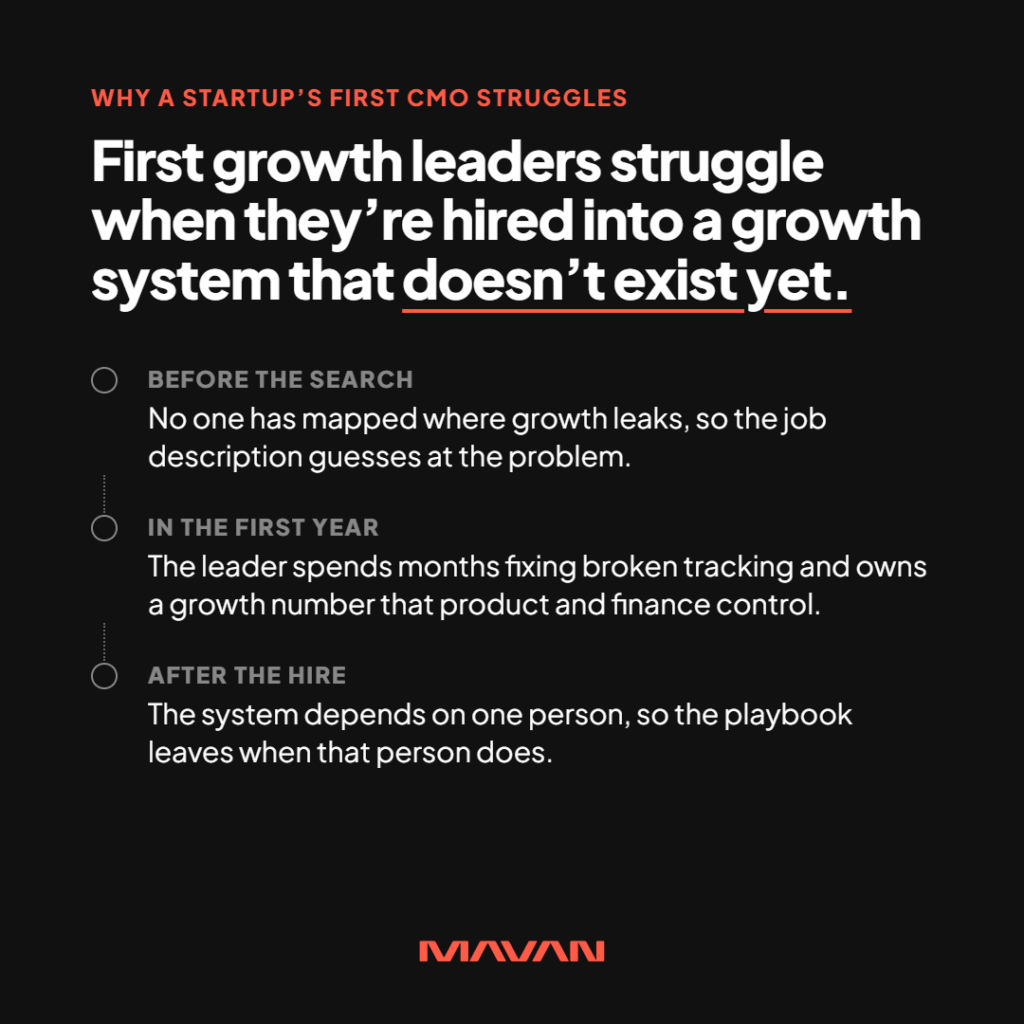
Before the hire, companies open the role without a diagnosis, so the job description guesses at the problem. During the first year, the leader inherits broken data and owns a number without authority over product or finance. After the hire, the system depends on one person, and the playbook leaves when that person does.
What Goes Wrong Before the Search Starts?
Many costly mistakes happen before anyone interviews. The founder writes a job description around a title instead of a constraint. Nobody has mapped where growth leaks, so the role description guesses. The company hires a brand leader for a pipeline problem, or a channel buyer for a data problem.
Jason Parmar, a member of the MAVAN Advisory Group whose background spans TikTok, Microsoft, and King, describes how problems hide in plain sight. “If you don’t have those experts in house and you haven’t hired them, you probably wouldn’t notice,” he told us. The missing skill is the one nobody can see.
The ideal customer is often undefined, too. In one recent Blueprint, activated leads spanned more than 40 industry categories with no vertical above 10%, against no agreed ICP. A company in that state cannot tell which kind of growth leader it needs, because it has not decided whom it sells to.
What Goes Wrong During the First Year?
The new leader inherits the plumbing. In the same Blueprint, attribution reached the ad platforms through a weekly manual export, so nothing optimized on live signal. A talented CMO in that seat spends months on tracking instead of growth, while the ad platforms keep spending on default settings.
The second failure is ownership without authority. The growth leader owns pipeline, but product owns onboarding, finance owns the model, and engineering owns the data. When results lag, Guerrieri warns, there is “an easy tendency to finger pointing.” Widdoes has watched it happen inside single teams, too: “You have different people pointing within.” Write down decision rights before the leader starts, including who can change onboarding, budgets, and tracking.
What Should the New Leader Fix First?
Mobile gaming answered this question a decade ago. Gaming teams grew up with device-level attribution, so per-user and per-campaign math became the default. The first growth leader in a B2B SaaS company should install the same three disciplines in the first 90 days:
- Full-funnel attribution. Track every touch from first ad to closed deal, so each channel earns its own payback number. We walk through the build in why B2B SaaS attribution breaks.
- Segmented CAC. Break CAC out by ICP, channel, campaign type, and placement. A blended number almost always hides one channel that loses money and one segment that deserves more.
- Value tiers in bidding. “Usually like fifteen, twenty percent of users are going to be eighty-plus percent of your revenue,” McLellan says of gaming. B2B SaaS has the same shape, so bid harder for the accounts that look like your best customers, as we outline in how to improve LTV:CAC.
What Goes Wrong Once the System Works?
Success can create its own risk. When one person holds the playbook, the playbook leaves with them, and the tenure data says that day comes quickly. A leader who builds a team around personal credit makes the exit harder still. Widdoes calls the alternative a standard we talk about constantly at MAVAN.
“You have to care more about the baby than you do about credit and or fault for that matter.” — Matt Widdoes, Founder and CEO, MAVAN
The fix is to make the plan independent of the person running it. McLellan designs the Blueprint that way: “it’s not determined at the time of us doing the blueprint who will actually be doing whatever.” Keep one set of numbers that finance and marketing share, and document the channels, the tests, and the metric definitions, so the next leader inherits a working system. The same rule applies to outside partners: if a vendor holds your accounts, data, and know-how, you have swapped one dependency for another. Our guide to structuring a growth team covers how to set that up.
Where Does a Growth Operating Company Fit Between Fractional and Full-Time?
A growth operating company sits between a fractional CMO and a full-time hire. It diagnoses the whole growth system, assigns senior operators to the real constraint, executes alongside your people, and hands the working program to your team. It fits when the problem crosses functions and results can’t wait for a permanent leader.
This is the model we built MAVAN around. We are a growth operating company. Every engagement starts with a Blueprint: 28 days, five or more MAVAN specialists inside the business, and full access to its platforms, people, and data. Every finding needs evidence. The roadmap sorts each action by who has to move it, labeled We start now, Needs a decision, or Needs a session. NEXUS, our human-augmented paid media analytics platform, is included with the Blueprint, so leadership works from the same numbers.
After the readout, the client decides. Some run the Blueprint with their own team. Others ask us to staff it from our network of 170+ specialists, who work in the client’s tools and meetings and report to the client. The team changes as the work changes, and a properly structured engagement has an end date. Our job at the company level is to make ourselves redundant, so the eventual full-time CMO inherits a working machine.
What Does That Look Like in Practice?
Fintech company 8fig shows the pattern at the first-leader stage. It had just raised a Series A and needed to diversify channels and grow lead flow, so it brought us in to augment its internal team. We led paid acquisition strategy and execution and advised across brand, content, creative, funnel efficiency, tracking, and analytics. Cost per lead fell 65%, paid channels grew fourfold, and qualified leads arrived at under half the expected cost. ElevenLabs followed the same arc to its end: once its paid search channel was proven, the program moved to its in-house team.
The same model works for PE sponsors. At Spark, a Bregal Sagemount company, we rebuilt broken data connections and launched evergreen campaigns that became the primary drivers of leads. At WGT, a Haveli Investments company, we worked across four functions and then left. For a fund, that is value creation, executed, with a partner it can redeploy to the next portco.
Frequently Asked Questions About Fractional, Outsourced, and Full-Time CMOs
Leaders weighing their first growth leader also ask practical questions about weekly hours, conversion to full-time, interim roles, PE ownership, and reporting lines. Each answer below comes back to one rule: define the scope, the data access, and the number the leader owns before the engagement starts.
How Many Hours a Week Does a Fractional CMO Work?
Most fractional CMOs work 10 to 20 hours a week per client, according to Fractional Jobs. Cost scales with hours, so define the weekly commitment, the meetings they attend, and the deliverables in the contract before the engagement starts.
Can a Fractional CMO Become a Full-Time CMO?
Yes, and many companies use fractional work as a trial. If you hire the leader directly, conversion is a conversation between you and that person. If a firm or network placed them, expect a buyout or placement fee, according to Fractional Jobs.
What Is the Difference Between an Interim CMO and a Fractional CMO?
An interim CMO works full-time for a fixed period, usually to cover a departure or a turnaround. Fractional CMOs work part-time across several companies on an ongoing basis. Interim fills a seat; fractional supplies senior judgment without filling one.
Do PE-Backed Portfolio Companies Use Fractional or Outsourced CMOs?
They can, and the hold period favors it. A CMO search and ramp can eat most of the first year of a multi-year hold. A sponsor can add fractional or outside capacity first, then make the permanent hire once the growth plan works, and judge both against revenue and EBITDA.
Who Should a Fractional CMO Report To?
Report to the CEO, with a standing slot in board or operating reviews. Give the leader access to the CRM, ad accounts, and finance data from the first week, because a fractional CMO who can’t see the numbers can only give opinions. Tie the role to one number the board already tracks.
So, When Should You Hire Your First Real Growth Leader?
Hire your first full-time growth leader when the system is ready: tracking you trust, CAC split by channel and segment, and one channel that pays back. Before that, a part-time, fractional, or outsourced CMO can supply senior judgment, and a growth operating company adds execution. Diagnose first, prove a channel second, and hire the permanent leader last.
Start this week with one test. Ask your team to trace a recent closed deal back to its first marketing touch, step by step. If they can’t, or if marketing and finance give you different CAC numbers, your first growth leader will spend their first quarter fixing that, whatever their title.
A Blueprint gives you that answer in four weeks. We map the whole growth system, evidence every finding, and hand you a sequenced roadmap you can run with your own team, a future CMO, or ours. You keep the Blueprint and NEXUS either way.
Request a Blueprint and get a straight answer in four weeks.
Casey Rock is Content Director at MAVAN, where he helps turn complex ideas into clear, strategic content that drives growth. With over 15 years of experience across content strategy, SEO, media, and digital marketing, Casey focuses on building content systems that connect audience insight, brand storytelling, and measurable business outcomes.
Book a complimentary consultation with one of our experts
to learn how MAVAN can help your business grow.
Want more growth insights?
[hubspot type=”form” portal=”20951211″ id=”9c538ed2-fb12-45f1-a573-ad7953c058cc”]
Related Content
-
When Should a B2B SaaS Startup Hire a Growth Leader (What Kind of CMO)?
Mobile gaming teams have operated with granular attribution, segmented CAC, and whale-tier bidding for over a decade. B2B SaaS companies adopting the same three disciplines see clearer unit economics, faster optimization, and fewer wasted first growth hires.
-
Who Does Due Diligence for Private Equity Deals?
Strategy consultancies and boutique firms run commercial due diligence on the market. Operations advisors and PE operating teams run operational due diligence on how the company works. Growth and GTM due diligence falls to specialist diligence firms, GTM boutiques, and growth operating companies like MAVAN, which test the revenue engine from inside and can stay to run the fix.
-
How Do Private Equity Operating Partners Drive Value Creation?
Private equity operating partners drive value creation by turning the investment thesis into operating work inside each portfolio company. They set priorities, fix leadership gaps, and track the numbers that matter at exit. Because most now cover five or more companies, the best results come when they add outside execution capacity, especially for revenue growth.