
Structure a growth team as one cross-functional unit that sits above product, marketing, data, and finance. Give it a single lead who owns the growth number and reports to the CEO. Staff only the four or five functions your biggest constraint crosses. Then put every team on one scoreboard, and reshape the team as the constraint moves.
TLDR — How to Structure a Growth Team Above the Silos
- Put growth above your silos, where it sees them all.
- Give one leader the number and the authority.
- Have the growth lead report to the CEO.
- Find the constraint before you pick any roles.
- Staff the four or five functions it touches.
- Run every team from one shared scoreboard.
- Make the gaps between teams someone’s job.
- Reshape the team when the constraint moves.
- Document every system so your team can own it.
- See how MAVAN’s growth services build your team.
Ask the leaders of a scaling company who owns growth, and you will often hear four answers. The CMO points to pipeline. The product lead points to activation. Sales blames lead quality, and finance blames the ad budget. Matt Widdoes, Founder and CEO of MAVAN, describes things this way: “you have sales saying, well, if marketing would get us better leads, we would close more deals.” Every answer holds a piece of the truth, yet no single leader can see the whole machine.
The split often starts at the top. In a 2023 study, McKinsey spoke with more than 100 C-level growth leaders and 21 CEOs. Over two-thirds of the CMOs it surveyed said two or more marketing-related leaders reported straight to the CEO. McKinsey’s analysis of Fortune 500 companies found that those with only one customer or growth role reporting to the CEO grew up to 2.3 times more than companies with several. Clear ownership of growth shows up in revenue growth.
At MAVAN, we build and run growth teams inside private equity portfolio companies and venture-backed scale-ups. We start from one belief: growth is a system that runs through every department, so the team that owns it has to sit above them. This guide covers how to structure that team, which roles it needs, and which org chart holds up once real money is on the line.
Key Terms for Structuring a Growth Team
- Growth Team
- A cross-functional group that owns a company’s growth number (such as revenue, customers won, or payback) across acquisition, conversion, retention, and measurement.
- Silo
- A team that plans, measures, and reports on its own work without sharing goals, data, or decisions with the teams around it.
- Growth Lead
- The one person accountable for the growth number, with the authority to set priorities across every function that moves it.
- Growth Constraint
- The single bottleneck that limits growth most right now, such as broken tracking, a leaky signup flow, or weak retention.
- Cross-Functional Growth Pod
- A small team that spans only the functions the constraint requires and works under one point of accountability.
Why Do Siloed Teams Destroy Growth?
Siloed teams destroy growth because the biggest leaks sit between departments, where no one has the authority to fix them. Each team chases its own metric, reads its own dashboard, and guards its own plan. Customers cross every one of those lines on the way to buying, so the damage piles up at the handoffs.
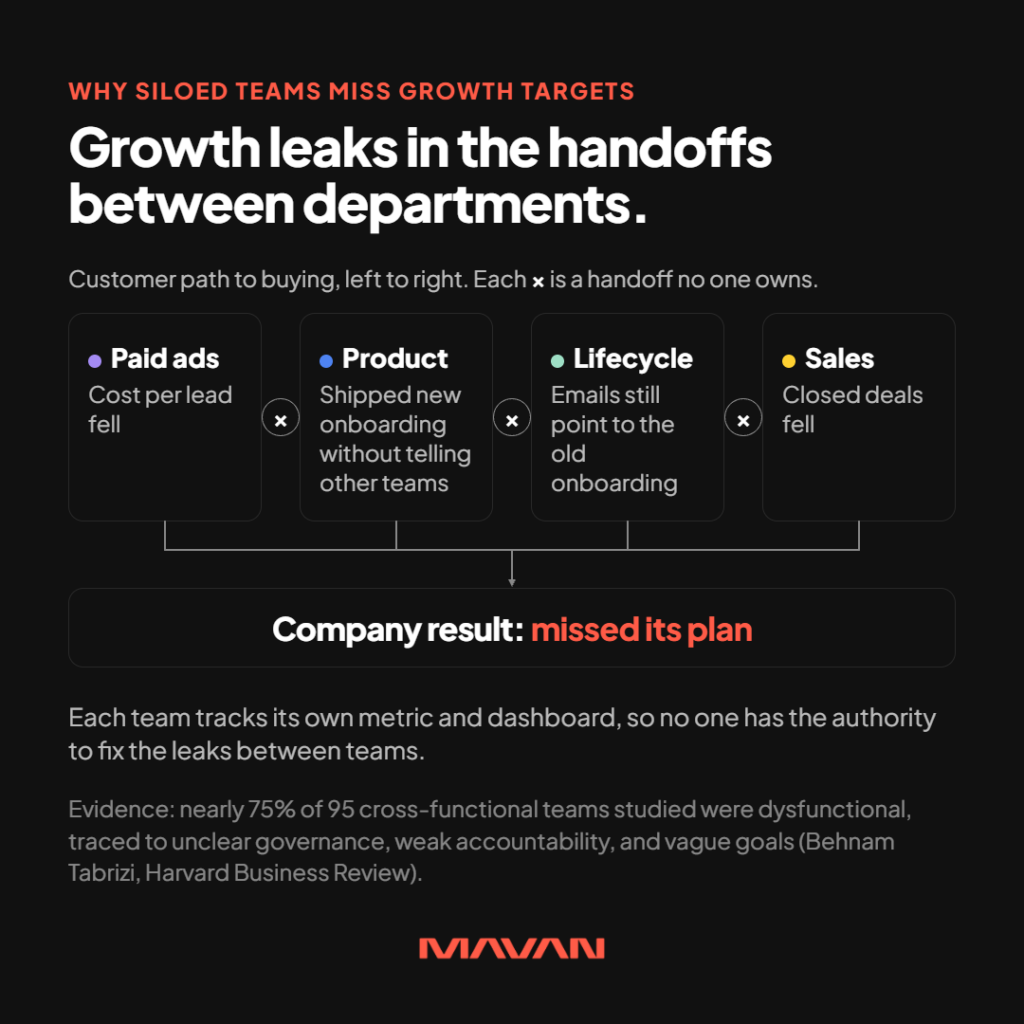
Picture a Series B software company in a slow quarter. Paid acquisition reports a lower cost per lead, while sales reports fewer closed deals. Product ships a new onboarding flow without telling either team. Lifecycle keeps sending emails that point to the old one. Each team can defend its own numbers, and the company still misses its plan. Widdoes has described how teams under one roof drift into separate camps: “It lives under one brand, but ultimately they operate almost like different business units.”
Information also gets stuck at the borders. Aurelie Guerrieri is Chief Marketing and Alliances Officer at DataDome and a member of MAVAN’s Advisory Group. She sees customer insight fail to reach the people writing the ads: “it’s way too often that you have marketing teams that are getting their information secondhand.”
Tools split along the same lines. Dan Barnes, President of MAVAN, calls it “an operational inefficiency” when one team plans in ClickUp and another works in Jira. He treats shared systems for software and analytics alike as the foundation everything else rests on.
What Does the Research Say About Silos?
Outside research tells the same story. Behnam Tabrizi, a consulting professor at Stanford University, studied 95 cross-functional teams in 25 leading companies. He reported in Harvard Business Review that nearly 75% of them were dysfunctional. Each of those failed at least three of five tests, such as staying on budget, staying on schedule, and keeping aligned with company goals. He traced the failures to unclear governance, weak accountability, and vague goals. More recently, Mural and The Martec Group surveyed 350 sales, marketing, and R&D professionals in 2025. Of those, 89% saw direct revenue damage from poor collaboration, including lost retention and missed growth goals.
Tabrizi’s data also points to the fix. The small share of teams that worked were steered by a single executive champion or by executives from each function, according to Inc.’s summary of his findings. His warning is blunt: “silos tend to perpetuate themselves.” Growth teams follow the same rule. They work when someone with real authority sits above the functions and owns the result.
How Should You Structure and Build a Growth Team?
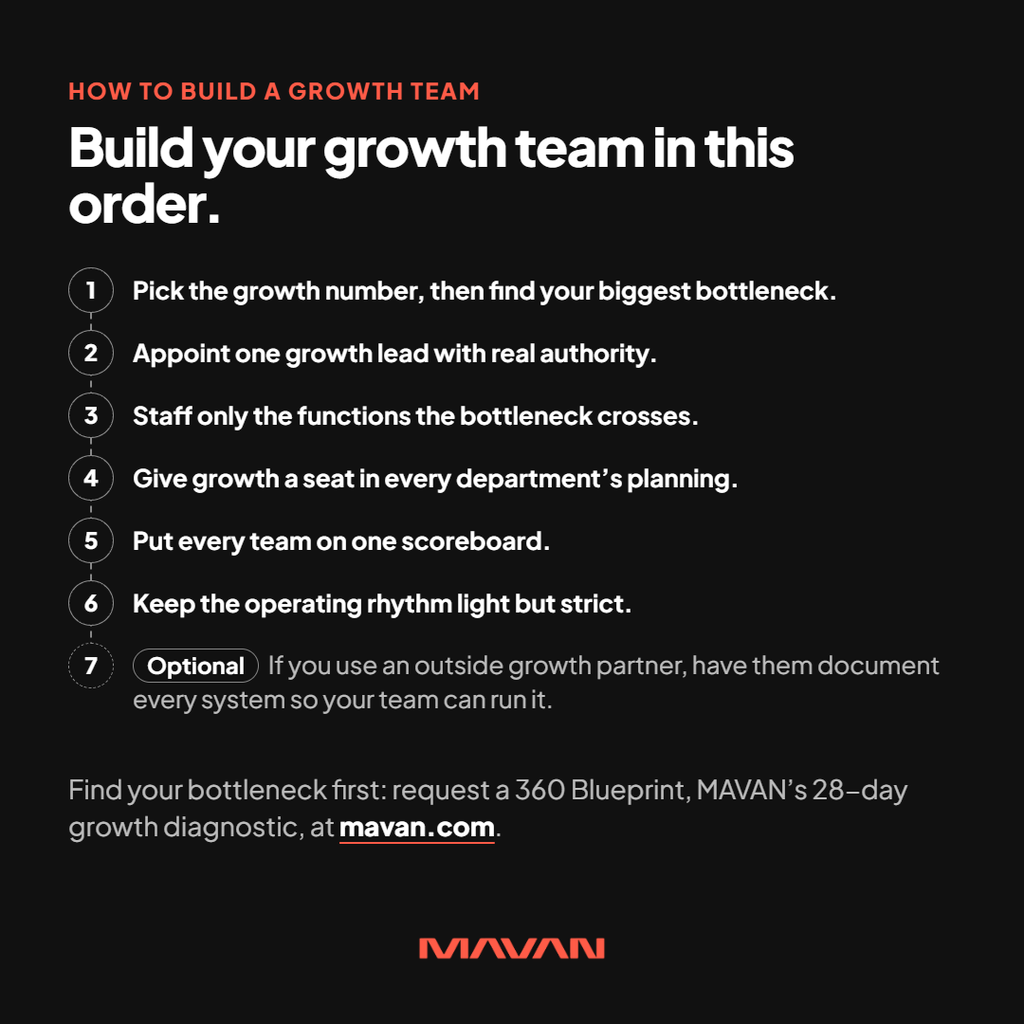
Build a growth team from the top down and from the constraint out. Name one growth number and one leader who owns it, then place that leader above the functions that move the number. Staff the four or five functions your biggest constraint crosses, share one scoreboard, and , if you involve an external partner, plan the handoff to your internal team from the start.
That top-down placement is the core of how we work. Sam McLellan, VP of Growth at MAVAN, describes our teams as a layer on top of product, marketing, and finance. The reason is practical. A growth lead who reports into marketing has little pull over the product roadmap. A lead buried in product has little say over ad spend. Andrew Chen, who spent three years on Uber’s growth team, calls the worst version a team with “no staff… just an expectation to run around and convince other teams to build your amazing ideas.” He labels it “a recipe for failure.”
“Like many things, this challenge begins with the leadership team, the alignment at the top, and the structure by which the org operates, hires, fires, and rewards their teams.” — Matt Widdoes, Founder and CEO, MAVAN
What Is the Build Order for a Growth Team?
We build every growth team in the same order:
- Pick the number, then find the constraint. Choose the metric your board watches most, such as revenue, payback, or EBITDA (earnings before interest, taxes, depreciation, and amortization). Find what holds it back before you hire. Chen warns against “a random org configuration” and says structure should follow the problem.
- Appoint one growth lead with real authority. This person owns the number and breaks ties between teams. In a portfolio company, the lead should answer to the CEO. They should also work directly with the operating partner who owns the value-creation plan (the sponsor’s roadmap for raising the company’s value).
- Staff only the functions the constraint crosses. Most problems worth solving touch four or five of roughly twelve growth functions. Start there and add skills as the work demands.
- Give growth a seat in every function’s planning. Launches, pricing changes, and budget calls all move the number, so the growth lead should hear about them before they ship.
- Put every team on one scoreboard. Finance, product, and growth should pull the same numbers from the same source. Our guide to the board-ready scoreboard covers which metrics belong on it.
- Keep the operating rhythm light but strict. Barnes says process “has to be lightweight, but incredibly rigid.” He adds that “when you have people whose sole job is to manage the process, you have ultimately failed.”
- OPTIONAL: Plan the handoff from day one. If you’re working with an external growth partner, make sure they document each system as its built, so your own people can run the growth engine later.
How Does the Structure Change as a Company Scales?
The right shape shifts with stage. Guerrieri puts it plainly: “as you’re scaling companies, you have to change your organization from stage of a series A, series B, series C.” Early on, few companies can afford a full-time specialist in every function. Brian Balfour, then VP of Growth at HubSpot, told Intercom that early growth teams often run as a “SWAT team.” That team finds the biggest friction in the funnel and moves to it. Larger companies can fund standing teams for each area. Chen notes that Uber’s growth team grew past 500 people at its peak.
Private equity raises the stakes on speed. Bain & Company’s 2026 Global Private Equity Report finds that typical deals now need about 10% to 12% annual EBITDA growth to earn the benchmark 2.5x return over five years. At that pace, a portfolio company can’t spend most of the hold period recruiting a growth org one seat at a time. It needs a lead tied to the value-creation plan and a team that forms around the first constraint quickly. That raises a practical question: who belongs on the team?
What Are the Roles and Responsibilities of a Growth Team?
A growth team needs one accountable lead plus the specialists your constraint requires. Most teams draw on strategy, data, paid ads, creative, lifecycle, conversion, and product or engineering. A finance partner joins the talks on spend and payback. Each role owns part of the number, and the lead owns all of it.
Chen’s roster from his Uber years includes a growth product manager who runs the experiment roadmap, a growth engineer, a growth marketer, a data analyst, and a designer. He adds that some decisions pulled in finance or operations. Our own roster maps to the 12 growth functions we staff from a network of 170+ vetted specialists. The table below shows the roles most growth teams draw from and the number each one should answer for.
| Role | Core Responsibilities | Number It Answers For |
| Growth Lead | Sets priorities across functions, breaks ties, and reports results to the CEO and board | The growth number itself |
| Strategy (Growth Product Manager) | Sequences the experiment roadmap and decides what starts now | Tests shipped and lessons learned |
| Data and Measurement | Builds tracking, attribution, and the shared source of truth | Numbers finance will sign off on |
| Paid Acquisition | Runs channel mix, bids, budgets, and new markets | CAC (the cost to win one customer) and payback |
| Creative | Builds ads and messages around testable ideas | Click-through and conversion by concept |
| Lifecycle and Retention | Runs onboarding, email, push, and win-back programs | Retention and repeat revenue |
| Conversion Optimization | Improves landing pages and signup flows through A/B tests | Conversion rate at each step |
| Product and Engineering | Ships in-product changes and growth features | Activation (a new user’s first real use) |
| Finance Partner | Checks budgets, payback windows, and margin | Contribution margin per customer |
“…who does what isn’t important, it’s what gets done.” — Dan Barnes, President, MAVAN
Do You Need Every Growth Role Filled Full Time?
You rarely need every seat filled full time. Guerrieri sees budget-limited companies “pick and choose” which functions get done, in a way that can seem “a little random.” A better filter is the constraint. Roles can also merge as a team matures. Lenny Rachitsky, a former growth lead at Airbnb, said on a Greylock podcast that Airbnb moved its performance marketing team inside its guest and host growth teams. Each one had a product manager leading marketers, data scientists, and engineers.
What Is the Best Growth Team Org Structure?
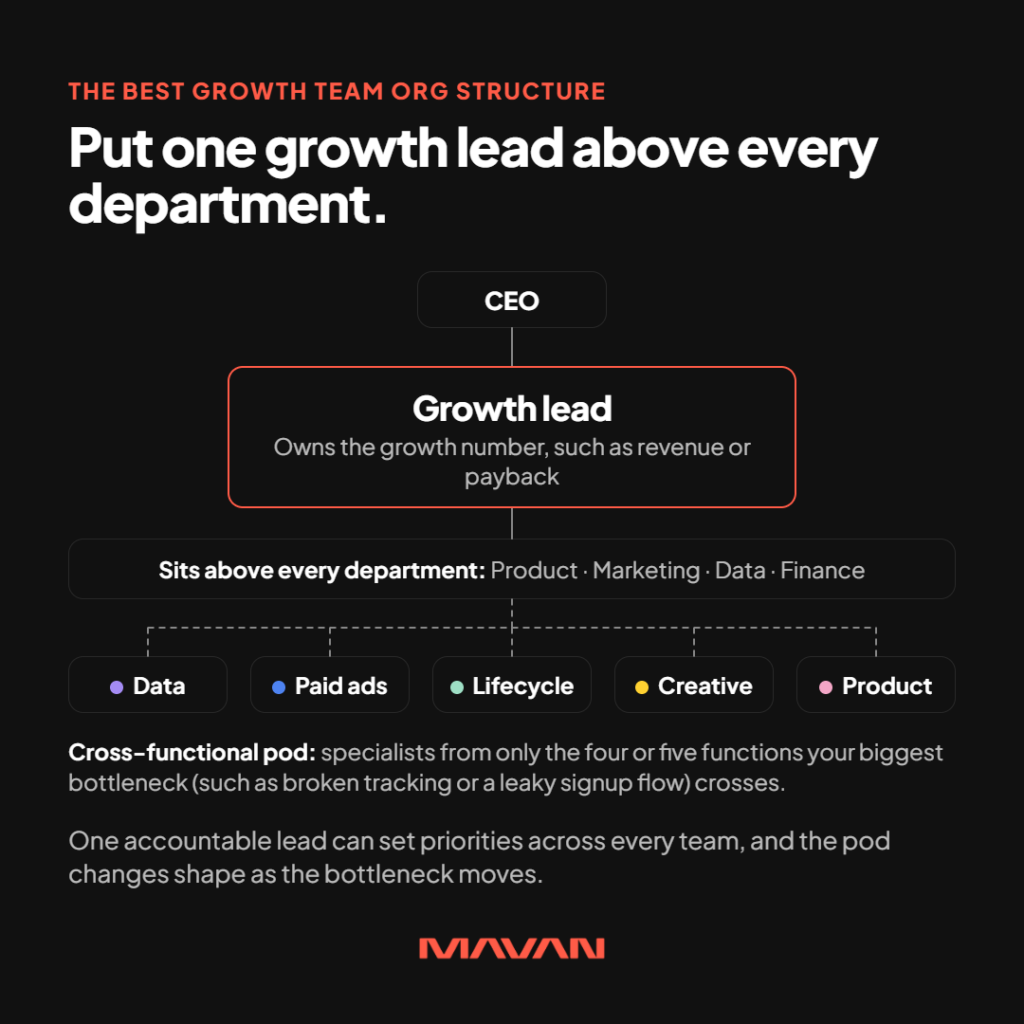
For most Series A to D companies and PE portfolio companies, the best structure is a hybrid. A growth lead reports to the CEO and sits above the functional teams. Under that lead, a small pod pulls specialists from data, paid ads, lifecycle, creative, and product. The pod changes shape as the constraint moves.
Most growth teams use one of four models. Chen describes two of them in his talk on Uber’s growth org. In one, growth pods are “matrixed” to their home functions, so each member reports to a functional boss. In the other, used at Facebook and an early version of Uber’s growth team, functions report into a general manager like a business unit. He notes that the second model gives the team independence but can split the org and cause conflict.
| Model | How It Works | Where It Breaks |
| Functional | Growth roles sit inside product or marketing and report to that function’s head | Growth can only move what its host function controls |
| Independent | A standalone growth unit with its own leader, often reporting to the CEO | It can split the org and spark conflict with core product teams |
| Matrixed Pods | Each pod member reports to a home function but works toward a shared growth goal | Without one clear owner, members drift back to home-team goals |
| Growth Lead Above the Functions, With an Embedded Pod | One accountable lead above every function and a pod built for the current constraint | It only works if the CEO gives the lead real authority |
Why Should Growth Sit Above the Functions?
We favor the last model because it fixes the governance gap the research keeps finding. McKinsey recommends that CEOs appoint a C-level growth role that acts as “a general manager of growth.” Tabrizi found that the cross-functional teams that worked had a single executive champion. Our 360 Blueprint looks for this gap on purpose. One of its four findings themes is organizational dynamics: who owns what, where decisions stall, and which relationships are being protected. The Blueprint then sorts every action in the roadmap by who has to move it, using three labels: “We start now,” “Needs a decision,” or “Needs a session.” That sorting works like an org chart drawn around the real constraint.
How Can You Stand Up a Cross-Functional Growth Team Fast?
You can stand up a cross-functional growth team fast by diagnosing first, then bringing in senior specialists for the functions your constraint needs. Your internal team works alongside them and learns the systems. The structure starts working while you recruit for the long term, and the systems stay behind when the outside specialists step back.
This is the structure we deploy. Every MAVAN engagement starts with a 360 Blueprint: 28 days, 5+ MAVAN specialists inside the business, and full access to its platforms, people, and data. The Blueprint names the constraint and sorts every action by owner. If the client chooses to continue with us, we assign the operators the roadmap needs from our network of 170+ specialists. They work in the company’s tools and meetings, report to the company, and stand down when the job is done. NEXUS is included with the 360 Blueprint, so every team works from the same view of acquisition performance.
How Has This Structure Worked for MAVAN Clients?
The team changes shape as the constraint moves. At WGT, a Haveli Investments company, the work ran Blueprint → paid acquisition → lifecycle rebuilt end to end → data and analytics stack. Nobody planned four functions at the start, and that work now sits inside the business. At ElevenLabs, paid search grew from a test to a high six-figure monthly budget. Payback fell from 15 months to 9 inside the first month, against a board target of 12, and held through scaling. The program then moved in-house. At Spark, a Bregal Sagemount company, paid-media leads had cratered because the ad accounts were optimizing against corrupted tracking signals. We rebuilt the data connections and launched evergreen campaigns that became Spark’s primary drivers of leads.
Weighing a part-time strategist against a full team? Our breakdown of whether growth pods or fractional CMOs scale Series A startups best walks through that choice step by step.
What Do Leaders Ask Most About Growth Team Structure?
Leaders most often ask what a growth team does, when to build one, and how it differs from marketing. They also ask who the team should report to and whether a PE fund can share one team across its portfolio. The short answers below draw on our operating experience and the research cited above.
What Does a Growth Team Do?
A growth team finds and fixes whatever holds back growth, from the first ad to the repeat sale. Andrew Chen describes product growth as applying “the scientific method to business KPIs” (key performance indicators). In practice, the team studies the data, forms a hypothesis, ranks the ideas, runs the test, and repeats. It owns the result across every team it touches.
When Should a Company Build a Growth Team?
Build one once customers stick with the product. A growth team speeds up whatever already exists, good or bad. McLellan tells founders that “the product has to be ready and scalable” before heavy spend makes sense. If retention is weak, the team’s first job is usually product and lifecycle work, not more acquisition.
What Is the Difference Between a Growth Team and a Marketing Team?
Marketing usually owns brand, PR, and awareness. A growth team owns a revenue number and works across product and marketing to move it. Chen notes that some levers, like SEO, paid ads, and email, can sit in either team. Facebook kept much of performance marketing inside growth, while Uber later moved it into marketing.
Who Should a Growth Team Report To?
In most companies, the growth lead should report to the CEO and have direct access to finance and product leaders. Report through one function’s head only when that function holds nearly all your growth levers. In a portfolio company, the lead should also work closely with the operating partner who owns the value-creation plan.
Can a PE Fund Share One Growth Team Across Its Portfolio?
Yes. A fund can keep MAVAN on retainer as its dedicated growth partner. It can then send us into any portfolio company that needs growth work, one at a time or several at once. Each company still gets its own diagnosis and its own team. Our guide on how PE funds repeat growth across portfolio companies covers that model in detail.
So, How Should You Structure a Growth Team?
Structure your growth team above the silos. Give one leader the number and the authority to move it. Staff the four or five functions your constraint crosses, and run every team from one scoreboard. The exact org chart matters less than clear ownership, and the team should change shape whenever the constraint does.
If you can’t name the person who owns your growth number, or the constraint they should fix first, start there. A 360 Blueprint gives you four weeks to a straight answer: evidenced findings, a roadmap sorted by who has to move each action, and the team the work actually needs. You can run that roadmap with your own people or with ours.
Request a Blueprint and see who should own your growth number.
Casey Rock is Content Director at MAVAN, where he helps turn complex ideas into clear, strategic content that drives growth. With over 15 years of experience across content strategy, SEO, media, and digital marketing, Casey focuses on building content systems that connect audience insight, brand storytelling, and measurable business outcomes.
Book a complimentary consultation with one of our experts
to learn how MAVAN can help your business grow.
Want more growth insights?
[hubspot type=”form” portal=”20951211″ id=”9c538ed2-fb12-45f1-a573-ad7953c058cc”]
Related Content
-
What Customer Retention Strategies Actually Reduce Churn?
The customer retention strategies that reduce churn start before the renewal date. Keep the promise that won each customer, shorten the path to first value, and recover failed payments. Then trigger lifecycle messages on behavior, aim saves at customers who will respond, and track net revenue retention by cohort from one source of truth.
-
How Do PE Firms Accelerate Revenue And EBITDA Post-Acquisition?
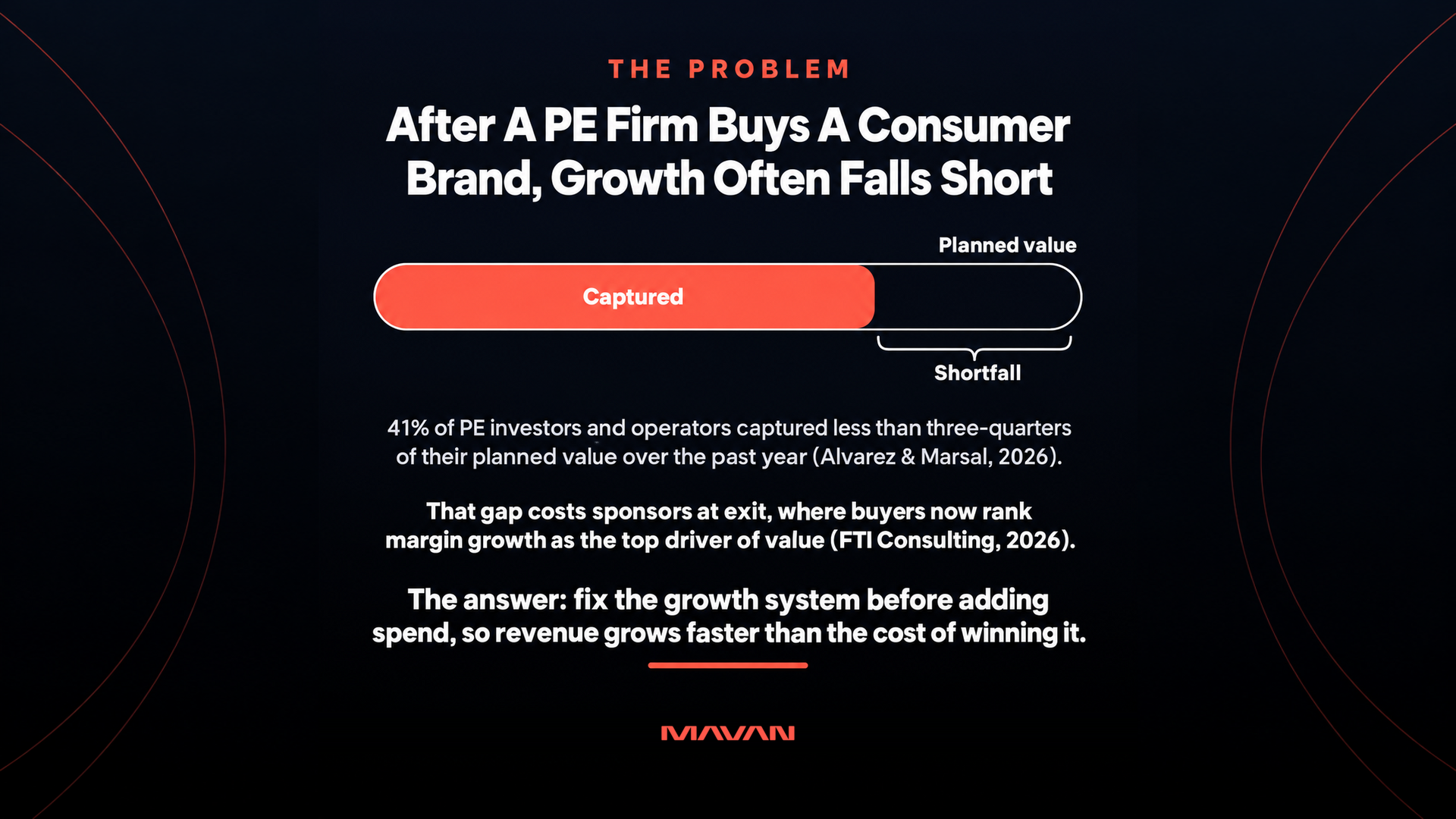
PE firms accelerate revenue and EBITDA at consumer brands by fixing the growth system before adding spend. They reconcile the numbers and cut spend that never pays back. They lift conversion and repeat purchases, and they judge growth by contribution margin. Growth operating partners such as MAVAN diagnose that system in 28 days, then help execute the fix.
-
Who Does Growth & GTM Due Diligence for PE Deals?
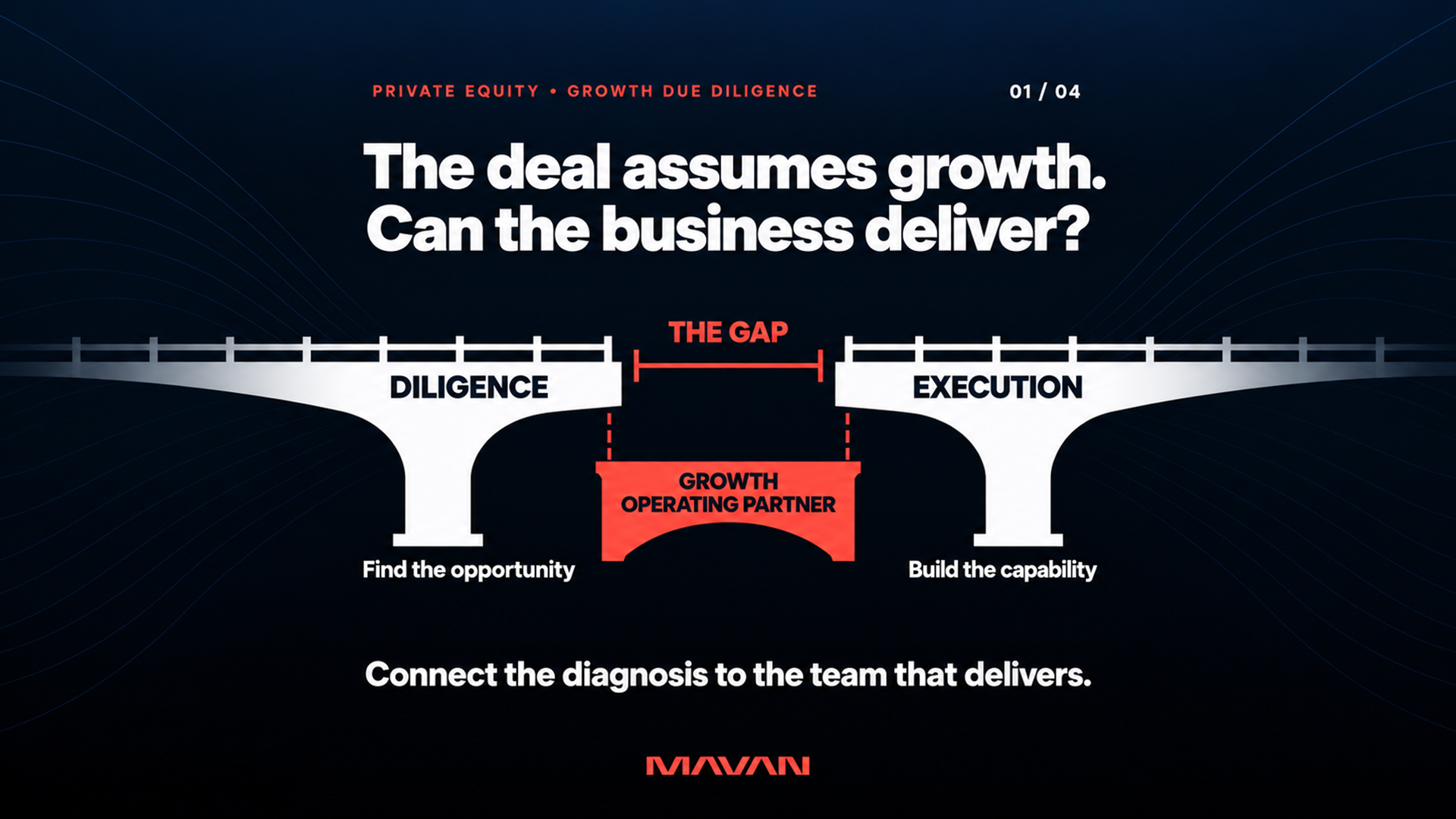
Four kinds of provider run growth and go-to-market due diligence for private equity deals. Strategy consultancies test the market. Specialist commercial diligence firms audit the pipeline. Go-to-market boutiques rebuild the sales motion. And growth operating partners examine the full revenue engine from inside the business, then stay to operate it after close.