
A growth audit reviews everything that drives revenue: data, acquisition, lifecycle, product, and the teams that run them. Marketing audits cover marketing alone. The best growth audits end in a growth plan that sorts every action by who has to move it. MAVAN’s 360 Blueprint delivers both in 28 days.
TLDR — Growth Audits, Marketing Audits, and Growth Plans
- A growth audit tests every system that drives revenue.
- A marketing audit tests marketing and can miss causes.
- Most growth leaks start between teams.
- Ask for full access to platforms, people, and data.
- Cut any finding without a number behind it.
- Test your current priorities against the evidence.
- Give every action one owner and one metric.
- Sort the plan by who has to move each action.
- Name risks and collisions before work starts.
- Get started by learning more about MAVAN’s growth services.
Why Do So Many Growth Plans Fall Short?
Most growth plans fall short for one of two reasons. The audit behind them looked at one part of the business and missed the real cause. Or the plan listed good ideas with no owner and no order. A growth audit solves the first problem, and a well-built growth plan solves the second.
In May 2026, Growth Factors, the operating team at Bregal Sagemount, routed us into one of the firm’s portfolio companies. Marketing-qualified leads (MQLs) from paid media had cratered after years as the company’s main source of leads. The ad accounts were optimizing against corrupted tracking signals, so they would not recover. A review of the campaigns alone would have tuned media that couldn’t come back. The cause sat in the data underneath. The company asked us to stay on before the diagnostic finished. We rebuilt the data connections and launched evergreen campaigns that became its primary drivers of leads.
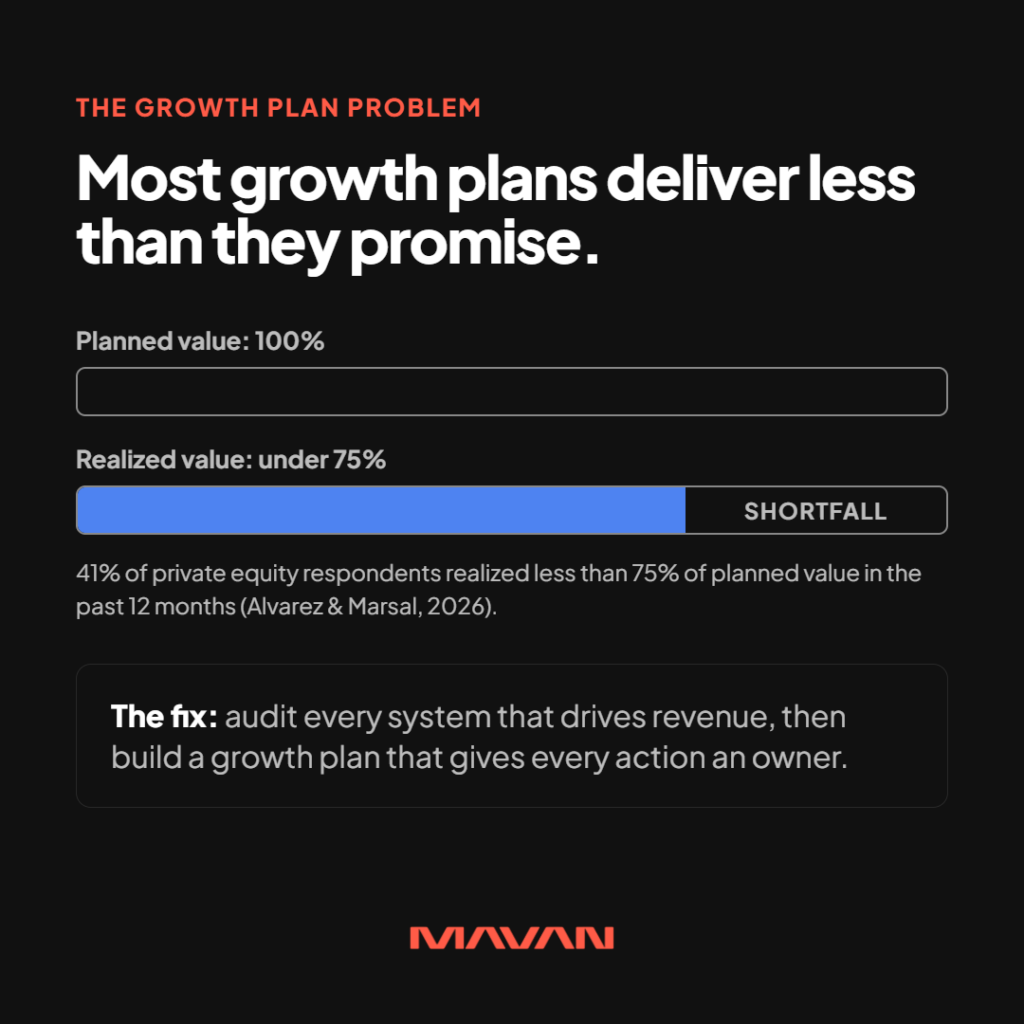
That story shows the gap this guide is about. Sponsors and growth leaders rarely lack plans. What they lack is a plan built on the real constraint, with a name against every line. In Alvarez & Marsal’s 2026 North America value creation survey, 41% of respondents said they realized less than 75% of planned value over the prior 12 months. The firm’s 2026 European survey, found that 65% had achieved less than half the value targeted in plans built over the past two years.
Why Is the Pressure on Growth Plans Rising?
The math behind those numbers keeps getting harder. Bain & Company’s 2026 Global Private Equity Report finds that typical private equity (PE) buyouts now need about 10% to 12% average annual EBITDA growth. That’s what it takes to earn a 2.5x return over five years. (EBITDA is earnings before interest, taxes, depreciation, and amortization.) In the 2010s, about 5% did the job. Bain calls the shift “12 is the new 5.” Growth leaders at venture-backed companies feel a version of the same squeeze. Marketing budgets have stayed nearly flat, at 7.8% of company revenue, in Gartner’s 2026 CMO Spend Survey. With money tight on both sides, the next round of growth has to come from a sharper plan.
Below, we explain what a growth audit is and how it differs from a marketing audit. We show how to turn its findings into a growth plan your team will run. Then we walk through the first 30 days of our own growth audit and what happens once it ends.
Key Terms To Know
- Growth Audit
- A review of every system that drives revenue, including data, acquisition, lifecycle, product, and the teams that run them. It ends in a ranked plan of action.
- Marketing Audit
- A review of a company’s marketing goals, strategy, organization, and activities. Many audits sold under this name now cover only paid channels and campaigns.
- Growth Plan
- The ordered list of actions a company will take to grow revenue. Each action has an owner, a dependency, and a metric that shows whether it worked.
- 360 Blueprint
- MAVAN’s 28-day growth audit. Five or more specialists work inside the business and deliver evidenced findings plus a roadmap sorted by who has to act.
- Sequencing Register
- The page of a Blueprint that names risks before work starts, such as a data timeline that can’t support the growth target.
- One Source of Truth
- A single, trusted set of numbers that finance, marketing, product, and leadership all use to make decisions.
- Full-Potential Read
- A PE term for a quick, evidence-based look at a portfolio company’s largest growth opportunities and limits.
What Is a Growth Audit?
A growth audit is an evidence-based review of every system that drives revenue. It covers the data, the go-to-market motion, the organization, and the plans leadership already holds. The audit finds the real constraint and ranks what to do about it. The output is a growth plan, with an owner and a metric for every action.
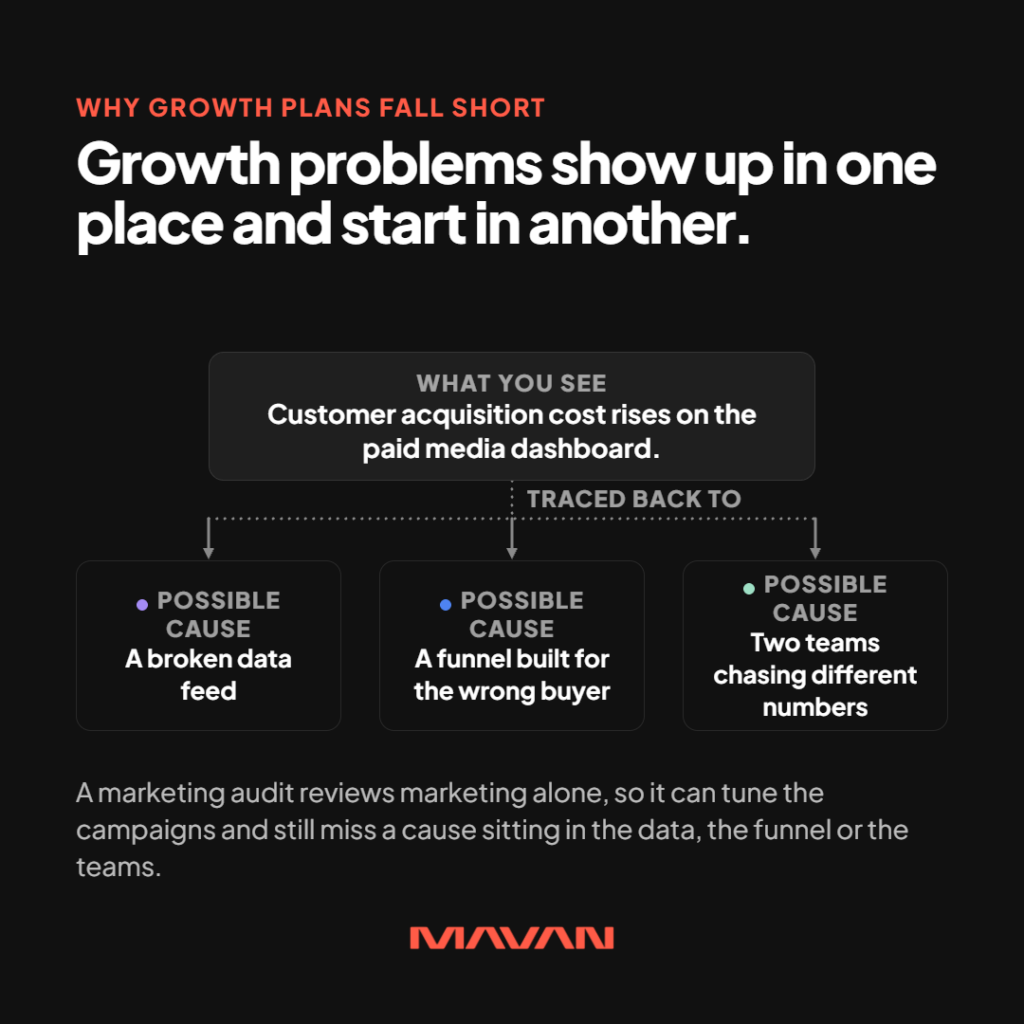
Growth problems tend to surface in one place and start in another. Rising CAC (customer acquisition cost) shows up first on the paid media dashboard. The cause might be a broken data feed, a funnel built for the wrong buyer, or two teams chasing different numbers. A growth audit follows the symptom back to its source, wherever that source sits.
What Does a Growth Audit Cover?
We group our own audit work into four themes. Each one asks plain questions:
- Data and infrastructure. What do the numbers say, do they agree with each other, and what are the ad platforms told?
- Go-to-market architecture. Who is the customer, how many sales and marketing motions are running, and does the funnel match them?
- Organizational dynamics. Who owns what, where do decisions stall, and which relationships does the team protect?
- Your priorities. What does the company already believe it should do, and does the evidence back it up?
The fourth theme matters more than it looks. Leadership teams arrive with plans already in motion, such as a channel to scale or a hire to make. A good audit tests each one. Sometimes the evidence backs the plan. When it doesn’t, someone has to say so before the company funds the wrong bet.
What Does a Useful Finding Look Like?
Every finding needs the number behind it. If we can’t show it, it doesn’t go in. A vague finding, such as “attribution needs work,” gives a board nothing to act on. Compare two findings from one of our live engagements, shared with details removed. Attribution reached the ad platforms through a weekly manual export, so no campaign was optimizing on live signal. And 29% of leads left before the first tracked conversion, which made mid-funnel nurture impossible to build. Each finding points to a fix someone can own. Our guide to fixing broken B2B attribution covers the first repair in depth.
Evidence also settles arguments that opinion can’t. Dan Barnes, our President, describes what happens when teams fall back on gut feel:
“You get those moments where ‘this is my idea, this is your idea,’ and it’s a question of opinions that win out.” — Dan Barnes, President, MAVAN
How Is a Growth Audit Different From a Marketing Audit?
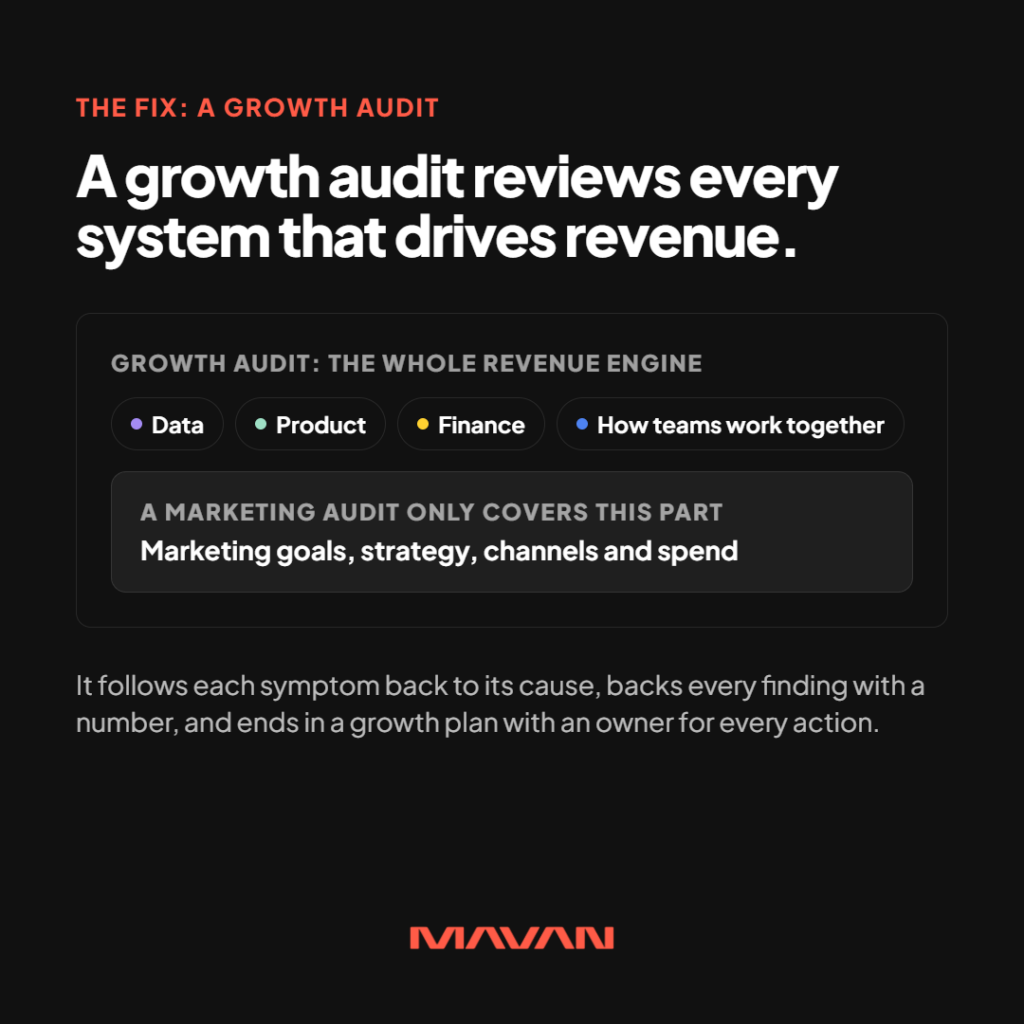
A marketing audit reviews marketing: its goals, strategy, channels, and spend. A growth audit reviews the whole revenue engine, including data, product, finance, and how teams work together. Pick a marketing audit when the problem clearly sits inside marketing. When the cause is unclear or crosses teams, you need a growth audit.
The marketing audit is an old and respected tool. Philip Kotler, William Gregor, and William Rodgers set out its classic definition in MIT Sloan Management Review in 1977. In their framing, a true marketing audit is broad, independent, systematic, and periodic. It looks at the outside market, plus the company’s goals, strategy, structure, systems, and functions. The idea dates back to the early 1950s, they noted.
Many audits sold under the name today are far narrower. They review ad accounts, campaigns, creative, and spend. Kotler and his co-authors had a name for that kind of review. They called it a vertical audit and said it should carry the name of the function it covers, as in an advertising audit. Vertical audits are useful. They also stop at the edge of the function, and growth problems rarely do.
Why Does the Narrow Version Miss So Much?
Each team built its reports to answer its own questions, at a different time. Sam McLellan, our VP of Growth, sees the result often. “Everyone has their own Looker dash,” he says. Dig in, and “your data is cut differently from the way they’re looking at the data. And that’s different from the way finance is looking at data.” Nobody holds the same picture of the business.
Finance leaders notice the gap. In the Confident B2B Marketer 2026 study from the ANA and NewtonX, 59% of marketers said they could measure marketing’s financial impact. Only 45% of finance leaders agreed. Just 37% of finance leaders said marketing’s impact had been reliable enough to inform planning and forecasting. The authors found one problem across the whole study. Marketing, sales, and finance don’t share definitions for pipeline, attribution, and impact. A marketing audit can tune the campaigns. It can’t settle which number the CFO trusts.
“You can’t answer ‘did it work’ without a shared definition of what ‘it’ was and where the data lives.” — Dan Barnes, President, MAVAN
The table below shows how the two audits compare in practice.
| Question | Marketing Audit | Growth Audit |
| Scope | Marketing goals, strategy, channels, and spend | Every system that drives revenue, across teams |
| Typical access | Ad accounts, analytics, and campaign reports | Platforms, people, and data across marketing, product, data, and finance |
| Starting question | Is our marketing working? | What is holding growth back? |
| Typical output | Channel and campaign fixes | A growth plan sorted by owner and dependency |
| Best fit | The problem clearly sits in one channel | The cause is unclear, or it crosses teams |
| Who acts on it | The marketing team | Leadership and every team the plan touches |
When Is a Marketing Audit Enough?
Sometimes the narrow tool is the right one. Say one channel is lagging, the tracking is trusted, and finance agrees with marketing’s numbers. A focused marketing audit will find that fix faster. When the leak sits on the website, our guide to improving website conversion covers the page-level work. Trouble starts when a team buys a channel review for a problem it hasn’t diagnosed. In our experience, the problem is rarely just the ads. More often, it lives in the data, the funnel, lifecycle, or the decision system around them.
How Do You Build a Growth Plan From a Growth Audit?
Build a growth plan by turning each evidenced finding into an action with an owner, a dependency, and a metric. Sort the actions by who has to move them. Name the risks that could break the order of work. Then report the plan in the terms your board or sponsor uses, starting with revenue and EBITDA.
Findings don’t grow anything until someone acts on them. Kotler and his co-authors made the same point in 1977, writing that “it is only in the company’s implementation of recommendations that the payoff will come.” In a later look back, they warned that auditors who present a new strategy and walk away often see it only partly in place two or three months later. A growth plan is the bridge from finding to action, and it needs to be built before anyone walks away.
What Steps Turn Findings Into a Growth Plan?
These seven steps keep the bridge standing:
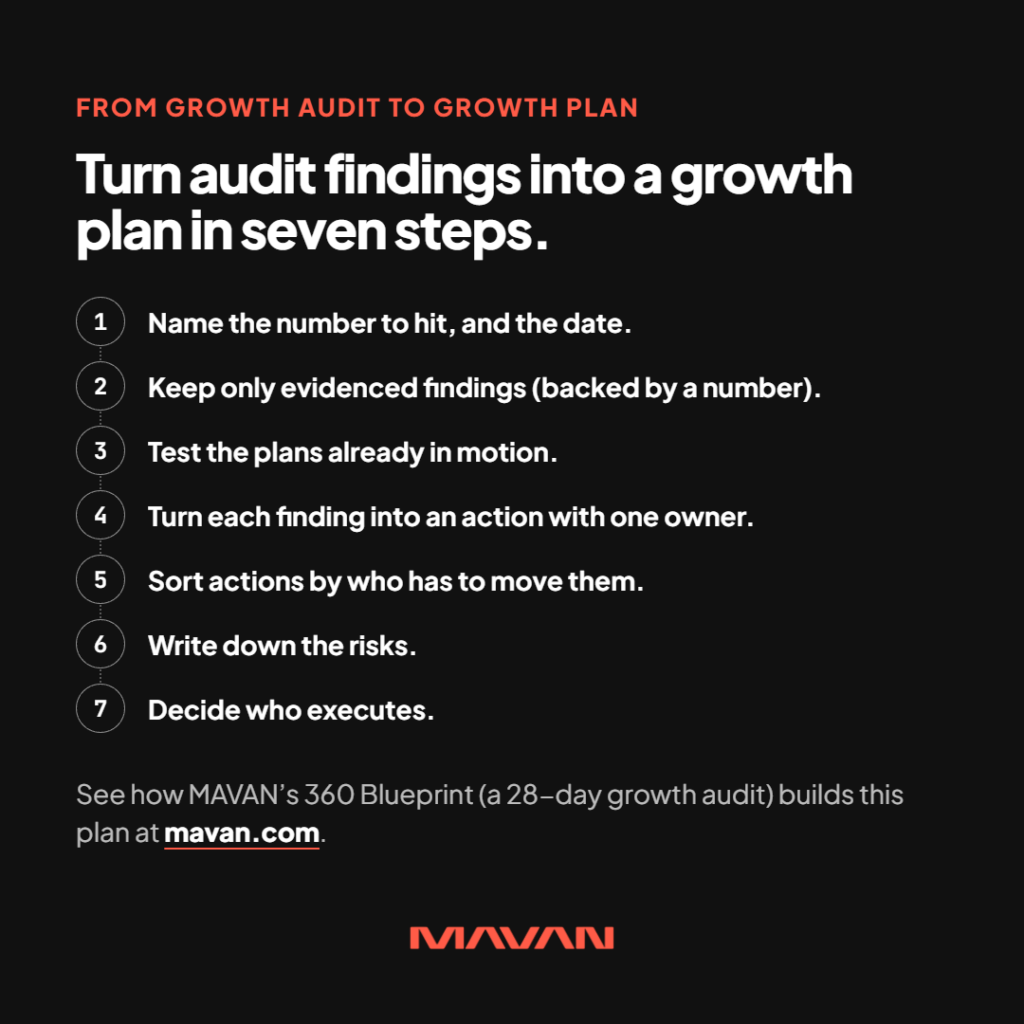
- Name the number and the date. Write down the revenue, EBITDA, or CAC payback target the plan must hit, and by when. Measure every action against it.
- Keep only evidenced findings. Send any finding without a number behind it back for more work before it shapes the plan.
- Test the plans already in motion. List what leadership believes it should do, then check each item against the evidence. Keep what holds up, and say plainly what doesn’t.
- Turn each finding into an action. Give every action one owner, the work it depends on, and the metric that will show it worked.
- Sort actions by who has to move them. Split them into work that can start now, work waiting on a decision, and work that needs the right people in a room.
- Write down the risks. Note where a data or tech timeline can’t support the target, and where two work streams are about to collide.
- Decide who executes. Choose which work your team runs, which needs outside operators, and when that outside help should step back.
Why Sort a Growth Plan by Who Has to Move It?
Most plans group actions by theme or rank them by a priority score. Neither shows you why a plan stalls. Our Blueprint roadmap tags every action with what it’s waiting on, using three labels:
| Roadmap Label | What It Means | What Unblocks It |
| We start now | Work inside our control, which can begin in week one with no sign-off | Nothing; the work starts |
| Needs a decision | Work blocked until the company or board settles a question, named with what’s waiting on it | A decision from the named owner |
| Needs a session | Work that email can’t resolve, because the right people have to be in one room | A working session with the people the plan names |
Most stalls happen between teams, and the labels make those handoffs visible. Donald Sull, Rebecca Homkes, and Charles Sull surveyed nearly 8,000 managers at more than 250 companies for a 2015 Harvard Business Review article. Most managers (84%) said they could count on their boss and their own team all or most of the time. Only 9% could always count on colleagues in other teams, and about half could most of the time. A plan sorted by owner shows where those handoffs will break before they do.
Getting the right people in one room is often the fastest fix. Aurelie Guerrieri, a member of the MAVAN Advisory Group, describes why:
“You take everything that is in everyone’s mind and you try and align it… once you have that alignment, then everybody’s empowered to scale.” — Aurelie Guerrieri, MAVAN Advisory Group
What Is a Sequencing Register?
A sequencing register names what could break the plan while there’s still time to change the order. In our Blueprints, it arrives in week four. It flags places where the infrastructure timeline can’t support the growth target, and work streams that are about to collide. It’s often the least comfortable page in the document. The register is also among the most useful pages, because a risk named in week four can still change the order of work.
How Should a Growth Plan Speak to a Board or Sponsor?
Lead with the outcome the board owns. For PE sponsors and operating partners, that means revenue growth, EBITDA, margin, and exit readiness. CAC, payback, LTV:CAC (customer lifetime value to CAC), and ROAS (return on ad spend) explain how the value gets created. They belong in the plan as the mechanism under the headline. Growth leaders at venture-backed companies can flip that order. Their boards tend to watch CAC payback and unit economics most closely. Our guide to fully loaded, blended, and paid CAC explains which version to report where.
Each metric also needs a trigger for action. Barnes separates targets from thresholds. A target says where you want to go, and a threshold tells you when to change course. Our board-ready scoreboard shows how to set both. For the update itself, Barnes keeps the structure simple:
“Here’s what’s true, here’s what we’re doing about it, here’s what it costs us, here’s what we need from you.” — Dan Barnes, President, MAVAN
What Is MAVAN’s 360 Blueprint?
The 360 Blueprint is MAVAN’s 360 growth audit. Over 28 days, five or more of our specialists work inside the business with full access to its platforms, people, and data. Every finding is evidenced. The output is a growth plan sorted by who has to move each action, plus NEXUS, our paid media analytics platform.
We’re a growth operating company. We diagnose what will move the business, embed the operators needed to do the work, and leave the company with stronger systems. Every engagement starts with a Blueprint, and we don’t take on operating work without one. Working from someone else’s assessment leads to misalignment once the real work begins.
The Blueprint applies everything above to one company. Part 1 holds the findings, grouped under the four themes. The roadmap in Part 2 sorts every action into We start now, Needs a decision, and Needs a session. Then the sequencing register names the risks. A PE sponsor gets a fast full-potential read tied to the value creation plan, while a growth leader gets a straight answer before a larger commitment.
Who Is the Blueprint For?
Three situations call for it most: The constraint crosses functions instead of sitting in one channel. A sponsor or board wants the diagnosis and the execution from the same team. Or leadership needs experienced operators ready to act on what the audit finds. Most of our clients are PE sponsors and their portfolio companies. We also work with fast-growing companies that look like the ones we already help.
Why Does the Blueprint Require Full Access?
An audit can only confirm what it can see. On our 360 Blueprint Analysis page, we publish outside-in mini analyses of companies such as Duolingo and Deel. Those reviews can read a website, an app store listing, ad creative, and brand positioning. They can’t check ad platform data against the CRM, or hear why a decision stalled. That’s why full access to platforms, people, and data is part of every kickoff.
NEXUS is included with the 360 Blueprint. It’s our human-augmented paid media analytics platform, and it connects the ad platforms, the mobile measurement partner, and the warehouse into one view of acquisition performance, with an AI insight layer on top. Finance, marketing, and leadership get the same numbers to work from, which is where most growth plans need to start.
What Happens in the First 30 Days of a Growth Audit?
In the first 30 days of a MAVAN growth audit, we gather context and access, interview the people closest to the work, connect what we find, and present it. The readout lands at day 28 with evidenced findings, a sequenced roadmap, and a sequencing register. Then the client decides what comes next.
Here’s how those 28 days run:
- Kickoff. We start with the business context: goals, constraints, and what success looks like. A questionnaire and a kickoff session line up the people, platforms, data, and past work we need. That way, we ask the right questions early.
- Breakout interviews. Focused sessions follow with the people closest to the work. These usually include paid media, product and engineering, and data and analytics. Other functions and follow-ups join as needed.
- Synthesis. We connect the dots, pressure-test what we learned, and write it up. The result is a cross-functional view of how the pieces connect, with clear priorities on what matters most first.
- Readout and decision. We share the findings, align on what they mean, and decide on next steps. The client can continue with MAVAN or run the Blueprint with its own team.
What Can the First Days Surface?
Big findings don’t always wait for the readout. Matt Widdoes, our Founder and CEO, recalls a Blueprint for a consumer app running at scale. Within the first 48 hours, the team found about $350,000 a month going to an evergreen paid campaign that had never come close to profit. Nobody had updated it in more than six months. The media team’s dashboard showed the campaign as fine, while revenue told a different story. “It turns out that the teams were looking at different numbers,” Widdoes says.
That’s why we treat gaps between teams as findings in their own right. Widdoes has seen capable, well-meaning staff run in several directions at once and end up with a “rats nest of infrastructure.” His fix starts at the top, with the systems leaders put in place:
“These business systems need to be set earlier than most people like to think and they need to be regularly reviewed, tested, and optimized like nearly every other function in the org.” — Matt Widdoes, Founder & CEO, MAVAN
What Do You Have at Day 28?
At the readout, you hold what you need to start the next morning:
- Evidenced findings across the four themes. McLellan calls this document “your encyclopedia of your current state of the business.”
- A roadmap that sorts every action by who has to move it, covering what to do across the coming year.
- A sequencing register that names the risks while there’s still time to reorder the work.
You keep all of it, along with NEXUS, whatever you decide next.
What Happens After the Growth Audit Ends?
After the readout, the client chooses. Some run the growth plan with their own team, using the Blueprint and NEXUS. Others ask MAVAN to staff it from our network of 170+ specialists. Those operators work inside the company’s tools and meetings. Either path starts from the same evidence and the same numbers.
McLellan is direct about the handoff. “We also design these things to be handed to the client that they can then go execute on themselves,” he says. “And, you know, some do.” Some clients take the roadmap in-house. Others start with the top priority, such as fixing paid media and getting the data in line to support it.
What Does Execution Look Like When MAVAN Stays?
We assign the operators the roadmap needs from our network of 170+ specialists. They’ve run this work before, and they’ve run it together. They embed in the company’s tools and meetings, report to the company, and work alongside its people. Our core team covers 12 growth functions, and most problems worth solving cross four or five of them. So the pod spans only the functions the constraint requires, under one point of accountability. The team changes as the work changes, and specialists stand down when they’re no longer needed.
How Have Growth Plans Played Out for Our Clients?
WGT, a Haveli Investments company, shows how a growth plan unfolds in practice. The work ran Blueprint → paid acquisition → lifecycle rebuilt end to end → data and analytics stack. Nobody planned four functions at the start. Each engagement was earned by the last one, and all of it was already in the roadmap the Blueprint produced. That work now sits inside the business.
At ElevenLabs, the board’s payback target was 12 months, and the business was at 15. We moved payback from 15 → 9 months inside the first month and held 9 through scaling. Paid search grew from a test to a high six-figure monthly budget. It stayed efficient for nearly a year and delivered positive incremental ROI across 20+ markets. Then the program moved in-house.
“After we had proven the channel with MAVAN, we were able to confidently transition the program to our in-house team.” — Luke Harries, Head of Growth, ElevenLabs
Planning work can grow out of execution, too. CrossFit came to us with 60 days to fill registrations for its annual competition. We built the launch plan, lifecycle automation, paid media, and landing pages, and CrossFit hit its target at an LTV:CAC above 3.0. Afterward, CrossFit retained MAVAN to lead its next strategic planning cycle and build a broader growth plan.
How Do PE Funds Use the Blueprint Across a Portfolio?
At the company level, we’re built to leave. A properly structured engagement has an end date, and the roadmap belongs to the business. At the fund level, we aim to stay. Funds can keep MAVAN on retainer as their dedicated growth partner and deploy us to any portco that needs growth work. That includes newly acquired companies, one at a time or several at once. Funds can also standardize the Blueprint across holdings, so lessons from one portco carry into the next. For more on where that fits, see how PE operating partners drive value creation and who does due diligence for private equity deals.
Frequently Asked Questions About Growth Audits and Growth Plans?
Leaders usually ask how long a growth audit takes, how often to run one, and whether a team can audit itself. They also ask who needs to be involved and whether the auditor has to run the plan. The short answers: about four weeks, on a regular rhythm, only with real independence, every team the plan touches, and no.
How Long Does a Growth Audit Take?
It depends on scope and access. Our Blueprint runs 28 days from kickoff to readout. In Kotler’s 1977 example, an outside audit of a plumbing and heating wholesaler was due to report its findings in six to eight weeks. Faster audits exist, but a day or two rarely leaves time to interview teams or reconcile data.
How Often Should You Run a Marketing Audit or Growth Audit?
Run one before a major plan, after a sharp change in performance, and on a regular rhythm in between. Kotler’s group warned against waiting for a crisis. Companies land in a crisis partly because they fail to revisit their assumptions in good times, they wrote. For PE-backed companies, the start of a hold and the run-up to exit are natural moments to audit.
Can We Run a Growth Audit Ourselves?
You can, with limits. Kotler and his co-authors called self-audits useful but not true audits, because they lack independence. A team from inside the company but outside the area under review can close part of that gap. The hard part is political. Someone has to tell leadership which of its priorities the evidence doesn’t support.
Who From Our Team Needs To Be Involved?
You need an executive sponsor who can open doors, plus the people closest to the work. In our Blueprints, interviews usually cover paid media, product and engineering, and data and analytics. Finance and other functions join as the questions require. Full access to platforms, people, and data is a requirement from the start.
Do We Have To Hire the Auditor To Run the Growth Plan?
No. A good growth plan should work in anyone’s hands. After a Blueprint, some clients run the roadmap with their own team. Others ask us to assemble the operators to run it with them. Either way, the findings, roadmap, sequencing register, and NEXUS stay with the company.
So, What Is a Growth Audit, and How Does It Build Your Growth Plan?
A growth audit is an evidence-based review of every system that drives revenue. Where a marketing audit stops at marketing, a growth audit follows each symptom to its cause. It builds your growth plan by turning findings into owned, ordered actions. The risks get named up front, and the results tie back to revenue.
Start with one test this week. Write down the single number your board or sponsor cares about most. Then ask leaders in marketing, finance, and product for its current value and where it comes from. If the answers differ, your growth plan rests on a number nobody shares.
That’s the gap a Blueprint closes. In four weeks, our team works inside your platforms, people, and data. We evidence every finding and hand you a roadmap sorted by who has to move each action. NEXUS is included with the 360 Blueprint, so your team works from the same numbers whether you run the plan yourself or with us.
Request a Blueprint and get a straight answer in four weeks.
Casey Rock is Content Director at MAVAN, where he helps turn complex ideas into clear, strategic content that drives growth. With over 15 years of experience across content strategy, SEO, media, and digital marketing, Casey focuses on building content systems that connect audience insight, brand storytelling, and measurable business outcomes.
Book a complimentary consultation with one of our experts
to learn how MAVAN can help your business grow.
Want more growth insights?
[hubspot type=”form” portal=”20951211″ id=”9c538ed2-fb12-45f1-a573-ad7953c058cc”]
Related Content
-
Should Startups Hire a Fractional CMO or Embedded Growth Pod?
A fractional CMO gives a Series A startup senior marketing strategy on a part-time basis. A growth pod adds the cross-functional team that ships it. The right choice depends on whether your real bottleneck is direction or delivery.
-
What Is a Growth Audit, and How Does It Build Your Growth Plan?
The first 30 days of a MAVAN growth audit delivers three things. First, a single, consolidated view of your business — data, paid, lifecycle, product, and finance — written down in one place and reconciled across teams, often for the first time. Second, the quick wins your team can execute in week two without waiting: pausing the paid waste, fixing the highest-leverage tracking gap, and getting the silos in one room. Third, a prioritized 90-day roadmap, with action items scored and assigned, that sequences exactly what to do first, second, and third — with or without us.
-
When Should a B2B SaaS Startup Hire a Growth Leader (What Kind of CMO)?
Mobile gaming teams have operated with granular attribution, segmented CAC, and whale-tier bidding for over a decade. B2B SaaS companies adopting the same three disciplines see clearer unit economics, faster optimization, and fewer wasted first growth hires.