
Conversion rate optimization (CRO) is the practice of getting more visitors to take a page’s main action, such as booking a demo or making a purchase. To improve website conversion, check traffic quality and tracking first. Then fix copy, the call to action, form friction, proof, and speed, in that order. Personalize landing pages once the core page converts.
TLDR — Ways To Improve Website and Landing Page Conversion
- CRO earns more revenue from traffic you already buy.
- Check traffic quality and tracking before redesigns.
- Fix copy first; every other fix sits downstream.
- Pass the five-second test on mobile and desktop.
- Give each landing page one goal and one CTA.
- Match each page to the ad or email behind the click.
- Cut form fields your CRM can fill in later.
- Put relevant proof close to the top of the page.
- Personalize by segment once the base page converts.
- See how MAVAN’s growth services lift conversion.
The Funnel Nobody Walked
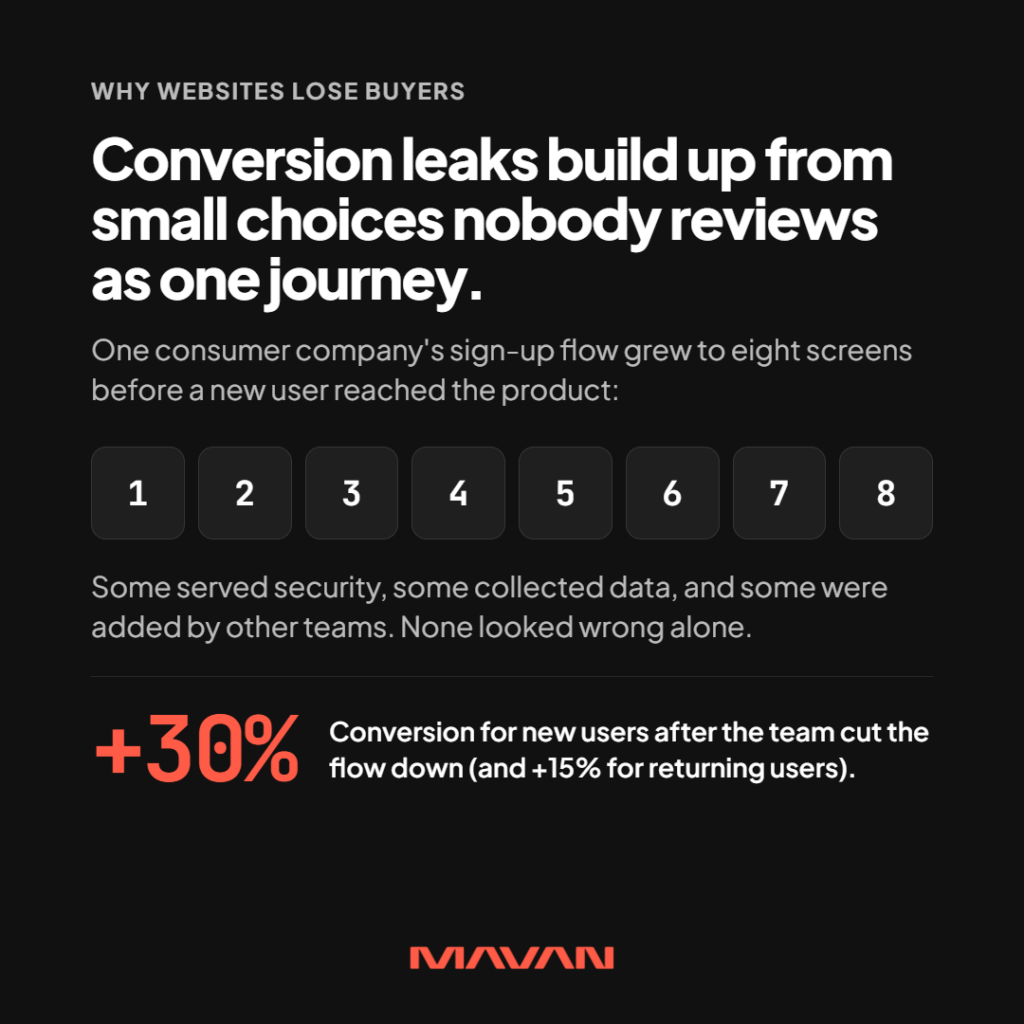
Eight steps. That’s how many screens stood between a new user and the product on one consumer company’s website. Matt Saunders, our Growth Lead, mapped that sign-up funnel end to end. Some steps existed for security. Others collected behavioral data. A few had simply piled up as different teams added them over time. No single step looked wrong, yet together they made people repeat themselves before they saw any value. The team cut the journey down and built separate flows for new and returning users. Conversion rose 30% for new users and 15% for existing ones.
That funnel shows the core lesson of conversion rate optimization. Friction builds up from many small, sensible choices that nobody reviews as one journey. Saunders sees the same pattern on growth-stage websites. He finds the fix “is almost always simpler than expected once someone takes the time to map the full experience from the user’s perspective.” We see it across our work with PE-backed portfolio companies and venture-backed scale-ups.
This guide covers conversion rate optimization (CRO) from diagnosis to measurement. It shows how to improve website conversion rate, write copy that converts, and build personalized landing pages. One rule from our work as a growth operating company runs through all of it. Find the real constraint before you change anything. The page is where a leak shows up, and the cause often sits somewhere else.
Key Conversion Terms To Know
- Conversion Rate
- The share of visitors who complete a page’s main action, such as a demo request, sign-up, or purchase. Divide conversions by visitors, then multiply by 100.
- Conversion Rate Optimization (CRO)
- The ongoing work of finding out why visitors don’t act, then fixing the causes through research, better pages, and controlled tests.
- Website Conversion Optimization
- CRO applied to the whole site and journey, including navigation, pricing, proof, forms, tracking, and the follow-up after someone converts.
- Landing Page Optimization
- The same work focused on one page built for one goal, usually the page an ad, email, or search result sends people to.
- Personalized Landing Page
- A landing page whose headline, proof, or offer changes to fit the visitor’s traffic source, industry, role, or company.
- Message Match
- How closely a landing page repeats the promise of the ad, email, or link that brought the visitor there.
- Friction-Remover
- A short line beside a call to action that answers the likeliest objection, such as cost, time, or commitment.
What Is Conversion Rate Optimization (CRO)?
Conversion rate optimization is the practice of raising the share of visitors who take a page’s main action. It works on the traffic you already have, so every gain lowers what you pay for each lead or customer. Good CRO starts with research into why people leave, then fixes and tests the causes.
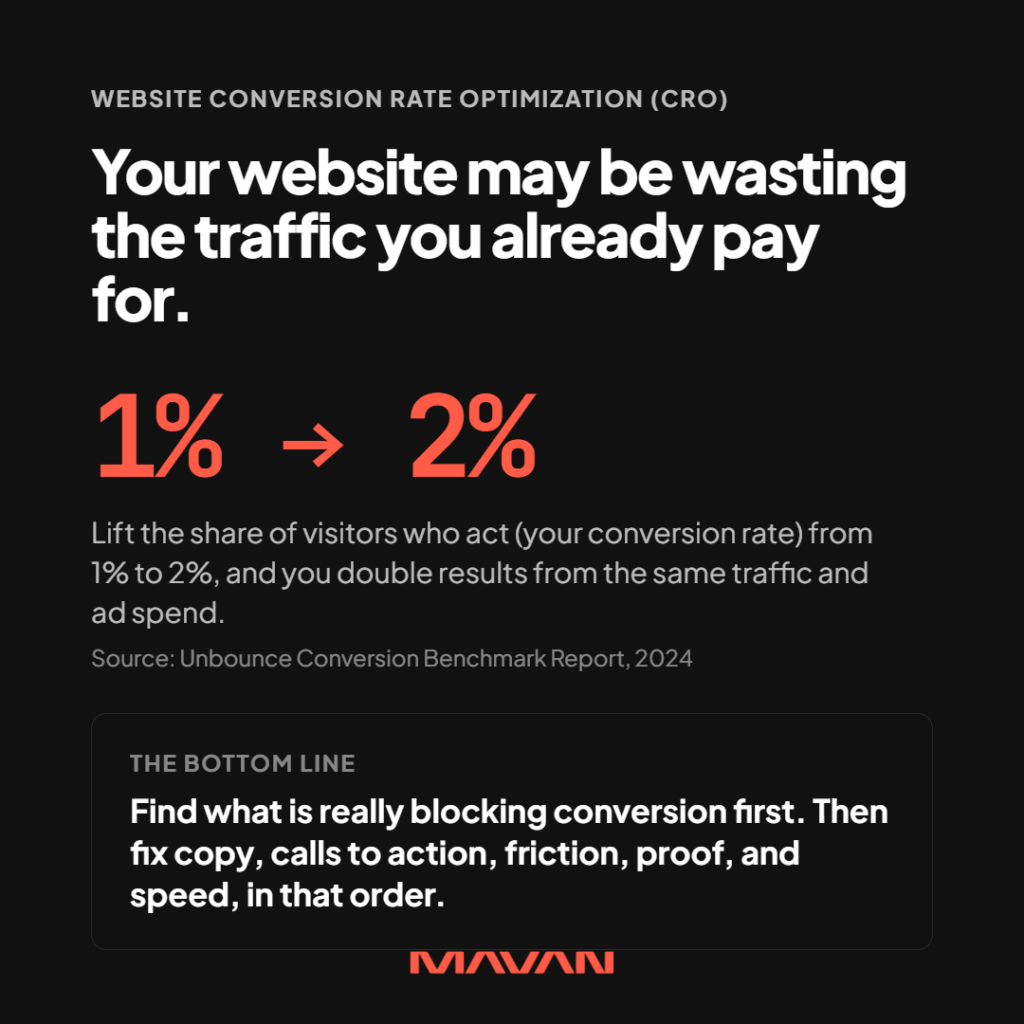
The math explains why operators care. Unbounce’s 2024 Conversion Benchmark Report draws on more than 41,000 landing pages and 57 million conversions. It puts the median landing page conversion rate at 6.6% across industries. SaaS pages sit lower, at 3.8%. The report also spells out the payoff. Lift a page from 1% to 2%, and you double the results from the same traffic and ad spend.
Benchmarks need care, though. A demo request, a free trial, and a newsletter sign-up ask very different things of a visitor. Unbounce notes that its data counts conversions, not the value of each one. A page below the median can still win if each conversion is worth five figures. Compare your pages against their own history, against similar asks, and against the revenue each conversion brings in.
Why Does Conversion Matter More Now?
The cost of a leaking page keeps rising, because clicks are harder to win. Pew Research Center tracked the browsing of 900 U.S. adults in March 2025. When Google showed an AI summary, users clicked a regular search result in 8% of visits, Pew found. Without a summary, that figure was 15%. Buyers also decide earlier. In 6sense’s 2025 survey of about 4,000 B2B buyers, the winning vendor was on the day-one shortlist 95% of the time. First contact with a seller came 61% of the way through the journey. Your website does much of the selling before anyone books a call.
Why Does CRO Matter to PE Sponsors and Growth Leaders?
For a PE sponsor, CRO is a revenue lever that needs no new budget. Bain & Company’s 2026 Global Private Equity Report found that typical buyouts now need about 10% to 12% annual EBITDA growth to earn a 2.5x return over five years. A decade ago, about 5% did the job. Bain sums it up as “12 is the new 5.” When a portfolio company converts more of its paid and organic traffic, revenue rises while acquisition spend holds flat. That gain lands in margin, and it holds up in exit diligence when the measurement is clean.
Growth leaders at venture-backed companies see the same math in other numbers. A higher conversion rate lowers CAC (customer acquisition cost). It also shortens CAC payback, with no new channel or hire. So we treat conversion as a lever that data, copy, design, and acquisition all share. When CAC climbs, the website is one of the first places we look, alongside the other causes we cover in why CAC rises and what to fix first.
Why Is Website Conversion Optimization a Growth System Problem?
Website conversion optimization looks at the whole journey, from the first click to the follow-up after a form. Leaks often start outside the page, in traffic quality, broken tracking, or slow follow-up. That is why we diagnose the full system before we touch a headline, so the team fixes the real constraint first.
A page can look broken when the real problem sits upstream. Saunders starts every engagement with the trend line. “Look at how your CVR has changed over time as your traffic mix has shifted,” he says. “Sometimes what looks like a conversion problem is actually a traffic quality problem in disguise.” If conversion fell in the month a new paid channel scaled, the audience changed, and the page may be fine. When conversion lags across paid, organic, direct, and referral traffic, the site itself is the bottleneck.
Tracking can hide the truth, too. In one recent 360 Blueprint, our 28-day growth diagnostic, 29% of leads left before the first tracked conversion. That made mid-funnel nurture impossible to build. In the same engagement, attribution reached the ad platforms through a weekly manual export, so no campaign optimized on live data. Neither problem shows up in a page audit, yet both cap what any page fix can deliver. Our guide to fixing broken B2B attribution covers that repair in depth.
Where Do Website Conversion Leaks Usually Hide?
Once traffic and tracking check out, the leaks tend to cluster in the same places. Our team finds these most often:
- Copy that describes the product instead of the problem. Buyers shouldn’t have to decode what you solve. “If they do, they leave,” Saunders says.
- Competing calls to action. A banner CTA that differs from the hero CTA is “a very common and very fixable leak,” in his words.
- Demo friction. A “we’ll be in touch” flow “kills momentum at exactly the moment intent is highest,” he says.
- Hidden pricing at lower deal sizes. “If a competitor one click away shows their pricing and you don’t, you’ve already lost,” he notes.
- Gates on trust-building content. Teams lock tours, screenshots, and case studies behind forms to capture leads. In most cases, Saunders says, that habit costs conversion.
- Slow, broken mobile pages. Load times and aggressive cookie pop-ups erode trust before a visitor reads a word, and mobile suffers most.
Each item looks minor alone. Stacked together, they behave like that eight-step funnel. Matt Widdoes, our Founder and CEO, wants marketers to catch them firsthand. Your marketers “should be going through the funnel,” he says, and “finding areas on the website that need optimized.” Inside the product, the same habit applies to onboarding, which we cover in our guide to finding your users’ desire paths.
How Do You Improve Your Website Conversion Rate?
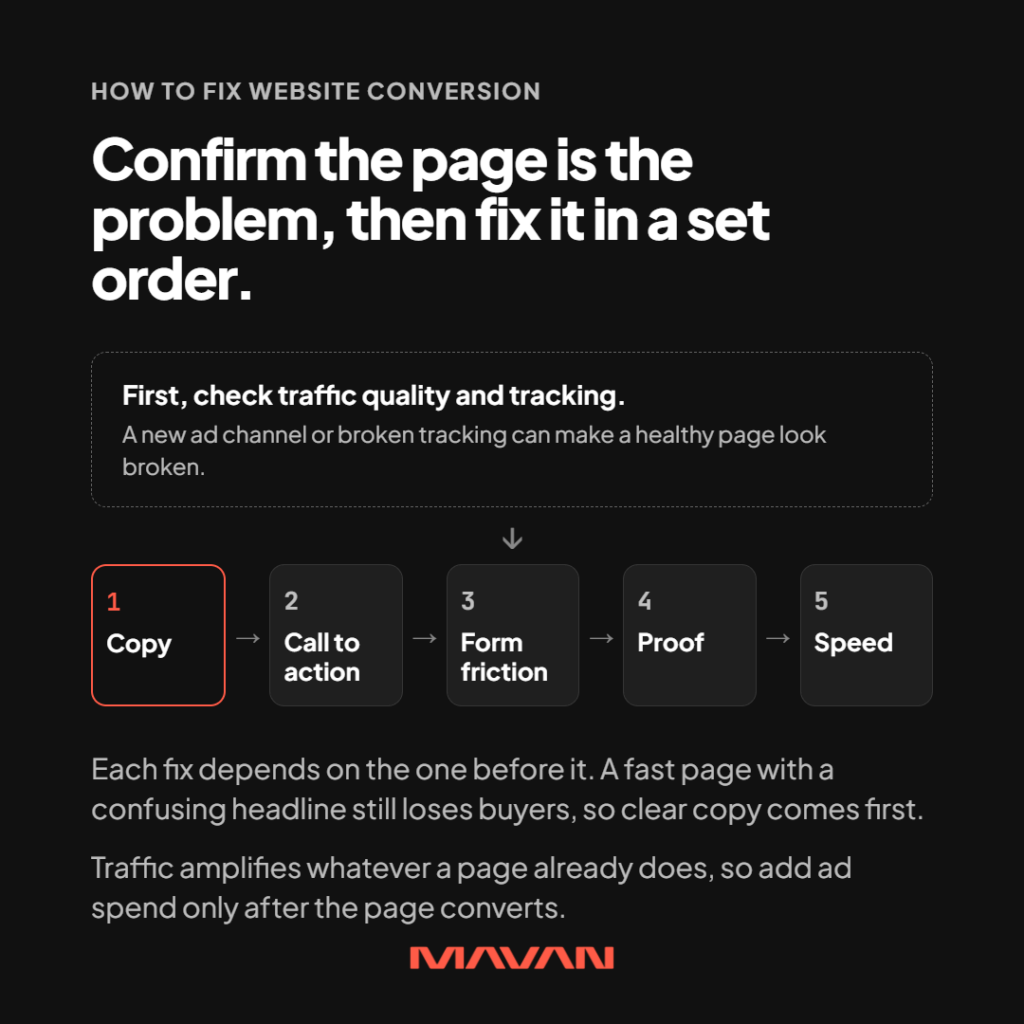
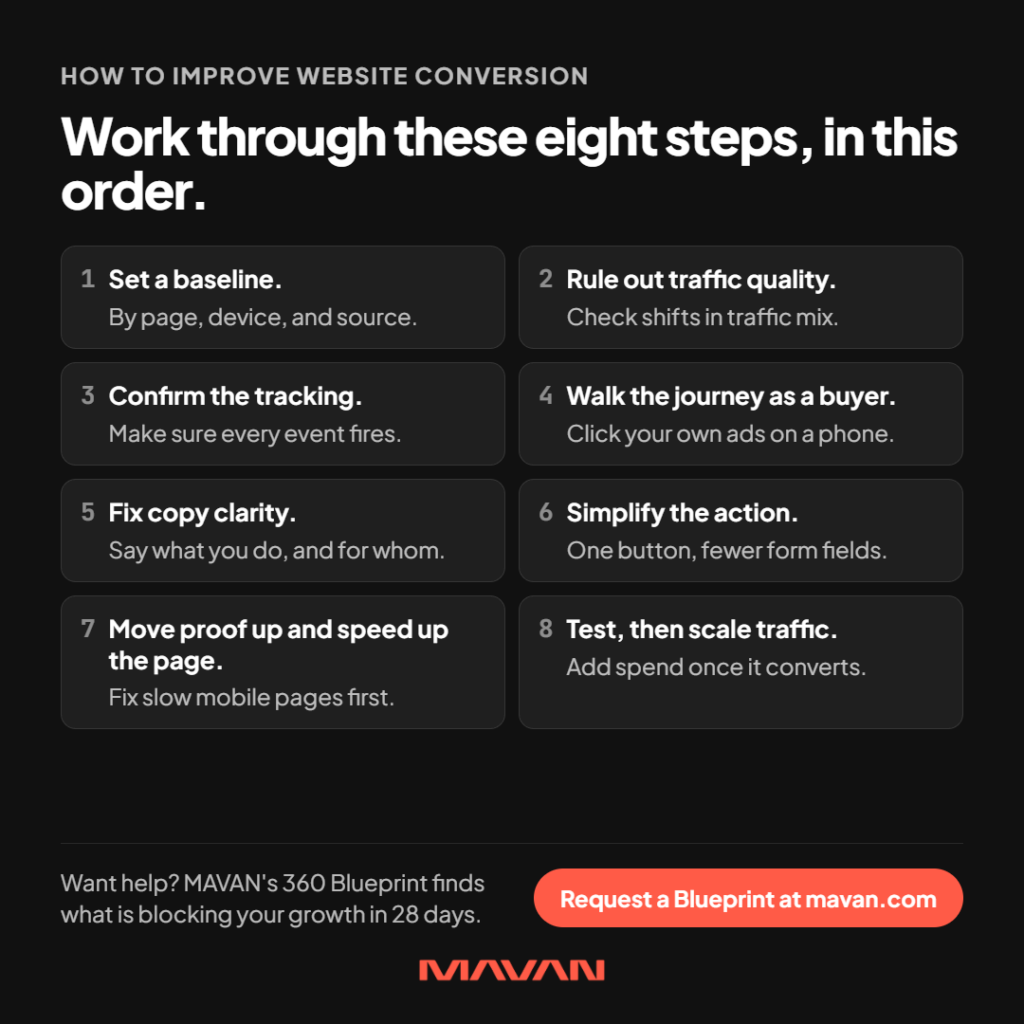
To improve your website conversion rate, work in order. Set a baseline, rule out traffic and tracking problems, and walk the journey as a buyer would. Next, fix copy, calls to action, friction, proof, and speed. Test the biggest changes, and add traffic only after the page converts. Each fix depends on the one before it.
This is the sequence we use with clients. Each step answers a question the next step depends on.
- Set a baseline. Pull the conversion rate for your main action by page, device, and traffic source. Record the value of each conversion as well.
- Rule out traffic quality. Compare conversion before and after big shifts in your traffic mix. A drop tied to one channel points to the audience first.
- Confirm the tracking. Check that every conversion event fires, lands in your CRM, and reaches the ad platforms.
- Walk the journey as a buyer. Click your own ads, fill in your own forms, and wait for your own follow-up. Do it on a phone.
- Fix copy clarity. Rewrite the hero so a first-time visitor knows what you do and whom you serve.
- Simplify the action. Keep one primary CTA, cut form fields, and say what happens after the click.
- Move proof up and speed up the page. Place relevant proof near the hero, and fix your slowest mobile templates.
- Test, then scale traffic. Test the changes that matter most, then add spend once the page converts. Our A/B testing framework covers small samples and long sales cycles.
Why Should Conversion Come Before More Traffic?
In a 30-day conversion sprint, Saunders sets aside comparison pages and broad SEO cleanup. His reasoning is blunt:
“Get your conversion rate to its best possible level before driving more traffic to the page.” — Matt Saunders, Growth Lead, MAVAN
More visitors won’t help a page that isn’t ready to convert them, because traffic amplifies whatever a page already does. A page that converts well turns new spend into revenue, while a leaking page turns it into a higher CAC. After copy and the call to action, Saunders picks the third fix by business model. Self-serve and lower-priced products should make pricing easy to find, because those buyers expect it. Sales-led, higher-priced products should fix page speed, since slow pages tax every visitor. SEO comes next. In Saunders’s experience, rewriting key pages around the words buyers already use, which Google Search Console shows you, lifts rankings and conversion together.
How Does Copywriting for Conversion Work?
Copywriting for conversion leads with the outcome a buyer wants, explains how it works in one line, asks for one action, and answers the biggest objection beside the button. It uses the buyer’s words, specific numbers, and plain language. If a first-time visitor can’t say what you do within five seconds, the copy needs work.
Copy comes first in our fix order because every other element depends on it. “Everything else is downstream of whether the visitor understands what you do, who it’s for, and what problem it solves,” Saunders says. “A fast page with a confusing hero is still a leaking page.”
Visitors decide fast. Jakob Nielsen of Nielsen Norman Group found that users often leave web pages within 10 to 20 seconds. To hold attention longer, a page must make its value clear within 10 seconds. Saunders sets a tighter bar with a five-second test. On mobile and desktop, without scrolling, can a first-time visitor tell what the company does and who it serves? He then compares clicks on the top call to action with clicks on buttons lower down. When the top button lags, the hero isn’t building enough interest.
What Is the Outcomes-First Copy Formula?
Saunders writes hero copy with a four-part formula, and he finds that most companies “get it backwards.” Here is the order he uses:
- An outcome headline. Lead with the result the customer gets. Save the product category for later.
- A one-line mechanism. Follow with a single sentence on how it works.
- One clear CTA. Ask for a single action that fits the visitor’s intent.
- A friction-remover. Add a line that handles the obvious objection, such as “No credit card · Live in 5 minutes.”
The failure he sees most is a hero built on adjectives, such as “powerful,” “seamless,” and “intelligent.” A category label fails the same way when the buyer hasn’t picked that category yet.
“If your hero could apply to any company in your space, it isn’t working hard enough.” — Matt Saunders, Growth Lead, MAVAN
Why Do Plain Words and Specific Proof Convert Better?
Simple writing wins on the numbers. Unbounce found that landing pages written at a fifth- to seventh-grade reading level converted at 11.1%. Pages written at a professional level converted at 5.3%. Of the copy traits Unbounce measured, difficult words (three or more syllables) had the strongest negative link to conversion.
Focus helps as much as plain words. Sam McLellan, our VP of Growth, watches teams cram five or even 20 features into one ad because they aren’t sure which one matters most. “You’ve got three seconds to hook somebody,” he says. His fix is to test one or two core messages per audience, “three tops.” Claims need the same discipline. A number tied to a named customer builds belief, Saunders says, while “the same claim without attribution lands nowhere.”
Tone matters as well. McLellan finds buyers respond better to ambition than to being told they’re behind. “Hey, you’re doing great. We can actually help you do a lot better,” is the easier sell, he says. Benefit-led copy works the same way on real pages. For EvolvH, a clean hair care brand, we wrote benefit-led lines such as “Manage Your Curls.” We paired them with customer posts from TikTok and Instagram, and conversions rose 16%.
What Is Landing Page Optimization?
Landing page optimization is CRO for a single page built around one goal and one audience. Most visitors arrive from an ad, email, or search result with a specific promise in mind. Strong landing pages keep that promise, remove distractions, show relevant proof early, and make the next step short, fast, and clear.
A homepage serves many audiences, while a landing page should serve one. That focus is why landing pages can convert well, and why they break when teams pile on options. “A landing page should have one clear, consistent CTA,” Saunders says. “The moment you give someone five menu options and three different CTAs, you’ve created a rabbit warren instead of a conversion path.”
The page also has to finish the story the click started. Unbounce gives this advice for paid search: match the landing page copy to the ad that earned the click. Dan Barnes, our President, makes the same point about a user’s first minutes inside a product. That first impression, he says, depends on how you acquired the user and what you promised them. The principle holds just as well for the page that follows an ad.
“If those two things aren’t continuous, you’re burning the trust you spent money to earn.” — Dan Barnes, President, MAVAN
What Does a High-Converting Landing Page Include?
Strong landing pages share a short list of traits. Use this table as a quick audit of your highest-traffic page.
| Element | What Strong Pages Do | Why It Matters |
| Headline | Repeats the ad’s promise as an outcome | Visitors confirm they’re in the right place within seconds |
| Primary CTA | Asks for one action, in the same words each time | Competing asks split attention |
| Navigation | Removed or cut to the essentials | Every extra link is a way out |
| Proof | Shows a relevant case study or quote near the hero | Buyers look for proof from companies like theirs |
| Form | Asks only for what sales truly needs | Every extra field is a drop-off risk |
| Friction-remover | Answers cost, time, or next steps in one line | It lowers fear at the moment of action |
| Speed and mobile | Loads fast and reads cleanly on a phone | Most landing page visits come from mobile |
Proof deserves extra care, because relevance beats fame. “A case study from a mid-size company in the visitor’s sector, solving the visitor’s specific problem, will outperform a logo from a Fortune 500 that operates in a completely different context,” Saunders says. Placement matters as much as choice. “If someone has to hunt for proof, most won’t.”
How Do You Improve Landing Page Conversion?
To improve landing page conversion, match the page to its traffic source, cut every extra link and field, explain what happens after the click, and make the page fast on a phone. Then test one meaningful change at a time. Small, well-ordered fixes often move the number within days, without a full redesign.
How Much Should a Landing Page Ask For?
When teams ask how to improve landing page conversion, we start with the form, because it carries the most friction on most pages. Saunders’s rule is “as few steps as possible to get the visitor to the action. Every unnecessary field is a drop-off risk.” Email is the minimum viable ask, in his view. Company size, industry, and role earn a place only if “your backend CRM can’t pick that up later from product usage or enrichment data.” When you do add those fields, make them optional.
Gates deserve the same scrutiny. Product tours, screenshots, and case studies build confidence, so a form in front of them slows buyers down. Saunders keeps gates for anything involving real, live data, which he calls “a trust and security requirement, not a marketing choice.” Where a gate stays, spell out what happens next. “‘No credit card · Live in 5 minutes’ removes the fear of commitment right at the point of action,” he says.
How Fast Does a Landing Page Need to Be?
Speed affects every visitor, whatever the channel or intent. Google commissioned Deloitte and analytics firm 55 to study 37 brands’ mobile sites. In that study, a 0.1-second gain in mobile site speed lifted retail conversions 8.4%. Bounce rates on lead-generation information pages improved 8.3%. Mobile is where most landing page traffic now lands. In Unbounce’s sample, 83% of visits came from mobile devices, yet desktop still converted 8% better. Unbounce’s advice is to stop building pages for desktop first.
What Should You Test First on a Landing Page?
With the obvious leaks fixed, test the changes that matter most: the headline, the offer, the form, and the proof. Give each audience its own page and URL, so you can see which journey converts and which one leaks. At KidStrong, signup-flow tests lifted form conversion 32%.
What Are Personalized Landing Pages, and When Do They Pay Off?
Personalized landing pages change the headline, proof, or offer to fit each visitor. The change can key off the ad they clicked, their industry, their role, or their company. These pages pay off when the base page already converts, your segments differ in real ways, and your data can tell them apart.
The upside is well documented. HubSpot compared more than 330,000 calls to action. Personalized ones converted 202% better than basic ones. McKinsey research found that 71% of consumers expect personalized interactions, and 76% get frustrated without them. Its researchers also estimate that personalization can cut acquisition costs by as much as 50% and lift revenue 5% to 15%.
Most of that research comes from consumer marketing. In B2B, the same need shows up as a demand for fit. “If I’m in healthcare, I want to see proof from healthcare,” Saunders says.
What Are the Levels of Landing Page Personalization?
Most teams personalize at one of four levels. Here they are, from easiest to hardest:
- Source match. The headline repeats the keyword, ad, or email the visitor clicked. Dynamic text replacement can swap those words in automatically.
- Segment pages. Each industry, role, or use case gets its own page and proof. “A page targeting ‘HR software for healthcare companies’ will likely outperform a generic HR software page for that visitor every time,” Saunders says.
- Account pages. Pages built for named target accounts, common in account-based marketing for large deals.
- Behavioral and AI-driven pages. Content changes based on what a visitor has done or viewed. Eric Seufert, a member of the MAVAN Advisory Group, sees generative AI making web storefronts “endlessly customizable.” Teams could then “experiment exhaustively” and “personalize the product that you’re offering right there on the web,” he says.
Segment pages are where most growth-stage teams should start. At fintech company 8fig, we built conversion-optimized landing pages mapped to target audience personas. That work was part of a broader acquisition program that cut cost per lead 65%.
When Does Landing Page Personalization Backfire?
Personalization fails in predictable ways. Watch for these before you scale it:
- It multiplies a weak page. Ten versions of a confusing hero give you ten confusing heroes. Fix the base page first.
- Segments are too thin to measure. Each variant needs enough traffic to show a result. Without it, teams ship guesses.
- The data can’t tell segments apart. McKinsey puts a customer data foundation first on its list. Barnes, speaking about lifecycle messaging, notes that most teams lack that resolution because they “never built the bridge between their user identity layer and their external data.”
- Search engines see something different. Google’s spam policies define cloaking as showing users and search engines different content to manipulate rankings and mislead users. The same policies warn against doorway pages built to rank for specific, similar queries.
- It feels invasive. In a 2022 survey McKinsey cites, 85% of customers said knowing a company’s privacy policies matters before they buy.
The safe pattern is simple. Serve one default page that crawlers and first-time visitors both see. Personalize on top of it, using context visitors expect you to know, such as the ad they clicked or the industry they chose.
How Should You Measure Conversion Gains?
Measure conversion gains in the order they appear. Conversion on the changed step moves first, often within days. Lead quality and funnel progress follow over weeks. CAC, payback, and revenue confirm the gain over months. Set the metric for each fix before you ship it, and report from one shared source of truth.
Teams often lose faith in good work because they judge it on the wrong clock. “Website conversion sits at the heart of your acquisition funnel,” Saunders says. “CVR improvement is the leading indicator. CAC reduction follows as the compounding effect builds.” He measures each fix at the funnel step it changed, because “that’s where you’ll see the signal quickest and most cleanly.”
| Signal | When It Usually Moves | What It Tells You |
| Conversion rate on the changed step | Days | Whether the fix worked |
| Lead quality, funnel progress, or activation | Weeks | Whether you’re converting the right buyers |
| Organic search visits | Weeks to months | Whether page rewrites are earning visibility |
| CAC | One to two months | Whether gains are compounding through the funnel |
| CAC payback and revenue | Months | Whether the gain holds on the P&L |
Write the hypothesis down before each test. Barnes puts the discipline plainly:
“If you can’t answer why you’re doing something before you do it, you don’t have a hypothesis. You have an opinion. And if you can’t answer whether it worked after the fact, you don’t have a learning. You have a sunk cost.” — Dan Barnes, President, MAVAN
How Do You Report Conversion Gains to a Board?
For sponsors, translate the chain into board terms. Lead with revenue and margin, then show conversion, CAC, and payback as the mechanism. Those numbers only persuade if everyone trusts them. “You have to have a single source of truth, full stop,” Barnes says. NEXUS, our human-augmented paid media analytics platform, connects the ad platforms, the mobile measurement partner, and the warehouse into one view of acquisition performance. Our board-ready scoreboard shows how to present that chain each month.
What Does Conversion Work Look Like Inside a Growth System?
Inside a growth system, conversion work connects to data, acquisition, creative, and lifecycle under one owner. The team that finds a leak also ships the fix and measures it against revenue. That is how we run conversion optimization at MAVAN, and we build each program so the client’s own team can run it.
MAVAN is a growth operating company. Our core team covers 12 growth functions, and conversion optimization is one of them. Behind that team stand 170+ vetted specialists. Most problems worth solving cross four or five of those functions. So a single MAVAN pod can own data, acquisition, lifecycle, creative, and conversion work under one point of accountability. Clients stop managing the seams between vendors.
What Results Has This Approach Produced?
The gains show up when conversion and acquisition run as one program:
- KidStrong. We paired CRO and creative testing with oversight of the company’s paid media agency. Along with the signup-flow gains, blended cost per lead improved 35%, and paid cost per lead improved 37%.
- Zig Zag. We combined conversion research and A/B testing with technical SEO and content. Online sales grew 56%, and organic traffic rose 47%.
- Pantaya. Pantaya is a Spanish-language streaming service formerly owned by Lionsgate. We studied its buy flow and tested removing steps. Subscriptions rose 5%, adding 2,000 to 3,000 subscribers in the first month.
- CrossFit. CrossFit had 60 days to fill registrations for its annual competition. We built landing pages and tested them over six weeks, with paid media and email running alongside. CrossFit hit its registration goal at an LTV:CAC above 3.0.
“MAVAN was like having a top-tier growth team on demand. As a team of one, I could tap into the right experts for whatever problem I was tackling.” — Angus Kirby, Director of Marketing, Titan
How Do PE Sponsors Use This Across a Portfolio?
For a fund, the value compounds across companies. Every engagement starts with a Blueprint, which tests the whole growth system before anyone funds a lever. It then sorts each action by who has to move it: We start now, Needs a decision, or Needs a session. After the readout, the company can run the roadmap itself or ask us to staff it. At WGT, a Haveli Investments company, that path ran from the Blueprint to paid acquisition, then a rebuilt lifecycle program and data stack. Then we left. Funds can keep MAVAN on retainer as their dedicated growth partner and deploy us to any portco that needs growth work. At each company, a properly structured engagement has an end date, because our job is to leave the team running the system.
Frequently Asked Questions About Conversion Rate Optimization
Leaders often ask what a good rate is, how long CRO takes, and whether it works with little traffic. They also ask about SEO risk and the value for PE-backed companies. In short, compare against similar pages, expect signal in days, fix clear leaks first, keep pages crawlable, and tie gains to revenue.
What Is a Good Website Conversion Rate?
No single rate is good for everyone. Unbounce puts the median landing page at 6.6% across industries and 3.8% for SaaS. A demo request will convert lower than a newsletter sign-up, though. Track your own trend by page and source, and weigh the value of each conversion alongside the rate.
How Long Does Conversion Rate Optimization Take to Work?
Conversion on a changed step can move within days. Lead quality shows up over weeks, and CAC follows over one to two months as gains compound. Payback and revenue take longest. Set the metric for each fix before launch, so you know when to judge it.
Can You Do CRO Without Much Traffic?
Yes. Start with leaks that need no test to justify, such as unclear copy, competing calls to action, long forms, and slow mobile pages. Then run fewer, bigger tests and accept directional results. Our A/B testing guide explains how to read small samples.
Do Personalized Landing Pages Hurt SEO?
They shouldn’t, if you build them with care. Google treats cloaking as showing search engines different content than users in order to manipulate rankings. Serve the same default page to crawlers and first-time visitors, personalize on top of it, and avoid near-duplicate pages made only to rank.
Is CRO Worth It for a PE-Backed Portfolio Company?
Usually, because it raises revenue from spend the company already makes. Bain estimates that typical buyouts now need 10% to 12% annual EBITDA growth, so sponsors need levers that add little cost. CRO works best inside the value-creation plan. Measure it against revenue and margin, using data that will hold up in diligence.
So, How Do You Improve Website Conversion?
Improve website conversion by finding the real constraint first, then fixing copy, calls to action, friction, proof, and speed in that order. Personalize landing pages once the core page converts. Measure each gain from the changed step through to revenue, because the order of the work decides whether the gains last.
Start this week with one test. Open your highest-traffic landing page on a phone and give yourself five seconds. Write down what the company does and whom it serves. Then ask someone outside the team to do the same. If your answers differ, start there.
When the leak runs deeper than the page, the Blueprint finds it. In 28 days, five or more MAVAN specialists work inside your business, with full access to its platforms, people, and data. Every finding comes with the number behind it, and the roadmap shows what to fix first. NEXUS is included with the 360 Blueprint, so your team works from the same numbers whether you run the roadmap yourself or with us.
Request a Blueprint and get a straight answer in four weeks.
Casey Rock is Content Director at MAVAN, where he helps turn complex ideas into clear, strategic content that drives growth. With over 15 years of experience across content strategy, SEO, media, and digital marketing, Casey focuses on building content systems that connect audience insight, brand storytelling, and measurable business outcomes.
Book a complimentary consultation with one of our experts
to learn how MAVAN can help your business grow.
Want more growth insights?
[hubspot type=”form” portal=”20951211″ id=”9c538ed2-fb12-45f1-a573-ad7953c058cc”]
Related Content
-
Should Startups Hire a Fractional CMO or Embedded Growth Pod?
A fractional CMO gives a Series A startup senior marketing strategy on a part-time basis. A growth pod adds the cross-functional team that ships it. The right choice depends on whether your real bottleneck is direction or delivery.
-
What Is a Growth Audit, and How Does It Build Your Growth Plan?
The first 30 days of a MAVAN growth audit delivers three things. First, a single, consolidated view of your business — data, paid, lifecycle, product, and finance — written down in one place and reconciled across teams, often for the first time. Second, the quick wins your team can execute in week two without waiting: pausing the paid waste, fixing the highest-leverage tracking gap, and getting the silos in one room. Third, a prioritized 90-day roadmap, with action items scored and assigned, that sequences exactly what to do first, second, and third — with or without us.
-
When Should a B2B SaaS Startup Hire a Growth Leader (What Kind of CMO)?
Mobile gaming teams have operated with granular attribution, segmented CAC, and whale-tier bidding for over a decade. B2B SaaS companies adopting the same three disciplines see clearer unit economics, faster optimization, and fewer wasted first growth hires.