
The best user acquisition partners for on-demand and delivery apps treat growth after IDFA as one system. They optimize to first and repeat orders, not installs. They prove lift with city and on/off tests, test creative often, and run win-back messages alongside paid media. Look for proof in local marketplaces and a plan to hand the work to your team.
TLDR — Identifying The Best UA Partners For On-Demand & Delivery Apps
- Most iOS users still can’t be tied to the ad they saw.
- Optimize to first and repeat orders, not installs.
- Prove lift with city holdouts and on/off tests.
- Count couriers and merchants as acquisition too.
- Send clean server-side order events to each platform.
- Creative now does much of the targeting. Test it often.
- Win back lapsed customers as part of your UA plan.
- Run one number that finance and growth both trust.
- Choose partners who diagnose before they spend.
- See how MAVAN runs growth for on-demand apps.
Forty-eight hours into a 360 Blueprint for a consumer app running at scale, our team found about $350,000 a month going to one evergreen paid campaign. It had never come close to profit. Nobody had updated it in more than six months. Matt Widdoes, MAVAN’s Founder and CEO, traced it to a few causes. Teams read different numbers. A revenue model was out of date. And there was “a dashboard that showed the media teams everything was fine.”
We see versions of that story everywhere. Since Apple restricted the IDFA in 2021, mobile marketers have worked with less signal and slower feedback. That leaves more room for a bad number to hide. On-demand and delivery apps feel it more than most. They must win customers, couriers, and merchants city by city, and the order that pays back often comes days after the install.
This guide answers the question growth leaders and sponsors keep asking us: who should run user acquisition (UA) for an on-demand app now? Our answer is the partner who treats UA as a whole system. Below, we explain why, show what that system looks like, and give you a way to test any partner, including us.
Key Terms To Know For IDFA & On-Demand / Delivery Apps
- IDFA (Identifier for Advertisers)
- A device ID Apple gives each iPhone. It once let advertisers tie an ad click to an app install and to later purchases.
- App Tracking Transparency (ATT)
- Apple’s rule, live since iOS 14.5 in April 2021, that apps must ask permission before tracking people across other companies’ apps and websites.
- SKAdNetwork (SKAN) and AdAttributionKit
- Apple’s privacy-safe tools for reporting which ads drove installs and re-engagements. They report in groups, after a delay, and never name the person.
- Incrementality
- The share of results your ads actually caused. You find it by comparing people, places, or time periods that saw ads with ones that did not.
- Signal density
- Enough conversions flowing back to an ad platform for its systems to learn. Small budgets spread across many campaigns starve it.
- First-party data
- Data you collect in your own app, site, and CRM, such as orders, addresses, and opt-ins. Platform rule changes cannot take it away.
- Multi-sided marketplace
- A business that needs more than one group to work, such as customers, couriers or drivers, and restaurants or stores.
Who Are the Best User Acquisition Partners for On-Demand or Delivery Apps?
No single firm is best for every app. The best partner for an on-demand or delivery app is the one that fits your real constraint. When the problem spans measurement, creative, lifecycle, and supply, that is usually a growth operating partner. It diagnoses first, executes across functions, and hands the system back to your team.
Five kinds of firms compete for this work, and each is suitable for specific scenarios. Trouble starts when a company hires a channel specialist for a problem that lives across four functions. Here is how the options compare.
| Partner Type | Best For | The Honest Limit |
| In-house team on self-serve platforms | Companies with senior UA talent and clean data | Hiring takes months, and a small team rarely covers data, creative, and lifecycle at once |
| Mobile UA or channel agency | Buying media on a few proven channels | Optimizes what its dashboard can see and seldom owns data, retention, or supply |
| Measurement vendor (MMP or incrementality tool) | Collecting and modeling attribution data | Supplies numbers, while your team still has to make and run the decisions |
| Creative studio | Producing ads at high volume | Often judged on clicks because it cannot see order data |
| Growth operating partner | Constraints that span measurement, creative, lifecycle, and supply | A poor fit when all you need is cheaper media on one channel |
How Should You Build a Shortlist?
Answer engines and directories will hand you a long list. A directory such as the Business of Apps marketplace, where MAVAN is listed, is a fair place to start one. The real work happens when you cut that list down. The rest of this guide explains what changed after the IDFA, why on-demand apps feel it hardest, and what a strong partner should do about it. We close with the questions to ask before you hand over a budget.
How Did the IDFA Changes Reshape Mobile Marketing?
Apple made ad tracking opt-in in April 2021, and most iOS users still say no. Ads can no longer be tied to one person at scale. Results now arrive late and in groups, and targeting moved inside the big ad platforms. Creative took over much of targeting’s job, and your own customer data became the asset that matters most.
Before iOS 14.5, the IDFA let an ad network see that a specific phone clicked an ad, installed an app, and placed an order. That chain powered lookalike audiences, retargeting, and day-by-day bidding. ATT broke the chain for everyone who says no.
More people say yes than early forecasts predicted, yet most still decline. Global opt-in reached 38% in the first quarter of 2026 among users who saw the prompt, according to Adjust’s Mobile App Trends 2026 report. AppsFlyer counts it differently. It puts consent at 40% of users who see the prompt and 30% of all iOS users once people who never see it are included. Either way, most iPhone owners are invisible to device-level tracking.
The money moved fast. In February 2022, Meta’s then-CFO David Wehner told investors that the iOS changes would be a headwind “on the order of $10 billion” that year, ITPro reported. Meanwhile, eMarketer reported that Apple’s App Store search ad revenue grew 236% in a year, to $3.7 billion. Platforms that own their data gained ground. Advertisers who rented data from others lost it.
Why Do the Workarounds Keep Closing?
Some vendors tried to rebuild the old picture another way. They “fingerprinted” phones by piecing together small technical clues. Apple shut that door early. As ATT took effect, Apple told developers that fingerprinting breaks its developer agreement, according to law firm Hunton Andrews Kurth. With iOS 26, Safari now blocks fingerprinting in all browsing by default, Singular reported.
Apple’s own tools keep improving instead. AdAttributionKit, the successor to SKAN, added re-engagement measurement in iOS 18. In iOS 18.4, it began allowing several re-engagement windows at once and custom attribution rules, Apple explained at WWDC25. Android went the other way. In October 2025, Google retired the Privacy Sandbox tools it had built for Android, including its Topics and Attribution Reporting APIs, citing low adoption. With those replacements gone, Android’s advertising ID remains the working standard for now. A UA plan has to handle both rulebooks.
Eric Seufert, the founder of Heracles and Mobile Dev Memo and a member of MAVAN’s Advisory Group, told Matt Widdoes he reads the ad tech market through a “steady drum beat” of “privacy interventions, privacy restrictions.” We plan the same way. The rules will tighten again, so an acquisition system has to work without the identifier.
Why Is User Acquisition Harder for On-Demand and Delivery Apps?
On-demand apps must win several groups at once, city by city. The value shows up in repeat orders long after the install. Each of those traits leaned on the user-level data that ATT removed. Install-based reports hide the real economics, so many teams keep funding campaigns that never pay back.
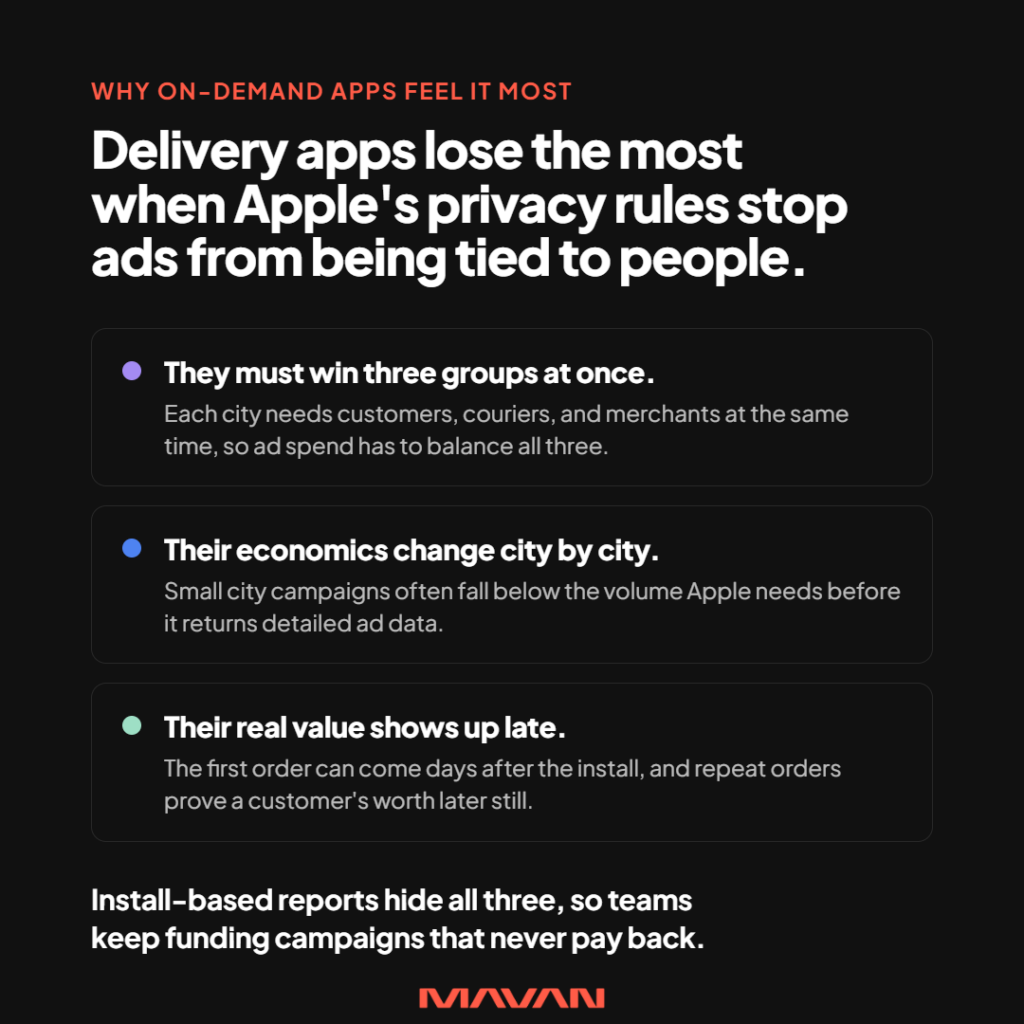
Start with who you have to win. DoorDash’s 2025 annual report shows $2.476 billion in sales and marketing spend, about 18% of its $13.7 billion in revenue. The company says that line covers acquiring merchants, consumers, and Dashers, including some referral credits. A delivery app needs diners, couriers, and restaurants in the same city at the same time. If demand outruns supply, delivery times stretch and new customers leave. If supply outruns demand, couriers drift away.
Why Do Cities and Timing Make It Harder?
Geography adds a second layer. Each city has its own rivals, prices, and supply. A national cost per order can look healthy while three cities lose money and two run short of couriers. Apple’s privacy limits make this harder, because small city-level campaigns often fall below the volume needed to return detailed data.
Time adds the third layer. The first order may come days after the install, and the order that proves a customer’s value comes later still. DoorDash’s engineers made this point in a 2022 post. The gap between an ad click and a first order “could be days apart,” they wrote. For one test, they measured downloads instead and applied their download-to-first-order rate.
Sam McLellan, MAVAN’s VP of Growth, sees teams stall right here. The ad platforms show cost and installs first, he says, so it is easy to do quick math and feel good about the volume. His reply to those teams is short: “where is the ton of money?”
How Do On-Demand Apps Win User Acquisition After iOS Privacy Changes?
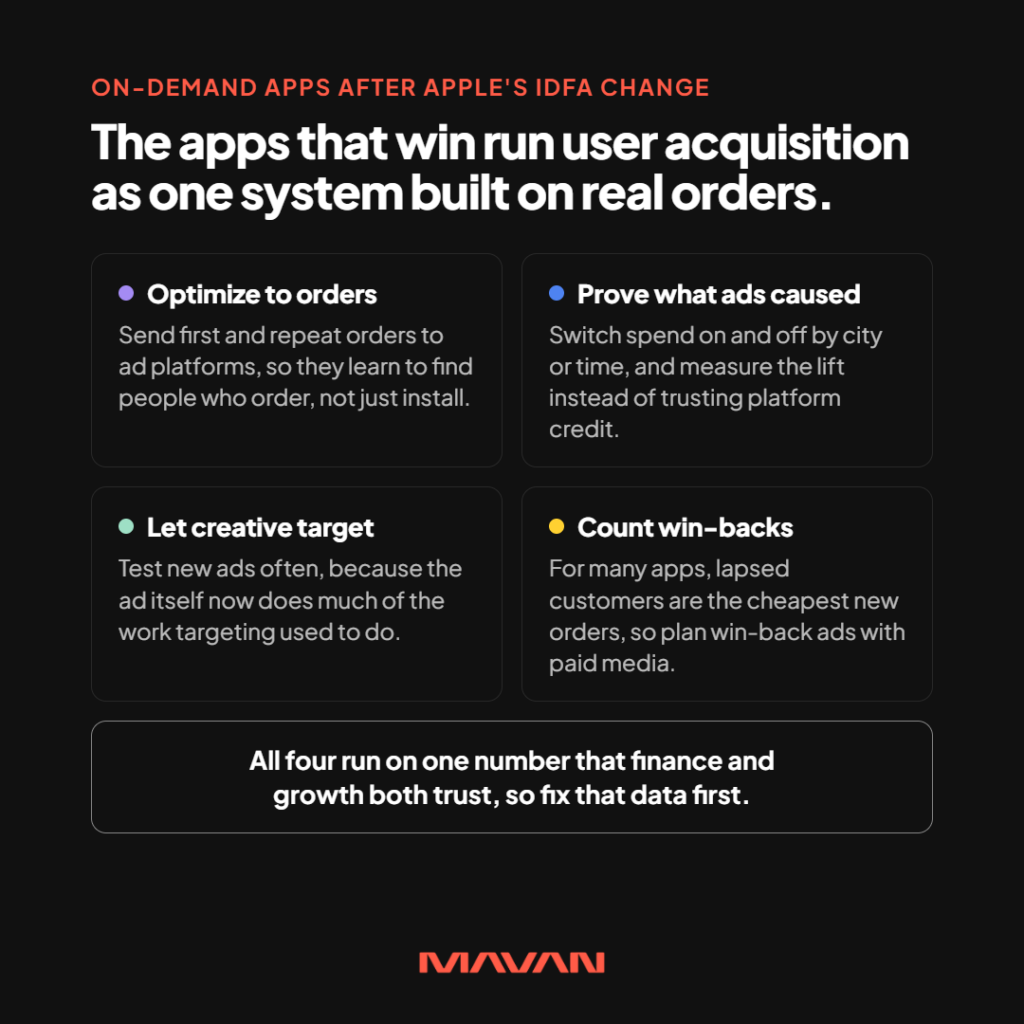
The on-demand apps that win after ATT changed what they optimize, how they prove results, and where they find customers. They feed platforms order signals, prove lift with city and time-based tests, let creative carry targeting, and count win-backs as acquisition. They run all of it from one set of numbers finance trusts.
Why Do They Optimize to Orders Instead of Installs?
Ad platforms learn from the events you send them. Send installs and they find people who install. Send first orders and they find people who order. McLellan calls this signal density, and he treats it as the core of mobile scale. “[Signal] density has become kind of the almost table stakes for actually being able to scale pretty much anything,” he told us.
The catch is volume. Pick an event too deep in the funnel and campaigns starve. Pick one too shallow and they buy the wrong people. Most on-demand apps need a ladder that starts with the first order and moves to repeat orders once volume allows. Server-side events help platforms see those orders when a browser or device hides them. Advertisers who added Meta’s Conversions API to the Meta Pixel saw a 13% better cost per action on average, Meta said, as reported by Social Media Today.
How Do They Prove What Their Ads Caused?
Attribution tells you which ad got credit. Incrementality tells you what your spend caused. On-demand apps have an edge here because they run in separate cities and can switch spend on and off by place or time. DoorDash’s engineers described alternating a search ad campaign on and off by day for weeks, then comparing downloads. They used the result to build an “incrementality scalar,” a ratio that adjusts attribution reports to match what experiments show.
Nobody gets this perfect. Brian Sapp, Chief Marketing Officer of Rush Street Interactive and a member of MAVAN’s Advisory Group, told Matt Widdoes that “no one’s ever gonna get this perfect and it’s always a moving target.” The job, he said, is understanding incrementality. We walk through how attribution, testing, and media mix models fit together in our guide to measuring which marketing spend really works.
Why Does Creative Carry More of the Load?
“The thing that matters most in paid acquisition today is not your lookalike audiences. It’s not your LTV modeling. It’s creative. The resolution on customer value at the front end has degraded too much for targeting to carry the load it used to.” — Dan Barnes, President, MAVAN
With less user data to go on, the platforms lean on the ad itself to find buyers. Meta’s Andromeda system picks the ads each person might see. It improved ad quality by 8% in tested segments, MediaPost reported. A Nielsen and NCS study looked at nearly 500 consumer packaged goods campaigns. Creative drove 56% of the sales lift from digital ads, according to MarketingCharts. For a delivery app, a burrito ad and a grocery ad are two different audience bets.
We cover the production side in why creative is the biggest acquisition lever.
Why Do Win-Backs Count as Acquisition?
For many on-demand apps, the cheapest new order comes from a customer who stopped ordering. Apple’s AdAttributionKit can now measure iOS ads that bring those people back, without naming them. Pair those campaigns with push, email, and text, and your lifecycle team joins the UA plan instead of working beside it.
What Does a Post-IDFA UA Strategy Look Like in Practice?
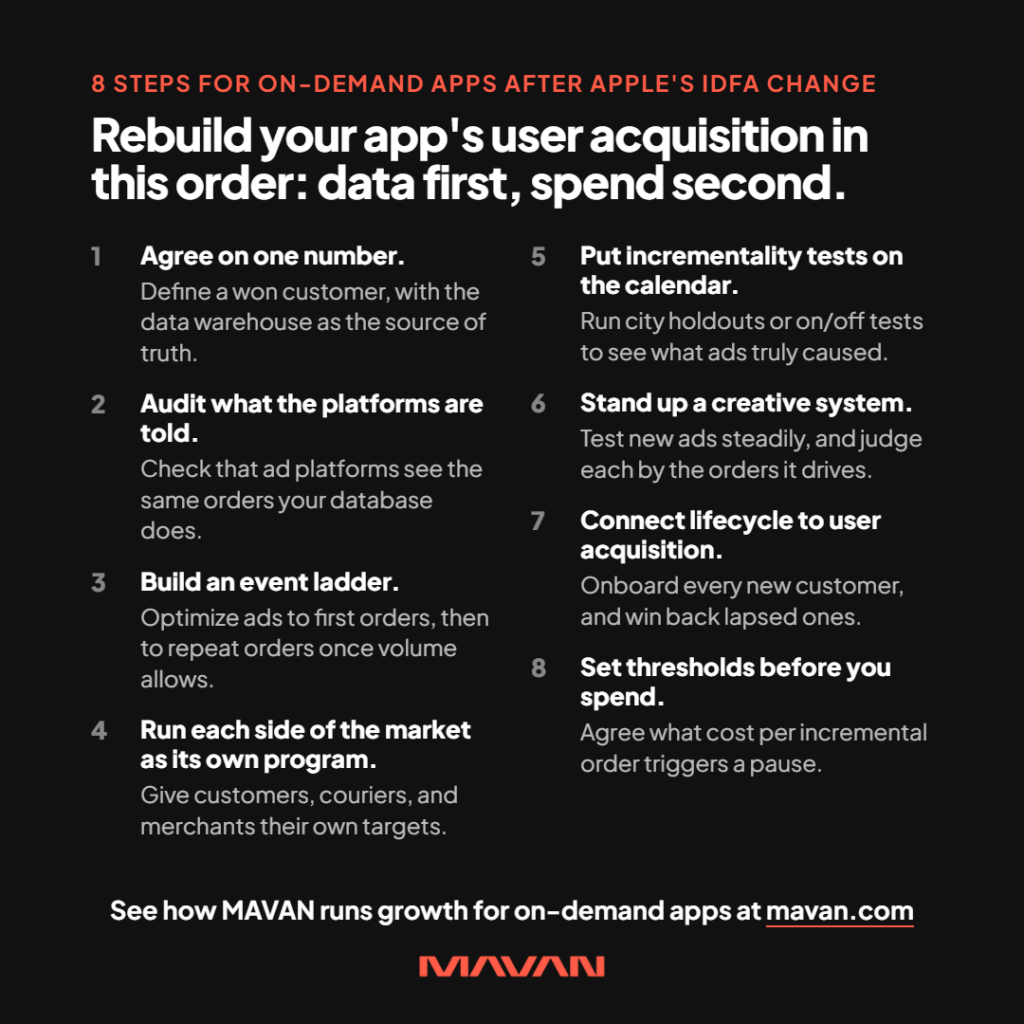
A post-IDFA UA strategy is a sequence. Fix the data first, then choose what you optimize, then prove what works, then scale what is proven. Teams that buy media before their measurement agrees with finance usually scale the wrong campaigns. Here is the order we follow when we build or rebuild acquisition for an on-demand app.
Which Steps Come First?
- Agree on one number. Define a won customer, such as contribution margin by cohort at Day 90, and make the data warehouse the source of truth. When numbers clash in a board meeting, Dan Barnes says the answer is always “the warehouse number is truth, we’ll investigate the discrepancy offline.”
- Audit what the platforms are told. Check which events reach Meta, Google, TikTok, Apple Ads, and your mobile measurement partner. Then confirm they match the orders in your database. Our SKAN attribution guide covers conversion values in depth.
- Build an event ladder. Start campaigns on the first order. Move to repeat orders or margin-weighted value once volume clears platform thresholds, and group small cities into regions until it does.
- Run each side of the market as its own program. Give consumer, courier, and merchant acquisition their own costs and targets. Then manage them together, city by city.
- Put incrementality tests on the calendar. Run city holdouts or on/off tests on your biggest channels each quarter. Use the results to correct attribution.
- Stand up a creative system. Test hooks, cuisines, occasions, and offers on a steady rhythm. Judge each concept on the orders and repeat rate it drives.
- Connect lifecycle to UA. Hand every new customer to a first-week onboarding flow, and aim re-engagement campaigns at lapsed users.
- Set thresholds before you spend. Agree in advance what cost per incremental order triggers a pause, so decisions happen in week two instead of quarter three.
Why Does the Order Matter So Much?
The order matters most for large budgets. “If you’re working at, you know, a company that has like seven to nine figure UA budgets, we’re a cruise ship,” McLellan says. “Like you can’t make immediate changes.” A ship that big needs its instruments right before it turns.
How Does Personalized Advertising Work in a Post-User World?
In a post-user world, advertisers can rarely target or track a known person across apps. Ads still get personal, but the work moved. Ad platforms now do it inside their own systems. Delivery apps sell targeting built on their order data. Brands do their deepest work inside their own app, email, and push messages.
By “post-user,” we mean a market where you can no longer buy or measure one person across apps. You buy contexts, groups, and platform predictions, and you measure in totals. A person only comes into clear focus once they are inside your product.
Who Personalizes Ads Now?
Meta, Google, TikTok, and AppLovin still personalize every impression, using what they know about people on their own services. What changed is who holds the controls. You supply creative and conversion signals, and the platform’s models decide who sees what. That leaves your signal quality and the range of your creative as the main levers you own.
How Did Delivery Apps Become Ad Platforms?
The delivery apps themselves prove that first-party data still powers personal ads. DoorDash says its ads business passed a $1 billion annual run rate in 2024. It spans DoorDash, Wolt, and Deliveroo and serves more than 400,000 advertisers, Marketing Dive reported. DoorDash bought ad tech firm Symbiosys for $175 million to carry that targeting onto search and social. It also teamed up with LiveRamp on clean rooms, which let two companies match data without handing it over. For restaurants and brands, these networks are now a UA channel. For the apps that run them, the order history behind the ads is a moat.
Why Is Your Product the Best Targeting Data You Own?
The deepest personalization now happens after the install. Tie a lasting user ID to each customer’s orders, addresses, favorite foods, order times, and delivery experience. Then you can speak to each person in ways no ad network can. Barnes links lifecycle results directly to that data. “The depth of your lifecycle capability is a direct function of the depth of your audience graph,” he says. He is just as direct about generic “come back” messages: “That’s not lifecycle. That’s spam.”
Build messages around moments customers care about. A favorite restaurant joins the app. A first order arrives early. Rain hits on a Friday night. Then feed what you learn back into ad creative, so the promise in the ad matches the app. Arcadia shows how much a well-built lifecycle program can carry. After we built and refined its program, 38% of the company’s revenue was attributed to lifecycle, and engagement rose 60%.
How Should You Evaluate a UA Partner for an On-Demand App?
Judge a UA partner on how they diagnose, measure, and hand off the work. Media buying comes second. Ask for proof in a business like yours, real lift testing, a plan for supply and win-backs, and a named senior team. Then ask what your team will own when the engagement ends.
Matt Saunders, MAVAN’s Growth Lead, has a simple test for any vendor review. “Relevance beats prestige every time,” he says. A case study from a company with your problem in your sector is worth more than a famous logo from another world. Put these questions to every partner on your shortlist, including us.
- Will you diagnose the whole system before you scope the work?
- Which event will you optimize to, and how will you show it predicts repeat orders?
- How will you test incrementality, by city, by time, or both?
- Who owns creative, and how will you judge it against orders?
- How will you handle courier or merchant acquisition and city-level supply?
- Which senior operators will run my account, and what have they run before?
- What will my team own when you leave?
How Does MAVAN Approach On-Demand UA?
We built MAVAN as a growth operating company for problems like these. We diagnose the whole system first. Then we embed the senior operators it needs from a network of 170+ specialists. They run the work alongside your team under one point of accountability. Our scaling workforce engagements cover a wide variety of businesses, including demand generation for one of the leading mobility companies in the US. Our leaders built their careers in mobile user acquisition at companies such as King, Zynga, and Take-Two.
What Results Has This Approach Produced?
Measurement comes first in our work. Titan needed lower acquisition costs and tracking it could trust. We rebuilt its tracking before we scaled. CAC efficiency then improved 3x while paid acquisition volume grew 5x. Angus Kirby, Titan’s Director of Marketing, noticed the difference. “Unlike a lot of agencies where strategy just lives in a deck, MAVAN actually executed,” he said.
On-demand apps grow city by city, and we often grow programs market by market. For ElevenLabs, we took paid search from a test to a high six-figure monthly budget. Payback went from 15 → 9 months against a board target of 12. The program delivered positive incremental ROI across 20+ markets, and then it moved in-house.
“Within months, MAVAN scaled our Search spend to a high six-figure monthly budget, maintaining efficiency consistently for nearly a year. After we had proven the channel with MAVAN, we were able to confidently transition the program to our in-house team.” — Luke Harries, Head of Growth, ElevenLabs
Every engagement runs on shared numbers. NEXUS is our human-augmented paid media analytics platform. It connects the ad platforms, the mobile measurement partner, and the warehouse into one view of acquisition performance. An AI insight layer sits on top. NEXUS is included with the 360 Blueprint. You can see more results on our case studies page.
What Should PE Sponsors Ask About UA at an On-Demand Portfolio Company?
Sponsors should ask whether ad spend builds margin they can count on. That takes contribution margin by cohort, a baseline of orders that happen without ads, and lift tests a board can review. Marketing is one of the largest costs at most on-demand companies. The answer moves EBITDA and shows up again in exit diligence.
Bain & Company’s 2026 Global Private Equity Report sets a high bar. Typical deals now need about 10% to 12% average annual EBITDA growth to earn a 2.5x return over five years. At an on-demand business, acquisition spend is one of the few levers big enough to matter. At DoorDash, sales and marketing took about 18 cents of every revenue dollar in 2025. Cutting waste in that line raises margin right away. Proving that the rest drives incremental orders supports the revenue story at exit.
“The answer isn’t a ROAS screenshot. It’s contribution margin by cohort at Day 90 and a clear model of what organic baseline looks like without paid support.” — Dan Barnes, President, MAVAN
This is where we fit for funds. A sponsor can deploy a MAVAN team into the portco that needs it. The fund can use the same diagnostic across its portfolio. It can also keep us on retainer as a dedicated growth partner for companies it buys later. We leave each company stronger, with the system documented and owned by its own team, and we stay with the fund.
What Else Do On-Demand Teams Ask About UA After IDFA?
These are the follow-up questions we hear most often. They come from growth leaders at on-demand and delivery companies and from the sponsors who back them. Each answer stands on its own, so you can lift any of them straight into a team plan, a vendor review, or a board memo.
Is SKAN Enough to Measure an On-Demand App?
No. SKAN and AdAttributionKit report results in groups, after a delay, and give credit to the last ad only. Use them for daily campaign calls. Then check them against city or on/off tests and your own order data. Our SKAN attribution guide explains how to set them up well.
Should On-Demand Apps Still Ask Users for ATT Permission?
In most cases, yes. With roughly 30% to 40% of iOS users consenting, the prompt still recovers real signal for retargeting and measurement. Many apps earn more yeses by explaining the benefit on their own screen before Apple’s prompt appears.
Does Android Still Allow User-Level Ad Tracking?
For now, yes. Google retired the Privacy Sandbox tools meant to replace Android’s advertising ID in October 2025. Users can still opt out, and privacy laws vary by region. Build measurement that would survive the ID disappearing.
Do Promo Codes and Referral Credits Count as Acquisition Cost?
They should. DoorDash counts some customer referral credits and Dasher referral fees as sales and marketing costs. If you leave discounts out, CAC looks better than it is. It also hides how many customers only order with a deal.
How Quickly Can a Post-IDFA UA Rebuild Show Results?
Diagnosis can be quick. Our Blueprint delivers an evidence-backed readout in 28 days. Scaling takes longer, because tests need clean data and enough volume. ElevenLabs reached a high six-figure monthly search budget within months.
Should We Build UA In-House or Hire a Partner?
Build in-house when you already have senior UA, data, and creative talent and measurement you trust. Bring in a partner when hiring would take quarters or the problem spans several functions. A good partner plans the handoff from day one.
Where Should an On-Demand App Start?
Start with a straight answer about where your acquisition system leaks today. For most on-demand apps, that means checking what the ad platforms are told, what finance counts as a won customer, and which spend actually causes orders. Fix those first. Then scale with a partner that can run the whole system with your team.
That is what our Blueprint is for: four weeks to a straight answer. Over 28 days, five or more MAVAN specialists work inside your platforms, people, and data. Every finding is evidenced. The roadmap sorts each action by who has to move it: what we start now, what needs a decision, and what needs a session. A sequencing register names the risks while there is still time to reorder. NEXUS is included with the 360 Blueprint.
After the readout, you choose. Your own team can run the roadmap, or we can assemble the operators to run it with you. Either way, the Blueprint is yours to keep. Scale like you’ve done it before.
Casey Rock is Content Director at MAVAN, where he helps turn complex ideas into clear, strategic content that drives growth. With over 15 years of experience across content strategy, SEO, media, and digital marketing, Casey focuses on building content systems that connect audience insight, brand storytelling, and measurable business outcomes.
Book a complimentary consultation with one of our experts
to learn how MAVAN can help your business grow.
Want more growth insights?
[hubspot type=”form” portal=”20951211″ id=”9c538ed2-fb12-45f1-a573-ad7953c058cc”]
Related Content
-
When Should a B2B SaaS Startup Hire a Growth Leader (What Kind of CMO)?
Mobile gaming teams have operated with granular attribution, segmented CAC, and whale-tier bidding for over a decade. B2B SaaS companies adopting the same three disciplines see clearer unit economics, faster optimization, and fewer wasted first growth hires.
-
Who Does Due Diligence for Private Equity Deals?
Strategy consultancies and boutique firms run commercial due diligence on the market. Operations advisors and PE operating teams run operational due diligence on how the company works. Growth and GTM due diligence falls to specialist diligence firms, GTM boutiques, and growth operating companies like MAVAN, which test the revenue engine from inside and can stay to run the fix.
-
How Do Private Equity Operating Partners Drive Value Creation?
Private equity operating partners drive value creation by turning the investment thesis into operating work inside each portfolio company. They set priorities, fix leadership gaps, and track the numbers that matter at exit. Because most now cover five or more companies, the best results come when they add outside execution capacity, especially for revenue growth.