
Performance marketing is paid advertising judged by a measurable action, such as a click, a lead, an install, or a sale. Growth marketing covers the whole system behind revenue, including data, conversion, lifecycle, and retention. Performance marketing buys customers. Growth marketing makes each customer worth buying, keeping, and scaling.
TLDR — Performance Marketing vs. Growth Marketing
- Performance marketing pays for measurable actions.
- Growth marketing runs the whole revenue system.
- Performance asks what a customer costs.
- Growth asks what a customer is worth over time.
- Ad platforms now automate targeting and bidding.
- Your edge sits in data, creative, and the funnel.
- Judge paid spend by payback and contribution margin.
- Many growth agencies still work like paid shops.
- A growth operating company diagnoses, then executes.
- Learn more about MAVAN’s growth services.
Why Companies Should Rethink Performance Marketing
Companies should rethink performance marketing because ad platforms now handle most targeting and bidding on their own. Budgets keep growing, but the old levers sit inside the platform’s code. The edge has moved to the work around the ads. That means clean data, strong creative, pages that convert, and customers who stay long enough to pay back.
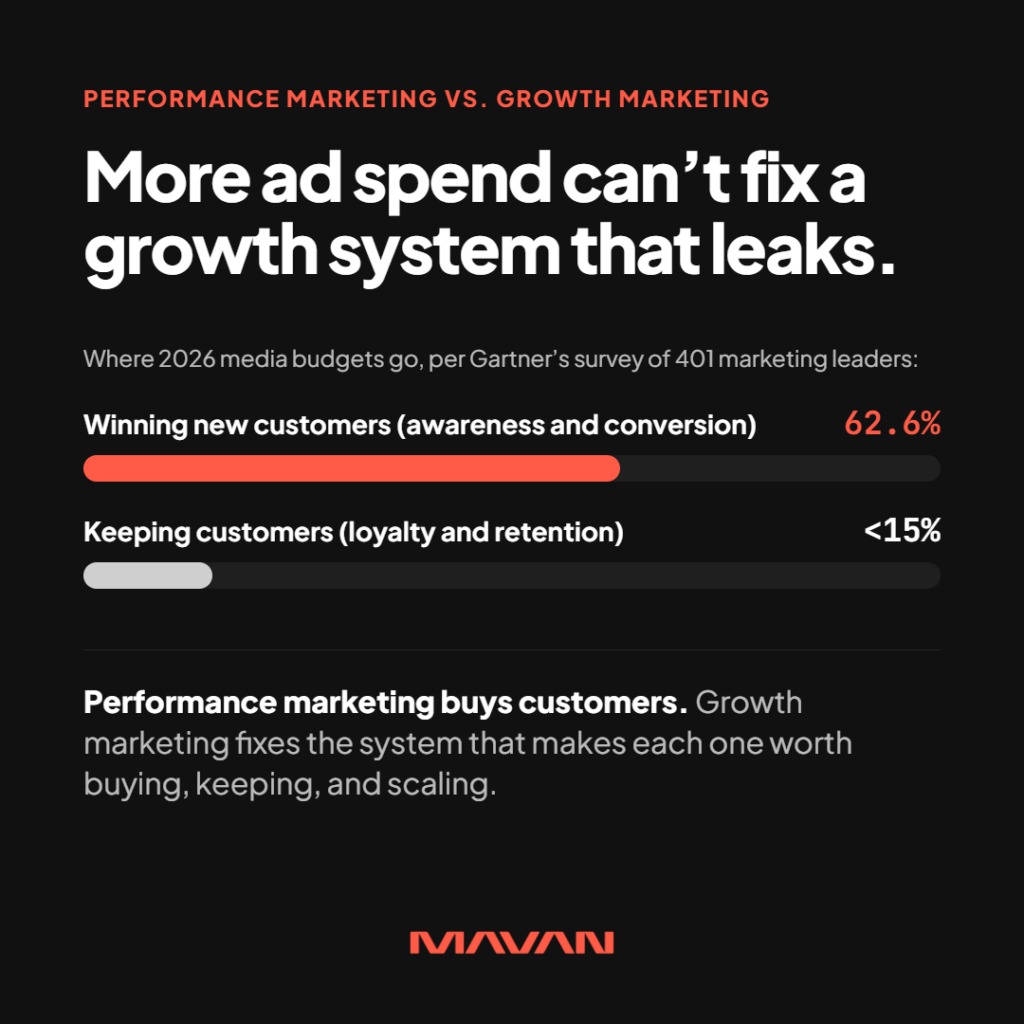
Money keeps flowing toward ads. U.S. digital ad revenue reached a record $294.6 billion in 2025, up 13.9% from the year before, according to the IAB’s annual revenue report, conducted by PwC. “This revenue growth reflects a market that has reoriented around performance channels,” IAB CEO David Cohen said in April. Budgets inside companies tell the same story. In Gartner’s 2026 CMO Spend Survey of 401 marketing leaders, awareness and conversion took 62.6% of media spend. Spending on loyalty and retention fell 29% since 2024, to less than 15% of the total.
So most media money now goes to winning the next customer, while little goes to keeping the last one. At the same time, the platforms that sell the clicks are automating work that media buyers once did by hand. The people who fund growth want more of it, too. Bain & Company’s 2026 Global Private Equity Report found that typical buyouts now need about 10% to 12% yearly EBITDA growth to earn a 2.5x return over five years. In the 2010s, roughly 5% did the job.
Where Do We Stand on Performance Marketing?
We’re MAVAN, a growth operating company. We run paid media for clients, and we fix what surrounds it, so we see this from both sides. Our view: performance marketing still matters, and it’s often the fastest way to reach new buyers. But it’s one engine inside a larger growth system. When that system leaks, more spend buys bigger leaks. This guide defines both disciplines and shows where they split. It also explains how to choose between a performance marketing agency, a growth agency, and a growth operating company.
Key Terms to Know About Growth & Performance Marketing
- Performance Marketing
- Paid advertising that is bought, judged, or both, against a measurable action, such as a click, lead, app install, or sale.
- Growth Marketing
- The practice of growing revenue across the whole customer journey, from first touch through activation, retention, referral, and repeat purchase.
- Performance Marketing Agency
- An outside firm that plans, buys, and tunes paid media, and usually reports channel results such as cost per lead or return on ad spend.
- Growth Agency
- An outside firm that sells growth across more of the funnel than paid media alone. The best ones own a business outcome, such as CAC payback, but scope and accountability vary widely.
- Growth Operating Company
- A company that embeds senior operators to diagnose and execute growth work inside a business, across functions, under one point of accountability. MAVAN is a growth operating company.
- Customer Acquisition Cost (CAC)
- What you spend to win one new customer. Fully loaded CAC adds the people, tools, and fees.
- CAC Payback
- The months it takes a new customer’s profit to repay what you spent to win them.
- Return on Ad Spend (ROAS)
- Revenue credited to ads, divided by ad spend. It reflects what a platform reported, which can differ from what the ads caused.
- Incrementality
- The share of results that would not have happened without the ad. It separates sales ads caused from sales they claimed.
- 360 Blueprint
- MAVAN’s 28-day growth diagnostic. Five or more specialists review the whole growth system and deliver evidenced findings and a sequenced roadmap.
What Is Performance Marketing?
Performance marketing is paid advertising you buy or judge against a measurable action. That action might be a click, a lead, an app install, or a sale. Search ads, paid social, affiliate programs, and programmatic display are the most common channels. The promise is simple: you can trace spend to a result.
Affiliate marketing gave the term its start. According to the Performance Marketing Association, it describes programs where companies pay publishers a commission “when a specific action is completed,” such as a sale, lead, or click. Most teams now use the phrase more loosely. It covers any paid media run against a tracked goal, even when the platform bills per view.
How Is Performance Marketing Priced and Measured?
Pricing follows the action you care about. Four models cover most deals:
- Cost per click (CPC): You pay each time someone clicks the ad. Most search campaigns work this way.
- Cost per lead (CPL): You pay when someone shares contact details, such as through a demo request form.
- Cost per acquisition (CPA): You pay for, or optimize toward, a finished action like a purchase or a signup.
- Cost per install (CPI): You pay for each app download, a common model for mobile apps and games.
The metrics follow the money. Teams track CAC, ROAS, and CAC payback, then shift budget toward the campaigns that return the most. Sam McLellan, our VP of Growth, whose experience includes Zynga and Take-Two, comes from this world. “I was always performance marketing first,” he says. He holds paid media to one standard: “for me it’s always going to be revenue based.”
How Does Performance Marketing Work Now That AI Runs the Ads?
A decade ago, media buyers split campaigns by audience and keyword, then tuned bids by hand. That job has shrunk. Brian Sapp, a MAVAN Advisory Group member, dates the shift to 2017 and 2018. That’s when “Facebook and Google really started rolling out with the ML campaigns,” he told our CEO, Matt Widdoes. (ML stands for machine learning.) The change “meant less work, set up one campaign for each geo or sets of geo with 50 creative.”
Now the platforms want the rest of the job. In June 2025, The Wall Street Journal reported Meta’s plan to let brands fully create and target ads with its AI tools. The target date was the end of 2026, according to Reuters. On an earnings call that April, Meta CEO Mark Zuckerberg described advertising as becoming “an AI agent that delivers measurable business results at scale,” Quartz reported.
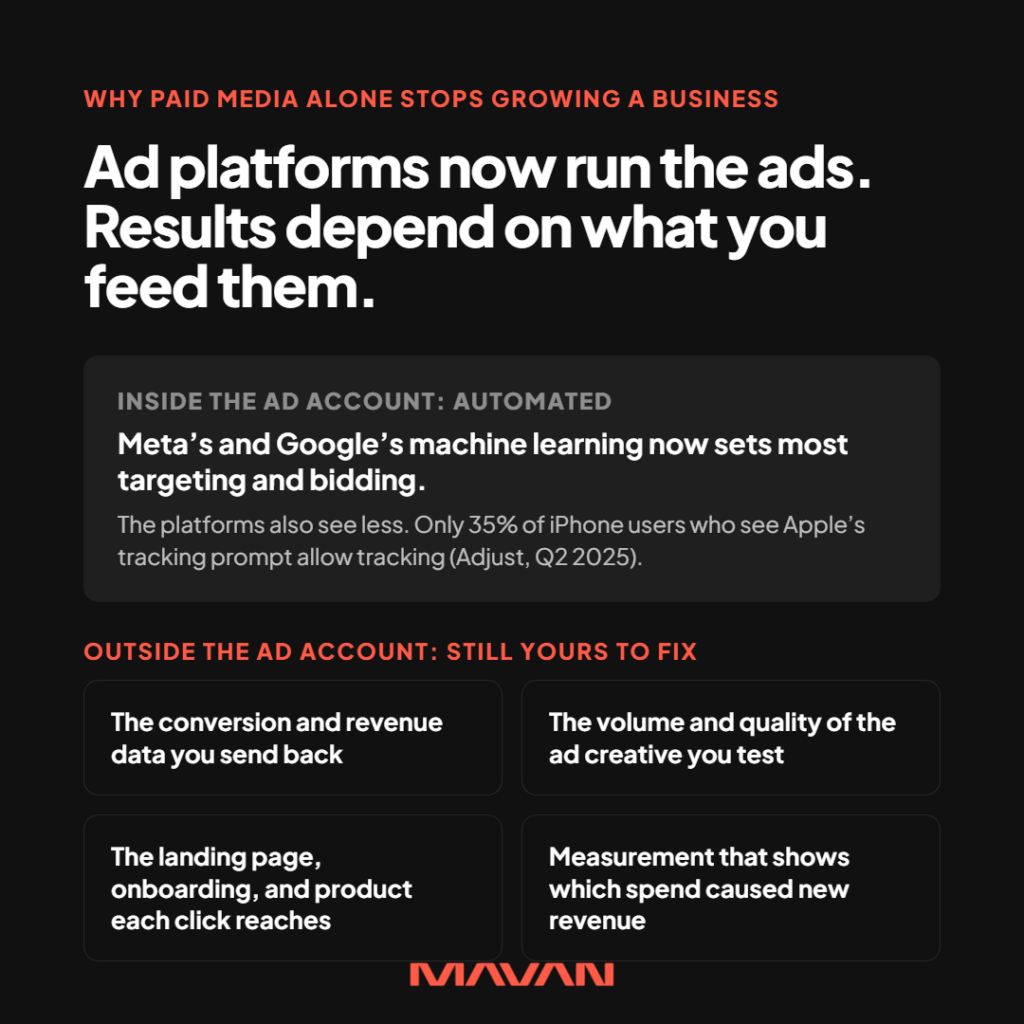
Automation also has less to see. Apple’s App Tracking Transparency prompt lets iPhone users refuse tracking across other companies’ apps and websites. In the second quarter of 2025, the average opt-in rate among users who saw the prompt was 35%, Adjust reported. So about two in three said no. With less signal, platforms lean on what advertisers feed them. Dan Barnes, our President, says it plainly: “The resolution on customer value at the front end has degraded too much for targeting to carry the load it used to. What fills that gap is creative that resonates.”
Which Performance Marketing Levers Still Belong to You?
That leaves a short list of levers that still belong to you. Most of them sit outside the ad account:
- The conversion events and revenue data you send back to each platform.
- The volume and quality of the ad creative you test each month.
- The landing page, onboarding flow, and product that each click reaches.
- Measurement that shows which spend actually caused new revenue.
Each of those levers is a growth marketing problem. That’s where the two disciplines meet. (Our guide to why creative is the biggest acquisition lever goes deeper on the second one.)
What Is Growth Marketing?
Growth marketing is the work of growing revenue across the whole customer journey. It treats winning, activating, keeping, and earning from customers as one linked system, along with referrals. Growth teams test changes anywhere in that system, from ads and pricing to onboarding and email. Then they judge each change by what it does to revenue.
The idea took hold in startups. In 2010, marketer Sean Ellis wrote a blog post titled “Find a Growth Hacker for Your Startup.” He described the role as “a person whose true north is growth.” Investor Dave McClure gave the field its map, with five stages: acquisition, activation, retention, referral, and revenue. People still call that model AARRR, or “pirate metrics.” Over time, the “hacking” label faded, while the full-funnel discipline stayed.
Growth marketing treats paid acquisition as one tool among many. Widdoes points out that user acquisition is also “one of the most important tools” for “discrete product testing,” especially at an early-stage company. A small paid test can show which promise pulls buyers before anyone builds the next feature. McLellan describes Widdoes’s view of growth this way: “growth isn’t really one specific thing. It’s a system essentially that sits above all of these individual silos that normally don’t talk to each other.” Paid media, product, lifecycle, and finance each own a piece. Growth marketing owns how the pieces connect.
Why Does Retention Matter So Much in Growth Marketing?
Retention sits at the center of the math. Frederick Reichheld of Bain & Company found that a 5% rise in customer retention lifts profits by 25% to 95%, Harvard Business Review reported. A paid campaign can’t win that gain by itself. It needs good onboarding, timely emails, and a product people keep using. At Arcadia, a climate-tech company, we built a full lifecycle program that taught buyers about clean technology. The company attributed 38% of its revenue to that program. Our guide to customer retention strategies that reduce churn covers the playbook.
What Is the Difference Between Growth and Performance Marketing?
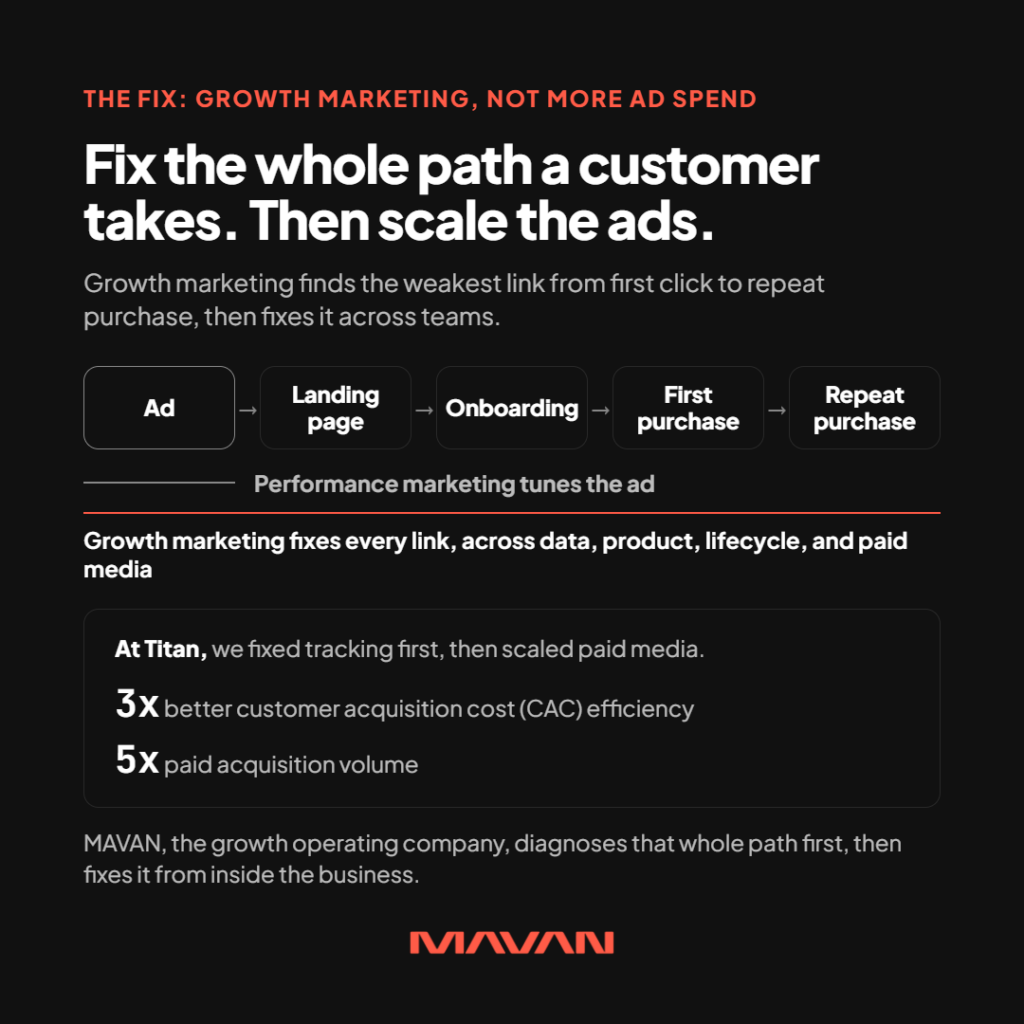
Performance marketing focuses on paid channels and the actions they drive right now. Growth marketing covers the full path from first touch to repeat revenue, across every team that touches it. Performance marketing asks what a customer costs. Growth marketing asks what that customer is worth, then fixes whatever keeps the number from rising.
The clearest way to compare growth marketing vs. performance marketing is by scope. One works inside the ad account. Its counterpart works on everything the ad account depends on. Here is where they split.
Growth Marketing vs. Performance Marketing
| Dimension | Performance Marketing | Growth Marketing |
| Main question | What does a new customer cost? | What is a customer worth, and what limits it? |
| Scope | Paid search, paid social, programmatic, and affiliate | The full journey, from acquisition to repeat revenue |
| Typical owner | A paid media team or agency | A cross-functional team that reaches data, product, and lifecycle |
| Core metrics | CPC, CPL, CPA, and ROAS | CAC payback, LTV:CAC, retention, and contribution margin |
| Time horizon | Days to weeks | Quarters to years |
| Common failure | Scaling spend into a funnel that leaks | Plans that cross teams with no one to ship them |
LTV:CAC compares what a customer is worth over time with what it cost to win them. Contribution margin is the profit each customer leaves after the direct costs to serve them.
Where Does Performance Marketing Hit Its Ceiling?
Paid media hits a ceiling when the ad account looks healthy and the business still stalls. McLellan sees it when teams fixate on the first numbers a platform shows them each morning: cost and volume. The math looks great until someone asks where the revenue went.
“I hear people say ‘We’re getting a ton of people.’ I’m like, ‘Where is the ton of money?’” — Sam McLellan, VP of Growth, MAVAN
Often, the cause sits upstream or downstream of the ads. Widdoes has traced rising costs to broken attribution, stale forecasting models, and dashboards that disagree. He has seen it at startups and at large companies such as King. Such problems “can only be found by taking an honest look at the entire machine vs a ‘problem du jour’ approach,” he says. When paid results slip, the fix usually lives in the data, the funnel, lifecycle, or the way a company makes decisions.
Where Do Brand and Paid Acquisition Fit?
Brand matters as well. Les Binet and Peter Field studied the IPA’s effectiveness databank for their 2013 report “The Long and the Short of It.” The best long-term results came from about 60% of budget on brand building and 40% on short-term activation, the IPA has summarized. In later B2B research, they put the balance closer to 46% brand and 54% activation, The Drum reported. A plan that funds only activation can win this quarter and stall the next.
Paid acquisition stays essential all the same. Eric Seufert, founder Heracles and Mobile Dev Memo, sits on the MAVAN Advisory Group. He notes that “the vast majority of the TAM are people that you would have to go and recruit and convince and sell with an ad.” (TAM means total addressable market.) Products built only for buyers who seek them out run short of those buyers early, he argues.
Do You Need Both Growth Marketing and Performance Marketing?
Most scaling companies need both, in the right order. Titan needed lower CAC and a measurement setup it could trust. We rebuilt its tracking and measurement first, so the team could see true acquisition performance. Then we found channels that could scale and refined media and creative. CAC efficiency improved 3x while paid acquisition volume grew 5x. The performance marketing worked because the growth work came first. At Fireflies, a voice meeting assistant, we expanded paid search into 31 new regions. Its growth lead described the payoff in terms of markets and customer value, beyond any single campaign.
“They helped us identify which markets to target, how to optimize customer value, and where to efficiently find scale. This partnership directly led to better campaign performance while scaling our growth significantly.” — Dionatan Korb, Growth Lead, Fireflies
What Does a Performance Marketing Agency Do?
A performance marketing agency plans, buys, and tunes paid media against a tracked goal, such as cost per lead or return on ad spend. It usually runs search, social, and display campaigns, makes ad versions to test, and reports on each channel. Most charge a monthly management fee, a share of ad spend, or a mix of both.
A good performance agency brings channel depth that a lean in-house team rarely has. Its buyers know each platform’s bidding rules, creative formats, and quirks. They also see results across many accounts, which helps them spot shifts early. When one known channel needs more output, that depth pays off fast. Our guide to acquisition architecture covers how to structure paid channels once you’re ready to scale them.
How Do Performance Marketing Agencies Charge?
Pricing tends to follow the media. Paid search pricing is most often a base management fee tied to the number of channels managed, Credo’s agency pricing survey found (last updated in 2022). Many firms add a percentage of ad spend above a set budget. Credo matches companies with vetted marketing firms. Percentage pricing has one quirk worth knowing: the fee rises as spend rises, whether or not the extra spend works.
The model has one built-in limit, and that limit is scope. A performance agency sees the ad account. It may never see the onboarding flow, the CRM, or the finance team’s numbers. If the leak sits there, the agency will keep tuning bids against a problem it can’t reach. That’s the edge of the job it was hired to do, and no amount of bidding skill moves it.
What Is the Difference Between a Growth Agency and a Performance Marketing Agency?
A performance marketing agency runs paid channels and reports channel metrics such as ROAS and cost per lead. A growth agency promises more: a business result, such as revenue or CAC payback, across more of the funnel. In practice, many growth agencies still run a few channels from outside the business. Judge each one by what it will own.
Many firms use both labels, so buyers often lump them together. Ask any outside team which number it will move and where its work stops. The table below adds a third model, the growth operating company, built for problems that sit between teams.
Performance Marketing Agency vs. Growth Agency vs. Growth Operating Company
| Question | Performance Marketing Agency | Growth Agency | Growth Operating Company |
|---|---|---|---|
| What does it own? | Paid channel results | Often a business metric, such as CAC payback | The business number, under one point of accountability |
| Where does it start? | Inside your ad accounts | Often with a channel plan | With a diagnosis of the whole growth system |
| What does it change? | Bids, budgets, audiences, and ad creative | Paid media, plus some landing page, email, or analytics work | Whatever the constraint needs, from data and product to paid media |
| What does it report? | ROAS, CPA, and cost per lead | Payback, pipeline, or revenue, next to channel metrics | Revenue, payback, and margin from one source of truth |
| Where does it sit? | Outside, on a retainer or share of spend | Usually outside, on a retainer for a set scope | Inside your tools and meetings, reporting to your leaders |
| When does it fit best? | Paid media is the known constraint | You need more than paid media, and the scope is clear | The cause is unclear, or the fix crosses teams |
Why Do Growth Agencies and Performance Agencies Often Look Alike?
Growth agencies and performance agencies look alike because they share a working model. Both sell a defined scope, usually on a monthly fee, a share of ad spend, or a mix of the two. Both work from outside the business and tend to report on the channels they manage. In our experience, many growth agencies are performance shops with a wider menu. They add landing pages, email, or analytics to a paid media core, and their work still stops at the edge of the contract. At MAVAN, we have a blunt line for this: “Agencies run your ads and call it growth.” Whatever an agency calls itself, the same test applies: what will it own, and where does its work stop?
What Does a Growth Operating Company Do?
A growth operating company diagnoses what will move the business, embeds the operators required to execute it, and leaves the company with stronger systems and internal capability. MAVAN built and owns this category alone. We built it for problems that sit between teams, where an agency’s scope runs out. Think of a tracking gap that starves the ad platforms, or an onboarding flow that loses the buyers paid media just won.
Our work runs in a different order from an agency engagement:
- We diagnose before we scope. We test the whole growth system first, then sequence the work by evidence, dependency, and who has to decide.
- We keep strategy and execution together. The operators who find the constraint can also fix it, so plans don’t stall in a handoff.
- We work inside the business. Our operators join your tools and meetings, report to your leaders, and answer to one point of accountability.
- We flex senior capacity. Specialists join for the functions the roadmap needs, then stand down when that work is done.
- We build to transfer. We document the system so your internal team can own it. A properly structured engagement has an end date.
For a PE fund, the model repeats. Funds can keep MAVAN on retainer as a dedicated growth partner and deploy us to any portfolio company, one at a time or several at once. Because the diagnostic and operating model stay the same, what we learn compounds across the portfolio.
Can a Growth Operating Company Work Alongside a Performance Agency?
Yes, and the pairing can work well. KidStrong already worked with a paid media agency when we arrived. We guided that agency with strategic input and performance reviews. Alongside it, we ran conversion tests on the signup flow and found the creative that resonated most with parents, including parent-filmed reels. Form conversion rose 32%. Blended cost per lead improved 35%, and paid cost per lead improved 37%.
What Does That Look Like in Practice?
Our core team covers 12 growth functions, from strategy and paid media to data, lifecycle, creative, product, and web work. Behind it stands a network of 170+ vetted specialists. Each team, or pod, includes only the skills the problem needs, and one person owns the result.
We still run performance marketing, and we hold it to growth math. When ElevenLabs came to us, the board’s CAC payback target was 12 months, and the business sat at 15. We moved payback 15 → 9 months inside the first month, then held 9 through scaling. Paid search grew from a test to a high six-figure monthly budget. It stayed efficient for nearly a year and delivered positive incremental ROI across 20+ markets. Then the program moved in-house. Our paid media fees scale with the spend we manage, and other work runs as a defined monthly engagement tied to a detailed scope. To vet any outside growth team, including us, see our guides to the best growth agencies for venture-backed startups and the best growth partner for PE portfolio companies.
Should You Hire a Performance Marketing Agency, a Growth Agency, or a Growth Operating Company?
Hire a performance marketing agency when you know paid media is the constraint, you trust your tracking, and your funnel converts. Choose a growth agency when you need more than paid media and the scope is clear. Bring in a growth operating company when nobody can explain why growth stalled or the fix spans multiple teams.
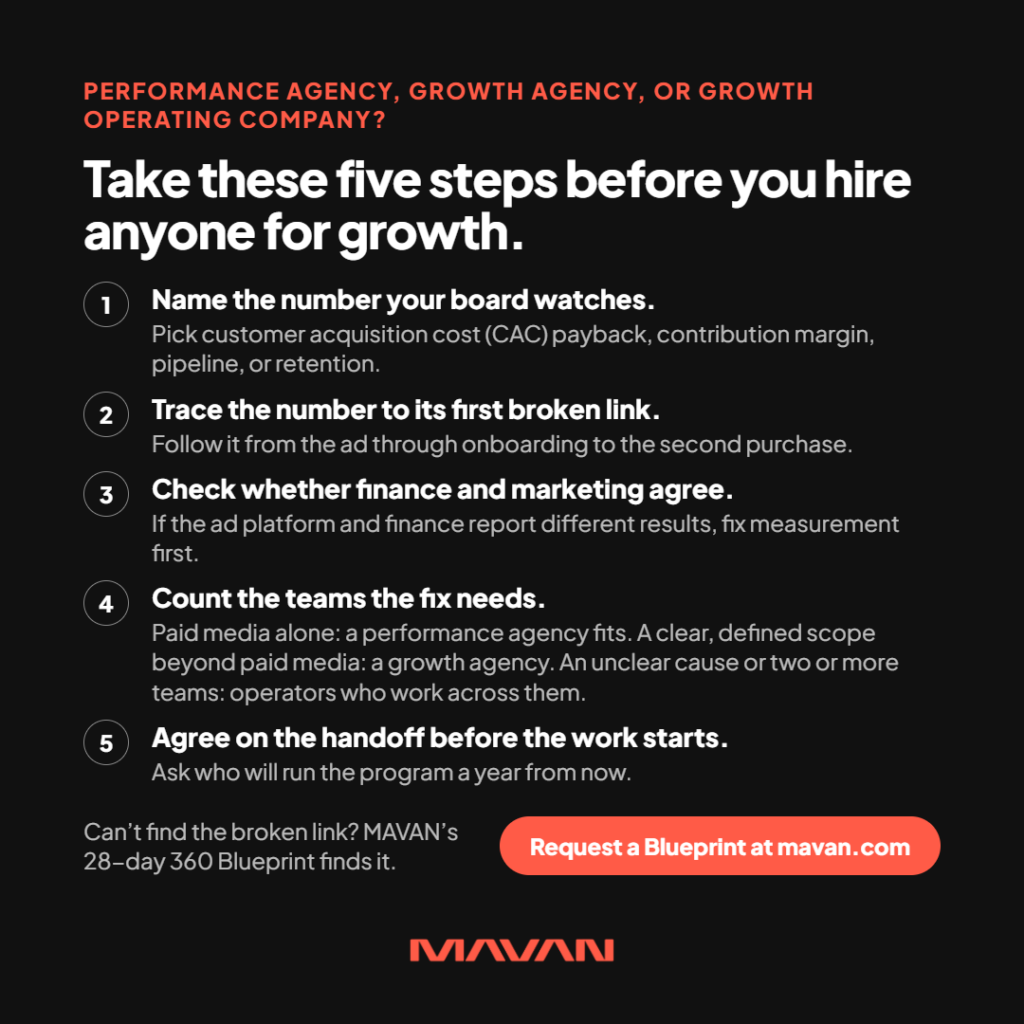
Work through these five steps before you sign with anyone:
- Name the number your board watches. Pick CAC payback, contribution margin, pipeline, or retention. Whoever owns that number should own this decision.
- Trace the number to its first broken link. Follow it from the ad to the landing page, onboarding, and the first and second purchase. Note where results fall off.
- Check whether finance and marketing agree. If the ad platform and the finance team report different results, fix measurement first. Otherwise, any agency will optimize toward a number nobody trusts.
- Count the teams the fix needs. Count the teams the fix needs. If paid media alone can solve it, a performance agency fits. If the fix is clear and stays within a defined scope, such as paid media plus landing pages or email, a growth agency can cover it. When the cause is unclear or two or more teams must change, you need operators who work across them.
- Agree on the handoff before the work starts. Ask who will run the program a year from now. The right team builds a system your own people can keep.
How Do You Vet Any Outside Growth Team?
If step two lands outside the ad account, an agency alone won’t close the gap. You’ll likely need to weigh growth agencies, consultancies, or our growth operating company. Hold each one to the five steps above, whatever it calls itself. Our guide to avoiding a growth agency that falls short shows how to vet agencies in detail. To weigh the operating models side by side, compare embedded operators and agency retainers.
How Do PE Firms Use Performance and Growth Marketing in Portfolio Companies?
PE firms treat performance marketing as one mechanism inside the value-creation plan. Sponsors lead with revenue, EBITDA, margin, and exit readiness, and paid media is one way to move them. The strongest portfolio programs fix data and the funnel first. Then they scale spend that will hold up in exit diligence.
The pressure on sponsors is real. Bain calls its new return math “12 is the new 5,” and it leaves little room to wait for the market to lift a portfolio company’s value. The firm’s 2026 report framed the response in one line.
“The winning firms will build systems, not slogans.” — Bain & Company, Global Private Equity Report 2026
For a portfolio company, a paid media problem is often a data problem in disguise. In May 2026, Growth Factors, the operating team at Bregal Sagemount, routed us into one of the firm’s portfolio companies. Qualified leads from paid media had cratered. The ad accounts were learning from broken tracking data, so they could not recover on their own. Before the diagnostic finished, the company asked us to stay on. We rebuilt the data connections. Then we launched always-on (evergreen) campaigns that became its main source of leads.
How Should Boards Judge Paid Spend in a Portfolio Company?
Boards should judge paid spend by unit economics. When a board asks whether spend is efficient, Barnes points past the platform dashboard. “The answer isn’t a ROAS screenshot,” he says. “It’s contribution margin by cohort at Day 90 and a clear model of what organic baseline looks like without paid support.” A cohort is a group of customers acquired in the same period.
At WGT, a Haveli Investments company, the work grew in steps: Blueprint → paid acquisition → lifecycle rebuilt end to end → data and analytics stack. All of it was already in the Blueprint’s roadmap. At the company level, we’re built to leave. Funds work differently. They can keep MAVAN on retainer as a dedicated growth partner and send us to any portfolio company that needs growth work, including new ones. Our guide to the best growth partner for PE portfolio companies goes deeper.
Frequently Asked Questions About Performance and Growth Marketing
Leaders tend to ask five questions. They want to know how performance marketing relates to digital marketing, and whether growth marketing is just growth hacking. Many also ask which metrics matter most, whether one partner can run both disciplines, and what a performance marketing agency costs. Short answers to each follow below.
Is Performance Marketing the Same as Digital Marketing?
No. Digital marketing covers every online channel, including SEO, content, email, organic social, and paid ads. Performance marketing is the paid slice judged by a measurable action. A brand video on YouTube is digital marketing. Buy a search ad on cost per lead, and that’s performance marketing. Both can belong in the same plan.
Is Growth Marketing Just Another Name for Growth Hacking?
Mostly no. Sean Ellis coined “growth hacker” in 2010 for a startup role built around fast, scrappy tests. Growth marketing kept the testing habit and widened the scope. Today it means a repeatable system across acquisition, activation, retention, and revenue, run by a team instead of one specialist.
Which Metrics Matter Most in Performance Marketing?
Start with CAC and CAC payback, then add contribution margin by customer cohort. ROAS helps inside a platform. It shows the revenue the platform credited to your ads, which can differ from what the ads caused. Incrementality tests close that gap. Our guides to fully loaded CAC and incrementality testing explain both.
Can One Partner Run Both Performance and Growth Marketing?
Yes, if the partner works across functions and owns a business number. At CrossFit, we had 60 days to lift registrations for its annual competition. We built the launch plan, lifecycle automation, paid social and search campaigns, and A/B-tested landing pages. CrossFit reached its registration goal, with LTV:CAC above 3.0.
How Much Does a Performance Marketing Agency Cost?
Cost depends on spend, channel count, and scope. Many firms charge a base fee per channel, and many add a percentage of ad spend above a set budget, Credo found. Compare cost per outcome as well as the fee. A cheaper agency that scales spend into a leaky funnel can cost more than a partner who fixes the leak first.
So, What Is the Difference Between Performance Marketing and Growth Marketing?
Performance marketing buys measurable actions through paid media, and it does that job well. Growth marketing builds the system that makes those actions pay, from data and conversion to lifecycle and retention. As AI takes over the buying, that system becomes your edge. So hire for where your real problem sits: inside the ad account or outside it.
Before you add budget or change agencies, ask your paid media, finance, and product leads one thing. What is the biggest reason our CAC payback isn’t better, and who would have to act on it? If all three point to the ad account, a strong performance agency may be enough. When their answers disagree, or nobody can name the cause, you need a diagnosis first.
A 360 Blueprint answers it. For 28 days, five or more of our specialists work inside your platforms, people, and data.
Every finding comes with the number behind it. You get a roadmap sorted by who has to act (We start now, Needs a decision, Needs a session), plus a sequencing register that names the risks in week four. NEXUS is included with the 360 Blueprint. This human-augmented paid media analytics platform joins your ad platforms, mobile measurement partner (the tool apps use to track installs), and data warehouse into one view. An AI insight layer sits on top. You keep the Blueprint and NEXUS, whether you run the roadmap yourself or with a pod from our network.
Request a Blueprint: four weeks to a straight answer.
Casey Rock is Content Director at MAVAN, where he helps turn complex ideas into clear, strategic content that drives growth. With over 15 years of experience across content strategy, SEO, media, and digital marketing, Casey focuses on building content systems that connect audience insight, brand storytelling, and measurable business outcomes.
Book a complimentary consultation with one of our experts
to learn how MAVAN can help your business grow.
Want more growth insights?
[hubspot type=”form” portal=”20951211″ id=”9c538ed2-fb12-45f1-a573-ad7953c058cc”]
Related Content
-
Who Is The Best Growth Partner For PE Portfolio Companies?
The best growth partner for a PE portfolio company diagnoses the whole growth system before it spends. It embeds senior operators inside the business, ties every workstream to revenue and EBITDA, and works on the fund’s clock. When the job is done, the capability stays behind, and the sponsor can send the team to the next portfolio company.
-
What Are the Best Growth Agencies for Venture-Backed Startups?
The best growth agencies for venture-backed startups find the real constraint before they spend more money. They tie their work to CAC payback and revenue, show proof at your stage and in your category, and execute across data, paid media, lifecycle, and product. The best ones also build systems your own team can run after they leave.
-
Who Are the Best Growth Consultants for Scaling Startups?
The best growth consultants for scaling startups are senior operators who have scaled companies like yours. They study the whole growth system, back every finding with a number, and sort each fix by who must act. Then they execute across teams or bring people who can. Judge them by what they shipped and what your team keeps.