
Lifecycle marketing is the practice of sending each customer the right message at each stage, from first sign-up to repeat purchase or renewal, through email, SMS, push, and in-app channels. Most companies underinvest because budgets chase new customers. Weak data, stale tools, and open-rate reports also hide how much revenue lifecycle programs can drive.
TLDR — How to Fix Underfunded Lifecycle Marketing
- Lifecycle turns customers you paid for into revenue.
- Pick a CRM for your data model, not its features.
- Clean and map your data before any CRM migration.
- Segment by stage and behavior, not demographics.
- Judge email on clicks and revenue, not opens.
- Automate welcome and cart flows before campaigns.
- Nurture early. Buyers pick favorites before sales.
- Match win-back offers to why customers left.
- Build loyalty that makes members feel valued.
- Learn more about MAVAN’s growth services.
Winning the Customer, Losing the Plot
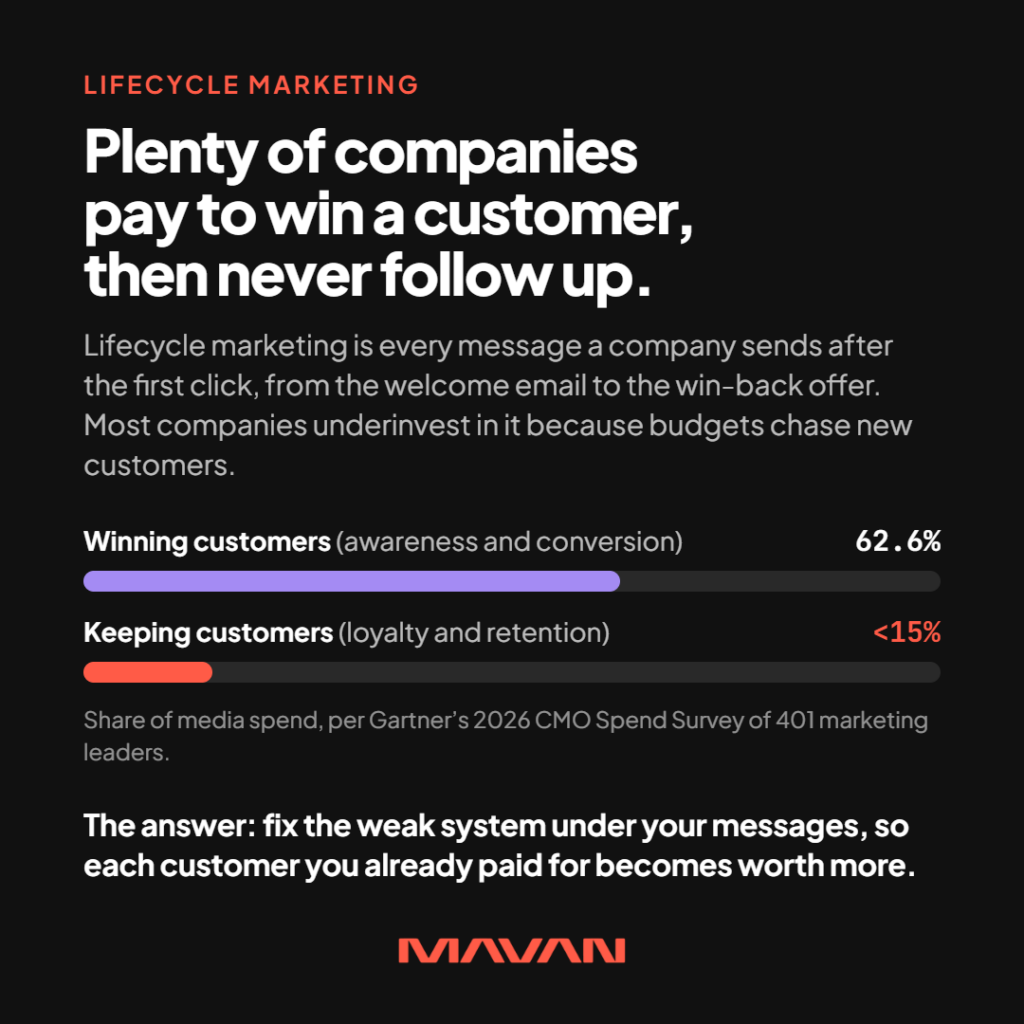
Plenty of companies pay to win a customer… But then they never follow-up. In its 2026 CMO Spend Survey of 401 marketing leaders, Gartner found that awareness and conversion now take 62.6% of media spend. Spending on loyalty and retention fell 29% over two years, to less than 15% of the total. Gartner also reported that the most AI-mature marketing teams give loyalty and retention a larger share of budget, not a smaller one.
That gap is where lifecycle marketing lives. It covers every message a company sends after the first click, from the welcome email to the win-back offer. When it works, each customer you already paid for becomes worth more. Underfund it, and the revenue those customers could produce leaks out between teams, tools, and dashboards.
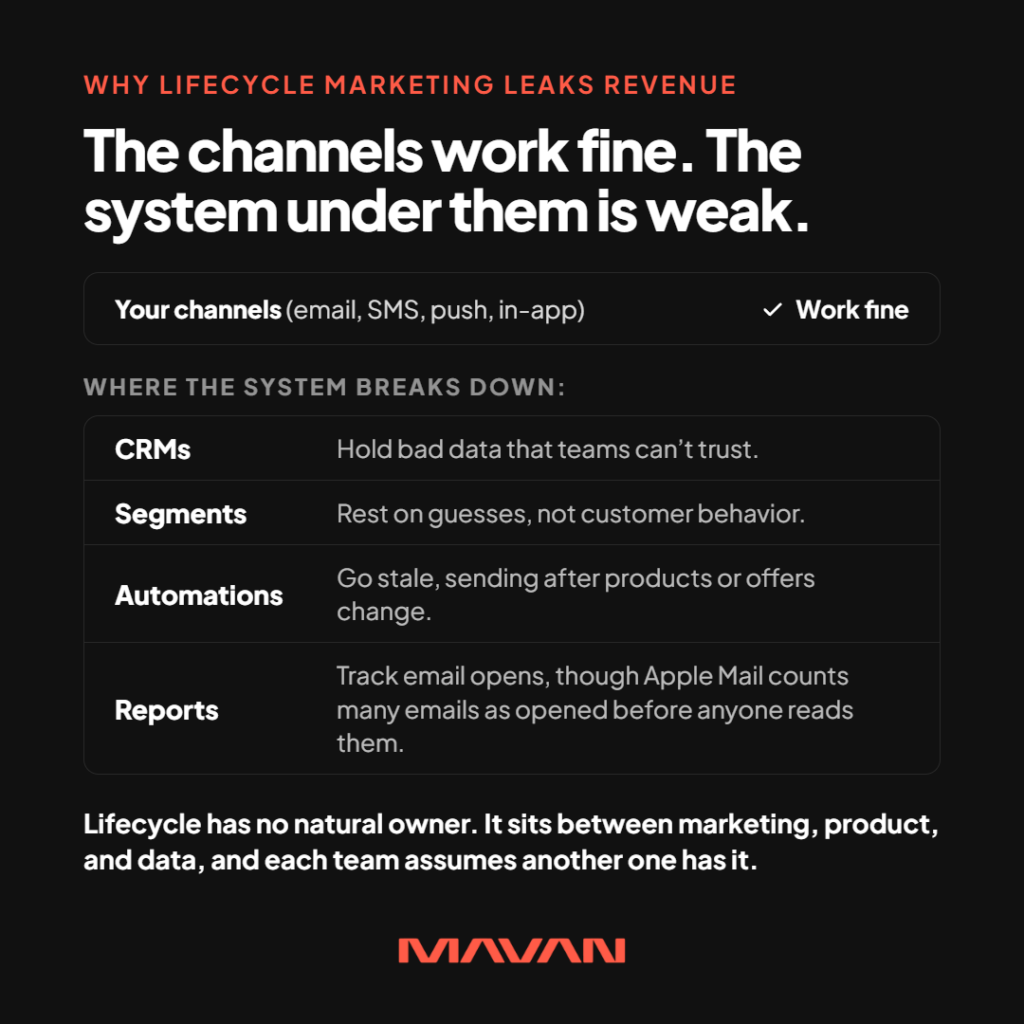
In our experience, the channels work fine. The system under them is weak. CRMs hold bad data, segments rest on guesses, automations go stale, and reports track opens that no longer mean much. This guide covers how to fix each piece, from strategy and CRM selection to segmentation, email automation, nurture, win-back, and loyalty. It closes with what to look for in a lifecycle marketing agency and how we approach the work at MAVAN.
(For churn prediction and net revenue retention, see our guide to customer retention strategies that reduce churn.)
Key Lifecycle Marketing Terms
Lifecycle marketing borrows terms from sales, email, and data teams, and each team tends to use them a little differently. The definitions below set a shared baseline for the rest of this guide. They also help sponsors, operators, and growth leads compare programs across companies without arguing over what a word means.
- Lifecycle Marketing
- Messages and offers timed to where each customer sits in their relationship with a company, from first sign-up through repeat purchase, renewal, or return.
- Lifecycle Marketing Strategy
- The plan that ties each customer stage to a goal, a program, and a number to watch.
- Customer Relationship Management (CRM) System
- The software that stores lead and customer records, their history, and their stage. It’s the system of record for lifecycle work.
- Email Service Provider (ESP)
- The platform that builds, sends, and tracks email. Many ESPs also send SMS and push messages.
- Email Marketing Automation
- Messages that send on their own when a customer takes, or skips, a specific action.
- Segmentation
- Splitting an audience into groups that share a trait or behavior, so each group gets a message that fits.
- Nurture Campaign
- A series of useful messages that keeps a prospect engaged until they’re ready to buy.
- Re-Engagement Campaign
- Messages aimed at subscribers or customers who have disengaged but haven’t left.
- Win-Back Campaign
- Outreach to former customers who canceled or stopped buying, designed to bring them back.
- Loyalty Program
- A structured set of rewards, perks, or recognition that gives customers a reason to keep buying.
- Mail Privacy Protection (MPP)
- An Apple Mail feature that loads email images in the background, so many emails register as opened whether or not anyone read them.
What Is Lifecycle Marketing?
Lifecycle marketing is the practice of sending each customer the right message for their stage, from first sign-up to repeat purchase or renewal. It runs on email, SMS, push, and in-app messages. Unlike one-off campaigns, lifecycle programs respond to what customers do, so each message arrives while it can still change the next step.
A campaign goes to a list on a date. Lifecycle programs wait for a signal instead. A new account triggers a welcome series. Stalled trials trigger help. Customers who haven’t bought in 60 days get a reason to return. Every message aims at one next step, and every step has a number attached.
The work spans more teams than most org charts admit. Data decides who sits in which stage. Product decides what a first win looks like. Finance owns pricing and billing. Marketing writes the messages. That spread is why we say the problem is rarely just the ads. It’s often the data, the funnel, the lifecycle program, or the decision system around them.
Why Do Companies Underinvest in Lifecycle Marketing?
Three habits push lifecycle down the budget list. Attribution tools tend to credit the last paid click, so a welcome series that closed the sale looks like a cost. Lifecycle also lacks a natural owner. It sits between marketing, product, and data, and each team assumes another one has it. Finally, many programs send generic messages. Weak results follow, and those results justify the next budget cut.
Time works against that habit. Eric Seufert, who founded Mobile Dev Memo and sits on the MAVAN Advisory Group, notes that products which keep their customers end up with a base made mostly of long-time users.
“The ultimate goal of product growth is to have the cohort stick around and retain such they compound. Well, then at some point, just mathematically, the majority of users will be old.” — Eric Seufert, MAVAN Advisory Group
If most future revenue will come from customers you already have, most of your marketing attention should follow them.
Why Does Lifecycle Marketing Matter to PE Sponsors and Growth Leaders?
Lifecycle marketing grows revenue from customers a company already has, with no new ad spend. PE sponsors get EBITDA growth and a cleaner exit story. Growth leaders at venture-backed or PE-owned companies get higher lifetime value and faster CAC payback. Both audiences need it built as a system the team can keep running.
The return math in private equity has changed. Typical deals now need about 10% to 12% average annual EBITDA growth to earn a 2.5x return over five years, according to Bain & Company’s 2026 Global Private Equity Report. Bain calls this “12 is the new 5.” Cost cuts can’t carry that load alone. Revenue has to grow, and the cheapest revenue in most portfolio companies sits inside the customer file. A reactivated customer needs no new ad spend and no new sales cycle.
In our view, lifecycle also helps at exit, as long as it runs as a system rather than a string of campaigns. Buyers trust revenue they can trace to documented programs, clean data, and cohorts that behave the same way quarter after quarter. A lifecycle program that lives in one marketer’s head reads as risk in diligence.
Sequence matters as much as effort. At WGT, a Haveli Investments company, our work moved through four functions: 360 Blueprint → paid acquisition → lifecycle rebuilt end to end → data and analytics stack. Each engagement was earned by the last one, and every step was already in the roadmap the Blueprint produced. The work now sits inside the business.
How Does Lifecycle Marketing Show Up in Unit Economics?
Growth leaders see the same work in their unit economics. Lifecycle raises lifetime value through repeat purchases and upgrades. It also shortens CAC payback by getting new customers to a first purchase or first win sooner. We explain how to model both effects in our guide to calculating LTV:CAC.
What Belongs in a Lifecycle Marketing Strategy?
A lifecycle marketing strategy maps each customer stage to one goal, one core program, and one number to watch. It names who owns each program and where the data comes from. Then it tests every program against a holdout group, so the team knows what the messages caused rather than what they happened to coincide with.
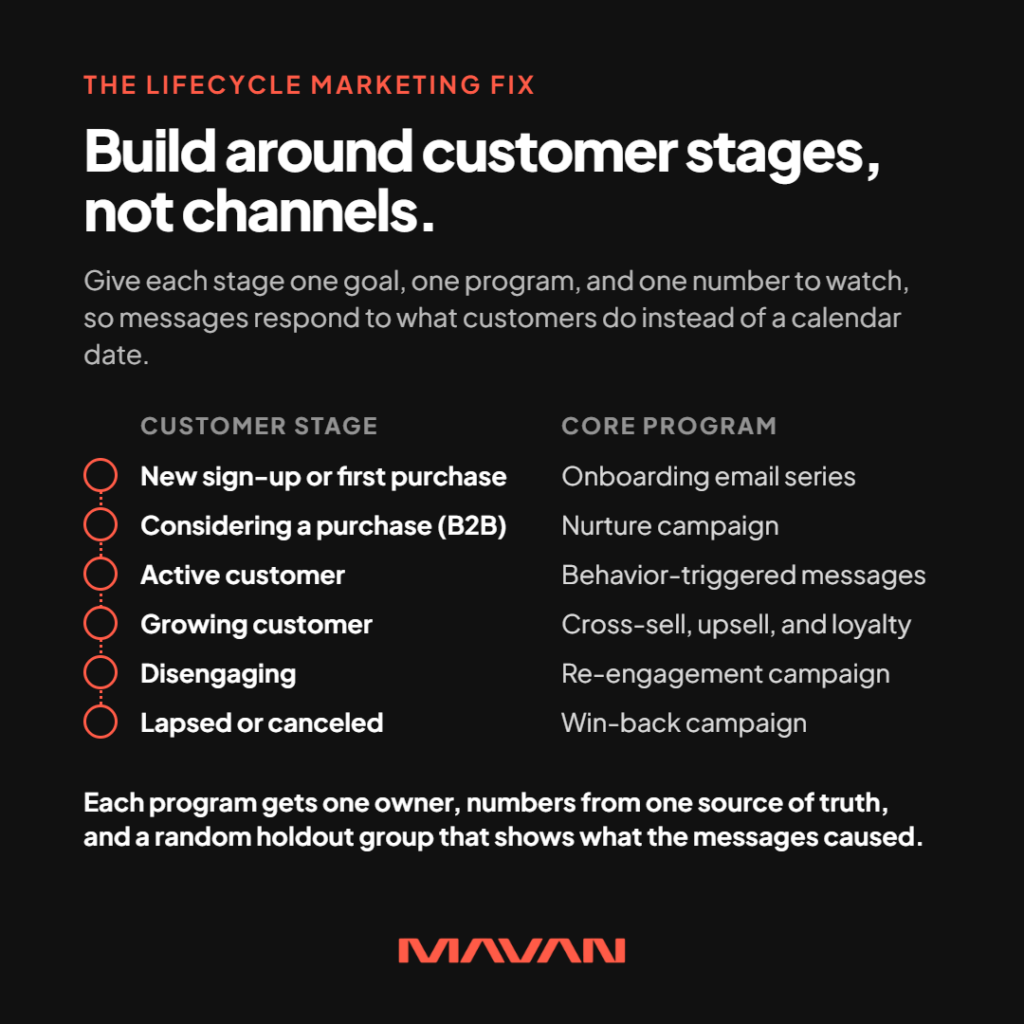
Most lifecycle plans start with channels: a newsletter, a few automations, a monthly promo. We start with stages, because each stage has a different job. New customers need to reach a first win. Loyal ones need reasons to buy more. Customers drifting away need a reason to stay. The table below shows the core program and first metric for each stage.
| Customer Stage | Core Program | Number to Watch |
| New sign-up or first purchase | Onboarding email series | Share who reach a first-value action |
| Considering a purchase (B2B) | Nurture campaign | Conversion and time between pipeline stages |
| Active customer | Behavior-triggered messages | Revenue per recipient |
| Growing customer | Cross-sell, upsell, and loyalty | Repeat purchase or expansion rate |
| Disengaging | Re-engagement campaign | Share who click or buy again in the window |
| Lapsed or canceled | Win-back campaign | Customers regained and their second-lifetime spend |
A few rules keep the strategy honest. Give each program one owner, even when many teams feed it. Pull every number from one source of truth, so finance and marketing see the same result. Hold back a random slice of each audience from every program, too. Comparing the two groups shows real lift, the same way incrementality testing works for paid media.
How Should You Approach CRM Selection and ESP Selection?
Treat CRM selection and ESP selection as data decisions, not feature contests. Pick the CRM that fits how your customers and revenue are structured. Then pick the ESP that can act on that data in real time and protect deliverability. Most teams already own more features than they use, so fit and adoption matter more.
Buying more software rarely fixes lifecycle. Marketers use only 49% of what their marketing tools can do, Gartner found in its 2025 Marketing Technology Survey, as Marketing Week reported. Many lifecycle teams we meet run two tools that overlap and a third nobody logs into. Before you sign a new contract, ask what the current stack can’t do. Then ask whether the real blocker is the tool, the data, or the lack of an owner.
What Matters Most in CRM Selection?
The CRM is your system of record, so start with your data model. B2B companies need accounts, buying groups, and deal stages. Consumer brands need individual profiles, orders, and consent records. Then check four things:
- Data fit. Can it store your customer, product, and revenue events without workarounds?
- Connections. Does it sync with your warehouse, product analytics, billing, and ad platforms?
- Ownership. Who will maintain fields, rules, and integrations after launch? A CRM with no owner drifts out of date.
- Revenue reporting. Can it report revenue by stage and by program, rather than activity counts alone?
What Matters Most in ESP Selection?
The ESP turns CRM data into messages, so judge it on what happens after you press send. Look for tools that help mail reach the inbox, such as sender checks, one-click unsubscribe, and complaint tracking. You also want triggers that fire within minutes of a purchase or product event. Check the reporting closely. ESPs treat Apple’s machine-made opens very differently. Some filter them out, while others count them as real, EmailToolTester found in its review of providers.
Template systems matter more than most buyers expect. Customer.io runs a platform for automated messages. Its customers’ complex email templates ran into speed and scaling problems, so the company brought us in. We audited the HTML line by line and rebuilt the framework for dynamic content. The new structure supported more than 200 templates and made production 2.5x faster.
How Do You Run a CRM Migration Without Losing Revenue?
A safe CRM migration cleans data before it moves, maps every field and lifecycle stage, and rebuilds automations instead of copying them. Run the old and new systems side by side until the numbers match. Then cut over and watch revenue, follow-up speed, and deliverability closely for the first few weeks.
Migrations go wrong when teams move bad data into a better tool. Data leaders estimate that 26% of their company’s data can’t be trusted, according to Salesforce’s State of Data and Analytics report. Moving that data faster doesn’t make it true. We run migrations in this order:
- Write down the questions the new CRM must answer. Which leads are stalled? What customers are lapsing? Where does revenue come from? Those questions decide the fields you need.
- Audit and clean before you move. Merge duplicates, fix stage definitions, and drop fields no one uses. Confirm consent records for every contact.
- Map fields and stages one to one. Agree, in writing, on what each lifecycle stage means before any data lands.
- Rebuild automations from your strategy. Old workflows often carry broken logic. Use the move to retire them and build from your stage map.
- Authenticate and warm up sending. If the ESP or sending domain changes, confirm SPF, DKIM, and DMARC, and ramp volume gradually.
- Run both systems in parallel. Compare counts, stages, and revenue until they agree.
- Cut over and watch daily. Track follow-up speed, revenue, bounces, and complaints through the first few weeks.
What Does a Well-Run CRM Migration Deliver?
Uniform Teeth shows what a well-run migration can deliver. The company handled a large, active sales pipeline with manual lead management. We moved it into a modern CRM, grouped leads by stage and type, and built automated follow-up sequences and reporting. Lifecycle-attributed sales rose 45%. The team now manages more than $3.7 million in active leads across a rolling 90-day database that averages 6,000 leads.
What Makes an Email Segmentation Strategy Work?
A strong email segmentation strategy groups people by stage, behavior, and value, then keeps each group large enough to learn from. Start with a handful of segments tied to clear actions. Add detail only once the basic segments perform and your data can tell groups apart. Segments built on guesses waste effort and inbox trust.
Customers notice when messages fit. In McKinsey’s research, 71% of consumers said they expect companies to tailor messages to them. And 76% said they get frustrated when that doesn’t happen. McKinsey found personalization most often drives a 10% to 15% revenue lift. For most teams, segmentation is where personalization starts.
Segments only work when a company agrees on who its customers are. In one live engagement, our Blueprint found activated leads spread across more than 40 industries. No industry made up more than 10% of them, and the company had no agreed ideal customer profile (ICP). Segments couldn’t fix that. The first job was deciding who the program was for.
Which Segments Should You Start With?
For most companies, five starting cuts carry the load:
- Lifecycle stage: new, active, growing, disengaged, or lapsed.
- Recent behavior: what someone viewed, bought, used, or skipped in the last 30 days.
- Value tier: high, mid, and low spenders, or account size in B2B.
- Interest: product or topic, based on clicks and purchases rather than stated preferences.
- Source: the channel and promise that brought each customer in.
Resist the urge to slice further too soon. Thin segments produce noisy results, a point our guide to acquisition architecture makes about paid media as well.
When Is Advanced Audience Segmentation Worth the Effort?
Advanced audience segmentation pays off once basic segments work and your data links each person’s purchases, product use, and preferences to one record. At that point, predictive and behavioral segments can target who is likely to buy, upgrade, or lapse next. Without that foundation, advanced models amplify bad data instead of fixing it.
Advanced segmentation goes beyond fixed groups. It uses models and live behavior to score each person: likely to buy again soon, likely to upgrade, or likely to disengage. These models can also hold back people a message won’t help, which protects inbox placement. Dan Barnes, MAVAN’s President, spent years scaling games at Zynga and Machine Zone. He ties lifecycle results directly to how much a company knows about each customer.
“The depth of your lifecycle capability is a direct function of the depth of your audience graph. If you know who paid, for what, in which game, during which event, and you can map that to their communication preferences, you can send messages that feel like gifts.” — Dan Barnes, President, MAVAN
Two tests tell you if you’re ready. First, can you join a customer’s purchases, product events, and email activity on one ID? Second, have your basic segments beaten a holdout group? If either answer is no, fix that first. Our piece on two growth questions every publishing org should answer explains the identity layer in more depth.
How Do You Improve Email Open Rate When Opens Can’t Be Trusted?
To improve email open rate, first make sure your mail reaches the inbox. Then send fewer, more relevant messages from a name people know. Treat opens as a health check, though, not a goal. Apple’s Mail Privacy Protection now logs many opens that no person made. Let clicks, sales, and revenue per email guide your choices.
Open rate used to be the headline email metric. It isn’t reliable anymore. Apple’s Mail Privacy Protection loads email images in the background, so messages can count as opened before anyone reads them. Apple clients accounted for 76.56% of tracked email opens in September 2026, according to Litmus data cited by CMSWire. On many lists, a large share of “opens” now describe Apple’s servers, not readers.
That shift changes what “improve email open rate” should mean. The goal is more real readers, and real readers start with inbox placement. Gmail and Yahoo began enforcing bulk sender rules in February 2024. Microsoft followed for Outlook.com, Hotmail, and Live addresses on May 5, 2025, Proofpoint noted. The rules require authenticated sending through SPF, DKIM, and DMARC, along with easy unsubscribes. Gmail and Yahoo also set a spam complaint ceiling of 0.3%, Validity reported.
What Actually Raises Real Opens?
- Authenticate every sending domain and add one-click unsubscribe headers.
- Stop mailing people who haven’t clicked or bought in months (see the re-engagement section below).
- Use a sender name people know, and keep it consistent.
- Write subject lines that state the value inside, in plain words.
- Send on behavior, so messages arrive when interest peaks.
Then measure what matters. Arcadia, a fast-growing climate-tech company, is a good example. We built and refined its full lifecycle program, with sharper segments and messages that taught buyers about clean technology. Open rates rose 47% and engagement rose 60%. More to the point, 38% of Arcadia’s revenue was attributed to the program. That’s the number we’d take to a board.
What Should Email Marketing Automation Handle First?
Email marketing automation should start where interest runs highest: welcome messages, abandoned carts and browsing, recent purchases, and product use. These flows make up a tiny share of sends but a large share of email revenue. Build them on behavior signals, not opens, and give each one an owner who reviews it on a schedule.
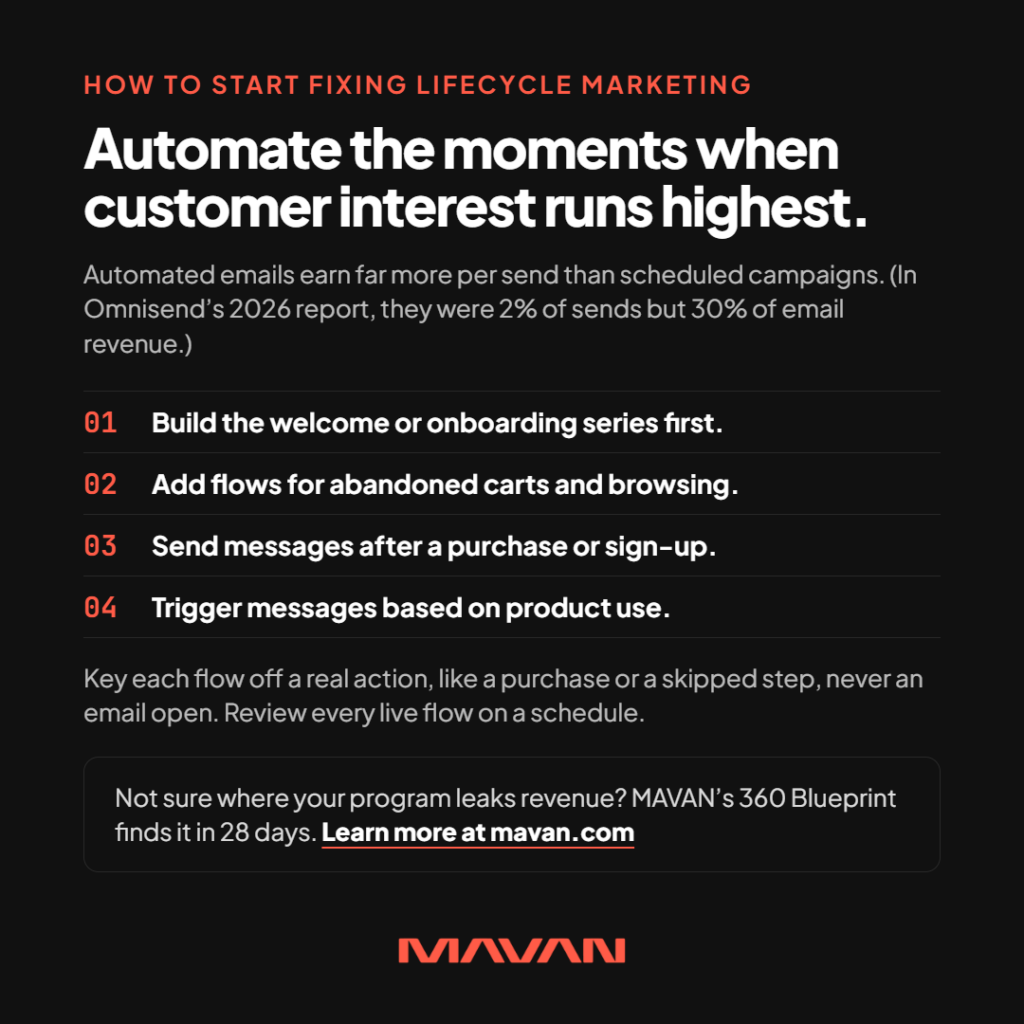
Automated messages earn far more than their volume suggests. Omnisend’s 2026 ecommerce report studied 27 billion emails sent by 150,000 brands in 2025. Automated emails made up 2% of sends but drove 30% of email revenue, Omnisend reported. They earned $2.87 per send, versus $0.18 for scheduled campaigns. Survey data from Litmus points the same way. In its State of Email 2026 research, teams earning $36 or more for every $1 spent on email automated lifecycle email flows 50% more often than low-ROI teams.
Which Automated Flows Should You Build First?
Order matters. We usually build the welcome or onboarding series first. Next come flows for abandoned carts and browsing, then messages after a purchase or sign-up, then triggers based on product use. Each flow should key off a real action, such as a purchase, a login, or a skipped step. Avoid flows triggered by opens, since Apple’s privacy feature makes many of those signals false.
Automations also need upkeep. Products change, prices shift, and offers expire, but flows keep sending. Our guide on how to structure a growth team describes a common break: product ships a new onboarding flow while lifecycle emails still point to the old one. A scheduled review of every live flow catches that drift before customers do.
What Should an Onboarding Email Series Do?
An onboarding email series should get each new customer to a first win as fast as possible. It picks up the promise that won the customer, points to one next action per email, and branches based on what people do. Welcome messages rank among the highest-earning automations, so they deserve the most testing.
New customers decide quickly whether a purchase was worth it. In 2025, welcome and abandoned-cart messages drove 76% of all orders from automated messages, Omnisend’s 2026 report found. Litmus found that high-ROI email teams lean harder on onboarding and transactional flows than their peers. The first week of messages carries more weight than any newsletter.
Matt Saunders, a Growth Lead at MAVAN, applies one rule to every step a customer takes.
“The broader principle is the same whether you’re converting someone fresh or keeping them from leaving: every step in a journey is a decision point, and what you put in front of someone at that moment either builds their confidence or erodes it.” — Matt Saunders, Growth Lead, MAVAN
How Should You Structure an Onboarding Email Series?
Onboarding also closes the gap between what a product does and what customers know it does. Matt Widdoes, MAVAN’s Founder and CEO, has seen companies feature a capability on their homepage, only to hear users say they “didn’t know that existed.” An onboarding series is the cheapest place to fix that. A simple structure works for most products:
- First message, sent right away: deliver what was promised and ask for one action.
- Second message: walk the customer to the first-value step, with a direct link into it.
- Third message: show proof from someone like them, such as a short customer result.
- Later messages: branch. People who finished the first step get the next feature, while people who stalled get help.
Onboarding can start before the first purchase, too. At Zig Zag, the rolling paper brand, our research found that sales converted best among customers who had joined the newsletter. We tested sign-up calls to action on key pages, and newsletter sign-ups rose 30%. For the in-product side of onboarding, see our guide to finding your users’ desire paths.
How Do You Build a Nurture Campaign Strategy for Long Sales Cycles?
A nurture campaign strategy keeps your company on a buyer’s shortlist during the long stretch before they talk to sales. Send useful content tied to the buyer’s problem, space it to match the sales cycle, and track movement between stages. Fix tracking first, because nurture can’t work on leads your systems lose.
B2B buyers make up their minds early. 6sense surveyed 4,611 recent buyers for its 2026 Global B2B Buyer Experience Report. Buying groups chose the vendor they favored before contacting a seller 82% of the time, Demand Gen Report noted. Vendors missing from the first shortlist had less than a 10% chance of winning. Meanwhile, 96% of buyers kept up with vendors between purchases, and 71% said their view of vendors changed between buying cycles.
That window is nurture’s job. Buying groups spend about 60% of an average 10.3-month cycle in the selection phase, before any seller is involved, 6sense found. More than half of buyers said justifying the category was as hard as picking a vendor, or harder. Good nurture content helps with both. Sam McLellan, MAVAN’s VP of Growth, describes the aim as staying present with useful content and well-timed nudges. The point, he says, is to be there “so that when they are ready to make that decision, you are front of mind.”
Why Do Nurture Campaigns Fail?
Nurture fails most often for a dull reason: the leads vanish. The same live engagement that lacked an ICP had this problem, too. Our Blueprint found that 29% of leads exited before the first tracked conversion. That made mid-funnel nurture structurally impossible. Fix the tracking, then build the sequence. Our guide to fixing broken B2B SaaS attribution covers that groundwork. Once leads stay visible, four habits keep nurture working:
- Map content to the buyer’s questions at each stage, from “is this problem worth solving?” to “which vendor fits us?”
- Space messages to match the cycle. A buyer on a nine-month path doesn’t need a daily sequence.
- Score movement rather than opens: replies, return visits, downloads, and meetings booked.
- Hand off to sales with context, so the first call picks up where the content left off.
How Do a Re-Engagement Campaign and a Win-Back Campaign Strategy Differ?
A re-engagement campaign targets subscribers or customers who have disengaged but haven’t left. By contrast, a win-back campaign strategy targets people who canceled or stopped buying. Re-engagement keeps your list healthy and wakes up interest. Win-back brings lost revenue back. Each needs its own triggers, offers, and metrics, and both should be judged on clicks and purchases, not opens.
When Should You Run a Re-Engagement Campaign?
Run one before inactive contacts drag down the rest of your list. Since December 2023, Google can delete accounts that sit inactive for two years, under its inactive account policy. Validity warns that addresses on deleted accounts start to hard bounce and may become recycled spam traps. It suggests most B2C and D2C marketers stop outreach after about six months without engagement, or send a re-permission campaign first.
Define “inactive” by clicks, purchases, and logins, since opens can be machine-made. Then send a short sequence that asks a plain question: still interested? Offer a lighter cadence or a choice of topics. Remove anyone who doesn’t respond. A smaller list that engages will reach more inboxes than a large list that triggers spam filters.
What Makes a Win-Back Campaign Strategy Work?
The best win-back strategies start with why the customer left. Marketing professor V. Kumar and two co-authors tested win-back offers on a telecom company’s lost customers. They published the results in the Journal of Marketing in 2015. Customers who had left over price tended to stay longer once won back, the American Marketing Association reported. The offer mattered as well. A bundled offer won back the most customers, but those customers left again soonest and spent the least, the authors wrote in a summary of their findings. Service upgrades won back the fewest, yet those customers stayed longest and spent the most.
The lesson is to judge win-back on second-lifetime value, not reacquisition rate alone. Sort lapsed customers by their reason for leaving, match the offer to the reason, and test against a holdout. CrossFit applied this logic on a deadline. With 60 days left before its annual competition, registrations had gone flat. We built automated email series to convert past registrants and activate new ones, with segments for each group. Paid social, paid search, and landing page tests ran alongside. CrossFit hit its registration goal, and each new registrant was worth more than three times what it cost to acquire (an LTV:CAC ratio above 3.0).
How Do You Build a Loyalty Program Strategy That Pays?
A loyalty program strategy that pays starts with the behavior you want to change and the margin you can afford to give back. Choose free, paid, or hybrid membership based on how often customers buy. Then prove the program changes behavior, because members who spend more may simply be your best customers already.
Loyalty budgets are growing. Antavo, which sells loyalty software, surveyed 3,000 marketers for its Global Customer Loyalty Report 2026. Respondents said 51.5% of their total marketing budget now goes to loyalty and CRM, Antavo announced. Program owners also reported an average return of 5.3x, Digital Applied noted in its review of the report. Those figures come from people who run programs, so treat them as a ceiling rather than a forecast.
Antavo’s own team warns that comparing members with non-members can mislead, since some members may already be a brand’s best customers. Its advice is to measure whether the program changed behavior. We use the same holdout test as every other lifecycle program: compare members with similar customers who weren’t invited.
Should a Loyalty Program Be Free or Paid?
Membership model is the next big choice. Members of paid loyalty programs were 60% more likely to spend more on the brand after joining, versus 30% for free programs, a 2020 McKinsey survey found. Paid programs ask more of customers, though. In our view, they suit brands with frequent purchases and benefits worth paying for. Free programs fit when the goal is turning occasional buyers into regulars. Brian Sapp, CMO of Rush Street Interactive, also advises MAVAN. He has watched that kind of bond form over years in gaming.
“I think what I’ve learned is that if a user is going to stick around, they tend to stick around, they really form a relationship with a game over years, especially payers.” — Brian Sapp, MAVAN Advisory Group
How Should You Approach Customer Loyalty Program Design?
Good customer loyalty program design makes members feel valued, beyond the discounts they earn. Let them reach a first reward quickly, reward the behaviors that matter to margin, and add recognition that discounts can’t copy. Connect the program to your CRM so every message reflects a member’s history, and keep redemption simple.
Most customers carry more loyalty memberships than they use. The 2026 Bond Loyalty Report surveyed 20,591 U.S. program members. It found the average American belongs to more than 20 loyalty programs but is active in only about 11. For four straight years, “feeling valued and important” has ranked as the top driver of loyalty in Bond’s research. Fewer than a third of Americans say their programs deliver it. Members who do feel valued show a 2x lift in loyalty, a 2.9x lift in spend, and a 2.4x lift in retention, Bond found.
What Belongs on a Loyalty Program Design Checklist?
The moments that create that feeling are rarely complicated, Bond notes. Personalized offers, surprise perks, and recognition of a long relationship all count. Yet only 20% to 30% of members report ever having one. Our design checklist follows from that gap:
- Put the first reward within reach of a typical customer’s first few purchases.
- Reward behaviors that help margin, such as full-price buys, repeat orders, or profile completion, not spend alone.
- Add recognition, like early access, surprise perks, or a note on a member’s anniversary.
- Feed program data into the CRM so lifecycle messages reflect each member’s history.
- Make redemption easy. Rewards members can’t claim feel like broken promises.
Aurelie Guerrieri leads marketing and alliances at DataDome and is a member of the MAVAN Advisory Group. She keeps the priority simple: “the most important relationship is with your customer.”
What Should You Look for in a Lifecycle Marketing Agency?
Look for a lifecycle marketing agency that can fix the data, CRM, and product gaps behind your messages. Writing and sending emails is the easy part. Ask for revenue proof at a company like yours, a diagnosis before any build, and a clear plan for handing the system to your team. Most lifecycle problems cross several functions.
Lifecycle work sits on top of other teams’ work. A welcome series depends on product events. Win-back flows depend on clean cancellation data. Revenue reporting depends on finance. So the useful test for any partner is whether it can act when the fix lives in tracking, onboarding, or the CRM.
Most growth agencies, lifecycle specialists included, work from outside the business on a set scope. That model fits a contained job, such as building templates or running a newsletter. It struggles when the constraint crosses teams. We weigh the trade-offs in our comparison of embedded operators and agency retainers.
What Should You Ask Before You Hire a Lifecycle Marketing Agency?
Before you sign with anyone, ask five questions:
- What will you review before you build anything?
- Can you show revenue results from lifecycle work at a company like ours?
- Who fixes the problem when it sits in data, product, or the CRM?
- How will you measure lift against a holdout group?
- What do we keep when you leave: the flows, the data, and the documentation?
Clients notice the difference between advice and execution. Angus Kirby, Director of Marketing at Titan, described our model after working with us.
“And unlike a lot of agencies where strategy just lives in a deck, MAVAN actually executed.” — Angus Kirby, Director of Marketing, Titan
Sponsors choosing partners for a whole portfolio can use the same tests. Our guide to the best growth partner for PE portfolio companies applies them at fund level.
How Does MAVAN Build Lifecycle Programs That Last?
We start every engagement with a 28-day Blueprint that tests the whole growth system, including CRM, data, product, and lifecycle. Every finding is evidenced. Then operators from our network of 170+ specialists fix what the roadmap calls for. They work inside your tools and meetings and document the system so your team can run it.
MAVAN is a growth operating company. We diagnose what will move the business, embed the operators required to execute it, and leave the company with stronger systems and internal capability. Lifecycle and retention is one of our 12 core growth functions. Those problems rarely stay inside one function, though, so the Blueprint examines the whole system first.
What Happens Inside the Blueprint?
In 28 days, 5+ MAVAN specialists work inside your platforms, people, and data. The findings cover four themes: your data and tools, how you go to market, how your teams work together, and the priorities you already hold. Each one is tested against the evidence. If we can’t show the number behind a finding, it doesn’t go in. The roadmap then sorts every action by who has to move it:
- We start now: items inside our control, such as a broken onboarding trigger, begin in week one.
- Needs a decision: items such as a CRM replacement wait until leadership or the board settles them.
- Needs a session: items such as agreeing on lifecycle stage definitions need the right people in a room, and we name those people.
A sequencing register names the risks while there’s still time to reorder, such as a CRM migration that must land before new automations launch. NEXUS is our human-augmented paid media analytics platform. It connects the ad platforms, the mobile measurement partner, and the warehouse into one view of acquisition performance, with an AI insight layer on top. NEXUS is included with the 360 Blueprint.
After the readout, you choose. Our operators can run the roadmap alongside your team, or your team can run it alone. Either way, the findings, the roadmap, and NEXUS stay with you. When we do run the work, we build it to transfer. ElevenLabs shows how that plays out. We scaled its paid search to a high six-figure monthly budget with positive incremental ROI across 20+ markets. Then the company moved the program in-house.
Frequently Asked Questions About Lifecycle Marketing
Operating partners, portfolio leaders, and growth teams often ask the same follow-up questions about lifecycle. The short answers below cover how lifecycle differs from email marketing, how fast results appear, open rate benchmarks, onboarding length, ownership, and B2B use. Each answer stands on its own.
What Is the Difference Between Lifecycle Marketing and Email Marketing?
Email marketing is a channel. Lifecycle marketing is the strategy that decides who gets which message, when, and why, across email, SMS, push, and in-app. Most lifecycle programs run largely on email, but the stage logic and data behind them are what make them work.
How Quickly Does Lifecycle Marketing Show Results?
Fixes to broken flows and triggers can start right away. In a Blueprint roadmap, items inside our control begin in week one. New programs need enough volume to beat a holdout group, so judge them by cohort over the span it takes your customers to buy again.
What Is a Good Email Open Rate?
No benchmark holds up anymore, because Apple’s privacy feature inflates opens unevenly from list to list. Track your own trend as a health check, ideally for readers outside Apple Mail. Judge performance on click rate, conversion rate, and revenue per email.
How Many Emails Should an Onboarding Email Series Include?
Use the smallest set that walks a new customer to first value, then add branches based on what people do or skip. Let completion of the first-value action, rather than a fixed count, decide when the series ends.
Who Should Own Lifecycle Marketing?
One person should own the number, even though product, data, finance, and marketing all move it. Without a single owner, flows go stale and stage definitions drift. Shared definitions and one source of truth keep the teams aligned.
Does Lifecycle Marketing Work for B2B Companies?
Yes. B2B lifecycle covers nurture before the sale, onboarding after it, and expansion and renewal later. Since most buying groups settle on a favorite vendor before they talk to sales, nurture carries extra weight in B2B.
Where Should You Start Fixing Your Lifecycle Marketing?
Start by finding where your lifecycle program leaks revenue before you add tools, flows, or headcount. That means checking whether your CRM data holds up, which automations pay off, and where customers drop off between stages. A diagnosis built on your own data puts those fixes in order and names who owns each one.
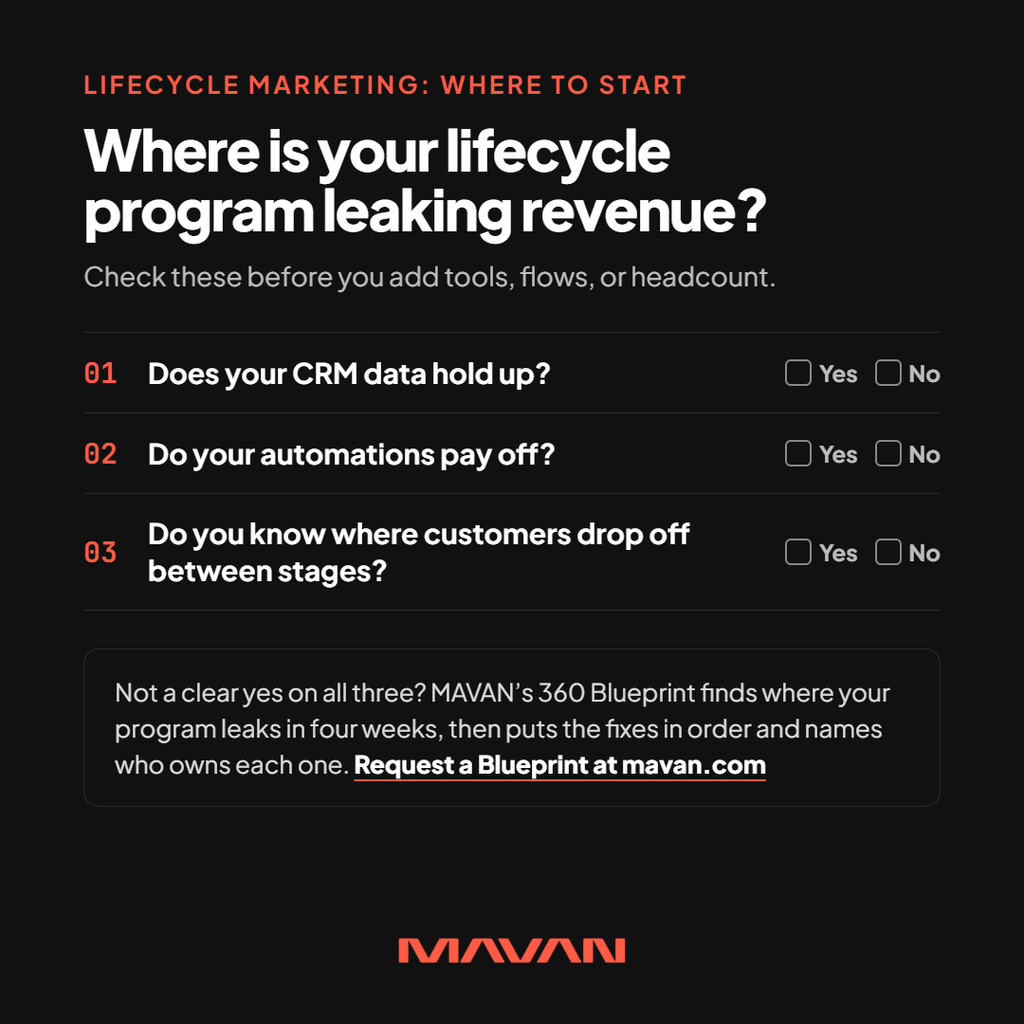
Most companies we meet don’t need more lifecycle ideas. They need to know which part of the system leaks revenue and what to fix first. A Blueprint answers that in four weeks. Our team works inside your CRM, ESP, product data, and reporting to trace where customers stall, which flows earn their keep, and which numbers deserve trust. You leave with evidenced findings, a roadmap sorted by who has to act, a sequencing register, and NEXUS. Run it with your own team, or with MAVAN’s operators alongside.
Request a Blueprint to see where your lifecycle program is leaking revenue.
Casey Rock is Content Director at MAVAN, where he helps turn complex ideas into clear, strategic content that drives growth. With over 15 years of experience across content strategy, SEO, media, and digital marketing, Casey focuses on building content systems that connect audience insight, brand storytelling, and measurable business outcomes.
Book a complimentary consultation with one of our experts
to learn how MAVAN can help your business grow.
Want more growth insights?
[hubspot type=”form” portal=”20951211″ id=”9c538ed2-fb12-45f1-a573-ad7953c058cc”]
Related Content
-
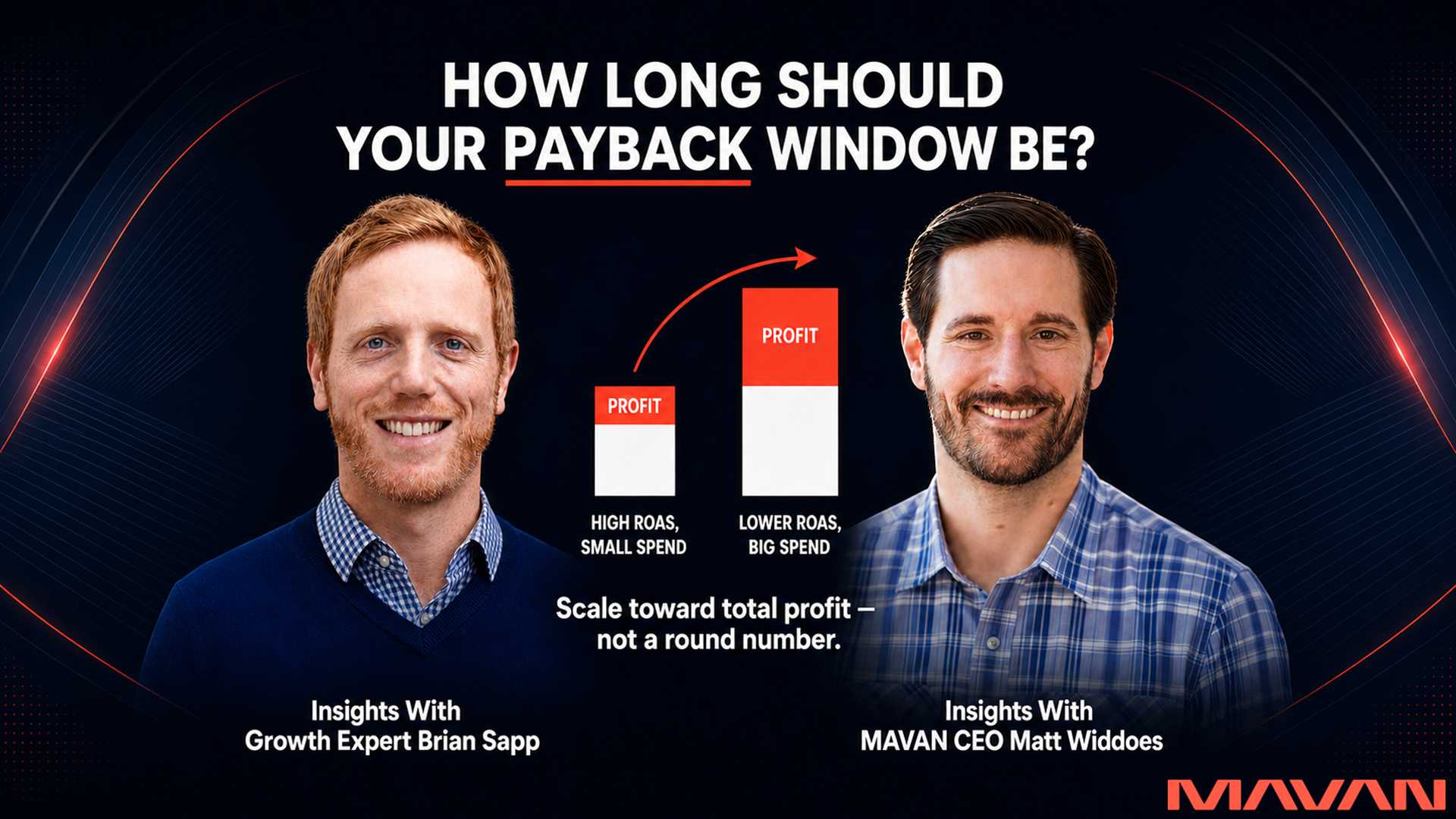
What Is a Good CAC Payback Period (How Do MER & ROAS Fit)?
A payback window is a business decision, not a fixed law. The teams that scale fastest will accept a lower return on ad spend at higher volume — because total profit, not a clean ROAS number, is what compounds.
-
Who Is The Best Growth Partner For PE Portfolio Companies?
The best growth partner for a PE portfolio company diagnoses the whole growth system before it spends. It embeds senior operators inside the business, ties every workstream to revenue and EBITDA, and works on the fund’s clock. When the job is done, the capability stays behind, and the sponsor can send the team to the next portfolio company.
-
What Are the Best Growth Agencies for Venture-Backed Startups?
The best growth agencies for venture-backed startups find the real constraint before they spend more money. They tie their work to CAC payback and revenue, show proof at your stage and in your category, and execute across data, paid media, lifecycle, and product. The best ones also build systems your own team can run after they leave.